REVIEW 2 major objections 3 minor 29 cited by
MeV-scale reheating temperature and thermalization of oscillating neutrinos by radiative and hadronic decays of massive particles
T0 review · 2 major / 3 minor · reviewed 2026-08-14 · deepseek-v4-flash
Pith's one-line read BBN alone sets a 1.8 MeV floor on the reheating temperature for radiative decays.
desk verdict A careful, internally consistent update of low-reheating BBN constraints; the new self-interaction physics is real, but the radiative bound's discrepancy with Ref [5] is left unexplained. read the letter →
The pith
A machine-rendered reading of the paper's core claim, the machinery that carries it, and where it could break.
The reading
What carries the argument
The argument runs on a momentum-dependent quantum kinetic equation (QKE) for the $2\times2$ neutrino density matrix, written in terms of polarization vectors $\mathbf{P}$ with collision terms for production, scattering, and neutrino self-interactions. The effective two-flavor mixing scheme treats $\nu_e$ mixing with a degenerate $\nu_x$ state, using the solar mixing parameters $(\delta m^2_{12}, \theta_{12})$, and includes neutrino self-interactions through the off-diagonal matter potential and collision terms. The reheating temperature is tied to the parent decay rate via $\Gamma_X = 3H(T_{\rm RH})$, and the resulting neutrino spectra feed into a BBN code that tracks the neutron-to-proton ratio and light-element abundances.
What would settle it
A direct check would be to solve the full QKE including the damping-like terms of Ref. [11] (rather than neglecting them) and recompute the neutrino spectra for $T_{\rm RH} \sim 1$–$5$ MeV; if the resulting $Y_p$ and D/H abundances move outside the observational 2-$\sigma$ regions at a given $T_{\rm RH}$, the bounds shift. Alternatively, a future precision measurement of $Y_p$ with uncertainty below 0.1% would test the predicted sharp rise in $Y_p$ at $T_{\rm RH} \lesssim 2$ MeV.
Extended reading notes
Core claim
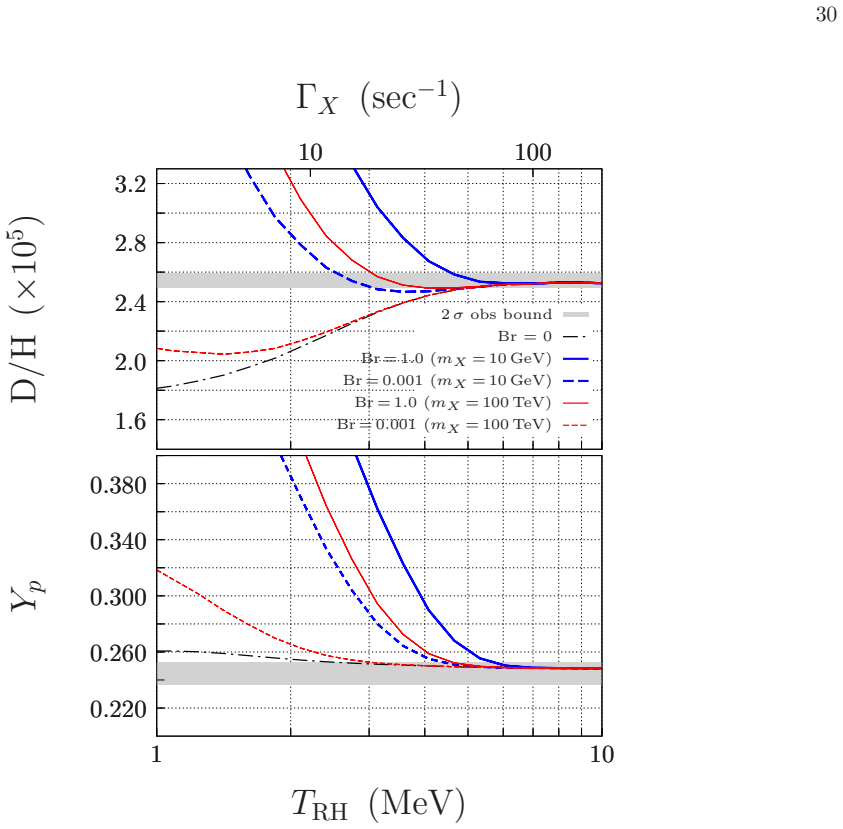
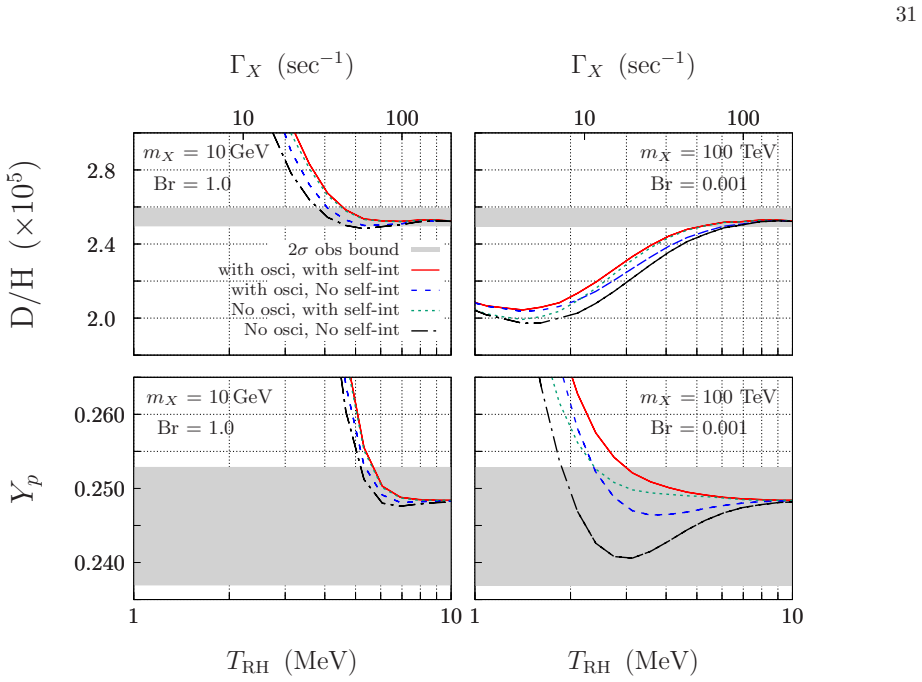
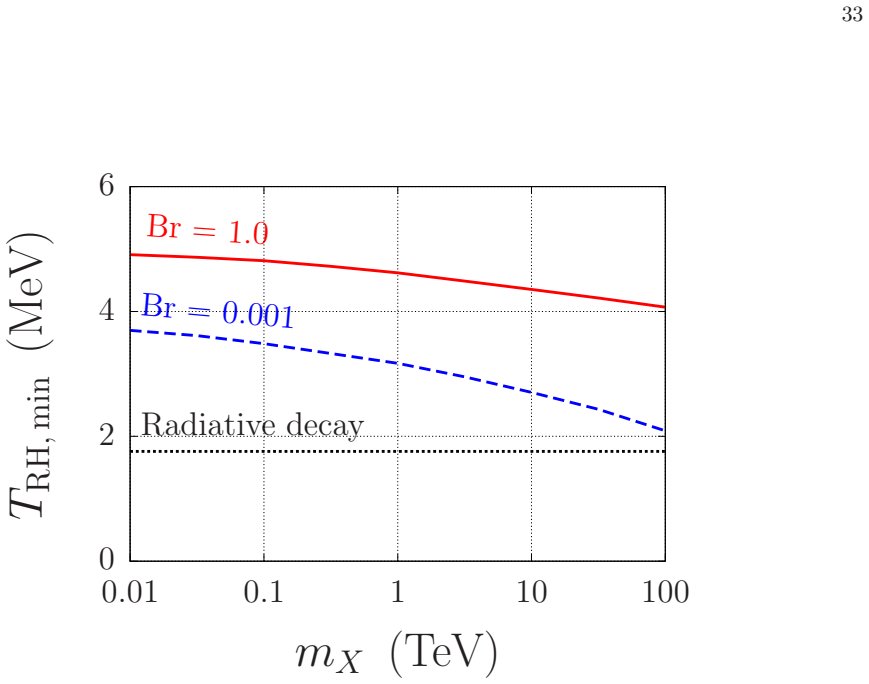
The central claim is that including neutrino oscillations and self-interactions in the neutrino thermalization calculation raises the minimum reheating temperature allowed by BBN, compared with earlier calculations that omitted these effects. For 100% radiative decay of the massive parent, the lower bound becomes $T_{\rm RH} \gtrsim 1.8$ MeV at 95% C.L.; for 100% hadronic decay, the bound rises to $T_{\rm RH} \gtrsim 4$–5 MeV, depending on the particle mass between 10 GeV and 100 TeV. The mechanism is that both oscillations and self-interactions equilibrate neutrino flavors, enhancing the total neutrino production rate and thereby increasing both the effective number of relativistic species and the helium-4 and deuterium abundances. A stronger neutrino bath and altered neutron-proton exchange rates push BBN further from observations, tightening the bound on $T_{\rm RH}$.
Load-bearing premise
The calculation assumes that the collisional damping of flavor coherence is fully captured by the single $D$-term in the quantum kinetic equations, and that the additional damping-like terms from the most general description are negligibly small at the MeV temperatures where neutrino production and oscillations both operate.
Editorial extensions
If this is right
- Low-reheating models with $T_{\rm RH}$ below about 1.8 MeV are excluded by BBN alone when the decay is purely radiative, and below about 4–5 MeV when hadronic decay channels are appreciable.
- The inclusion of neutrino self-interactions is not a minor correction: it changes the bound by up to a factor of a few in the radiative case, so future low-reheating analyses should treat the full collision terms rather than only oscillations.
- The bound is nearly independent of the parent particle mass for radiative decays, while hadronic-decay bounds are stronger for lighter parents because the comoving abundance of the parent scales as $T_{\rm RH}/m_X$.
- The effective two-flavor treatment with $\theta_{12}$ suffices for BBN constraints; the reactor angle $\theta_{13}$ has a negligible effect regardless of mass ordering.
- If the same neutrino thermalization is used as an input to CMB and large-scale-structure calculations, the combined constraints on $T_{\rm RH}$ will be at least as strong as these BBN bounds, and likely stronger.
Reading between the lines
- The BBN-only bound could be sharpened by future measurements of the primordial helium abundance, since $Y_p$ responds strongly to the neutrino spectra at $T_{\rm RH} \sim 2$ MeV.
- A full three-flavor treatment, beyond the effective two-flavor scheme, might alter the quantitative bounds by a few percent at most, given the smallness of $\theta_{13}$ effects shown here; this could still matter for precision cosmology.
- The assumption that hadrons thermalize and interact only through the listed channels leaves room for additional hadronic reactions or meson injection scenarios that could either strengthen or weaken the hadronic bound, depending on the hadron spectrum.
- The same QKE machinery could be applied to scenarios with direct neutrino decay channels (e.g., $X \to \nu\bar{\nu}$), which the paper explicitly leaves out; those would produce a very different neutrino spectrum and hence different bounds.
Signed reviews
Editorial analysis
A structured set of objections, weighed in public.
Referee Report
Summary. The paper computes lower bounds on the MeV-scale reheating temperature T_RH from big-bang nucleosynthesis, including for the first time both neutrino oscillations and neutrino self-interactions in the neutrino thermalization calculation. The authors solve momentum-dependent quantum kinetic equations for an effective two-flavor system, with production and damping terms, coupled to the background evolution with energy conservation. They feed the resulting neutrino spectra into a Monte Carlo BBN calculation and combine D/H and Yp in a chi-square analysis, scanning over the baryon-to-photon ratio eta_B and T_RH. For 100% radiative decays of the massive particle X they obtain T_RH ≳ 1.8 MeV at 95% C.L.; for 100% hadronic decays they obtain T_RH ≳ 4.1–4.9 MeV for m_X = 10 GeV–100 TeV at Br = 1 and T_RH ≳ 2.1–3.7 MeV at Br = 0.001. The paper concludes that neutrino oscillations and self-interactions enhance neutrino thermalization and tighten the radiative-decay bound compared to the case without these effects.
Significance. If the bounds are correct, this is an important update of BBN constraints on low reheating scenarios, and the inclusion of neutrino self-interactions and oscillations in the thermalization calculation is a genuine technical step forward. The paper is careful in several respects: it evolves full momentum-dependent QKEs with energy conservation, it propagates nuclear rate uncertainties through a Monte Carlo BBN calculation, and it presents a clear chi-square combination of D/H and Yp. The hadronic-decay bounds are broadly consistent with earlier work, while the radiative-decay bound is the main new quantitative result. The central claim, however, rests on a simplified treatment of collisional damping in the QKE, and the factor-of-two discrepancy with the three-flavor BBN bound of Ref. [5] is not reconciled in the manuscript.
major comments (2)
- [Sec. II, Eq. (2.3)] The collision term in Eq. (2.3) keeps only the diagonal production rates R_nu_e, R_nu_x and an off-diagonal damping term -D rho_ex, and the text immediately after Eq. (2.3) states that 'damping-like terms' from Ref. [11] are neglected following Ref. [5]. This approximation directly controls the degree of flavor coherence near T ~ 1-3 MeV, where the production and oscillation rates overlap and where the final nu_e spectrum is set. Since the weak rates in Eqs. (4.1)-(4.3) depend on f_nu_e, the approximation is load-bearing for the central radiative-decay bound of Eq. (4.10). The paper should estimate the sensitivity of T_RH,min to this approximation, for example by comparing with the full collision-term expression of Ref. [11] or by varying the functional form of the damping term.
- [Sec. IV.B, Eq. (4.10)] The Introduction cites Ref. [5] as obtaining T_RH > 4.1 MeV (95% C.L.) from BBN with three-flavor oscillations, whereas the present analysis, which adds neutrino self-interactions and should if anything strengthen the bound, obtains T_RH ≳ 1.8 MeV. The manuscript never reconciles this factor-of-two discrepancy. Because the difference could in principle arise from the likelihood setup (free eta_B scan versus a CMB prior on eta_B, different Y_p and D/H data, or different treatment of theoretical errors) rather than from the QKE approximation, the authors should provide a direct comparison with Ref. [5] under controlled assumptions, or otherwise quantify which input drives the weaker bound.
minor comments (3)
- [Title and Fig. 12 caption] There are typos in the title ('osc illating') and in the caption of Fig. 12 ('in of hadronic decaythe case'); these should be corrected.
- [Sec. III, Eq. (3.6)] The definition of R_dist uses T_nu,eff, which depends on the neutrino number density n_nu through the same ratio; the text should state explicitly that T_nu,eff is evaluated with the same n_nu appearing in the ratio, so that the definition is unambiguous.
- [Sec. IV.B, footnote 10] The footnote explains why the CMB prior on eta_B is not used; it would be helpful to state whether the quoted bound from Ref. [5] used such a prior, since this is directly relevant to interpreting the comparison in Eq. (4.10).
Circularity Check
No circularity: the T_RH bounds are obtained by scanning model parameters and comparing calculated light-element abundances with external observations.
full rationale
The derivation chain is self-contained against external data. Neutrino spectra are evolved with QKEs (Eqs. 2.15-2.20) using external oscillation parameters (Eqs. 2.10-2.12) and weak-interaction matrix elements from Table I; the resulting f_nu enters the weak rates (4.1)-(4.3); BBN yields are computed with the Kawano code with external nuclear rates and compared with observed Yp and D/H (Eqs. 4.5-4.6) via a chi^2 scan over (eta_B, T_RH) (Eq. 4.9). T_RH is an input grid coordinate tied to Gamma_X by Eq. (2.37); it is not tuned to produce the bound. The bound (4.10) is read off the 95% contour where theoretical abundances leave the observed region. The paper's use of self-citations is technical rather than load-bearing: the LASAGNA code [16,17], the full collision-term evaluation [13], and the hadronic-decay treatment [3,23,28] supply numerical machinery and standard cross sections, not the target constraint. The explicit modeling approximation in Sec. II, neglecting 'damping-like terms' from Ref. [11] in favor of the simplified diagonal damping (2.3), could shift the final neutrino spectra and hence the quantitative bound, but that is a systematic/correctness risk, not a circularity: nothing in that approximation assumes the desired T_RH lower limit. The discrepancy with the 4.1 MeV three-flavor bound of Ref. [5] is likewise an unresolved consistency concern, not evidence that the present derivation reduces to its own inputs. No equation is defined in terms of the quantity it purports to predict, and no fitted parameter is renamed as a prediction.
Assumptions & free parameters
free parameters (3)
- Baryon-to-photon ratio eta_B =
6.13e-10 for fixed plots; marginalized in the Monte Carlo analysis
- Neutrino oscillation parameters (delta m^2_12, theta_12, delta m^2_13, theta_13) =
delta m^2_12=7.55e-5 eV^2, sin^2 theta_12=0.320, delta m^2_13=2.50e-3 (NO) or -2.42e-3 (IO), sin^2 theta_13 about…
- Hadronic branching ratio Br and mass m_X =
Br from 0.001 to 1.0, m_X from 10 GeV to 100 TeV
assumptions (6)
- domain assumption The universe was matter-dominated before the decay of X, with the massive particle energy density dominating initially.
- domain assumption Neutrino chemical potentials vanish and neutrino and antineutrino density matrices are equal.
- domain assumption Decay products other than neutrinos, including photons, charged leptons, and hadrons, thermalize rapidly; direct decays into neutrinos are not considered.
- domain assumption Injected hadrons are stopped by Coulomb or inverse-Compton scattering before interconverting nucleons, so thermal cross sections apply.
- domain assumption The simplified collisional damping treatment, with only the diagonal D term, is adequate; additional damping-like terms from Ref. [11] are neglected.
- domain assumption The effective two-flavor mixing scheme with theta_12 reproduces the thermalization effect of full three-flavor mixing; theta_13 effects are small.
Cite this review
Pith. "Pith review of MeV-scale reheating temperature and thermalization of oscillating neutrinos by radiative and hadronic decays of massive particles." pith.science (2026). https://pith.science/paper/YFO75KLT
@misc{pith2026190810189,
  author       = {Pith},
  title        = {Pith review of: MeV-scale reheating temperature and thermalization of oscillating neutrinos by radiative and hadronic decays of massive particles},
  year         = {2026},
  howpublished = {\url{https://pith.science/paper/YFO75KLT}},
  note         = {Machine review of arXiv:1908.10189}
}
abstract
From a theoretical point of view, there is a strong motivation to consider an MeV-scale reheating temperature induced by long-lived massive particles with masses around the weak scale, decaying only through gravitational interaction. In this study, we investigate lower limits on the reheating temperature imposed by big-bang nucleosynthesis assuming both radiative and hadronic decays of such massive particles. For the first time, effects of neutrino self-interactions and oscillations are taken into account in the neutrino thermalization calculations. By requiring consistency between theoretical and observational values of light element abundances, we find that the reheating temperature should conservatively be $T_{\rm RH} \gtrsim 1.8$ MeV in the case of the 100% radiative decay, and $T_{\rm RH} \gtrsim$ 4-5 MeV in the case of the 100% hadronic decays for particle masses in the range of 10 GeV to 100 TeV.
Figures


Figures from the paper (10 more)



Forward citations
Cited by 29 Pith papers
-
The Dark Dimension meets the Axiverse
Dark dimension dark matter can evade decay constraints if N≳50 axion KK towers share the tower energy, diluting Standard Model energy injection by roughly 1/N.
-
Light PIDM in Warped Extra Dimensions
A UV-Dark-IR brane construction in warped 5D space allows light (MeV-TeV) purely gravitational dark matter to freeze in with TeV-scale reheating temperatures.
-
TransPlanckian Censorship on Dark Dimension Inflation
TransPlanckian Censorship forces dark-dimension inflation into a narrow one-dimension window with a pre-inflationary phase and suppresses tensor modes to r < 10^-10.
-
Reviving the Affleck-Dine Curvaton Scenario with Compensated Isocurvature Perturbations
The Affleck-Dine field can act as both baryogenesis engine and curvaton if gravitino dark matter, produced before curvaton decay, supplies the compensating isocurvature perturbation that hides the baryon isocurvature ...
-
Leptogenesis with sub-electroweak-scale reheating temperature
Leptogenesis remains viable for reheating temperatures below sphaleron freeze-out in three perturbative monomial-inflaton scenarios, with blue-tilted primordial GWs as a potential probe.
-
Primordial Black Hole from Tensor-induced Density Fluctuation: First-order Phase Transitions and Domain Walls
Tensor perturbations from FOPT and domain-wall sources are claimed to induce second-order scalar perturbations large enough to form primordial black holes, potentially all of the dark matter.
-
MobileEgo Anywhere: Open Infrastructure for long horizon egocentric data on commodity hardware
MobileEgo Anywhere supplies an open mobile app, 200-hour long-form egocentric dataset, and processing pipeline that enables collection of persistent-state egocentric trajectories on commodity hardware for VLA and foun...
-
Baryon-dark matter coincidence in Randall-Sundrum Model
Graviton- and radion-mediated freeze-in in a Randall-Sundrum model can match the observed dark matter relic abundance, and TeV-scale resonant leptogenesis through the same portals can match the observed baryon asymmet...
-
Burdening (or not) gravitational waves in the presence of primordial black holes
A single gravitational wave template combining inflaton and evaporating primordial black hole sources, with and without memory burden, yields new frequency-ratio signatures for testing black hole evaporation.
-
Primordial black hole induced gravitational waves in $f(R)$ gravity
In R^(1+ε) gravity, exponential growth of scalar perturbations during a PBH-driven early matter era enhances the induced gravitational wave signal, with Ω_GW ∝ f on large scales.
-
Constraining the axiverse with reionization
Roughly 10 to 15 percent of explicit string theory axiverse models are disfavored by CMB reionization data unless reheating stayed below about 10^10 GeV.
-
Setting up stasis with gravitational interactions
PBH evaporation can fill a decaying particle tower with Ω_l ∝ m_l^{+1} or m_l^{-1}, and CGPP with α = 0, 1/2, or 2, matching the conditions needed for cosmological stasis.
-
Searching for coupled, hyperlight scalars across cosmic history
Hyperlight quadratically coupled scalars making up a few percent of dark matter are bounded to near- or sub-gravitational couplings to electrons and photons over 10^-31 to 10^-28 eV, with quasar spectra setting the st...
-
Ephemeral Oscillons in Scalar-Tensor Theories: The Higgs-like case
In a Higgs-like Einstein-Cartan inflation model, oscillons formed after inflation are short-lived and their decay drives radiation domination within about four e-folds.
-
Dark Matter Ultraviolet Freeze-in in General Reheating Scenarios
The paper derives analytic dark matter freeze-in yields for arbitrary power-law reheating histories and maps the gravitational production parameter space.
-
Photonic Freeze-In
Dark matter can be produced by photon annihilation through a loop-generated F² operator, a new photonic freeze-in scenario that is testable at low reheat temperatures.
-
The Sound of Dark Sectors in Pulsar Timing Arrays
A dark sector phase transition at the MeV scale, with a dark Higgs mass around 3 MeV, can reproduce the gravitational wave background seen by pulsar timing arrays.
-
Primordial Black Holes (as Dark Matter) from the Supercooled Phase Transitions with Radiative Symmetry Breaking
Supercooled radiative symmetry breaking phase transitions generically produce primordial black holes, and the false-vacuum decay rate grows exponentially with time to high accuracy.
-
Using $\Delta N_{\rm eff}$ to constrain preferred axion model dark matter
In preferred axion models with slow heavy-quark decays, axions produced after decoupling form dark radiation that can exceed Planck's ΔNeff bound, excluding much of the parameter space of models D and E.
-
Improved Predictions on Higgs-Starobinsky Inflation and Reheating with ACT DR6 and Primordial Gravitational Waves
Adding the gravitational-wave bound on extra radiation shrinks the allowed reheating ranges and excludes Higgs-Starobinsky inflation at 1-sigma while leaving a 2-sigma window.
-
ACT DR6 Insights on the Inflationary Attractor models and Reheating
With ACT DR6 combined data, E-type alpha-attractors allow matter-like reheating, but T-type alpha-attractors require a stiff post-inflationary equation of state around w_phi=0.44 or higher.
-
Two Micron-Size Dark Dimensions
Two micron-size dark dimensions are consistent with observations only if the compact space has no isometries and the normalcy temperature is fine-tuned to about 2 MeV.
-
Constraining Quintessential Inflation with ACT: A Gauss-Bonnet Gateway
Exponential and sech Gauss–Bonnet couplings restore ACT-compatible ns and r for quintessential inflation, while tanh fails for a structural sign reason; reheating remains BBN-safe.
-
A multi-axion model of inflation and dark matter
A 300-mode Kaluza-Klein axion tower is proposed as a unified inflaton and dark-matter sector, but the lightest state's quoted lifetime contradicts the paper's own decay-rate formula.
-
Starobinsky Inflation in k-Essence Framework: Attractor Dynamics, Reheating, and Consistency with ACT DR6
A power-law non-canonical kinetic coupling F(φ)=1+Aφ^n revives the Starobinsky inflation potential's consistency with ACT DR6 CMB data while preserving attractor dynamics and yielding viable reheating.
-
Cosmological preference for a positive neutrino mass at 2.7$\sigma$: A joint analysis of DESI DR2, DESY5, and DESY1 data
A joint fit of DESI DR2, CMB, DESY5 and DESY1 data gives total neutrino mass 0.098 (+0.016, -0.037) eV, a 2.7 sigma preference for positive mass in the w0waCDM model.
-
Power Law Plateau Inflation and Primary Gravitational Waves in the light of ACT
Power-law plateau inflation can sit inside the 1 sigma region of ACT DR6, but the reheating bound from gravitational waves forces the total number of e-folds N_k below about 62.
-
New bounds on Memory Burdened Primordial Black Holes from Big Bang Nucleosynthesis
Memory-burdened primordial black holes lighter than 10^9 grams are newly constrained by Big Bang nucleosynthesis, with a residual unconstrained window around 1-100 grams for suppression index k=2.
-
Asymmetries from a charged memory-burdened PBH
A parameter-space scan shows that very large curvature-current couplings can fit the baryon asymmetry and dark matter abundance, while the electric charge of the black hole plays no role in the mechanism.
Reference graph
Works this paper leans on
-
[5]
046 0 1 2 3 1 10 with osci: θ12
-
[11]
P. F. de Salas, M. Lattanzi, G. Mangano, G. Miele, S. Pastor and O . Pisanti, Bounds on very low reheating scenarios after Planck , Phys. Rev. D92 (2015) 123534 [ 1511.00672]
arXiv 2015
-
[1]
Particle Data Group collaboration, Review of Particle Physics , Phys. Rev. D98 (2018) 030001
work page 2018
-
[2]
5×10⁻³ eV2 ) 1/ 6 5 MeV ( δm2 13
-
[3]
046 1 2 3 with self-int
-
[4]
K. Ichikawa, M. Kawasaki and F. Takahashi, The Oscillation effects on thermalization of the neutrinos in the Universe with low reheating temperature , Phys. Rev. D72 (2005) 043522 [ astro-ph/0505395]
arXiv 2005
-
[6]
046 Neff Γ X (sec−1) No osci with osci: θ13 (NO) with osci: θ13 (IO) with osci: θ12 Neff No osci with osci: θ13 (NO) with osci: θ13 (IO) with osci: θ12 Neff TRH (MeV) No self-int with self-int Fig. 1. Relations between TRH and Neff . The top- and middle panels respectively show the effect of neutrino oscillation in the case without and with neutrino self-inter...
-
[7]
5×10⁻⁵ eV2 ) 1/ 6 , (2.28) where, in the above evaluation, we have replaced p with ⟨p⟩ ∼ 3.15 Tγ and approximated (cos 2θ)1/ 6 ∼ 1 which is well satisfied for θ12 and θ13. Therefore, neutrino oscillation becomes effective at around a temperature of O(1) MeV for the solar neutrino mixing ( θ12, δm12) and the reactor neutrino mixing ( θ13, δm13), which is the...
Show all 42 references
-
[8]
Kawasaki, K
M. Kawasaki, K. Kohri and N. Sugiyama, Cosmological constraints on late time entropy production , Phys. Rev. Lett. 82 (1999) 4168 [ astro-ph/9811437]
1999 arXiv
-
[9]
Kawasaki, K
M. Kawasaki, K. Kohri and N. Sugiyama, MeV scale reheating temperature and thermalization of neutrino background, Phys. Rev. D62 (2000) 023506 [ astro-ph/0002127]
2000 arXiv
-
[10]
P. F. de Salas, D. V. Forero, C. A. Ternes, M. Tortola and J. W. F. Valle, Status of neutrino oscillations 2018: 3 σ hint for normal mass ordering and improved CP sensitivity , Phys. Lett. B782 (2018) 633 [ 1708.01186]
2018 arXiv
-
[12]
Hannestad, What is the lowest possible reheating temperature? , Phys
S. Hannestad, What is the lowest possible reheating temperature? , Phys. Rev. D70 (2004) 043506 [astro-ph/0403291]
2004 arXiv
-
[13]
Ichikawa, M
K. Ichikawa, M. Kawasaki and F. Takahashi, Constraint on the Effective Number of Neutrino Species from the WMAP and SDSS LRG Power Spectra , JCAP 0705 (2007) 007 [ astro-ph/0611784]
2007 arXiv
-
[14]
De Bernardis, L
F. De Bernardis, L. Pagano and A. Melchiorri, New constraints on the reheating temperature of the universe after WMAP-5 , Astropart. Phys. 30 (2008) 192
2008
-
[15]
Johns, M
L. Johns, M. Mina, V. Cirigliano, M. W. Paris and G. M. Fuller, Neutrino flavor transformation in the lepton-asymmetric universe , Phys. Rev. D94 (2016) 083505 [ 1608.01336]
2016 arXiv
-
[16]
Hannestad, I
S. Hannestad, I. Tamborra and T. Tram, Thermalisation of light sterile neutrinos in the early universe, JCAP 1207 (2012) 025 [ 1204.5861]
2012 arXiv
-
[17]
B. H. J. McKellar and M. J. Thomson, Oscillating doublet neutrinos in the early universe , Phys. Rev. D49 (1994) 2710
1994
-
[18]
Sigl and G
G. Sigl and G. Raffelt, General kinetic description of relativistic mixed neutrin os, Nucl. Phys. B406 (1993) 423
1993
-
[19]
Hannestad, R
S. Hannestad, R. S. Hansen, T. Tram and Y. Y. Y. Wong, Active-sterile neutrino oscillations in the early Universe with full collision terms , JCAP 1508 (2015) 019 [ 1506.05266]
2015 arXiv
-
[20]
Wolfenstein, Effects of Matter on Neutrino Oscillations , AIP Conf
L. Wolfenstein, Effects of Matter on Neutrino Oscillations , AIP Conf. Proc. 52 (1979) 108
1979
-
[21]
S. P. Mikheyev and A. Y. Smirnov, Resonant neutrino oscillations in matter , Prog. Part. Nucl. Phys. 23 (1989) 41
1989
-
[22]
Foot and R
R. Foot and R. R. Volkas, The Exact parity symmetric model and big bang nucleosynthes is, Astropart. Phys. 7 (1997) 283 [ hep-ph/9612245]
1997 arXiv
-
[23]
Therefore, we do not use the value i n this paper
is irrelevant to the oscillation between νe and νx in the effective two-flavor mixing scheme. Therefore, we do not use the value i n this paper. 10 In addition, we can rewrite the expression of Eq. (2.2) as fol lows: ˙P = − →H × P − D (Px x + Py y) + (Rνe − Rνx) z , (2.15) ˙P0 =...
-
[24]
Hannestad, R
S. Hannestad, R. S. Hansen and T. Tram, Can active-sterile neutrino oscillations lead to chaotic behavior of the cosmological lepton asymmetry? , JCAP 1304 (2013) 032 [ 1302.7279]
2013 arXiv
-
[25]
Mangano, G
G. Mangano, G. Miele, S. Pastor, T. Pinto, O. Pisanti and P. D. S erpico, Relic neutrino decoupling including flavor oscillations , Nucl. Phys. B729 (2005) 221 [ hep-ph/0506164]. 37
2005 arXiv
-
[26]
P. F. de Salas and S. Pastor, Relic neutrino decoupling with flavour oscillations revisi ted, JCAP 1607 (2016) 051 [ 1606.06986]
2016 arXiv
-
[27]
N. F. Bell, R. R. Volkas and Y. Y. Y. Wong, Relic neutrino asymmetry evolution from first principles , Phys. Rev. D59 (1999) 113001 [ hep-ph/9809363]
1999 arXiv
-
[28]
Enqvist, K
K. Enqvist, K. Kainulainen and M. J. Thomson, Stringent cosmological bounds on inert neutrino mixing, Nucl. Phys. B373 (1992) 498
1992
-
[29]
M. H. Reno and D. Seckel, Primordial Nucleosynthesis: The Effects of Injecting Hadro ns, Phys. Rev. D37 (1988) 3441
1988
-
[30]
Kohri, Primordial nucleosynthesis and hadronic decay of a massive particle with a relatively short lifetime, Phys
K. Kohri, Primordial nucleosynthesis and hadronic decay of a massive particle with a relatively short lifetime, Phys. Rev. D64 (2001) 043515 [ astro-ph/0103411]
2001 arXiv
-
[31]
Kawasaki, K
M. Kawasaki, K. Kohri and T. Moroi, Big-Bang nucleosynthesis and hadronic decay of long-lived massive particles , Phys. Rev. D71 (2005) 083502 [ astro-ph/0408426]
2005 arXiv
-
[32]
Pospelov and J
M. Pospelov and J. Pradler, Metastable GeV-scale particles as a solution to the cosmolo gical lithium problem, Phys. Rev. D82 (2010) 103514 [ 1006.4172]
2010 arXiv
-
[33]
Kawano, Let’s go: Early universe
L. Kawano, Let’s go: Early universe. 2. Primordial nucleosynthesis: T he Computer way ,
-
[34]
Kawasaki, K
M. Kawasaki, K. Kohri, T. Moroi and Y. Takaesu, Revisiting Big-Bang Nucleosynthesis Constraints on Long-Lived Decaying Particles , Phys. Rev. D97 (2018) 023502 [ 1709.01211]
2018 arXiv
-
[35]
Steigman, Primordial Nucleosynthesis in the Precision Cosmology Era , Ann
G. Steigman, Primordial Nucleosynthesis in the Precision Cosmology Era , Ann. Rev. Nucl. Part. Sci. 57 (2007) 463 [ 0712.1100]
2007 arXiv
-
[36]
E. Aver, K. A. Olive and E. D. Skillman, The effects of He I λ10830 on helium abundance determinations, JCAP 1507 (2015) 011 [ 1503.08146]
2015 arXiv
-
[37]
E. O. Zavarygin, J. K. Webb, S. Riemer-Srensen and V. Dumont , Primordial deuterium abundance at zabs = 2:504 towards Q1009+2956 , J. Phys. Conf. Ser. 1038 (2018) 012012 [ 1801.04704]
2018 arXiv
-
[38]
Planck collaboration, Planck 2018 results. VI. Cosmological parameters , 1807.06209
2018 arXiv
-
[39]
Esmailzadeh, G
R. Esmailzadeh, G. D. Starkman and S. Dimopoulos, Primordial nucleosynthesis without a computer , Astrophys. J. 378 (1991) 504
1991
-
[40]
M. S. Smith, L. H. Kawano and R. A. Malaney, Experimental, computational, and observational analysis of primordial nucleosynthesis , Astrophys. J. Suppl. 85 (1993) 219
1993
-
[41]
Hamann, S
J. Hamann, S. Hannestad, G. G. Raffelt and Y. Y. Y. Wong, Sterile neutrinos with eV masses in cosmology: How disfavoured exactly? , JCAP 1109 (2011) 034 [ 1108.4136]
2011 arXiv
-
[42]
Hasegawa, N
T. Hasegawa, N. Hiroshima, K. Kohri, S. Wang, R. S. Hansen, T. Tram et al., In preparation, 2019 ,
2019
Reviewed August 14, 2026 · model on record in the stance chip above.
Discussion (0). Continue with ORCID to comment.