REVIEW 4 major objections 6 minor 2 cited by
The paper presents Kete, an open-source tool that predicts positions and magnitudes of known asteroids in survey images, and demonstrates full recovery of every reported asteroid observation from a year of ZTF and the cryogenic WISE mission
Reviewed by Pith at T0; open to challenge. T0 means a machine referee read the full paper against a public rubric. the ladder, T0–T4 →
An open-source software package, Kete, accurately predicts positions and magnitudes of known small solar system bodies in survey images, recovering millions of archival observations.
T0 review reviewed 2026-08-05 challenge →
load-bearing objection Genuinely useful open-source engineering, but the 'recovered all WISE observations' claim conflicts with the diameter-subset restriction in Section 2; fix the validation details and this is a solid software paper. the 4 major comments →
Kete: Predicting Known Minor Bodies in Images
The pith
A machine-rendered reading of the paper's core claim, the machinery that carries it, and where it could break.
The reading
Core claim
The paper claims that a single propagation strategy can scale to survey-sized problems without losing accuracy: batch images by time, integrate the full n-body problem only to the midpoint of each batch, then approximate motion inside the batch with two-body dynamics, including light-time correction. Applied to a year of ZTF and the cryogenic phase of WISE, this reproduces every reported asteroid observation—3.89 million and 1.77 million respectively—with astrometric and photometric residuals consistent with each survey's known precision. Kete also predicts fluxes in the optical and infrared by combining an H-G phase model with thermophysical models, and uses geometric field-of-view tests ba
What carries the argument
The central mechanism is the adaptive-precision propagator: it groups field-of-view records into time-ordered batches no wider than a few days, runs a full n-body integration (planets, main-belt perturbers, general relativity, oblateness) only to the batch midpoint, then evolves each object to individual image times with a short two-body update and light-time correction. This keeps the number of costly integration steps low—about 7,100 times fewer steps for WISE's twelve-second cadence—while the geometric field-of-view inclusion test, a set of dot products against great-circle plane normals, quickly filters which of hundreds of thousands of objects appear in each image.
Load-bearing premise
The load-bearing premise is that asteroid motion within each batch of images (up to three days) is well approximated by two-body dynamics after a full n-body integration to the batch midpoint; if that approximation produces errors above a few hundred milliarcseconds for a substantial share of asteroids, the claim of recovering every reported observation would break down.
What would settle it
Pick a set of asteroids that pass near Jupiter or have very eccentric orbits and recompute their positions at every image time using full n-body integration over the entire year; compare those positions with Kete's batched adaptive predictions. If the two-body-within-batch approximation shows differences larger than a few hundred milliarcseconds for a meaningful fraction of the sample, the unconditional recovery claim fails.
If this is right
- Archival survey images can be systematically labeled with every known asteroid they contain, recovering pre-discovery detections such as the 1950 photographic plate where one object was identified 52 years before its official discovery.
- Observation planning for small bodies becomes a local, all-sky computation: any site or telescope with defined footprints can be queried for visibility windows and magnitudes without a server-side ephemeris service.
- Survey-scale validation is possible in under an hour on a laptop, so known-object labeling can become part of routine image processing rather than an offline task.
- The same machinery applies to cometary dust modeling and orbital-evolution studies, making the ephemeris engine reusable outside pure detection.
Where Pith is reading between the lines
- The two-body batch approximation is most likely to strain for asteroids in close encounters or with very high eccentricity; a targeted population-level test of those objects would show whether the survey-wide agreement holds where the dynamics are hardest.
- The same batching strategy could be applied to alert streams, attaching known-object labels to candidate detections before human review, since the cost is low enough for a laptop-scale run.
- The per-facet thermal model opens a route to using Kete as a forward model in shape and albedo inversion: if errors are dominated by facet geometry rather than dynamics, fitting those facets to residuals could turn the simulator into an estimator.
- Because the geometry check is a simple dot-product test on spherical polygons, it should transfer directly to irregular, multi-detector footprints like those of upcoming survey missions.
Editorial analysis
A structured set of objections, weighed in public.
Referee Report
Summary. The paper presents Kete, an open-source Python/Rust package for predicting positions and magnitudes of asteroids and comets in large survey images, with applications to observation planning, pre-discovery, and dust modeling. The central demonstration is a full-year simulation for ZTF (2021) and for the WISE cryogenic phase (2010): Kete computes ephemerides and magnitudes for hundreds of thousands of numbered asteroids across more than 11 million images and claims to have recovered all 3.89 million ZTF and 1.77 million WISE MPC-submitted observations, with residuals matching the known precision of each survey. Additional sections showcase pre-discovery identification on a 1950 Palomar plate, Finson-Probstein cometary dust modeling, Monte Carlo orbital evolution of comet 103P/Hartley, and observation planning for (2) Pallas.
Significance. If the validation claims hold, Kete would be a significant open-source contribution: it offers a fast, high-throughput, modular tool for labeling known small bodies in current and upcoming surveys (e.g., LSST, NEO Surveyor), and the public code and documentation lower the barrier for community adoption. The paper also demonstrates a useful precovery workflow and a dust-tail model integrated with n-body propagation. The main strength is the breadth of capabilities and the claimed computational performance on commodity hardware. However, the headline 'full recovery' claim is currently under-specified and, for WISE, internally inconsistent with the diameter-subset restriction, so the validation does not yet support the abstract's strongest statements.
major comments (4)
- [Section 2 vs Section 3.2 and Abstract] The WISE simulation is explicitly restricted to a 'subset of the numbered asteroids for which diameters are either directly measured or reliably fitted' (Section 2), yet Section 3.2 states that Kete 'successfully recovered all 3.89 million ZTF and 1.77 million WISE MPC-submitted observations' and the Abstract claims prediction of 'all observations of every numbered asteroid seen by WISE.' The paper gives no count of excluded numbered asteroids, no count of WISE MPC observations attached to them, and no demonstration that the diameter subset covers all WISE-observed numbered asteroids. If any MPC observation belongs to an excluded asteroid, the 'all' claim is false. Also, the source of diameters and the NEATM parameters (e.g., the beaming parameter eta) are not stated; if the diameters come from WISE/NEOWISE fits, the NEATM magnitude comparison in Fig. 4b is not independent.
- [Section 3.2, Fig. 3] The term 'successfully recovered' is never defined. The paper does not specify the matching criterion between predicted positions and MPC-reported astrometry: association radius or chi-square threshold, handling of multiple detections per exposure, treatment of duplicates, or how non-recovered observations were counted. Figure 3 shows residual distributions but lacks quantitative statistics (RMS, median, percentiles) and error bars. Without this information, the claim that residuals 'match the known precision for ZTF and WISE MPC submissions' cannot be verified, and the 'full recovery' number is not reproducible from the text.
- [Section 2, adaptive propagation] The hybrid propagation strategy is central to the performance claim, but its accuracy is not quantified. Section 2 states that batches of FoVs 'do not span more than 3 days of time' and that within each batch motion is approximated by two-body dynamics, with the approximation interval treated as a tunable parameter. No test is reported comparing this batch-two-body scheme against a full n-body integration for representative orbits, including high-eccentricity NEOs or objects undergoing close encounters. Please provide the default parameter values used in the ZTF and WISE simulations and a quantitative bound (e.g., maximum and percentile astrometric error) for the two-body approximation. Otherwise, the claimed sub-arcsecond residuals cannot be attributed to the propagation algorithm.
- [Section 3.2, validation independence] The validation uses MPC astrometry as ground truth, but the orbit catalog used by Kete is itself fitted to those same MPC observations (including ZTF and WISE data). The paper does not address the resulting potential circularity: agreement with MPC observations may largely reflect the quality of the input orbit fits rather than Kete's propagation or matching logic. A stronger validation would use withheld observations, or an independent dataset such as Gaia asteroid astrometry or stellar occultations. At minimum, the paper should explicitly discuss this limitation and quantify how much of the residual can be attributed to orbit uncertainty versus Kete's own error.
minor comments (6)
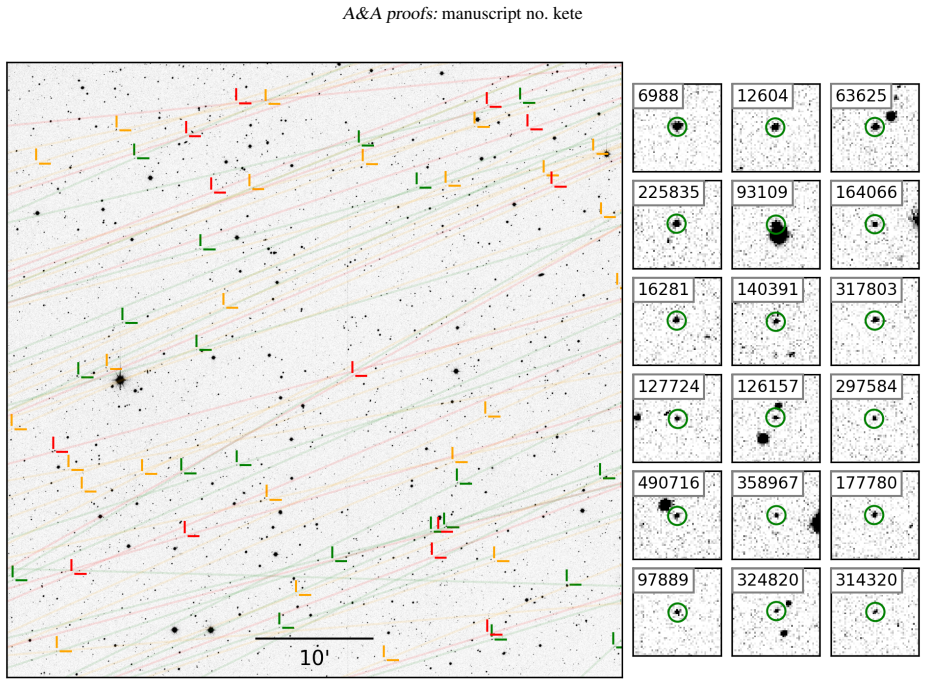
- [Section 3.2] The text references 'Figure 3.1' but the figure is numbered 'Figure 3'; please fix the cross-reference.
- [Section 4.1] 'Astometry.net' should be 'Astrometry.net'.
- [References] Harris 1998 appears twice as Harris 1998a and 1998b but both refer to the same Icarus article (pp. 291); similarly Burns et al. 1979a and 1979b are the same paper. Please collapse these duplicate entries.
- [Fig. 4a] The 'intrinsic band offsets' for ZTF magnitudes are described qualitatively but never tabulated. Please provide the offset values and state whether they were fitted or adopted from external calibrations.
- [Abstract / Section 2] The Abstract says 'over 11 million images' while Section 2 specifies 9,976,181 ZTF images plus WISE images; clarify whether the 11 million figure is the combined total and define the WISE image counting convention (e.g., unique sky patches vs per-band exposures).
- [Fig. 3] The residual plots would benefit from showing encircled-energy radii or survey astrometric uncertainty ellipses, and from separating residuals by asteroid population (e.g., main belt vs NEO).
Circularity Check
No significant circularity: Kete fits no parameters, validation is a round-trip implementation check, and the minor self-cited precision benchmark is not load-bearing.
full rationale
Kete is an open-source software tool that propagates pre-existing orbit catalogs (JPL Horizons/MPC) and applies standard photometric models (H-G, NEATM, FRM); it does not fit a model to data and then rename that fit as a prediction. The central validation—recovering 3.89 million ZTF and 1.77 million WISE MPC-submitted observations—is a round-trip consistency exercise: the same MPC astrometry was used to fit the orbit catalogs that Kete propagates, so the 'recovery' is not an independent prediction of new data, but it does verify the integration, FoV filtering, and timing implementation against an external archive. This is software verification, not a circular derivation of a scientific result. The precision benchmark is attributed to Masiero et al. (2023), which shares authors with this paper, but the residuals are plotted in Figure 3 and the code is publicly available, so the self-citation is not load-bearing. The WISE NEATM magnitude comparison uses diameters that Section 2 says are 'directly measured or reliably fitted'; however, the paper never states that these diameters come from the same WISE observations, so no specific reduction can be exhibited. The abstract's claim of predicting 'all observations of every numbered asteroid seen by WISE' conflicts with Section 2's statement that the WISE simulation used a subset of numbered asteroids with measured or fitted diameters; this is an internal consistency/correctness caveat, not a circularity. Overall, the derivation chain is self-contained and the circularity burden is low.
Axiom & Free-Parameter Ledger
free parameters (3)
- Two-body approximation interval within batches
- ZTF band magnitude offsets
- NEATM beaming parameter eta
axioms (4)
- domain assumption MPC astrometric observations are accurate ground truth for validation
- domain assumption The orbit catalog and physical parameters from JPL/MPC are accurate
- ad hoc to paper The two-body approximation is valid over the batch interval
- domain assumption NEATM with a single beaming parameter is valid for all target asteroids
Cite this review
Pith. "Pith review of Kete: Predicting Known Minor Bodies in Images." pith.science (2026). https://pith.science/paper/YFYHDR5V
@misc{pith2026250904666,
  author       = {Pith},
  title        = {Pith review of: Kete: Predicting Known Minor Bodies in Images},
  year         = {2026},
  howpublished = {\url{https://pith.science/paper/YFYHDR5V}},
  note         = {Machine review of arXiv:2509.04666}
}
abstract
Kete is an open-source software package for quickly and accurately predicting the positions and magnitudes of asteroids and comets in large-scale, all-sky surveys. It can predict observable objects for any ground or space-based telescope. Kete contains a collection of tools, including simple optical and thermal modeling, $n$-body orbit calculations, and custom multi-threaded SPICE kernel support. It can be used for observation planning, pre-discovery of detections at a large scale, and labeling known solar system objects in images. Here we demonstrate some of the capabilities by predicting all observations of every numbered asteroid seen by the Wide-field Infrared Survey Explorer (WISE) and Zwicky Transient Facility (ZTF) surveys during single years of their operations, predicting locations and magnitudes of 756,999 asteroids in over 11 million images.
Figures


Forward citations
Cited by 2 Pith papers
-
Prospects for detecting surface color heterogeneity on asteroid surfaces from sparse multiband photometric survey data
The paper proposes a statistical test for asteroid surface color heterogeneity from sparse multiband photometry and evaluates its performance and sensitivity to model errors through Monte Carlo simulations of syntheti...
-
A comprehensive study of comet 67P/Churyumov-Gerasimenko in the 2021/2022 apparition. II. Colorimetry, polarimetry, modeling
Comet 67P's 2021/22 coma was red near the nucleus, bluer outward, with polarization up to 11%, and models imply dust grains larger than 10 μm dominate.
Reference graph
Works this paper leans on
-
[1]
, " * write output.state after.block = add.period write newline
ENTRY address archiveprefix author booktitle chapter edition editor howpublished institution eprint journal key month note number organization pages publisher school series title type volume year label extra.label sort.label short.list INTEGERS output.state before.all mid.sentence after.sentence after.block FUNCTION init.state.consts #0 'before.all := #1 ...
-
[2]
write newline
" write newline "" before.all 'output.state := FUNCTION n.dashify 't := "" t empty not t #1 #1 substring "-" = t #1 #2 substring "--" = not "--" * t #2 global.max substring 't := t #1 #1 substring "-" = "-" * t #2 global.max substring 't := while if t #1 #1 substring * t #2 global.max substring 't := if while FUNCTION word.in bbl.in " " * FUNCTION format....
-
[3]
Acton Jr, C. H. 1996, Planetary and Space Science, 44, 65
work page 1996
-
[4]
C., Kulkarni, S
Bellm, E. C., Kulkarni, S. R., Graham, M. J., et al. 2018, Publications of the Astronomical Society of the Pacific, 131, 018002
2018
-
[5]
Bottke, W. F., DeMeo, F. E., & Michel, P. 2015, Asteroids IV (University of Arizona Press)
work page 2015
-
[6]
Bowell , E., Hapke , B., Domingue , D., et al. 1989, in Asteroids II, ed. R. P. Binzel , T. Gehrels , & M. S. Matthews , 524--556
work page 1989
- [7]
- [8]
-
[9]
Capitaine, N., Wallace, P. T., & Chapront, J. 2003, Astronomy & Astrophysics, 412, 567
work page 2003
-
[10]
Chambers, J. E. 1999, Monthly Notices of the Royal Astronomical Society, 304, 793
1999
-
[11]
2020, Astronomy & Astrophysics, 644, A159
Charlot, P., Jacobs, C., Gordon, D., et al. 2020, Astronomy & Astrophysics, 644, A159
work page 2020
-
[12]
P., Werner, M., Akeson, R., et al
Crill, B. P., Werner, M., Akeson, R., et al. 2020, in Space Telescopes and Instrumentation 2020: Optical, Infrared, and Millimeter Wave, Vol. 11443, SPIE, 61--77
work page 2020
-
[13]
Damour, T. & Deruelle, N. 1985, Annales de l'IHP Physique th \'e orique, 43, 107
work page 1985
-
[14]
1985, in International Astronomical Union Colloquium, Vol
Everhart, E. 1985, in International Astronomical Union Colloquium, Vol. 83, Cambridge University Press, 185--202
work page 1985
-
[15]
Festou, M., Keller, H. U., & Weaver, H. A. 2004, Comets II (University of Arizona Press)
work page 2004
-
[16]
Finson, M. L. & Probstein, R. F. 1968, Astrophysical Journal, vol. 154, p. 327-352 (1968)., 154, 327
work page 1968
-
[17]
Harker, D. E., Woodward, C. E., Kelley, M. S., & Wooden, D. H. 2018, The Astronomical Journal, 155, 199
work page 2018
-
[18]
Harris, A. W. 1998 a , Icarus, 131, 291
work page 1998
-
[19]
Harris, A. W. 1998 b , Icarus, 131, 291
work page 1998
-
[20]
R., Millman, K
Harris, C. R., Millman, K. J., Van Der Walt, S. J., et al. 2020, Nature, 585, 357
2020
-
[21]
2016, Astronomy & Astrophysics, 591, A132
Ip, W.-H., Lai, I.-L., Lee, J.-C., et al. 2016, Astronomy & Astrophysics, 591, A132
work page 2016
-
[22]
Jones, R. L., Bannister, M. T., Bolin, B. T., et al. 2020, arXiv preprint arXiv:2009.07653
Pith/arXiv arXiv 2020
- [23]
-
[24]
1998, in American Astronomical Society, DPS meeting\# 30, id
Larson, S., Brownlee, J., Hergenrother, C., & Spahr, T. 1998, in American Astronomical Society, DPS meeting\# 30, id. 12. P14; Bulletin of the American Astronomical Society, Vol. 30, p. 1037, Vol. 30, 1037
work page 1998
-
[25]
2011, The Astrophysical Journal, 743, 156
Mainzer, A., Grav, T., Bauer, J., et al. 2011, The Astrophysical Journal, 743, 156
work page 2011
-
[26]
R., Abell, P
Mainzer, A., Masiero, J. R., Abell, P. A., et al. 2023, The Planetary Science Journal, 4, 224
2023
-
[27]
Masci, F. J., Laher, R. R., Rusholme, B., et al. 2018, Publications of the Astronomical Society of the Pacific, 131, 018003
work page 2018
-
[28]
Masiero, J. R., Dahlen, D. W., Mainzer, A. K., et al. 2023, The Planetary Science Journal, 4, 225
work page 2023
-
[29]
Mosby Jr, G., Rauscher, B. J., Bennett, C., et al. 2020, Journal of Astronomical Telescopes, Instruments, and Systems, 6, 046001
work page 2020
-
[30]
Moyer, T. 2003, Formulation for Observed and Computed Values of Deep Space Network Data Types for Navigation (John Wiley & Sons, Ltd)
work page 2003
-
[31]
Park, R. S., Folkner, W. M., Williams, J. G., & Boggs, D. H. 2021, The Astronomical Journal, 161, 105
work page 2021
-
[32]
G., et al
Prusti, T., De Bruijne, J., Brown, A. G., et al. 2016, Astronomy & astrophysics, 595, A1
2016
-
[33]
Rein, H. & Spiegel, D. S. 2015, Monthly Notices of the Royal Astronomical Society, 446, 1424
work page 2015
-
[34]
Spencer, J. R., Lebofsky, L. A., & Sykes, M. V. 1989, Icarus, 78, 337
work page 1989
-
[35]
Stokes, G. H., Evans, J. B., Viggh, H. E., Shelly, F. C., & Pearce, E. C. 2000, Icarus, 148, 21
work page 2000
-
[36]
Stoughton, C., Lupton, R. H., Bernardi, M., et al. 2002, The Astronomical Journal, 123, 485
work page 2002
-
[37]
Tammann, G. & Sandage, A. 1968, Astrophysical Journal, vol. 151, p. 825, 151, 825
work page 1968
-
[38]
2018, Publications of the Astronomical Society of the Pacific, 130, 064505
Tonry, J., Denneau, L., Heinze, A., et al. 2018, Publications of the Astronomical Society of the Pacific, 130, 064505
work page 2018
-
[39]
Wright, E. L., Eisenhardt, P. R., Mainzer, A. K., et al. 2010, The Astronomical Journal, 140, 1868
work page 2010
-
[40]
G., Adelman, J., Anderson Jr, J
York, D. G., Adelman, J., Anderson Jr, J. E., et al. 2000, The Astronomical Journal, 120, 1579
2000
This paper was first reviewed by deepseek-v4-flash on August 5, 2026.
discussion (0)
Sign in with ORCID, Apple, or X to comment. Anyone can read and Pith papers without signing in.