REVIEW 3 major objections 4 minor 28 references
Enabling Cyber Security Education through Digital Twins and Generative AI
T0 review · 3 major / 4 minor · reviewed 2026-08-06 · deepseek-v4-flash
Pith's one-line read This paper argues that combining Digital Twins, LLMs, and a kill-chain-aligned toolkit called Red Team Knife can make cybersecurity training more practical, interactive, and relevant to real-world security operations.
desk verdict Coherent proposal, but the abstract's effectiveness claim is unsupported by the paper's own conclusion, and no data is presented. read the letter →
The pith
A machine-rendered reading of the paper's core claim, the machinery that carries it, and where it could break.
The reading
What carries the argument
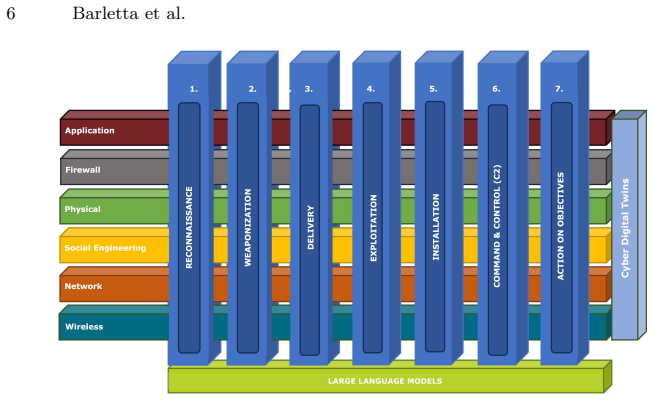
The load-bearing mechanism is the Red Team Knife (RTK), a unified interface over widely used red-teaming tools—Nmap, theHarvester, Feroxbuster, the w4af scanner, Commix, Sqlmap, and others—organized according to the Cyber Kill Chain, a seven-stage model of a cyberattack. The surrounding logical architecture is a matrix: the horizontal axis lists the asset types a Digital Twin simulates, and the vertical axis lists kill-chain phases from reconnaissance to actions on objectives. LLMs sit on top of this matrix, converting raw tool output into plain-language explanations and contextual guidance. This is what lets a learner run real penetration-testing tools against a safe virtual replica and receive structured, phase-aware feedback.
What would settle it
Run a controlled study in which one group learns penetration testing with the Digital Twin plus LLM plus RTK environment and a control group learns with conventional virtual machines and written labs, then test both groups against a live, unseen target; the central claim fails if the trained group shows no measurable advantage in finding and exploiting vulnerabilities.
Extended reading notes
Core claim
The central claim is that a Cyber Digital Twin augmented by LLMs and by the Red Team Knife (RTK) toolkit can structure penetration-testing education so that learners acquire practical red-team and blue-team competencies. In the paper's architecture each asset category simulated by the Digital Twin—application, firewall, physical, social engineering, network, and wireless—is crossed with each Cyber Kill Chain phase, and RTK guides the learner through the corresponding tools and techniques. LLMs interpret tool outputs, explain threats in natural language, and suggest next steps, including revisiting earlier phases when new findings warrant it. The paper argues that this integrated environment reduces the gap between theoretical knowledge and real-world application, making full-spectrum security analysis accessible to non-experts and useful to professionals.
Load-bearing premise
The training benefit depends on skills and judgment learned on simulated digital twins transferring to real IT, OT, and IoT systems, and on LLM explanations actually improving learning and retention; neither is tested in the paper.
Editorial extensions
If this is right
- Learners can rehearse reconnaissance, exploitation, and response on simulated IT, OT, and IoT assets without putting live systems at risk.
- The kill-chain alignment gives each exercise an explicit training target, so course designers can map lessons to specific phases of an attack.
- LLM-generated explanations make raw tool output legible to non-experts, lowering the barrier to red-team practice and supporting blue-team and security operations center (SOC) training.
- The same environment can deliver vulnerability-assessment and threat-detection practice across many asset classes in academic settings.
- Prompted returns to earlier kill-chain phases, as when the w4af scanner calls for revisiting reconnaissance, model realistic non-linear attack workflows rather than fixed scripts.
Reading between the lines
- Editorial extension: the asset-by-kill-chain matrix could be used as a competency map, letting an instructor generate a fresh scenario for each cell and track which phases a learner has mastered.
- Editorial extension: if the untested transfer from simulated to real systems holds, the same environment could serve as an entry-level certification instrument, but the paper presents no evidence for that transfer.
- Editorial extension: the LLM's role could be inverted so it acts as an adaptive adversary during exercises, generating red-team pressure rather than explanations after the fact.
Editorial analysis
A structured set of objections, weighed in public.
Referee Report
Summary. The paper proposes a framework for cybersecurity education that combines Digital Twins (DTs), Large Language Models (LLMs), and a custom penetration-testing toolkit called Red Team Knife (RTK). The horizontal dimension of the framework represents different asset categories (application, firewall, physical, social engineering, network, wireless), while the vertical dimension follows the Cyber Kill Chain. The authors describe RTK as a unified interface for several existing tools, such as Nmap, sqlmap, and w3af, and argue that LLM-generated feedback supports learners during simulated attacks. The paper does not present any empirical evaluation; Section 5 states that user studies are still being designed and that the framework is in early development.
Significance. The proposed application of DTs and LLMs to penetration-testing education is timely and addresses a real need for hands-on, scalable cybersecurity training. The paper's strengths include a clear organization of related work, a practical architecture tying the Cyber Kill Chain to concrete tool usage, and a publicly available RTK repository that could support reproducibility. However, the central claim in the abstract—that initial findings show significant improvement in training effectiveness—is unsupported by any data, metrics, or user study in the manuscript. As a position or vision paper, the work has merit, but the current framing overstates what has been demonstrated and requires revision before publication.
major comments (3)
- [Abstract and Section 5] The abstract states that 'Initial findings suggest that the integration significantly improves the effectiveness and relevance of cybersecurity training' and 'the research demonstrates how DTs and LLMs together can transform cybersecurity education.' Section 5, however, explicitly says 'we are currently designing user studies to assess its effectiveness' and 'the framework is still in its early development phase.' No empirical data, quantitative results, or user-study outcomes appear anywhere in the paper. This is an internal contradiction, and the claimed improvement is not supported by the presented evidence. The authors should either remove the effectiveness/demonstration claims and reframe the paper as a proposed framework, or include the missing study data.
- [Section 4 and Section 4.1] The framework is described at a conceptual level, but key implementation details needed to substantiate the learning-effectiveness claim are absent. The paper does not specify what digital twin models are used for the six horizontal asset categories, how the LLM is prompted, what guardrails or evaluation criteria govern LLM feedback, or how skill acquisition would be measured. Without these details, the architecture is not reproducible and the claimed benefits remain untestable. At minimum, the authors should clearly label the design as provisional and provide a concrete evaluation protocol that will be used in the planned user studies.
- [Section 4.1] The paper asserts that RTK makes penetration-testing tools accessible to less-experienced users and that integrated tools provide 'contextual suggestions,' but no usability assessment, comparative analysis, or performance measurement is provided. The claim that such guidance improves learning or operational readiness requires evidence beyond the tool's existence. If user studies are still being designed, the authors should state this limitation prominently and avoid implying that the framework's value is empirically established.
minor comments (4)
- [Abstract and throughout] The manuscript contains numerous spacing and formatting errors, such as 'allowingforreal-time' and 'section2describes,' which should be corrected in a careful proofreading pass.
- [Section 4, paragraph on social media research] The phrase 'LLM-powered DTs like Y' is unclear; the letter 'Y' appears to refer to the system described in reference [21], but this should be spelled out for readers.
- [Figures 1-4] The figures are central to the architecture description, but the text provides only brief and partially grammatical explanations (e.g., 'RTK identify vulnerabilities'). Please expand the captions and the in-text references so that the figures can be interpreted without guessing.
- [Section 1] The citation [3] is used after 'redefinition of key security functions,' but the reference describes a hack-space teaching model; it may not be the most appropriate support for that specific claim, so please verify the citation placement.
Circularity Check
No circular reasoning found: the paper makes a framework proposal with no quantitative derivation, and its central weakness is lack of evidence rather than circularity.
full rationale
The paper presents a conceptual architecture combining Digital Twins, LLMs, and the Red Team Knife for cybersecurity education. It contains no fitted parameters, no quantitative predictions derived from data, and no mathematical derivation chain that could reduce a claimed result to its inputs. The abstract's phrase 'Initial findings suggest that the integration significantly improves the effectiveness and relevance of cybersecurity training' is contradicted by Section 5, which states 'we are currently designing user studies to assess its effectiveness and practical relevance.' That is an unsupported empirical claim, but it is not circular reasoning: nothing is defined in terms of itself, and no prediction is statistically forced by a fitted input. The paper's self-citations ([3], [4]) appear only as background references in the introduction and are not load-bearing for the proposed framework, which is described on its own terms. The alignment of RTK with the Cyber Kill Chain is a design choice, not a derivation of an empirical result. Accordingly, the appropriate concern is absence of validation, which falls under correctness or evidence risk, not circularity.
Assumptions & free parameters
assumptions (3)
- domain assumption Skills practiced on digital twin simulations transfer to real IT, OT, and IoT systems.
- domain assumption LLM-generated feedback and explanations improve cybersecurity learning outcomes.
- domain assumption The Cyber Kill Chain is an appropriate pedagogical model for guiding penetration testing education.
invented entities (1)
-
Red Team Knife (RTK)
Cite this review
Pith. "Pith review of Enabling Cyber Security Education through Digital Twins and Generative AI." pith.science (2026). https://pith.science/paper/YKHN4M7Y
@misc{pith2026250717518,
  author       = {Pith},
  title        = {Pith review of: Enabling Cyber Security Education through Digital Twins and Generative AI},
  year         = {2026},
  howpublished = {\url{https://pith.science/paper/YKHN4M7Y}},
  note         = {Machine review of arXiv:2507.17518}
}
read the original abstract
Digital Twins (DTs) are gaining prominence in cybersecurity for their ability to replicate complex IT (Information Technology), OT (Operational Technology), and IoT (Internet of Things) infrastructures, allowing for real time monitoring, threat analysis, and system simulation. This study investigates how integrating DTs with penetration testing tools and Large Language Models (LLMs) can enhance cybersecurity education and operational readiness. By simulating realistic cyber environments, this approach offers a practical, interactive framework for exploring vulnerabilities and defensive strategies. At the core of this research is the Red Team Knife (RTK), a custom penetration testing toolkit aligned with the Cyber Kill Chain model. RTK is designed to guide learners through key phases of cyberattacks, including reconnaissance, exploitation, and response within a DT powered ecosystem. The incorporation of Large Language Models (LLMs) further enriches the experience by providing intelligent, real-time feedback, natural language threat explanations, and adaptive learning support during training exercises. This combined DT LLM framework is currently being piloted in academic settings to develop hands on skills in vulnerability assessment, threat detection, and security operations. Initial findings suggest that the integration significantly improves the effectiveness and relevance of cybersecurity training, bridging the gap between theoretical knowledge and real-world application. Ultimately, the research demonstrates how DTs and LLMs together can transform cybersecurity education to meet evolving industry demands.
Figures


Figures from the paper (1 more)

Reference graph
Works this paper leans on
-
[1]
In: 2024 IEEE 9th International Conference for Convergence in Technology (I2CT)
A P, J., Shankar, A., J R, A.N., Koliparthy, K., Badiger, V.N., Shivakumar, V.: Exploring the applications and challenges of digital twins in various industries. In: 2024 IEEE 9th International Conference for Convergence in Technology (I2CT). pp. 1–7 (2024).https://doi.org/10.1109/I2CT61223.2024.10543818
arXiv 2024
-
[2]
Journal of Information Technology in Construction26, 159–173 (2021)
Alshammari, K., Beach, T., Rezgui, Y.: Cybersecurity for digital twins in the built environment: Current research and future directions. Journal of Information Technology in Construction26, 159–173 (2021)
work page 2021
-
[3]
Baldassarre, M.T., Barletta, V.S., Caivano, D., Raguseo, D., Scalera, M.: Teaching cyber security: The hack-space integrated model. vol. 2315 (2019), https://www.scopus.com/inward/record.uri?eid=2-s2.0-85061370504& partnerID=40&md5=e8da8bde8df7b4a276e5517e34136832
work page 2019
-
[4]
Barletta, V.S., Caivano, D., Calvano, M., Curci, A., Piccinno, A.: Craste: Human factors and perception in cybersecurity education. vol. 3713, p. 75 – 81 (2024), https://www.scopus.com/inward/record.uri?eid=2-s2. 0-85198753881&partnerID=40&md5=35f9b858e583d214bb7a53c0a7dbf0da
work page 2024
-
[5]
Biffl, S., Eckhart, M., Lüder, A., Weippl, E.: Introduction to Security and Quality Improvement in Complex Cyber-Physical Systems Engineering, pp. 1–29. Springer International Publishing, Cham (2019)
work page 2019
-
[6]
Deng, G., Liu, Y., Mayoral-Vilches, V., Liu, P., Li, Y., Xu, Y., Zhang, T., Liu, Y., Pinzger, M., Rass, S.: Pentestgpt: An llm-empowered automatic penetration testing tool (2024),https://arxiv.org/abs/2308.06782
arXiv 2024
-
[7]
In: Proceedings of the 15th International Conference on Availability, Reliability and Security
Dietz, M., Vielberth, M., Pernul, G.: Integrating digital twin security simulations in the security operations center. In: Proceedings of the 15th International Conference on Availability, Reliability and Security. ARES ’20, Association for Computing Machinery, New York, NY, USA (2020)
work page 2020
-
[8]
El-Hajj, M.: Leveraging digital twins and intrusion detection systems for enhanced security in iot-based smart city infrastructures. Electronics13(19) (2024). https: //doi.org/10.3390/electronics13193941
Show all 28 references
-
[9]
In: International Conference on Broadband Communi- cations, Networks and Systems
Faleiro,R.,Pan,L.,Pokhrel,S.R.,Doss,R.:Digitaltwinforcybersecurity:Towards enhancing cyber resilience. In: International Conference on Broadband Communi- cations, Networks and Systems. pp. 57–76. Springer (2021)
2021
-
[10]
Multimedia Tools and Applications81(19), 26941–26967 (2022)
Guo, J., Lv, Z.: Application of digital twins in multiple fields. Multimedia Tools and Applications81(19), 26941–26967 (2022). https://doi.org/10.1007/ s11042-022-12536-5, https://doi.org/10.1007/s11042-022-12536-5
2022 doi
-
[11]
International Journal of Computational and Experimental Science and Engineering 10(3) (Sep 2024).https://doi.org/10.22399/ijcesen.469
Guven, M.: A comprehensive review of large language models in cyber security. International Journal of Computational and Experimental Science and Engineering 10(3) (Sep 2024).https://doi.org/10.22399/ijcesen.469
2024 doi
-
[12]
In: 2020 IEEE 28th International Requirements Engineering Conference (RE)
Hadar, E., Kravchenko, D., Basovskiy, A.: Cyber digital twin simulator for au- tomatic gathering and prioritization of security controls’ requirements. In: 2020 IEEE 28th International Requirements Engineering Conference (RE). pp. 250–259 (2020). https://doi.org/10.1109/RE4852...
2020
-
[13]
org/abs/2405.14487
Hassanin, M., Moustafa, N.: A comprehensive overview of large language models (llms) for cyber defences: Opportunities and directions (2024), https://arxiv. org/abs/2405.14487
2024 arXiv
-
[14]
Holmes, D., Papathanasaki, M., Maglaras, L., Ferrag, M.A., Nepal, S., Janicke, H.: Digital twins and cyber security – solution or challenge? In: 2021 6th South- East Europe Design Automation, Computer Engineering, Computer Networks and Social Media Conference (SEEDA-CECNSM). p...
2021
-
[15]
In: Sharma, S.K., Dwivedi, Y.K., Metri, B., Lal, B., Elbanna, A
Joshi, R.P., Gulati, S., Kar, A.K.: Digital twin for industrial applications – a lit- erature review. In: Sharma, S.K., Dwivedi, Y.K., Metri, B., Lal, B., Elbanna, A. (eds.) Transfer, Diffusion and Adoption of Next-Generation Digital Technologies. pp. 92–103. Springer Nature S...
2024
-
[16]
2022 IEEE International Conference on Communications, Control, and Computing Technologies for Smart Grids (Smart- GridComm) pp
Khan, M.M.S., Giraldo, J.A., Parvania, M.: Real-time cyber-physical analysis of distribution systems using digital twins. 2022 IEEE International Conference on Communications, Control, and Computing Technologies for Smart Grids (Smart- GridComm) pp. 34–39 (2022), https://api.s...
2022
-
[17]
https://doi.org/https://doi.org/10.18235/0013166
Latorre, L., Rego, E., De Leo, L., Gutierrez, M.: Tech report: Digital twins (2024). https://doi.org/https://doi.org/10.18235/0013166
2024 doi
-
[18]
Lin, Y.Z., Alhamadah, A.H.J., Redondo, M.W., Patel, K.H., Ghimire, S., Latibari, B.S., Salehi, S., Satam, P.: Transforming engineering education using generative ai and digital twin technologies (2024),https://arxiv.org/abs/2411.14433
2024
-
[19]
In: 2024 Second International Conference on Emerging Trends in Information Technology and Engineering (ICETITE)
Luzzi, J., Naha, R., Arulappan, A., Mahanti, A.: Sok: A holistic view of cyberat- tacks prediction with digital twins. In: 2024 Second International Conference on Emerging Trends in Information Technology and Engineering (ICETITE). pp. 1–7 (2024). https://doi.org/10.1109/ic-ET...
2024
-
[20]
EDPACS 68(6), 35–39 (2023).https://doi.org/10.1080/07366981.2023.2263214
McLaughlin, K.L.: The power of digital twins in the cybersecurity mesh. EDPACS 68(6), 35–39 (2023).https://doi.org/10.1080/07366981.2023.2263214
2023
-
[21]
Rossetti, G., Stella, M., Cazabet, R., Abramski, K., Cau, E., Citraro, S., Failla, A., Improta, R., Morini, V., Pansanella, V.: Y social: an llm-powered social media digital twin (2024),https://arxiv.org/abs/2408.00818
2024 arXiv
-
[22]
In: 2024 International Conference on Intelligent Algorithms for Computational Intelli- gence Systems (IACIS)
Sasikala, M., Mahaboob John, Y.M., Jothi, B., S, N., S, S.K.: Integrating digital twins with ai for real-time intrusion detection in smart infrastructure networks. In: 2024 International Conference on Intelligent Algorithms for Computational Intelli- gence Systems (IACIS). pp....
2024
-
[23]
Shen, X., Wang, L., Li, Z., Chen, Y., Zhao, W., Sun, D., Wang, J., Ruan, W.: Pentestagent: Incorporating llm agents to automated penetration testing (2025), https://arxiv.org/abs/2411.05185
2025 arXiv
-
[24]
In: 2023 IEEE Smart World Congress (SWC)
Somma, A., Casola, V., Cavalli, A.R., De Benedictis, A., Mallouli, W., Valdés, V.E.: A cyber digital twin framework to support cyber-physical systems security. In: 2023 IEEE Smart World Congress (SWC). pp. 1–10 (2023).https://doi.org/ 10.1109/SWC57546.2023.10449161
2023
-
[25]
Tarnowski, I.: How to use cyber kill chain model to build cybersecurity? European Journal of Higher Education IT (2017)
2017
-
[26]
In: 2022 IEEE International Conference on Pervasive Computing and Communications Workshops and other Affiliated Events (PerCom Workshops)
Varghese, S.A., Dehlaghi Ghadim, A., Balador, A., Alimadadi, Z., Papadimitratos, P.: Digital twin-based intrusion detection for industrial control systems. In: 2022 IEEE International Conference on Pervasive Computing and Communications Workshops and other Affiliated Events (P...
2022
-
[27]
ArXiv abs/1606.03184 (2015)
Yadav, T.K., Rao, A.M.: Technical aspects of cyber kill chain. ArXiv abs/1606.03184 (2015)
2015 arXiv
-
[28]
org/abs/2503.02167
Yang,L.,Luo,S.,Cheng,X.,Yu,L.:Leveraginglargelanguagemodelsforenhanced digital twin modeling: Trends, methods, and challenges (2025),https://arxiv. org/abs/2503.02167
2025 arXiv
Reviewed August 6, 2026 · model on record in the stance chip above.
Discussion (0). Sign in to comment.