REVIEW 4 major objections 4 minor 5 cited by
Quantum Scaling in Energy Correlators Beyond the Confinement Transition
T0 review · 4 major / 4 minor · reviewed 2026-08-06 · deepseek-v4-flash
Pith's one-line read The post-confinement EEC plateau scales with Q according to the J=5 DGLAP anomalous dimension.
desk verdict Plausible and elegantly framed, but the J=5 claim is not yet isolated by the Monte Carlo check; worth a serious referee. read the letter →
The pith
A machine-rendered reading of the paper's core claim, the machinery that carries it, and where it could break.
The reading
What carries the argument
The machinery is the light-ray OPE for a pair of energy detectors, $E(n_1)E(n_2)=\sum_{J_L,k} A_{J_L,k}\, \mathcal C_{J_L}(n_1,n_2,\partial_{n_2})\, O^H_{J_L,k}(n_2)$, where each hadronic light-ray operator $O^H_{J_L,k}$ has a definite boost weight $J_L$ and the celestial block behaves as $|n_{12}|^{-6-J_L}$. In the free-hadron approximation the relevant operators are double-twist operators $[EE]_{n,0}$ with $J_L=-6-2n$. Each such operator is matched, by Lorentz symmetry alone, onto the perturbative twist-2 DGLAP light-ray detector with the same boost weight, whose renormalization-group evolution is the time-like DGLAP anomalous dimension; this is what converts the non-perturbative hadron spectrum into the $J=5$ quantum-scaling prediction for the leading plateau term.
What would settle it
A track-based measurement of the EEC plateau height at two different collision energies $Q_1,Q_2$ with the same $\zeta Q^2$ would settle the claim: if the ratio of plateau heights disagrees with $[\alpha_s(\kappa^2 Q_2^2)/\alpha_s(\kappa^2 Q_1^2)]^{\hat\gamma_5^{(0)}/\beta_0}$ (up to scale uncertainties), the $J=5$ quantum-scaling prediction is falsified. A model in which hadron interactions produce sizeable odd-$J_L$ operators would make the effective exponent differ from the $J=5$ value, which is also testable in the same comparison.
Extended reading notes
Core claim
The central claim is that in the post-confinement regime $\zeta Q^2 \ll \Lambda_{\rm QCD}^2$, the reduced correlator $F_{\alpha,\beta}(\zeta Q^2,Q^2)$ obeys the light-ray OPE expansion of Eq. (10): it is a sum over $n$ of $(\zeta Q^2)^n$ times matching coefficients $\vec R^{\alpha,\beta}_n$ and the leading-log DGLAP evolution operator evaluated at boost weight $J_L=-\alpha-\beta-4-2n$. For the standard small-angle EEC with $\alpha=\beta=1$, the leading plateau term ($n=0$) has $J_L=-6$, so its $Q$-dependence is controlled by the DGLAP anomalous dimension at $J=5$; the plateau height therefore scales as $Q^2$ times a mild logarithmic factor. The paper further claims that the non-perturbative matching coefficients are moments of the mass-dependent dihadron fragmentation function, $\vec R_{-6-2n}=4^n\,\vec J^{(n)}_{1,1}$, and that this dictionary is consistent with the known evolution of the DFF. The authors also conjecture a contour-integral formula that interpolates between this post-confinement expansion and the perturbative pre-confinement expansion.
Load-bearing premise
The prediction rests on the approximation that hadrons in the post-confinement regime are nearly free massless particles, so only double-twist operators with even boost weights $J_L=-6-2n$ appear in the hadron light-ray OPE; as the authors note, hadron interactions could induce odd-$J_L$ contributions and shift the leading scaling. It also assumes the matching of hadronic operators onto perturbative twist-2 DGLAP detectors at equal boost weight, a result taken from the companion paper [43] rather than proven here.
Editorial extensions
If this is right
- The plateau height of the post-confinement EEC carries a calculable $Q$-dependence, so measuring it at two energies (e.g., 200 and 1000 GeV) directly tests the $J=5$ DGLAP anomalous dimension in a regime usually thought of as purely non-perturbative.
- The identity $\vec R_{-6-2n}=4^n\,\vec J^{(n)}_{1,1}$ makes the small-angle energy correlator a direct experimental window into the mass-dependent dihadron fragmentation function.
- At leading-log accuracy the evolved prediction matches Monte Carlo simulations of both $e^+e^-$ and $pp$ collisions, and it continues to hold for track-based measurements, which are the most practical way to reach the post-confinement plateau.
- Because the evolution kernel depends on $\alpha_s$ through $\beta_0$ and the one-loop anomalous dimension, a percent-level measurement of the plateau scaling would translate into a competitive $\alpha_s$ determination at colliders.
Reading between the lines
- Beyond the paper, the dictionary with DFF moments suggests that existing DFF parametrizations could be used as non-perturbative input to predict the overall normalization of the EEC plateau, leaving only the $Q$-dependent exponent as the perturbative prediction.
- Beyond the paper, measuring the generalized correlators $F_{\alpha,\beta}$ for several distinct weights would give a family of scaling exponents indexed by $\alpha+\beta$; agreement among them would be a sharper test of the single-$J_L$ assignment than the plateau height alone.
- Going further, if the conjectured contour formula of Eq. (12) is correct, then the power corrections of the pre-confinement region and the post-confinement expansion are two sides of the same Regge spectrum, so hadron-level information could in principle predict the size of non-perturbative corrections in the perturbative regime.
Editorial analysis
A structured set of objections, weighed in public.
Referee Report
Summary. The manuscript develops a light-ray operator product expansion (OPE) formalism for the small-angle energy-energy correlator (EEC) in the post-confinement regime. The authors argue that in this regime the hadronic EFT product E(n1)E(n2) decomposes into double-twist operators with boost weights JL = −6−2n, which match onto twist-2 DGLAP detectors in perturbative QCD. This yields the central prediction, Eq. (10): the energy-scaled correlator F_{α,β}(ζQ^2,Q^2) is a sum over (ζQ^2)^n times coefficients whose Q-dependence is controlled by the DGLAP anomalous dimension at J = −JL−1 = 5+2n, so the plateau (n=0) scales with the J=5 anomalous dimension. The authors also derive a correspondence between the non-perturbative OPE coefficients and moments of the dihadron fragmentation function, Eq. (16). They validate the LL-evolved prediction against Pythia 8.2 for e+e− and pp collisions and for track-based measurements, fitting at Q=500 GeV and evolving to 200 and 1000 GeV. The paper is clearly written and honest about its conjectural elements, including the contour deformation in Eq. (12) and the existence of QCD light-ray Regge trajectories.
Significance. If correct, the J=5 scaling is a crisp, testable prediction for track-based EEC measurements at LEP, RHIC, and the LHC, and the OPE/DFF dictionary provides a novel bridge between light-ray OPE and standard factorization approaches to hadronization. The paper includes a concrete validation pipeline (fit at one energy, evolve, compare), and the LL evolution is implemented with standard kernels. However, the strength of the validation is limited: the central J=5 conclusion rests on the free-hadron spectrum assumption, which the manuscript itself flags as potentially modified by hadron interactions, and the Monte Carlo test does not isolate the exponent because the same generator is used for the fit and the validation.
major comments (4)
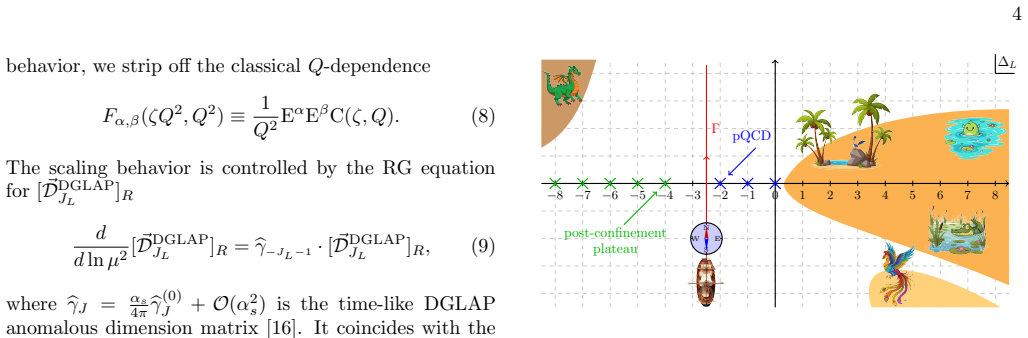
- [Light-ray OPE analysis, Fig. 2 caption and text after Eq. (5); Eq. (10)] The derivation of the J=5 scaling assumes that the only operators in the hadronic light-ray OPE have boost weights JL = −6−2n. The manuscript itself acknowledges that hadron interactions may induce odd-JL operators (Fig. 2, orange points) and can modify the spectrum, but it provides no power-counting estimate of such contributions. Since an odd-JL operator with JL = −7 would produce a ζ^{1/2} celestial block that is subleading as ζ→0 but contaminates the finite ζQ^2 region used in the fits, the Monte Carlo agreement does not establish that the J=5 exponent is the one controlling the plateau. Please either quantify the interaction-induced corrections or clearly present the J=5 claim as conditional on the free-hadron spectrum.
- [Phenomenological studies, Fig. 4 and Eqs. (23)-(25)] The validation is a soft consistency check: the OPE coefficients are obtained by fitting Pythia data at Q=500 GeV and the predictions are compared with Pythia data at Q=200 and 1000 GeV. Because Pythia's parton shower and the LL evolution in Eq. (11) are based on the same DGLAP kernels, good agreement is expected a priori. To make the test sensitive to the claimed non-perturbative scaling, the authors should isolate the leading exponent, for example by extracting the slope of the n=0 coefficient c^{(0)}_{α,β}(Q) as a function of Q and comparing it with bγ^{(0)}_5/β0, or by including an independent data set or experimental measurement.
- [SM 'Details of Series Approximation and Scaling Prediction', Eq. (23); main text after Fig. 4] The Laurent ansatz is used far outside the formal domain of validity of Eq. (10), which is derived for ζQ^2 ≪ Λ_QCD^2; the fits extend to ζQ^2 ~ 100 GeV^2, and the paper itself notes that the convergence breaks down around ~50 GeV^2. The agreement in the transition region is therefore testing the conjectural contour-deformation formula Eq. (12) rather than the OPE derivation. Please state how the finite truncation order N=8 controls the error and how the transition-regime prediction is justified.
- [Light-ray OPE analysis, Eq. (4) and Fig. 2] The hadron-to-pQCD detector matching in Eq. (4), and the assertion that the twist-2 DGLAP trajectory has the largest −Δ_L for each JL, is imported from the companion paper [43]. Because the entire JL spectrum and the J=5 conclusion depend on this step, the manuscript should summarize the argument in the main text or state explicitly that Eq. (4) is a result of [43] that is not proven here, so that the present paper is self-contained on this load-bearing point.
minor comments (4)
- [General notation] The variable ζ is used throughout the paper (e.g., Eqs. (5)-(8), Figs. 4-8) but is never explicitly defined; please define ζ = (1 − n1·n2)/2 ≈ θ^2/4 at first use.
- [Eq. (13)] The vector notation in Eq. (13), especially the definition of ⃗H = (2H_q, H_g) and the factor of 2 for quark and anti-quark contributions, should be explained more explicitly for readers not familiar with the factorization of Ref. [16].
- [SM Eq. (22)] In Eq. (22), the same symbol J^{(n)} is used both for the expansion coefficient of the jet function and for the angular momentum labels elsewhere in the paper; please use a distinct notation to avoid confusion with the spin variable J.
- [Text before Eq. (13)] The sentence 'the invariant mass of the hadron pair is related to their angular separation by m^2/4 = z1z2Q^2ζ' would benefit from a short derivation or a reference, since this relation fixes the normalization of ζ and the factor 4 in Eq. (14).
Circularity Check
J=5 plateau scaling rests on a self-cited hadron-to-DGLAP matching assumption; the DFF dictionary is a coefficient-identification tautology, though the Q-evolution test itself remains a genuine prediction.
-
self citation load bearing
[Light-ray OPE analysis, Eq. (4) and surrounding text]
"Furthermore, [43] argues that any measurement of hadrons at infinity can be matched in the regime Q ≫ Λ_QCD onto a linear combination of detectors D_{JL,i}(n, µ^2) of pQCD. ... As illustrated in Fig. 2, the twist-2 DGLAP detectors D⃗^{DGLAP}_{JL} = (D^{DGLAP}_{JL,q}, D^{DGLAP}_{JL,g})^T have the largest −∆L for a fixed JL and hence give the dominant contribution in the matching O^H_{JL,k} ≈ B⃗_{JL,k}(µ^2; Λ²_QCD) · [D⃗^{DGLAP}_{JL}]^R(µ^2)."
The central derivation of Eqs. (5)-(10), and hence the claimed J=5 quantum scaling of the post-confinement plateau, depends on this matching of hadron operators onto pQCD DGLAP detectors. The only support offered is [43], a companion paper by four of the same authors (Chang, Chen, Simmons-Duffin, and Zhu), which the text itself describes as 'argues' rather than proves. This paper supplies no independent derivation or external check of that matching. The load-bearing premise is therefore carried by a self-citation whose content is not established here.
-
self definitional
[Relation to the dihadron fragmentation function, Eqs. (14)-(18)]
"Critically, Eq. (14) is identical in form to the light-ray OPE in Eq. (6). This allows us to identify the non-perturbative OPE coefficients R⃗_{−6−2n}(µ^2; Λ²_QCD) with the moment of the n-th derivative of the DFF ... and the detectors [D⃗^{DGLAP}_{JL}]^R with the moments of the hard function H⃗. ... This agreement in the scaling behavior from both the DFF and OPE perspectives validates the connection between these two independent approaches."
Eq. (14) and Eq. (6) are two Taylor expansions in (ζQ²)^n of the same EEC. Once both expansions are assumed, equating their coefficients in Eqs. (16)-(17) is automatic rather than a derived prediction. The subsequent RG consistency, Eq. (18), is obtained by imposing dEEC/d ln µ² = 0, so the DFF jet-function evolution is forced by the hard-function DGLAP evolution; it is not an independent check. Calling this agreement a 'validation' of the connection is a self-consistency statement, not an independent confirmation, and the dictionary does not independently determine the J=5 scaling that already entered through the OPE side.
full rationale
The central Q-scaling prediction is not, by itself, circular: Eq. (7) combined with the RG equation (9) genuinely predicts how each coefficient of (ζQ²)^n evolves with Q via α_s^{γ_{5+2n}/β0}, and the phenomenology honestly fits coefficients at Q0 = 500 GeV while testing the evolution at 200 and 1000 GeV. However, two load-bearing pieces weaken the claim. First, the bridge from the hadron EFT to pQCD, Eq. (4), is imported from the authors' own companion paper [43], described as 'argues' rather than proved here, so the J=5 scaling rests on a self-citation. Second, the DFF dictionary in Eqs. (16)-(17) is an identification of the coefficients of two Taylor expansions of the same EEC; because Eq. (14) is 'identical in form' to Eq. (6), equating coefficients is automatic, and the RG 'agreement' in Eq. (18) is merely the consistency condition of that identification, not an independent validation. The paper honestly flags the free-hadron approximation and the possible odd-JL contributions in Fig. 2 and the supplemental material; that is a real, unquantified limitation but is not itself circularity. The Monte Carlo comparison is also a legitimate soft consistency check rather than a disguised fit, since the Q-dependence is not fitted at the test energies. Overall, the main exponent prediction retains independent content, but the derivation chain contains one load-bearing self-citation and one tautological dictionary, giving a score of 4.
Assumptions & free parameters
free parameters (4)
- OPE coefficient vectors V_{alpha,beta,n} (equivalently c_{alpha,beta}^{(n)}) =
not quoted; 9 coefficients per (process, weight) at Q0=500 GeV (N=8)
- track plateau height initial condition =
value at Q=250 GeV from Pythia tracks
- hard scale parameter kappa (mu_H = kappa Q) =
kappa = 1/4 in e+e-; mu = EJ R for jets in pp
- series truncation order N and fit window =
N=8, zeta Q^2 < 100 GeV^2; N=24 in the QED-on case
assumptions (5)
- domain assumption Matching of hadronic light-ray operators onto leading-twist DGLAP detectors with the same boost weight (Eq. 4)
- domain assumption Free-hadron approximation for the post-confinement spectrum: only double-twist operators with JL = -6-2n appear
- standard math RG of light-ray detectors governed by the time-like DGLAP anomalous dimension matrix (Eq. 9)
- domain assumption The mass-dependent DFF is analytic in m^2 near 0, permitting the Taylor expansion (14)
- ad hoc to paper Regge trajectories of light-ray operators exist and the contour deformation around them converges (Eq. 12)
invented entities (2)
-
Regge trajectories of QCD light-ray operators (complex Delta_L analytic structure behind Eq. 12)
-
Hadronic light-ray operators O^H_{JL,k} of the hadron EFT (Eq. 2)
Cite this review
Pith. "Pith review of Quantum Scaling in Energy Correlators Beyond the Confinement Transition." pith.science (2026). https://pith.science/paper/YNDDXUNM
@misc{pith2026250715923,
  author       = {Pith},
  title        = {Pith review of: Quantum Scaling in Energy Correlators Beyond the Confinement Transition},
  year         = {2026},
  howpublished = {\url{https://pith.science/paper/YNDDXUNM}},
  note         = {Machine review of arXiv:2507.15923}
}
abstract
We study the QCD scaling behavior of the small-angle Energy-Energy Correlator (EEC), focusing on the transition between its perturbative pre-confinement and non-perturbative post-confinement regimes. Applying the light-ray Operator Product Expansion (OPE), we develop a formalism that describes the scaling of the EEC with the input energy $Q$ in the transition and the post-confinement region, where the latter quantum scaling is determined by the $J=5$ DGLAP anomalous dimension. A key result of our work is a novel connection between the light-ray OPE and the dihadron fragmentation function (DFF), where we show that the non-perturbative OPE coefficients correspond to moments of the DFF. This finding establishes a new paradigm for studying hadronization. Our theoretical predictions are validated against Monte Carlo simulations for both $e^+e^-$ and $pp$ collisions, showing excellent agreement. The potential role of the quantum scaling in the precision determination of $\alpha_s$ is also discussed.
Figures


Figures from the paper (5 more)


Forward citations
Cited by 5 Pith papers
-
High precision heavy-boson-jet substructure with energy correlators
The EEC peak in boosted Z jets is the Sudakov back-to-back region of the Z-pole EEC seen through a Lorentz boost, determined by one Lorentz-invariant shape function and computable at N3LL'.
-
Energy Correlators of Spinning Sources
Spinning energy correlators classify the full Euler-angle dependence of N-point energy flux, obey generalized Hofman–Maldacena positivity bounds, and their ratios to inclusive correlators in QCD are largely insensitiv...
-
Energy-Energy Correlators at Strong Coupling
The strong-coupling EEC in planar N=4 SYM is now known through λ⁻² for p=2 and through λ⁻³ᐟ² for all half-BPS operators O_p, derived independently from worldsheet and low-energy Wilson-coefficient methods.
-
Benchmarking the Nearside Energy-Energy Correlators with Mellin Transform
A Mellin-transform framework with one fitted transition scale Λ describes nearside EECs in e+e− annihilation at NNLO+NNLL accuracy across ALEPH and earlier data.
-
Heavy Quark Pair Energy Correlators: From Profiling Partonic Splittings to Probing Heavy-Flavor Fragmentation
Heavy-flavor energy-energy correlators isolate the gluon to heavy quark-antiquark splitting and are predicted to be sensitive to medium modifications and anisotropic quark-gluon plasma structure.
Reference graph
Works this paper leans on
-
[43]
Jefferson Lab Angular Momentum (JAM), C. Cocuzza et al., Phys. Rev. D 109, 034024 (2024), 2308.14857
arXiv 2024
- [1]
-
[2]
to resum large logarithms related to the scaling violation Fα,β(ζQ 2, Q2) = X n≥0 (ζQ 2)n ⃗Rα,β n (µ2 J , Λ2 QCD)· UJL (µ2 J , µ2 H ) · ⟨[ ⃗DDGLAP JL ]R(µ2 H )⟩Q Q−JL−2 JL=−α−β−4−2n , (10) where the hard and jet scales are chosen to be µH ∼ O(Q), µJ ∼ O(ΛQCD). This is main prediction for the EEC in the post-confinement and transition regions from the ligh...
-
[3]
is U LL JL (µ2 1, µ2
-
[4]
New Opportunities in Particle and Nuclear Physics with Energy Correlators
= αs(µ2 2) αs(µ2 1) bγ(0) −JL −1/β0 , (11) where β0 = 11 3 CA − 4 3 nf TF is the one-loop beta function constant in QCD. To summarize, the spectrum of operators OH JL,k in the hadron light-ray OPE (2) determines the celestial blocks in the small angle expansion of the EEC (5). The co- efficient of each celestial block fJL (ζ) then evolves with scale accor...
work page 2025
-
[5]
R. D. Field and R. P. Feynman, Nucl. Phys. B 136, 1 (1978)
1978
-
[6]
B. Andersson, G. Gustafson, G. Ingelman, and T. Sjos- trand, Phys. Rept. 97, 31 (1983)
work page 1983
-
[7]
B. R. Webber, Nucl. Phys. B 238, 492 (1984)
work page 1984
Show all 61 references
-
[8]
J. C. Collins and D. E. Soper, Nucl. Phys. B 194, 445 (1982)
1982
- [9]
-
[10]
P. T. Komiske, I. Moult, J. Thaler, and H. X. Zhu, Phys. Rev. Lett. 130, 051901 (2023), 2201.07800
2023 arXiv
-
[11]
Tamis, PoS HardProbes2023, 175 (2024), 2309.05761
STAR, A. Tamis, PoS HardProbes2023, 175 (2024), 2309.05761
2024 arXiv
-
[12]
Hayrapetyan et al., Phys
CMS, A. Hayrapetyan et al., Phys. Rev. Lett. 133, 071903 (2024), 2402.13864
2024 arXiv
- [13]
-
[14]
STAR, (2025), 2502.15925
2025 arXiv
-
[15]
Chekhovsky et al., Phys
CMS, V. Chekhovsky et al., Phys. Lett. B 866, 139556 (2025), 2503.19993
2025 arXiv
- [16]
-
[17]
C. L. Basham, L. S. Brown, S. D. Ellis, and S. T. Love, Phys. Rev. Lett. 41, 1585 (1978)
1978
-
[18]
Konishi, A
K. Konishi, A. Ukawa, and G. Veneziano, Nucl. Phys. B 157, 45 (1979)
1979
-
[19]
L. J. Dixon, I. Moult, and H. X. Zhu, Phys. Rev. D 100, 014009 (2019), 1905.01310
2019 arXiv
-
[20]
K. Lee, A. Pathak, I. W. Stewart, and Z. Sun, Phys. Rev. Lett. 133, 231902 (2024), 2405.19396
2024 arXiv
-
[21]
H. Chen, P. F. Monni, Z. Xu, and H. X. Zhu, Phys. Rev. Lett. 133, 231901 (2024), 2406.06668
2024 arXiv
-
[22]
X. Liu, W. Vogelsang, F. Yuan, and H. X. Zhu, Phys. Rev. Lett. 134, 151901 (2025), 2410.16371
2025 arXiv
-
[23]
Barata, Z.-B
J. Barata, Z.-B. Kang, X. Mayo L´ opez, and J. Penttala, Phys. Rev. Lett. 134, 251903 (2025), 2411.11782
2025 arXiv
-
[24]
Chicherin, G
D. Chicherin, G. P. Korchemsky, E. Sokatchev, and A. Zhiboedov, JHEP 11, 134 (2023), 2306.14330
2023 arXiv
- [25]
-
[26]
D. M. Hofman and J. Maldacena, JHEP 05, 012 (2008), 0803.1467
2008 arXiv
- [27]
-
[28]
N. A. Sveshnikov and F. V. Tkachov, Phys. Lett. B 382, 403 (1996), hep-ph/9512370
1996 arXiv
-
[29]
G. F. Sterman, (1975)
1975
- [30]
-
[31]
Kologlu, P
M. Kologlu, P. Kravchuk, D. Simmons-Duffin, and A. Zhiboedov, JHEP 01, 128 (2021), 1905.01311
2021 arXiv
-
[32]
Chang, M
C.-H. Chang, M. Kologlu, P. Kravchuk, D. Simmons- Duffin, and A. Zhiboedov, JHEP 05, 059 (2022), 2010.04726
2022 arXiv
-
[33]
H. Chen, I. Moult, and H. X. Zhu, Phys. Rev. Lett. 126, 112003 (2021), 2011.02492
2021 arXiv
- [34]
-
[35]
de Florian and L
D. de Florian and L. Vanni, Phys. Lett. B 578, 139 (2004), hep-ph/0310196
2004 arXiv
-
[36]
Majumder and X.-N
A. Majumder and X.-N. Wang, Phys. Rev. D 70, 014007 (2004), hep-ph/0402245
2004 arXiv
-
[37]
Majumder and X.-N
A. Majumder and X.-N. Wang, Phys. Rev. D 72, 034007 (2005), hep-ph/0411174
2005 arXiv
-
[38]
R. L. Jaffe, X.-m. Jin, and J. Tang, Phys. Rev. Lett. 80, 1166 (1998), hep-ph/9709322
1998 arXiv
-
[39]
Bianconi, S
A. Bianconi, S. Boffi, R. Jakob, and M. Radici, Phys. Rev. D 62, 034008 (2000), hep-ph/9907475
2000 arXiv
-
[40]
Bacchetta and M
A. Bacchetta and M. Radici, Phys. Rev. D 67, 094002 (2003), hep-ph/0212300
2003 arXiv
- [41]
- [42]
-
[44]
Pitonyak, C
D. Pitonyak, C. Cocuzza, A. Metz, A. Prokudin, and N. Sato, Phys. Rev. Lett. 132, 011902 (2024), 2305.11995
2024 arXiv
-
[45]
Caron-Huot, M
S. Caron-Huot, M. Kologlu, P. Kravchuk, D. Meltzer, and D. Simmons-Duffin, JHEP 04, 014 (2023), 2209.00008
2023 arXiv
-
[46]
Chang, H
C.-H. Chang, H. Chen, D. Simmons-Duffin, and H. X. Zhu, (2025), 2506.06431
2025
-
[47]
V. N. Gribov and L. N. Lipatov, Sov. J. Nucl. Phys. 15, 438 (1972)
1972
- [48]
-
[49]
Chen, T.-Z
H. Chen, T.-Z. Yang, H. X. Zhu, and Y. J. Zhu, Chin. Phys. C 45, 043101 (2021), 2006.10534
2021 arXiv
-
[50]
G. P. Korchemsky, JHEP 01, 008 (2020), 1905.01444
2020 arXiv
-
[51]
M. S. Costa, V. Goncalves, and J. Penedones, JHEP 12, 091 (2012), 1209.4355
2012 arXiv
-
[52]
H. Chen, I. Moult, and H. X. Zhu, JHEP 08, 233 (2022), 8 2104.00009
2022 arXiv
-
[53]
Sj¨ ostrandet al., Comput
T. Sj¨ ostrandet al., Comput. Phys. Commun. 191, 159 (2015), 1410.3012
2015 arXiv
-
[54]
Chang, M
H.-M. Chang, M. Procura, J. Thaler, and W. J. Waalewijn, Phys. Rev. Lett. 111, 102002 (2013), 1303.6637
2013 arXiv
-
[55]
Y. Li, I. Moult, S. S. van Velzen, W. J. Waalewijn, and H. X. Zhu, Phys. Rev. Lett. 128, 182001 (2022), 2108.01674
2022 arXiv
-
[56]
Lee and I
K. Lee and I. Stewart, (2025), 2507.11495
2025
-
[57]
K. Lee, I. Moult, and X. Zhang, (2024), 2410.01902
2024 arXiv
-
[58]
H. Chen, I. Moult, X. Zhang, and H. X. Zhu, Phys. Rev. D 102, 054012 (2020), 2004.11381
2020 arXiv
-
[59]
Chen et al., JHEP 05, 043 (2024), 2307.07510
W. Chen et al., JHEP 05, 043 (2024), 2307.07510
2024 arXiv
-
[60]
Gonzalez, K
M. Gonzalez, K. Lee, and I. Moult, to appear
-
[61]
Jaarsma, Y
M. Jaarsma, Y. Li, I. Moult, W. J. Waalewijn, and H. X. Zhu, JHEP 12, 087 (2023), 2307.15739. 9 Supplemental Materials Details of All-order F actorization F ormula The discussions from both light-ray OPE and dihadron fragmentation perspectives in this Letter can be summarized ...
2023 arXiv
Reviewed August 6, 2026 · model on record in the stance chip above.
Discussion (0). Sign in to comment.