REVIEW 3 major objections 5 minor 2 cited by
Probing the Dynamics of Two-Level System Defect Ensembles via Broadband Cryogenic Transient Dielectric Spectroscopy
T0 review · 3 major / 5 minor · reviewed 2026-08-07 · deepseek-v4-flash
Pith's one-line read A broadband cryogenic waveguide technique, BCTDS, reads out the post-pulse transient emission of two-level system defect ensembles, encoding their eigenmode frequencies in V-shaped Fourier features and exposing memory effects.
desk verdict Genuinely new broadband TLS probe, but the unsubtracted empty-waveguide background at 10 mK keeps the central claim from being established. read the letter →
The pith
A machine-rendered reading of the paper's core claim, the machinery that carries it, and where it could break.
The reading
What carries the argument
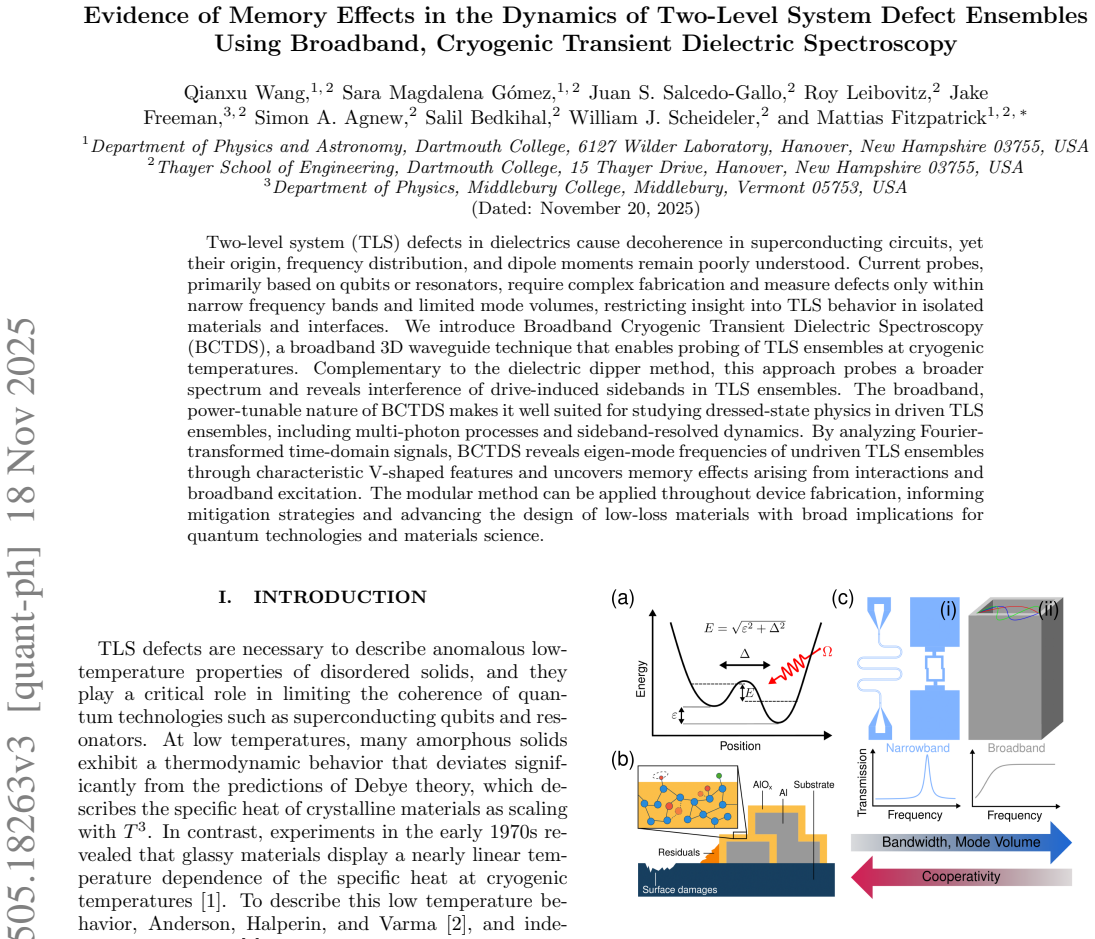
The load-bearing object is the driven standard tunneling model: each TLS defect is a double-well system with energy detuning εj and tunneling amplitude Δj, coupled to the microwave field through its electric dipole and to other defects through dipole–dipole couplings Jij. During the pulse the periodic drive dresses the ensemble, producing Floquet quasi-energy sidebands; after the pulse, the emitted field is proportional to the collective polarization, and the Fourier components of the ring-down contain quasi-energy differences and sideband shifts that form the V-shaped structures. The model is solved with a Lindblad master equation that adds collective radiative decay mediated by the broadband waveguide, and the measured homodyne intensity is connected to the susceptibility through Kubo and input–output relations.
What would settle it
Re-run the measurement with the sample retracted in situ while keeping the waveguide, antennas, and readout chain identical: if the V-shaped features and revival oscillations appear unchanged, the signal cannot be assigned to the mounted sample. A complementary check is to fabricate a resonator or qubit on the same material and compare its resolved TLS frequencies to the V-shape vertices; agreement would support the assignment, and disagreement would falsify it.
Extended reading notes
Core claim
The central discovery is that a strongly driven ensemble of TLS defects, observed through a broadband 3D waveguide, continues to emit coherently after the drive ends, and that this re-emission carries the frequency structure of the defect ensemble. In the measured Fourier spectra of the ring-down, V-shaped features appear whose arms converge toward the bare eigenfrequencies of the TLS ensemble as the pulse length increases; the paper interprets these as off-resonant emission from dominant defect modes made visible by the broadband environment. The time-domain signal shows repeated collapse and revival, the two-time correlation function g(2) decays non-exponentially with oscillations, and the extracted imaginary susceptibility χ''(ω) becomes non-monotonic and negative near the bright spectral features, which the paper reads as information backflow and physics beyond linear response. These observations are attributed to memory effects arising from TLS–TLS interactions and broadband excitation, and they are qualitatively reproduced by a driven standard tunneling model with a few interacting TLSs under collective dissipation.
Load-bearing premise
The load-bearing premise is that the post-pulse transient signal is emitted by TLS defects in the mounted sample rather than by the waveguide's own oxide layers, antenna surfaces, or amplifier and detection artifacts, and the paper itself reports defect features in an empty waveguide at 10 mK and defers their removal as baseline to future work.
Editorial extensions
If this is right
- Material screening becomes possible at the wafer stage: TLS-sensitive spectra can be recorded on bare sapphire, deposited oxide layers, and photoresist-covered samples without any resonator or qubit fabrication step.
- Drive-pulse duration acts as a control knob: longer pulses sharpen the transient emission lines and prolong ring-downs, suggesting that coherent control and spectral resolution of TLS ensembles can be tuned pulse by pulse.
- The observed memory effects imply that TLS ensembles can exhibit non-Markovian dynamics under broadband driving, which, if present in quantum processors, would matter for error-correction assumptions.
- Thermocycling changes the transient spectral fingerprint of the same sample, consistent with TLS rearrangement, so BCTDS can track how thermal and processing history reshapes the defect environment.
- A 2 nm oxide layer and a photoresist layer both increase the transient response relative to bare sapphire, indicating that thin-film morphology and interface quality dominate the defect population.
Reading between the lines
- Editorial extension: the paper does not perform this check, but if the V-shape vertices are truly the bare TLS eigenfrequencies, then the dominant revival frequencies in the time-domain traces should coincide with those same vertices; fitting both spectra jointly would test the assignment more sharply.
- Editorial extension: the empty-waveguide background the paper reports makes a decisive experiment available: retracting the sample in situ while leaving the waveguide untouched would directly measure how much of the V-shape survives without the sample, which the paper itself lists as future work.
- Editorial extension: the paper attributes memory effects to TLS interactions plus broadband drive; a drive-amplitude sweep could distinguish that explanation from single-defect dynamics, since interaction-driven revivals should appear or intensify only above some coupling-related threshold.
- Editorial extension: the authors note the technique should also detect non-spin defects such as dopants and vacancies; comparing a BCTDS spectrum on such a sample against an independently known defect resonance would test the generality of the method.
Editorial analysis
A structured set of objections, weighed in public.
Referee Report
Summary. The paper introduces Broadband Cryogenic Transient Dielectric Spectroscopy (BCTDS), a 3D waveguide technique intended to probe ensembles of two-level-system (TLS) defects in dielectrics at millikelvin temperatures without fabricating qubits or resonators. The method applies strong microwave square pulses in the 3–5 GHz band and records the post-pulse homodyne transient response. The authors report coherent ring-down signals, V-shaped features in Fourier-transformed transients, collapse-and-revival patterns in two-time intensity correlations g(2), and estimates of χ'' that become negative, which they interpret as evidence of memory effects and non-Markovian dynamics of interacting TLS ensembles. Supporting numerics use driven interacting few-spin master-equation and Floquet calculations to reproduce qualitatively the pulse-length-dependent sharpening of spectral features. The abstract and introduction claim that BCTDS reveals eigenmode frequencies of undriven TLS ensembles and can serve as a modular wafer-level materials probe.
Significance. If the sample-specific assignment of the transient signals were established, BCTDS would fill a real gap: existing TLS probes based on qubits or resonators are narrowband, require full device fabrication, and couple to only a small mode volume. The paper contains several commendable elements: room-temperature control experiments, cooldown-to-cooldown reproducibility checks (Appendix C), an HFSS-based electric-field calibration (Appendix E), transmission/reflection comparisons (Appendix D), and qualitative Floquet/master-equation simulations that connect V-shaped spectral features and pulse-length sharpening to dressed-state physics. The central novelty—broadband, modular, transient dielectric spectroscopy of TLS ensembles—is potentially valuable for superconducting-circuit materials engineering. However, the current manuscript does not yet demonstrate that the observed transients originate from the mounted samples rather than from the waveguide's own TLS-hosting surface oxides and uncontrolled enclosure modes; the empty-waveguide background at 10 mK shows similar features.
major comments (3)
- [III A and Fig. 3(c)–3(f)] The empty-waveguide control at 10 mK (Fig. 3(c)) already exhibits transient defect features, attributed by the authors to oxide layers on the waveguide and antenna surfaces and to uncontrolled modes in the fridge enclosure, and the text explicitly states that removing these baseline contributions is future work. Because Figs. 3(e), 3(f), 4, and 5 are unsubtracted superpositions of this background and any sample response, the V-shaped FFT features, the collapse-and-revival g(2), and the negative χ'' extracted from them cannot be uniquely assigned to TLS ensembles in the photoresist or AlOx films. The increased transient response for treated samples and the cooldown change in Appendix C are suggestive, but a thermal cycle also rearranges TLSs in the waveguide's own oxide layers, so these observations do not by themselves separate sample and background. Please provide interleaved empty-waveguide baselines and a subtraction or in-situ retraction protocol before claiming sample-specific TLS spectroscopy; without this, the central claim that BCTDS probes the material under test is not supported.
- [II B, Eq. (14), and Fig. 5(d)] Equation (14) asserts χ''(ω) ∝ Im ∫ dt e^{iωt}⟨I(t)I(0)⟩, citing Ref. [47], but no derivation is given. Combining Eq. (13), A(t) ∝ ⟨P(t)⟩e^{iω0t}, with I(t) ∝ A²(t) makes the right-hand side of Eq. (14) a fourth-order dipole correlation, not the linear-response susceptibility defined in Eqs. (8)–(12). The cited reference concerns optomechanical sideband asymmetry via stochastic electrodynamics and does not establish this identity. The subsequent interpretation of negative χ'' as physics beyond linear response (Sec. III C, Fig. 5(d)) rests entirely on this unproven relation. Please either derive Eq. (14) from input-output theory with explicit assumptions, or replace χ'' with a directly defined spectral measure of the transient homodyne field and discuss the negativity in those terms.
- [Appendix G] The few-spin simulations use hand-chosen parameters (drive amplitude, collective decay rate, dipole-dipole couplings, bare TLS frequencies) and are not fitted to the experimental data. The authors are appropriately cautious in calling the agreement qualitative, and the V-shaped mechanism follows from standard Floquet theory (Eqs. G13–G16), so this is not by itself an error. However, to make the comparison meaningful, the simulated observable should be matched to the experimental analysis pipeline: the experiment Fourier-transforms the logarithmic amplitude of the detected field, while the simulations show the collective population ⟨σ+σ−⟩. Please state explicitly how the simulated quantity maps to the measured I-Q transient and whether the V-shape persistence after the pulse is robust to the choice of collective versus independent decay, since the collective-decay assumption in Eq. (G18) is not derived from the waveguide geometry.
minor comments (5)
- [III C, Eq. (15)] The normalized two-time correlation g(2)(τ') is defined with ⟨I(t)⟩² in the denominator, which is only appropriate for a stationary process; the transient signal is manifestly nonstationary. Please clarify whether the average is over t for each τ' and whether a product ⟨I(t)⟩⟨I(t+τ')⟩ would be more appropriate, or state the stationarity assumption explicitly.
- [III C] There is a typo: 'non-Makovian' should be 'non-Markovian'.
- [Appendix G] The sentence 'The assumption of collective decay is motivated by the broadband nature of the waveguide, which couples similarly to all TLSs' needs justification: a broadband waveguide generally provides independent emission channels whose phases depend on TLS positions and mode structure, and collective decay requires phase-matched coupling. Please either provide a quantitative argument or weaken the claim.
- [Data availability] The data availability statement says data are available 'upon reasonable request'; for a new spectroscopy method with many nontrivial analysis steps, a public repository containing raw I-Q traces and analysis scripts would substantially strengthen reproducibility.
- [Fig. 4 caption] The caption does not state which sample is used for the pulse-length study; from the text it appears to be the 2 nm AlOx sample, but this should be stated explicitly in the caption.
Circularity Check
No significant circularity: BCTDS observations and Floquet-model interpretation are independent; the acknowledged empty-waveguide background is a confound, not a circular step.
full rationale
The paper's target observations—post-pulse coherent transients, V-shaped FFT features, g(2) oscillations, and negative χ''—are measured quantities, not outputs of a fitted model. The numerical simulations in Appendix G use hand-assigned parameters (e.g., 'randomly assigned bare frequencies and dipole-dipole couplings, drawn from uniform distributions ϵ ∈ [3.0, 5.0] GHz and J ∈ [−50.0, 50.0] MHz') and are explicitly qualitative ('The theoretical framework used here shows good qualitative agreement'), so no fitted input is relabeled as a prediction. The V-shape mechanism follows from standard Floquet theory (Eqs. G13–G16) with poles at ω = Eα − Eβ + lΩ; the bare eigenfrequencies are inputs to the illustrative simulation, not fit to the data. No self-citation is load-bearing: the Hamiltonian citing Lisenfeld et al. [19] and the tantalum-oxide claim citing Place et al. [51] (which includes the senior author) are independent external results, and neither is invoked to force BCTDS's interpretation. The most serious limitation is explicitly stated by the authors: 'In Fig. 3(c), we observe defect features in the absence of mounted samples, which we attribute to oxide layers present on the waveguide and antenna surfaces' and 'In future work, we intend to remove these baseline contributions by retracting the samples in situ.' That is a background-separation confound for the material-specific assignment of the transients, but it is not a circular derivation: the observed signals and the model remain logically independent of the inputs. Therefore no specific equation or fitted parameter reduces the predicted effect to an input by construction, and the circularity score is 0.
Assumptions & free parameters
free parameters (4)
- Drive amplitude A (simulation) =
100 MHz (N=2), 400 MHz (N=4)
- Collective decay rate Gamma (simulation) =
2.0 MHz (N=2), 1.0 MHz (N=4)
- Dipole-dipole coupling J (simulation) =
50 MHz (N=2); random in [-50, 50] MHz (N=4)
- Bare TLS frequencies (simulation) =
3.5 and 4.5 GHz (N=2); uniform in [3.0, 5.0] GHz (N=4)
assumptions (6)
- domain assumption Standard tunneling model represents each defect as a two-level double-well system (Eq. 1).
- domain assumption Kubo linear response susceptibility, Eqs. 8-9, relates polarization to field.
- domain assumption Input-output relation A(t) proportional to <P(t)> exp(i omega0 t), Eq. 13.
- ad hoc to paper Eq. 14 relates chi'' to the intensity autocorrelation <I(t)I(0)> via a citation to Novotny et al.
- domain assumption Lindblad master equation with collective radiative decay, Eqs. G17-G18.
- standard math Floquet formalism for time-periodic drives, Eqs. G1-G7.
Cite this review
Pith. "Pith review of Probing the Dynamics of Two-Level System Defect Ensembles via Broadband Cryogenic Transient Dielectric Spectroscopy." pith.science (2026). https://pith.science/paper/YYDOMKJF
@misc{pith2026250518263,
  author       = {Pith},
  title        = {Pith review of: Probing the Dynamics of Two-Level System Defect Ensembles via Broadband Cryogenic Transient Dielectric Spectroscopy},
  year         = {2026},
  howpublished = {\url{https://pith.science/paper/YYDOMKJF}},
  note         = {Machine review of arXiv:2505.18263}
}
read the original abstract
Two-level system (TLS) defects in dielectrics are a major source of decoherence in superconducting circuits, yet their microscopic origin and distribution remain poorly understood. Existing circuit-QED probes access limited frequency ranges and mode volumes, restricting studies of isolated materials and interfaces. Here, we present Broadband Cryogenic Transient Dielectric Spectroscopy (BCTDS), a technique for probing TLS-hosting materials over a broad frequency range at cryogenic temperatures. Under strong finite-duration microwave excitation, the transient homodyne I-Q response exhibits coherent phase dynamics after the drive is turned off. Fourier analysis of the transient phase reveals characteristic V-shaped structures that move between cooldowns, consistent with thermocycling-induced changes in the local TLS defect environment that shift defect resonance frequencies. The transient response of BCTDS further enables estimation of susceptibility and two-time correlation functions of the TLS defect ensemble. The observed phase dynamics are qualitatively captured by a driven standard tunneling model containing only a few representative TLS defects. Despite its simplicity relative to the full experimental ensemble, the model reproduces the essential Floquet-dressed dynamics during the drive and generates post-pulse V-shaped structures and interference fringes consistent with the experimental data. The observed BCTDS response may reflect a crossover from localized TLS defect dynamics to a delocalized regime under strong driving, before being quenched into a transient regime that reflects the TLS defect resonance frequencies. Overall, BCTDS represents a potentially useful broadband, time-resolved wafer-level approach for probing TLS defects relevant to quantum technologies.
Figures


Figures from the paper (9 more)




Forward citations
Cited by 2 Pith papers
-
Mechanical loss in amorphous solids: spatial correlations, interacting transitions, and annealed thermodynamic pathways
Atomic transitions causing mechanical loss in amorphous solids are spatially clustered and interact, requiring a connected-network description over independent two-level systems; flattening the energy landscape lowers...
-
Manarat: A Scalable QICK-Based Control System for Superconducting Quantum Processors Supporting Synchronized Control of 10 Flux-Tunable Qubits
A multi-board extension of the QICK control platform synchronizes two RFSoC boards to sub-100 ps skew and runs synchronized control of 10 flux-tunable qubits.
Reference graph
Works this paper leans on
-
[47]
Kubo, Statistical-Mechanical Theory of Irreversible Processes
R. Kubo, Statistical-Mechanical Theory of Irreversible Processes. I. General Theory and Simple Applications to Magnetic and Conduction Problems, J. Phys. Soc. Jpn. 12, 570 (1957)
1957
-
[1]
W aveguide Design The fundamental building block of our waveguides is an adapter that provides a 50 Ω impedance-matched con- version between an SMA coaxial cable and a WR-229 3D rectangular waveguide. To understand the basic features of the waveguide, we solve the wave equation for a rectan- gular prism, with boundary conditions that the electric field go...
-
[2]
W aveguide F abrication The waveguide used in this manuscript is manufac- tured from Aluminum 6061 using a HAAS Super Mini Mill in Dartmouth’s Thayer School of Engineering ma- chine shop. A combination of steel wire wool and polish- ing stones was used to improve the surface finish, espe- cially the rounded corners, and remove any feed marks left behind f...
-
[3]
R. C. Zeller and R. O. Pohl, Thermal conductivity and specific heat of noncrystalline solids, Phys. Rev. B4, 2029 (1971)
work page 1971
-
[4]
P. W. Anderson, B. I. Halperin, and C. M. Varma, Anomalous low-temperature thermal properties of glasses and spin glasses, Philos. Mag. 25, 1 (1972)
work page 1972
-
[5]
W. A. Phillips, Tunneling states in amorphous solids, J. Low Temp. Phys. 7, 351 (1972)
work page 1972
-
[6]
W. Arnold and S. Hunklinger, Experimental evidence for the direct interaction between two-level systems in glasses at very low temperatures, Solid State Commun. 17, 883 (1975)
work page 1975
-
[7]
B. Golding and J. E. Graebner, Phonon echoes in glass, Phys. Rev. Lett. 37, 852 (1976)
work page 1976
Show all 75 references
-
[8]
J. E. Graebner and B. Golding, Phonon echoes in a glass at low temperatures, Phys. Rev. B 19, 964 (1979)
1979
-
[9]
J. L. Black and B. I. Halperin, Spectral diffusion, phonon echoes, and saturation recovery in glasses at low temper- atures, Phys. Rev. B 16, 2879 (1977)
1977
-
[10]
Hu and L
P. Hu and L. R. Walker, Spectral diffusion in glasses at low temperatures, Solid State Commun. 24, 813 (1977)
1977
-
[11]
Carroll, S
M. Carroll, S. Rosenblatt, P. Jurcevic, I. Lauer, and A. Kandala, Dynamics of superconducting qubit relax- ation times, npj Quantum Inf. 8, 132 (2022)
2022
-
[12]
J. H. B´ ejanin, C. T. Earnest, A. S. Sharafeldin, and M. Mariantoni, Interacting defects generate stochastic fluctuations in superconducting qubits, Phys. Rev. B 104, 094106 (2021)
2021
-
[13]
Lisenfeld, C
J. Lisenfeld, C. M¨ uller, J. H. Cole, P. Bushev, A. Lukashenko, and A. V. Ustinov, Electric field spec- troscopy of material defects in transmon qubits, npj Quantum Inf. 5, 105 (2019)
2019
-
[14]
C. Wang, C. Axline, Y. Y. Gao, T. Brecht, Y. Chu, L. Frunzio, M. H. Devoret, and R. J. Schoelkopf, Sur- face participation and dielectric loss in superconducting qubits, Appl. Phys. Lett. 107, 162601 (2015)
2015
-
[15]
A. P. Read, B. J. Chapman, C. U. Lei, J. C. Cur- tis, S. Ganjam, L. Krayzman, L. Frunzio, and R. J. Schoelkopf, Precision Measurement of the Microwave Dielectric Loss of Sapphire in the Quantum Regime with Parts-per-Billion Sensitivity, Phys. Rev. Appl. 19, 034064 (2023)
2023
-
[16]
D. M. Pozar, Microwave engineering, 4th ed. (Wiley, Hoboken, NJ, 2012)
2012
-
[17]
M. D. Reed, B. R. Johnson, A. A. Houck, L. DiCarlo, J. M. Chow, D. I. Schuster, L. Frunzio, and R. J. Schoelkopf, Fast reset and suppressing spontaneous emis- sion of a superconducting qubit, Appl. Phys. Lett. 96, 203110 (2010)
2010
-
[18]
E. M. Purcell, H. C. Torrey, and R. V. Pound, Reso- nance Absorption by Nuclear Magnetic Moments in a Solid, Phys. Rev. 69, 37 (1946)
1946
-
[19]
Lisenfeld, C
J. Lisenfeld, C. M¨ uller, J. H. Cole, P. Bushev, A. Lukashenko, A. Shnirman, and A. V. Ustinov, Measur- ing the temperature dependence of individual two-level systems by direct coherent control, Phys. Rev. Lett. 105, 230504 (2010)
2010
-
[20]
G. J. Grabovskij, T. Peichl, J. Lisenfeld, G. Weiss, and A. V. Ustinov, Strain tuning of individual atomic tunnel- ing systems detected by a superconducting qubit, Science 338, 232 (2012)
2012
-
[21]
Lisenfeld, G
J. Lisenfeld, G. J. Grabovskij, C. M¨ uller, J. H. Cole, G. Weiss, and A. V. Ustinov, Observation of directly interacting coherent two-level systems in an amorphous material, Nat. Commun. 6, 6182 (2015)
2015
-
[22]
L. Yu, S. Matityahu, Y. J. Rosen, C.-C. Hung, A. Maksy- 17 mov, A. L. Burin, M. Schechter, and K. D. Osborn, Experimentally revealing anomalously large dipoles in the dielectric of a quantum circuit, Sci. Rep. 12, 16960 (2022)
2022
-
[23]
G. S. MacCabe, H. Ren, J. Luo, J. D. Cohen, H. Zhou, A. Sipahigil, M. Mirhosseini, and O. Painter, Nano- acoustic resonator with ultralong phonon lifetime, Sci- ence 370, 840 (2020)
2020
-
[24]
K. D. Crowley, R. A. McLellan, A. Dutta, N. Shumiya, A. P. M. Place, X. H. Le, Y. Gang, T. Madhavan, M. P. Bland, R. Chang, N. Khedkar, Y. C. Feng, E. A. Um- barkar, X. Gui, L. V. H. Rodgers, Y. Jia, M. M. Feldman, S. A. Lyon, M. Liu, R. J. Cava, A. A. Houck, and N. P. de Leon...
2023
-
[25]
Chiappina, J
P. Chiappina, J. Banker, S. Meesala, D. Lake, S. Wood, and O. Painter, Design of an ultra-low mode volume piezo-optomechanical quantum transducer, Opt. Express 31, 22914 (2023)
2023
-
[26]
M. Chen, J. C. Owens, H. Putterman, M. Sch¨ afer, and O. Painter, Phonon engineering of atomic-scale de- fects in superconducting quantum circuits, Sci. Adv. 10, eado6240 (2024)
2024
-
[27]
M. P. Bland, F. Bahrami, J. G. C. Martinez, P. H. Preste- gaard, B. M. Smitham, A. Joshi, E. Hedrick, A. Pakpour- Tabrizi, S. Kumar, A. Jindal, R. D. Chang, A. Yang, G. Cheng, N. Yao, R. J. Cava, N. P. de Leon, and A. A. Houck, 2d transmons with lifetimes and coherence times e...
2025 arXiv
-
[28]
J. Gao, M. Daal, A. Vayonakis, S. Kumar, J. Zmuidzinas, B. Sadoulet, B. A. Mazin, P. K. Day, and H. G. Leduc, Experimental evidence for a surface distribution of two- level systems in superconducting lithographed microwave resonators, Appl. Phys. Lett. 92, 152505 (2008)
2008
-
[29]
Calusine, A
G. Calusine, A. Melville, W. Woods, R. Das, C. Stull, V. Bolkhovsky, D. Braje, D. Hover, D. K. Kim, X. Miloshi, D. Rosenberg, A. Sevi, J. L. Yoder, E. A. Dauler, and W. D. Oliver, Analysis and mitigation of interface losses in trenched superconducting coplanar waveguide resona...
2018
-
[30]
Woods, G
W. Woods, G. Calusine, A. Melville, A. Sevi, E. Golden, D. K. Kim, D. Rosenberg, J. L. Yoder, and W. D. Oliver, Determining interface dielectric losses in superconduct- ing coplanar-waveguide resonators, Phys. Rev. Appl. 12, 014012 (2019)
2019
-
[31]
C. R. H. McRae, H. Wang, J. Gao, M. R. Vissers, T. Brecht, A. Dunsworth, D. P. Pappas, and J. Mutus, Materials loss measurements using superconducting mi- crowave resonators, Rev. Sci. Instrum.91, 091101 (2020)
2020
-
[32]
C.-C. Hung, L. Yu, N. Foroozani, S. Fritz, D. Gerthsen, and K. D. Osborn, Probing hundreds of individual quan- tum defects in polycrystalline and amorphous alumina, Phys. Rev. Appl. 17, 034025 (2022)
2022
-
[33]
J. M. Martinis, K. B. Cooper, R. McDermott, M. Stef- fen, M. Ansmann, K. D. Osborn, K. Cicak, S. Oh, D. P. Pappas, R. W. Simmonds, and C. C. Yu, Decoherence in josephson qubits from dielectric loss, Phys. Rev. Lett. 95, 210503 (2005)
2005
-
[34]
Burnett, L
J. Burnett, L. Faoro, I. Wisby, V. L. Gurtovoi, A. V. Chernykh, G. M. Mikhailov, V. A. Tulin, R. Shaikhaidarov, V. Antonov, P. J. Meeson, A. Y. Tza- lenchuk, and T. Lindstr¨ om, Evidence for interacting two- level systems from the 1/f noise of a superconducting res- onator, Na...
2014
-
[35]
M¨ uller, J
C. M¨ uller, J. Lisenfeld, A. Shnirman, and S. Poletto, In- teracting two-level defects as sources of fluctuating high- frequency noise in superconducting circuits, Phys. Rev. B 92, 035442 (2015)
2015
-
[36]
Agarwal, L
A. Agarwal, L. P. Lindoy, D. Lall, F. Jamet, and I. Rung- ger, Modelling non-markovian noise in driven supercon- ducting qubits, Quantum Sci. Technol. 9, 035017 (2024)
2024
-
[37]
M. Odeh, K. Godeneli, E. Li, R. Tangirala, H. Zhou, X. Zhang, Z.-H. Zhang, and A. Sipahigil, Non-markovian dynamics of a superconducting qubit in a phononic bandgap, Nat. Phys. 21, 406 (2025)
2025
-
[38]
Spiecker, A
M. Spiecker, A. I. Pavlov, A. Shnirman, and I. M. Pop, Solomon equations for qubit and two-level systems: In- sights into non-poissonian quantum jumps, Phys. Rev. A 109, 052218 (2024)
2024
-
[39]
B. R. Mollow, Power spectrum of light scattered by two- level systems, Phys. Rev. 188, 1969 (1969)
1969
-
[40]
Macklin, K
C. Macklin, K. O’Brien, D. Hover, M. E. Schwartz, V. Bolkhovsky, X. Zhang, W. D. Oliver, and I. Siddiqi, A near-quantum-limited josephson traveling-wave para- metric amplifier, Science 350, 307 (2015)
2015
-
[41]
O’Brien, C
K. O’Brien, C. Macklin, I. Siddiqi, and X. Zhang, Res- onant phase matching of josephson junction traveling wave parametric amplifiers, Phys. Rev. Lett.113, 157001 (2014)
2014
-
[42]
Boselli, J
M. Boselli, J. Grebel, A. Peugeot, R. Dassonneville, B. Huard, and A. Bienfait, Observation and mitigation of microwave echoes from dielectric defects in joseph- son traveling wave amplifiers (2025), arXiv:2503.00190 [quant-ph]
2025 arXiv
-
[43]
Delattre, I
A. Delattre, I. Golokolenov, R. Pedurand, N. Roch, A. Ranadive, M. Esposito, L. Planat, A. Fefferman, E. Collin, X. Zhou, M. A. Sillanp¨ a¨ a, L. Mercier de Lep- inay, A. D. Armour, and J. Glatthard, Quantitative cal- ibration of a TWPA applied to an optomechanical plat- form ...
2025
-
[44]
A. M. Holder, K. D. Osborn, C. J. Lobb, and C. B. Mus- grave, Bulk and surface tunneling hydrogen defects in alumina, Phys. Rev. Lett. 111, 065901 (2013)
2013
-
[45]
Megrant and Y
A. Megrant and Y. Chen, Scaling up superconducting quantum computers, Nature Electronics , 1 (2025)
2025
-
[46]
Thorwart, M
M. Thorwart, M. Grifoni, and P. H¨ anggi, Strong coupling theory for driven tunneling and vibrational relaxation, Phys. Rev. Lett. 85, 860 (2000)
2000
-
[48]
C. W. Gardiner and M. J. Collett, Input and output in damped quantum systems: Quantum stochastic differen- tial equations and the master equation, Phys. Rev. A 31, 3761 (1985)
1985
-
[49]
Novotny, M
L. Novotny, M. Frimmer, A. Militaru, A. Norrman, O. Romero-Isart, and P. Maurer, Optomechanical side- band asymmetry explained by stochastic electrodynam- ics, Phys. Rev. A 106, 043511 (2022)
2022
-
[50]
Stefanazzi, K
L. Stefanazzi, K. Treptow, N. Wilcer, C. Stoughton, C. Bradford, S. Uemura, S. Zorzetti, S. Montella, G. Can- celo, S. Sussman, A. Houck, S. Saxena, H. Arnaldi, A. Agrawal, H. Zhang, C. Ding, and D. I. Schuster, The qick (quantum instrumentation control kit): Readout and contr...
2022
-
[51]
K. D. Crowley, R. A. McLellan, A. Dutta, N. Shumiya, A. P. M. Place, X. H. Le, Y. Gang, T. Madhavan, M. P. Bland, R. Chang, N. Khedkar, Y. C. Feng, E. A. Um- barkar, X. Gui, L. V. H. Rodgers, Y. Jia, M. M. Feld- man, S. A. Lyon, M. Liu, R. J. Cava, A. A. Houck, and N. P. De Le...
2023
-
[52]
Lisenfeld, C
J. Lisenfeld, C. M¨ uller, J. H. Cole, P. Bushev, A. Lukashenko, A. Shnirman, and A. V. Ustinov, Mea- suring the Temperature Dependence of Individual Two- Level Systems by Direct Coherent Control, Phys. Rev. Lett. 105, 230504 (2010)
2010
-
[53]
A. P. M. Place, L. V. H. Rodgers, P. Mundada, B. M. Smitham, M. Fitzpatrick, Z. Leng, A. Premkumar, J. Bryon, A. Vrajitoarea, S. Sussman, G. Cheng, T. Mad- havan, H. K. Babla, X. H. Le, Y. Gang, B. J¨ ack, A. Gye- nis, N. Yao, R. J. Cava, N. P. de Leon, and A. A. Houck, New ma...
2021
-
[54]
Sangtawesin, B
S. Sangtawesin, B. L. Dwyer, S. Srinivasan, J. J. Allred, L. V. H. Rodgers, K. De Greve, A. Stacey, N. Dontschuk, K. M. O’Donnell, D. Hu, D. A. Evans, C. Jaye, D. A. Fis- cher, M. L. Markham, D. J. Twitchen, H. Park, M. D. Lukin, and N. P. de Leon, Origins of diamond surface n...
2019
-
[55]
M. W. Olszewski, J. T. Paustian, T. Banerjee, H. Lu, J. L. Ramirez, N. Nguyen, K. Okubo, R. Pant, A. B. Biedron, D. C. Ralph, C. J. K. Richardson, G. D. Fuchs, C. R. H. McRae, I. V. Pechenezhskiy, B. L. T. Plourde, and V. Fatemi, Low-loss nb on si supercon- ducting resonators ...
2025 arXiv
-
[56]
Gaikwad, D
C. Gaikwad, D. Kowsari, C. Brame, X. Song, H. Zhang, M. Esposito, A. Ranadive, G. Cappelli, N. Roch, E. M. Levenson-Falk, and K. W. Murch, Entanglement assisted probe of the non-markovian to markovian transition in open quantum system dynamics, Phys. Rev. Lett. 132, 200401 (2024)
2024
-
[57]
R. D. Chang, N. Shumiya, R. A. McLellan, Y. Zhang, M. P. Bland, F. Bahrami, J. Mun, C. Zhou, K. Kisslinger, G. Cheng, B. M. Smitham, A. C. Pakpour-Tabrizi, N. Yao, Y. Zhu, M. Liu, R. J. Cava, S. Gopalakrish- nan, A. A. Houck, and N. P. de Leon, Eliminating sur- face oxides of ...
2025
-
[58]
C. M. Quintana, A. Megrant, Z. Chen, A. Dunsworth, B. Chiaro, R. Barends, J. Kelly, J. Mutus, D. Sank, J. Wenner, Y. Yin, J. Zhao, A. N. Cleland, and J. M. Martinis, Characterization and reduction of microfabrication-induced decoherence in superconduct- ing quantum circuits, A...
2014
-
[59]
M¨ uller, J
C. M¨ uller, J. H. Cole, and J. Lisenfeld, Towards under- standing two-level-systems in amorphous solids: insights from quantum circuits, Rep. Prog. Phys. 82, 124501 (2019)
2019
-
[60]
L´ evi, C
B. L´ evi, C. C. L´ opez, J. Emerson, and D. G. Cory, Effi- cient error characterization in quantum information pro- cessing, Phys. Rev. A 75, 022314 (2007)
2007
-
[61]
Laine, J
E.-M. Laine, J. Piilo, and H.-P. Breuer, Measure for the non-markovianity of quantum processes, Phys. Rev. A 81, 062115 (2010)
2010
-
[62]
Rivas, S
A. Rivas, S. F. Huelga, and M. B. Plenio, Measures of non-markovianity: Divisibility versus backflow of infor- mation, Phys. Rev. A 83, 052128 (2011)
2011
-
[63]
M. S. Kumar and G. S. Agarwal, Effects of arbitrary relaxation and strong-field dressing of energy levels on nonlinear optical susceptibilities, Phys. Rev. A 33, 1817 (1986)
1986
-
[64]
M. M. Ali, P.-Y. Lo, M. W.-Y. Tu, and W.-M. Zhang, Non-markovianity measure using two-time correlation functions, Phys. Rev. A 92, 062306 (2015)
2015
-
[65]
Busiello, Out-of-equilibrium dissipative ac- susceptibility in quantum ising spin glass, J
G. Busiello, Out-of-equilibrium dissipative ac- susceptibility in quantum ising spin glass, J. Mod. Phys. 04, 784 (2013)
2013
-
[66]
Castles, J
F. Castles, J. A. J. Fells, D. Isakov, S. M. Morris, A. A. R. Watt, and P. S. Grant, Active metamaterials with nega- tive static electric susceptibility, Adv. Mater.32, 1904863 (2020)
2020
-
[67]
B. M. Terhal and G. Burkard, Fault-tolerant quantum computation for local non-markovian noise, Phys. Rev. A 71, 012336 (2005)
2005
-
[68]
P. W. Shor, Fault-tolerant quantum computation, inPro- ceedings of the 37th Annual Symposium on Foundations of Computer Science (FOCS)(1996) pp. 56–65
1996
-
[69]
Zhang, K
Z.-H. Zhang, K. Godeneli, J. He, M. Odeh, H. Zhou, S. Meesala, and A. Sipahigil, Acceptor-induced bulk di- electric loss in superconducting circuits on silicon, Phys. Rev. X 14, 041022 (2024)
2024
-
[70]
Shalibo, Y
Y. Shalibo, Y. Rofe, D. Shwa, F. Zeides, M. Neeley, J. M. Martinis, and N. Katz, Lifetime and coherence of two- level defects in a josephson junction, Phys. Rev. Lett. 105, 177001 (2010)
2010
-
[71]
A. K. Jonscher, The ’universal’ dielectric response, Na- ture 267, 673 (1977)
1977
-
[72]
Jonscher, The universal dielectric response and its physical significance, IEEE Trans
A. Jonscher, The universal dielectric response and its physical significance, IEEE Trans. Electr. Insul. 27, 407 (1992)
1992
-
[73]
Stefanazzi, K
L. Stefanazzi, K. Treptow, N. Wilcer, C. Stoughton, C. Bradford, S. Uemura, S. Zorzetti, S. Montella, G. Can- celo, S. Sussman, A. Houck, S. Saxena, H. Arnaldi, A. Agrawal, H. Zhang, C. Ding, and D. I. Schuster, The QICK (Quantum Instrumentation Control Kit): Read- out and con...
2022
-
[74]
U. D. Giovannini and H. H¨ ubener, Floquet analysis of excitations in materials, Journal of Physics: Materials 3, 012001 (2019)
2019
-
[75]
Grifoni and P
M. Grifoni and P. H¨ anggi, Driven quantum tunneling, Physics Reports 304, 229 (1998)
1998
Reviewed August 7, 2026 · model on record in the stance chip above.
Discussion (0). Continue with ORCID to comment.