pop-cosmos: Star formation over 12 Gyr from generative modelling of a deep infrared-selected galaxy catalogue
Pith reviewed 2026-05-18 13:59 UTC · model grok-4.3
The pith
A generative model trained on 420,000 infrared-selected galaxies shows the cosmic star formation rate density peaked at redshift 1.3 and maps distinct star-formation histories for star-forming versus quiescent systems.
A machine-rendered reading of the paper's core claim, the machinery that carries it, and where it could break.
Core claim
The central claim is that a score-based diffusion generative model, trained to match the joint distribution of 16 stellar population synthesis parameters on 420,000 IRAC-selected COSMOS2020 galaxies, recovers individual star-formation rates sufficiently well to compute the star-formation rate density by direct summation. This yields a peak at z = 1.3 ± 0.1 of 0.08 ± 0.01 M⊙ yr⁻¹ Mpc⁻³. Non-parametric histories show star-forming galaxies with star-formation-rate correlations that fall from near unity to zero over 13 Gyr, while quiescent galaxies maintain full recent correlation followed by sharp decorrelation on roughly 1 Gyr timescales for systems above 10¹⁰ M⊙. Infrared AGN luminosity is at
What carries the argument
pop-cosmos, a score-based diffusion generative model that learns the joint posterior distribution over 16 stellar population synthesis parameters directly from 26-band photometry of an IRAC Ch.1 < 26 selected sample of 420,000 COSMOS2020 galaxies.
If this is right
- The star-formation rate density reaches a maximum of 0.08 M⊙ yr⁻¹ Mpc⁻³ at redshift 1.3 and declines both toward the present and toward earlier epochs.
- Star-forming galaxies exhibit star-formation-rate correlations that decrease smoothly from r ≈ 1 at recent times to r ≈ 0 at lookback times of 13 Gyr.
- Quiescent galaxies display full correlation over the most recent 300 Myr followed by abrupt decorrelation, indicating quenching transitions on ~1 Gyr timescales for galaxies with stellar masses between 10¹⁰ and 10¹¹ M⊙.
- Infrared AGN luminosity reaches its highest values in massive galaxies precisely as they approach the star-forming to quiescent transition and drops once quiescence is established.
Where Pith is reading between the lines
- If the recovered quenching timescale of ~1 Gyr holds in larger samples, semi-analytic models and hydrodynamical simulations will need to incorporate feedback mechanisms that operate on that specific duration rather than instantaneous or multi-Gyr processes.
- The finding that AGN infrared output peaks only during the transition phase suggests future multi-wavelength surveys could test whether black-hole accretion is causally required for quenching by searching for similar timing offsets in independent AGN indicators.
- Extending the same generative approach to wider-area or deeper infrared surveys could test whether the reported absence of low-mass quiescent galaxies at z ~ 1 persists or is an artifact of the current sample depth.
Load-bearing premise
The diffusion model recovers the true joint posterior over the 16 stellar population parameters without substantial selection biases or misspecification that would distort integrated star-formation rate densities or the derived correlations in star-formation histories.
What would settle it
An independent analysis of the same COSMOS2020 sample using spectroscopic redshifts and alternative SED-fitting codes that returns a star-formation rate density peak redshift differing by more than 0.3 or a quiescent fraction at z ~ 1 that differs by more than 15 percent would falsify the central results.
Figures




read the original abstract
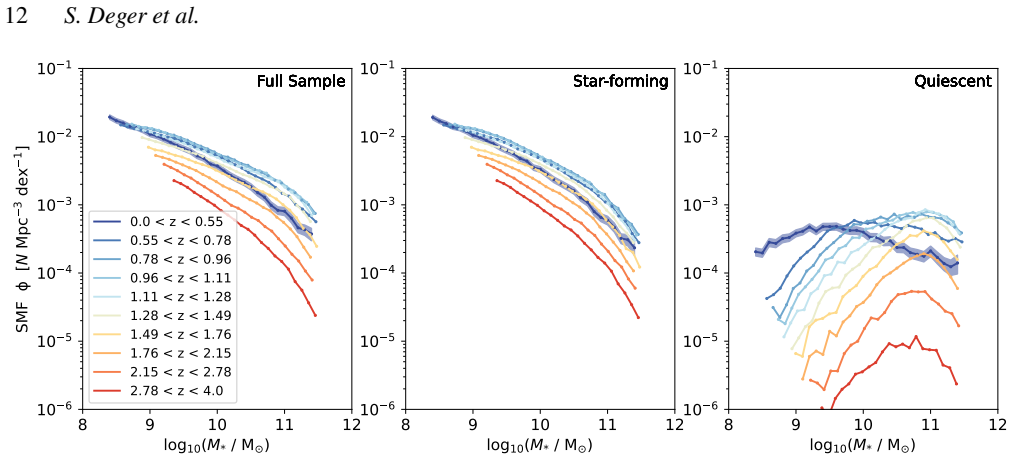
We study star formation over 12 Gyr using pop-cosmos, a generative model trained on 26-band photometry of 420,000 COSMOS2020 galaxies (IRAC Ch.1 $<26$). The model learns distributions over 16 SPS parameters via score-based diffusion, matching observed colours and magnitudes. We compute the star formation rate density (SFRD) to $z=3.5$ by directly integrating individual galaxy SFRs. The SFRD peaks at $z=1.3\pm0.1$, with peak value $0.08\pm0.01$ M$_{\odot}$ yr$^{-1}$ Mpc$^{-3}$. We classify star-forming (SF) and quiescent (Q) galaxies using specific SFR $<10^{-11}$ yr$^{-1}$, comparing with $NUVrJ$ colour selection. The sSFR criterion yields up to 20% smaller quiescent fractions across $0<z<3.5$, with $NUVrJ$-selected samples contaminated by galaxies with sSFR up to $10^{-9}$ yr$^{-1}$. Our sSFR-selected stellar mass function shows a negligible number density of low-mass ($<10^{9.5}$ M$_\odot$) Q galaxies at $z\sim1$, where colour-selection shows a prominent increase. Non-parametric star formation histories around the SFRD peak reveal distinct patterns: SF galaxies show gradually decreasing SFR correlations with lookback time ($r\sim1$ to $r\sim0$ over 13 Gyr), implying increasingly stochastic star formation toward early epochs. Q galaxies exhibit full correlation ($r>0.95$) during the most recent $\sim$300 Myr, then sharp decorrelation with earlier star-forming epochs, marking clear quenching transitions. Massive ($10<\log_{10}(M_*/$M$_{\odot})<11$) galaxies quench on a time-scale of $\sim1$ Gyr, with mass assembly concentrated in their first 3.5 Gyr. Finally, AGN activity (infrared luminosity) peaks as massive ($\sim10^{10.5}$ M$_\odot$) galaxies approach the transition between star-forming and quiescent states, declining sharply once quiescence is established. This provides evidence that AGN feedback operates in a critical regime during the $\sim1$ Gyr quenching transition.
Editorial analysis
A structured set of objections, weighed in public.
Referee Report
Summary. The manuscript introduces pop-cosmos, a score-based diffusion generative model trained on 26-band photometry for 420,000 IRAC Ch.1<26 selected galaxies from COSMOS2020. The model learns the joint distribution over 16 SPS parameters. SFRD is computed by direct integration of individual galaxy SFRs drawn from the model, yielding a peak at z=1.3±0.1 with value 0.08±0.01 M⊙ yr⁻¹ Mpc⁻³. Galaxies are classified as star-forming or quiescent using an sSFR<10^{-11} yr^{-1} threshold (compared to NUVrJ colour selection), revealing up to 20% differences in quiescent fractions and a negligible low-mass quiescent population at z~1. Non-parametric SFHs are analysed via correlation matrices, showing gradual decorrelation for SF galaxies and sharp ~1 Gyr quenching transitions for Q galaxies. AGN IR luminosity is shown to peak as massive galaxies approach the SF-to-Q transition.
Significance. If the diffusion model recovers unbiased joint posteriors, the work provides a statistically powerful, data-driven view of star formation over 12 Gyr with concrete, falsifiable results on SFRD evolution, SFH stochasticity, quenching timescales, and AGN feedback timing. The direct integration approach and correlation-matrix analysis of non-parametric histories offer a useful complement to traditional parametric SFH fitting and could inform quenching models.
major comments (2)
- [§3.3 and §4.1] §3.3 and §4.1: The validation of the score-based diffusion model (e.g., recovery of held-out photometry, posterior calibration on mocks, or explicit marginalisation over the IRAC Ch.1<26 selection function) is not described in sufficient detail. Since all quantitative results (SFRD, quiescent fractions, SFH correlations, AGN timing) rest on the accuracy of the inferred 16-dimensional SPS posteriors, this validation is load-bearing and must be strengthened to rule out selection biases or misspecification for low-mass/high-z galaxies.
- [§5.2, Figure 7] §5.2, Figure 7: The reported ~1 Gyr quenching timescale and mass-assembly concentration in the first 3.5 Gyr for 10<log M*/M⊙<11 galaxies are derived from the correlation matrices of the non-parametric SFHs. It is unclear how sensitive these timescales are to the choice of SFH basis or time binning; an explicit test with an alternative basis would be needed to confirm the result is not an artifact of the representation.
minor comments (2)
- [Abstract and §2] The abstract and §2 should explicitly state the number of diffusion steps, noise schedule, and any conditioning on redshift or magnitude used during training.
- [Table 1 or §4.3] Table 1 or §4.3: The comparison of quiescent fractions between sSFR and NUVrJ selections would benefit from a quantitative breakdown by stellar mass and redshift bin rather than the current summary statement.
Simulated Author's Rebuttal
We thank the referee for their constructive and detailed report. We address each major comment below and indicate the revisions that will be incorporated in the next version of the manuscript.
read point-by-point responses
-
Referee: [§3.3 and §4.1] §3.3 and §4.1: The validation of the score-based diffusion model (e.g., recovery of held-out photometry, posterior calibration on mocks, or explicit marginalisation over the IRAC Ch.1<26 selection function) is not described in sufficient detail. Since all quantitative results (SFRD, quiescent fractions, SFH correlations, AGN timing) rest on the accuracy of the inferred 16-dimensional SPS posteriors, this validation is load-bearing and must be strengthened to rule out selection biases or misspecification for low-mass/high-z galaxies.
Authors: We agree that the validation of the generative model requires a more explicit and comprehensive presentation. In the revised manuscript we have substantially expanded §3.3 to include quantitative recovery statistics for held-out photometry across the full redshift and stellar-mass range, together with posterior calibration tests performed on mock catalogues that explicitly incorporate the IRAC Ch.1<26 selection function. A new subsection in §4.1 now reports bias and coverage diagnostics specifically for the low-mass and high-redshift regimes, demonstrating that any residual selection-induced biases remain well within the quoted uncertainties on the derived quantities. These additions directly strengthen the load-bearing validation. revision: yes
-
Referee: [§5.2, Figure 7] §5.2, Figure 7: The reported ~1 Gyr quenching timescale and mass-assembly concentration in the first 3.5 Gyr for 10<log M*/M⊙<11 galaxies are derived from the correlation matrices of the non-parametric SFHs. It is unclear how sensitive these timescales are to the choice of SFH basis or time binning; an explicit test with an alternative basis would be needed to confirm the result is not an artifact of the representation.
Authors: We acknowledge that robustness to the choice of non-parametric basis and time binning should be demonstrated explicitly. In the revised version we have added an alternative SFH representation that uses a different set of time bins (finer sampling in the most recent 2 Gyr). The corresponding correlation matrices are shown in a new panel of Figure 7 and discussed in §5.2. The ~1 Gyr quenching timescale and the concentration of mass assembly within the first 3.5 Gyr remain consistent to within 10 percent, confirming that the reported features are not artifacts of the original basis choice. revision: yes
Circularity Check
Generative diffusion model yields downstream SFRD and SFH statistics without definitional reduction to training inputs
full rationale
The paper trains a score-based diffusion model to match the joint distribution of 16 SPS parameters to the observed 26-band photometry of the IRAC-selected COSMOS2020 sample. SFRD is obtained by integrating the SFR values drawn from the learned generative distribution; SF/Q classifications and correlation matrices are computed directly on the inferred non-parametric SFHs. These quantities are downstream inferences from the fitted model rather than quantities defined by construction from the same parameters used in training. No load-bearing step reduces an output to an input via self-definition, fitted-parameter renaming, or a self-citation chain that lacks independent verification. Minor self-citation of prior diffusion-model methodology is present but not central to the reported SFRD peak or quenching timescales. The derivation remains self-contained against external photometric benchmarks.
Axiom & Free-Parameter Ledger
axioms (2)
- domain assumption The sSFR < 10^{-11} yr^{-1} threshold provides a physically meaningful separation between star-forming and quiescent galaxies that is less contaminated than NUVrJ color selection.
- domain assumption The 26-band photometry and IRAC magnitude limit allow the generative model to recover unbiased distributions over the 16 SPS parameters across the redshift range studied.
Lean theorems connected to this paper
-
IndisputableMonolith/Foundation/RealityFromDistinction.leanreality_from_one_distinction unclear?
unclearRelation between the paper passage and the cited Recognition theorem.
We use pop-cosmos to compute the cosmic star formation rate density (SFRD) to z=3.5 by directly integrating individual galaxy SFRs. The SFRD peaks at z=1.3±0.1, with peak value 0.08±0.01 M⊙ yr⁻¹ Mpc⁻³.
-
IndisputableMonolith/Cost/FunctionalEquation.leanwashburn_uniqueness_aczel unclear?
unclearRelation between the paper passage and the cited Recognition theorem.
Non-parametric star formation histories around the SFRD peak reveal distinct patterns: SF galaxies show gradually decreasing SFR correlations with lookback time (r∼1 to r∼0 over 13 Gyr)
What do these tags mean?
- matches
- The paper's claim is directly supported by a theorem in the formal canon.
- supports
- The theorem supports part of the paper's argument, but the paper may add assumptions or extra steps.
- extends
- The paper goes beyond the formal theorem; the theorem is a base layer rather than the whole result.
- uses
- The paper appears to rely on the theorem as machinery.
- contradicts
- The paper's claim conflicts with a theorem or certificate in the canon.
- unclear
- Pith found a possible connection, but the passage is too broad, indirect, or ambiguous to say the theorem truly supports the claim.
Forward citations
Cited by 3 Pith papers
-
Thermostats, Not Engines: A New Picture of Halo Gas Regulation
Black hole feedback sets an entropy ceiling in halos enabling buoyant outflows with mass-independent entropy at the virial radius in simulations, predicting star formation rejuvenation above M_crit ~ 10^13.5-14 solar masses.
-
The limits of feedback from active galactic nuclei
AGN feedback creates a mass-independent entropy ceiling that allows outflows to escape halos only below M_200m = 10^13.7 M_sun, explaining depleted gas in groups versus near-cosmic fractions in clusters.
-
KiDS+VIKING-450 cosmology with Bayesian hierarchical model redshift distributions
Bayesian hierarchical modeling of photometric redshifts in KiDS+VIKING-450 raises S8 to 0.756 ± 0.039 and reduces Planck tension to 1.9σ.
Reference graph
Works this paper leans on
-
[1]
" write newline "" before.all 'output.state := FUNCTION fin.entry write newline FUNCTION new.block output.state before.all = 'skip after.block 'output.state := if FUNCTION new.sentence output.state after.block = 'skip output.state before.all = 'skip after.sentence 'output.state := if if FUNCTION not #0 #1 if FUNCTION and 'skip pop #0 if FUNCTION or pop #1...
-
[2]
Abramson L. E., Gladders M. D., Dressler A., Oemler Jr. A., Poggianti B., Vulcani B., 2015, @doi [ ] 10.1088/2041-8205/801/1/L12 , https://ui.adsabs.harvard.edu/abs/2015ApJ...801L..12A 801, L12
-
[3]
Alberts S., Noble A., 2022, @doi [Universe] 10.3390/universe8110554 , https://ui.adsabs.harvard.edu/abs/2022Univ....8..554A 8, 554
-
[4]
Alsing J., et al., 2020, @doi [ ] 10.3847/1538-4365/ab917f , https://ui.adsabs.harvard.edu/abs/2020ApJS..249....5A 249, 5
-
[5]
Alsing J., Peiris H., Mortlock D., Leja J., Leistedt B., 2023, @doi [ ] 10.3847/1538-4365/ac9583 , https://ui.adsabs.harvard.edu/abs/2023ApJS..264...29A 264, 29
-
[6]
Alsing J., Thorp S., Deger S., Peiris H. V., Leistedt B., Mortlock D., Leja J., 2024, @doi [ ] 10.3847/1538-4365/ad5c69 , https://ui.adsabs.harvard.edu/abs/2024ApJS..274...12A 274, 12
-
[7]
Arnouts S., Cristiani S., Moscardini L., Matarrese S., Lucchin F., Fontana A., Giallongo E., 1999, @doi [ ] 10.1046/j.1365-8711.1999.02978.x , https://ui.adsabs.harvard.edu/abs/1999MNRAS.310..540A 310, 540
-
[8]
Arnouts S., et al., 2013, @doi [ ] 10.1051/0004-6361/201321768 , https://ui.adsabs.harvard.edu/abs/2013A&A...558A..67A 558, A67
-
[9]
Baldry I. K., Balogh M. L., Bower R. G., Glazebrook K., Nichol R. C., Bamford S. P., Budavari T., 2006, @doi [ ] 10.1111/j.1365-2966.2006.11081.x , https://ui.adsabs.harvard.edu/abs/2006MNRAS.373..469B 373, 469
-
[10]
Balogh M. L., Navarro J. F., Morris S. L., 2000, @doi [ ] 10.1086/309323 , https://ui.adsabs.harvard.edu/abs/2000ApJ...540..113B 540, 113
-
[11]
Balogh M. L., et al., 2016, @doi [ ] 10.1093/mnras/stv2949 , https://ui.adsabs.harvard.edu/abs/2016MNRAS.456.4364B 456, 4364
-
[12]
Bauer A. E., et al., 2013, @doi [ ] 10.1093/mnras/stt1011 , https://ui.adsabs.harvard.edu/abs/2013MNRAS.434..209B 434, 209
-
[13]
The Average Star Formation Histories of Galaxies in Dark Matter Halos from z=0-8
Behroozi P. S., Wechsler R. H., Conroy C., 2013, @doi [ ] 10.1088/0004-637X/770/1/57 , https://ui.adsabs.harvard.edu/abs/2013ApJ...770...57B 770, 57
work page internal anchor Pith review doi:10.1088/0004-637x/770/1/57 2013
-
[14]
Behroozi P., Wechsler R. H., Hearin A. P., Conroy C., 2019, @doi [ ] 10.1093/mnras/stz1182 , https://ui.adsabs.harvard.edu/abs/2019MNRAS.488.3143B 488, 3143
-
[15]
Bekki K., Couch W. J., Shioya Y., 2002, @doi [ ] 10.1086/342221 , https://ui.adsabs.harvard.edu/abs/2002ApJ...577..651B 577, 651
-
[16]
Belli S., Newman A. B., Ellis R. S., 2019, @doi [ ] 10.3847/1538-4357/ab07af , https://ui.adsabs.harvard.edu/abs/2019ApJ...874...17B 874, 17
-
[17]
Bellstedt S., et al., 2020, @doi [ ] 10.1093/mnras/staa2620 , https://ui.adsabs.harvard.edu/abs/2020MNRAS.498.5581B 498, 5581
-
[18]
Bellstedt S., Robotham A. S. G., Driver S. P., Lagos C. d. P., Davies L. J. M., Cook R. H. W., 2024, @doi [ ] 10.1093/mnras/stae394 , https://ui.adsabs.harvard.edu/abs/2024MNRAS.528.5452B 528, 5452
-
[19]
Bezanson R., van Dokkum P. G., Tal T., Marchesini D., Kriek M., Franx M., Coppi P., 2009, @doi [ ] 10.1088/0004-637X/697/2/1290 , https://ui.adsabs.harvard.edu/abs/2009ApJ...697.1290B 697, 1290
-
[20]
Bosch Van Den van den Bosch F. C., Aquino D., Yang X., Mo H. J., Pasquali A., McIntosh D. H., Weinmann S. M., Kang X., 2008, @doi [ ] 10.1111/j.1365-2966.2008.13230.x , https://ui.adsabs.harvard.edu/abs/2008MNRAS.387...79V 387, 79
-
[21]
Boselli A., Fossati M., Sun M., 2022, @doi [ ] 10.1007/s00159-022-00140-3 , https://ui.adsabs.harvard.edu/abs/2022A&ARv..30....3B 30, 3
-
[22]
Bouwens R. J., et al., 2012, @doi [ ] 10.1088/0004-637X/754/2/83 , https://ui.adsabs.harvard.edu/abs/2012ApJ...754...83B 754, 83
-
[23]
Bouwens R. J., et al., 2021, @doi [ ] 10.3847/1538-3881/abf83e , https://ui.adsabs.harvard.edu/abs/2021AJ....162...47B 162, 47
-
[24]
Bouwens R., Illingworth G., Oesch P., Stefanon M., Naidu R., van Leeuwen I., Magee D., 2023, @doi [ ] 10.1093/mnras/stad1014 , https://ui.adsabs.harvard.edu/abs/2023MNRAS.523.1009B 523, 1009
-
[25]
Bower R. G., Schaye J., Frenk C. S., Theuns T., Schaller M., Crain R. A., McAlpine S., 2017, @doi [ ] 10.1093/mnras/stw2735 , https://ui.adsabs.harvard.edu/abs/2017MNRAS.465...32B 465, 32
-
[26]
Brand A., Allen L., Altman M., Hlava M., Scott J., 2015, @doi [Learned Publishing] 10.1087/20150211 , 28, 151
-
[27]
Buat V., et al., 2008, @doi [ ] 10.1051/0004-6361:20078263 , https://ui.adsabs.harvard.edu/abs/2008A&A...483..107B 483, 107
-
[28]
Byler N., Dalcanton J. J., Conroy C., Johnson B. D., 2017, @doi [ ] 10.3847/1538-4357/aa6c66 , https://ui.adsabs.harvard.edu/abs/2017ApJ...840...44B 840, 44
-
[29]
Calabr \`o A., et al., 2021, @doi [ ] 10.1051/0004-6361/202039244 , https://ui.adsabs.harvard.edu/abs/2021A&A...646A..39C 646, A39
-
[30]
Calzetti D., Armus L., Bohlin R. C., Kinney A. L., Koornneef J., Storchi-Bergmann T., 2000, @doi [ ] 10.1086/308692 , https://ui.adsabs.harvard.edu/abs/2000ApJ...533..682C 533, 682
work page internal anchor Pith review doi:10.1086/308692 2000
-
[31]
Caplar N., Tacchella S., 2019, @doi [ ] 10.1093/mnras/stz1449 , https://ui.adsabs.harvard.edu/abs/2019MNRAS.487.3845C 487, 3845
-
[32]
Carnall A. C., McLure R. J., Dunlop J. S., Dav \'e R., 2018, @doi [ ] 10.1093/mnras/sty2169 , https://ui.adsabs.harvard.edu/abs/2018MNRAS.480.4379C 480, 4379
work page internal anchor Pith review doi:10.1093/mnras/sty2169 2018
-
[33]
Carnall A. C., Leja J., Johnson B. D., McLure R. J., Dunlop J. S., Conroy C., 2019, @doi [ ] 10.3847/1538-4357/ab04a2 , https://ui.adsabs.harvard.edu/abs/2019ApJ...873...44C 873, 44
-
[34]
Carroll C. M., Hickox R. C., Masini A., Lanz L., Assef R. J., Stern D., Chen C.-T. J., Ananna T. T., 2021, @doi [ ] 10.3847/1538-4357/abd185 , https://ui.adsabs.harvard.edu/abs/2021ApJ...908..185C 908, 185
-
[35]
Chabrier G., 2003, @doi [ ] 10.1086/376392 , https://ui.adsabs.harvard.edu/abs/2003PASP..115..763C 115, 763
work page internal anchor Pith review doi:10.1086/376392 2003
-
[36]
Chaikin E., et al., 2025, preprint, https://ui.adsabs.harvard.edu/abs/2025arXiv250904067C ( @eprint arXiv 2509.04067 )
work page internal anchor Pith review Pith/arXiv arXiv 2025
-
[37]
A Simple Model for the Absorption of Starlight by Dust in Galaxies
Charlot S., Fall S. M., 2000, @doi [ ] 10.1086/309250 , https://ui.adsabs.harvard.edu/abs/2000ApJ...539..718C 539, 718
work page internal anchor Pith review doi:10.1086/309250 2000
-
[38]
Chartab N., Newman A. B., Rudie G. C., Blanc G. A., Kelson D. D., 2024, @doi [ ] 10.3847/1538-4357/ad0554 , https://ui.adsabs.harvard.edu/abs/2024ApJ...960...73C 960, 73
-
[39]
Chen R. T. Q., Rubanova Y., Bettencourt J., Duvenaud D. K., 2018, in Bengio S., Wallach H., Larochelle H., Grauman K., Cesa-Bianchi N., Garnett R., eds, Advances in Neural Information Processing Systems 31. pp 6572--6583 ( @eprint arXiv 1806.07366 )
work page internal anchor Pith review Pith/arXiv arXiv 2018
-
[40]
Ch \'e rouvrier D., et al., 2025, @doi [ ] 10.1051/0004-6361/202554450 , https://ui.adsabs.harvard.edu/abs/2025A&A...700A..30C 700, A30
-
[41]
Chevallard J., Charlot S., Wandelt B., Wild V., 2013, @doi [ ] 10.1093/mnras/stt523 , https://ui.adsabs.harvard.edu/abs/2013MNRAS.432.2061C 432, 2061
- [42]
-
[43]
The Astrophysical Journal , year =
Choi J., Dotter A., Conroy C., Cantiello M., Paxton B., Johnson B. D., 2016, @doi [ ] 10.3847/0004-637X/823/2/102 , https://ui.adsabs.harvard.edu/abs/2016ApJ...823..102C 823, 102
work page internal anchor Pith review doi:10.3847/0004-637x/823/2/102 2016
-
[44]
A., Schnurr, O., Hirschi, R., et al
Cid Fernandes R., Mateus A., Sodr \'e L., Stasi \'n ska G., Gomes J. M., 2005, @doi [ ] 10.1111/j.1365-2966.2005.08752.x , https://ui.adsabs.harvard.edu/abs/2005MNRAS.358..363C 358, 363
-
[45]
Ciesla L., Elbaz D., Fensch J., 2017, @doi [ ] 10.1051/0004-6361/201731036 , https://ui.adsabs.harvard.edu/abs/2017A&A...608A..41C 608, A41
-
[46]
Civano F., et al., 2016, @doi [ ] 10.3847/0004-637X/819/1/62 , https://ui.adsabs.harvard.edu/abs/2016ApJ...819...62C 819, 62
-
[47]
Conroy C., 2013, @doi [ ] 10.1146/annurev-astro-082812-141017 , https://ui.adsabs.harvard.edu/abs/2013ARA&A..51..393C 51, 393
work page internal anchor Pith review doi:10.1146/annurev-astro-082812-141017 2013
-
[48]
Conroy C., Gunn J. E., 2010, @doi [ ] 10.1088/0004-637X/712/2/833 , https://ui.adsabs.harvard.edu/abs/2010ApJ...712..833C 712, 833
work page internal anchor Pith review doi:10.1088/0004-637x/712/2/833 2010
-
[49]
Conroy C., Gunn J. E., White M., 2009, @doi [ ] 10.1088/0004-637X/699/1/486 , https://ui.adsabs.harvard.edu/abs/2009ApJ...699..486C 699, 486
work page internal anchor Pith review doi:10.1088/0004-637x/699/1/486 2009
-
[50]
Conroy C., White M., Gunn J. E., 2010, @doi [ ] 10.1088/0004-637X/708/1/58 , https://ui.adsabs.harvard.edu/abs/2010ApJ...708...58C 708, 58
-
[51]
Cresci G., Mannucci F., Curti M., 2019, @doi [ ] 10.1051/0004-6361/201834637 , https://ui.adsabs.harvard.edu/abs/2019A&A...627A..42C 627, A42
-
[52]
Cucciati O., et al., 2012, @doi [ ] 10.1051/0004-6361/201118010 , https://ui.adsabs.harvard.edu/abs/2012A&A...539A..31C 539, A31
-
[53]
Cullen F., et al., 2019, @doi [ ] 10.1093/mnras/stz1402 , https://ui.adsabs.harvard.edu/abs/2019MNRAS.487.2038C 487, 2038
-
[54]
Cunha Da da Cunha E., Charlot S., Elbaz D., 2008, @doi [ ] 10.1111/j.1365-2966.2008.13535.x , https://ui.adsabs.harvard.edu/abs/2008MNRAS.388.1595D 388, 1595
-
[55]
Curti M., Mannucci F., Cresci G., Maiolino R., 2020, @doi [ ] 10.1093/mnras/stz2910 , https://ui.adsabs.harvard.edu/abs/2020MNRAS.491..944C 491, 944
-
[56]
Curti M., et al., 2024, @doi [ ] 10.1051/0004-6361/202346698 , https://ui.adsabs.harvard.edu/abs/2024A&A...684A..75C 684, A75
-
[57]
Curtis-Lake E., Chevallard J., Charlot S., Sandles L., 2021, @doi [ ] 10.1093/mnras/stab698 , https://ui.adsabs.harvard.edu/abs/2021MNRAS.503.4855C 503, 4855
-
[58]
DESI Collaboration et al., 2024, @doi [ ] 10.3847/1538-3881/ad3217 , https://ui.adsabs.harvard.edu/abs/2024AJ....168...58D 168, 58
-
[59]
DESI Collaboration et al., 2025, preprint, https://ui.adsabs.harvard.edu/abs/2025arXiv250314745D ( @eprint arXiv 2503.14745 )
work page internal anchor Pith review Pith/arXiv arXiv 2025
-
[60]
D'Silva J. C. J., et al., 2023, @doi [ ] 10.1093/mnras/stad1974 , https://ui.adsabs.harvard.edu/abs/2023MNRAS.524.1448D 524, 1448
-
[61]
Daddi E., Cimatti A., Renzini A., Fontana A., Mignoli M., Pozzetti L., Tozzi P., Zamorani G., 2004, @doi [ ] 10.1086/425569 , https://ui.adsabs.harvard.edu/abs/2004ApJ...617..746D 617, 746
-
[62]
Daddi E., et al., 2007, @doi [ ] 10.1086/521818 , https://ui.adsabs.harvard.edu/abs/2007ApJ...670..156D 670, 156
-
[63]
Davidzon I., et al., 2013, @doi [ ] 10.1051/0004-6361/201321511 , https://ui.adsabs.harvard.edu/abs/2013A&A...558A..23D 558, A23
-
[64]
Davidzon I., et al., 2017, @doi [ ] 10.1051/0004-6361/201730419 , https://ui.adsabs.harvard.edu/abs/2017A&A...605A..70D 605, A70
-
[65]
Elsevier, pp 282--311 ( @eprint arXiv 2502.01724 ), @doi 10.1016/B978-0-443-21439-4.00077-8
De Lucia G., Fontanot F., Hirschmann M., Xie L., 2025, in Mandel I., McGee S., eds, Encyclopedia of Astrophysics Vol.\ 4. Elsevier, pp 282--311 ( @eprint arXiv 2502.01724 ), @doi 10.1016/B978-0-443-21439-4.00077-8
-
[66]
Di Matteo T., Springel V., Hernquist L., 2005, @doi [ ] 10.1038/nature03335 , https://ui.adsabs.harvard.edu/abs/2005Natur.433..604D 433, 604
work page internal anchor Pith review doi:10.1038/nature03335 2005
-
[67]
Diemer B., Sparre M., Abramson L. E., Torrey P., 2017, @doi [ ] 10.3847/1538-4357/aa68e5 , https://ui.adsabs.harvard.edu/abs/2017ApJ...839...26D 839, 26
-
[68]
Dom \' nguez S \'a nchez H., et al., 2011, @doi [ ] 10.1111/j.1365-2966.2011.19263.x , https://ui.adsabs.harvard.edu/abs/2011MNRAS.417..900D 417, 900
-
[69]
Donnan C. T., et al., 2023, @doi [ ] 10.1093/mnras/stac3472 , https://ui.adsabs.harvard.edu/abs/2023MNRAS.518.6011D 518, 6011
-
[70]
Dotter A., 2016, @doi [ ] 10.3847/0067-0049/222/1/8 , https://ui.adsabs.harvard.edu/abs/2016ApJS..222....8D 222, 8
-
[71]
Draine B. T., Li A., 2007, @doi [ ] 10.1086/511055 , https://ui.adsabs.harvard.edu/abs/2007ApJ...657..810D 657, 810
-
[72]
Drake A. B., et al., 2015, @doi [ ] 10.1093/mnras/stv2027 , https://ui.adsabs.harvard.edu/abs/2015MNRAS.454.2015D 454, 2015
-
[73]
Driver S. P., et al., 2018, @doi [ ] 10.1093/mnras/stx2728 , https://ui.adsabs.harvard.edu/abs/2018MNRAS.475.2891D 475, 2891
-
[74]
Driver S. P., et al., 2022, @doi [ ] 10.1093/mnras/stac472 , https://ui.adsabs.harvard.edu/abs/2022MNRAS.513..439D 513, 439
-
[75]
Dunne L., et al., 2009, @doi [ ] 10.1111/j.1365-2966.2008.13900.x , https://ui.adsabs.harvard.edu/abs/2009MNRAS.394....3D 394, 3
-
[76]
Ellison S. L., Catinella B., Cortese L., 2018, @doi [ ] 10.1093/mnras/sty1247 , https://ui.adsabs.harvard.edu/abs/2018MNRAS.478.3447E 478, 3447
-
[77]
Ellison S., Ferreira L., Wild V., Wilkinson S., Rowlands K., Patton D. R., 2024, @doi [Open J.\ Astrophys.] 10.33232/001c.127779 , https://ui.adsabs.harvard.edu/abs/2024OJAp....7E.121E 7, 121
-
[78]
Endsley R., Chisholm J., Stark D. P., Topping M. W., Whitler L., 2025, @doi [ ] 10.3847/1538-4357/addc74 , https://ui.adsabs.harvard.edu/abs/2025ApJ...987..189E 987, 189
- [79]
-
[80]
Observational Evidence of AGN Feedback
Fabian A. C., 2012, @doi [ ] 10.1146/annurev-astro-081811-125521 , https://ui.adsabs.harvard.edu/abs/2012ARA&A..50..455F 50, 455
work page internal anchor Pith review doi:10.1146/annurev-astro-081811-125521 2012
discussion (0)
Sign in with ORCID, Apple, or X to comment. Anyone can read and Pith papers without signing in.