REVIEW 1 major objections 1 minor 13 cited by
FitDiT: Advancing the Authentic Garment Details for High-fidelity Virtual Try-on
T0 review · 1 major / 1 minor · reviewed 2026-08-12 · deepseek-v4-flash
Pith's one-line read FitDiT customizes a Diffusion Transformer for virtual try-on, beating U-Net baselines on texture and fit.
desk verdict First DiT-based virtual try-on with strong numbers, but the frequency loss's strict-mask term likely conflicts with the relaxed-mask training strategy and needs scrutiny before the size-fitting claim holds. read the letter →
The pith
A machine-rendered reading of the paper's core claim, the machinery that carries it, and where it could break.
The reading
What carries the argument
The load-bearing object is a customized Stable Diffusion 3-style Diffusion Transformer (a transformer-based denoising network) split into a frozen GarmentDiT that extracts clothing features and a DenoisingDiT that generates the try-on. The argument rests on three mechanisms: hybrid attention concatenation of garment keys and values into the denoising branch; a frequency loss $L_f$ that applies a 2D discrete Fourier transform to the predicted and ground-truth images masked by the garment region; and the dilated-relaxed mask, a coarse rectangular mask randomly expanded so the model cannot infer garment length from the mask boundary. The paper also uses an attention-parameter-ratio analysis to argue that DiT allocates far more parameters to high-resolution latent features than U-Net backbones, which is why it suits detail-heavy tasks like try-on.
What would settle it
Run a controlled ablation on cross-category pairs: train FitDiT with (a) dilated-relaxed masks and no frequency loss, (b) dilated-relaxed masks plus the strict-mask frequency loss as in Eq. (6), and (c) dilated-relaxed masks plus a frequency loss computed on the same loosely expanded mask used for denoising. If variant (b) does not improve or worsens garment-length accuracy measured against human-annotated garment boundaries compared with (a), the frequency loss is undermining size-aware fitting; if (c) matches or exceeds (b), the exact-mask choice in Eq. (6) is not the right one.
Extended reading notes
Core claim
FitDiT is presented as the first customization of a Diffusion Transformer for virtual try-on. The authors adapt Stable Diffusion 3 by removing the text encoder (about 72 percent parameter savings), modulating DiT blocks with garment image embeddings instead of text, and injecting garment key/value features from a frozen GarmentDiT into the denoising branch through hybrid attention. Three additions carry the performance claims: a garment priors evolution stage that fine-tunes the garment extractor on garment data, a frequency-spectra distance loss computed in pixel space after a one-step denoising estimate that pushes high-frequency detail toward the ground truth, and a dilated-relaxed mask strategy that trains the model with loosely expanded masks so it learns garment shape rather than filling the mask. In paired and unpaired tests on VITON-HD, DressCode, and a self-collected complex-texture dataset (CVDD), FitDiT reports better SSIM, LPIPS, FID, and KID than the compared baselines, with particular gains on complex textures and cross-category outfits.
Load-bearing premise
The load-bearing premise is that the dilated-relaxed mask prevents garment-shape leakage while the frequency loss, computed on the exact garment mask, does not leak shape back in and does not conflict with the loose-mask training; the paper provides no ablation isolating that interaction.
Editorial extensions
If this is right
- Rich textures such as text, logos, stripes, and patterns transfer to the target person with fewer artifacts than previous U-Net diffusion try-on methods, according to the reported metrics.
- Cross-category try-on produces garments of the correct length rather than filling the entire inpainting mask, thanks to the dilated-relaxed mask strategy.
- The slimmed DiT reaches 4.57 seconds per 1024x768 image, about 27 percent faster than StableVITON and 54 percent faster than IDM-VTON, and can run below 6GB GPU memory with CPU offload.
- The DiT backbone's high-resolution attention allocation makes it a viable base for other detail-preserving image generation tasks beyond try-on.
Reading between the lines
- The frequency loss in Eq. (6) is computed on the exact garment mask of the target person, while training uses deliberately loose masks; this mismatch is never ablated, so a natural next test is whether the strict-mask frequency term partially reintroduces the garment-shape leakage the loose masks are meant to remove.
- The reported gains on CVDD, a self-collected dataset of 516 challenging pairs, may not transfer to standard benchmarks without that extra fine-tuning; the paper's strongest KID reductions are shown on CVDD and unpaired VITON-HD.
- If the attention-parameter-ratio argument is the real cause, the same customization should improve other exemplar-guided inpainting tasks, such as object retexturing or furniture try-on, which could be tested by applying the three mechanisms to a non-fashion dataset.
Signed reviews
Editorial analysis
A structured set of objections, weighed in public.
Referee Report
Summary. The paper proposes FitDiT, a diffusion-transformer-based virtual try-on method with three technical contributions: a garment priors evolution stage that fine-tunes a garment feature extractor, a frequency-domain loss in pixel space intended to improve high-frequency texture fidelity, and a dilated-relaxed mask strategy intended to improve size-aware fitting. The method is evaluated on VITON-HD, DressCode, and a self-collected Complex Virtual Dressing Dataset (CVDD), with quantitative comparisons against several recent baselines, an ablation study, and an inference-time analysis. The paper claims state-of-the-art results on the tested datasets and reports a 4.57-second inference time for a 1024x768 image.
Significance. If the reported results hold, FitDiT would be a meaningful advance for image-based virtual try-on: it is, to the authors' knowledge, the first DiT-specific customization for this task, it reports consistent quantitative improvements over strong baselines on two public benchmarks, and it addresses the practically important cross-category and size-mismatch scenario. The paper also provides a useful architectural analysis of attention parameter allocation across U-Net and DiT backbones, and the inference-time comparison is a concrete practical contribution. However, the strength of the central claims is moderated by three gaps: the frequency loss and the dilated-relaxed mask strategy interact in an unanalyzed way, the ablations are limited to the self-collected CVDD without error bars, and the CVDD itself is not yet released and its construction is not fully specified. These issues are addressable and do not invalidate the approach, but they need to be resolved before the state-of-the-art claim can be considered fully supported.
major comments (1)
- [§3.4, Eq. (5)] The one-step estimate of z_0 in Eq. (5) involves division by (1-t), which becomes numerically unstable for timesteps close to t=1. The paper does not mention how such timesteps are handled during training. Please clarify the clipping or rescaling strategy used in practice.
minor comments (1)
- [Supplementary Material, Sec. 13] The limitation statement regarding hand and finger details is honest and useful, but it should be mirrored in the main text's conclusion so that readers of the main paper are aware of the primary failure mode.
Circularity Check
No significant circularity; the SOTA claim rests on external held-out evaluations, with only minor non-load-bearing self-citations.
full rationale
The paper's central claims are empirical and are supported by quantitative comparisons on held-out test splits of VITON-HD, DressCode, and a self-collected CVDD set; no fitted parameter is renamed as a prediction, and no result is derived from its own input by construction. The frequency-spectra loss in Eq. (6) is a training objective rather than a predicted output, and the dilated-relaxed mask is a data-augmentation strategy; their interaction is a potential design or correctness concern (the strict mask m_g may partially conflict with the relaxed-mask goal of avoiding garment shape leakage), but it does not make any claimed result equivalent to its inputs. The only author self-citations are to Diffumatting [19] and Vton-HandFit [24], both used as related-work technique references; neither carries a load-bearing premise, forbids alternatives, or supplies a uniqueness theorem. The supplementary limitation about hand details is an acknowledged weakness, not a circular step. Accordingly, no circular step is identified; the score reflects only the presence of minor, non-load-bearing self-citations.
Assumptions & free parameters
free parameters (4)
- frequency_loss_weight
- denoising_loss_weight =
1.0 (assumed)
- w(t) weighting function
- mask_expansion_pixels =
a few pixels (exact range not given)
assumptions (5)
- domain assumption Stable Diffusion 3 (SD3) pretrained weights provide a valid initialization for both GarmentDiT and DenoisingDiT.
- domain assumption Removing the text encoder from SD3 does not harm try-on fidelity.
- domain assumption DWPose keypoints plus a 4-layer conv Pose Guider are sufficient to preserve body coherence in the inpainted area.
- domain assumption The human parsing model produces accurate garment segmentation masks mg for both the frequency loss and the mask construction.
- ad hoc to paper Minimizing spectral distance in pixel space between predicted and real images improves high-frequency texture fidelity.
Cite this review
Pith. "Pith review of FitDiT: Advancing the Authentic Garment Details for High-fidelity Virtual Try-on." pith.science (2026). https://pith.science/paper/ZOJGTCLD
@misc{pith2026241110499,
  author       = {Pith},
  title        = {Pith review of: FitDiT: Advancing the Authentic Garment Details for High-fidelity Virtual Try-on},
  year         = {2026},
  howpublished = {\url{https://pith.science/paper/ZOJGTCLD}},
  note         = {Machine review of arXiv:2411.10499}
}
read the original abstract
Although image-based virtual try-on has made considerable progress, emerging approaches still encounter challenges in producing high-fidelity and robust fitting images across diverse scenarios. These methods often struggle with issues such as texture-aware maintenance and size-aware fitting, which hinder their overall effectiveness. To address these limitations, we propose a novel garment perception enhancement technique, termed FitDiT, designed for high-fidelity virtual try-on using Diffusion Transformers (DiT) allocating more parameters and attention to high-resolution features. First, to further improve texture-aware maintenance, we introduce a garment texture extractor that incorporates garment priors evolution to fine-tune garment feature, facilitating to better capture rich details such as stripes, patterns, and text. Additionally, we introduce frequency-domain learning by customizing a frequency distance loss to enhance high-frequency garment details. To tackle the size-aware fitting issue, we employ a dilated-relaxed mask strategy that adapts to the correct length of garments, preventing the generation of garments that fill the entire mask area during cross-category try-on. Equipped with the above design, FitDiT surpasses all baselines in both qualitative and quantitative evaluations. It excels in producing well-fitting garments with photorealistic and intricate details, while also achieving competitive inference times of 4.57 seconds for a single 1024x768 image after DiT structure slimming, outperforming existing methods.
Figures
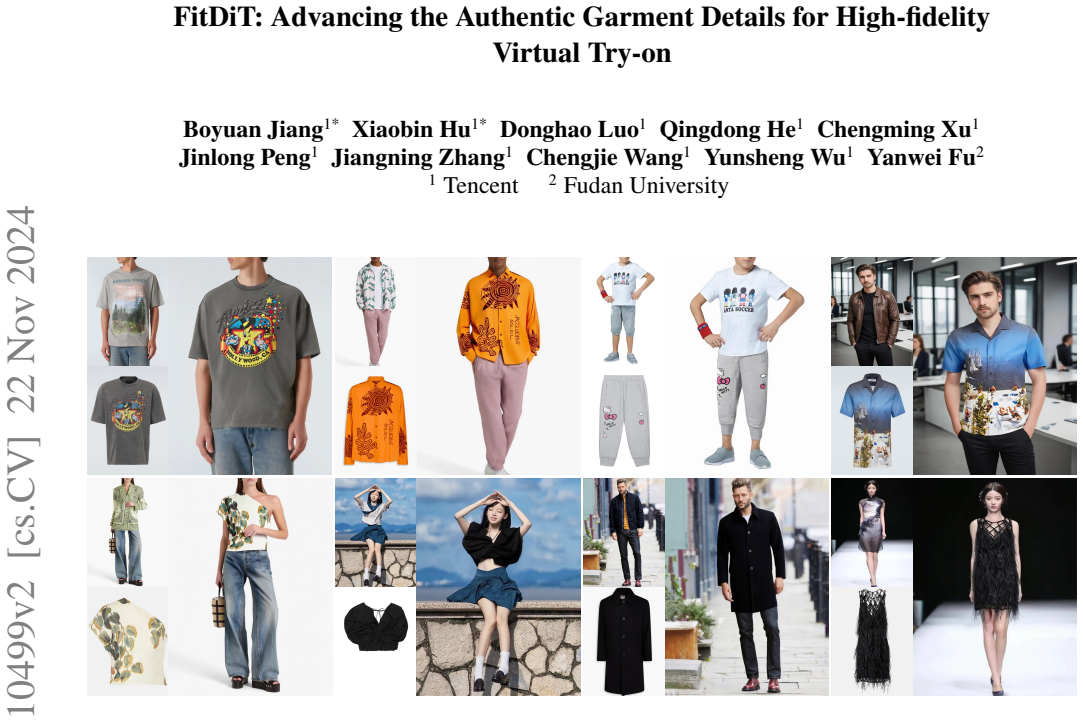


Figures from the paper (13 more)


Forward citations
Cited by 13 Pith papers
-
Layering Virtual Try-On
A two-stage diffusion pipeline and new benchmark let virtual try-on add, remove, or swap clothing layers while preserving inner layers, with SOTA results on the new LVTON benchmark and on VITON-HD/DressCode.
-
CtrlVTON: Controllable Virtual Try-On via Visual-Instance-Prompt Segmentation
CtrlVTON recasts virtual try-on as mask-conditioned editing and introduces VIP-SAM for instance-level garment segmentation, beating proprietary editors on layout fidelity while matching garment quality.
-
VTBench: Comprehensive Benchmark Suite Towards Real-World Virtual Try-on Models
VTBench is a multi-dimensional benchmark with novel unpaired metrics and human preference data for evaluating image-based virtual try-on models, though the human-alignment evidence is incomplete.
-
Structure-Detail Decoupled Autoregressive Generation for Fast and High-Fidelity Virtual Try-On
STAR-VTON decouples latent VAR structure synthesis from pixel-space matching-based detail recovery, yielding faster high-fidelity virtual try-on than diffusion baselines.
-
UniVVT: A Unified End-to-End Framework for High-Fidelity Video Virtual Try-on
UniVVT reports state-of-the-art video and image virtual try-on by conditioning a diffusion video generator on task tokens from a multimodal language model, with no masks, poses, or warping at inference.
-
Oxygen-TryOn: Fashion-Native Foundation Model for Any-item Virtual Try-On
Oxygen-TryOn performs any-item, multi-reference virtual try-on via understanding-driven generation, reporting state-of-the-art scores on public and internal benchmarks.
-
FastFit: Accelerating Multi-Reference Virtual Try-On via Cacheable Diffusion Models
FastFit uses a cacheable diffusion UNet to compute multi-reference garment features once per generation, enabling about 3.5x faster multi-item virtual try-on with comparable or better fidelity.
-
GarmentX: Autoregressive Parametric Representations for High-Fidelity 3D Garment Generation
An image-conditioned masked autoregressive model predicts GarmentCode-compatible garment parameters, then decodes them into valid, simulation-ready 3D garments without pattern self-intersections.
-
Any2AnyTryon: Leveraging Adaptive Position Embeddings for Versatile Virtual Clothing Tasks
A single DiT-based model with adaptive position embeddings performs virtual try-on, garment reconstruction, model-free try-on, and layered try-on from text and variable-size image inputs.
-
TAMF-VTON: Texture-Aware Mask-Free Virtual Try-On via High-Fidelity Image Synthesis
TAMF-VTON is a mask-free diffusion virtual try-on system using Mixture-of-Experts adapters and frequency-domain supervision, reporting SOTA results on VITON-HD and DressCode with multi-garment support.
-
JCo-MVTON: Jointly Controllable Multi-Modal Diffusion Transformer for Mask-Free Virtual Try-on
A mask-free diffusion transformer for virtual try-on, trained with a self-generated and manually curated triplet dataset, achieves state-of-the-art scores on DressCode and competitive results on VITON-HD.
-
ChronoTailor: Harnessing Attention Guidance for Fine-Grained Video Virtual Try-On
ChronoTailor combines region-aware attention guidance, temporal feature fusion, and multi-scale garment-pose alignment to produce state-of-the-art video virtual try-on results, and contributes the StyleDress dataset.
-
CONVERGE: A Multi-Agent Vision-Radio Architecture for xApps
CONVERGE fuses camera and radio sensing inside O-RAN xApps via a multi-agent architecture, reporting under-one-millisecond sensing delay for real-time blockage-driven RAN control.
Reference graph
Works this paper leans on
-
[1]
All are worth words: A vit backbone for diffusion models
Fan Bao, Shen Nie, Kaiwen Xue, Yue Cao, Chongxuan Li, Hang Su, and Jun Zhu. All are worth words: A vit backbone for diffusion models. In Proceedings of the IEEE/CVF con- ference on computer vision and pattern recognition , pages 22669–22679, 2023. 3
2023
-
[2]
Improving image generation with better captions
James Betker, Gabriel Goh, Li Jing, Tim Brooks, Jianfeng Wang, Linjie Li, Long Ouyang, Juntang Zhuang, Joyce Lee, Yufei Guo, et al. Improving image generation with better captions. Computer Science. https://cdn. openai. com/papers/dall-e-3. pdf, 2(3):8, 2023. 3
2023
-
[3]
Mikołaj Bi ´nkowski, Danica J Sutherland, Michael Arbel, and Arthur Gretton. Demystifying mmd gans. arXiv preprint arXiv:1801.01401, 2018. 7
arXiv 2018
-
[4]
Wear-any-way: Manip- ulable virtual try-on via sparse correspondence alignment
Mengting Chen, Xi Chen, Zhonghua Zhai, Chen Ju, Xuewen Hong, Jinsong Lan, and Shuai Xiao. Wear-any-way: Manip- ulable virtual try-on via sparse correspondence alignment. arXiv preprint arXiv:2403.12965, 2024. 3
arXiv 2024
-
[5]
Reproducible scal- ing laws for contrastive language-image learning
Mehdi Cherti, Romain Beaumont, Ross Wightman, Mitchell Wortsman, Gabriel Ilharco, Cade Gordon, Christoph Schuh- mann, Ludwig Schmidt, and Jenia Jitsev. Reproducible scal- ing laws for contrastive language-image learning. In Pro- ceedings of the IEEE/CVF Conference on Computer Vision and Pattern Recognition, pages 2818–2829, 2023. 4
work page 2023
-
[6]
Viton-hd: High-resolution virtual try-on via misalignment-aware normalization
Seunghwan Choi, Sunghyun Park, Minsoo Lee, and Jaegul Choo. Viton-hd: High-resolution virtual try-on via misalignment-aware normalization. In Proceedings of the IEEE/CVF conference on computer vision and pattern recognition, pages 14131–14140, 2021. 6
work page 2021
-
[7]
Improving diffusion models for vir- tual try-on
Yisol Choi, Sangkyung Kwak, Kyungmin Lee, Hyungwon Choi, and Jinwoo Shin. Improving diffusion models for vir- tual try-on. ECCV, 2024. 2, 3, 4, 7
work page 2024
-
[8]
Catvton: Concatenation is all you need for virtual try- on with diffusion models
Zheng Chong, Xiao Dong, Haoxiang Li, Shiyue Zhang, Wenqing Zhang, Xujie Zhang, Hanqing Zhao, and Xiaodan Liang. Catvton: Concatenation is all you need for virtual try- on with diffusion models. arXiv preprint arXiv:2407.15886,
Show all 58 references
-
[9]
Towards multi-pose guided virtual try-on network
Haoye Dong, Xiaodan Liang, Xiaohui Shen, Bochao Wang, Hanjiang Lai, Jia Zhu, Zhiting Hu, and Jian Yin. Towards multi-pose guided virtual try-on network. In Proceedings of the IEEE/CVF international conference on computer vision, pages 9026–9035, 2019. 2
2019
-
[10]
Scaling recti- fied flow transformers for high-resolution image synthesis
Patrick Esser, Sumith Kulal, Andreas Blattmann, Rahim Entezari, Jonas M ¨uller, Harry Saini, Yam Levi, Dominik Lorenz, Axel Sauer, Frederic Boesel, et al. Scaling recti- fied flow transformers for high-resolution image synthesis. In Forty-first International Conference on Mach...
2024
-
[11]
Disentangled cycle consistency for highly- realistic virtual try-on
Chongjian Ge, Yibing Song, Yuying Ge, Han Yang, Wei Liu, and Ping Luo. Disentangled cycle consistency for highly- realistic virtual try-on. In Proceedings of the IEEE/CVF con- ference on computer vision and pattern recognition , pages 16928–16937, 2021. 2
2021
-
[12]
Parser-free virtual try-on via distilling appearance flows
Yuying Ge, Yibing Song, Ruimao Zhang, Chongjian Ge, Wei Liu, and Ping Luo. Parser-free virtual try-on via distilling appearance flows. In Proceedings of the IEEE/CVF con- ference on computer vision and pattern recognition , pages 8485–8493, 2021. 2
2021
-
[13]
Generative adversarial networks
Ian Goodfellow, Jean Pouget-Abadie, Mehdi Mirza, Bing Xu, David Warde-Farley, Sherjil Ozair, Aaron Courville, and Yoshua Bengio. Generative adversarial networks. Commu- nications of the ACM, 63(11):139–144, 2020. 2
2020
-
[14]
Taming the power of diffusion models for high-quality virtual try-on with appearance flow
Junhong Gou, Siyu Sun, Jianfu Zhang, Jianlou Si, Chen Qian, and Liqing Zhang. Taming the power of diffusion models for high-quality virtual try-on with appearance flow. In Proceedings of the 31st ACM International Conference on Multimedia, pages 7599–7607, 2023. 3
2023
-
[15]
Viton: An image-based virtual try-on network
Xintong Han, Zuxuan Wu, Zhe Wu, Ruichi Yu, and Larry S Davis. Viton: An image-based virtual try-on network. In Proceedings of the IEEE conference on computer vision and pattern recognition, pages 7543–7552, 2018. 2
2018
-
[16]
Clothflow: A flow-based model for clothed person generation
Xintong Han, Xiaojun Hu, Weilin Huang, and Matthew R Scott. Clothflow: A flow-based model for clothed person generation. In Proceedings of the IEEE/CVF international conference on computer vision, pages 10471–10480, 2019
2019
-
[17]
Style-based global appearance flow for virtual try-on
Sen He, Yi-Zhe Song, and Tao Xiang. Style-based global appearance flow for virtual try-on. In Proceedings of the IEEE/CVF Conference on Computer Vision and Pattern Recognition, pages 3470–3479, 2022. 2
2022
-
[18]
Animate anyone: Consistent and controllable image- to-video synthesis for character animation
Li Hu. Animate anyone: Consistent and controllable image- to-video synthesis for character animation. InProceedings of the IEEE/CVF Conference on Computer Vision and Pattern Recognition, pages 8153–8163, 2024. 4
2024
-
[19]
Diffumatting: Synthe- sizing arbitrary objects with matting-level annotation
Xiaobin Hu, Xu Peng, Donghao Luo, Xiaozhong Ji, Jin- long Peng, Zhengkai Jiang, Jiangning Zhang, Taisong Jin, Chengjie Wang, and Rongrong Ji. Diffumatting: Synthe- sizing arbitrary objects with matting-level annotation. arXiv preprint arXiv:2403.06168, 2024. 3
2024 arXiv
-
[20]
Do not mask what you do not need to mask: a parser-free virtual try-on
Thibaut Issenhuth, J ´er´emie Mary, and Cl ´ement Calauzenes. Do not mask what you do not need to mask: a parser-free virtual try-on. In Computer Vision–ECCV 2020: 16th Euro- pean Conference, Glasgow, UK, August 23–28, 2020, Pro- ceedings, Part XX 16, pages 619–635. Springer, 2020. 2
2020
-
[21]
Stableviton: Learning semantic correspon- dence with latent diffusion model for virtual try-on
Jeongho Kim, Guojung Gu, Minho Park, Sunghyun Park, and Jaegul Choo. Stableviton: Learning semantic correspon- dence with latent diffusion model for virtual try-on. In Pro- ceedings of the IEEE/CVF Conference on Computer Vision and Pattern Recognition, pages 8176–8185, 2024. 2
2024
-
[22]
High-resolution virtual try-on with misalignment and occlusion-handled conditions
Sangyun Lee, Gyojung Gu, Sunghyun Park, Seunghwan Choi, and Jaegul Choo. High-resolution virtual try-on with misalignment and occlusion-handled conditions. In Eu- ropean Conference on Computer Vision , pages 204–219. Springer, 2022. 2
2022
-
[23]
Anyfit: Controllable virtual try- on for any combination of attire across any scenario
Yuhan Li, Hao Zhou, Wenxiang Shang, Ran Lin, Xuanhong Chen, and Bingbing Ni. Anyfit: Controllable virtual try- on for any combination of attire across any scenario. arXiv preprint arXiv:2405.18172, 2024. 3
2024 arXiv
-
[24]
Vton- handfit: Virtual try-on for arbitrary hand pose guided by hand priors embedding
Yujie Liang, Xiaobin Hu, Boyuan Jiang, Donghao Luo, Kai Wu, Wenhui Han, Taisong Jin, and Chengjie Wang. Vton- handfit: Virtual try-on for arbitrary hand pose guided by hand priors embedding. arXiv preprint arXiv:2408.12340, 2024. 3
2024 arXiv
-
[25]
Flow straight and fast: Learning to generate and transfer data with rectified flow
Xingchao Liu, Chengyue Gong, and Qiang Liu. Flow straight and fast: Learning to generate and transfer data with rectified flow. arXiv preprint arXiv:2209.03003, 2022. 5
2022 arXiv
-
[26]
Fixing weight decay regularization in adam
Ilya Loshchilov, Frank Hutter, et al. Fixing weight decay regularization in adam. arXiv preprint arXiv:1711.05101, 5,
-
[27]
Controllable person image synthesis with attribute-decomposed gan
Yifang Men, Yiming Mao, Yuning Jiang, Wei-Ying Ma, and Zhouhui Lian. Controllable person image synthesis with attribute-decomposed gan. In Proceedings of the IEEE/CVF conference on computer vision and pattern recognition , pages 5084–5093, 2020. 2
2020
-
[28]
Cp-vton+: Clothing shape and tex- ture preserving image-based virtual try-on
Matiur Rahman Minar, Thai Thanh Tuan, Heejune Ahn, Paul Rosin, and Yu-Kun Lai. Cp-vton+: Clothing shape and tex- ture preserving image-based virtual try-on. In CVPR work- shops, pages 10–14, 2020. 2
2020
-
[29]
Dress code: High- resolution multi-category virtual try-on
Davide Morelli, Matteo Fincato, Marcella Cornia, Federico Landi, Fabio Cesari, and Rita Cucchiara. Dress code: High- resolution multi-category virtual try-on. In Proceedings of the IEEE/CVF conference on computer vision and pattern recognition, pages 2231–2235, 2022. 6
2022
-
[30]
Ladi-vton: Latent diffusion textual-inversion enhanced virtual try-on
Davide Morelli, Alberto Baldrati, Giuseppe Cartella, Mar- cella Cornia, Marco Bertini, and Rita Cucchiara. Ladi-vton: Latent diffusion textual-inversion enhanced virtual try-on. In Proceedings of the 31st ACM International Conference on Multimedia, pages 8580–8589, 2023. 3
2023
-
[31]
On aliased resizing and surprising subtleties in gan evaluation
Gaurav Parmar, Richard Zhang, and Jun-Yan Zhu. On aliased resizing and surprising subtleties in gan evaluation. In Proceedings of the IEEE/CVF Conference on Computer Vision and Pattern Recognition, pages 11410–11420, 2022. 7
2022
-
[32]
Scalable diffusion models with transformers
William Peebles and Saining Xie. Scalable diffusion models with transformers. In Proceedings of the IEEE/CVF Inter- national Conference on Computer Vision, pages 4195–4205,
-
[33]
Sdxl: Improving latent diffusion mod- els for high-resolution image synthesis
Dustin Podell, Zion English, Kyle Lacey, Andreas Blattmann, Tim Dockhorn, Jonas M ¨uller, Joe Penna, and Robin Rombach. Sdxl: Improving latent diffusion mod- els for high-resolution image synthesis. arXiv preprint arXiv:2307.01952, 2023. 3, 5
2023 arXiv
-
[34]
Learning transferable visual models from natural language supervi- sion
Alec Radford, Jong Wook Kim, Chris Hallacy, Aditya Ramesh, Gabriel Goh, Sandhini Agarwal, Girish Sastry, Amanda Askell, Pamela Mishkin, Jack Clark, et al. Learning transferable visual models from natural language supervi- sion. In International conference on machine learning, ...
2021
-
[35]
Exploring the limits of transfer learning with a unified text-to-text transformer
Colin Raffel, Noam Shazeer, Adam Roberts, Katherine Lee, Sharan Narang, Michael Matena, Yanqi Zhou, Wei Li, and Peter J Liu. Exploring the limits of transfer learning with a unified text-to-text transformer. Journal of machine learning research, 21(140):1–67, 2020. 4
2020
-
[36]
High-resolution image synthesis with latent diffusion models
Robin Rombach, Andreas Blattmann, Dominik Lorenz, Patrick Esser, and Bj ¨orn Ommer. High-resolution image synthesis with latent diffusion models. In Proceedings of the IEEE/CVF conference on computer vision and pattern recognition, pages 10684–10695, 2022. 2, 3, 5
2022
-
[37]
U- net: Convolutional networks for biomedical image segmen- tation
Olaf Ronneberger, Philipp Fischer, and Thomas Brox. U- net: Convolutional networks for biomedical image segmen- tation. In Medical image computing and computer-assisted intervention–MICCAI 2015: 18th international conference, Munich, Germany, October 5-9, 2015, proceedings, pa...
2015
-
[38]
Dreambooth: Fine tuning text-to-image diffusion models for subject-driven generation
Nataniel Ruiz, Yuanzhen Li, Varun Jampani, Yael Pritch, Michael Rubinstein, and Kfir Aberman. Dreambooth: Fine tuning text-to-image diffusion models for subject-driven generation. In Proceedings of the IEEE/CVF conference on computer vision and pattern recognition , pages 2250...
2023
-
[39]
Photorealistic text-to-image diffusion models with deep language understanding
Chitwan Saharia, William Chan, Saurabh Saxena, Lala Li, Jay Whang, Emily L Denton, Kamyar Ghasemipour, Raphael Gontijo Lopes, Burcu Karagol Ayan, Tim Salimans, et al. Photorealistic text-to-image diffusion models with deep language understanding. Advances in neural information...
2022
-
[40]
Kolors: Effective training of diffusion model for photorealistic text-to-image synthesis
Kolors Team. Kolors: Effective training of diffusion model for photorealistic text-to-image synthesis. arXiv preprint,
-
[41]
Toward characteristic- preserving image-based virtual try-on network
Bochao Wang, Huabin Zheng, Xiaodan Liang, Yimin Chen, Liang Lin, and Meng Yang. Toward characteristic- preserving image-based virtual try-on network. In Proceed- ings of the European conference on computer vision (ECCV), pages 589–604, 2018. 2
2018
-
[42]
Image quality assessment: from error visibility to structural similarity
Zhou Wang, Alan C Bovik, Hamid R Sheikh, and Eero P Si- moncelli. Image quality assessment: from error visibility to structural similarity. IEEE transactions on image processing, 13(4):600–612, 2004. 7
2004
-
[43]
Gp- vton: Towards general purpose virtual try-on via collabora- tive local-flow global-parsing learning
Zhenyu Xie, Zaiyu Huang, Xin Dong, Fuwei Zhao, Haoye Dong, Xijin Zhang, Feida Zhu, and Xiaodan Liang. Gp- vton: Towards general purpose virtual try-on via collabora- tive local-flow global-parsing learning. In Proceedings of the IEEE/CVF Conference on Computer Vision and Patte...
2023
-
[44]
Oot- diffusion: Outfitting fusion based latent diffusion for control- lable virtual try-on
Yuhao Xu, Tao Gu, Weifeng Chen, and Chengcai Chen. Oot- diffusion: Outfitting fusion based latent diffusion for control- lable virtual try-on. arXiv preprint arXiv:2403.01779, 2024. 2, 4, 7
2024 arXiv
-
[45]
Towards photo-realistic virtual try-on by adaptively generating-preserving image content
Han Yang, Ruimao Zhang, Xiaobao Guo, Wei Liu, Wang- meng Zuo, and Ping Luo. Towards photo-realistic virtual try-on by adaptively generating-preserving image content. In Proceedings of the IEEE/CVF conference on computer vi- sion and pattern recognition, pages 7850–7859, 2020. 2
2020
-
[46]
Occlumix: Towards de-occlusion vir- tual try-on by semantically-guided mixup
Zhijing Yang, Junyang Chen, Yukai Shi, Hao Li, Tianshui Chen, and Liang Lin. Occlumix: Towards de-occlusion vir- tual try-on by semantically-guided mixup. IEEE Transac- tions on Multimedia, 25:1477–1488, 2023. 2
2023
-
[47]
Effec- tive whole-body pose estimation with two-stages distillation
Zhendong Yang, Ailing Zeng, Chun Yuan, and Yu Li. Effec- tive whole-body pose estimation with two-stages distillation. In Proceedings of the IEEE/CVF International Conference on Computer Vision, pages 4210–4220, 2023. 4
2023
-
[48]
The unreasonable effectiveness of deep features as a perceptual metric
Richard Zhang, Phillip Isola, Alexei A Efros, Eli Shecht- man, and Oliver Wang. The unreasonable effectiveness of deep features as a perceptual metric. In Proceedings of the IEEE conference on computer vision and pattern recogni- tion, pages 586–595, 2018. 7
2018
-
[49]
Tryondiffusion: A tale of two unets
Luyang Zhu, Dawei Yang, Tyler Zhu, Fitsum Reda, William Chan, Chitwan Saharia, Mohammad Norouzi, and Ira Kemelmacher-Shlizerman. Tryondiffusion: A tale of two unets. In Proceedings of the IEEE/CVF Conference on Com- puter Vision and Pattern Recognition , pages 4606–4615,
-
[51]
Additional qualitative results of FitDiT on rich texture maintenance are shown in Fig
More Qualitative Results on Texture-aware Preservation As one of main challenges, texture-aware preservation re- quires the model to well-capture intricate texture ( e.g., pat- tern, font). Additional qualitative results of FitDiT on rich texture maintenance are shown in Fig. 10
-
[52]
More Qualitative Results on Size-aware Fitting To verify the effectiveness of the dilated-relaxed mask strat- egy on the size mismatching garments virtual try-on, we provide more qualitative results in Fig. 11
-
[53]
More Qualitative Results in the Wild To examine the virtual try-on generalization ability of Fit- DiT in the wild, more qualitative results compared with other SOTA baselines are provided in Fig. 12
-
[54]
More Qualitative Results on Complex Pose The presence of complex poses beyond the training set poses a significant challenge in achieving satisfactory vir- tual try-on results. Fig. 13 demonstrates more qualitative comparisons with baselines on complex pose, which indi- cates ...
-
[55]
More qualitative results on the VITON-HD dataset are shown in Fig
More Visual Results on Public Dataset VITON-HD dataset. More qualitative results on the VITON-HD dataset are shown in Fig. 14. DressCode dataset. Additional qualitative results on the DressCode dataset are shown in Fig. 15
-
[56]
16, we visualize more cases of CVDD to demon- strate the complexity including the intricate textures, di- verse backgrounds, and complicated poses
Visual Cases of Complex Virtual Dressing Dataset (CVDD) In Fig. 16, we visualize more cases of CVDD to demon- strate the complexity including the intricate textures, di- verse backgrounds, and complicated poses. We anticipate that the inclusion of self-collected challenging te...
-
[57]
17 illustrates FitDiT’s capability to facilitate model- to-model virtual try-on applications, catering to the diverse demands encountered in real-world scenarios
Applications on Model-to-model Try-on Fig. 17 illustrates FitDiT’s capability to facilitate model- to-model virtual try-on applications, catering to the diverse demands encountered in real-world scenarios. In the model- to-model scenario, the target garment is sourced from an-...
-
[58]
Limitation and Future Work Similar to other virtual try-on approaches, FitDiT faces challenges in accurately preserving the intricate details of human hands and fingers with complex pose, due to the lack of hand-relevant priors. In our future work, we intend to conduct a compr...
-
[2023]
2, 3 FitDiT: Advancing the Authentic Garment Details for High-fidelity Virtual Try-on Supplementary Material
Reviewed August 12, 2026 · model on record in the stance chip above.
Discussion (0). Continue with ORCID to comment.