Comments on the linear modified Poisson-Boltzmann equation in electrolyte solution theory
Pith reviewed 2026-05-25 14:39 UTC · model grok-4.3
The pith
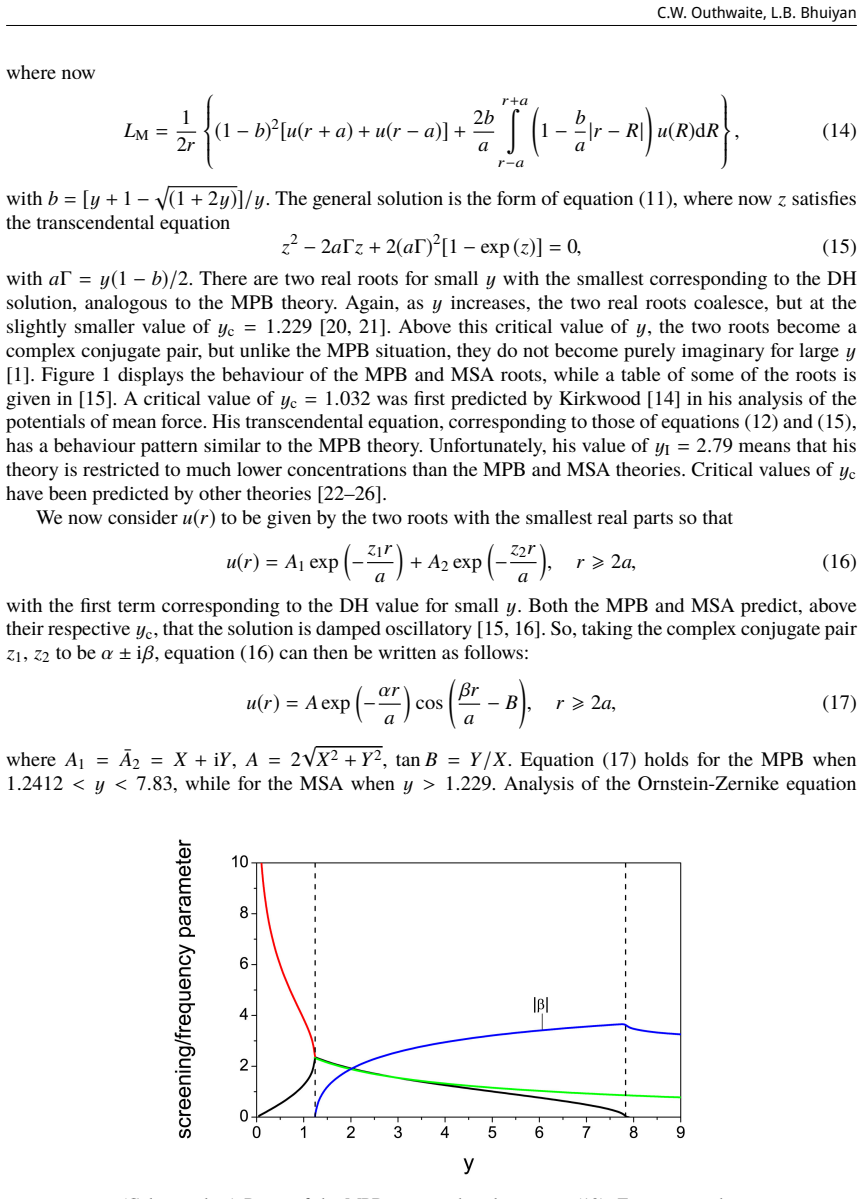
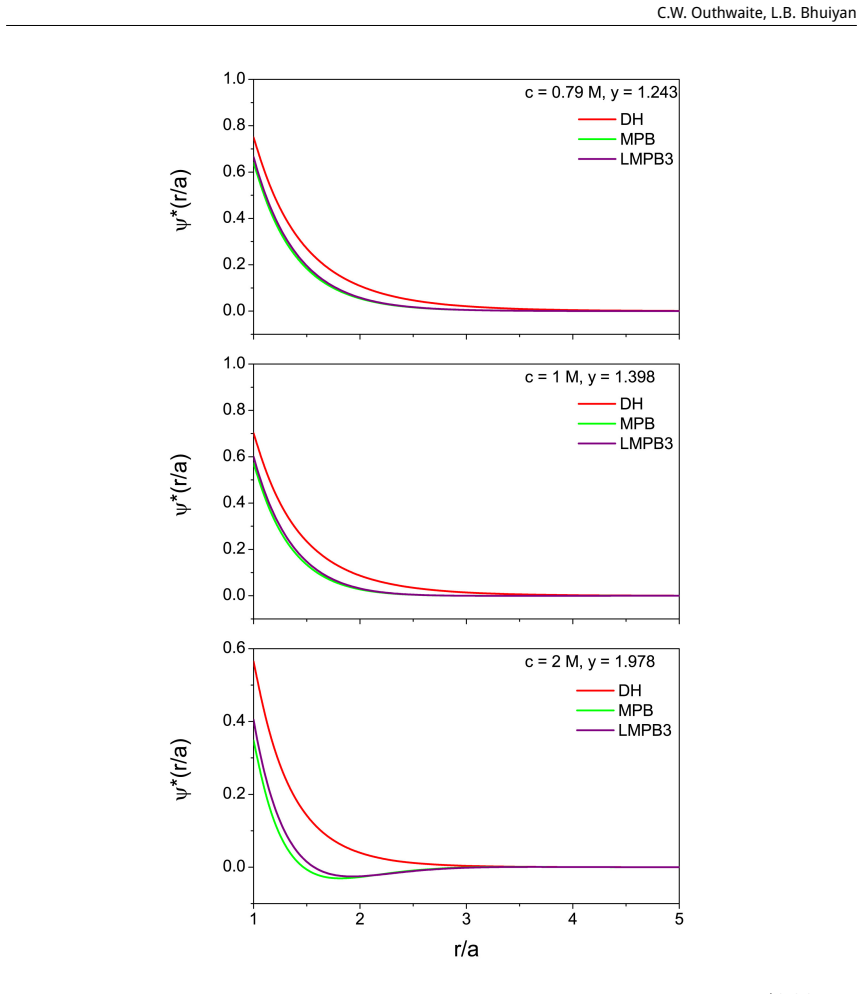
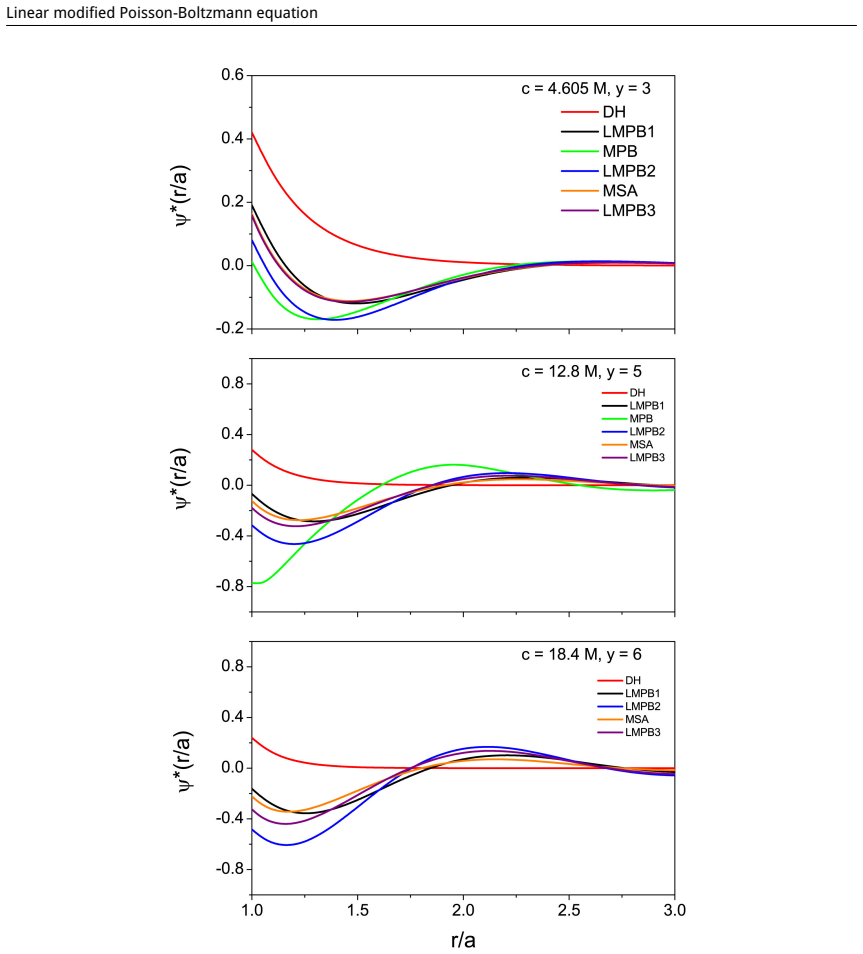
Linear electrolyte theories predict a switch from exponential to oscillatory screening above a critical concentration.
A machine-rendered reading of the paper's core claim, the machinery that carries it, and where it could break.
Core claim
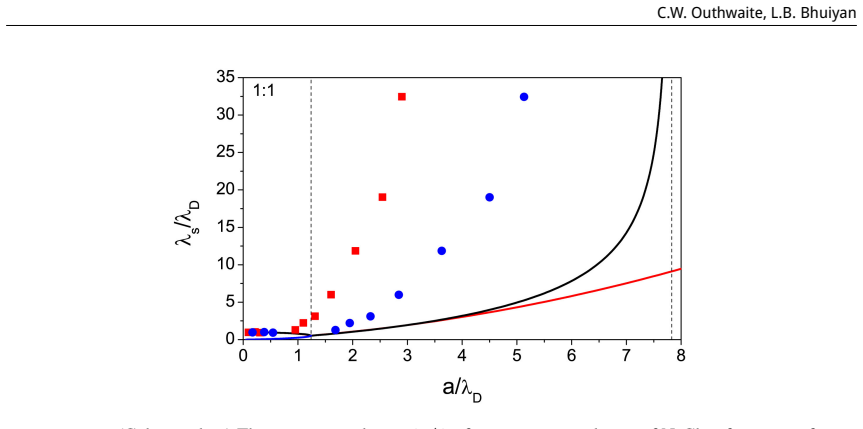
The linear modified Poisson-Boltzmann equation supplies closed-form expressions that locate a concentration-driven transition in the mean electrostatic potential from damped-exponential to damped-oscillatory form; once the oscillatory regime is entered the screening length decreases with further increases in concentration.
What carries the argument
The linear approximation to the modified Poisson-Boltzmann equation, which yields analytic solutions for the mean electrostatic potential and its screening length.
If this is right
- The mean electrostatic potential acquires damped oscillations beyond a critical electrolyte concentration.
- Screening length shortens with rising concentration inside the oscillatory regime.
- The linear analytic results can be compared directly with mean spherical approximation predictions.
- Some experimental screening lengths for aqueous NaCl are consistent with the predicted high-concentration trend.
Where Pith is reading between the lines
- The same linear framework might be tested against other symmetric electrolytes to see whether the critical concentration scales with ion size or valency.
- If the oscillatory transition survives in more refined nonlinear treatments, it could affect interpretations of force measurements between charged surfaces in concentrated salt solutions.
Load-bearing premise
The linear approximation to the modified Poisson-Boltzmann equation remains valid at the high concentrations where the oscillatory regime appears.
What would settle it
Direct measurement showing either that the mean electrostatic potential stays purely exponential at all concentrations or that the screening length increases rather than decreases once oscillations set in.
Figures
read the original abstract
Three analytic results are proposed for a linear form of the modified Poisson-Boltzmann equation in the theory of bulk electrolytes. Comparison is also made with the mean spherical approximation results. The linear theories predict a transition of the mean electrostatic potential from a Debye-H\"{u}ckel type damped exponential to a damped oscillatory behaviour as the electrolyte concentration increases beyond a critical value. The screening length decreases with increasing concentration when the mean electrostatic potential is damped oscillatory. A comparison is made with one set of recent experimental screening results for aqueous NaCl electrolytes.
Editorial analysis
A structured set of objections, weighed in public.
Referee Report
Summary. The manuscript proposes three analytic results for solutions of a linear form of the modified Poisson-Boltzmann equation for bulk electrolytes. It compares these results to mean-spherical-approximation (MSA) predictions and reports that the mean electrostatic potential undergoes a transition from Debye-Hückel-type damped exponential decay to damped oscillatory behavior above a critical concentration; the screening length decreases with increasing concentration in the oscillatory regime. A limited comparison to one experimental data set for aqueous NaCl is also presented.
Significance. If the three analytic results are rigorously derived, the work demonstrates that the linearized modified PB equation itself exhibits a mathematically well-defined transition to oscillatory screening, consistent with MSA benchmarks. This clarifies the concentration dependence of screening within the linear theory and supplies a concrete, falsifiable prediction (decreasing screening length in the oscillatory regime) that can be tested against independent calculations or data.
major comments (2)
- [Abstract and main derivations] The abstract asserts three analytic results that establish the transition and the decreasing screening length, yet the manuscript provides neither the explicit functional forms nor the intermediate steps needed to verify that the critical concentration and the sign change in the decay constant follow directly from the linearized equation (rather than from auxiliary approximations).
- [Experimental comparison paragraph] The experimental comparison is restricted to a single NaCl data set; the manuscript does not state the concentration window examined, the criterion used to identify the critical concentration, or any quantitative measure (e.g., root-mean-square deviation) of agreement between the predicted screening lengths and the measured values.
minor comments (1)
- Notation for the modified Poisson-Boltzmann equation and the linearization step should be written explicitly once at the beginning of the derivations to avoid ambiguity when the three analytic results are introduced.
Simulated Author's Rebuttal
We thank the referee for the careful reading and constructive comments. We respond to each major comment below.
read point-by-point responses
-
Referee: [Abstract and main derivations] The abstract asserts three analytic results that establish the transition and the decreasing screening length, yet the manuscript provides neither the explicit functional forms nor the intermediate steps needed to verify that the critical concentration and the sign change in the decay constant follow directly from the linearized equation (rather than from auxiliary approximations).
Authors: We agree that the explicit functional forms and derivation steps were not presented with sufficient detail. In the revised manuscript we will insert the closed-form expressions for the three analytic solutions together with the algebraic steps that locate the critical concentration and demonstrate the change in sign of the decay constant, confirming that both features originate directly from the linearized modified Poisson-Boltzmann equation. revision: yes
-
Referee: [Experimental comparison paragraph] The experimental comparison is restricted to a single NaCl data set; the manuscript does not state the concentration window examined, the criterion used to identify the critical concentration, or any quantitative measure (e.g., root-mean-square deviation) of agreement between the predicted screening lengths and the measured values.
Authors: We accept that the experimental section lacks the requested specifics. The revision will state the concentration interval examined, the precise criterion used to identify the critical concentration from the analytic expressions, and a quantitative metric (root-mean-square deviation) comparing predicted and measured screening lengths. revision: yes
Circularity Check
No significant circularity; mathematical properties of linearized equation derived independently
full rationale
The paper proposes three analytic results for the linear modified Poisson-Boltzmann equation and shows that its solutions exhibit a transition from Debye-Hückel damped exponential to damped oscillatory screening above a critical concentration, with screening length decreasing in the oscillatory regime. These follow directly from solving the linearized differential equation itself (supported by explicit analytic forms and comparison to external mean-spherical-approximation results plus one NaCl experimental dataset). No load-bearing step reduces by construction to a fitted parameter, self-definition, or self-citation chain; the central claim is a statement about the equation's mathematical solutions rather than an assertion of physical validity in the high-concentration regime. The derivation is therefore self-contained against external benchmarks.
Axiom & Free-Parameter Ledger
axioms (1)
- domain assumption The modified Poisson-Boltzmann equation admits a linear approximation whose solutions remain physically meaningful beyond the Debye-Hückel regime.
Reference graph
Works this paper leans on
-
[1]
InTRoduCTIon Little attention has been paid to the linear modified Poisson-Boltzmann (MPB) equation in the electrolyte solution theory, mainly due to the ready availability of the mean spherical approximation (MSA) analytical results [1]. By contrast, the non-linear MPB approach along with the hypernetted chain (HNC) [2] theory have proved two of the more ...
work page internal anchor Pith review Pith/arXiv arXiv 1906
-
[2]
-PBTheoRy Improvements to the classical PB theory rest upon a more accurate pair distribution functiongi j for two ionsi and j. In the mean electrostatic potential approach, this implies an improvement in the mean electrostatic potentialψ(1; 2) at the field pointr2 for an ioni at r1 through the solution of the Poisson equation ∇2ψi(1; 2) =− 1 ε0εr Õ s esns...
-
[3]
2eSuLTSAnddISCuSSIon The physical parameters used in all the calculations were as follows: the temperatureT = 298.15 K, a = 4.25× 10⁻¹⁰ m,relativepermittivity εr = 78.381withtheconcentrationvaryingfrom c = 0.79Mto 18.4 M, so the range ofy is 1.243 to 6. Plots of the dimensionless mean electrostatic potentialψ∗(r/a) [= β|e|ψ(r/a)]for the 6 theories MPB, LM...
-
[4]
3uMMARy The potential approach of the MPB theory provides a natural extension to the DH theory. At lower electrolyteconcentrations,thepredictionsmimictheDHtheorybutqualitativedifferencesoccurathigher concentrations. In the regionyc < y < y I, the MPB predicts a damped oscillatory potential which is in accordance with simulation and other theoretical work. ...
-
[5]
Blum L., In: Theoretical Chemistry, Advances and Perspectives, Vol. 5, Eyring H., Henderson H. (Eds.), Academic Press, New York, 1980, 1
work page 1980
-
[6]
Friedman H.L., A Course in Statistical Mechanics, Prentice Hall, New Jersey, 1985
work page 1985
-
[7]
Vlachy V., Annu. Rev. Phys. Chem., 1999,50, 145, doi:10.1146/annurev.physchem.50.1.145
-
[8]
BhuiyanL.B.,VlachyV.,OuthwaiteC.W.,Int.Rev.Phys.Chem.,2002, 21,1,doi:10.1080/01442350110078842
-
[9]
Matter Phys., 2018,21, 23802, doi:10.5488/CMP.21.23802
Quiñones A.O., Bhuiyan L.B., Outhwaite C.W., Condens. Matter Phys., 2018,21, 23802, doi:10.5488/CMP.21.23802
-
[10]
Henderson D., Blum L., J. Electroanal. Chem. Interfacial Electrochem., 1978,93, 151, doi:10.1016/S0022-0728(78)80228-9
-
[11]
Henderson D., Blum L., J. Chem. Phys., 1979,70, 3149, doi:10.1063/1.437813
- [12]
-
[13]
Gouy G., J. Phys. Theor. Appl., 1910,9, 457, doi:10.1051/jphystap:019100090045700
-
[14]
Mag., 1913,25, 475, doi:10.1080/14786440408634187
Chapman D.L., Philos. Mag., 1913,25, 475, doi:10.1080/14786440408634187
-
[15]
Rotenberg B., Bernard O., Hansen J.-P., J. Phys.: Condens. Matter, 2018,30, 054005, doi:10.1088/1361-648X/aaa3ac
-
[16]
Smith A.M., Lee A.A., Perkin S., J. Phys. Chem. Lett., 2016,7, 2157, doi:10.1021/acs.jpclett.6b00867
-
[17]
Lee A.A., Perez-Martinez C.S., Smith A.M., Perkin S., Phys. Rev. Lett., 2017,119, 026002, doi:10.1103/PhysRevLett.119.026002
-
[18]
Rev., 1936,19, 275, doi:10.1021/cr60064a007
Kirkwood J.G., Chem. Rev., 1936,19, 275, doi:10.1021/cr60064a007
-
[19]
Outhwaite C.W., In: Statistical Mechanics, Vol. 2, Singer K. (Ed.), The Chemical Society, London, 1975, 188–255, doi:10.1039/9781847556936-00188
-
[20]
Matter Phys., 2004,7, 719, doi:10.5488/CMP.7.4.719
Outhwaite C.W., Condens. Matter Phys., 2004,7, 719, doi:10.5488/CMP.7.4.719
-
[21]
Outhwaite C.W., Molero M., Bhuiyan L.B., J. Chem. Soc., Faraday Trans., 1991,87, 3227, doi:10.1039/FT9918703227
-
[22]
Outhwaite C.W., J. Chem. Phys., 1969,50, 2277, doi:10.1063/1.1671378
-
[23]
Kirkwood J.G., J. Chem. Phys., 1934,2, 767, doi:10.1063/1.1749393
-
[24]
Outhwaite C.W., Hutson V.C.L., Mol. Phys., 1975,29, 1521, doi:10.1080/00268977500101331
-
[25]
(Eds.), North-Holland Publishing Company, Amsterdam, New York, Oxford, 1982, 175
Hafskjold B., Stell G., In: The Liquid State of Matter: Fluids, Simple and Complex, Montroll W.L., Lebowitz J.L. (Eds.), North-Holland Publishing Company, Amsterdam, New York, Oxford, 1982, 175
work page 1982
- [26]
- [27]
-
[28]
Rasaiah J., Chem. Phys. Lett., 1970,7, 260, doi:10.1016/0009-2614(70)80303-7
-
[29]
Kjellander R., J. Phys. Chem., 1995,99, 10392, doi:10.1021/j100025a048. 23801-9 C.7./UTHWAITE,,.B.BHUIyAN
-
[30]
Lett., 1997,39, 611, doi:10.1209/epl/i1997-00402-x
Lee B.P., Fisher M., Europhys. Lett., 1997,39, 611, doi:10.1209/epl/i1997-00402-x
-
[31]
Phys., 1994,83, 619, doi:10.1080/00268979400101491
Leote de Carvalho R.J.F., Evans R., Mol. Phys., 1994,83, 619, doi:10.1080/00268979400101491
-
[32]
Stillinger F.H., Lovett R., J. Chem. Phys., 1968,48, 3858, doi:10.1063/1.1669709
-
[33]
Outhwaite C.W., Chem. Phys. Lett., 1974,24, 73, doi:10.1016/0009-2614(74)80216-2
-
[34]
Henderson D., Smith W.R., J. Stat. Phys., 1978,19, 191, doi:10.1007/BF01012511
-
[35]
Phys., 1971,20, 705, doi:10.1080/00268977100100671
Outhwaite C.W., Mol. Phys., 1971,20, 705, doi:10.1080/00268977100100671. A. AnALyTICexPReSSIonSFoRTheThReeL-PBTheoRIeS A.1.0 ⩽ y ⩽ 1.2412 Roots of equation (12),z1 = α1, z2 = α2. ψi =[A1 exp(−α1r/a) + A2 exp(−α2r/a)]/r, r ⩾ a. (a) LMPB1 A1 = ei 4πε0εr exp(α1)[α2 1G2− ω(1 + α2)]/D, A2 = ei 4πε0εr exp(α2)[−α2 2G1 + ω(1 + α1)]/D, D = α2 1(1 + α1)G2− α2 2(1 +...
discussion (0)
Sign in with ORCID, Apple, or X to comment. Anyone can read and Pith papers without signing in.