NSF-DOE Vera C. Rubin Observatory Observations of Interstellar Comet 3I/ATLAS (C/2025 N1)
Pith reviewed 2026-05-19 04:59 UTC · model grok-4.3
The pith
Rubin Observatory photometry of interstellar comet 3I/ATLAS yields a near-nucleus dust-to-nucleus scattering cross-section ratio of at least 13.
A machine-rendered reading of the paper's core claim, the machinery that carries it, and where it could break.
Core claim
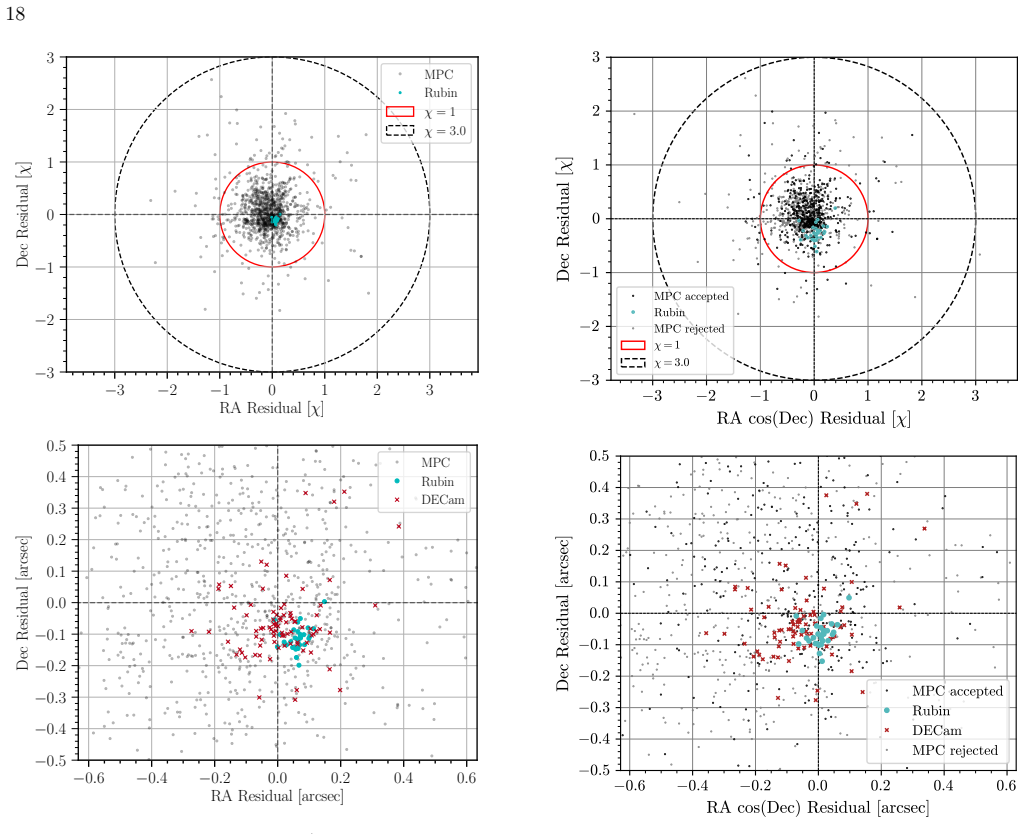
We recover detections of interstellar comet 3I/ATLAS in Rubin ugrizy images spanning June 21 to July 20 2025, measure on-sky positions to roughly 70 mas, and obtain grizy magnitudes to 0.01 mag precision with no variability above that level. Using the Rubin photometry together with an upper-limit nucleus size from separate Hubble observations we derive a near-nucleus dust-to-nucleus scattering cross-section ratio eta of at least 13 on July 2. The measured colors are g minus r equals 0.657 plus or minus 0.013 mag, r minus i equals 0.235 plus or minus 0.018 mag, i minus z equals 0.147 plus or minus 0.042 mag, and z minus y equals 0.047 plus or minus 0.052 mag.
What carries the argument
The near-nucleus dust-to-nucleus scattering cross-section ratio eta, obtained by comparing Rubin photometry to an external upper limit on nucleus size.
If this is right
- Dust scattering dominates the observed brightness of 3I/ATLAS near the time of the July 2 observation.
- The object shows no short-term photometric variability above the 0.01 mag level in the Rubin data.
- The measured colors provide a baseline spectral characterization for this interstellar comet.
- These early large-aperture observations preview the data products the Legacy Survey of Space and Time will generate once routine operations begin.
Where Pith is reading between the lines
- Similar dust ratios on future interstellar objects could be compared directly to Solar System comets to test for compositional differences.
- Repeated color measurements over weeks or months would reveal whether the dust properties change as the comet approaches the Sun.
- If the same eta threshold appears in additional Rubin detections, it would suggest that most interstellar comets carry substantial near-nucleus dust envelopes.
- Extending the analysis to include later Rubin epochs could test whether eta remains constant or evolves with heliocentric distance.
Load-bearing premise
The Hubble Space Telescope upper limit on nucleus size is taken at face value without independent re-derivation or validation in this work.
What would settle it
A future direct measurement of the nucleus radius larger than the Hubble upper limit used here, combined with the same dust photometry, would produce an eta value below 13.
Figures




read the original abstract
We report on the observation and measurement of astrometry, photometry, morphology, and activityof the interstellar object 3I/ATLAS, also designated C/2025 N1 (ATLAS) with the NSF-DOE Vera C. Rubin Observatory. Comet 3I/ATLAS, the third known interstellar object, was discovered on UT 2025 July 1. Rubin Observatory had coincidentally collected images of the object's region of the sky during routine commissioning. Facilitated by Rubin's high resolution and large aperture, we successfully recovered object detections from Rubin observations spanning UT 2025 June 21 (10 days before discovery, when 3I/ATLAS was 4.5 au from the Sun) through the date of discovery, and we acquired additional images through UT 2025 July 20 as part of commissioning. We measure on-sky locations of 3I/ATLAS in Rubin ugrizy bands, with a typical precision of about 70 mas, and briefly describe the reason this is coarser than our measured static source astrometric precision of about 3 mas in Rubin images. We measure grizy magnitudes of 3I/ATLAS photometry at about 0.01 mag precision, detecting no short-term photometric variability above 0.01 mag. We derive an estimated near-nucleus dust-to-nucleus scattering cross-section ratio of eta >= 13 on UT 2025 July 2 based on Rubin photometry and an upper limit nucleus size computed from Hubble Space Telescope observations. We find Rubin colors of g - r = (0.657 +/- 0.013) mag, r - i = (0.235 +/- 0.018) mag, i - z = (0.147 +/- 0.042) mag, z - y = (0.047 +/- 0.052) mag. These data represent the earliest observations of this object by a large (>=8-meter class) telescope and illustrate the type of measurements (and discoveries) Rubin's Legacy Survey of Space and Time (LSST) will begin to provide after it begins in early 2026.
Editorial analysis
A structured set of objections, weighed in public.
Referee Report
Summary. The manuscript reports early observations of interstellar comet 3I/ATLAS (C/2025 N1) from Rubin Observatory commissioning data spanning June 21 to July 20 2025. It presents astrometric positions measured at ~70 mas precision in ugrizy bands, photometry at ~0.01 mag precision with no detected short-term variability above that level, derived colors g-r = 0.657±0.013, r-i = 0.235±0.018, i-z = 0.147±0.042, z-y = 0.047±0.052, and a lower limit eta >=13 on the near-nucleus dust-to-nucleus scattering cross-section ratio obtained on UT 2025 July 2 by combining Rubin total cross-section measurements with an external HST nucleus-size upper limit. These are presented as the earliest large-telescope data on the object and as a demonstration of LSST capabilities.
Significance. If the measurements hold, the work supplies timely, high-precision photometry and colors for the third known interstellar object, enabling comparisons with prior interstellar visitors and Solar System comets. The direct reduction of Rubin images against external catalogs avoids circularity in the reported values. The eta lower limit provides a quantitative indicator of dust activity, and the overall dataset illustrates Rubin's performance for faint, moving targets ahead of the LSST survey.
major comments (1)
- [Abstract] Abstract and results section on eta: the reported lower bound eta >=13 is obtained by subtracting an HST-derived upper-limit nucleus scattering cross-section from the total cross-section measured in the Rubin photometry on UT 2025 July 2. The manuscript cites the HST observations but does not restate or validate the albedo, phase-function, or SNR assumptions used to convert the non-detection into a size limit. Because eta is defined as the dust-to-nucleus ratio, any revision to the adopted nucleus radius directly changes the numerical floor; this dependency should be quantified or cross-checked within the present work for robustness.
minor comments (1)
- The brief explanation for the difference between the 70 mas moving-object astrometric precision and the 3 mas static-source precision could be expanded with a short quantitative discussion of the dominant error sources (e.g., trailing, catalog uncertainties).
Simulated Author's Rebuttal
We thank the referee for their positive evaluation of the manuscript and for the recommendation of minor revision. We address the single major comment point by point below.
read point-by-point responses
-
Referee: [Abstract] Abstract and results section on eta: the reported lower bound eta >=13 is obtained by subtracting an HST-derived upper-limit nucleus scattering cross-section from the total cross-section measured in the Rubin photometry on UT 2025 July 2. The manuscript cites the HST observations but does not restate or validate the albedo, phase-function, or SNR assumptions used to convert the non-detection into a size limit. Because eta is defined as the dust-to-nucleus ratio, any revision to the adopted nucleus radius directly changes the numerical floor; this dependency should be quantified or cross-checked within the present work for robustness.
Authors: We agree that the manuscript would benefit from greater transparency on the HST assumptions. In the revised version we will expand the relevant paragraph in the results section to explicitly restate the albedo, phase-function, and SNR thresholds adopted in the cited HST non-detection analysis. We will also add a short sensitivity discussion (or supplementary table) showing how the eta >=13 floor shifts under plausible variations in the assumed nucleus radius, thereby quantifying the dependency directly within this work. revision: yes
Circularity Check
No significant circularity: eta >=13 and colors are direct reductions from independent Rubin photometry plus external HST nucleus limit
full rationale
The paper's derivation chain consists of direct astrometric and photometric reductions of Rubin ugrizy images against external catalogs, yielding colors at ~0.01 mag precision and a total scattering cross-section on UT 2025 July 2. The eta >=13 lower bound is obtained by subtracting an independent upper-limit nucleus cross-section (from separate HST observations) from the Rubin total; this is a straightforward arithmetic combination of two externally sourced quantities rather than any self-referential definition, fitted parameter renamed as prediction, or load-bearing self-citation. No equations or steps reduce the reported results to the paper's own inputs by construction, and the measurements remain falsifiable against standard catalogs without internal circular dependencies.
Axiom & Free-Parameter Ledger
axioms (1)
- domain assumption Standard astrometric and photometric reduction pipelines produce unbiased positions and magnitudes when applied to moving solar-system objects.
Forward citations
Cited by 3 Pith papers
-
The Volatile Inventory of 3I/ATLAS as seen with JWST/MIRI
JWST mid-IR observations of interstellar comet 3I/ATLAS yield the first direct methane detection and confirm strongly enhanced CO2:H2O mixing ratios relative to solar system comets.
-
Searching for Ultracool Dwarfs in Early LSST Data Products
Early LSST data recovers known ultracool dwarfs and yields 89 candidates with 17 unique to this work, forecasting over 17,000 detections in Data Preview 2 using synthetic populations.
-
A Physical Model for the Ice Coma of the Interstellar, Hyperactive Comet 3I/ATLAS
A Haser model tracking the fading of icy grain albedo by sublimation explains the exponential surface brightness profiles and photometry of comet 3I/ATLAS, with total ice scattering cross-section peaking at 3-4 au.
Reference graph
Works this paper leans on
-
[1]
A’Hearn, M. F., Schleicher, D. G., Millis, R. L., Feldman, P. D., & Thompson, D. T. 1984, AJ, 89, 579, doi: 10.1086/113552
-
[2]
R., Serra-Ricart, M., Licandro, J., et al
Alarcon, M. R., Serra-Ricart, M., Licandro, J., et al. 2025, Deep g’-band Imaging of Interstellar Comet 3I/ATLAS from the Two-meter Twin Telescope (TTT), The Astronomer’s Telegram, No. 17264. https://www.astronomerstelegram.org/?read=17264
work page 2025
-
[3]
Alard, C., & Lupton, R. H. 1998, ApJ, 503, 325, doi: 10.1086/305984
-
[4]
2006, A&A, 458, 1007, doi: 10.1051/0004-6361:20064971
Alvarez-Candal, A., & Licandro, J. 2006, A&A, 458, 1007, doi: 10.1051/0004-6361:20064971
-
[5]
Alvarez-Candal, A., Rizos, J. L., Lara, L. M., et al. 2025, arXiv e-prints, arXiv:2507.07312, doi: 10.48550/arXiv.2507.07312
-
[6]
Bannister, M. T., Schwamb, M. E., Fraser, W. C., et al. 2017, ApJ, 851, L38, doi: 10.3847/2041-8213/aaa07c
-
[7]
Belton, M. J. S., Hainaut, O. R., Meech, K. J., et al. 2018, ApJL, 856, L21, doi: 10.3847/2041-8213/aab370
-
[8]
Bernardinelli, P. H., Bernstein, G. M., Jindal, N., et al. 2023, ApJS, 269, 18, doi: 10.3847/1538-4365/acf6bf
-
[9]
2006, in Astronomical Data Analysis Software and Systems XV ASP Conference Series, Vol
Berthier, J., Vachier, F., Thuillot, W., et al. 2006, in Astronomical Data Analysis Software and Systems XV ASP Conference Series, Vol. 351 (Orem, UT: Astronomical Society of the Pacific), 367
work page 2006
-
[10]
1996, A&AS, 117, 393, doi: 10.1051/aas:1996164
Bertin, E., & Arnouts, S. 1996, Astronomy and Astrophysics Supplement Series, 117, 393, doi: 10.1051/aas:1996164
-
[11]
B., Jones, L., Ivezi´ c, v., Ritz, S., & Rubin Project Science Team
Bianco, F. B., Jones, L., Ivezi´ c, v., Ritz, S., & Rubin Project Science Team. 2022, Updated estimates of the Rubin system throughput and expected LSST image depth, Rubin Observatory Project Document PSTN-054. https://pstn-054.lsst.io
work page 2022
-
[12]
Bodewits, D., Noonan, J. W., Feldman, P. D., et al. 2020, Nature Astronomy, 4, 867, doi: 10.1038/s41550-020-1095-2
-
[13]
Bolin, B. T., Belyakov, M., Gray, C. L., et al. 2025, The Astronomer’s Telegram, 17284, 1
work page 2025
-
[14]
Bolin, B. T., Weaver, H. A., Fernandez, Y. R., et al. 2018, ApJL, 852, L2, doi: 10.3847/2041-8213/aaa0c9
-
[15]
Bolin, B. T., Lisse, C. M., Kasliwal, M. M., et al. 2020, AJ, 160, 26, doi: 10.3847/1538-3881/ab9305
-
[16]
T., Belyakov, M., Fremling, C., et al
Bolin, B. T., Belyakov, M., Fremling, C., et al. 2025, Interstellar comet 3I/ATLAS: discovery and physical description. https://arxiv.org/abs/2507.05252
-
[17]
Borisov, G., Durig, D. T., Sato, H., & et al. 2019, Central Bureau Electronic Telegrams, 1
work page 2019
-
[18]
2018, PASJ, 70, S5, doi: 10.1093/pasj/psx080
Bosch, J., Armstrong, R., Bickerton, S., et al. 2018, PASJ, 70, S5, doi: 10.1093/pasj/psx080
-
[19]
F., Vokrouhlick´ y, D., Marshall, R., et al
Bottke, W. F., Vokrouhlick´ y, D., Marshall, R., et al. 2023, PSJ, 4, 168, doi: 10.3847/PSJ/ace7cd
-
[20]
2018, AJ, 155, 245, doi: 10.3847/1538-3881/aabd81
Mottola, S. 2018, AJ, 155, 245, doi: 10.3847/1538-3881/aabd81
-
[21]
2025, The Astronomer’s Telegram, 17283, 1
Champagne, C., McClure, L., Emery, J., et al. 2025, The Astronomer’s Telegram, 17283, 1
work page 2025
-
[22]
Chandler, C. O., Kueny, J. K., Trujillo, C. A., Trilling, D. E., & Oldroyd, W. J. 2020, The Astrophysical Journal Letters, 892, L38, doi: 10/gg36xz
work page 2020
-
[23]
Chandler, C. O., Trujillo, C. A., Oldroyd, W. J., et al. 2024, The Astronomical Journal, 167, 156, doi: 10.3847/1538-3881/ad1de2
-
[24]
Claver, C., Bauer, A., Bechtol, K., et al. 2025, Construction Completeness and Operations Readiness Criteria, Commissioning Technical Note SITCOMTN-005, NSF-DOE Vera C. Rubin Observatory. https://sitcomtn-005.lsst.io/ 33
work page 2025
-
[25]
V., Ragozzine, D., Granvik, M., & Stephens, D
Cook, N. V., Ragozzine, D., Granvik, M., & Stephens, D. C. 2016, ApJ, 825, 51, doi: 10.3847/0004-637X/825/1/51
-
[26]
Cordiner, M. A., Milam, S. N., Biver, N., et al. 2020, Nature Astronomy, 4, 861, doi: 10.1038/s41550-020-1087-2
-
[27]
Cremonese, G., Fulle, M., Cambianica, P., et al. 2020, ApJL, 893, L12, doi: 10.3847/2041-8213/ab8455 de Le´ on, J., Licandro, J., Serra-Ricart, M., et al. 2019, Research Notes of the American Astronomical Society, 3, 131, doi: 10.3847/2515-5172/ab449c de Le´ on, J., Licandro, J., de la Fuente Marcos, C., et al. 2020, MNRAS, 495, 2053, doi: 10.1093/mnras/staa1190
-
[28]
Deam, S. E., Bannister, M. T., Opitom, C., et al. 2025, arXiv e-prints, arXiv:2507.05051, doi: 10.48550/arXiv.2507.05051
- [29]
-
[30]
Dorsey, R. C., Hopkins, M. J., Bannister, M. T., et al. 2025, arXiv e-prints, arXiv:2502.16741, doi: 10.48550/arXiv.2502.16741
-
[31]
Tumbling motion of 1I/'Oumuamua reveals body's violent past
Drahus, M., Guzik, P., Waniak, W., et al. 2017, arXiv e-prints, arXiv:1712.00437, doi: 10.48550/arXiv.1712.00437
work page internal anchor Pith review Pith/arXiv arXiv doi:10.48550/arxiv.1712.00437 2017
-
[32]
Eggl, S., Farnocchia, D., Chamberlin, A. B., & Chesley, S. R. 2020, Icarus, 339, 113596
work page 2020
-
[33]
2017, AJ, 153, 133, doi: 10.3847/1538-3881/aa5c8a
Engelhardt, T., Jedicke, R., Vereˇ s, P., et al. 2017, AJ, 153, 133, doi: 10.3847/1538-3881/aa5c8a
-
[34]
Farnham, T. L., Kelley, M. S. P., & Bauer, J. M. 2021, PSJ, 2, 236, doi: 10.3847/PSJ/ac323d
-
[35]
Farnocchia, D., Chesley, S. R., & Chamberlin, A. B. 2016, in AAS/Division for Planetary Sciences Meeting
work page 2016
-
[36]
Finson, M. J., & Probstein, R. F. 1968a, ApJ, 154, 327, doi: 10.1086/149761
-
[37]
Finson, M. L., & Probstein, R. F. 1968b, ApJ, 154, 353, doi: 10.1086/149762
-
[38]
2023, arXiv e-prints, arXiv:2303.17980, doi: 10.48550/arXiv.2303.17980
Fitzsimmons, A., Meech, K., Matr` a, L., & Pfalzner, S. 2023, arXiv e-prints, arXiv:2303.17980, doi: 10.48550/arXiv.2303.17980
-
[39]
Fitzsimmons, A., Hainaut, O., Meech, K. J., et al. 2019, The Astrophysical Journal Letters, 885, L9, doi: 10.3847/2041-8213/ab49fc
-
[40]
Flaugher, B., Diehl, H. T., Honscheid, K., et al. 2015, The Astronomical Journal, 150, 150, doi: 10.1088/0004-6256/150/5/150
-
[41]
C., Pravec, P., Fitzsimmons, A., et al
Fraser, W. C., Pravec, P., Fitzsimmons, A., et al. 2018, Nature Astronomy, 2, 383, doi: 10.1038/s41550-018-0398-z Gaia Collaboration, Vallenari, A., Brown, A. G. A., et al. 2023, A&A, 674, A1, doi: 10.1051/0004-6361/202243940
-
[42]
Ginsburg, A., Sip˝ ocz, B. M., Brasseur, C. E., et al. 2019, AJ, 157, 98, doi: 10.3847/1538-3881/aafc33
-
[43]
Giorgini, J. D., Yeomans, D. K., Chamberlin, A. B., et al. 1996, American Astronomical Society, 28, 25.04
work page 1996
-
[44]
2022, The Rubin Data Products, Abridged (2022), Zenodo, Version 2, doi: 10.5281/zenodo.7011229
Graham, M. 2022, The Rubin Data Products, Abridged (2022), Zenodo, Version 2, doi: 10.5281/zenodo.7011229
-
[45]
Gray, B. 2022, Find Orb: Orbit determination from observations, Astrophysics Source Code Library, record ascl:2202.016
work page 2022
-
[46]
2020, Nature Astronomy, 4, 53, doi: 10.1038/s41550-019-0931-8
Guzik, P., Drahus, M., Rusek, K., et al. 2020, Nature Astronomy, 4, 53, doi: 10.1038/s41550-019-0931-8
- [47]
-
[48]
Harris, C. R., Millman, K. J., van der Walt, S. J., et al. 2020, Nature, 585, 357, doi: 10.1038/s41586-020-2649-2
-
[49]
Holman, M. J., Bernardinelli, P. H., Schwamb, M. E., et al. 2025, arXiv e-prints, arXiv:2506.02140, doi: 10.48550/arXiv.2506.02140
-
[50]
Hopkins, M. J., Bannister, M. T., & Lintott, C. 2025, AJ, 169, 78, doi: 10.3847/1538-3881/ad9eb3
-
[51]
Hopkins, M. J., Dorsey, R. C., Forbes, J. C., et al. 2025, From a Different Star: 3I/ATLAS in the context of the ¯Otautahi-Oxford interstellar object population model. https://arxiv.org/abs/2507.05318
-
[52]
H., Ishiguro, M., Lacerda, P., & Jewitt, D
Hsieh, H. H., Ishiguro, M., Lacerda, P., & Jewitt, D. 2011, AJ, 142, 29, doi: 10.1088/0004-6256/142/1/29
-
[53]
Hsieh, H. H., & Jewitt, D. 2005, ApJ, 624, 1093, doi: 10.1086/429250
-
[54]
Hsieh, H. H., Denneau, L., Wainscoat, R. J., et al. 2015, Icarus, 248, 289, doi: 10.1016/j.icarus.2014.10.031
-
[55]
Hsieh, H. H., Noonan, J. W., Kelley, M. S. P., et al. 2025, PSJ, 6, 3, doi: 10.3847/PSJ/ad9199
-
[56]
Hui, M.-T., Ye, Q.-Z., F¨ ohring, D., Hung, D., & Tholen, D. J. 2020, AJ, 160, 92, doi: 10.3847/1538-3881/ab9df8
-
[57]
Hunter, J. D. 2007, Computing in Science & Engineering, 9, 90, doi: 10.1109/MCSE.2007.55 Ivezi´ c,ˇZ., Kahn, S. M., Tyson, J. A., et al. 2019, ApJ, 873, 111, doi: 10.3847/1538-4357/ab042c
-
[58]
2020, ApJL, 888, L23, doi: 10.3847/2041-8213/ab621b
Jewitt, D., Hui, M.-T., Kim, Y., et al. 2020, ApJL, 888, L23, doi: 10.3847/2041-8213/ab621b
-
[59]
2019, ApJL, 886, L29, doi: 10.3847/2041-8213/ab530b —
Jewitt, D., & Luu, J. 2019, ApJL, 886, L29, doi: 10.3847/2041-8213/ab530b —. 2025, Interstellar Interloper C/2025 N1 is Active, The Astronomer’s Telegram, No. 17263. https://www.astronomerstelegram.org/?read=17263
-
[60]
2017, ApJL, 850, L36, doi: 10.3847/2041-8213/aa9b2f
Jewitt, D., Luu, J., Rajagopal, J., et al. 2017, ApJL, 850, L36, doi: 10.3847/2041-8213/aa9b2f
-
[61]
Jewitt, D., & Seligman, D. Z. 2023, ARA&A, 61, 197, doi: 10.1146/annurev-astro-071221-054221 34
-
[62]
Jones, L., Bianco, F. B., Yoachim, P., & Neilsen, E. 2025, https://survey-strategy.lsst.io, v0.1.0, Zenodo, doi: 10.5281/zenodo.15128504
-
[63]
L., Yoachim, P., Chandrasekharan, S., et al
Jones, R. L., Yoachim, P., Chandrasekharan, S., et al. 2014, in Society of Photo-Optical Instrumentation Engineers (SPIE) Conference Series, Vol. 9149, Observatory Operations: Strategies, Processes, and Systems V, ed. A. B. Peck, C. R. Benn, & R. L. Seaman, 0, doi: 10.1117/12.2056835
-
[64]
Jordi, K., Grebel, E. K., & Ammon, K. 2006, A&A, 460, 339, doi: 10.1051/0004-6361:20066082
-
[65]
Joye, W. A. 2006, in Astronomical Data Analysis Software and Systems XV ASP Conference Series, Vol. 351, 574– Juri´ c, M., Kantor, J., Lim, K. T., et al. 2017, in Astronomical Society of the Pacific Conference Series, Vol. 512, Astronomical Data Analysis Software and Systems XXV, ed. N. P. F. Lorente, K. Shortridge, & R. Wayth, 279, doi: 10.48550/arXiv.15...
-
[66]
2025, Galactic Trajectories of Interstellar Objects 1I/’Oumuamua, 2I/Borisov, and 3I/Atlas
Kakharov, S., & Loeb, A. 2025, Galactic Trajectories of Interstellar Objects 1I/’Oumuamua, 2I/Borisov, and 3I/Atlas. https://arxiv.org/abs/2408.02739
-
[67]
2020, ApJL, 895, L34, doi: 10.3847/2041-8213/ab9228
Kim, Y., Jewitt, D., Mutchler, M., et al. 2020, ApJL, 895, L34, doi: 10.3847/2041-8213/ab9228
-
[68]
M., Kokotanekova, R., & Samarasinha, N
Knight, M. M., Kokotanekova, R., & Samarasinha, N. H. 2024, in Comets III, ed. K. J. Meech, M. R. Combi, D. Bockel´ ee-Morvan, S. N. Raymodn, & M. E. Zolensky (University of Arizona Press), 361–404
work page 2024
-
[69]
Knight, M. M., Protopapa, S., Kelley, M. S. P., et al. 2017, ApJL, 851, L31, doi: 10.3847/2041-8213/aa9d81
-
[70]
2017, MNRAS, 471, 2974, doi: 10.1093/mnras/stx1716
Kokotanekova, R., Snodgrass, C., Lacerda, P., et al. 2017, MNRAS, 471, 2974, doi: 10.1093/mnras/stx1716
-
[71]
Kurucz, R. L. 1993, VizieR Online Data Catalog: Model Atmospheres (Kurucz, 1979), VI/39, VizieR Online Data Catalog. https://ui.adsabs.harvard.edu/abs/1993yCat.6039....0K
work page 1993
-
[72]
Lam, S. K., Pitrou, A., & Seibert, S. 2015, in Proceedings of the Second Workshop on the LLVM Compiler Infrastructure in HPC, 1–6
work page 2015
-
[73]
W., Mierle, K., Blanton, M., & Roweis, S
Lang, D., Hogg, D. W., Mierle, K., Blanton, M., & Roweis, S. 2010, Astronomical Journal, 139, 1782, doi: 10.1088/0004-6256/139/5/1782
-
[74]
2025, The Consolidated Database of Image
Lim, K.-T. 2025, The Consolidated Database of Image
work page 2025
-
[76]
Luu, J. X., & Jewitt, D. C. 1992, Icarus, 97, 276, doi: 10.1016/0019-1035(92)90134-S
-
[77]
Makadia, R., Farnocchia, D., Chesley, S. R., & Eggl, S. 2025, The Planetary Science Journal, 6, 85
work page 2025
-
[78]
Marcus, J. N. 2007, International Comet Quarterly, 29, 39 Marˇ ceta, D., & Seligman, D. Z. 2023, PSJ, 4, 230, doi: 10.3847/PSJ/ad08c1
-
[79]
2019, MNRAS, 489, 3003, doi: 10.1093/mnras/stz2380
Mashchenko, S. 2019, MNRAS, 489, 3003, doi: 10.1093/mnras/stz2380
-
[80]
McKay, A. J., Cochran, A. L., Dello Russo, N., & DiSanti, M. A. 2020, ApJL, 889, L10, doi: 10.3847/2041-8213/ab64ed
-
[81]
McNeill, A., Trilling, D. E., & Mommert, M. 2018, ApJL, 857, L1, doi: 10.3847/2041-8213/aab9ab
discussion (0)
Sign in with ORCID, Apple, or X to comment. Anyone can read and Pith papers without signing in.