REVIEW 4 major objections 6 minor 38 references
A keyword-aware loss replaces ASR loss in TCPGen, cutting WER from 29.71% to 11.81%.
Reviewed by Pith at T0; open to challenge. T0 means a machine referee read the full paper against a public rubric. the ladder, T0–T4 →
A keyword-aware loss with masked cross-entropy and binary gating terms reduces overfitting in synthetic-data training of TCPGen, improving Whisper WER on NSC Part 2 from 14.16% (AGEM baseline) to 11.81%.
T0 review reviewed 2026-08-04 challenge →
load-bearing objection A simple, plausible loss change for TCPGen that needs more careful reporting before the headline WER drop is credible. the 4 major comments →
Improving Synthetic Data Training for Contextual Biasing Models with a Keyword-Aware Cost Function
The pith
A machine-rendered reading of the paper's core claim, the machinery that carries it, and where it could break.
The reading
Core claim
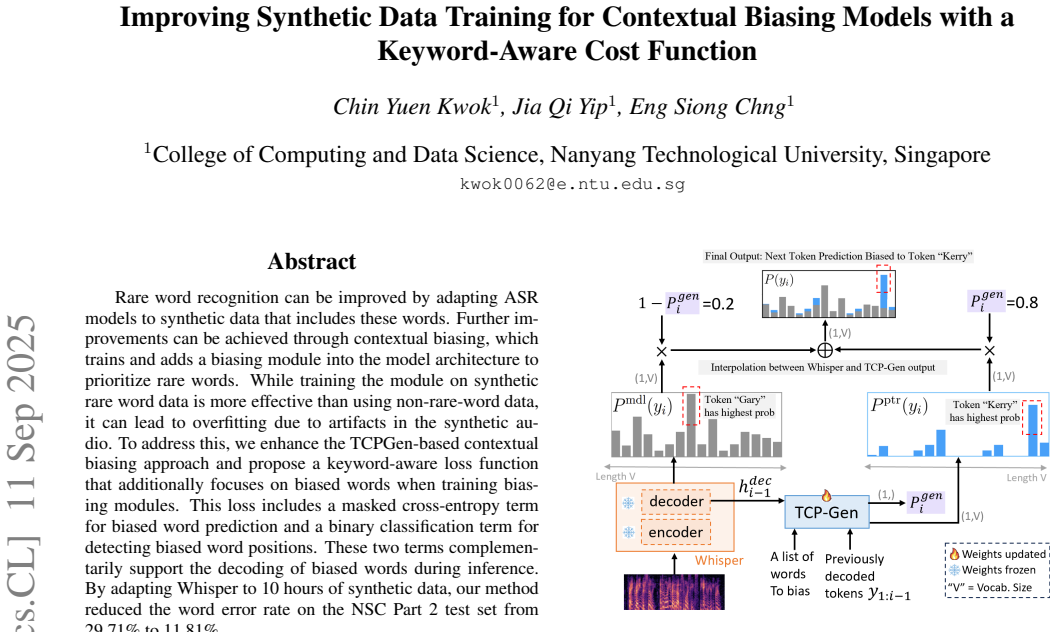
The central claim is that the vanilla TCPGen training objective, which optimizes the ASR cross-entropy loss on the interpolated output, fails for Whisper-based contextual biasing because the pre-fine-tuned model already achieves near-zero loss on the synthetic training set, leaving no gradient signal for the biasing module. The paper replaces that ASR loss with two keyword-aware losses: a binary classification loss on the generation probability P_gen^i that learns whether the i-th token needs biasing, and a masked cross-entropy loss on the pointer distribution P_ptr(y_i) that learns to predict only the rare-word token at the positions where biasing is needed. This formulation also removes th
What carries the argument
The key machinery is the Tree-Constrained Pointer Generator (TCPGen), a decoder-side contextual biasing module that outputs a pointer distribution P_ptr(y_i) over biasing-list tokens and a scalar generation probability P_gen^i interpolating between the base model and the pointer distribution. The paper's contribution is a new training objective: instead of the vanilla ASR loss on the interpolated output, it trains P_gen^i with a weighted binary classification loss (α>0.5 to handle rare-word imbalance) and trains P_ptr(y_i) with a masked cross-entropy loss that only back-propagates at positions in the set K of known biased-token positions. This makes the module learn the desirable P_ptr and P
Load-bearing premise
The training objective assumes exact knowledge of which token positions in the transcript correspond to the biased rare words (the set K); if this alignment is noisy or ambiguous, the gate and pointer losses are trained on incorrect targets and the benefit could vanish.
What would settle it
Run the same NSC Part 2 experiment with deliberately perturbed token-position alignments (shifting K by one or two positions) for a fraction of the training data; if the method's WER advantage over the AGEM baseline disappears or reverses, the benefit is driven by the oracle alignment assumption rather than by the loss design itself.
If this is right
- If correct, the method removes the need for the ASR loss when training contextual biasing modules, simplifying the training pipeline and avoiding the failure mode where an already-fine-tuned model provides no useful gradient.
- The explicit gate target makes the biasing decision auditable: false acceptance rate and true acceptance rate can be computed directly, allowing system designers to tune the trade-off between over-biasing and missed rare words.
- The method applies to decoder-side modules on speech foundation models like Whisper, which do not produce frame-level predictions, extending contextual biasing to architectures that cannot use frame-level biasing techniques.
- Removing the (1-P_gen^i) scaling for non-biased tokens prevents the pointer distribution from suppressing base-model probabilities for out-of-list words, reducing unintended insertions.
- The two loss terms can be used standalone or in addition to the ASR loss; the paper shows they are effective without the ASR loss, which previous work had not demonstrated.
Where Pith is reading between the lines
- Because the method depends on oracle token-position alignment, its benefit may shrink in settings where the rare word is not a single token or where the transcript tokenizer maps a word to multiple subword tokens; an extension would be to compute K from word-to-token alignments rather than exact token positions.
- The explicit gate loss could be repurposed as a confidence measure for accepting or rejecting biased predictions at inference time, enabling a controllable rejection threshold beyond the 0.5 decision boundary.
- The approach might transfer to other pointer-based biasing modules or even to shallow-fusion-style decoding, where the 'when to bias' decision is currently heuristic; the binary gate could serve as a learned fusion weight.
- The paper tests only two models (Whisper-small and Qwen Audio); a natural testable extension is whether the two-loss objective scales to larger decoder-only ASR models and whether it remains stable when the biasing list contains many distractors (N up to 100 here).
Editorial analysis
A structured set of objections, weighed in public.
Referee Report
Summary. The paper proposes a modification to the training objective of TCPGen, a tree-constrained pointer-generator module for contextual biasing in ASR. Instead of training the module with the standard ASR cross-entropy loss on the interpolated output, the authors replace it with two keyword-aware losses: a binary classification loss on the generation gate P_gen (Eq. 3) and a masked cross-entropy loss on the pointer distribution P_ptr (Eq. 4). The losses use oracle knowledge of the token positions that require biasing. On NSC-Part-2 with Whisper-small, the paper reports an improvement over the AGEM baseline from 14.16% to 11.81% WER at N=10 (a 16.6% relative reduction), and on DSTC2 with Qwen-Audio a 17.1% relative B-WER reduction. The paper also introduces an analysis of false acceptance rate (FAR) and true acceptance rate (TAR) for the gate. The abstract headline attributes a 29.71% to 11.81% reduction to the overall adaptation pipeline.
Significance. If the reported results are reproducible, the method is a simple and potentially useful contribution: it demonstrates that explicit supervision of the biasing gate and pointer can replace the standard ASR loss when training contextual biasing modules on synthetic data, and it provides interpretability of the gate via FAR/TAR. The two-loss formulation is clean and the experiments cover two architectures and datasets. However, the central claim of a significant WER improvement is currently supported only by single-run numbers without statistical validation, and there is an unexplained discrepancy between development-set and test-set WER for the same method. These issues need to be resolved before the contribution can be fully assessed.
major comments (4)
- [§4.2, Table 3 vs. §3.1, Table 1] The same method (AGEM+TCPGen-2L) is reported with 11.81% test WER in Table 1 at N=10, but Table 3 reports 25.3% development-set WER at the best α=0.7. The paper does not specify the size or split of the development set, the N used in Table 3, or the α used to produce the Table 1 test results. If the dev set is representative, this >2x gap is implausible and casts doubt on the test result; if it is not representative, the experimental protocol is unverifiable. Please reconcile the two numbers and state all hyperparameters for the reported test results.
- [§3.2, Tables 1–2] No error bars, confidence intervals, significance tests, or multiple-seed runs are reported. The headline 16.6% relative WER improvement (14.16% vs. 11.81%) rests on a single 2-hour test set. Given typical utterance-level variability, this difference may be within noise. Please provide multiple random seeds and/or a matched-pair significance test (e.g., bootstrap or McNemar) for the key comparisons, including the DSTC2 B-WER result.
- [§2.4] The inference-time modification in Eq. 5 — removing the (1−P_gen) scaling for tokens not in the bias list — is a separate heuristic from the proposed losses. The paper does not ablate this change. If the vanilla TCPGen baseline uses the original scaling while TCPGen-2L uses the modified inference, the comparison conflates the loss change with the inference change. Please report results for both inference variants, and also for vanilla TCPGen with the modified inference, so the contribution of each component is isolated.
- [§2.2, Eqs. 3–4] The definition of the oracle set K is underspecified for subword tokenizers such as Whisper's BPE. A rare word may span multiple subword tokens. Is K the set of all subword-token indices belonging to the biased word, or only the first token? How is the word-to-token alignment derived from the synthetic transcript? Without this detail, the targets for the masked cross-entropy loss are not fully reproducible, and the assumption of oracle alignment is not tested.
minor comments (6)
- [Abstract and §1] The abstract's '29.71% to 11.81%' attributes the entire adaptation pipeline (synthetic-data fine-tuning + AGEM + TCPGen-2L) to the proposed loss. The controlled comparison for the contribution is AGEM+TCPGen vs. AGEM+TCPGen-2L (14.16% vs. 11.81%). Please reword to avoid overclaiming.
- [§3.1 and Table 1] The dataset description mentions a train set and a test set but no development set, yet Table 3 uses a development set. Please describe the dev split, its size, and how it was used for hyperparameter tuning.
- [Table 1] The 'Real Syn' column header and the checkmarks are not clearly explained. It would help to add an explicit caption statement that the checkmark indicates whether the real or synthetic version of the NSC-Part-2 train/dev set was used for that row.
- [§4.2] An ablation isolating ℓ_gen and ℓ_ptr is missing. The paper claims the two losses work complementarily, but no experiment trains with only one of them. Adding such an ablation would strengthen the claim.
- [Figure 2 caption and §2.2] The figure text refers to 'Qwen Audio' as the ASR model in the example, while the experiments in Table 1 use Whisper. Please make the example consistent or clarify the intended model.
- [Table 2] The row for 'Sun et al. [21] 13.9' lists only WER and no B-WER/U-WER, and the baseline comparison for ΔBWER is not explicit. Please clarify the source of this number and define the baseline for the relative improvement.
Circularity Check
No significant circularity: the proposed losses are supervised objectives trained on ground-truth target positions; the reported gains are empirical and measured on held-out test sets.
full rationale
The paper's derivation chain is empirical: it proposes replacing the TCPGen ASR loss with a binary-classification loss (Eq. 3) and a masked cross-entropy loss (Eq. 4), trains the biasing module on synthetic data, and then measures WER on held-out NSC-Part-2 and DSTC2 test sets. The loss targets K are derived from ground-truth transcripts and the biasing list; this is standard supervised learning, not a fitted parameter renamed as a prediction. No equation reduces to its own input: Eq. 3 classifies positions in K, Eq. 4 masks the pointer loss to K, and the final interpolation Eq. 1 is not used to derive the claimed improvement. The paper cites several prior works by the same authors ([14], [15], [17], [26], [27]) for the adaptation setup, synthetic-data generation, and AGEM configuration, but these are reproducible external resources and are not invoked as an authority to force the central claim. The internal dev/test WER discrepancy (Table 3 dev WER 25.3% vs Table 1 test WER 11.81% for the same method) is a possible experimental-validity concern, but it is not circularity: the test numbers are measurements, not consequences of the loss definitions. Therefore no circular step is identified.
Axiom & Free-Parameter Ledger
free parameters (2)
- alpha (class weight in binary classification loss) =
not stated for main results; swept over 0.1, 0.3, 0.5, 0.7 in ablation
- Learning rates =
0.005 for Whisper, 0.0001 for Qwen Audio
axioms (4)
- domain assumption Rare words are defined as words outside a 10K common-word list, following Sun et al. [21]
- domain assumption Synthetic audio from VITS trained on VCTK is a sufficient proxy for the target NSC-Part-2 domain
- domain assumption Whisper decoder hidden states provide sufficient context for TCPGen to select and gate biased tokens
- ad hoc to paper Oracle knowledge of token positions needing biasing (set K) is available for training
Cite this review
Pith. "Pith review of Improving Synthetic Data Training for Contextual Biasing Models with a Keyword-Aware Cost Function." pith.science (2026). https://pith.science/paper/YBAQQSAC
@misc{pith2026250909197,
  author       = {Pith},
  title        = {Pith review of: Improving Synthetic Data Training for Contextual Biasing Models with a Keyword-Aware Cost Function},
  year         = {2026},
  howpublished = {\url{https://pith.science/paper/YBAQQSAC}},
  note         = {Machine review of arXiv:2509.09197}
}
read the original abstract
Rare word recognition can be improved by adapting ASR models to synthetic data that includes these words. Further improvements can be achieved through contextual biasing, which trains and adds a biasing module into the model architecture to prioritize rare words. While training the module on synthetic rare word data is more effective than using non-rare-word data, it can lead to overfitting due to artifacts in the synthetic audio. To address this, we enhance the TCPGen-based contextual biasing approach and propose a keyword-aware loss function that additionally focuses on biased words when training biasing modules. This loss includes a masked cross-entropy term for biased word prediction and a binary classification term for detecting biased word positions. These two terms complementarily support the decoding of biased words during inference. By adapting Whisper to 10 hours of synthetic data, our method reduced the word error rate on the NSC Part 2 test set from 29.71% to 11.81%.
Figures

Reference graph
Works this paper leans on
-
[1]
Introduction Accurate recognition of rare words in automatic speech recog- nition (ASR) is crucial, as these words often carry key seman- tic information. However, ASR models frequently misiden- tify them due to their limited presence in training data. Con- textual biasing addresses this challenge by incorporating ad- ditional contextual information, such...
Pith/arXiv arXiv 2025
-
[2]
My name is Kerry
Method 2.1. Tree-constrained pointer generator (TCPGen) TCPGen is a neural network component that is added to ASR models for contextual biasing, where TCPGen is trained end- to-end and the weights of the pre-trained ASR model is frozen. As shown in Fig. 1, at output stepi, TCPGen takes the last hid- den stateh dec i−1 of Whisper’s decoder, a list of words...
-
[3]
Experiment Setup 3.1. Dataset and metrics Experiments were conducted on the National Speech Corpus Part 2 (NSC-Part-2) dataset [16], a subset of a large-scale Sin- gapore English corpus that includes road names and addresses. They are recordings of people asking for directions and con- sist of 13K unique utterances. This dataset is chosen because syntheti...
-
[4]
Results and Discussions The contextual biasing results of whisper-small are shown in Table 1. The first block of the table shows that whisper-small originally performs worse on NSC-Part-2, and the performance improves if the model is vanilla fine-tuned (FT) on the synthetic data. AGEM further improves the performance, as it regularizes the training on syn...
-
[5]
These objectives work to- gether to reduce overfitting and enhance performance, achiev- ing up to a 16.6% relative WER reduction for Whisper and Qwen Audio
Conclusion This paper proposes two novel training objectives for TCPGen to replace the traditional ASR loss. These objectives work to- gether to reduce overfitting and enhance performance, achiev- ing up to a 16.6% relative WER reduction for Whisper and Qwen Audio
-
[6]
Acknowledgements This research is supported by the National Research Founda- tion, Singapore, under the AI Singapore Programme (AISG Award No.: AISG2-100E-2022-102). Any opinions, findings and conclusions or recommendations expressed in this mate- rial are those of the author(s) and do not reflect the views of National Research Foundation, Singapore. The ...
2022
-
[7]
Phoneme-aware encoding for prefix-tree-based contextual asr,
H. Futami, E. Tsunoo, Y . Kashiwagi, H. Ogawa, S. Arora, and S. Watanabe, “Phoneme-aware encoding for prefix-tree-based contextual asr,” inICASSP 2024-2024 IEEE International Con- ference on Acoustics, Speech and Signal Processing (ICASSP). IEEE, 2024, pp. 10 641–10 645
2024
-
[8]
Adaptive contextual biasing for transducer based streaming speech recognition,
T. Xu, Z. Yang, K. Huang, P. Guo, A. Zhang, B. Li, C. Chen, C. Li, and L. Xie, “Adaptive contextual biasing for transducer based streaming speech recognition,”arXiv preprint arXiv:2306.00804, 2023
Pith/arXiv arXiv 2023
-
[9]
Selective Biasing with Trie- based Contextual Adapters for Personalised Speech Recognition using Neural Transducers,
P. Harding, S. Tong, and S. Wiesler, “Selective Biasing with Trie- based Contextual Adapters for Personalised Speech Recognition using Neural Transducers,” inProc. INTERSPEECH 2023, 2023, pp. 256–260
2023
-
[10]
Contextual adapters for personalized speech recognition in neural transducers,
K. M. Sathyendra, T. Muniyappa, F.-J. Chang, J. Liu, J. Su, G. P. Strimel, A. Mouchtaris, and S. Kunzmann, “Contextual adapters for personalized speech recognition in neural transducers,” in ICASSP 2022-2022 IEEE International Conference on Acoustics, Speech and Signal Processing (ICASSP). IEEE, 2022, pp. 8537– 8541
2022
-
[11]
Effective Training of Attention-based Contextual Biasing Adapters with Synthetic Audio for Personalised ASR,
B. Naowarat, P. Harding, P. D’Alterio, S. Tong, and B. Awwad Shiekh Hasan, “Effective Training of Attention-based Contextual Biasing Adapters with Synthetic Audio for Personalised ASR,” in Proc. INTERSPEECH 2023, 2023, pp. 1264–1268
2023
-
[12]
Keyword-guided adaptation of automatic speech recognition,
A. Shamsian, A. Navon, N. Glazer, G. Hetz, and J. Keshet, “Keyword-guided adaptation of automatic speech recognition,”in Proc. INTERSPEECH 2024, 2024
2024
-
[13]
Can Contex- tual Biasing Remain Effective with Whisper and GPT-2?
G. Sun, X. Zheng, C. Zhang, and P. C. Woodland, “Can Contex- tual Biasing Remain Effective with Whisper and GPT-2?” inProc. INTERSPEECH 2023, 2023, pp. 1289–1293
2023
-
[14]
Continual learning optimizations for auto-regressive decoder of multilingual asr systems,
——, “Continual learning optimizations for auto-regressive decoder of multilingual asr systems,”arXiv preprint arXiv:2407.03645, 2024
Pith/arXiv arXiv 2024
-
[15]
Using synthetic audio to improve the recognition of out-of-vocabulary words in end-to-end asr systems,
X. Zheng, Y . Liu, D. Gunceler, and D. Willett, “Using synthetic audio to improve the recognition of out-of-vocabulary words in end-to-end asr systems,”ICASSP 2021 - 2021 IEEE Interna- tional Conference on Acoustics, Speech and Signal Processing (ICASSP), pp. 5674–5678, 2020
2021
-
[16]
Spike-triggered contextual biasing for end-to-end mandarin speech recognition,
K. Huang, A. Zhang, B. Zhang, T. Xu, X. Song, and L. Xie, “Spike-triggered contextual biasing for end-to-end mandarin speech recognition,” in2023 IEEE Automatic Speech Recognition and Understanding Workshop (ASRU). IEEE, 2023, pp. 1–8
2023
-
[17]
Multilingual contextual adapters to improve custom word recognition in low-resource languages,
D. Kulshreshtha, S. Dingliwal, B. Houston, and S. Bo- dapati, “Multilingual contextual adapters to improve custom word recognition in low-resource languages,”arXiv preprint arXiv:2307.00759, 2023
Pith/arXiv arXiv 2023
-
[18]
Improving asr contextual biasing with guided attention,
J. Tang, K. Kim, S. Shon, F. Wu, and P. Sridhar, “Improving asr contextual biasing with guided attention,” inICASSP 2024-2024 IEEE International Conference on Acoustics, Speech and Signal Processing (ICASSP). IEEE, 2024, pp. 12 096–12 100
2024
-
[19]
Robust speech recognition via large-scale weak supervision,
A. Radford, J. W. Kim, T. Xu, G. Brockman, C. McLeavey, and I. Sutskever, “Robust speech recognition via large-scale weak supervision,” inInternational Conference on Machine Learning, 2022. [Online]. Available: https://api.semanticscholar. org/CorpusID:252923993
2022
-
[20]
Improved alignment for score combination of rnn-t and ctc decoder for online decod- ing,
C. Y . Kwok, J. Q. Yip, and E. S. Chng, “Improved alignment for score combination of rnn-t and ctc decoder for online decod- ing,” inInternational Conference on Text, Speech, and Dialogue. Springer, 2024, pp. 70–80
2024
-
[21]
Can contextual biasing remain effective with whisper and gpt-2?
G. Sun, X. Zheng, C. Zhang, and P. C. Woodland, “Can contextual biasing remain effective with whisper and gpt-2?”
-
[22]
Continual learning with embedding layer surgery and task- wise beam search using whisper,
——, “Continual learning with embedding layer surgery and task- wise beam search using whisper,” in2024 IEEE Spoken Language Technology Workshop (SLT). IEEE, 2024, pp. 140–146
2024
-
[23]
Building the singapore english national speech corpus,
J. X. Koh, A. Mislan, K. Khoo, B. Ang, W. Ang, C. Ng, and Y . Tan, “Building the singapore english national speech corpus,” Malay, vol. 20, no. 25.0, pp. 19–3, 2019
2019
-
[24]
We adapt whisper-small and Qwen Audio with vanilla fine-tuning (FT) or AGEM [25] for 2 epochs and set the train batch size to 6
toolkit. We adapt whisper-small and Qwen Audio with vanilla fine-tuning (FT) or AGEM [25] for 2 epochs and set the train batch size to 6. AGEM is a regularization method that constrains the gradients, and we find it to be effective in re- ducing overfitting on synthetic training data. We simply follow the setup from Kwok et al. [14] to apply AGEM. We set ...
-
[25]
Asr model adaptation for rare words using synthetic data generated by multiple text- to-speech systems,
C. Y . Kwok, H. Y . Li, and E. S. Chng, “Asr model adaptation for rare words using synthetic data generated by multiple text- to-speech systems,” in2023 Asia Pacific Signal and Information Processing Association Annual Summit and Conference (APSIPA ASC). IEEE, 2023, pp. 1771–1778
2023
-
[26]
Libritts: A corpus derived from librispeech for text- to-speech,
H. Zen, V . Dang, R. Clark, Y . Zhang, R. J. Weiss, Y . Jia, Z. Chen, and Y . Wu, “Libritts: A corpus derived from librispeech for text- to-speech,”arXiv preprint arXiv:1904.02882, 2019
Pith/arXiv arXiv 1904
-
[27]
Conditional variational autoencoder with adversarial learning for end-to-end text-to-speech,
J. Kim, J. Kong, and J. Son, “Conditional variational autoencoder with adversarial learning for end-to-end text-to-speech,” inInter- national Conference on Machine Learning. PMLR, 2021, pp. 5530–5540
2021
-
[28]
Cstr vctk corpus: English multi-speaker corpus for cstr voice cloning toolkit (version 0.92),
J. Yamagishi, C. Veaux, and K. MacDonald, “Cstr vctk corpus: English multi-speaker corpus for cstr voice cloning toolkit (version 0.92),” 2019. [Online]. Available: https: //api.semanticscholar.org/CorpusID:213060286
2019
-
[29]
G2g: Tts-driven pronunciation learning for graphemic hybrid asr,
D. Le, T. Koehler, C. Fuegen, and M. L. Seltzer, “G2g: Tts-driven pronunciation learning for graphemic hybrid asr,” inICASSP 2020-2020 IEEE International Conference on Acoustics, Speech and Signal Processing (ICASSP). IEEE, 2020, pp. 6869–6873
2020
-
[30]
The second dialog state tracking challenge,
M. Henderson, B. Thomson, and J. D. Williams, “The second dialog state tracking challenge,” inProceedings of the 15th Annual Meeting of the Special Interest Group on Discourse and Dialogue (SIGDIAL), K. Georgila, M. Stone, H. Hastie, and A. Nenkova, Eds. Philadelphia, PA, U.S.A.: Association for Computational Linguistics, Jun. 2014, pp. 263–272. [Online]....
2014
-
[31]
D. Le, M. Jain, G. Keren, S. Kim, Y . Shi, J. Mahadeokar, J. Chan, Y . Shangguan, C. Fuegen, O. Kalinliet al., “Contextual- ized streaming end-to-end speech recognition with trie-based deep biasing and shallow fusion,”arXiv preprint arXiv:2104.02194, 2021
Pith/arXiv arXiv 2021
-
[32]
SpeechBrain: A general-purpose speech toolkit,
M. Ravanelli, T. Parcollet, P. Plantinga, A. Rouhe, S. Cornell, L. Lugosch, C. Subakan, N. Dawalatabad, A. Heba, J. Zhong, J.-C. Chou, S.-L. Yeh, S.-W. Fu, C.-F. Liao, E. Rastorgueva, F. Grondin, W. Aris, H. Na, Y . Gao, R. D. Mori, and Y . Ben- gio, “SpeechBrain: A general-purpose speech toolkit,” 2021, arXiv:2106.04624
Pith/arXiv arXiv 2021
-
[33]
Gradient episodic memory for continual learning,
D. Lopez-Paz and M. Ranzato, “Gradient episodic memory for continual learning,”Advances in neural information processing systems, vol. 30, 2017
2017
-
[34]
Low resource language adaptation using two-stage regularization for multilingual asr,
C. Y . Kwok, J. Q. Yip, and E. S. Chng, “Low resource language adaptation using two-stage regularization for multilingual asr,” in2024 International Conference on Asian Language Processing (IALP). IEEE, 2024, pp. 332–337
2024
-
[35]
Extending whisper for emotion prediction using word-level pseudo labels,
C. Y . Kwok, S. Li, J. Q. Yip, C. Chu, T. Kawahara, and E. S. Chng, “Extending whisper for emotion prediction using word-level pseudo labels,” inICASSP 2025-2025 IEEE Interna- tional Conference on Acoustics, Speech and Signal Processing (ICASSP). IEEE, 2025, pp. 1–5
2025
-
[36]
Contextual biasing speech recognition in speech-enhanced large language model,
X. Gong, A. Lv, Z. Wang, and Y . Qian, “Contextual biasing speech recognition in speech-enhanced large language model,” Proc. Interspeech. ISCA, pp. 257–261, 2024
2024
-
[38]
Deep shallow fusion for rnn-t personalization,
D. Le, G. Keren, J. Chan, J. Mahadeokar, C. Fuegen, and M. L. Seltzer, “Deep shallow fusion for rnn-t personalization,” in2021 IEEE Spoken Language Technology Workshop (SLT). IEEE, 2021, pp. 251–257
2021
-
[2023]
Available: https://arxiv.org/abs/2306.01942
[Online]. Available: https://arxiv.org/abs/2306.01942
This paper was first reviewed by deepseek-v4-flash on August 4, 2026.
discussion (0)
Sign in with ORCID, Apple, or X to comment. Anyone can read and Pith papers without signing in.