REVIEW 3 major objections 5 minor 44 references
In the minimal low-scale quark–lepton unification model, the next-generation muon-to-electron conversion experiment can test symmetry-breaking scales up to 10^4 TeV, far beyond any collider bound.
Reviewed by Pith at T0; open to challenge. T0 means a machine referee read the full paper against a public rubric. the ladder, T0–T4 →
T0 review · deepseek-v4-flash
2026-08-02 19:28 UTC pith:B4DTH7BX
load-bearing objection A solid EFT analysis of LFV in the minimal Pati–Salam-style matter-unification model, but the flashy Mu2e '10^4 TeV' reach is a property of hand-picked mixing textures, not a robust prediction, and the benchmark bound in Eq. (30) looks off by an order of magnitude. the 3 major comments →
Matter Unification and Lepton Flavour Violation
The pith
A machine-rendered reading of the paper's core claim, the machinery that carries it, and where it could break.
Core claim
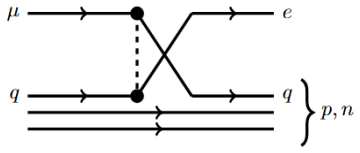
The paper's central claim is that in the minimal matter-unification framework, the process μ→e conversion in nuclei is mediated at tree level by the vector leptoquark X_μ and the scalar leptoquark Φ4, and that this process dominates the experimental constraints once the unknown quark–lepton mixing angles are allowed to suppress the KL→μ±e∓ amplitude. Working with a general effective Hamiltonian that contains eight independent Wilson coefficients for the kaon decay, the authors identify benchmark mixing textures (Cases II–IV) in which the kaon decay vanishes at tree level. In those cases, current bounds from muon-to-electron conversion in gold already require the vector leptoquark mass to be
What carries the argument
The central object is the effective Hamiltonian obtained after integrating out the vector leptoquark X_μ, whose couplings are governed by the unknown quark–lepton mixing matrices V_L = D_L† E_L and V_R = D_R† E_R. For KL→μ±e∓ this yields eight Wilson coefficients; for μ→e conversion it yields vector, scalar, left- and right-handed operators for d and s quarks. The four benchmark mixing textures (Case I–IV) parametrize the freedom in the mixing angles θ12, θ13, θ23 and determine which quark flavor contributes to conversion. The scalar leptoquark Φ4 contributes through the Yukawa coupling y2, expressed after rotation as y2 = U_R† Y2 E_L, with only the up-quark channel surviving in the coherent
Load-bearing premise
The O(1) size of the quark–lepton mixing entries that drive μ→e conversion; if the physical matrices V_L and V_R suppress the relevant products, the theory could evade all current and projected bounds.
What would settle it
Measure the conversion rate in aluminum at 10^-17 sensitivity. If no events are seen, then in the benchmark textures with maximal mixing the vector leptoquark mass must exceed 10^4 TeV, contradicting the multi-TeV unification claim; conversely, a rate above the Standard Model background would confirm the model. A precise measurement of the strange-quark scalar content of the nucleon would also sharpen or invalidate the s-only bounds.
If this is right
- A null result at the projected conversion sensitivity would set M_X ≳ 10^4 TeV in the benchmark scenarios, excluding the multi-TeV realization of this unification model.
- Discovery of μ→e conversion at a rate consistent with the model would establish matter unification at the multi-TeV scale and indirectly fix the symmetry-breaking scale.
- The correlation with KL→μ±e∓ means that improved kaon-decay limits alone cannot rule out the model, but a positive conversion signal would point to the mixing textures that suppress kaon decays.
- Current gold-conversion bounds already exclude part of the parameter space, so the model's viability depends on the mixing angles.
- Collider searches for leptoquarks are subdominant: the conversion bound on the mass scale is orders of magnitude stronger.
Where Pith is reading between the lines
- The same mixing freedom that nulls the kaon amplitude could in principle also suppress the μ→e conversion rate, so the 10^4 TeV reach is conditional on the assumed textures; a measurement of μ→e conversion at a rate near the current bound would strongly constrain the mixing product |V*_se V_sμ| or |V*_de V_dμ|.
- The ~50% uncertainty in the strange-quark scalar form factor translates directly into a similar uncertainty in the projected mass bound in the s-only scenarios; reducing that lattice uncertainty would sharpen the forecast.
- The argument extends naturally to other nuclei: comparing conversion rates in aluminum and gold would discriminate between d- and s-quark dominance, and thus between the benchmark textures.
- If the next-generation experiment reaches 10^-17 sensitivity and sees nothing, the model would require either a fine-tuned suppression in the mixing matrices or a unification scale beyond 10^4 TeV, eroding the 'low-scale' motivation.
Editorial analysis
A structured set of objections, weighed in public.
Referee Report
Summary. This paper studies the minimal SU(4)_C × SU(2)_L × U(1)_R matter-unification model at the TeV scale, focusing on lepton-flavor-violating (LFV) signals. It derives the tree-level effective Hamiltonians for K_L → μ±e∓ and μ→e conversion induced by the vector leptoquark X_μ and the scalar leptoquark Φ4, retaining the unknown quark–lepton mixing matrices V_L and V_R. The kaon amplitude is shown to depend on one combination C_K = V*_de V_sμ + V*_se V_dμ in the simplified V_L = V_R case, and four benchmark textures are given in which C_K = 0 and K_L → μe vanishes at tree level. For these benchmarks the authors compute μ→e conversion, compare with SINDRUM II bounds and projected Mu2e sensitivities, and conclude that Mu2e can probe M_X up to ~10^4 TeV. Scalar-leptoquark contributions to μ→e are analyzed separately.
Significance. If the central reach claim were robust, this would be an important result: it would identify a concrete, falsifiable low-energy signal for a TeV-scale matter-unification framework. The paper has clear strengths: the eight independent Wilson coefficients for K_L→μe are written out explicitly, the QCD running of scalar operators is included, current experimental limits are used, and no fit to data is attempted. The benchmark construction is transparent, and I verified that Eq. (30) follows from Eqs. (19)–(26) and that C_K = cos 2θ12 in Case I. However, because V_L and V_R are completely unconstrained by the model, the statement that Mu2e 'can probe symmetry breaking scales as high as 10^4 TeV' is not a model prediction but a property of hand-picked textures. There are valid mixing choices for which all tree-level LFV amplitudes vanish, so the reach claim is conditional. This needs to be stated much more explicitly and reflected in the abstract and summary.
major comments (3)
- [Section 4 (Eqs. 31 and 38) and Section 6] The conclusion that μ→e conversion necessarily constrains the breaking scale when K_L→μe is suppressed is not valid for the full parameter space. The paper states in Section 3 (below Eq. (11)) that this theory does not predict V_L and V_R. Take V_L = V_R = P, where P is the identity matrix (or any permutation with P_de = 1 and P_sμ = P_se = P_dμ = 0). Then C_K = V*_de V_sμ + V*_se V_dμ = 0 in Eq. (31), and all coefficients in Eq. (38) vanish: C_VL^(q) = C_VR^(q) = C_SR^(q) = C_SL^(q) = 0 for q = d,s. The Φ4 contribution can also be absent if the y2 Yukawa matrix is diagonal. Thus a valid, non-exotic choice of the mixing matrices evades every LFV bound considered here, and no lower bound on M_X follows from LFV. The '10^4 TeV' Mu2e reach in the abstract and Section 6 is therefore a benchmark-dependent statement, not a robust consequence of matter unification. Please add an explicit caveat
- [Section 1 vs Section 3, Eq. (30)] The introduction states that 'in the simplest scenarios, these bounds require the SU(4)_C breaking scale to lie above 10^3 TeV,' but Section 3, with V_L = V_R ~ 1 and C_K = 1, derives M_X > 2.4×10^5 GeV = 240 TeV from BR(K_L→e±μ∓) < 4.7×10^-12. Case I later quotes 1800 TeV. The factor of roughly 4–7 between these numbers is not explained. This matters because the paper's motivation is the actual lower bound on the symmetry-breaking scale. Please state precisely which combination of bounds (K_L→μe, K_L→e+e−, RG running, mixing-angle values) produces each quoted number and reconcile the statements.
- [Section 4, Eq. (42) and Figs. 5–6] In the s-quark-only scenarios (Cases II and IV), the scalar operators contribute with coefficients comparable to the vector ones (compare Eqs. (38) and (39)), but the strange scalar form factor entering Eq. (40) has f_Sp^(s) = (53±27)×10^-3, a ~50% uncertainty. The paper quotes reach statements such as M_X ≳ 10^4 TeV without showing how this uncertainty propagates into the extracted limits. Because the quantitative reach is a central result, please provide uncertainty bands in Figs. 5 and 6, or at least a sensitivity estimate. Without this, the specific reach numbers are not robust.
minor comments (5)
- [Section 5, Eq. (51)–(52)] The tensor operator in Eq. (51) is dropped with the statement that 'the tensor operator doesn't contribute.' This is correct for spin-independent coherent conversion, but a one-line explanation or citation would help the reader.
- [Section 4, Eq. (40)] The symbol m_N is used in the neutron scalar form-factor normalization without definition; elsewhere m_p and m_n appear. Please define m_N explicitly and use consistent notation.
- [Abstract and Section 6] The phrase 'demonstrate that ... can probe symmetry breaking scales as high as 10^4 TeV' should be qualified to make clear that this reach applies to the benchmark textures considered, not to the model as a whole.
- [Fig. 5] The four panels in Fig. 5 are referred to as 'a)–d)' but the captions do not explicitly label which panel corresponds to Case I–IV. Please add the case labels to the caption.
- [References] Reference [21] is incomplete (no journal or arXiv identifier), and [25] likewise lacks full publication data. Please supply the missing information.
Circularity Check
No significant circularity: LFV rates are derived from the Lagrangian and compared with external experimental limits; the Mu2e reach claim is conditional on declared mixing benchmarks, with one minor non-load-bearing self-citation.
full rationale
The LFV amplitudes are obtained by integrating out vector and scalar leptoquarks (Eqs. 16, 37, 49), with Wilson coefficients proportional to g4^2/M_X^2 times products of the unknown mixing matrices V_L, V_R. No parameter is fitted to LFV data and then renamed as a prediction. The numerical limits used are external: BNL BR(KL→e±μ∓)<4.7×10^-12 [31], SINDRUM II μ→e conversion in Au [33], Mu2e projections [22], Kitano-Koike-Okada overlap integrals [34], and lattice/pion-nucleon form factors [37,38]. The benchmark V matrices in Eqs. (33)-(36) are explicitly declared assumptions; the paper states 'this theory does not predict the mixing matrices between quarks and leptons... the lower bound... can be predicted only assuming some values for the mixing angles.' Thus the 'Mu2e can probe 10^4 TeV' statement is a conditional consequence of the benchmark textures, not a fit masquerading as a prediction. A skeptical reader can choose a different unitary V for which both C_K and C_VL vanish, but that is a robustness/overclaim concern, not a circular reduction. The only circularity-adjacent element is the use of '∆K(e+e−)< 5×10^-12 [32]' for the Case I kaon bound, where Ref. [32] is a same-author theory paper rather than an independent experimental compilation; this affects the 1800 TeV kaon statement but is not load-bearing for the central μ→e/Mu2e reach claim. Hence no significant circularity; score 2 reflects the minor, non-load-bearing self-citation.
Axiom & Free-Parameter Ledger
free parameters (3)
- Quark-lepton mixing matrices V_L = D_L†E_L, V_R = D_R†E_R (benchmark textures) =
Cases I–IV: V_L = V_R = V with θ13, θ23 ∈ {0, π/2} and θ12 free (e.g., Case I: C_K = cos 2θ12)
- y2 (Φ4 scalar leptoquark Yukawa coupling) =
Scanned up to O(1); Mu2e reach M_Φ4 ~ 10^4 TeV quoted at y2 ~ 1 (Fig. 8)
- Effective α_s normalization / RG treatment in Eqs. 26–30 =
Unspecified
axioms (6)
- domain assumption Gauge group SU(4)_C × SU(2)_L × U(1)_R with matter content of Eqs. (1)–(3) and vector leptoquark X_μ of Eqs. (9)–(10)
- domain assumption Neutrino masses arise necessarily via inverse seesaw (abstract, Section 2, Ref. [23])
- standard math Fierz identities (Eq. 17) and neglect of the electron mass in the K_L amplitude
- domain assumption One-loop QCD RG running: vector/axial operators do not run; scalar/pseudoscalar run via Eqs. (28)–(29) (Buras)
- domain assumption Coherent μ→e conversion rate formula (Eq. 39, Kitano–Koike–Okada) with nuclear form factors and overlap integrals (Eqs. 40–42, Table I)
- domain assumption Gauge-coupling identification g_4 ≈ g_s used to express all rates in powers of α_s (Eq. 30)
invented entities (2)
-
Vector leptoquark X_μ ~ (3,1,2/3)_SM
independent evidence
-
Scalar leptoquarks Φ3 and Φ4 (components of Φ ~ (15,2,1/2))
independent evidence
read the original abstract
We explore the idea of quark-lepton unification at low energies. In particular, we discuss the minimal framework for matter unification at the multi-TeV scale, in which neutrino masses are necessarily generated via the inverse seesaw mechanism. To assess the testability of this theory for physics beyond the Standard Model, we analyze current experimental constraints and derive the corresponding lower bound on the symmetry breaking scale. We reexamine the impact of existing limits from lepton number violating meson decays, taking into account the freedom associated with unknown quark-lepton mixing angles. Furthermore, we study the correlation between bounds from meson decays and $\mu \to e$ conversion. We demonstrate that the upcoming $\mu \to e$ conversion experiment at Fermilab can play a crucial role in probing quark-lepton unification at the multi-TeV scale.
Figures



Reference graph
Works this paper leans on
-
[1]
INTRODUCTION The Standard Model (SM) of particle physics is one of the most successful theories for fun- damental interactions. Nevertheless, it must be extended to account for the origin of neutrino masses and the observed matter–antimatter asymmetry of the Universe. The idea of unification is among the most compelling frameworks for physics beyond the S...
Pith/arXiv arXiv 2026
-
[2]
MA TTER UNIFICA TION The minimal theory for matter unification is based on the gauge symmetry [7] SU(4)C ⊗SU(2) L ⊗U(1) R, while the SM matter fields are unified as follows FqL = ur ug ub ν dr dg db e L ∼(4,2,0),(1) FuR = ur ug ub ν R ∼(4,1,1/2),(2) FdR = dr dg db e R ∼(4,1,−1/2).(3) 2 Hereu i andd i (withi=r, g, b) are the quarks with different colors. T...
-
[3]
The constraints from Kaon decays have been investigated from a long time, see, for example, the studies in Refs
LEPTON FLA VOUR VIOLA TING MESON DECA YS In order to find the lower bound on theSU(4)C breaking scale, we need to revisit the predic- tions for rare meson decays and use the current experimental bounds. The constraints from Kaon decays have been investigated from a long time, see, for example, the studies in Refs. [11, 17]. The relevant interactions for t...
-
[4]
Complex Spinors and Unified Theories,
Murray Gell-Mann, Pierre Ramond, and Richard Slansky, “Complex Spinors and Unified Theories,” Conf. Proc. C790927, 315–321 (1979), arXiv:1306.4669 [hep-th]
Pith/arXiv arXiv 1979
-
[5]
SUMMAR Y The idea of quark–lepton unification remains one of the most compelling frameworks for physics beyond the Standard Model. In this article, we have analyzed the predictions of the minimal theory of matter unification realized at the multi-TeV scale, where Majorana neutrino masses are generated through the inverse seesaw mechanism. To assess the te...
-
[6]
The mass of the vector leptoquarks,Xµ ∼(3,1,2/3) SM, is given by M 2 X = 1 4 g2 4v2 χ .(10) This mass defines for us theSU(4)C symmetry breaking scale
Once the scalar field,χ= χr χg χb χ0 ∼ (4,1,1/2), acquires a vacuum expectation value,vχ, the new massive vectors associated with the broken generators ofSU(4)C acquire mass. The mass of the vector leptoquarks,Xµ ∼(3,1,2/3) SM, is given by M 2 X = 1 4 g2 4v2 χ .(10) This mass defines for us theSU(4)C symmetry breaking scale. In the next section, we will d...
-
[7]
Is Baryon Number Conserved?
Jogesh C. Pati and Abdus Salam, “Is Baryon Number Conserved?” Phys. Rev. Lett.31, 661–664 (1973)
1973
-
[8]
Lepton Number as the Fourth Color,
Jogesh C. Pati and Abdus Salam, “Lepton Number as the Fourth Color,” Phys. Rev. D10, 275–289 (1974), [Erratum: Phys.Rev.D 11, 703–703 (1975)]
1974
-
[9]
µ→eγat a Rate of One Out of10 9 Muon Decays?
Peter Minkowski, “µ→eγat a Rate of One Out of10 9 Muon Decays?” Phys. Lett. B67, 421–428 (1977)
1977
-
[10]
Neutrino Mass and Spontaneous Parity Nonconserva- tion,
Rabindra N. Mohapatra and Goran Senjanovic, “Neutrino Mass and Spontaneous Parity Nonconserva- tion,” Phys. Rev. Lett.44, 912 (1980)
1980
-
[11]
Horizontal gauge symmetry and masses of neutrinos,
Tsutomu Yanagida, “Horizontal gauge symmetry and masses of neutrinos,” Conf. Proc. C7902131, 95–99 (1979)
1979
-
[12]
Low Scale Quark-Lepton Unification,
Pavel Fileviez Perez and Mark B. Wise, “Low Scale Quark-Lepton Unification,” Phys. Rev. D88, 057703 (2013), arXiv:1307.6213 [hep-ph]
Pith/arXiv arXiv 2013
-
[13]
Quark-Lepton Unification Signatures,
Jon Butterworth, Hridoy Debnath, Pavel Fileviez Perez, and Peng Wang, “Quark-Lepton Unification Signatures,” (2025), arXiv:2512.00143 [hep-ph]
Pith/arXiv arXiv 2025
-
[14]
Finite naturalness and quark-lepton unification,
Pavel Fileviez Pérez, Clara Murgui, Samuel Patrone, Adriano Testa, and Mark B. Wise, “Finite naturalness and quark-lepton unification,” Phys. Rev. D109, 015011 (2024), arXiv:2308.07367 [hep- ph]
Pith/arXiv arXiv 2024
-
[15]
Two-Higgs-doublet model and quark- lepton unification,
Pavel Fileviez Perez, Elliot Golias, and Alexis D. Plascencia, “Two-Higgs-doublet model and quark- lepton unification,” JHEP08, 293 (2022), arXiv:2205.02235 [hep-ph]. 14
Pith/arXiv arXiv 2022
-
[16]
Flavor anomalies and quark-lepton unification,
Pavel Fileviez Perez and Clara Murgui, “Flavor anomalies and quark-lepton unification,” Phys. Rev. D 106, 035033 (2022), arXiv:2203.07381 [hep-ph]
Pith/arXiv arXiv 2022
-
[17]
Probing quark-lepton unification with leptoquark and Higgs boson decays,
Pavel Fileviez Perez, Elliot Golias, and Alexis D. Plascencia, “Probing quark-lepton unification with leptoquark and Higgs boson decays,” Phys. Rev. D105, 075011 (2022), arXiv:2107.06895 [hep-ph]
Pith/arXiv arXiv 2022
-
[18]
Leptoquarks and matter unification: Flavor anomalies and the muon g-2,
Pavel Fileviez Perez, Clara Murgui, and Alexis D. Plascencia, “Leptoquarks and matter unification: Flavor anomalies and the muon g-2,” Phys. Rev. D104, 035041 (2021), arXiv:2104.11229 [hep-ph]
Pith/arXiv arXiv 2021
-
[19]
Hunting and identifying coloured resonances in four top events with machine learning,
Thomas Flacke, Jeong Han Kim, Manuel Kunkel, Jun Seung Pi, and Werner Porod, “Hunting and identifying coloured resonances in four top events with machine learning,” (2025), arXiv:2506.04318 [hep-ph]
Pith/arXiv arXiv 2025
-
[20]
All possible first signals of gauge leptoquark in quark-lepton unification and beyond,
Hedvika Gedeonová and Matěj Hudec, “All possible first signals of gauge leptoquark in quark-lepton unification and beyond,” Phys. Rev. D107, 095029 (2023), arXiv:2210.00347 [hep-ph]
Pith/arXiv arXiv 2023
-
[21]
Scalar leptoquarks, baryon number violation, and Pati-Salam sym- metry,
Clara Murgui and Mark B. Wise, “Scalar leptoquarks, baryon number violation, and Pati-Salam sym- metry,” Phys. Rev. D104, 035017 (2021), arXiv:2105.14029 [hep-ph]
Pith/arXiv arXiv 2021
-
[22]
Quark - lepton unification and rare meson decays,
G. Valencia and S. Willenbrock, “Quark - lepton unification and rare meson decays,” Phys. Rev. D50, 6843–6848 (1994), arXiv:hep-ph/9409201
Pith/arXiv arXiv 1994
-
[23]
Charged Lepton Flavor Violation: An Experimenter’s Guide,
Robert H. Bernstein and Peter S. Cooper, “Charged Lepton Flavor Violation: An Experimenter’s Guide,” Phys. Rept.532, 27–64 (2013), arXiv:1307.5787 [hep-ex]
Pith/arXiv arXiv 2013
-
[24]
Charged Lepton Flavor Violation,
SachaDavidson, BertrandEchenard, RobertH.Bernstein, JulianHeeck, andDavidG.Hitlin,“Charged Lepton Flavor Violation,” (2022), arXiv:2209.00142 [hep-ex]
Pith/arXiv arXiv 2022
-
[25]
Reach and complementarity ofµ→esearches,
Sacha Davidson and Bertrand Echenard, “Reach and complementarity ofµ→esearches,” Eur. Phys. J. C82, 836 (2022), arXiv:2204.00564 [hep-ph]
Pith/arXiv arXiv 2022
-
[26]
On Baryon and Lepton Number Violation,
Pavel Fileviez Perezet al., “On Baryon and Lepton Number Violation,” (2022), arXiv:2208.00010 [hep-ph]
Pith/arXiv arXiv 2022
-
[27]
L. Bartoszeket al.(Mu2e), “Mu2e Technical Design Report,” (2014), 10.2172/1172555, arXiv:1501.05241 [physics.ins-det]
Pith/arXiv arXiv 2014
-
[28]
Neutrino Mass and Baryon Number Nonconservation in Super- string Models,
R. N. Mohapatra and J. W. F. Valle, “Neutrino Mass and Baryon Number Nonconservation in Super- string Models,” Phys. Rev. D34, 1642 (1986)
1986
-
[29]
The Minimal quark - lepton symmetry model and the limit on Z-prime mass,
A. D. Smirnov, “The Minimal quark - lepton symmetry model and the limit on Z-prime mass,” Phys. Lett. B346, 297–302 (1995), arXiv:hep-ph/9503239
Pith/arXiv arXiv 1995
-
[30]
TeV Scale Quark-Lepton Unification,
K. S. Babu, Sumit Biswas, and Shaikh Saad, “TeV Scale Quark-Lepton Unification,” (2025), arXiv:2512.11113 [hep-ph]
Pith/arXiv arXiv 2025
-
[31]
Georges Aadet al.(ATLAS), “Search for pair production of third-generation leptoquarks decaying into a bottom quark and aτ-lepton with the ATLAS detector,” Eur. Phys. J. C83, 1075 (2023), arXiv:2303.01294 [hep-ex]
Pith/arXiv arXiv 2023
-
[32]
Aram Hayrapetyanet al.(CMS), “Search for pair production of scalar and vector leptoquarks decaying to muons and bottom quarks in proton-proton collisions at s=13 TeV,” Phys. Rev. D109, 112003 (2024), arXiv:2402.08668 [hep-ex]
Pith/arXiv arXiv 2024
-
[33]
A. Hayrapetyanet al.(CMS), “Search fort-channel scalar and vector leptoquark exchange in the high- mass dimuon and dielectron spectra in proton-proton collisions at√s= 13 TeV,” JHEP12, 052 (2025), arXiv:2503.20023 [hep-ex]
arXiv 2025
-
[34]
Armen Tumasyanet al.(CMS), “Searches for additional Higgs bosons and for vector leptoquarks in τ τfinal states in proton-proton collisions at√s= 13 TeV,” JHEP07, 073 (2023), arXiv:2208.02717 [hep-ex]
Pith/arXiv arXiv 2023
-
[35]
Weak Hamiltonian, CP violation and rare decays,
Andrzej J. Buras, “Weak Hamiltonian, CP violation and rare decays,” inLes Houches Summer School in Theoretical Physics, Session 68: Probing the Standard Model of Particle Interactions(1998) pp. 281–539, arXiv:hep-ph/9806471
Pith/arXiv arXiv 1998
-
[36]
New limit on muon and electron lepton number violation from K0(L) —> mu+- e-+ decay,
D. Ambroseet al.(BNL), “New limit on muon and electron lepton number violation from K0(L) —> mu+- e-+ decay,” Phys. Rev. Lett.81, 5734–5737 (1998), arXiv:hep-ex/9811038
Pith/arXiv arXiv 1998
-
[37]
Leptoquarks and Neutrino Masses at the LHC,
Pavel Fileviez Perez, Tao Han, Tong Li, and Michael J. Ramsey-Musolf, “Leptoquarks and Neutrino Masses at the LHC,” Nucl. Phys. B819, 139–176 (2009), arXiv:0810.4138 [hep-ph]
Pith/arXiv arXiv 2009
-
[38]
A Search for muon to electron conversion in muonic gold,
Wilhelm H. Bertlet al.(SINDRUM II), “A Search for muon to electron conversion in muonic gold,” Eur. Phys. J. C47, 337–346 (2006)
2006
-
[39]
Ryuichiro Kitano, Masafumi Koike, and Yasuhiro Okada, “Detailed calculation of lepton flavor vio- 15 lating muon electron conversion rate for various nuclei,” Phys. Rev. D66, 096002 (2002), [Erratum: Phys.Rev.D 76, 059902 (2007)], arXiv:hep-ph/0203110
Pith/arXiv arXiv 2002
-
[40]
Andreas Crivellin, Sacha Davidson, Giovanni Marco Pruna, and Adrian Signer, “Renormalisation- group improved analysis ofµ→eprocesses in a systematic effective-field-theory approach,” JHEP05, 117 (2017), arXiv:1702.03020 [hep-ph]
Pith/arXiv arXiv 2017
-
[41]
On the model discrim- inating power of mu —>e conversion in nuclei,
Vincenzo Cirigliano, Ryuichiro Kitano, Yasuhiro Okada, and Paula Tuzon, “On the model discrim- inating power of mu —>e conversion in nuclei,” Phys. Rev. D80, 013002 (2009), arXiv:0904.0957 [hep-ph]
Pith/arXiv arXiv 2009
-
[42]
High-Precision Determi- nation of the Pion-NucleonσTerm from Roy-Steiner Equations,
Martin Hoferichter, J. Ruiz de Elvira, Bastian Kubis, and Ulf-G. Meißner, “High-Precision Determi- nation of the Pion-NucleonσTerm from Roy-Steiner Equations,” Phys. Rev. Lett.115, 092301 (2015), arXiv:1506.04142 [hep-ph]
Pith/arXiv arXiv 2015
-
[43]
Scalar strange content of the nucleon from lattice QCD,
Parikshit Junnarkar and Andre Walker-Loud, “Scalar strange content of the nucleon from lattice QCD,” Phys. Rev. D87, 114510 (2013), arXiv:1301.1114 [hep-lat]
Pith/arXiv arXiv 2013
-
[44]
Total Nuclear Capture Rates for Negative Muons,
T. Suzuki, David F. Measday, and J. P. Roalsvig, “Total Nuclear Capture Rates for Negative Muons,” Phys. Rev. C35, 2212 (1987). 16
1987
discussion (0)
Sign in with ORCID, Apple, or X to comment. Anyone can read and Pith papers without signing in.