REVIEW 4 major objections 5 minor 1 cited by
RADAR is a fully autonomous, closed-loop data generation engine that uses VLM planning, GNN execution, VQA evaluation, and LIFO reverse resets to remove humans from the collection cycle.
Reviewed by Pith at T0; open to challenge. T0 means a machine referee read the full paper against a public rubric. the ladder, T0–T4 →
T0 review · deepseek-v4-flash
2026-08-02 18:18 UTC pith:UAIASWOP
load-bearing objection A competent system integration with a genuinely new reset-planning idea, but the headline 'fully autonomous' claim runs ahead of the evidence: the reset module itself is never measured. the 4 major comments →
RADAR: Closed-Loop Robotic Data Generation via Semantic Planning and Autonomous Causal Environment Reset
The pith
A machine-rendered reading of the paper's core claim, the machinery that carries it, and where it could break.
Core claim
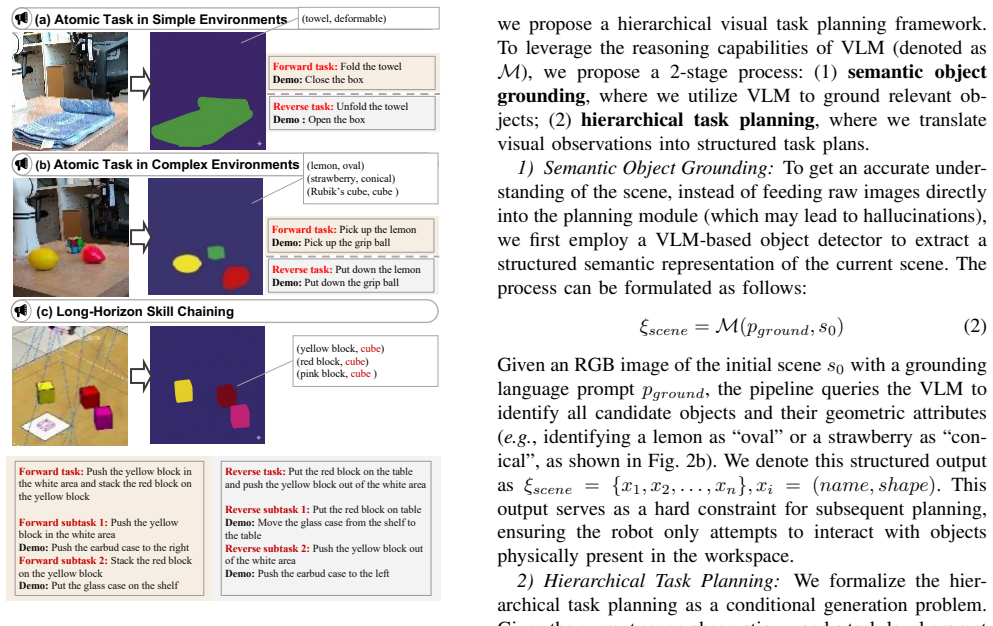
The paper's central claim is that a robot can operate as a fully autonomous, human-out-of-the-loop data generation engine: given just 2-5 manual demonstrations, it can continuously produce high-fidelity manipulation data. The claimed mechanism is 'brain-cerebellum synergy' - a vision-language model handles semantic planning and evaluation while a graph-diffusion policy handles precise physical execution - welded together by a Finite State Machine that treats reset as an inverse planning problem. Because forward and reverse plans are generated together under a strict Last-In, First-Out causal constraint, the robot's own actions are reversible, and when reversal fails the system recovers by sa
What carries the argument
The load-bearing mechanism is simultaneous forward-reverse planning: the VLM planner is prompted to produce, alongside the forward task plan, an exact causal inverse plan obeying a strict Last-In, First-Out (LIFO) order - each reverse subtask undoes the physical change of the most recent forward subtask first - which is then executed by the same graph-based in-context imitation policy. Around this, a Finite State Machine decouples physical execution states (planning, forward, reverse) from data-routing states (dual storage on success, single storage on reset failure), so the system loops B-C-B on clean resets and routes B-C-A otherwise, turning a failed reset into a new initial scene. A thre
Load-bearing premise
The system's promise of zero human intervention collapses if the VLM's reverse plan, when executed by the same policy, does not physically restore the workspace, or if the VQA evaluator incorrectly certifies restoration - and the paper itself states that 100% reliable environment resetting remains an open challenge.
What would settle it
Run the full closed loop (plan, execute, evaluate, reset) for 100 episodes of a chained task and judge restoration with an independent perception system that compares the post-reset point cloud to the initial one. If the fraction of episodes that complete without any human intervention is not close to 100%, the claim of completely removing humans from the collection cycle is false; measuring p_forward × p_reverse separately would also show the gap.
If this is right
- If reset works, data collection scales without human presence: the same handful of demonstrations yields many trajectory variations because the successful loop B→C→B replays the skill repeatedly without re-planning.
- The LIFO constraint makes multi-step tasks self-reversible, so long-horizon data can be collected autonomously rather than only atomic skills.
- Asymmetric routing means even failed resets are not wasted: the valid forward trajectory is stored and the altered workspace becomes the seed for a new, different task.
- The separation of semantic planning from low-level execution avoids pixel-space hallucination, making tasks like deformable-object folding tractable with one-shot adaptation.
- The 80-90% simulated success on chained tasks contrasts with near-zero performance of 2D-prompting baselines, suggesting the approach transfers to long horizons.
Where Pith is reading between the lines
- The true bottleneck in this design is not the policy but the verification stack: if the VQA evaluator's boolean verdicts are miscalibrated, the FSM will route on bad signals, so an obvious extension is to measure evaluator precision/recall against ground-truth scene comparisons.
- Because the paper's simulated numbers were collected with ground-truth resets, the headline 90% does not exercise the reset module; a direct extension is to report p_forward × p_reverse as the real end-to-end success rate.
- The reverse plan is an implicit world model; failures in reset could be harvested as training signal for a learned inverse model, which is a natural next step beyond the hand-coded LIFO prompting.
- Physical irreversibility (deformation, plastic changes, fluid spills) bounds the approach; for such tasks the 'reset' is approximate, so a practical variant might declare certain tasks non-reversible and route them through the asymmetric recovery loop instead.
Editorial analysis
A structured set of objections, weighed in public.
Referee Report
Summary. The paper proposes RADAR, a four-module pipeline for autonomous robotic data collection: (1) VLM-based scene-relevant task planning and in-context skill retrieval from an affordance library, (2) a GNN-based in-context imitation policy for execution, (3) a three-stage VQA success evaluator, and (4) an FSM-orchestrated autonomous environment reset driven by simultaneous forward-reverse planning with a LIFO constraint. The authors report up to 90% success on select RLBench tasks and qualitative real-world execution of contact-rich skills, and claim that the system is a fully autonomous, human-out-of-the-loop data generation engine.
Significance. If the closed-loop claim were fully validated, the proposed system would address a genuine bottleneck in robot learning data acquisition. The conceptual decomposition—separating semantic planning, low-level execution, automated verification, and autonomous reset—is sensible, and the forward-execution simulation results relative to MOKA and ReKep are encouraging. The paper also correctly identifies a real weakness of prior work such as SOAR: reliance on manual resets. However, the central novelty, Module 4 (autonomous reset), is never quantitatively evaluated: simulation resets use ground truth, and real-world evaluation is only qualitative. The paper's own limitations section concedes that reliable resetting remains an open challenge. As a result, the paper establishes a promising framework but does not yet substantiate its main claim of a self-sustaining, human-out-of-the-loop data collection system.
major comments (4)
- [Section IV-A and Table I] The simulation experiments explicitly reset environments using ground truth: 'the environments are reset using simulation ground truth between rollouts.' Therefore Table I measures only forward task generation and execution (Modules 1–3), not the autonomous reset module that is the core closed-loop contribution. No experiment measures reset success rate, closed-loop cycle count, or time-to-human-intervention. The real-world section (IV-D) reports only qualitative forward-task feasibility and no reset metrics. The claim that RADAR 'completely removes human intervention' is not supported by the data presented. Please add quantitative reset evaluation: reset success under randomized initial states, full-loop success p_forward × p_reverse, and cycles completed without human intervention.
- [Section IV-D (Limitations)] The limitation paragraph states that 'fully 100% reliable environment resetting remains an open challenge' and that the FSM is a 'proof-of-concept for simple-to-moderate scenes.' This directly contradicts the abstract's claim of 'completely removes human intervention.' The asymmetric recovery loop can in principle tolerate reset failures by re-planning on the altered scene, but that adaptive mode is not quantified either. The paper should clearly scope the claim to forward-execution autonomy and treat autonomous reset as a demonstrated proof-of-concept, not a validated closed-loop guarantee.
- [Section IV-B and related work, Section II-A] SOAR (Ref. [14]) is identified as the closest prior autonomous data-collection framework, and the paper criticizes its reset bottleneck and single-stage evaluation. Yet no empirical comparison with SOAR is reported. A direct comparison on the same RLBench tasks would strengthen the claim that RADAR's planning/evaluation components improve over the state of the art. In addition, Table I reports only 10 rollouts per task with no error bars, confidence intervals, or multiple seeds; with n=10, the difference between 0.80 and 0.90 is not statistically meaningful. Reporting variance or repeating the evaluation would make the comparison more credible.
- [Section III-D and Section IV-D] The success evaluator (Module 3) uses VLM/LLM components of the same family as the task generator and, in the real-world deployment, the same visual grounding stack. There is no independent verification that the post-reset scene matches s0; the only evidence is the VQA binary signal. Since the entire closed-loop claim rests on the trustworthiness of this signal, please provide a human-verification study of the VQA labels (agreement rate) and, for the reset module, quantitative scene-state comparison metrics (e.g., object-pose error between s0 and the post-reset state) on a subset of trials.
minor comments (5)
- [Section III (intro)] The sentence 'In the following subsections, we first define the prerequisite Affordance Library, and subsequently detail the technical formulation of each of the four pipeline modules' is duplicated verbatim in the same section. Please remove the repetition.
- [Abstract and Section IV] The abstract claims '2-5 3D human demonstrations,' but the experiments report using a single demonstration ('1-shot') for both RLBench and real-world deployment. Please reconcile this inconsistency or explain how the 2-5 range is used in the affordance library construction.
- [Equation (4)] The graph construction in Eq. (4) is not fully specified: the notation G^a_l(a) and the action sampling distribution are unclear. A brief formal definition of the heterogeneous graph and its node/edge types would improve reproducibility.
- [Table I and Fig. 2] Some task names (e.g., 'Large Container (Laptop)') are not standard RLBench task names and are not defined in the text. Please map them to the corresponding RLBench environments or provide explicit task descriptions.
- [Section IV-D] The real-world section reports 'qualitative feasibility' but does not state the number of trials, success counts, or failure examples. At minimum, a short quantitative summary (e.g., 5/5 towel folds) would greatly increase confidence in the claimed real-world capability.
Circularity Check
Autonomous reset success is self-defined: 'perfectly restored' is the VQA evaluator's own boolean, not a measurement of s0.
specific steps
-
self definitional
[Section III-D (Eqs. 5-7) and Section III-E.2 (Continuous Collection via Finite State Machine)]
"We utilize a parsing LLM Mparse to distill the verbose evaluation into a strict binary success signal bsucc... bsucc = Mparse(ct, qvqa, rvlm). ... Governed by the binary success signal bsucc from the VQA evaluator, the system executes the following operational loops... If both the forward task and the reverse reset succeed, the physical environment is perfectly restored."
Reset success is not checked against the initial state s0; it is defined as the VQA evaluator's boolean bsucc for the reverse subtask, where the interrogative query qvqa is generated from the same VLM's reverse plan (Eqs. 5-7). Consequently, the claim that the environment is 'perfectly restored' is equivalent to the evaluator answering its own query affirmatively. The closed-loop/autonomous-reset claim is thus supported by a self-generated verdict rather than by an independent measurement of workspace state.
full rationale
The forward-execution numbers in Table I are externally grounded: Section IV-A states that the environments are reset using simulation ground truth between rollouts, and the reported success rates are RLBench task successes, so the 80-90% forward claim is not circular. There is no load-bearing self-citation: the policy builds on Instant Policy [16] and segmentation uses SAM/XMem++, all external. The circularity is confined to the autonomous-reset validation chain. The FSM's transition to 'reverse reset succeed' is driven by b_succ from the VQA evaluator (Eq. 7), whose query is generated from the VLM's own reverse plan. No independent check (e.g., point-cloud registration vs s0, or a human-verified reset metric) is reported; the paper's own Limitations section admits 'fully 100% reliable environment resetting remains an open challenge.' Therefore the closed-loop autonomy claim partially reduces to the evaluator's self-consistent answer. This warrants a moderate score, not higher, because the forward execution and planning claims retain independent empirical content and the limitation is acknowledged.
Axiom & Free-Parameter Ledger
free parameters (1)
- Demonstration count =
1 (sim), 2-5 (real)
axioms (3)
- domain assumption In-context imitation learning via graph diffusion generalizes to novel objects with a single demonstration
- domain assumption VLM semantic object grounding and in-context skill retrieval are accurate enough to mask distractors and select geometrically congruent demonstrations
- domain assumption VLM-generated LIFO reverse plans are physically executable and causally undo forward actions, restoring the workspace
read the original abstract
The acquisition of large-scale physical interaction data, a critical prerequisite for modern robot learning, is severely bottlenecked by the prohibitive cost and scalability limits of human-in-the-loop collection paradigms. To break this barrier, we introduce Robust Autonomous Data Acquisition for Robotics (RADAR), a fully autonomous, closed-loop data generation engine that completely removes human intervention from the collection cycle. RADAR elegantly divides the cognitive load into a four-module pipeline. Anchored by 2-5 3D human demonstrations as geometric priors, a Vision-Language Model first orchestrates scene-relevant task generation via precise semantic object grounding and skill retrieval. Next, a Graph Neural Network policy translates these subtasks into physical actions via in-context imitation learning. Following execution, the VLM performs automated success evaluation using a structured Visual Question Answering pipeline. Finally, to shatter the bottleneck of manual resets, a Finite State Machine orchestrates an autonomous environment reset and asymmetric data routing mechanism. Driven by simultaneous forward-reverse planning with a strict Last-In, First-Out causal sequence, the system seamlessly restores unstructured workspaces and robustly recovers from execution failures. This continuous brain-cerebellum synergy transforms data collection into a self-sustaining process. Extensive evaluations highlight RADAR's exceptional versatility. In simulation, our framework achieves up to 90% success rates on complex, long-horizon tasks, effortlessly solving challenges where traditional baselines plummet to near-zero performance. In real-world deployments, the system reliably executes diverse, contact-rich skills (e.g., deformable object manipulation) via few-shot adaptation without domain-specific fine-tuning, providing a highly scalable paradigm for robotic data acquisition.
Figures


Forward citations
Cited by 1 Pith paper
-
Zero2Skill: Bootstrapping Robot Skills through Autonomous Data Collection, Training, and Deployment
Corrective Memory lets a robot data collector reuse natural-language corrections across rounds, cutting human time to 16% of teleoperation while matching its success rate and downstream policy performance.
Reference graph
Works this paper leans on
-
[1]
π 0: A vision-language-action flow model for general robot control,
K. Blacket al., “π 0: A vision-language-action flow model for general robot control,”arXiv preprint arXiv:2410.24164, 2024
Pith/arXiv arXiv 2024
-
[2]
π 0.5: a vision-language-action model with open-world generalization,
P. Intelligence, K. Black,et al., “π 0.5: a vision-language-action model with open-world generalization,”arXiv preprint arXiv:2504.16054, 2025
Pith/arXiv arXiv 2025
-
[3]
Rdt-1b: a diffusion foundation model for bimanual ma- nipulation,
S. Liuet al., “Rdt-1b: a diffusion foundation model for bimanual ma- nipulation,” inThe Thirteenth International Conference on Learning Representations, 2024
2024
-
[4]
Imitating task and motion planning with visuomotor transformers,
M. Dalal, A. Mandlekar, C. R. Garrett, A. Handa, R. Salakhutdinov, and D. Fox, “Imitating task and motion planning with visuomotor transformers,” inConference on Robot Learning. PMLR, 2023, pp. 2565–2593
2023
-
[5]
Robogen: towards unleashing infinite data for automated robot learning via generative simulation,
Y . Wang, Z. Xian, F. Chen, T.-H. Wang, Y . Wang, K. Fragkiadaki, Z. Erickson, D. Held, and C. Gan, “Robogen: towards unleashing infinite data for automated robot learning via generative simulation,” inProceedings of the 41st International Conference on Machine Learning, 2024, pp. 51 936–51 983
2024
-
[6]
Mimicgen: A data generation system for scalable robot learning using human demonstrations,
A. Mandlekar, S. Nasiriany, B. Wen, I. Akinola, Y . Narang, L. Fan, Y . Zhu, and D. Fox, “Mimicgen: A data generation system for scalable robot learning using human demonstrations,” inConference on Robot Learning. PMLR, 2023, pp. 1820–1864
2023
-
[7]
Dexmimicgen: Automated data generation for bimanual dexterous manipulation via imitation learning,
Z. Jiang, Y . Xie, K. Lin, Z. Xu, W. Wan, A. Mandlekar, L. J. Fan, and Y . Zhu, “Dexmimicgen: Automated data generation for bimanual dexterous manipulation via imitation learning,” in2025 IEEE International Conference on Robotics and Automation (ICRA). IEEE, 2025, pp. 16 923–16 930
2025
-
[8]
Rt-1: Robotics transformer for real-world control at scale,
A. Brohanet al., “Rt-1: Robotics transformer for real-world control at scale,”Robotics: Science and Systems XIX, 2023
2023
-
[9]
Bridge data: Boosting gener- alization of robotic skills with cross-domain datasets,
F. Ebert, Y . Yang, K. Schmeckpeper, B. Bucher, G. Georgakis, K. Daniilidis, C. Finn, and S. Levine, “Bridge data: Boosting gener- alization of robotic skills with cross-domain datasets,” inProceedings of Robotics: Science and Systems, New York City, NY , USA, 6 2022
2022
-
[10]
Do as i can, not as i say: Grounding language in robotic affordances,
A. Brohanet al., “Do as i can, not as i say: Grounding language in robotic affordances,” inConference on Robot Learning. PMLR, 2023, pp. 287–318
2023
-
[11]
Interactive language: Talking to robots in real time,
C. Lynch, A. Wahid, J. Tompson, T. Ding, J. Betker, R. Baruch, T. Armstrong, and P. Florence, “Interactive language: Talking to robots in real time,”IEEE Robotics and Automation Letters, 2023
2023
-
[12]
Moka: Open-world robotic manipulation through mark-based visual prompting,
K. Fang, F. Liu, P. Abbeel, and S. Levine, “Moka: Open-world robotic manipulation through mark-based visual prompting,” inRobotics: Science and Systems (RSS), 2024
2024
-
[13]
Rekep: Spatio-temporal reasoning of relational keypoint constraints for robotic manipulation,
W. Huang, C. Wang, Y . Li, R. Zhang, and L. Fei-Fei, “Rekep: Spatio-temporal reasoning of relational keypoint constraints for robotic manipulation,” inConference on Robot Learning. PMLR, 2025, pp. 4573–4602
2025
-
[14]
Autonomous improvement of instruction following skills via founda- tion models,
Z. Zhou, P. Atreya, A. Lee, H. R. Walke, O. Mees, and S. Levine, “Autonomous improvement of instruction following skills via founda- tion models,” inConference on Robot Learning. PMLR, 2025, pp. 4805–4825
2025
-
[15]
Zero-shot robotic manipulation with pre-trained image-editing diffusion models,
K. Black, M. Nakamoto, P. Atreya, H. R. Walke, C. Finn, A. Ku- mar, and S. Levine, “Zero-shot robotic manipulation with pre-trained image-editing diffusion models,” inThe Twelfth International Confer- ence on Learning Representations, 2023
2023
-
[16]
Instant policy: In-context imitation learning via graph diffusion,
V . V osylius and E. Johns, “Instant policy: In-context imitation learning via graph diffusion,” inThe Thirteenth International Conference on Learning Representations, 2024
2024
-
[17]
Diffusion policy: Visuomotor policy learning via action diffusion,
C. Chi, S. Feng, Y . Du, Z. Xu, E. Cousineau, B. Burchfiel, and S. Song, “Diffusion policy: Visuomotor policy learning via action diffusion,” in Proceedings of Robotics: Science and Systems (RSS), 2023
2023
-
[18]
Vid2robot: End-to-end video-conditioned policy learning with cross-attention transformers,
V . Jain, M. Attarian, N. J. Joshi, A. Wahid, D. Driess, Q. Vuong, P. R. Sanketi, P. Sermanet, S. Welker, C. Chan, I. Gilitschenski, Y . Bisk, and D. Dwibedi, “Vid2robot: End-to-end video-conditioned policy learning with cross-attention transformers,” inProceedings of (RSS) Robotics Science and Systems. Proceedings of Robotics: Science and Systems, May 2024
2024
-
[19]
Robocat: A self-improving generalist agent for robotic manipulation,
K. Bousmaliset al., “Robocat: A self-improving generalist agent for robotic manipulation,”Transactions on Machine Learning Research, 2024. [Online]. Available: https://openreview.net/forum?id= vsCpILiWHu
2024
-
[20]
Bc-z: Zero-shot task generalization with robotic imitation learning,
E. Jang, A. Irpan, M. Khansari, D. Kappler, F. Ebert, C. Lynch, S. Levine, and C. Finn, “Bc-z: Zero-shot task generalization with robotic imitation learning,” inConference on Robot Learning. PMLR, 2022, pp. 991–1002
2022
-
[21]
Open x-embodiment: Robotic learning datasets and rt-x models,
J. J. Lim, “Open x-embodiment: Robotic learning datasets and rt-x models,” inIEEE International Conference on Robotics and Automa- tion. IEEE, 2024
2024
-
[22]
Hind- sight experience replay,
M. Andrychowicz, F. Wolski, A. Ray, J. Schneider, R. Fong, P. Welin- der, B. McGrew, J. Tobin, O. Pieter Abbeel, and W. Zaremba, “Hind- sight experience replay,”Advances in neural information processing systems, vol. 30, 2017
2017
-
[23]
The theory of affordances,
J. J. Gibson, “The theory of affordances,”Hilldale, USA, vol. 1, no. 2, pp. 67–82, 1977
1977
-
[24]
kpam: Keypoint affordances for category-level robotic manipulation,
L. Manuelli, W. Gao, P. Florence, and R. Tedrake, “kpam: Keypoint affordances for category-level robotic manipulation,” inInternational Symposium on Robotics Research (ISRR), 2019
2019
-
[25]
Set-of-mark prompting unleashes extraordinary visual grounding in gpt-4v,
J. Yanget al., “Set-of-mark prompting unleashes extraordinary visual grounding in gpt-4v,”arXiv preprint arXiv:2310.11441, 2023
Pith/arXiv arXiv 2023
-
[26]
Grounding dino: Marrying dino with grounded pre- training for open-set object detection,
S. Liuet al., “Grounding dino: Marrying dino with grounded pre- training for open-set object detection,” inEuropean conference on computer vision. Springer, 2024, pp. 38–55
2024
-
[27]
Nervenet: Learning structured policy with graph neural networks,
T. Wang, R. Liao, J. Ba, and S. Fidler, “Nervenet: Learning structured policy with graph neural networks,” inInternational Conference on Learning Representations (ICLR), 2018
2018
-
[28]
Rlbench: The robot learning benchmark & learning environment,
S. James, Z. Ma, D. R. Arrojo, and A. J. Davison, “Rlbench: The robot learning benchmark & learning environment,”IEEE Robotics and Automation Letters, vol. 5, no. 2, pp. 3019–3026, 2020
2020
-
[29]
Segment anything,
A. Kirillov, E. Mintun, N. Ravi, H. Mao, C. Rolland, L. Gustafson, T. Xiao, S. Whitehead, A. C. Berg, W.-Y . Lo,et al., “Segment anything,” inProceedings of the IEEE/CVF International Conference on Computer Vision, 2023, pp. 4015–4026
2023
-
[30]
Xmem++: Production-level video segmentation from few annotated frames,
M. Bekuzarov, A. Bermudez, J.-Y . Lee, and H. Li, “Xmem++: Production-level video segmentation from few annotated frames,” in Proceedings of the IEEE/CVF International Conference on Computer Vision, 2023, pp. 635–644
2023
discussion (0)
Sign in with ORCID, Apple, or X to comment. Anyone can read and Pith papers without signing in.