REVIEW 2 major objections 5 minor 4 cited by
A single-stage open RL recipe on a balanced six-category visual dataset produces broad gains across charts, STEM, spatial tasks, and open-ended chat without teacher distillation.
Reviewed by Pith at T0; open to challenge. T0 means a machine referee read the full paper against a public rubric. the ladder, T0–T4 →
T0 review · grok-4.5
2026-07-13 09:36 UTC pith:VRNYWBAP
load-bearing objection Solid open multi-domain RL recipe for VLMs: public 600K mixture, task-routed rewards, and clean evidence that joint training beats single-category RL on both scores and CoT style. the 2 major comments →
Vero: An Open RL Recipe for General Visual Reasoning
The pith
A machine-rendered reading of the paper's core claim, the machinery that carries it, and where it could break.
Core claim
Broad visual reasoning can be obtained from a fully open, single-stage RL recipe: a uniformly mixed 600K-sample dataset spanning six task categories plus task-routed rewards that handle heterogeneous answer formats. Trained this way, models gain 2.9–5.4 average points over their starting checkpoints on a 30-benchmark suite, and an instruct-model variant can surpass a thinking-model baseline without any distillation warm start. Different categories elicit distinct reasoning patterns; learning them jointly, rather than in isolation, is what produces the broad gains.
What carries the argument
Vero-600K with task-routed rewards: a 600K-sample training mixture assembled from 59 datasets, allocated uniformly across six capability categories, and scored by type-specific verifiers (exact match, numeric, IoU, web-action fields, instruction checks, and LLM-as-judge) inside a GSPO-style RL loop.
Load-bearing premise
That the authors’ six-category taxonomy and 30-benchmark suite, scored under their decoding settings and chosen judges, are a fair stand-in for general visual reasoning outside that suite.
What would settle it
Train the same recipe on a held-out model family, then evaluate on a large set of visual-reasoning benchmarks that were never used in VeroEval construction or filtering; if the multi-category mixture no longer beats strong single-domain or distillation baselines on those external suites, the central claim fails.
Editorial analysis
A structured set of objections, weighed in public.
Referee Report
Summary. The paper presents Vero, a fully open single-stage RL recipe for general visual reasoning. It constructs Vero-600K (600K samples from 59 datasets across six task categories: Chart & OCR, STEM, Spatial & Action, Knowledge & Recognition, Grounding/Counting/Search, and Captioning & IF), pairs it with task-routed accuracy rewards plus format and overlong terms under a GSPO-style objective, and evaluates on VeroEval (30 benchmarks). Under controlled RL settings, Vero-600K outperforms prior open RL datasets (ViRL-39k, OpenMMReasoner-74k, LLaVA-OV-1.5-RL-70k). Applied to five post-trained bases, Vero yields +2.9 to +5.4 overall points; Vero-Qwen3I-8B beats Qwen3-VL-8B-Thinking by +3.8 without distillation. Ablations show uniform category mixing beats difficulty/area/length weighting, multi-route rewards beat math_verify, GSPO is preferred, and single-category training produces negative transfer and distinct CoT behaviors that joint training mitigates. All data, code, and models are released.
Significance. If the results hold, this is a high-value open systems contribution: it shows that breadth of carefully filtered multi-category RL data plus task-routed rewards, not distillation warm-starts or multi-stage curricula, is sufficient for broad visual-reasoning gains on open VLMs. Strengths include multi-seed controlled dataset comparisons (Fig. 6), multi-base application (Table 3), SFT-vs-RL and reward/algorithm ablations (Table 4), and behavioral analyses linking categories to distinct CoT profiles and skills (Figs. 7, 11–13). Full public release of Vero-600K/1.6M, VeroEval, code, and models makes the recipe reproducible and extensible—rare for multimodal RL work of this scope.
major comments (2)
- The central claim of “general visual reasoning” rests on VeroEval and the six-category taxonomy (Section 3.1–3.2, Table A2). The suite is curated by the authors with difficulty/quality/diversity criteria and evaluated under family-specific decoding and Qwen3-32B / Qwen3-VL-32B judges (Section 4, Appendix C). Gains are consistent within this suite, but the manuscript does not report results on held-out external suites (e.g., standard MMMU full, SEED-Bench, or non-overlapping chart/GUI sets) under independent protocols. A short external-suite table or explicit limitation on suite dependence would strengthen the generality claim without changing the within-suite evidence.
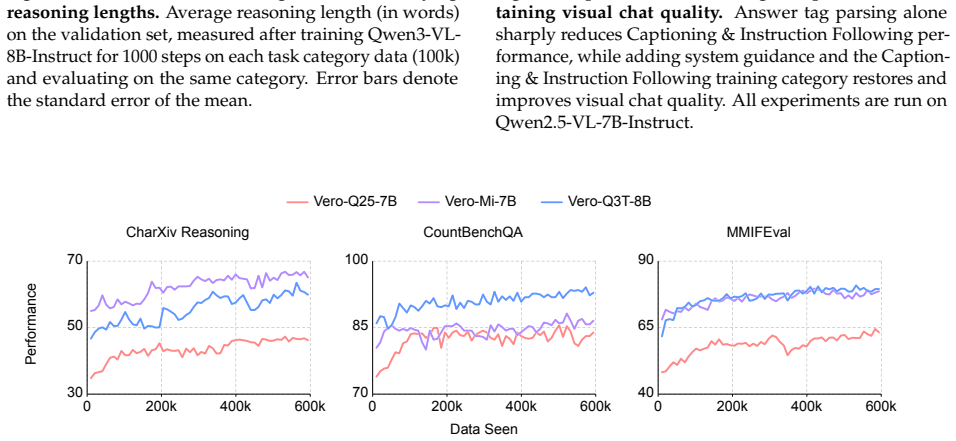
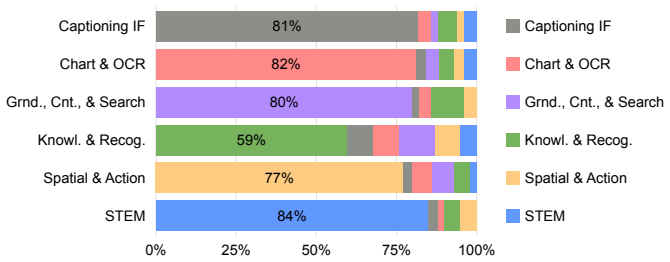
- Section 5 / Figure 7 and Section 7 argue that joint multi-category training is necessary because single-category runs yield negative transfer and distinct CoT/skill profiles. The single-category runs use 100k samples (1 epoch) while the full mixture uses 600k; the compute-controlled 100k mix is positive but smaller. The paper should more clearly separate “joint training is necessary for broad gains” from “more data and longer training help,” e.g., by reporting a matched-step single-category vs mix comparison at the full 600k budget or stating the compute-control caveat more prominently in the abstract/conclusion.
minor comments (5)
- Table 3 mixes official report numbers and author-evaluated † scores; a short note on which baselines used identical decoding/judge settings would improve fairness of head-to-head comparisons.
- Figure 1 and the bottom-row category bars are dense; axis labels and which model is “Vero Initial” vs final could be clearer for readers skimming.
- Appendix A.3–A.4 filtering rules and the LLM-judge prompt (Listing B.3) are thorough; a one-paragraph main-text summary of residual failure modes (e.g., remaining ambiguous Knowledge items) would help practitioners.
- Limitations (Section 8) correctly note no video/multi-turn and small model scale (7–9B); a sentence on whether the recipe is expected to transfer to larger bases would be useful.
- Typos/notation: occasional “Qwen35” vs “Qwen3.5”; ensure consistent naming of Vero-Qwen3I-8B / Vero-Qwen3T-8B across Table 3 and figures.
Circularity Check
No significant circularity: empirical multi-task RL gains measured on external benchmarks, not derived by construction from fitted inputs or self-definition.
full rationale
Vero is systems/empirical work. The load-bearing claims (Vero-600K beats prior open RL sets under controlled training from the same base; +2.9–5.4 overall on five post-trained models; joint six-category training needed because single-category runs show negative transfer and distinct CoT profiles) are established by training runs, held-out VeroEval scores, and ablations (Figs. 1, 6–7, 11–13; Tables 1–4), not by algebraic identity or by renaming a fit as a prediction. Rewards are outcome-based against ground-truth answers or constrained judges (Eqs. 1–4, task-routed verifiers in Sec. 3.3); success is not redefined as the training objective. Use of Qwen-family models for question/answer filtering and LLM-as-judge is standard tooling, not a self-citation uniqueness chain that forces the result. No uniqueness theorem, ansatz smuggled via self-citation, or self-definitional step appears in the derivation. The paper is self-contained against external benchmarks under fixed protocols; circularity score is therefore 0.
Axiom & Free-Parameter Ledger
free parameters (6)
- format_reward_weight_alpha =
0.2
- GSPO_clip_epsilons =
0.0003 / 0.0004
- learning_rate_and_batch =
1e-6; batch 256; G=8
- mixture_weighting_exponent_alpha =
ratio max/min = 1.6
- overlong_penalty_buffer =
B=2048, λ=1.0
- LLM_judge_score_normalization =
(s-1)/9; w=0.5
axioms (5)
- domain assumption Outcome-based RL (GSPO/GRPO-style) with verifiable or judge rewards improves multimodal reasoning without requiring teacher CoT distillation.
- ad hoc to paper The six task categories partition the skills needed for general visual reasoning and are the right axes for balanced multi-task RL.
- domain assumption LLM-as-judge scores (with anti-hacking guidelines) are sufficiently aligned rewards for captioning and instruction following.
- domain assumption Filtering with a large VLM/LLM for ambiguity, verifiability, and answer canonicity improves RL signal more than it biases the distribution.
- standard math Standard sequence-level policy optimization math (importance ratios, group-normalized advantages, clipping) is a valid training objective for VLMs.
invented entities (4)
-
Vero-600K / Vero-1.6M multi-task RL mixture
independent evidence
-
VeroEval 30-benchmark suite
independent evidence
-
Task-routed multi-verifier reward system
independent evidence
-
Six-category visual-reasoning taxonomy for RL
no independent evidence
read the original abstract
What does it take to build a visual reasoner that works across charts, science, spatial understanding, and open-ended tasks? The strongest vision-language models (VLMs) suggest that broad visual reasoning is within reach, yet their closed data and reinforcement learning (RL) pipelines make their gains difficult to study, reproduce, or extend. We introduce Vero, a family of fully open VLMs that match or exceed existing open-weight models across diverse visual reasoning tasks. We scale RL data and rewards across six broad task categories, constructing Vero-600K, a 600K-sample dataset from 59 datasets, and designing task-routed rewards that handle heterogeneous answers. Across VeroEval, our 30-benchmark suite, Vero-600K outperforms existing RL datasets under controlled comparisons. Applied to five starting models, Vero variants gain 2.9-5.4 points on average over their initial models. Notably, Vero-Qwen3I-8B, trained on the Instruct model, surpasses Qwen3-VL-8B-Thinking by 3.8 points on average without additional distillation. Systematic ablations reveal that different task categories elicit distinct reasoning patterns and that broad gains depend on learning them jointly rather than in isolation. All data, code, and models are publicly available.
Figures




Forward citations
Cited by 4 Pith papers
-
Zone of Proximal Policy Optimization: Teacher in Prompts, Not Gradients
ZPPO improves distillation to small vision-language models by using binary and negative candidate prompts plus a replay buffer for hard questions, outperforming standard distillation and GRPO on a 31-benchmark suite w...
-
Beacon: Knowing When and How to Perform Agentic Visual Reasoning
Beacon improves agentic visual reasoning by teaching models when tools are necessary and how to use them for net gains, via necessity-aware rewards and hint-guided RL.
-
MIRROR: Learning from the Other View for Multi-Modal Reasoning
An RL method that selects the best-performing view of each geometry problem as an internal teacher and distills it into weaker views improves VLM reasoning accuracy and consistency.
-
Trace: A Taxonomy-Guided Environment for Multidomain Visual Reasoning
RLVR training on 64,000 procedurally generated Trace instances improves Qwen2.5-VL macro-average on 24 external visual reasoning benchmarks by 3.51 points at 3B and 4.06 points at 7B.
Reference graph
Works this paper leans on
-
[1]
Spatial & Action receives the largest share (0.273) due to its low initial accuracy, while STEM receives the smallest (0.170)
Difficulty-weighted(rd ∝( 1 −acc d)α, α= 0.475): Up-weights domains where the model performs poorly after the profiling run. Spatial & Action receives the largest share (0.273) due to its low initial accuracy, while STEM receives the smallest (0.170)
-
[2]
Chart & OCR and Spatial & Action receive the largest shares ( ∼0.23 each), while Knowledge & Recognition receives the smallest (0.148)
Reasoning-length-weighted( rd ∝L α d, α= 0.144): Up-weights domains whose responses require longer chains of thought. Chart & OCR and Spatial & Action receive the largest shares ( ∼0.23 each), while Knowledge & Recognition receives the smallest (0.148). We also evaluate the inverse scheme (rd ∝L −α d ), which favors domains with shorter reasoning traces
-
[3]
Grounding, Counting & Search receives the largest share (0.244), while Spatial & Action receives the smallest (0.153)
Image-area-weighted( rd ∝A α d, α= 0.443): Up-weights domains with larger input images. Grounding, Counting & Search receives the largest share (0.244), while Spatial & Action receives the smallest (0.153)
-
[4]
REASONING
Without Knowledge & Recognition: Sets rd = 0 for Knowledge & Recognition and distributes weight equally among the remaining four domains (rd = 0.25 each). This ablation tests whether the lowest-gain category can be dropped without harming overall performance. 32 B Training Details B.1 System Prompt We provide the system prompt forVeroduring training and e...
2025
discussion (0)
Sign in with ORCID, Apple, or X to comment. Anyone can read and Pith papers without signing in.