Recognition: 1 theorem link
· Lean TheoremThermodynamic and Transport Properties of Quark-Gluon Plasma at Finite Chemical Potential with a DNN framework
Pith reviewed 2026-05-10 19:36 UTC · model grok-4.3
The pith
A deep neural network trained only at zero baryon density emulates quark-gluon plasma thermodynamic and transport properties at finite chemical potential.
A machine-rendered reading of the paper's core claim, the machinery that carries it, and where it could break.
Core claim
In the deep-learning-assisted quasi-particle model, neural networks are trained to reproduce lattice QCD results for the equation of state at vanishing baryon chemical potential. The networks then supply the thermal masses of quasi-particles as functions of both temperature and baryon chemical potential, allowing direct evaluation of thermodynamic quantities (speed of sound, specific heat) and transport coefficients (viscosity, conductivity) at finite chemical potential. The resulting values are consistent with available lattice calculations and other models, demonstrating that the trained network functions as a practical emulator for the finite-density regime.
What carries the argument
The deep-learning-assisted quasi-particle model (DLQPM), in which a neural network emulates the baryon-chemical-potential dependence of quasi-particle thermal masses after training on zero-density lattice QCD data.
If this is right
- Speed of sound and specific heat of the QGP become computable at finite baryon density without direct lattice simulation.
- Shear viscosity and electrical conductivity can be obtained from the same quasi-particle masses at nonzero chemical potential.
- The framework supplies an efficient route to thermodynamic and transport properties in the density range relevant to lower-energy heavy-ion collisions.
- The approach bypasses the sign problem by learning the zero-density lattice data and then extending via the quasi-particle ansatz.
Where Pith is reading between the lines
- The emulator could be inserted into hydrodynamic codes used to model baryon-rich heavy-ion collisions at facilities such as FAIR or NICA.
- Direct comparison with forthcoming lattice data at small nonzero chemical potential would provide a quantitative test of the extrapolation quality.
- Similar neural-network emulators might be constructed for other QCD observables limited by the sign problem, such as the phase diagram or susceptibilities.
Load-bearing premise
A neural network trained exclusively on lattice results at vanishing chemical potential can be embedded in the quasi-particle model to give accurate thermal masses at finite chemical potential.
What would settle it
Fresh lattice QCD results for the speed of sound or specific heat at small but nonzero baryon chemical potential that lie well outside the model's predicted bands would show the extrapolation is unreliable.
Figures



read the original abstract
The characteristics of a thermal system depend strongly on its response to thermal gradients and the underlying microscopic interactions among constituents. In the present study, we investigate the thermodynamic and transport properties of the quark-gluon plasma (QGP) at finite baryon chemical potential within a deep-learning-assisted quasi-particle model (DLQPM). The temperature ($\mathrm{T}$) and baryon chemical potential ($\mu_B$)-dependent thermal masses of quasi-particles are estimated using neural networks trained to reproduce lattice QCD (lQCD) results for the equation of state, obtained via a Taylor-like expansion around vanishing baryon chemical potential. The trained model acts as an effective emulator, enabling us to estimate the thermodynamic and transport properties at finite $\mu_B$. We compute the speed of sound, specific heat, viscosity, and conductivity of the deconfined medium. Our findings are in good agreement with available lattice calculations and other phenomenological models. The present study demonstrates that a DNN-based approach provides an efficient framework for studying the properties of the QGP at finite baryon density.
Editorial analysis
A structured set of objections, weighed in public.
Referee Report
Summary. The manuscript introduces a deep neural network (DNN) framework integrated into a quasi-particle model (DLQPM) for computing thermodynamic and transport properties of the quark-gluon plasma at finite baryon chemical potential. Neural networks are trained exclusively on lattice QCD equation-of-state data obtained via Taylor expansion around μ_B=0 to predict T- and μ_B-dependent thermal masses of quasi-particles. These masses are inserted into the quasi-particle model to evaluate the speed of sound, specific heat, shear viscosity, and electrical conductivity. The authors state that the resulting predictions agree with available lattice calculations and other phenomenological models, presenting the DNN as an effective emulator for extending zero-density results to finite density.
Significance. If the neural-network generalization to finite μ_B proves reliable, the work supplies a practical computational tool for estimating QGP properties in the baryon-rich regime inaccessible to direct lattice simulations due to the sign problem. This could support hydrodynamic modeling of heavy-ion collisions at moderate-to-high baryon density, where quantities such as the speed of sound and transport coefficients enter directly. The approach of training a DNN on existing μ_B=0 lattice data and embedding it in an established quasi-particle ansatz is methodologically economical and reproducible in principle.
major comments (2)
- [Abstract and Results] The central claim that the trained DNN furnishes reliable thermal masses at finite μ_B (and therefore trustworthy thermodynamic and transport coefficients) is not supported by any reported validation in the target regime. The network is fitted only to μ_B=0 Taylor-expanded lattice data; no cross-validation on held-out higher-order Taylor coefficients, no uncertainty bands on the extrapolated masses, and no direct comparison against the limited finite-μ_B lattice points that do exist are provided. This extrapolation step is load-bearing for every finite-density result presented.
- [Model description and numerical results] The quasi-particle model itself introduces additional assumptions (temperature- and density-dependent masses, specific dispersion relations) whose validity at μ_B > 0 is not independently tested. Because the DNN outputs are fed directly into these ansätze, any mismatch between the quasi-particle framework and true QCD dynamics at finite density propagates into all computed observables without quantified error.
minor comments (2)
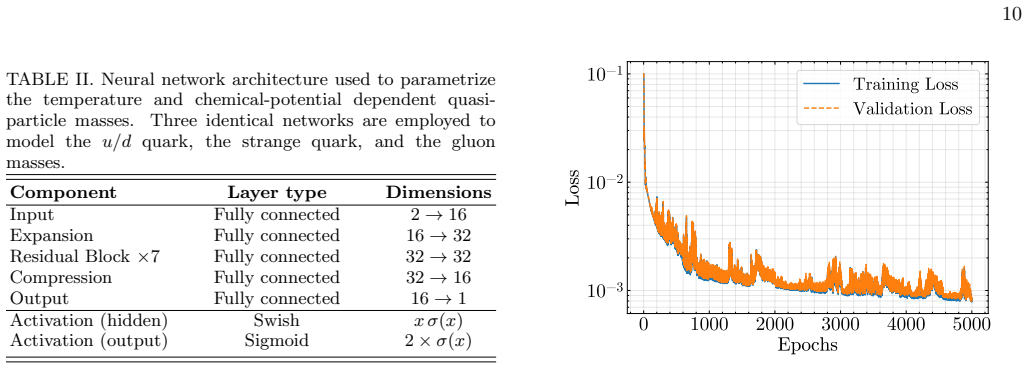
- [Methodology] The manuscript would benefit from an explicit statement of the neural-network architecture (number of layers, neurons, activation functions, loss function, and training/validation split) together with convergence diagnostics.
- [Figures] Figure captions and axis labels should indicate whether error bands or statistical uncertainties from the lattice training data are propagated through the DNN predictions.
Simulated Author's Rebuttal
We thank the referee for the careful and constructive review of our manuscript. The comments correctly identify key aspects of validation and model assumptions that warrant clarification and strengthening. We respond point-by-point below and outline the revisions we will make.
read point-by-point responses
-
Referee: [Abstract and Results] The central claim that the trained DNN furnishes reliable thermal masses at finite μ_B (and therefore trustworthy thermodynamic and transport coefficients) is not supported by any reported validation in the target regime. The network is fitted only to μ_B=0 Taylor-expanded lattice data; no cross-validation on held-out higher-order Taylor coefficients, no uncertainty bands on the extrapolated masses, and no direct comparison against the limited finite-μ_B lattice points that do exist are provided. This extrapolation step is load-bearing for every finite-density result presented.
Authors: We agree that explicit validation of the DNN extrapolation to finite μ_B is essential. The network is trained on the full set of available Taylor coefficients from lattice QCD at μ_B=0, which already encode the leading μ_B dependence. In the current manuscript we demonstrate consistency by reproducing the input lattice EoS at μ_B=0 and small μ_B. To address the referee’s concern, the revised version will include: (i) cross-validation by holding out higher-order Taylor coefficients where data permit, (ii) uncertainty bands on the predicted thermal masses obtained via an ensemble of networks or dropout-based estimation, and (iii) direct comparisons of thermodynamic quantities against the limited existing finite-μ_B lattice results in the overlapping temperature and density range. These additions will be presented in a new subsection on validation. revision: yes
-
Referee: [Model description and numerical results] The quasi-particle model itself introduces additional assumptions (temperature- and density-dependent masses, specific dispersion relations) whose validity at μ_B > 0 is not independently tested. Because the DNN outputs are fed directly into these ansätze, any mismatch between the quasi-particle framework and true QCD dynamics at finite density propagates into all computed observables without quantified error.
Authors: The quasi-particle model is a phenomenological framework whose parameters are fixed by matching lattice thermodynamics at μ_B=0; the DNN then supplies the μ_B dependence of those parameters. This is a standard strategy in the literature for extending zero-density results. We acknowledge that the dispersion relations and mass ansatz remain assumptions at finite density. In the revision we will expand the model-description section to explicitly list these assumptions, discuss their expected range of validity, and add comparisons of our transport coefficients (viscosity and conductivity) with other phenomenological models that employ similar quasi-particle or effective-mass approaches. While a fully quantified systematic error from the model choice is beyond the present scope, the added discussion will make the limitations transparent. revision: partial
Circularity Check
No significant circularity; extrapolation via trained emulator is not a reduction by construction
full rationale
The derivation trains a DNN exclusively on lQCD Taylor-expanded EOS data at μ_B=0 to produce T- and μ_B-dependent quasi-particle thermal masses, then inserts those masses into the quasi-particle model to compute finite-μ_B thermodynamics and transport. This is an out-of-distribution extrapolation whose outputs are not forced to equal the training inputs by any equation or statistical identity; the quasi-particle ansatz and NN generalization remain independent modeling choices. No self-definitional loops, fitted parameters renamed as predictions within the same data regime, or load-bearing self-citations appear in the abstract or described chain. The reported agreement with limited lattice results at small μ_B is a consistency check, not a closed loop.
Axiom & Free-Parameter Ledger
free parameters (1)
- Neural network weights and biases
axioms (1)
- domain assumption Quasi-particle model with T- and μ_B-dependent thermal masses accurately captures QGP thermodynamics and transport
invented entities (1)
-
DNN-based emulator for thermal masses
no independent evidence
Lean theorems connected to this paper
-
IndisputableMonolith/Cost/FunctionalEquation.leanwashburn_uniqueness_aczel unclear?
unclearRelation between the paper passage and the cited Recognition theorem.
The temperature (T) and baryon chemical potential (μ_B)-dependent thermal masses of quasi-particles are estimated using neural networks trained to reproduce lattice QCD (lQCD) results for the equation of state, obtained via a Taylor-like expansion around vanishing baryon chemical potential.
What do these tags mean?
- matches
- The paper's claim is directly supported by a theorem in the formal canon.
- supports
- The theorem supports part of the paper's argument, but the paper may add assumptions or extra steps.
- extends
- The paper goes beyond the formal theorem; the theorem is a base layer rather than the whole result.
- uses
- The paper appears to rely on the theorem as machinery.
- contradicts
- The paper's claim conflicts with a theorem or certificate in the canon.
- unclear
- Pith found a possible connection, but the passage is too broad, indirect, or ambiguous to say the theorem truly supports the claim.
Forward citations
Cited by 1 Pith paper
-
Inferring identified hadron production in $pp$ collisions with physics-informed machine learning at the LHC
A physics-informed neural network infers pT spectra of pi, K, p, Lambda, and Ks in unmeasured rapidity regions from PYTHIA8 pp collisions at 13.6 TeV, achieving 1.5-5.83% yield uncertainties while reproducing yield ra...
Reference graph
Works this paper leans on
-
[1]
We observe that the effective masses decrease mono- tonically as temperature increases, which matches the trends predicted by quasi-particle models [20, 21] varying by marginal modifications done to reproduce the training data. Once the training is completed, the model can reli- ably predict the effective masses of the quasi-particle, re- producing its tr...
2000
-
[2]
C. P. Singh, Phys. Rept.236, 147 (1993)
1993
-
[3]
K. G. Wilson, Phys. Rev. D10, 2445 (1974)
1974
-
[4]
Creutz, Phys
M. Creutz, Phys. Rev. D21, 2308 (1980)
1980
-
[5]
J. B. Kogut and L. Susskind, Phys. Rev. D11, 395 (1975)
1975
-
[6]
Muroya, A
S. Muroya, A. Nakamura, C. Nonaka and T. Takaishi, Prog. Theor. Phys.110, 615 (2003)
2003
-
[7]
de Forcrand, PoSLA T2009, 010 (2009)
P. de Forcrand, PoSLA T2009, 010 (2009)
2009
-
[8]
N. K. Glendenning,Compact Stars: Nuclear Physics, Particle Physics, and General Relativity, Springer, e- ISBN: 978-1-4612-7045-4 (2000)
2000
-
[9]
Annala, T
E. Annala, T. Gorda, A. Kurkela, J. N¨ attil¨ a and A. Vuorinen, Nature Phys.16, 907 (2020)
2020
-
[10]
C. R. Allton, S. Ejiri, S. J. Hands, O. Kaczmarek, F. Karsch, E. Laermann, C. Schmidt and L. Scorzato, Phys. Rev. D66, 074507 (2002)
2002
-
[11]
Borsanyi, G
S. Borsanyi, G. Endrodi, Z. Fodor, S. D. Katz, S. Krieg, C. Ratti and K. K. Szabo, J. High Energy Phys.08, 053 (2012)
2012
-
[12]
Nambu and G
Y. Nambu and G. Jona-Lasinio, Phys. Rev.122, 345 (1961)
1961
-
[13]
Nambu and G
Y. Nambu and G. Jona-Lasinio, Phys. Rev.124, 246 11 (1961)
1961
-
[14]
Marty, E
R. Marty, E. Bratkovskaya, W. Cassing, J. Aichelin and H. Berrehrah, Phys. Rev. C88, 045204 (2013)
2013
-
[15]
Dwibedi, D
A. Dwibedi, D. R. J. Marattukalam, N. Padhan, D. Sahu, J. Dey, K. Goswami, A. Chatterjee, S. Ghosh and R. Sa- hoo, Phys. Rev. C113, 044903 (2026)
2026
-
[16]
Fukushima, Phys
K. Fukushima, Phys. Lett. B591, 277 (2004)
2004
-
[17]
Ratti, M
C. Ratti, M. A. Thaler and W. Weise, Phys. Rev. D73, 014019 (2006)
2006
-
[18]
Costa, M
P. Costa, M. C. Ruivo, C. A. de Sousa, H. Hansen and W. M. Alberico, Phys. Rev. D79, 116003 (2009)
2009
-
[19]
Goswami, D
K. Goswami, D. Sahu, J. Dey, R. Sahoo and R. Stock, Phys. Rev. D109, 074012 (2024)
2024
-
[20]
Peshier, B
A. Peshier, B. K¨ ampfer and G. Soff, Phys. Rev. C61, 045203 (2000)
2000
-
[21]
Plumari, W
S. Plumari, W. M. Alberico, V. Greco and C. Ratti, Phys. Rev. D84, 094004 (2011)
2011
-
[22]
M. L. Sambataro, V. Greco, G. Parisi and S. Plumari, Eur. Phys. J. C84, 881 (2024)
2024
-
[23]
Singh and R
K. Singh and R. Sahoo, Phys. Rev. D112, 034032 (2025)
2025
-
[24]
P. K. Srivastava, S. K. Tiwari and C. P. Singh, Phys. Rev. D82, 014023 (2010)
2010
-
[25]
Guest, K
D. Guest, K. Cranmer and D. Whiteson, Ann. Rev. Nucl. Part. Sci.68, 161 (2018)
2018
-
[26]
Mallick, S
N. Mallick, S. Tripathy, A. N. Mishra, S. Deb and R. Sa- hoo, Phys. Rev. D103, 094031 (2021)
2021
-
[27]
Goswami, S
K. Goswami, S. Prasad, N. Mallick, R. Sahoo and G. B. Mohanty, Phys. Rev. D110, 034017 (2024)
2024
-
[28]
Prasad, N
S. Prasad, N. Mallick and R. Sahoo, Phys. Rev. D109, 014005 (2024)
2024
- [29]
-
[30]
A. J. Larkoski, I. Moult and B. Nachman, Phys. Rept. 841, 1 (2020)
2020
-
[31]
Mallick, S
N. Mallick, S. Prasad, A. N. Mishra, R. Sahoo and G. G. Barnaf¨ oldi, Phys. Rev. D105, 114022 (2022)
2022
-
[32]
Mallick, S
N. Mallick, S. Prasad, A. N. Mishra, R. Sahoo and G. G. Barnaf¨ oldi, Phys. Rev. D107, 094001 (2023)
2023
-
[33]
Hornik, M
K. Hornik, M. Stinchcombe and H. White, Neural Net- works2, 59 (1989)
1989
-
[34]
LeCun, Y
Y. LeCun, Y. Bengio and G. Hinton, Nature521, 436 (2015)
2015
-
[35]
Baldi, P
P. Baldi, P. Sadowski and D. Whiteson, Nature Commun. 5, 4308 (2014)
2014
-
[36]
F. P. Li, H. L. L¨ u, L. G. Pang and G. Y. Qin, Phys. Lett. B844, 138088 (2023)
2023
-
[37]
F. P. Li, L. G. Pang and G. Y. Qin, Phys. Lett. B868, 139692 (2025)
2025
-
[38]
M. Y. Jamal, F. P. Li, L. G. Pang and G. Y. Qin, Phys. Rev. C113, 034915 (2026)
2026
-
[39]
Bors´ anyi, Z
S. Bors´ anyi, Z. Fodor, J. N. Guenther, R. Kara, S. D. Katz, P. Parotto, A. P´ asztor, C. Ratti and K. K. Szab´ o, Phys. Rev. Lett.126, 232001 (2021)
2021
-
[40]
Goloviznin and H
V. Goloviznin and H. Satz, Z. Phys. C57, 671 (1993)
1993
-
[41]
M. I. Gorenstein and S. N. Yang, Phys. Rev. D52, 5206 (1995)
1995
-
[42]
Puglisi, S
A. Puglisi, S. Plumari and V. Greco, Phys. Rev. D90, 114009 (2014)
2014
-
[43]
Schenke, S
B. Schenke, S. Jeon and C. Gale, Phys. Rev. C85, 024901 (2012)
2012
-
[44]
F. G. Gardim and J. Y. Ollitrault, Phys. Rev. C103, 044907 (2021)
2021
-
[45]
Sahoo, C
B. Sahoo, C. R. Singh, D. Sahu, R. Sahoo and J. e. Alam, Eur. Phys. J. C83, 873 (2023)
2023
-
[46]
Singh, J
K. Singh, J. Dey and R. Sahoo, Phys. Rev. D110, 114051 (2024)
2024
-
[47]
Singh, J
K. Singh, J. Dey and R. Sahoo, Phys. Rev. D109, 014018 (2024)
2024
-
[48]
Sasaki and K
C. Sasaki and K. Redlich, Phys. Rev. C79, 055207 (2009)
2009
-
[49]
Electrical conductivity of QGP with quasiparticle quarks and Gribov gluon
S. Madni, L. Thakur and N. Haque, [arXiv:2404.09767 [hep-ph]]
work page internal anchor Pith review Pith/arXiv arXiv
-
[50]
Singh, J
K. Singh, J. Dey, R. Sahoo and S. Ghosh, Phys. Rev. D 108, 094007 (2023)
2023
-
[51]
Abhishek, A
A. Abhishek, A. Das, D. Kumar and H. Mishra, Eur. Phys. J. C82, 71 (2022)
2022
-
[52]
PyTorch: An Imperative Style, High-Performance Deep Learning Library
A. Paszke, S. Gross, F. Massa, A. Lerer, J. Brad- bury, G. Chanan, T. Killeen, Z. Lin, N. Gimelshein and L. Antiga,et al.[arXiv:1912.01703 [cs.LG]]
work page internal anchor Pith review Pith/arXiv arXiv 1912
-
[53]
Available online:https://docs.pytorch.org/ tutorials/beginner/blitz/autograd_tutorial.html (Accessed on: 30 March 2026)
2026
-
[54]
D. P. Kingma and J. Ba, [arXiv:1412.6980 [cs.LG]]
work page internal anchor Pith review Pith/arXiv arXiv
-
[55]
Decoupled Weight Decay Regularization
I. Loshchilov and F. Hutter, [arXiv:1711.05101 [cs.LG]]
work page internal anchor Pith review Pith/arXiv arXiv
-
[56]
Available online:https://docs.pytorch.org/docs/ stable/generated/torch.optim.AdamW.html(Accessed on: 30 March 2026)
2026
-
[57]
StepLR.html(Accessed on: 30 March 2026)
Available online:https://docs.pytorch.org/docs/ stable/generated/torch.optim.lr_scheduler. StepLR.html(Accessed on: 30 March 2026)
2026
-
[58]
A. S. Khvorostukhin, V. D. Toneev and D. N. Voskresen- sky, Nucl. Phys. A845, 106 (2010)
2010
-
[59]
Hayrapetyanet al.[CMS], Rept
A. Hayrapetyanet al.[CMS], Rept. Prog. Phys.87, 077801 (2024)
2024
-
[60]
Bazavovet al.[HotQCD], Phys
A. Bazavovet al.[HotQCD], Phys. Rev. D90, 094503 (2014)
2014
-
[61]
Borsanyi, Z
S. Borsanyi, Z. Fodor, C. Hoelbling, S. D. Katz, S. Krieg and K. K. Szabo, Phys. Lett. B730, 99 (2014)
2014
-
[62]
L. D. Landau and E. M. Lifshitz,Fluid Mechanics, Perg- amon, e-ISBN: 978-0-08-033933-7 (1987)
1987
-
[63]
M. Haas, L. Fister and J. M. Pawlowski, Phys. Rev. D 90, 091501 (2014)
2014
-
[64]
Kovtun, D
P. Kovtun, D. T. Son and A. O. Starinets, Phys. Rev. Lett.94, 111601 (2005)
2005
-
[65]
J. E. Bernhard, J. S. Moreland and S. A. Bass, Nat. Phys. 15, 1113 (2019)
2019
-
[66]
Aarts, C
G. Aarts, C. Allton, A. Amato, P. Giudice, S. Hands and J. I. Skullerud, JHEP02, 186 (2015)
2015
-
[67]
Amato, G
A. Amato, G. Aarts, C. Allton, P. Giudice, S. Hands and J. I. Skullerud, Phys. Rev. Lett.111172001 (2013)
2013
discussion (0)
Sign in with ORCID, Apple, or X to comment. Anyone can read and Pith papers without signing in.