Recognition: unknown
On quantum tunnelling in the presence of Noether charges
Pith reviewed 2026-05-10 17:05 UTC · model grok-4.3
The pith
Quantum tunnelling from states with conserved Noether charges follows a simple Euclidean prescription
A machine-rendered reading of the paper's core claim, the machinery that carries it, and where it could break.
Core claim
The central claim is that tunnelling rates out of initial states carrying a conserved Noether charge are given by an unambiguous Euclidean-time path integral prescription. This prescription is obtained through a direct derivation that avoids ad-hoc generalisations and supplies a simple explanation for the appearance of complex saddle points. The result is illustrated for a point particle with angular momentum, generalised to multiple dimensions and arbitrary charges, and applied to a complex scalar field with U(1) symmetry, yielding the first explicit results for states that possess both charge and energy.
What carries the argument
The Euclidean-time path integral prescription that incorporates the constraint imposed by the conserved Noether charge.
If this is right
- Tunnelling rates can be calculated for initial states that carry both a Noether charge and a non-zero energy.
- The method supplies a transparent justification for the appearance of complex saddle points when conserved charges are present.
- It provides an easy-to-implement recipe that works in multiple dimensions for any conserved Noether charge.
- The results establish a foundation for computing rates in finite-density and charge-asymmetric systems.
Where Pith is reading between the lines
- The prescription could simplify analytic or numerical studies of vacuum decay in models that include chemical potentials.
- It may connect to calculations of false vacuum decay in the early universe when particle asymmetries are present.
- One could test the result by comparing its output to exact solutions in solvable quantum-mechanical models with rotational symmetry.
Load-bearing premise
The real-time dynamics with a conserved charge can be continued to Euclidean time in a direct manner that captures the tunnelling without extra adjustments.
What would settle it
An exact computation of the tunnelling rate for the two-dimensional point particle with fixed angular momentum that differs from the rate given by the Euclidean prescription.
Figures



read the original abstract
We provide a complete first-principles based discussion of quantum tunnelling out of initial states carrying a conserved Noether charge. Our main result is a simple, unambiguous Euclidean-time prescription for the calculation of tunnelling rates out of such states. By relying on a combination of the direct approach and the steadyon framework for the evaluation of real-time path integrals, our derivation offers full transparency of its underlying assumptions, and is independent of any ad-hoc generalisations. This strategy also offers a simple explanation for the emergence of complex saddle points for such systems, justifying techniques postulated by earlier works. Our analysis furthermore offers the first results for initial states with both a conserved Noether charge and a non-trivial energy. We first illustrate the main conceptual points of our analysis for the simple example of a point particle in two spatial dimensions carrying a conserved angular momentum. Then, we generalise our results to the case of multiple dimensions and an arbitrary conserved Noether charge, providing an easy-to-implement prescription for the calculation of the tunnelling rate. We furthermore apply our results to the example of a complex scalar field subject to a global U(1)-symmetry with associated charge. These results provide a reliable foundation for the calculation of tunnelling rates in applications in finite-density and charge-asymmetric systems.
Editorial analysis
A structured set of objections, weighed in public.
Referee Report
Summary. The paper derives a first-principles Euclidean-time prescription for quantum tunnelling rates from initial states carrying conserved Noether charges. It combines the direct approach with the steadyon framework for real-time path integrals to obtain an unambiguous method that explains the emergence of complex saddles. The derivation is illustrated first for a 2D point particle with angular momentum, then generalized to multiple dimensions and arbitrary charges, and finally applied to a U(1)-charged complex scalar field, yielding results for states with both non-zero charge and non-trivial energy.
Significance. If the central derivation holds, the work supplies a transparent, assumption-minimal route to tunnelling calculations in charged systems. This is relevant for finite-density and charge-asymmetric applications in high-energy physics and condensed matter. The explicit link to the steadyon framework and the treatment of states with both charge and energy constitute genuine advances over prior ad-hoc prescriptions.
major comments (2)
- [§4] §4 (generalisation to arbitrary Noether charges): the contour deformation that justifies the Euclidean continuation for non-zero charge and finite initial energy is stated to follow automatically from the steadyon framework, yet the explicit steps showing uniqueness of the deformation (or absence of additional assumptions) are not provided; this is load-bearing for the claim of an 'unambiguous' and 'assumption-free' prescription.
- [§5] §5 (complex scalar field application): while the emergence of complex saddles is explained, the explicit matching between the steadyon real-time contour and the Euclidean saddle for the U(1) charge is not shown in sufficient detail to confirm that the prescription remains parameter-free when both charge and energy are non-trivial.
minor comments (2)
- [Introduction] The abstract and introduction refer to 'full transparency of underlying assumptions' but do not list the precise set of assumptions retained from the steadyon framework; a short enumerated list would improve clarity.
- [§2] Notation for the conserved charge Q and the associated chemical potential is introduced without an explicit definition of the initial-state density matrix; adding this in §2 would aid readers unfamiliar with the direct approach.
Simulated Author's Rebuttal
We thank the referee for the careful reading and constructive feedback on our manuscript. The comments highlight opportunities to enhance the transparency of our derivation, particularly regarding contour deformations and explicit matchings. We address each major comment below and will incorporate clarifications in the revised version to strengthen the presentation of our first-principles approach.
read point-by-point responses
-
Referee: [§4] §4 (generalisation to arbitrary Noether charges): the contour deformation that justifies the Euclidean continuation for non-zero charge and finite initial energy is stated to follow automatically from the steadyon framework, yet the explicit steps showing uniqueness of the deformation (or absence of additional assumptions) are not provided; this is load-bearing for the claim of an 'unambiguous' and 'assumption-free' prescription.
Authors: We agree that additional explicit steps would improve clarity. The steadyon framework determines the contour via its real-time path-integral construction, which enforces the deformation uniquely through the requirement of convergence and the analytic continuation of the Noether charge constraint. In the revised manuscript we will insert a dedicated subsection in §4 that derives the contour step-by-step from the steadyon saddle-point equations, demonstrating that no extra assumptions beyond the framework itself are required. This will make the uniqueness manifest and reinforce the assumption-minimal character of the prescription. revision: yes
-
Referee: [§5] §5 (complex scalar field application): while the emergence of complex saddles is explained, the explicit matching between the steadyon real-time contour and the Euclidean saddle for the U(1) charge is not shown in sufficient detail to confirm that the prescription remains parameter-free when both charge and energy are non-trivial.
Authors: We thank the referee for this observation. The matching follows from substituting the steadyon contour into the Euclidean action and verifying that the resulting saddle equations reproduce the charge and energy constraints without introducing free parameters. In the revised §5 we will add an explicit calculation that traces the real-time contour through the U(1) phase rotation to the Euclidean saddle, including the case of simultaneous non-zero charge and energy. This will confirm parameter independence and provide the requested detail. revision: yes
Circularity Check
No significant circularity detected in the claimed first-principles derivation
full rationale
The paper derives its Euclidean-time prescription by combining the direct approach with the steadyon framework for real-time path integrals, then generalizes from the 2D point-particle example (angular momentum) to the U(1) scalar field. The abstract explicitly states that this yields a transparent, assumption-light result independent of ad-hoc generalizations and provides an explanation for complex saddles. No quoted equations, definitions, or steps in the provided text reduce the central prescription to a fitted input, self-definition, or load-bearing self-citation chain by construction. The result is presented as having independent content from the method combination, making the derivation self-contained against external benchmarks.
Axiom & Free-Parameter Ledger
axioms (1)
- domain assumption The direct approach combined with the steadyon framework provides a transparent, assumption-free evaluation of real-time path integrals for charged states.
Forward citations
Cited by 1 Pith paper
-
Tunneling and tidal stripping in multifield ultralight dark matter halos
A semiclassical tunneling model shows that two-field ultralight DM halos have stability bounds that can be relaxed for some density-mass ratios but become more stringent across much of the parameter space compared to ...
Reference graph
Works this paper leans on
-
[1]
Effective one-dimensional description 11
-
[2]
Summary and Euclidean-time procedure 14 D
Two-dimensional description 13 C. Summary and Euclidean-time procedure 14 D. Detailed example 15 IV. Generalisation to field theory 17 A. Field wave functional 19 B. Tunnelling at fixedQin QFT 19 V. Conclusions 22 A. WKB approximation for the wave function 23 B. Fixed-charge tunnelling in configuration-space coordinates 25
-
[3]
Amplitude in terms of the initial wave functional 25 ∗ giulio.barni@ift.csic.es † thomas.steingasser@uam.es arXiv:2604.08660v1 [hep-th] 9 Apr 2026 2
work page internal anchor Pith review Pith/arXiv arXiv 2026
-
[4]
Semiclassical exponent and boundary contribution 26
-
[5]
Configuration-space Lagrangian and reduced Routhian 27
-
[6]
Equations of motion at fixed charge 28
-
[7]
Steadyon and Euclidean formulations 29
-
[8]
INTRODUCTION Quantum tunnelling is one of the most characteristic non-perturbative phenomena in all quantum theories
Relation to the mechanical case 29 References 30 I. INTRODUCTION Quantum tunnelling is one of the most characteristic non-perturbative phenomena in all quantum theories. In quantum mechanics, tunnelling describes the exponentially suppressed propagation of a particle through a classically forbidden region, providing the basic mechanism behind phenomena su...
-
[9]
(48), we found that the tunnelling rate is, to leading order, controlled by the Routhian action, whose variation yields the equation of motion for the radial component of steadyon
Effective one-dimensional description In Eq. (48), we found that the tunnelling rate is, to leading order, controlled by the Routhian action, whose variation yields the equation of motion for the radial component of steadyon. Starting from Eq. (45) it is straightforward to identify the regularised Routhian action with the integral of the corresponding 12 ...
-
[10]
The latter is again determined by the angular momentum of the initial state through Eq
Two-dimensional description To understand the transition from real to Euclidean time in the full theory, we observe that the regularised action can also be identified with an integral of an analytic function alongγ ϵ, Sγϵ[r]= ∫γϵ dz[ m 2 ( dr dz) 2 + m 2 r2( dφ dz ) 2 −V(r)].(60) It is again straightforward to obtain the analytic continuation of this expr...
-
[11]
Integrate out the cyclic variable by inverting the defining equation of its associated Noether charge, J≡∂L/∂˙φ
-
[12]
Absorb the Noether charge-dependent term into the potential,V(r)→V eff(r)
-
[13]
Construct the Euclidean-time Routhian actionS R,E as SR,E[r;J]= ∫ ∆τper 0 dτ m 2 gij ˙ri ˙rj+V eff(r),(71) where the Noether charge is identical to that in the initial state, andg ij denotes the metric in the submanifold spanned by the non-cyclical variablesr
-
[14]
Identify the submanifolds Σ ∗and Σs through the initial state’s energyEusing the conditions Veff(r∗)=E=V eff(rs),for allr ∗∈Fandr s ∈R.(72) Recall thatFwas defined as the basin of attraction of the false vacuum, whileRdenotes the region into which the particle tunnels. See Fig. 1
-
[15]
Solve the Euclidean equation of motion forrwith vanishing initial velocity, d2gij¯rj I dτ 2 = ∂Veff(¯rI) ∂r i ,¯r I(0)∈Σ∗ d¯rI dτ (0)=0.(73)
-
[16]
Read off ∆τ per as the Euclidean time when ¯rI reachesr s for thefirsttime
-
[17]
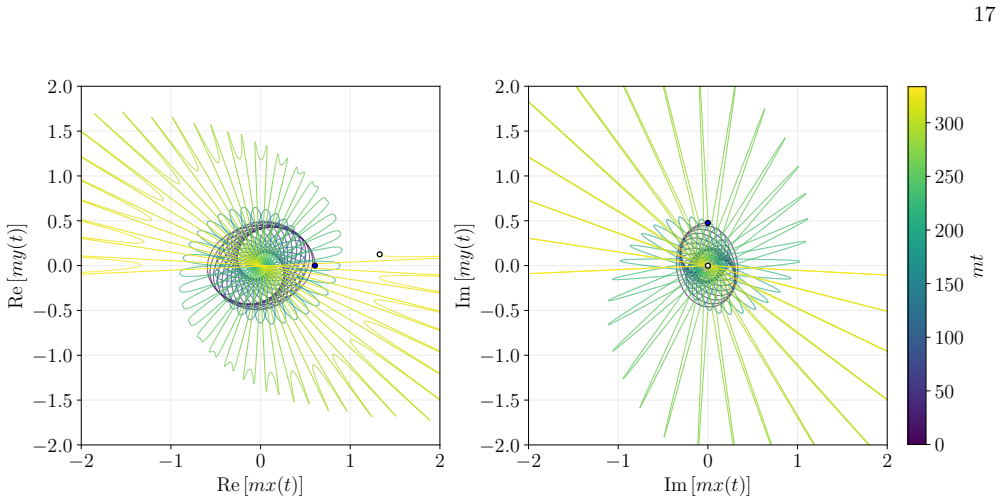
Evaluate ¯SE in Eq. (71) as the Euclidean-time Routhian actionS R,E of ¯rI. D. Detailed example To make the general discussion fully explicit, we now consider the simplest non-trivial model: a particle of unit mass in two dimensions, subject to the rotationally invariant potential V(r)= 1 2 mω2r2−λ 4 r4, V eff(r)=V(r)+ J2 2mr2 ,(74) where, for simplicity,...
-
[18]
26 The fixed-charge assumption means that Ψ Q transforms as an eigenfunctional of the globalU(1) generator
Amplitude in terms of the initial wave functional We consider a complex scalar field with action S[ϕ, ϕ∗]= ∫ d4x ∂µϕ∗∂µϕ−V(ϕ∗ϕ).(B1) The transition amplitude from an initial state of fixed chargeQto a final field configurationϕ s at time ∆tcan be written as AQ[ϕs,∆t∣Σ∗]= ∫Σ∗ Dϕi ΨQ[ϕi]DF[ϕs,∆t∣ϕi],(B2) where ΨQ[ϕi]is the initial wave functional and DF[ϕs,...
-
[19]
Semiclassical exponent and boundary contribution In the semiclassical approximation, DF[ϕs,∆t∣Θi, Yi]∼exp(iS[Θ, Y]),(B12) whereS[Θ, Y]denotes the action evaluated on the relevant saddle connecting the initial configuration labelled by(Θ i, Yi)to the chosen final configuration. The amplitude then takes the form AQ[ϕs,∆t∣Σ∗]∼∫ dΘi DYi exp(iS[Θ, Y]+iQΘ i+log...
-
[20]
Configuration-space Lagrangian and reduced Routhian We now derive the explicit configuration-space form of the action. Using ϕ(x)=e iΘχ(x;Y), ˙ϕ=e iΘ(i ˙Θχ+˙χ ) ,(B19) we find ∣˙ϕ∣2 = ˙Θ2∣χ∣2+i ˙Θ(χ∗˙χ−˙χ∗χ)+∣˙χ∣2 .(B20) The spatial gradient does not depend on Θ, ∣∇ϕ∣2 =∣∇χ∣2 ,(B21) and similarlyV(ϕ ∗ϕ)=V(χ ∗χ). The full Lagrangian can therefore be writte...
-
[21]
(B32), this becomes 0= d dt [GAB ˙Y B+ AA I (Q−AC ˙Y C)]−1 2 ∂AGBC ˙Y B ˙Y C+∂ AU +1 2 ∂A( 1 I)(Q−A C ˙Y C) 2 −1 I(Q−AC ˙Y C)∂ AAB ˙Y B ,(B35) where∂ A ≡δ/δY A
Equations of motion at fixed charge The reduced action is SR[Y;Q]= ∫ ∆t 0 dt R(Y, ˙Y;Q).(B33) The fixed-charge equations of motion are therefore the Euler-Lagrange equations for the transverse configuration-space coordinates, d dt δR δ ˙Y A −δR δY A =0.(B34) Using Eq. (B32), this becomes 0= d dt [GAB ˙Y B+ AA I (Q−AC ˙Y C)]−1 2 ∂AGBC ˙Y B ˙Y C+∂ AU +1 2 ∂...
-
[22]
In the steadyon formulation, the original action is replaced by its regulated versionS ϵ, SR,ϵ[Y;Q]= ∫ dt Rϵ(Y, ˙Y;Q),(B36) with the regulated RouthianR ϵ (100)
Steadyon and Euclidean formulations Up to this point, the discussion in this appendix is independent of the chosen time variable. In the steadyon formulation, the original action is replaced by its regulated versionS ϵ, SR,ϵ[Y;Q]= ∫ dt Rϵ(Y, ˙Y;Q),(B36) with the regulated RouthianR ϵ (100). The steadyon equations are then the Euler–Lagrange equations asso...
-
[23]
The only difference is that, in ordinary mechanics, the reduced coordinatesY A are finite in number, while in field theory they label an infinite-dimensional configuration space
Relation to the mechanical case The above construction is completely identical to the quantum-mechanical one. The only difference is that, in ordinary mechanics, the reduced coordinatesY A are finite in number, while in field theory they label an infinite-dimensional configuration space. In this sense, quantum mechanics is simply the 0+1-dimensional versi...
-
[24]
Gamow, Zur quantentheorie des atomkernes, Z
G. Gamow, Zur quantentheorie des atomkernes, Z. Phys.51, 204 (1928)
1928
-
[25]
R. W. Gurney and E. U. Condon, Wave mechanics and radioactive disintegration, Nature122, 439 (1928)
1928
-
[26]
S. R. Coleman, The Fate of the False Vacuum. 1. Semiclassical Theory, Phys. Rev.D15, 2929 (1977), [Erratum: Phys. Rev.D16,1248(1977)]
1977
-
[27]
C. G. Callan and S. Coleman, Fate of the false vacuum. ii. first quantum corrections, Phys. Rev. D16, 1762 (1977)
1977
-
[28]
S. R. Coleman and F. De Luccia, Gravitational effects on and of vacuum decay, Physical Review D21, 3305 (1980)
1980
-
[29]
Linde, Fate of the false vacuum at finite temperature: Theory and applications, Physics Letters B100, 37 (1981)
A. Linde, Fate of the false vacuum at finite temperature: Theory and applications, Physics Letters B100, 37 (1981)
1981
-
[30]
Precision decay rate calculations in quantum field theory
A. Andreassen, D. Farhi, W. Frost, and M. D. Schwartz, Precision decay rate calculations in quantum field theory, Phys. Rev. D95, 085011 (2017), arXiv:1604.06090 [hep-th]
work page Pith review arXiv 2017
-
[31]
Lee, Quantum tunneling with global charge, Physical Review D50, 5333 (1994)
K. Lee, Quantum tunneling with global charge, Physical Review D50, 5333 (1994)
1994
- [32]
- [33]
-
[34]
Barni and J
G. Barni and J. R. Espinosa, Tunneling decay at fixed charge: nucleation theory (2026), work in progress, to appear
2026
-
[35]
Lee, Wormholes and goldstone bosons, Physical Review Letters61, 263 (1988)
K. Lee, Wormholes and goldstone bosons, Physical Review Letters61, 263 (1988)
1988
-
[36]
S. R. Coleman and K.-M. Lee, Wormholes made without massless matter fields, Nuclear Physics B329, 387 (1990)
1990
-
[37]
S. B. Giddings and A. Strominger, Axion-induced topology change in quantum gravity and string theory, Nucl. Phys. B306, 890 (1988)
1988
-
[38]
S. B. Giddings and A. Strominger, Loss of incoherence and determination of coupling constants in quantum gravity, Nucl. Phys. B307, 854 (1988)
1988
-
[39]
R. Alonso and A. Urbano, Wormholes and masses for goldstone bosons, JHEP02, 136, arXiv:1706.07415 [hep-ph]
- [40]
-
[41]
T. Steingasser and D. I. Kaiser, Toward quantum tunneling from excited states: Recovering imaginary-time instantons from a real-time analysis, Phys. Rev. D111, 096009 (2025), arXiv:2402.00099 [hep-th]
-
[42]
T. Steingasser, M. K¨ onig, and D. I. Kaiser, Finite-temperature instantons from first principles, Phys. Rev. D 110, L111902 (2024), arXiv:2310.19865 [hep-th]
- [43]
- [44]
-
[45]
A direct approach to quantum tunneling
A. Andreassen, D. Farhi, W. Frost, and M. D. Schwartz, Direct Approach to Quantum Tunneling, Phys. Rev. Lett.117, 231601 (2016), arXiv:1602.01102 [hep-th]. 31
work page Pith review arXiv 2016
-
[46]
N. K. Glendenning, First-order phase transitions with more than one conserved charge: Consequences for neutron stars, Phys. Rev. D46, 1274 (1992)
1992
-
[47]
K. Iida and K. Sato, Quantum nucleation of two-flavor quark matter in neutron stars, Prog. Theor. Phys.98, 277 (1997), arXiv:astro-ph/9705211 [astro-ph]
- [48]
- [49]
-
[50]
E. R. Most, L. J. Papenfort, V. Dexheimer, M. Hanauske, S. Schramm, H. Stoecker, and L. Rezzolla, Signatures of quark-hadron phase transitions in general-relativistic neutron-star mergers, Phys. Rev. Lett.122, 061101 (2019), arXiv:1807.03684 [astro-ph.HE]
work page Pith review arXiv 2019
-
[51]
A. Bauswein, N.-U. F. Bastian, D. B. Blaschke, K. Chatziioannou, J. A. Clark, T. Fischer, and M. Oertel, Identifying a first-order phase transition in neutron star mergers through gravitational waves, Phys. Rev. Lett. 122, 061102 (2019), arXiv:1809.01116 [astro-ph.HE]
- [52]
- [53]
- [54]
-
[55]
E. J. Routh,An Elementary Treatise on the Dynamics of a System of Rigid Bodies(Macmillan, Cambridge and London, 1860)
-
[56]
Goldstein, C
H. Goldstein, C. P. Poole, and J. L. Safko,Classical Mechanics, 3rd ed. (Addison-Wesley, San Francisco, 2001)
2001
-
[57]
L. D. Landau and E. M. Lifshitz,Mechanics, 3rd ed., Course of Theoretical Physics, Vol. 1 (Pergamon Press, Oxford, 1976)
1976
-
[58]
Steingasser,New perspectives on solitons and instantons in the Standard Model and beyond, Ph.D
T. Steingasser,New perspectives on solitons and instantons in the Standard Model and beyond, Ph.D. thesis, Munich U. (2022)
2022
- [59]
-
[60]
D. Tong, TASI lectures on solitons: Instantons, monopoles, vortices and kinks, JHEP02, 030, arXiv:hep- th/0509216
discussion (0)
Sign in with ORCID, Apple, or X to comment. Anyone can read and Pith papers without signing in.