Recognition: unknown
Nonlinear response of flow harmonics in Gubser flow with participant-reaction planes mismatch
Pith reviewed 2026-05-10 16:16 UTC · model grok-4.3
The pith
A mismatch between participant and reaction planes in Gubser flow can change both the strength and sign of nonlinear response coefficients for flow harmonics v2 and v4.
A machine-rendered reading of the paper's core claim, the machinery that carries it, and where it could break.
Core claim
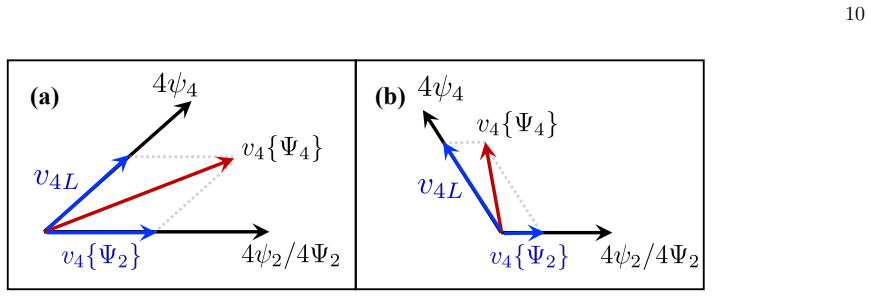
By extending the perturbative solutions of Gubser flow, analytic nonlinear response relations are derived connecting e2, e4 to v2, v4, reproducing v4/v2^2 to 1/2 at large pT, and the participant-reaction plane mismatch introduces an additional factor from the participant-plane angles that modifies the strength and can even change the sign of the effective nonlinear response coefficient.
What carries the argument
Perturbative extension of Gubser flow solutions incorporating participant-reaction plane mismatch angles in the nonlinear response relations.
If this is right
- The ratio v4/v2^2 approaches 1/2 in the large transverse momentum limit.
- The conventional nonlinear response coefficients are multiplied by an angle-dependent factor from the mismatch.
- This factor makes the effective response sensitive to the specific initial configuration of the colliding nuclei.
- The mismatch is not merely statistical noise but can have deterministic effects on observed flows.
Where Pith is reading between the lines
- This suggests that experimental analyses of flow harmonics should account for event-by-event plane alignments rather than averaging them out.
- Similar mismatch effects might appear in other hydrodynamic models or at different collision energies.
- Future work could test these analytic relations against full numerical simulations of viscous hydrodynamics.
Load-bearing premise
The perturbative extension of Gubser flow solutions remains valid for the eccentricities and mismatch angles considered in the derivation.
What would settle it
Observation of the effective nonlinear response coefficient v4/v2^2 deviating from the predicted angle-dependent modification in collisions with controlled or measured participant plane orientations.
Figures


read the original abstract
We investigate the nonlinear response of flow harmonics $v_2,v_4$ to initial-state eccentricities $\epsilon_2,\epsilon_4$ within the Gubser-flow framework. By extending the perturbative solutions of Gubser flow, we derive analytic nonlinear response relations connecting the eccentricities $\epsilon_2,\epsilon_4$ to the flow harmonics $v_2,v_4$. Our results reproduce the well-known result $v_4/v_2^2 \to 1/2$ in large transverse momentum $p_T$ limit. Furthermore, we study the effects of a mismatch between the participant and reaction planes. We find that the conventional nonlinear response coefficients acquire an additional factor determined by the participant-plane angles, which is often approximated as statistical noise driven by event-by-event fluctuations. This factor can modify both the strength but even the sign of the effective nonlinear response coefficient, making it sensitive to the initial configuration of the colliding nuclei. Our study provides new analytical insight into the origin of collective phenomena in relativistic heavy-ion collisions.
Editorial analysis
A structured set of objections, weighed in public.
Referee Report
Summary. The paper claims to derive analytic nonlinear response relations connecting initial eccentricities ε₂, ε₄ to flow harmonics v₂, v₄ by extending perturbative Gubser flow solutions. It reproduces the known high-p_T limit v₄/v₂² → 1/2 and shows that a mismatch between participant and reaction planes introduces an additional trigonometric factor that can modify both the magnitude and sign of the conventional nonlinear response coefficients.
Significance. If the derivations hold, this work supplies parameter-free analytic expressions for nonlinear hydrodynamic response within an exactly solvable boost-invariant conformal model, which is a clear strength for benchmarking. The reproduction of the standard v₄/v₂² limit serves as an important consistency check, while the mismatch-angle factor offers a deterministic mechanism that could explain event-by-event variations in observed nonlinear coefficients beyond pure statistical fluctuations.
major comments (1)
- [§4] §4 (nonlinear response with plane mismatch): the derivation of the additional angle-dependent factor multiplying the nonlinear coefficients assumes the second-order perturbative truncation remains accurate even when the mismatch angle renders the effective azimuthal source non-small. No estimate of the size of omitted O(ε³) terms or viscous corrections is supplied for the regime where the sign change is predicted; this is load-bearing for the central claim that the factor can reverse the sign of the effective response.
minor comments (1)
- [Abstract] Abstract: the phrasing 'modify both the strength but even the sign' is grammatically awkward and should be revised to 'modify both the strength and even the sign' for clarity.
Simulated Author's Rebuttal
We thank the referee for the careful reading of our manuscript and the constructive feedback. We address the single major comment point by point below.
read point-by-point responses
-
Referee: [§4] §4 (nonlinear response with plane mismatch): the derivation of the additional angle-dependent factor multiplying the nonlinear coefficients assumes the second-order perturbative truncation remains accurate even when the mismatch angle renders the effective azimuthal source non-small. No estimate of the size of omitted O(ε³) terms or viscous corrections is supplied for the regime where the sign change is predicted; this is load-bearing for the central claim that the factor can reverse the sign of the effective response.
Authors: We agree that the validity of the second-order truncation is central and that explicit error estimates would strengthen the presentation. In the derivation the eccentricities ε₂ and ε₄ remain the small expansion parameters; the participant-reaction-plane mismatch angle ψ enters only through geometric projection factors (e.g., cos(4ψ)) that modulate the coefficient but do not alter the magnitude of the source term itself. Consequently the size of the omitted O(ε³) contributions continues to be controlled by |ε| ≪ 1 independently of ψ. Because the underlying Gubser solution is conformal and ideal, viscous corrections lie outside the present analytic framework. We will add a short paragraph in the revised §4 that (i) reiterates the small-ε assumption, (ii) notes that the sign-reversal feature is a prediction within this controlled approximation, and (iii) suggests numerical hydrodynamic tests for regimes where |ε| is no longer small. This constitutes a partial revision that directly responds to the referee’s concern without requiring new third-order calculations. revision: partial
Circularity Check
Derivation from Gubser hydrodynamic equations is self-contained with no circular reduction
full rationale
The paper derives the nonlinear response relations by extending the known perturbative Gubser flow solutions (ideal, boost-invariant, conformal hydrodynamics) to second order in eccentricities ε2, ε4 while treating participant-reaction plane mismatch angles as fixed external parameters. The resulting analytic expressions for v2, v4 and the modified nonlinear coefficients follow directly from the hydrodynamic equations in Gubser coordinates; the reproduction of the known large-pT limit v4/v2² → 1/2 functions as an independent consistency check rather than an input. No step reduces by construction to a fitted parameter, self-referential definition, or load-bearing self-citation chain, and the mismatch trigonometric factor emerges from the azimuthal expansion without presupposing the final sign-flip result. The framework remains self-contained against external benchmarks.
Axiom & Free-Parameter Ledger
axioms (1)
- domain assumption Gubser flow provides an exact analytic solution to ideal hydrodynamic equations under boost-invariant and azimuthally symmetric conditions
Forward citations
Cited by 1 Pith paper
-
Investigation of Nonlinear Collective Dynamics in Relativistic Heavy-Ion Collisions Using A Multi-Phase Transport Model
AMPT simulations show the ratio of nonlinear response coefficients between U+U and Au+Au collisions remains stable across evolution stages, isolating initial geometric correlations.
Reference graph
Works this paper leans on
-
[1]
0.5 1. 1.5 2. 2.5 3. 0.5 1. 1.5 4(ψ2-ψ4)/rad ξ*/rad FIG. 3. Angleξ ∗ as a function of 4(ψ 2 −ψ 4). The parameters are chosen to be the same as those in Fig. 1, withϵ 2 = 0.04 and ϵ4 = 0.01. reaction-plane angle Ψ n. To better quantify anisotropic flow, we therefore need to account for the mismatch between ψn and Ψn and its impact on the relation betweenϵ ...
-
[2]
STAR, J. Adamset al., Nucl. Phys. A757, 102 (2005), nucl-ex/0501009
work page Pith review arXiv 2005
-
[3]
PHENIX, K. Adcoxet al., Nucl. Phys. A757, 184 (2005), nucl-ex/0410003
-
[4]
BRAHMS, I. Arseneet al., Nucl. Phys. A757, 1 (2005), nucl-ex/0410020
-
[5]
Aamodtet al., JINST3, S08002 (2008)
ALICE, K. Aamodtet al., JINST3, S08002 (2008)
2008
-
[6]
CMS, S. Chatrchyanet al., Phys. Rev. C89, 044906 (2014), 1310.8651
- [7]
-
[8]
PHENIX, A. Adareet al., Phys. Rev. C93, 051902 (2016), 1412.1038
-
[9]
B. Alver and G. Roland, Phys. Rev. C81, 054905 (2010), 1003.0194, [Erratum: Phys.Rev.C 82, 039903 (2010)]
-
[10]
PHOBOS, B. Alveret al., Phys. Rev. Lett.98, 242302 (2007), nucl-ex/0610037. 16
- [11]
- [12]
-
[13]
L. Yan and J.-Y. Ollitrault, Phys. Lett. B744, 82 (2015), 1502.02502
-
[14]
S. Zhao, H.-j. Xu, Y.-X. Liu, and H. Song, Phys. Lett. B839, 137838 (2023), 2204.02387
- [15]
- [16]
- [17]
- [18]
-
[19]
Y. Hatta and B.-W. Xiao, Phys. Lett. B736, 180 (2014), 1405.1984
-
[20]
Y. Hatta, J. Noronha, G. Torrieri, and B.-W. Xiao, Phys. Rev. D90, 074026 (2014), 1407.5952
- [21]
- [22]
-
[23]
CERN Report No., , 2012 (unpublished)
2012
-
[24]
N. Borghini and J.-Y. Ollitrault, Phys. Lett. B642, 227 (2006), nucl-th/0506045
- [25]
- [26]
-
[27]
C. Gombeaud and J.-Y. Ollitrault, Phys. Rev. C81, 014901 (2010), 0907.4664
- [28]
- [29]
-
[30]
ALICE, K. Aamodtet al., Phys. Rev. Lett.107, 032301 (2011), 1105.3865
-
[31]
PHENIX, A. Adareet al., Phys. Rev. Lett.107, 252301 (2011), 1105.3928
- [32]
- [33]
discussion (0)
Sign in with ORCID, Apple, or X to comment. Anyone can read and Pith papers without signing in.