Recognition: unknown
Singlet-doublet dark matter induced radiative neutrino mass and TeV scale leptogenesis
Pith reviewed 2026-05-08 17:27 UTC · model grok-4.3
The pith
Singlet-doublet dark matter allows sub-TeV leptogenesis and radiative neutrino masses through the same new particles.
A machine-rendered reading of the paper's core claim, the machinery that carries it, and where it could break.
Core claim
In the Majorana singlet-doublet dark matter scenario the CP-violating out-of-equilibrium decays of the heavier singlets generate the baryon asymmetry even in the sub-TeV regime, while the first-generation singlet-doublet fermions supply the dark matter and the loop particles induce the correct neutrino masses. In the Dirac singlet-doublet scenario the out-of-equilibrium decays of the complex scalars generate the asymmetry via the Dirac leptogenesis route at a few TeV.
What carries the argument
The CP-violating out-of-equilibrium decays of the heavier singlets (Majorana case) or complex scalars (Dirac case), which are the same states that set the dark matter relic density and propagate in the one-loop diagram for neutrino masses.
If this is right
- Successful leptogenesis remains possible below the TeV scale in the Majorana realization.
- Leptogenesis occurs at a few TeV in the Dirac realization.
- Collider signatures include prompt decays and displaced vertices from the TeV-scale states.
- In the Dirac case the right-handed neutrinos can contribute measurably to the effective number of neutrino species.
Where Pith is reading between the lines
- The dark matter direct-detection rate becomes directly linked to the size of the radiative neutrino mass.
- Precision measurements of the baryon asymmetry or the neutrino mass ordering could narrow the allowed leptogenesis window.
- The framework suggests looking for correlated signals in flavor-violating processes at future intensity-frontier experiments.
Load-bearing premise
The same set of TeV-scale masses and couplings can be chosen so that the out-of-equilibrium decays produce exactly the observed baryon asymmetry while the remaining states simultaneously match the dark matter relic density and the neutrino mass matrix without violating flavor, direct-detection, or other bounds.
What would settle it
A global scan showing that no choice of TeV-scale parameters simultaneously reproduces the measured baryon asymmetry, the observed dark matter density, and the neutrino oscillation data.
Figures


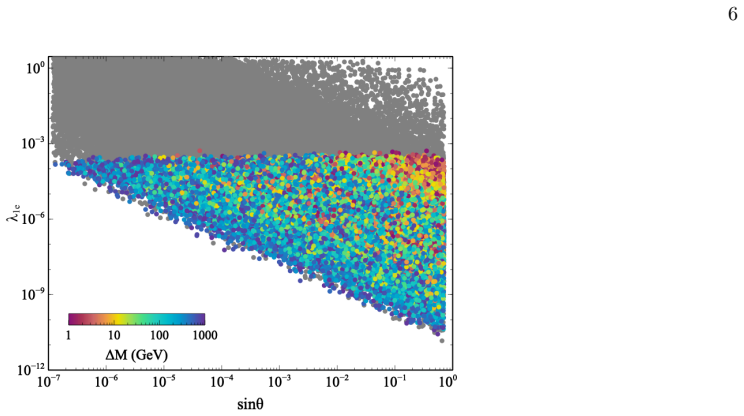


read the original abstract
The singlet-doublet dark matter (SDDM) model is a well-motivated WIMP framework that accommodates viable dark matter over a broad range of parameter space. In this work, we explore the possibility of TeV-scale leptogenesis within two realizations of the SDDM setup: Majorana SDDM scenario and Dirac SDDM scenario. The light neutrino mass, in either case, arises radiatively at one loop level. The particles running in the loop are responsible for Dark matter relic and TeV-scale leptogenesis while satisfying other phenomenological constraints. In the Majorana setup, the Standard Model is extended by three generations of singlet fermions $N_i$ and doublet fermions $\Psi_i$, and a singlet scalar $\phi$. The \textit{CP}-violating, out-of-equilibrium decays of the heavier singlets ($N_{2,3}$) generate baryon asymmetry via the leptogenesis route, while the first generation of singlet-doublet fermions give rise to the usual SD Majorana dark matter. In the Dirac setup, the standard model is extended by three generations of complex scalars ($\phi_i$) and right-handed Dirac partners ($\nu_{R_i}$) of SM neutrinos ($\nu_{L_i}$), along with a pair of singlet-doublet fermions $\chi$ and $\Psi$. The \textit{CP}-violating out-of-equilibrium decays of the scalar fields $\phi_i$ generate baryon asymmetry via the Dirac leptogenesis route. We show that in the Majorana setup, successful leptogenesis is possible even in the sub-TeV regime, while in the Dirac setup, the scale of leptogenesis is at a few TeV. With the particle mass at the TeV scale, the model remains promising for collider experiments, particularly through signatures such as prompt decays and displaced vertex searches. In addition, the presence of Dirac neutrinos can contribute to $\Delta N_{\rm eff}$, providing complementary cosmological signatures.
Editorial analysis
A structured set of objections, weighed in public.
Referee Report
Summary. The paper extends the singlet-doublet dark matter (SDDM) framework in two ways (Majorana and Dirac realizations) such that the same new particles generate light neutrino masses radiatively at one loop, yield a viable WIMP relic density, and produce the observed baryon asymmetry through CP-violating out-of-equilibrium decays at the TeV scale. In the Majorana case three generations of singlet fermions N_i, doublet fermions Psi_i and a singlet scalar phi are added; the heavier N_{2,3} drive leptogenesis while the lightest singlet-doublet pair is the DM. In the Dirac case complex scalars phi_i and right-handed Dirac neutrinos nu_Ri are added together with a singlet-doublet pair chi, Psi; the phi_i decays generate Dirac leptogenesis. The manuscript asserts that sub-TeV leptogenesis is viable in the Majorana setup and few-TeV leptogenesis in the Dirac setup, with additional collider and Delta N_eff signatures.
Significance. If a consistent parameter region exists that simultaneously satisfies the neutrino-mass scale, the observed baryon asymmetry, the correct DM relic density, and all phenomenological bounds, the construction would provide a unified TeV-scale explanation of three major beyond-Standard-Model phenomena with direct collider accessibility and cosmological tests. The explicit linkage of the same loop particles to all three observables is a conceptual strength.
major comments (2)
- [Abstract and leptogenesis sections] The one-loop neutrino-mass diagram fixes the relevant Yukawa couplings to O(10^{-3}–10^{-2}) for TeV-scale masses in order to reproduce m_nu ~ 0.05 eV. The CP asymmetry epsilon in the decays of N_{2,3} (Majorana) or phi_i (Dirac) then scales as ~ (Y^2 Delta M / 8 pi M) times a loop factor. At sub-TeV or few-TeV scales this is typically far below the 10^{-6} level required for successful leptogenesis unless extreme degeneracy (Delta M/M ≲ 10^{-6}) is imposed. The same small Y also controls the decay width that must satisfy the out-of-equilibrium condition while the annihilation cross section still yields Omega h^2 ≈ 0.12. No explicit parameter point or scan demonstrating simultaneous satisfaction of all three requirements plus flavor and direct-detection bounds is provided.
- [Leptogenesis and dark-matter relic-density calculations] The central claim that 'successful leptogenesis is possible even in the sub-TeV regime' (Majorana) and 'at a few TeV' (Dirac) rests on unshown derivations of the Boltzmann equations, washout factors, and relic-density calculation. Without these, the compatibility of the Yukawa values required by the radiative neutrino mass with the CP asymmetry and out-of-equilibrium conditions cannot be verified.
minor comments (2)
- [Abstract] The abstract would benefit from a brief statement of the mass ranges and typical Yukawa values that realize the claimed leptogenesis.
- [Model sections] Notation for the new fields (N_i, Psi_i, phi, chi, nu_Ri) should be introduced once with a clear table of quantum numbers and interactions.
Simulated Author's Rebuttal
We thank the referee for the thorough review and for recognizing the conceptual strengths of linking radiative neutrino masses, TeV-scale leptogenesis, and singlet-doublet dark matter in a unified framework. We address the major comments below with clarifications on our approach and commit to revisions that strengthen the presentation of parameter viability and calculational details.
read point-by-point responses
-
Referee: [Abstract and leptogenesis sections] The one-loop neutrino-mass diagram fixes the relevant Yukawa couplings to O(10^{-3}–10^{-2}) for TeV-scale masses in order to reproduce m_nu ~ 0.05 eV. The CP asymmetry epsilon in the decays of N_{2,3} (Majorana) or phi_i (Dirac) then scales as ~ (Y^2 Delta M / 8 pi M) times a loop factor. At sub-TeV or few-TeV scales this is typically far below the 10^{-6} level required for successful leptogenesis unless extreme degeneracy (Delta M/M ≲ 10^{-6}) is imposed. The same small Y also controls the decay width that must satisfy the out-of-equilibrium condition while the annihilation cross section still yields Omega h^2 ≈ 0.12. No explicit parameter point or scan demonstrating simultaneous satisfaction of all three requirements plus flavor and direct-detection bounds is provided.
Authors: We agree that the Yukawa couplings fixed by the one-loop neutrino mass are small, and that non-resonant leptogenesis would yield insufficient CP asymmetry at TeV scales. Our construction relies on resonant leptogenesis in the Majorana case, where the mass splitting Delta M/M is tuned to ~10^{-6} (or smaller) between N2 and N3 to enhance epsilon sufficiently while keeping the out-of-equilibrium condition satisfied due to the suppressed decay widths. In the Dirac realization, the few-TeV scale is achieved with analogous tuning of the scalar decays. The dark matter relic density is controlled primarily by the first-generation singlet-doublet mixing and gauge interactions, which are independent of the leptogenesis-sector Yukawas. We will add an explicit benchmark point (with numerical values for masses, Yukawas, resulting m_nu, eta_B, and Omega h^2) plus checks against flavor and direct-detection constraints in the revised manuscript to demonstrate simultaneous viability. revision: yes
-
Referee: [Leptogenesis and dark-matter relic-density calculations] The central claim that 'successful leptogenesis is possible even in the sub-TeV regime' (Majorana) and 'at a few TeV' (Dirac) rests on unshown derivations of the Boltzmann equations, washout factors, and relic-density calculation. Without these, the compatibility of the Yukawa values required by the radiative neutrino mass with the CP asymmetry and out-of-equilibrium conditions cannot be verified.
Authors: The Boltzmann equations and relic-density computations follow standard treatments, but we acknowledge that explicit derivations would improve verifiability. In the revision we will include the relevant Boltzmann equations, expressions for the CP asymmetry and washout factors, and the annihilation cross-section formulas in an appendix, together with the benchmark point mentioned above. This will allow direct confirmation that the small Yukawas required by neutrino masses remain compatible with successful leptogenesis and the observed relic density. revision: yes
Circularity Check
No significant circularity; model demonstrates parameter-space compatibility via standard loop and decay calculations
full rationale
The paper defines an extension of the SM with singlet-doublet fermions/scalars that participate in a one-loop diagram for m_ν, in DM annihilation, and in CP-violating decays for leptogenesis. These are independent mechanisms linked only by sharing the same fields and couplings; the paper claims existence of viable points at TeV scale rather than deriving one observable from another by algebraic identity or by fitting one and relabeling it a prediction. No self-citation is used to justify a uniqueness theorem or ansatz, and no equation reduces the output to the input by construction. The derivation chain is self-contained against external benchmarks (loop integrals, Boltzmann equations, relic-density formulas) that are not tautological with the target observables.
Axiom & Free-Parameter Ledger
free parameters (2)
- Masses and CP phases of N_{2,3} and phi
- Mass parameters of chi and Psi in Dirac case
axioms (2)
- domain assumption Out-of-equilibrium decays of heavy particles generate lepton asymmetry that converts to baryon asymmetry via sphalerons
- domain assumption One-loop diagrams with new fermions and scalars generate the observed neutrino mass matrix
invented entities (3)
-
Singlet fermions N_i and doublet fermions Psi_i
no independent evidence
-
Singlet scalar phi
no independent evidence
-
Complex scalars phi_i and right-handed Dirac neutrinos nu_Ri
no independent evidence
Reference graph
Works this paper leans on
-
[1]
Thermal relic of dark matter 6
-
[2]
Leptogenesis fromN 2,3 decay 9 III
Direct detection prospects 9 F. Leptogenesis fromN 2,3 decay 9 III. Model B: singlet-doublet Dirac dark matter and leptogenesis 12 A. The model 12 B. Neutrino mass 13 C. Muon anomalous magnetic moment 14 D. Charged lepton flavor violation 14 E. Dark matter phenomenology 15
-
[3]
Thermal relic of dark matter 15
-
[4]
Singlet-doublet dark matter induced radiative neutrino mass and TeV scale leptogenesis
Direct detection prospects 17 F. Dirac leptogenesis fromϕdecay 17 IV. Conclusion and future outlook 19 Acknowledgments 20 ∗ ph22resch11012@iith.ac.in † nsahu@phy.iith.ac.in ‡ ph23resch11016@iith.ac.in arXiv:2605.04824v1 [hep-ph] 6 May 2026 2 A. Singlet-doublet Majorana dark matter model 20 B. Singlet-doublet Dirac dark matter model 21 References 22 I. INT...
work page internal anchor Pith review Pith/arXiv arXiv 2026
-
[5]
We will discuss these aspects in detail in Sec. II F. The C.I. parametersz i =α i +iβ i is also varied logarithmically withα i, βi ∈[−π, π]. E. Dark matter phenomenology
-
[6]
previously
Thermal relic of dark matter As we discussed in Sec. II Aχ 3 is the lightest stable particle and serves as the Majorana singlet-doublet dark matter with massM χ3 ≡M DM, which is predominantly singlet-like. The details of the mixing are given in the Appendix A. In our analysis, we define two dark sectors: (a) sector 1, containingχ 3, and (b) sector 2, comp...
-
[7]
Direct detection prospects FIG. 6. [Left]: points satisfying correct relic and direct detection from the LZ experiment are shown in the ∆M−M DM plane for the decoupling limit. The color code represents sinθ. [Right]: same as theleftbut for more general case. Note that all these points satisfy the constraints from neutrino mass, (g−2), and cLFV. In this sc...
-
[8]
The lightest of these states (χ 1 as shown in Appendix B) becomes the dark matter candidate
Thermal relic of dark matter As explained before, after the electroweak symmetry breaking, the neutral component of the doublet fermion mixes with the singlet fermion, giving rise to two Dirac mass eigenstatesχ 1 andχ 2. The lightest of these states (χ 1 as shown in Appendix B) becomes the dark matter candidate. We usemicrOMEGAsto compute the relic densit...
-
[9]
We calculate the SI direct detection cross sections for the points shown in Fig
Direct detection prospects In this scenario, spin-independent (SI) DM direct detection is possible with the SM Higgs andZBoson exchange diagrams. We calculate the SI direct detection cross sections for the points shown in Fig. 12 and impose constraints from LZ [90] and PANDAX-4T [91]. The allowed points from direct detection are shown in the plane ofM DM ...
-
[10]
+h.c.(A1) The neutral fermion mass matrix can be written in the left-handed Weyl spinor basis ψ0 L (ψ0 R)c N c 1 T as M= 0M Ψ mD√ 2 MΨ 0 mD√ 2mD√ 2 mD√ 2 MN1 (A2) wherem D =y 11v/ √
-
[11]
This mass matrix can be diagonalized using a unitary matrixUwhich is defined as: U= 1 0 0 0e iδ 0 0 0 1 cosθ 1 0−sinθ 1 0 1 0 sinθ 1 0 cosθ 1 1 0 0 0 cosθ 2 −sinθ 2 0 sinθ 2 cosθ 2 cosθ 3 −sinθ 3 0 sinθ 3 cosθ 3 0 0 0 1 (A3) Keeping in mind the texture of the mass matrix A2, we can use a simple version of the unitary matrix...
-
[12]
+⟨σ 1122v⟩ Y 2 1 −Y 2 2 Y eq 1 2 Y eq 2 2 ! +⟨σ 1200v⟩(Y1Y2 −Y eq 1 Y eq 2 ) +⟨σ 1222v⟩ Y1Y2 −Y 2 2 Y eq 1 Y eq 2 − ⟨σ1211v⟩ Y1Y2 −Y 2 1 Y eq 2 Y eq 1 − Γ2→1 s Y2 −Y 1 Y eq 2 Y eq 1 ,(A13) dY2 dT = 1 3H ds dT " ⟨σ2200v⟩(Y 2 2 −Y eq 2 2)− ⟨σ 1122v⟩ Y 2 1 −Y 2 2 Y eq 1 2 Y eq 2 2 ! +⟨σ 1200v⟩(Y1Y2 −Y eq 1 Y eq 2 ) − ⟨σ1222v⟩ Y1Y2 −Y 2 2 Y eq 1 Y eq 2 +⟨σ 12...
-
[13]
Planck 2018 results. VI. Cosmological parameters
N. Aghanimet al.(Planck), Planck 2018 results. VI. Cosmological parameters, Astron. Astrophys.641, A6 (2020), [Erratum: Astron.Astrophys. 652, C4 (2021)], arXiv:1807.06209 [astro-ph.CO]
work page internal anchor Pith review arXiv 2018
- [14]
-
[15]
K. Abeet al.(T2K), Measurements of neutrino oscillation in appearance and disappearance channels by the T2K exper- iment with 6.6×10 20 protons on target, Phys. Rev. D91, 072010 (2015), arXiv:1502.01550 [hep-ex]
- [16]
- [17]
-
[18]
K. Eguchiet al.(KamLAND), First results from KamLAND: Evidence for reactor anti-neutrino disappearance, Phys. Rev. Lett.90, 021802 (2003), arXiv:hep-ex/0212021
-
[19]
S. Fukudaet al.(Super-Kamiokande), Constraints on neutrino oscillations using 1258 days of Super-Kamiokande solar neutrino data, Phys. Rev. Lett.86, 5656 (2001), arXiv:hep-ex/0103033
-
[20]
A. D. Sakharov, Violation of CP Invariance, C asymmetry, and baryon asymmetry of the universe, Pisma Zh. Eksp. Teor. Fiz.5, 32 (1967)
1967
-
[21]
Fukugita and T
M. Fukugita and T. Yanagida, Baryogenesis Without Grand Unification, Phys. Lett. B174, 45 (1986)
1986
-
[22]
M. A. Luty, Baryogenesis via leptogenesis, Phys. Rev. D45, 455 (1992)
1992
-
[23]
R. N. Mohapatra and X. Zhang, Electroweak baryogenesis in left-right-symmetric models, Phys. Rev. D46, 5331 (1992)
1992
- [24]
-
[25]
S. Davidson, E. Nardi, and Y. Nir, Leptogenesis, Phys. Rept.466, 105 (2008), arXiv:0802.2962 [hep-ph]
work page Pith review arXiv 2008
-
[26]
W. Buchmuller, P. Di Bari, and M. Plumacher, Leptogenesis for pedestrians, Annals Phys.315, 305 (2005), arXiv:hep- ph/0401240
-
[27]
R. Barbieri, P. Creminelli, A. Strumia, and N. Tetradis, Baryogenesis through leptogenesis, Nucl. Phys. B575, 61 (2000), arXiv:hep-ph/9911315
-
[28]
A. Pilaftsis and T. E. J. Underwood, Resonant leptogenesis, Nucl. Phys. B692, 303 (2004), arXiv:hep-ph/0309342
work page Pith review arXiv 2004
-
[29]
A. Pilaftsis and T. E. J. Underwood, Electroweak-scale resonant leptogenesis, Phys. Rev. D72, 113001 (2005), arXiv:hep- ph/0506107
-
[30]
V. A. Kuzmin, V. A. Rubakov, and M. E. Shaposhnikov, On the Anomalous Electroweak Baryon Number Nonconservation in the Early Universe, Phys. Lett. B155, 36 (1985)
1985
-
[31]
Minkowski,µ→eγat a Rate of One Out of 10 9 Muon Decays?, Phys
P. Minkowski,µ→eγat a Rate of One Out of 10 9 Muon Decays?, Phys. Lett. B67, 421 (1977)
1977
-
[32]
Schechter and J
J. Schechter and J. W. F. Valle, Neutrino Masses in SU(2) x U(1) Theories, Phys. Rev. D22, 2227 (1980)
1980
-
[33]
R. N. Mohapatra and G. Senjanovic, Neutrino Masses and Mixings in Gauge Models with Spontaneous Parity Violation, Phys. Rev. D23, 165 (1981)
1981
-
[34]
Lazarides, Q
G. Lazarides, Q. Shafi, and C. Wetterich, Proton Lifetime and Fermion Masses in an SO(10) Model, Nucl. Phys. B181, 287 (1981)
1981
-
[35]
Wetterich, Neutrino Masses and the Scale of B-L Violation, Nucl
C. Wetterich, Neutrino Masses and the Scale of B-L Violation, Nucl. Phys. B187, 343 (1981)
1981
-
[36]
Schechter and J
J. Schechter and J. W. F. Valle, Neutrino Decay and Spontaneous Violation of Lepton Number, Phys. Rev. D25, 774 (1982)
1982
- [37]
-
[38]
R. Foot, H. Lew, X. G. He, and G. C. Joshi, Seesaw Neutrino Masses Induced by a Triplet of Leptons, Z. Phys. C44, 441 (1989)
1989
-
[39]
Verifiable radiative seesaw mechanism of neutrino mass and dark matter,
E. Ma, Verifiable radiative seesaw mechanism of neutrino mass and dark matter, Phys. Rev. D73, 077301 (2006), arXiv:hep-ph/0601225
-
[40]
Y. Farzan and E. Ma, Dirac neutrino mass generation from dark matter, Phys. Rev. D86, 033007 (2012), arXiv:1204.4890 [hep-ph]
- [41]
- [42]
-
[43]
Improved Naturalness with a Heavy Higgs: An Alternative Road to LHC Physics
R. Barbieri, L. J. Hall, and V. S. Rychkov, Improved naturalness with a heavy Higgs: An Alternative road to LHC physics, Phys. Rev. D74, 015007 (2006), arXiv:hep-ph/0603188
work page Pith review arXiv 2006
- [44]
-
[45]
J. Kubo and D. Suematsu, Neutrino masses and CDM in a non-supersymmetric model, Phys. Lett. B643, 336 (2006), arXiv:hep-ph/0610006
-
[46]
K. Cheung and O. Seto, Phenomenology of TeV right-handed neutrino and the dark matter model, Phys. Rev. D69, 113009 (2004), arXiv:hep-ph/0403003
-
[47]
M. Gustafsson, J. M. No, and M. A. Rivera, Predictive Model for Radiatively Induced Neutrino Masses and Mixings with Dark Matter, Phys. Rev. Lett.110, 211802 (2013), [Erratum: Phys.Rev.Lett. 112, 259902 (2014)], arXiv:1212.4806 [hep-ph]
- [48]
- [49]
-
[50]
S. Jyoti Das, D. Mahanta, and D. Borah, Low scale leptogenesis and dark matter in the presence of primordial black holes, JCAP11, 019, arXiv:2104.14496 [hep-ph]
-
[51]
Common Origin of Neutrino Mass, Dark Matter and Dirac Leptogenesis
D. Borah and A. Dasgupta, Common Origin of Neutrino Mass, Dark Matter and Dirac Leptogenesis, JCAP12, 034, arXiv:1608.03872 [hep-ph]
-
[52]
S. Baumholzer, V. Brdar, and P. Schwaller, The NewνMSM (ννMSM): Radiative Neutrino Masses, keV-Scale Dark Matter and Viable Leptogenesis with sub-TeV New Physics, JHEP08, 067, arXiv:1806.06864 [hep-ph]
- [53]
- [54]
- [55]
-
[56]
N. Sahu and U. Sarkar, Extended Zee model for Neutrino Mass, Leptogenesis and Sterile Neutrino like Dark Matter, Phys. Rev. D78, 115013 (2008), arXiv:0804.2072 [hep-ph]
-
[57]
N. Narendra, S. Patra, N. Sahu, and S. Shil, Baryogenesis via Leptogenesis from Asymmetric Dark Matter and radiatively generated Neutrino mass, Phys. Rev. D98, 095016 (2018), arXiv:1805.04860 [hep-ph]
- [58]
-
[59]
S. Bhattacharya, P. Ghosh, N. Sahoo, and N. Sahu, Mini Review on Vector-Like Leptonic Dark Matter, Neutrino Mass, and Collider Signatures, Front. in Phys.7, 80 (2019), arXiv:1812.06505 [hep-ph]
-
[60]
G. Cynolter, J. Kov´ acs, and E. Lendvai, Doublet–singlet model and unitarity, Mod. Phys. Lett. A31, 1650013 (2016), arXiv:1509.05323 [hep-ph]
-
[61]
S. Bhattacharya, N. Sahoo, and N. Sahu, Minimal vectorlike leptonic dark matter and signatures at the LHC, Phys. Rev. D93, 115040 (2016), arXiv:1510.02760 [hep-ph]
-
[62]
S. Bhattacharya, N. Sahoo, and N. Sahu, Singlet-Doublet Fermionic Dark Matter, Neutrino Mass and Collider Signatures, Phys. Rev. D96, 035010 (2017), arXiv:1704.03417 [hep-ph]
-
[63]
S. Bhattacharya, P. Ghosh, and N. Sahu, Multipartite Dark Matter with Scalars, Fermions and signatures at LHC, JHEP 02, 059, arXiv:1809.07474 [hep-ph]
-
[64]
S. Bhattacharya, B. Karmakar, N. Sahu, and A. Sil, Flavor origin of dark matter and its relation with leptonic nonzero θ13 and Dirac CP phaseδ, JHEP05, 068, arXiv:1611.07419 [hep-ph]
- [65]
- [66]
- [67]
- [68]
- [69]
- [70]
-
[71]
D’Eramo, Dark matter and Higgs boson physics, Phys
F. D’Eramo, Dark matter and Higgs boson physics, Phys. Rev. D76, 083522 (2007), arXiv:0705.4493 [hep-ph]
- [72]
-
[73]
Integrating in the Higgs Portal to Fermion Dark Matter
A. Freitas, S. Westhoff, and J. Zupan, Integrating in the Higgs Portal to Fermion Dark Matter, JHEP09, 015, arXiv:1506.04149 [hep-ph]
-
[74]
L. Calibbi, A. Mariotti, and P. Tziveloglou, Singlet-Doublet Model: Dark matter searches and LHC constraints, JHEP 10, 116, arXiv:1505.03867 [hep-ph]
-
[75]
C. Cheung and D. Sanford, Simplified Models of Mixed Dark Matter, JCAP02, 011, arXiv:1311.5896 [hep-ph]
-
[76]
S. Banerjee, S. Matsumoto, K. Mukaida, and Y.-L. S. Tsai, WIMP Dark Matter in a Well-Tempered Regime: A case study on Singlet-Doublets Fermionic WIMP, JHEP11, 070, arXiv:1603.07387 [hep-ph]
-
[77]
A. Dutta Banik, A. K. Saha, and A. Sil, Scalar assisted singlet doublet fermion dark matter model and electroweak vacuum stability, Phys. Rev. D98, 075013 (2018), arXiv:1806.08080 [hep-ph]
-
[78]
S. Horiuchi, O. Macias, D. Restrepo, A. Rivera, O. Zapata, and H. Silverwood, The Fermi-LAT gamma-ray excess at the Galactic Center in the singlet-doublet fermion dark matter model, JCAP03, 048, arXiv:1602.04788 [hep-ph]
-
[79]
Radiative Neutrino Masses in the Singlet-Doublet Fermion Dark Matter Model with Scalar Singlets,
D. Restrepo, A. Rivera, M. S´ anchez-Pel´ aez, O. Zapata, and W. Tangarife, Radiative Neutrino Masses in the Singlet- Doublet Fermion Dark Matter Model with Scalar Singlets, Phys. Rev. D92, 013005 (2015), arXiv:1504.07892 [hep-ph]
-
[80]
Abe, Effect of CP violation in the singlet-doublet dark matter model, Phys
T. Abe, Effect of CP violation in the singlet-doublet dark matter model, Phys. Lett. B771, 125 (2017), arXiv:1702.07236 [hep-ph]
discussion (0)
Sign in with ORCID, Apple, or X to comment. Anyone can read and Pith papers without signing in.