REVIEW 1 major objections 1 cited by
Reviewed by Pith at T0; open to challenge.
T0 means a machine referee read the full paper against a public rubric. The mark states how deep the mechanical check went, never who wrote it. the ladder, T0–T4 →
T0 review · grok-4.3
Ordering demonstrations for smooth conceptual progression turns many-shot CoT-ICL into effective test-time learning on reasoning tasks.
2026-06-30 21:31 UTC pith:A2CQIYS2
load-bearing objection CDS gives a modest gain on one math task but the abstract leaves the ordering effect unisolated from demo selection. the 1 major comments →
Many-Shot CoT-ICL: Making In-Context Learning Truly Learn
The pith
A machine-rendered reading of the paper's core claim, the machinery that carries it, and where it could break.
Core claim
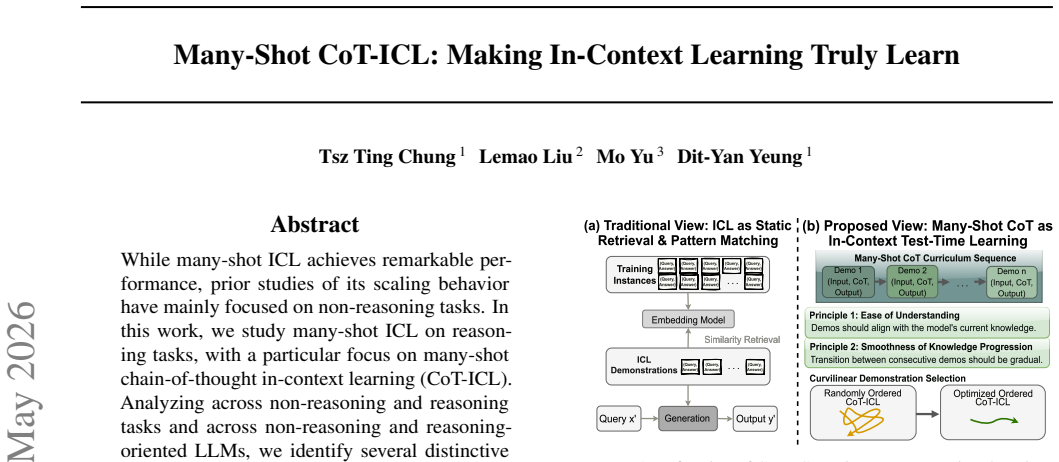
Viewing many-shot CoT-ICL as in-context test-time learning rather than scaled pattern matching yields the principles that demonstrations should be easy to understand and ordered for smooth conceptual progression; Curvilinear Demonstration Selection based on these principles produces up to a 5.42 percentage-point gain on a math task with 64 demonstrations.
What carries the argument
Curvilinear Demonstration Selection (CDS), an ordering method that arranges demonstrations to support smooth conceptual progression from easier to more complex examples.
Load-bearing premise
The performance gains come from the proposed ordering principles rather than from other aspects of how the demonstrations were chosen or from task-specific factors.
What would settle it
An experiment on the same math task with 64 demonstrations that uses random ordering or a non-curvilinear selection method and measures whether the 5.42-point gain disappears.
If this is right
- Many-shot CoT-ICL on reasoning tasks benefits when the context window is treated as a learning curriculum.
- Performance on math reasoning improves when demonstrations follow a curvilinear ordering that matches the model's understanding.
- Long context windows can serve as structured test-time curricula beyond simple pattern retrieval.
- Distinctive scaling behaviors appear for both non-reasoning and reasoning-oriented models under many-shot CoT-ICL.
Where Pith is reading between the lines
- The curvilinear ordering idea might extend to other reasoning domains if an automatic way to measure conceptual progression can be defined.
- Models that already receive curriculum-style training during pretraining could show larger or smaller gains from CDS at test time.
- Whether CDS helps on non-reasoning tasks depends on whether a meaningful progression dimension exists for those tasks.
Editorial analysis
A structured set of objections, weighed in public.
Referee Report
Summary. The paper studies many-shot chain-of-thought in-context learning (CoT-ICL) on reasoning tasks, identifying distinctive scaling properties compared to non-reasoning tasks and models. It reframes many-shot CoT-ICL as in-context test-time learning rather than pattern matching, proposes two principles (easy-to-understand demonstrations and smooth conceptual progression), and introduces Curvilinear Demonstration Selection (CDS) as an ordering method that yields up to 5.42 percentage-point gains on a math task with 64 demonstrations.
Significance. If the reported gains are shown to arise specifically from the ordering principles rather than demonstration selection, the work would provide a substantive reframing of long-context ICL as structured test-time learning, with implications for curriculum design in prompting. The empirical result on math tasks with many shots is a concrete contribution, though its attribution requires verification.
major comments (1)
- [Abstract / CDS description and experimental results] The abstract and method description attribute the 5.42 pp gain on the math task with 64 demonstrations to CDS ordering that enforces smooth conceptual progression (principle ii) after selecting easy demonstrations (principle i). No mention is made of controls that hold the demonstration set fixed while varying only the order (e.g., random permutation of the identical 64 examples versus CDS order). Without such isolation, the performance improvement cannot be unambiguously credited to the curvilinear progression rather than the choice of demonstrations, weakening the claim that many-shot CoT-ICL functions as structured in-context test-time learning.
Simulated Author's Rebuttal
We thank the referee for this constructive comment on isolating the contribution of ordering. We agree that the current presentation does not fully separate the effects of demonstration selection from ordering, and we will add the requested control experiments in the revision.
read point-by-point responses
-
Referee: [Abstract / CDS description and experimental results] The abstract and method description attribute the 5.42 pp gain on the math task with 64 demonstrations to CDS ordering that enforces smooth conceptual progression (principle ii) after selecting easy demonstrations (principle i). No mention is made of controls that hold the demonstration set fixed while varying only the order (e.g., random permutation of the identical 64 examples versus CDS order). Without such isolation, the performance improvement cannot be unambiguously credited to the curvilinear progression rather than the choice of demonstrations, weakening the claim that many-shot CoT-ICL functions as structured in-context test-time learning.
Authors: We agree that an explicit ablation holding the demonstration set fixed while varying only the order is necessary to attribute gains specifically to the curvilinear progression. CDS currently combines selection of easy-to-understand examples (principle i) with curvilinear ordering (principle ii). In the revised manuscript we will add results comparing (a) the CDS-selected set in random order versus (b) the same set in CDS order, on the same math task with 64 demonstrations. These controls will be reported alongside the existing results, with updated discussion clarifying the separate contributions of selection and ordering. revision: yes
Circularity Check
No circularity: empirical performance claim from proposed method
full rationale
The paper reports an empirical study identifying properties of many-shot CoT-ICL, proposes CDS ordering guided by two principles, and measures a performance gain on a math task. No equations or derivations are presented that reduce to inputs by construction. No self-citations are invoked as load-bearing for uniqueness theorems or ansatzes. The central result is an observed experimental outcome rather than a fitted parameter renamed as prediction or a self-definitional claim. The analysis remains self-contained via direct reporting of task results.
Axiom & Free-Parameter Ledger
read the original abstract
While many-shot ICL achieves remarkable performance, prior studies of its scaling behavior have mainly focused on non-reasoning tasks. In this work, we study many-shot ICL on reasoning tasks, with a particular focus on many-shot chain-of-thought in-context learning (CoT-ICL). Analyzing across non-reasoning and reasoning tasks and across non-reasoning and reasoning-oriented LLMs, we identify several distinctive properties of many-shot CoT-ICL. We further interpret these findings by viewing many-shot CoT-ICL as in-context test-time learning rather than scaled pattern matching, and suggest two principles: (i) demonstrations should be easy for the target model to understand, and (ii) they should be ordered to support a smooth conceptual progression. Guided by the principle, we propose Curvilinear Demonstration Selection (CDS), a simple ordering method that yields up to a 5.42 percentage-point gain on a math task with 64 demonstrations. Overall, our results reframe the long context window from a retrieval buffer into a structured curriculum for in-context test-time learning.
Figures




Forward citations
Cited by 1 Pith paper
-
Onnes: A Physics-Grounded Multi-Agent LLM Simulator for Cryogenic Fault Diagnosis in Quantum Computing Infrastructure
A physics-grounded dilution-fridge simulator with LLM agents achieves supervised-ML parity on cryogenic fault classification using six demonstrations and no training, validated on simulated telemetry plus a real-hardw...
Reference graph
Works this paper leans on
-
[1]
Benchmarking natural language understanding services for building conversational agents. In Increasing Naturalness and Flexibility in Spoken Dialogue Interaction, Lecture Notes in Electrical Engineering, pp.\ 165--183. Springer, 2021. ISBN 9789811593222. doi:10.1007/978-981-15-9323-9_15. URL https://iwsds2019.unikore.it/
-
[2]
Agarwal, R., Singh, A., Zhang, L., Bohnet, B., Rosias, L., Chan, S., Zhang, B., Anand, A., Abbas, Z., Nova, A., et al. Many-shot in-context learning. volume 37, pp.\ 76930--76966, 2024
work page 2024
-
[3]
J., Gupta, P., Oh, G., Dalmia, S., and Kolhar, P
Baek, J., Lee, S. J., Gupta, P., Oh, G., Dalmia, S., and Kolhar, P. Revisiting in-context learning with long context language models. In Findings of the Association for Computational Linguistics: ACL 2025, pp.\ 26950--26966, 2025. URL https://aclanthology.org/2025.findings-acl.1382/
work page 2025
-
[4]
Benson, J. B. Encyclopedia of infant and early childhood development. Elsevier, 2020
work page 2020
-
[5]
Bertsch, A., Ivgi, M., Xiao, E., Alon, U., Berant, J., Gormley, M. R., and Neubig, G. In-context learning with long-context models: An in-depth exploration. In Proceedings of the 2025 Conference of the Nations of the Americas Chapter of the Association for Computational Linguistics: Human Language Technologies (Volume 1: Long Papers), pp.\ 12119--12149, 2025
work page 2025
-
[6]
Efficient intent detection with dual sentence encoders
Casanueva, I., Tem c inas, T., Gerz, D., Henderson, M., and Vuli \'c , I. Efficient intent detection with dual sentence encoders. In Wen, T.-H., Celikyilmaz, A., Yu, Z., Papangelis, A., Eric, M., Kumar, A., Casanueva, I., and Shah, R. (eds.), Proceedings of the 2nd Workshop on Natural Language Processing for Conversational AI, pp.\ 38--45, Online, 2020. A...
-
[7]
Chen, W., Ma, X., Wang, X., and Cohen, W. W. Program of thoughts prompting: Disentangling computation from reasoning for numerical reasoning tasks. Transactions on Machine Learning Research, 2023. ISSN 2835-8856. URL https://openreview.net/forum?id=YfZ4ZPt8zd
work page 2023
-
[8]
T., Cui, L., Liu, L., Huang, X., Shi, S., and Yeung, D.-Y
Chung, T. T., Cui, L., Liu, L., Huang, X., Shi, S., and Yeung, D.-Y. Selection-p: Self-supervised task-agnostic prompt compression for faithfulness and transferability. In Al-Onaizan, Y., Bansal, M., and Chen, Y.-N. (eds.), Findings of the Association for Computational Linguistics: EMNLP 2024, pp.\ 11057--11070, Miami, Florida, USA, November 2024. Associa...
-
[9]
T., Liu, L., Yu, M., and Yeung, D.-Y
Chung, T. T., Liu, L., Yu, M., and Yeung, D.-Y. D iv L ogic E val: A framework for benchmarking logical reasoning evaluation in large language models. In Christodoulopoulos, C., Chakraborty, T., Rose, C., and Peng, V. (eds.), Findings of the Association for Computational Linguistics: EMNLP 2025, pp.\ 901--915, Suzhou, China, November 2025. Association for...
-
[10]
Training Verifiers to Solve Math Word Problems
Cobbe, K., Kosaraju, V., Bavarian, M., Chen, M., Jun, H., Kaiser, L., Plappert, M., Tworek, J., Hilton, J., Nakano, R., Hesse, C., and Schulman, J. Training verifiers to solve math word problems. ArXiv preprint, abs/2110.14168, 2021. URL https://arxiv.org/abs/2110.14168
work page internal anchor Pith review Pith/arXiv arXiv 2021
-
[11]
Croes, G. A. A method for solving traveling-salesman problems. Operations research, 6 0 (6): 0 791--812, 1958
work page 1958
-
[12]
Crosbie, J. and Shutova, E. Induction heads as an essential mechanism for pattern matching in in-context learning. In Chiruzzo, L., Ritter, A., and Wang, L. (eds.), Findings of the Association for Computational Linguistics: NAACL 2025, pp.\ 5049--5111, Albuquerque, New Mexico, April 2025. Association for Computational Linguistics. ISBN 979-8-89176-195-7. ...
-
[13]
Deepseek-r1 incentivizes reasoning in llms through reinforcement learning
DeepSeek-AI. Deepseek-r1. Nature, 645: 0 633--638, 2025. doi:10.1038/s41586-025-09422-z
-
[14]
L., Liu, Y., Shang, N., Sun, Y., Zhu, Y., Yang, F., and Yang, M
Guan, X., Zhang, L. L., Liu, Y., Shang, N., Sun, Y., Zhu, Y., Yang, F., and Yang, M. rstar-math: Small llms can master math reasoning with self-evolved deep thinking. In Proceedings of the 42nd International Conference on Machine Learning, 2025. URL https://openreview.net/forum?id=5zwF1GizFa
work page 2025
-
[15]
LM -infinite: Zero-shot extreme length generalization for large language models
Han, C., Wang, Q., Peng, H., Xiong, W., Chen, Y., Ji, H., and Wang, S. LM -infinite: Zero-shot extreme length generalization for large language models. In Duh, K., Gomez, H., and Bethard, S. (eds.), Proceedings of the 2024 Conference of the North American Chapter of the Association for Computational Linguistics: Human Language Technologies (Volume 1: Long...
work page 2024
-
[16]
Measuring mathematical problem solving with the math dataset
Hendrycks, D., Burns, C., Kadavath, S., Arora, A., Basart, S., Tang, E., Song, D., and Steinhardt, J. Measuring mathematical problem solving with the math dataset. NeurIPS, 2021
work page 2021
-
[17]
Toward semantics-based answer pinpointing
Hovy, E., Gerber, L., Hermjakob, U., Lin, C.-Y., and Ravichandran, D. Toward semantics-based answer pinpointing. In Proceedings of the first international conference on Human language technology research, 2001
work page 2001
-
[18]
Exploring the role of diversity in example selection for in-context learning
Kapuriya, J., Kaushik, M., Ganguly, D., and Bhatia, S. Exploring the role of diversity in example selection for in-context learning. In Proceedings of the 48th International ACM SIGIR Conference on Research and Development in Information Retrieval, pp.\ 2962--2966, 2025. URL https://doi.org/10.1145/3726302.3730194
-
[19]
S., Reid, M., Matsuo, Y., and Iwasawa, Y
Kojima, T., Gu, S. S., Reid, M., Matsuo, Y., and Iwasawa, Y. Large language models are zero-shot reasoners. volume 35, pp.\ 22199--22213, 2022
work page 2022
-
[20]
Kwon, W., Li, Z., Zhuang, S., Sheng, Y., Zheng, L., Yu, C. H., Gonzalez, J. E., Zhang, H., and Stoica, I. Efficient memory management for large language model serving with pagedattention. In Proceedings of the ACM SIGOPS 29th Symposium on Operating Systems Principles, 2023
work page 2023
-
[21]
u ttler, H., Lewis, M., Yih, W.-t., Rockt \
Lewis, P., Perez, E., Piktus, A., Petroni, F., Karpukhin, V., Goyal, N., K \"u ttler, H., Lewis, M., Yih, W.-t., Rockt \"a schel, T., et al. Retrieval-augmented generation for knowledge-intensive nlp tasks. volume 33, pp.\ 9459--9474, 2020
work page 2020
-
[22]
Li, T., Zhang, G., Do, Q. D., Yue, X., and Chen, W. Long-context llms struggle with long in-context learning. Transactions on Machine Learning Research, 2025 a . URL https://openreview.net/forum?id=Cw2xlg0e46
work page 2025
-
[23]
Test-time preference optimization: On-the-fly alignment via iterative textual feedback
Li, Y., Hu, X., Qu, X., Li, L., and Cheng, Y. Test-time preference optimization: On-the-fly alignment via iterative textual feedback. In Proceedings of the 42nd International Conference on Machine Learning, 2025 b . URL https://openreview.net/forum?id=ArifAHrEVD
work page 2025
-
[24]
Y., Ravichander, A., Lu, X., Dziri, N., Sclar, M., Chandu, K
Lin, B. Y., Ravichander, A., Lu, X., Dziri, N., Sclar, M., Chandu, K. R., Bhagavatula, C., and Choi, Y. The unlocking spell on base llms: Rethinking alignment via in-context learning. In The Twelfth International Conference on Learning Representations, ICLR 2024, Vienna, Austria, May 7-11, 2024 . OpenReview.net, 2024. URL https://openreview.net/forum?id=w...
work page 2024
-
[25]
What Makes Good In-Context Examples for
Liu, J., Shen, D., Zhang, Y., Dolan, B., Carin, L., and Chen, W. What makes good in-context examples for GPT -3? In Agirre, E., Apidianaki, M., and Vuli \'c , I. (eds.), Proceedings of Deep Learning Inside Out (DeeLIO 2022): The 3rd Workshop on Knowledge Extraction and Integration for Deep Learning Architectures, pp.\ 100--114, Dublin, Ireland and Online,...
- [26]
-
[27]
Introducing meta llama 3: The most capable openly available llm to date, 2024
MetaAI. Introducing meta llama 3: The most capable openly available llm to date, 2024. URL https://ai.meta.com/blog/meta-llama-3/
work page 2024
-
[28]
Rethinking the Role of Demonstrations: What Makes In-Context Learning Work?
Min, S., Lyu, X., Holtzman, A., Artetxe, M., Lewis, M., Hajishirzi, H., and Zettlemoyer, L. Rethinking the role of demonstrations: What makes in-context learning work? In Goldberg, Y., Kozareva, Z., and Zhang, Y. (eds.), Proceedings of the 2022 Conference on Empirical Methods in Natural Language Processing, pp.\ 11048--11064, Abu Dhabi, United Arab Emirat...
-
[29]
In-context Learning and Induction Heads
Olsson, C., Elhage, N., Nanda, N., Joseph, N., DasSarma, N., Henighan, T., Mann, B., Askell, A., Bai, Y., Chen, A., Conerly, T., Drain, D., Ganguli, D., Hatfield-Dodds, Z., Hernandez, D., Johnston, S., Jones, A., Kernion, J., Lovitt, L., Ndousse, K., Amodei, D., Brown, T., Clark, J., Kaplan, J., McCandlish, S., and Olah, C. In-context learning and inducti...
work page internal anchor Pith review Pith/arXiv arXiv 2022
-
[30]
Yarn: Efficient context window extension of large language models
Peng, B., Quesnelle, J., Fan, H., and Shippole, E. Yarn: Efficient context window extension of large language models. In The Twelfth International Conference on Learning Representations, ICLR 2024, Vienna, Austria, May 7-11, 2024 . OpenReview.net, 2024. URL https://openreview.net/forum?id=wHBfxhZu1u
work page 2024
-
[31]
Qwen, :, Yang, A., Yang, B., Zhang, B., Hui, B., Zheng, B., Yu, B., Li, C., Liu, D., Huang, F., Wei, H., Lin, H., Yang, J., Tu, J., Zhang, J., Yang, J., Yang, J., Zhou, J., Lin, J., Dang, K., Lu, K., Bao, K., Yang, K., Yu, L., Li, M., Xue, M., Zhang, P., Zhu, Q., Men, R., Lin, R., Li, T., Tang, T., Xia, T., Ren, X., Ren, X., Fan, Y., Su, Y., Zhang, Y., Wa...
work page internal anchor Pith review Pith/arXiv arXiv 2024
-
[32]
Scaling LLM test-time compute optimally can be more effective than scaling parameters for reasoning
Snell, C., Lee, J., Xu, K., and Kumar, A. Scaling LLM test-time compute optimally can be more effective than scaling parameters for reasoning. In The Thirteenth International Conference on Learning Representations, 2025 a . URL https://openreview.net/forum?id=4FWAwZtd2n
work page 2025
-
[33]
V., Lee, J., Xu, K., and Kumar, A
Snell, C. V., Lee, J., Xu, K., and Kumar, A. Scaling LLM test-time compute optimally can be more effective than scaling parameters for reasoning. In The Thirteenth International Conference on Learning Representations, 2025 b . URL https://openreview.net/forum?id=4FWAwZtd2n
work page 2025
-
[34]
An information-theoretic approach to prompt engineering without ground truth labels
Sorensen, T., Robinson, J., Rytting, C., Shaw, A., Rogers, K., Delorey, A., Khalil, M., Fulda, N., and Wingate, D. An information-theoretic approach to prompt engineering without ground truth labels. In Muresan, S., Nakov, P., and Villavicencio, A. (eds.), Proceedings of the 60th Annual Meeting of the Association for Computational Linguistics (Volume 1: L...
-
[35]
Transformers learn in-context by gradient descent
Von Oswald, J., Niklasson, E., Randazzo, E., Sacramento, J., Mordvintsev, A., Zhmoginov, A., and Vladymyrov, M. Transformers learn in-context by gradient descent. In International Conference on Machine Learning, pp.\ 35151--35174. PMLR, 2023
work page 2023
-
[36]
Wan, X., Zhou, H., Sun, R., Nakhost, H., Jiang, K., S erban, C ., and Ar k, S. \"O . From few to many: Self-improving many-shot reasoners through iterative optimization and generation. In International Conference on Learning Representations (ICLR), 2025. URL https://openreview.net/forum?id=JBXO05r4AV
work page 2025
-
[37]
Superglue: A stickier benchmark for general-purpose language understanding systems
Wang, A., Pruksachatkun, Y., Nangia, N., Singh, A., Michael, J., Hill, F., Levy, O., and Bowman, S. Superglue: A stickier benchmark for general-purpose language understanding systems. volume 32, 2019
work page 2019
-
[38]
Wei, J., Wang, X., Schuurmans, D., Bosma, M., Xia, F., Chi, E., Le, Q. V., Zhou, D., et al. Chain-of-thought prompting elicits reasoning in large language models. Advances in neural information processing systems, 35: 0 24824--24837, 2022
work page 2022
-
[39]
Wu, Z., Wang, Y., Ye, J., and Kong, L. Self-adaptive in-context learning: An information compression perspective for in-context example selection and ordering. In Rogers, A., Boyd-Graber, J., and Okazaki, N. (eds.), Proceedings of the 61st Annual Meeting of the Association for Computational Linguistics (Volume 1: Long Papers), pp.\ 1423--1436, Toronto, Ca...
-
[40]
arXiv preprint arXiv:2409.02465 , year=
Xu, Z., Ye, J., Liu, X., Liu, X., Sun, T., Liu, Z., Guo, Q., Li, L., Liu, Q., Huang, X., and Qiu, X. Detectiveqa: Evaluating long-context reasoning on detective novels, 2024. URL https://arxiv.org/abs/2409.02465
-
[41]
Yang, A., Li, A., Yang, B., Zhang, B., Hui, B., Zheng, B., Yu, B., Gao, C., Huang, C., Lv, C., Zheng, C., Liu, D., Zhou, F., Huang, F., Hu, F., Ge, H., Wei, H., Lin, H., Tang, J., Yang, J., Tu, J., Zhang, J., Yang, J., Yang, J., Zhou, J., Zhou, J., Lin, J., Dang, K., Bao, K., Yang, K., Yu, L., Deng, L., Li, M., Xue, M., Li, M., Zhang, P., Wang, P., Zhu, Q...
work page internal anchor Pith review Pith/arXiv arXiv 2025
-
[42]
Tree of thoughts: Deliberate problem solving with large language models
Yao, S., Yu, D., Zhao, J., Shafran, I., Griffiths, T., Cao, Y., and Narasimhan, K. Tree of thoughts: Deliberate problem solving with large language models. Advances in neural information processing systems, 36: 0 11809--11822, 2023
work page 2023
-
[43]
T., Zhou, C., Li, T., Lu, R., Li, J., Xu, L., Lu, H., Zhang, N., Li, J., and Zhou, J
Yu, M., Chung, T. T., Zhou, C., Li, T., Lu, R., Li, J., Xu, L., Lu, H., Zhang, N., Li, J., and Zhou, J. Prelude: A benchmark designed to require global comprehension and reasoning over long contexts, 2025 a . URL https://arxiv.org/abs/2508.09848
-
[44]
T., Zhang, S., Li, J., Yeung, D.-Y., and Zhou, J
Yu, M., Liu, L., Wu, J., Chung, T. T., Zhang, S., Li, J., Yeung, D.-Y., and Zhou, J. The stochastic parrot on LLM ' s shoulder: A summative assessment of physical concept understanding. In Chiruzzo, L., Ritter, A., and Wang, L. (eds.), Proceedings of the 2025 Conference of the Nations of the Americas Chapter of the Association for Computational Linguistic...
-
[45]
Qwen3 Embedding: Advancing Text Embedding and Reranking Through Foundation Models
Zhang, Y., Li, M., Long, D., Zhang, X., Lin, H., Yang, B., Xie, P., Yang, A., Liu, D., Lin, J., Huang, F., and Zhou, J. Qwen3 embedding: Advancing text embedding and reranking through foundation models, 2025. URL https://arxiv.org/abs/2506.05176
work page internal anchor Pith review Pith/arXiv arXiv 2025
-
[46]
Automatic chain of thought prompting in large language models
Zhang, Z., Zhang, A., Li, M., and Smola, A. Automatic chain of thought prompting in large language models. In The Eleventh International Conference on Learning Representations, ICLR 2023, Kigali, Rwanda, May 1-5, 2023 . OpenReview.net, 2023. URL https://openreview.net/pdf?id=5NTt8GFjUHkr
work page 2023
-
[47]
" write newline "" before.all 'output.state := FUNCTION n.dashify 't := "" t empty not t #1 #1 substring "-" = t #1 #2 substring "--" = not "--" * t #2 global.max substring 't := t #1 #1 substring "-" = "-" * t #2 global.max substring 't := while if t #1 #1 substring * t #2 global.max substring 't := if while FUNCTION format.date year duplicate empty "emp...
discussion (0)
Sign in with ORCID, Apple, or X to comment. Anyone can read and Pith papers without signing in.