Core-collapse supernovae and supernova neutrinos
Pith reviewed 2026-06-29 20:38 UTC · model grok-4.3
The pith
Neutrinos and multi-dimensional fluid flow drive core-collapse supernova explosions by extracting energy from the collapsed core.
A machine-rendered reading of the paper's core claim, the machinery that carries it, and where it could break.
Core claim
The modern theory of neutrino-driven supernova explosions holds that neutrinos and multi-dimensional fluid flow are essential for reviving the stalled shock and driving the ejection of the star's outer layers after the iron core collapses.
What carries the argument
the neutrino-driven mechanism, in which neutrino heating combined with multi-dimensional convection extracts energy from the proto-neutron star to power the explosion
If this is right
- Nuclear physics inputs such as neutrino interaction rates control the energy transfer that revives the shock.
- Neutrinos and gravitational waves serve as observable probes of the conditions inside the supernova core.
- The mechanism produces the observed explosion energy of order 10^51 erg when multi-dimensional flows assist the neutrino heating.
- The outer layers of the star are ejected after the iron core collapses in the majority of cases.
Where Pith is reading between the lines
- Realistic predictions require three-dimensional simulations to capture the role of fluid flows.
- The same energy extraction process connects to the nucleosynthesis of heavy elements in the ejected material.
- Future neutrino detections from galactic supernovae could directly measure the efficiency of the heating mechanism.
Load-bearing premise
The iron core is supported by electron degeneracy pressure until collapse and the neutrino-driven mechanism accurately describes the explosion in most cases.
What would settle it
A core-collapse supernova observed with no neutrino burst or with an explosion energy that cannot be supplied by neutrino heating would contradict the central mechanism.
Figures
read the original abstract
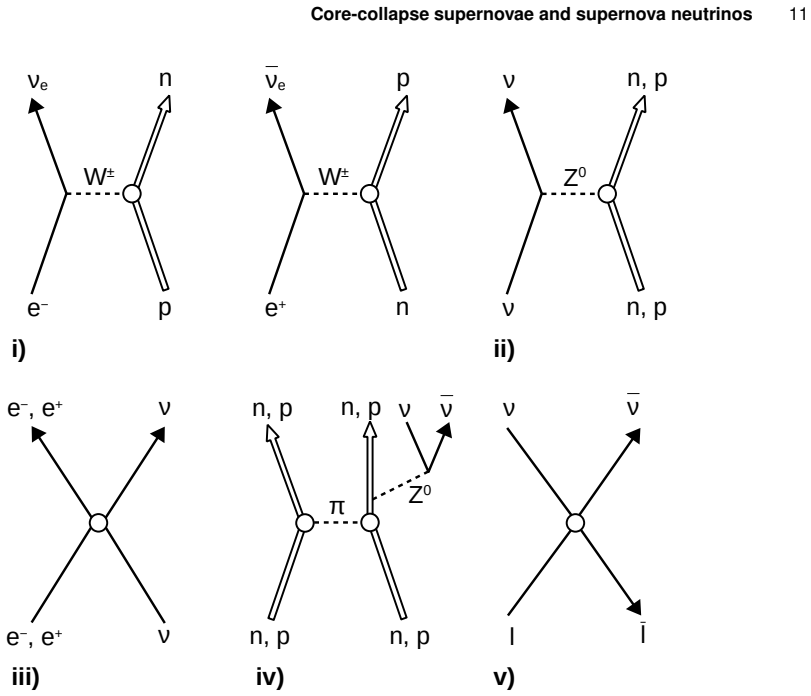
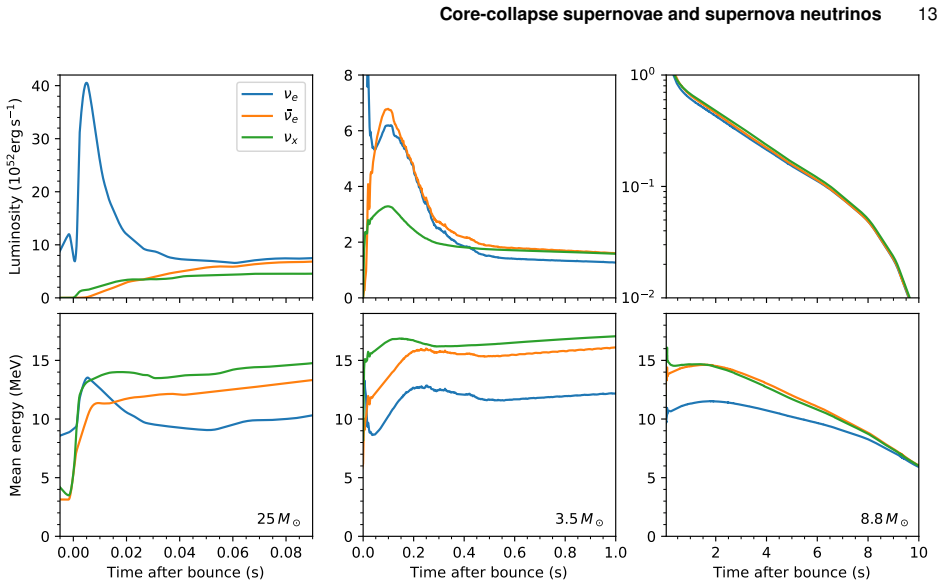
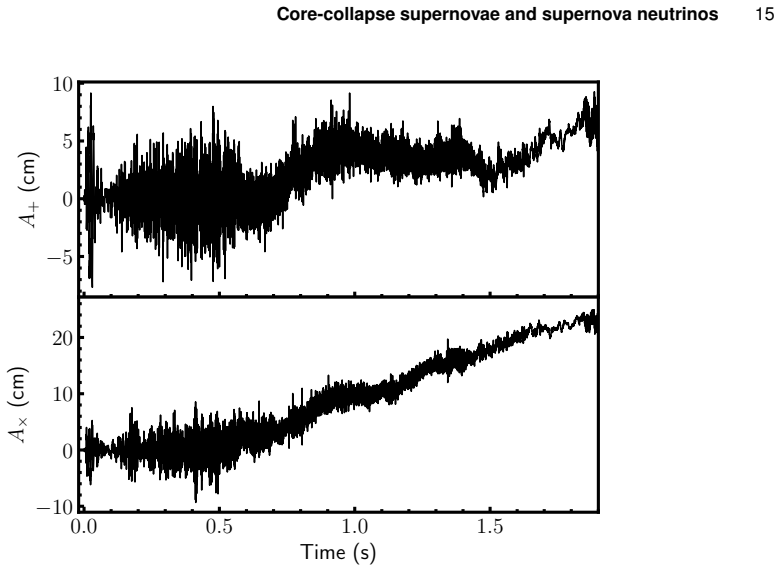
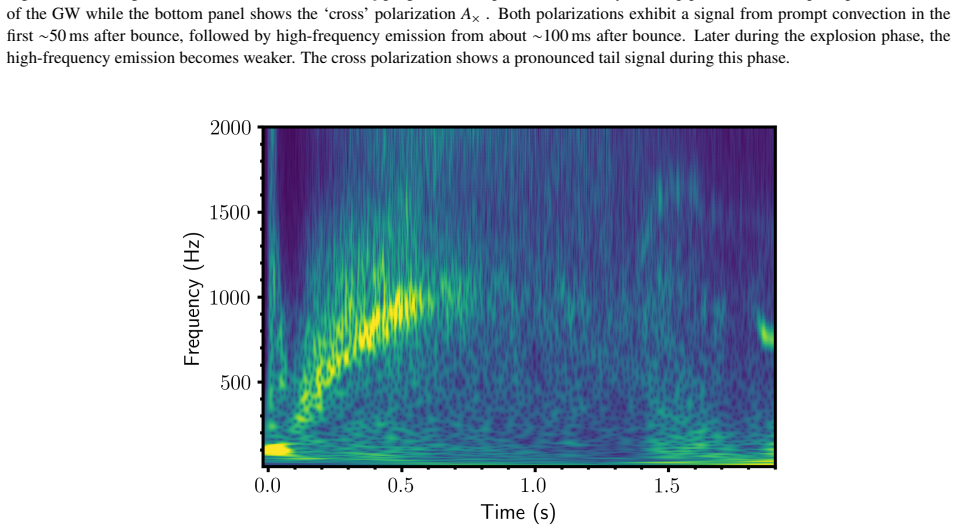
Core-collapse supernovae are the terminal explosions of massive stars. After successive phases of nuclear fusion proceeding up to silicon burning, these stars form an iron core that is supported by electron degeneracy pressure. The core eventually collapses to a proto-neutron star, and in most cases the outer layers of the star are ejected by a shock wave, with a kinetic energy of order $10^{51}\,\mathrm{erg}$. Neutrinos and multi-dimensional fluid flow play a key role in extracting energy from the collapsed core to drive the explosion. After adumbrating the astrophysical context of stellar evolution and transient observations, this chapter sketches the modern theory of neutrino-driven supernova explosions, and discusses the key role of nuclear physics and neutrino interaction rates in the supernova problem. It also outlines the role of neutrinos and gravitational waves as probes into the supernova core.
Editorial analysis
A structured set of objections, weighed in public.
Referee Report
Summary. The manuscript is a review chapter on core-collapse supernovae. It sketches the astrophysical context of massive-star evolution through silicon burning, the formation of an iron core supported by electron degeneracy pressure, its gravitational collapse to a proto-neutron star, and the subsequent ejection of the stellar envelope by a shock wave carrying ~10^51 erg. The central narrative emphasizes the neutrino-driven mechanism in which neutrinos and multi-dimensional fluid flows extract energy from the collapsed core to revive the shock. The chapter also discusses the role of nuclear physics and neutrino interaction rates, and positions neutrinos and gravitational waves as diagnostics of the supernova core.
Significance. As a concise review of the established neutrino-driven explosion paradigm, the chapter offers a useful entry point for readers seeking an overview of the interplay between stellar evolution, core-collapse dynamics, nuclear physics inputs, and multi-messenger probes. It faithfully recapitulates the consensus picture without advancing new derivations or predictions.
minor comments (1)
- The abstract uses 'adumbrating' for the astrophysical context section; a more direct phrasing would improve readability for a broad audience.
Simulated Author's Rebuttal
We thank the referee for their positive evaluation of the manuscript and for recommending acceptance. The review accurately captures the scope and content of the chapter as a concise overview of the neutrino-driven explosion paradigm, stellar evolution context, nuclear physics inputs, and multi-messenger signals.
Circularity Check
No significant circularity; review summarizes established models without derivations
full rationale
The paper is a review chapter sketching the standard neutrino-driven core-collapse supernova mechanism, including the iron core supported by electron degeneracy pressure, collapse to a proto-neutron star, and the role of neutrinos and multi-dimensional flows, without advancing any new derivations, equations, predictions, or parameter fits. No load-bearing steps exist that reduce by construction to inputs, self-citations, or ansatzes; the content matches consensus descriptions and contains no internal chains that could exhibit circularity.
Axiom & Free-Parameter Ledger
axioms (2)
- domain assumption Iron core supported by electron degeneracy pressure until collapse
- domain assumption Neutrino-driven mechanism revives the shock wave in most cases
Forward citations
Cited by 1 Pith paper
-
Neutrino mass ordering from the next Galactic supernova at DUNE, HK, and JUNO
Neutronization burst and accretion-phase rise-time observables from a 10 kpc core-collapse supernova enable DUNE, HK and JUNO to discriminate neutrino mass ordering at 3-6 sigma using multiple progenitor simulations.
Reference graph
Works this paper leans on
-
[1]
Log-concavity of Lucas Sequences of first kind
Abbott BP , Abbott R, Abbott TD, Acernese F , Ackley K, Adams C, Adams T, Addesso P , Adhikari RX, Adya VB, Affeldt C, Agarwal B, Agathos M, Agatsuma K, Aggarwal N, Aguiar OD, Aiello L, Ain A, Ajith P , Allen B, Allen G, Allocca A, Aloy MA, Altin PA, Amato A, Ananyeva A, Anderson SB, Anderson WG, Angelova SV, Antier S, Appert S, Arai K, Araya MC, Areeda J...
work page internal anchor Pith review Pith/arXiv arXiv doi:10.1103/physrevlett.121.161101.1805.11581 2018
-
[2]
Adams SM, Kochanek CS, Gerke JR, Stanek KZ and Dai X (2017), Jul. The search for failed supernovae with the Large Binocular Telescope: confirmation of a disappearing star.MNRAS468 (4): 4968–4981. doi:10.1093/mnras/stx816.1609.01283. Airapetian A, Akopov N, Akopov Z, Andrus A, Aschenauer EC, Augustyniak W and Avakian R (2007), Jan. Precise determination of...
work page internal anchor Pith review Pith/arXiv arXiv doi:10.1093/mnras/stx816.1609.01283 2017
-
[3]
Supernova 1987A.ARA&A27: 629–700
Arnett WD, Bahcall JN, Kirshner RP and Woosley SE (1989). Supernova 1987A.ARA&A27: 629–700. doi:10.1146/annurev.aa.27.090189.003213. Baade W and Zwicky F (1934a). Cosmic Rays from Super-novae.Proceedings of the National Academy of Science20: 259–263. doi:10.1073/ pnas.20.5.259. Baade W and Zwicky F (1934b). On Super-novae.Proceedings of the National Acade...
-
[5]
Bollig R, Janka HT, Lohs A, Mart´ınez-Pinedo G, Horowitz CJ and Melson T (2017), Dec
doi:10.1086/190176. Bollig R, Janka HT, Lohs A, Mart´ınez-Pinedo G, Horowitz CJ and Melson T (2017), Dec. Muon Creation in Supernova Matter Facilitates Neutrino- Driven Explosions.Physical Review Letters119 (24): 242702. doi:10.1103/PhysRevLett.119.242702. Bollig R, Y adav N, Kresse D, Janka HT, M¨uller B and Heger A (2021), Jul. Self-consistent 3D Supern...
-
[6]
doi:10.3847/1538-4357/abf82e. Bruenn SW (1985), Aug. Stellar core collapse - Numerical model and infall epoch.ApJS58: 771–841. doi:10.1086/191056. Bruenn SW (1987), Aug. Neutrinos from SN1987A and current models of stellar-core collapse.Physical Review Letters59: 938–941. doi: 10.1103/PhysRevLett.59.938. Bruenn SW, Mezzacappa A and Dineva T (1995), May. D...
-
[7]
The Pantheon+ Analysis: Cos- mological Constraints
doi:10.3847/1538-4357/ addd04.2412.07831. Cabez´on RM, Pan KC, Liebend¨orfer M, Kuroda T, Ebinger K, Heinimann O, Perego A and Thielemann FK (2018), Nov. Core-collapse supernovae in the hall of mirrors. A three-dimensional code-comparison project.A&A619, A118. doi:10.1051/0004-6361/201833705. Cardall CY , Endeve E and Mezzacappa A (2013), Jul. Conservativ...
-
[8]
Cinquegrana GC, Joyce M and Karakas AI (2023), Nov
doi:10.3847/1538-4357/ad74f8. Cinquegrana GC, Joyce M and Karakas AI (2023), Nov. Bridging the gap between intermediate and massive stars II: Mmas for the most metal-rich stars and implications for Fe CCSNe rates.MNRAS525 (3): 3216–3235. doi:10.1093/mnras/stad2461.2308.06002. Colgate SA and White RH (1966), Mar. The Hydrodynamic Behavior of Supernovae Exp...
-
[9]
doi:10.3847/1538-4357/aae7c9. Ehlers J (1971),
-
[10]
General relativity and kinetic theory.Rend. Scu. Int. Fis. Enrico Fermi47: 1–70.https://www.osti.gov/biblio/4707856. Einstein A (1918). ¨Uber Gravitationswellen.Sitzungsberichte der K ¨oniglich Preußischen Akademie der Wissenschaften (Berlin), Seite 154-167 : 154–167. Eldridge JJ and Tout CA (2004), Sep. The progenitors of core-collapse supernovae.MNRAS35...
-
[11]
doi:10.1088/0004-637X/749/2/142. Filippenko AV (1997), Jan. Optical Spectra of Supernovae.ARA&A35: 309–355. doi:10.1146/annurev.astro.35.1.309. Fischer T (2016), Sep. The role of medium modifications for neutrino-pair processes from nucleon-nucleon bremsstrahlung. Impact on the protoneutron star deleptonization.A&A593, A103. doi:10.1051/0004-6361/20162899...
-
[12]
Fischer T, Chakraborty S, Giannotti M, Mirizzi A, Payez A and Ringwald A (2016), Oct
doi:10.1088/0067-0049/194/2/39. Fischer T, Chakraborty S, Giannotti M, Mirizzi A, Payez A and Ringwald A (2016), Oct. Probing axions with the neutrino signal from the next Galactic supernova.Phys. Rev. D94 (8), 085012. doi:10.1103/PhysRevD.94.085012.1605.08780. Fischer T, Bastian NU, Blaschke D, Cierniak M, Hempel M, Kl ¨ahn T, Mart´ınez-Pinedo G, Newton ...
-
[13]
PUSHing Core-collapse Supernovae to Explosions in Spherical Symmetry
Ghosh S, Wolfe N and Fr ¨ohlich C (2022), Apr. PUSHing Core-collapse Supernovae to Explosions in Spherical Symmetry. V. Equation of State Dependency of Explosion Properties, Nucleosynthesis Yields, and Compact Remnants.ApJ929 (1),
2022
-
[14]
Glas R, Janka HT, Melson T, Stockinger G and Just O (2019), Aug
doi:10.3847/1538-4357/ac4d20. Glas R, Janka HT, Melson T, Stockinger G and Just O (2019), Aug. Effects of LESA in Three-dimensional Supernova Simulations with Multidi- mensional and Ray-by-ray-plus Neutrino Transport.ApJ881 (1):
-
[15]
New Supernova Limit on Large Extra Dimensions
doi:10.3847/1538-4357/ab275c. Halzen F and Martin AD (1984). Quarks and leptons: an introductory course in modern particle physics, John Wiley & Sons, New Y ork. Hannestad S and Raffelt G (1998), Nov. Supernova Neutrino Opacity from Nucleon-Nucleon Bremsstrahlung and Related Processes.ApJ507: 339–352. doi:10.1086/306303. Hannestad S and Raffelt GG (2001),...
work page internal anchor Pith review Pith/arXiv arXiv doi:10.3847/1538-4357/ab275c 1984
-
[16]
Janka HT (2025), Sep. Long-Term Multidimensional Models of Core-Collapse Supernovae: Progress and Challenges.Annual Review of Nuclear and Particle Science75 (1): 425–461. doi:10.1146/annurev-nucl-121423-100945. Janka HT and Kresse D (2024), Aug. Interplay between neutrino kicks and hydrodynamic kicks of neutron stars and black holes.Ap&SS369 (8),
-
[17]
Janka HT and M¨uller E (1996), Feb
doi:10.1007/s10509-024-04343-1. Janka HT and M¨uller E (1996), Feb. Neutrino heating, convection, and the mechanism of Type-II supernova explosions.A&A306: 167–198. Janka HT, Langanke K, Marek A, Mart ´ınez-Pinedo G and M¨uller B (2007), Apr. Theory of core-collapse supernovae.Phys. Rep.442: 38–74. doi:10.1016/j.physrep.2007.02.002. Janka HT, Hanke F , H¨...
-
[18]
Jerkstrand A, Wongwathanarat A, Janka HT, Gabler M, Alp D, Diehl R, Maeda K, Larsson J, Fransson C, Menon A and Heger A (2020), May. Properties of gamma-ray decay lines in 3D core-collapse supernova models, with application to SN 1987A and Cas A.MNRAS494 (2): 20Core-collapse supernovae and supernova neutrinos 2471–2497. doi:10.1093/mnras/staa736.2003.0515...
-
[19]
doi:10.1088/0004-637X/797/2/83. Jones S, R ¨opke FK, Pakmor R, Seitenzahl IR, Ohlmann ST and Edelmann PVF (2016), Sep. Do electron-capture supernovae make neutron stars?. First multidimensional hydrodynamic simulations of the oxygen deflagration.A&A593: A72. doi:10.1051/0004-6361/201628321. Just O, Bollig R, Janka HT, Obergaulinger M, Glas R and Nagataki ...
work page internal anchor Pith review Pith/arXiv arXiv doi:10.1088/0004-637x/797/2/83 2016
-
[20]
Kuroda T, Kotake K, Takiwaki T and Thielemann FK (2018), Jun
doi:10.3847/1538-4357/abd54e.2010.04728. Kuroda T, Kotake K, Takiwaki T and Thielemann FK (2018), Jun. A full general relativistic neutrino radiation-hydrodynamics simulation of a collapsing very massive star and the formation of a black hole.MNRAS477: L80–L84. doi:10.1093/mnrasl/sly059. Langanke K, Mart ´ınez–Pinedo G, Sampaio JM, Dean DJ, Hix WR, Messer...
-
[21]
Very Low Energy Supernovae from Neutrino Mass Loss
doi:10.1088/0004-637X/ 769/2/109.1303.5055. Lucente G, Carenza P , Fischer T, Giannotti M and Mirizzi A (2020), Dec. Heavy axion-like particles and core-collapse supernovae: constraints and impact on the explosion mechanism.JCAP2020 (12),
work page internal anchor Pith review Pith/arXiv arXiv doi:10.1088/0004-637x/ 2020
-
[22]
Lunardini C, M ¨uller B and Janka HT (2008), Jul
doi:10.1088/1475-7516/2020/12/008.2008.04918. Lunardini C, M ¨uller B and Janka HT (2008), Jul. Neutrino oscillation signatures of oxygen-neon-magnesium supernovae.Phys. Rev. D78 (2): 023016:1–13. doi:10.1103/PhysRevD.78.023016. Lunardini C, Takiwaki T, Kinugawa T, Horiuchi S and Kotake K (2026), Mar. Diffuse supernova neutrino background: An update with ...
-
[23]
doi:10.1007/s41115-020-00010-8. Core-collapse supernovae and supernova neutrinos21 Mezzacappa A, Marronetti P , Landfield RE, Lentz EJ, Y akunin KN, Bruenn SW, Hix WR, Messer OEB, Endeve E, Blondin JM and Harris JA (2020b), Jul. Gravitational-wave signal of a core-collapse supernova explosion of a 15 M ⊙ star.Phys. Rev. D102 (2), 023027. doi: 10.1103/Phys...
work page internal anchor Pith review Pith/arXiv arXiv doi:10.1007/s41115-020-00010-8 2023
-
[24]
Morozova V, Radice D, Burrows A and Vartanyan D (2018), Jul
doi:10.1086/165368. Morozova V, Radice D, Burrows A and Vartanyan D (2018), Jul. The Gravitational Wave Signal from Core-collapse Supernovae.ApJ861 (1):
-
[25]
Motornenko A, Steinheimer J, Vovchenko V, Schramm S and Stoecker H (2020), Mar
doi:10.3847/1538-4357/aac5f1. Motornenko A, Steinheimer J, Vovchenko V, Schramm S and Stoecker H (2020), Mar. Equation of state for hot QCD and compact stars from a mean-field approach.Phys. Rev. C101 (3), 034904. doi:10.1103/PhysRevC.101.034904. M¨uller B (2019), Oct. Neutrino Emission as Diagnostics of Core-Collapse Supernovae.Annual Review of Nuclear a...
-
[26]
doi:10.1007/s41115-020-0008-5. M¨uller B (2025), Supernova simulations, Bambi C, Mizuno Y , Shashank S and Yuan F , (Eds.), New Frontiers in GRMHD Simulations, Springer Nature Singapore, Singapore, 663–698. M¨uller B (2026), Mar. Core-Collapse Supernovae and their Gravitational Wave Signals: The Status of Theory and Modeling.arXiv e-prints, arXiv:2603.242...
-
[27]
M¨uller B and Janka HT (2015), Apr
doi:10.1088/0004-637X/788/1/82. M¨uller B and Janka HT (2015), Apr. Non-radial instabilities and progenitor asphericities in core-collapse supernovae.MNRAS448: 2141–2174. doi:10.1093/mnras/stv101. M¨uller B, Janka H and Dimmelmeier H (2010), Jul. A New Multi-dimensional General Relativistic Neutrino Hydrodynamic Code for Core-collapse Supernovae. I. Metho...
-
[28]
M¨uller B, Heger A, Liptai D and Cameron JB (2016), Jul
doi:10.1088/0004-637X/766/1/43. M¨uller B, Heger A, Liptai D and Cameron JB (2016), Jul. A simple approach to the supernova progenitor-explosion connection.MNRAS460: 742–764. doi:10.1093/mnras/stw1083. M¨uller B, Melson T, Heger A and Janka HT (2017a), Nov. Supernova simulations from a 3D progenitor model - Impact of perturbations and evolution of explosi...
-
[29]
doi:10.3847/1538-4357/aa72f1. M¨uller B, Tauris TM, Heger A, Banerjee P , Qian YZ, Powell J, Chan C, Gay DW and Langer N (2019), Apr. Three-dimensional simulations of neutrino-driven core-collapse supernovae from low-mass single and binary star progenitors.MNRAS484: 3307–3324. doi:10.1093/mnras/ stz216. Murphy JW and Meakin C (2011), Dec. A Global Turbule...
-
[30]
Murphy JW, Ott CD and Burrows A (2009), Dec
doi:10.1088/0004-637X/742/2/74. Murphy JW, Ott CD and Burrows A (2009), Dec. A Model for Gravitational Wave Emission from Neutrino-Driven Core-Collapse Supernovae.ApJ 707: 1173–1190. doi:10.1088/0004-637X/707/2/1173. Nadezhin DK (1980), May. Some Secondary Indications of Gravitational Collapse.Ap&SS69 (1): 115–125. doi:10.1007/BF00638971. Nakamura K, Taki...
-
[31]
O’Connor E and Ott CD (2011), Apr
doi:10.3847/1538-4357/aadcf7. O’Connor E and Ott CD (2011), Apr. Black Hole Formation in Failing Core-Collapse Supernovae.ApJ730:
-
[32]
O’Connor E and Ott CD (2013), Jan
doi:10.1088/0004-637X/730/2/70. O’Connor E and Ott CD (2013), Jan. The Progenitor Dependence of the Pre-explosion Neutrino Emission in Core-collapse Supernovae.ApJ 762:
-
[33]
doi:10.1088/0004-637X/762/2/126. O’Connor E, Bollig R, Burrows A, Couch S, Fischer T, Janka HT, Kotake K, Lentz EJ, Liebend ¨orfer M, Messer OEB, Mezzacappa A, Takiwaki T and Vartanyan D (2018), Oct. Global comparison of core-collapse supernova simulations in spherical symmetry.Journal of Physics G Nuclear Physics45 (10): 104001. doi:10.1088/1361-6471/aad...
-
[34]
Evolution of Proto-Neutron stars with kaon condensates
doi:10.1088/0004-637X/806/2/225. Pons JA, Reddy S, Prakash M, Lattimer JM and Miralles JA (1999), Mar. Evolution of Proto-Neutron Stars.ApJ513: 780–804. doi:10.1086/306889. Pons JA, Miralles JA, Prakash M and Lattimer JM (2001a), May. Evolution of Proto-Neutron Stars with Kaon Condensates.ApJ553: 382–393. doi:10.1086/320642.astro-ph/0008389. Pons JA, Stei...
work page internal anchor Pith review Pith/arXiv arXiv doi:10.1088/0004-637x/806/2/225 1999
-
[35]
The light curve of SN 1987A revisited: constraining production masses of radioactive nuclides
doi:10.1088/0004-637X/792/1/10.1408.5986. Serpico PD, Chakraborty S, Fischer T, H¨udepohl L, Janka HT and Mirizzi A (2012), Apr. Probing the neutrino mass hierarchy with the rise time of a supernova burst.Phys. Rev. D85 (8): 085031. doi:10.1103/PhysRevD.85.085031. Smartt SJ (2015), Apr. Observational Constraints on the Progenitors of Core-Collapse Superno...
work page internal anchor Pith review Pith/arXiv arXiv doi:10.1088/0004-637x/792/1/10.1408.5986 2012
-
[36]
Smartt SJ, Eldridge JJ, Crockett RM and Maund JR (2009), May
doi:10.1017/pasa.2015.17. Smartt SJ, Eldridge JJ, Crockett RM and Maund JR (2009), May. The death of massive stars - I. Observational constraints on the progenitors of Type II-P supernovae.MNRAS395: 1409–1437. doi:10.1111/j.1365-2966.2009.14506.x. Smith N, Li W, Filippenko AV and Chornock R (2011), Apr. Observed fractions of core-collapse supernova types ...
-
[37]
Suwa Y , Takiwaki T, Kotake K, Fischer T, Liebend¨orfer M and Sato K (2013), Feb
doi:10.3847/0004-637X/821/1/38. Suwa Y , Takiwaki T, Kotake K, Fischer T, Liebend¨orfer M and Sato K (2013), Feb. On the Importance of the Equation of State for the Neutrino- driven Supernova Explosion Mechanism.ApJ764:
work page internal anchor Pith review doi:10.3847/0004-637x/821/1/38 2013
-
[38]
Sykes B and M ¨uller B (2025a), Mar
doi:10.1088/0004-637X/764/1/99. Sykes B and M ¨uller B (2025a), Mar. Long-time 2D simulations of fallback supernovae: a systematic investigation of explosions dynamics and mass ejection.MNRAS538 (1): 572–592. doi:10.1093/mnras/staf317.2410.04944. Sykes B and M¨uller B (2025b), Mar. Long-time 3D supernova simulations of nonrotating progenitors with magneti...
-
[39]
Tamborra I, M¨uller B, H¨udepohl L, Janka HT and Raffelt G (2012), Dec
doi:10.1088/0004-637X/786/2/83. Tamborra I, M¨uller B, H¨udepohl L, Janka HT and Raffelt G (2012), Dec. High-resolution supernova neutrino spectra represented by a simple fit. Phys. Rev. D86 (12): 125031. doi:10.1103/PhysRevD.86.125031. Tamborra I, Hanke F , Janka HT, M¨uller B, Raffelt GG and Marek A (2014), Sep. Self-sustained Asymmetry of Lepton-number...
-
[40]
Torres-Forn´e A, Cerd ´a-Dur´an P , Passamonti A and Font JA (2018), Mar
doi:10.1088/0004-637X/792/2/96. Torres-Forn´e A, Cerd ´a-Dur´an P , Passamonti A and Font JA (2018), Mar. Towards asteroseismology of core-collapse supernovae with gravitational-wave observations - I. Cowling approximation.MNRAS474 (4): 5272–5286. doi:10.1093/mnras/stx3067. Tubbs DL and Schramm DN (1975), Oct. Neutrino Opacities at High Temperatures and D...
-
[41]
Varma V, M¨uller B and Obergaulinger M (2021), Dec
doi:10.1088/0004-637X/757/1/69. Varma V, M¨uller B and Obergaulinger M (2021), Dec. A comparison of 2D Magnetohydrodynamic supernova simulations with the COCONUT - FMT and AENUS-ALCAR codes.MNRAS508 (4): 6033–6048. doi:10.1093/mnras/stab2983. Vartanyan D, Burrows A, Radice D, Skinner MA and Dolence J (2019), Jan. A successful 3D core-collapse supernova ex...
-
[42]
Woosley SE and Bloom JS (2006), Sep
doi:10.3847/1538-4357/836/2/244. Woosley SE and Bloom JS (2006), Sep. The Supernova Gamma-Ray Burst Connection.ARA&A44 (1): 507–556. doi:10.1146/annurev.astro.43. 072103.150558. Core-collapse supernovae and supernova neutrinos23 Woosley SE and Heger A (2021), May. The Pair-instability Mass Gap for Black Holes.ApJ912 (2), L31. doi:10.3847/2041-8213/abf2c4....
-
[43]
Transport Equations for Oscillating Neutrinos
doi:10.3847/1538-4357/abec4c. Zhang Y and Burrows A (2013), Nov. Transport equations for oscillating neutrinos.Phys. Rev. D88 (10), 105009. doi:10.1103/PhysRevD.88.105009. 1310.2164
work page internal anchor Pith review Pith/arXiv arXiv doi:10.3847/1538-4357/abec4c 2013
discussion (0)
Sign in with ORCID, Apple, or X to comment. Anyone can read and Pith papers without signing in.