On a mixed-state extension of the holographic signal inequality
Pith reviewed 2026-06-29 16:23 UTC · model grok-4.3
The pith
The holographic signal inequality extends to mixed states but is violated in geometries with vanishing Markov gap and restored via canonical purification.
A machine-rendered reading of the paper's core claim, the machinery that carries it, and where it could break.
Core claim
We generalize this holographic signal inequality to mixed states. In a minimal extension, we compute the reflected genuine multi-entropy and find a class of holographic geometries that violate this minimally extended inequality due to vanishing Markov gap. The inequality is restored on the canonically purified state, as expected. Finally, we conjecture a new inequality for tripartite holographic states and give supporting evidence.
What carries the argument
The reflected genuine multi-entropy, obtained by reflecting the genuine multi-entropy over a purification of the mixed state, together with the Markov gap that controls whether violations appear.
If this is right
- Violations of the extended inequality occur exactly in those holographic geometries whose Markov gap vanishes.
- The inequality is satisfied whenever the residual entropy is computed on the canonically purified state rather than the original mixed state.
- A new conjectured inequality is proposed to hold for all tripartite holographic states.
- The prohibition on purely GHZ-like tripartite entanglement persists under the mixed-state extension.
Where Pith is reading between the lines
- Canonical purification may act as a general restoration mechanism for other holographic inequalities that break on mixed states.
- The vanishing Markov gap could serve as a diagnostic for when multi-partite holographic inequalities are saturated or violated.
- The new conjecture, if confirmed, would further restrict the allowed entanglement patterns realizable in holographic mixed states.
Load-bearing premise
That the reflected genuine multi-entropy constructed via the cited prescription supplies the correct minimal extension of the original pure-state inequality.
What would settle it
An explicit holographic geometry in which the minimally extended inequality holds even though the Markov gap vanishes, or fails to hold after the residual entropy is evaluated on the canonical purification.
Figures
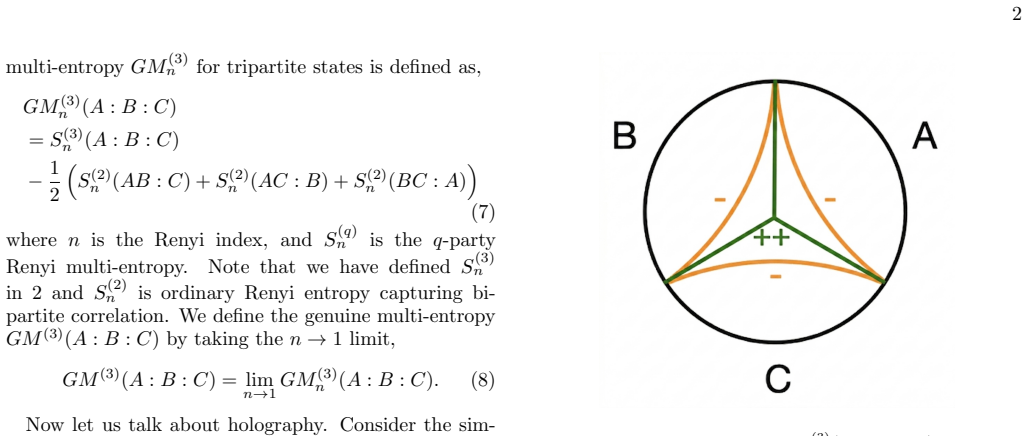
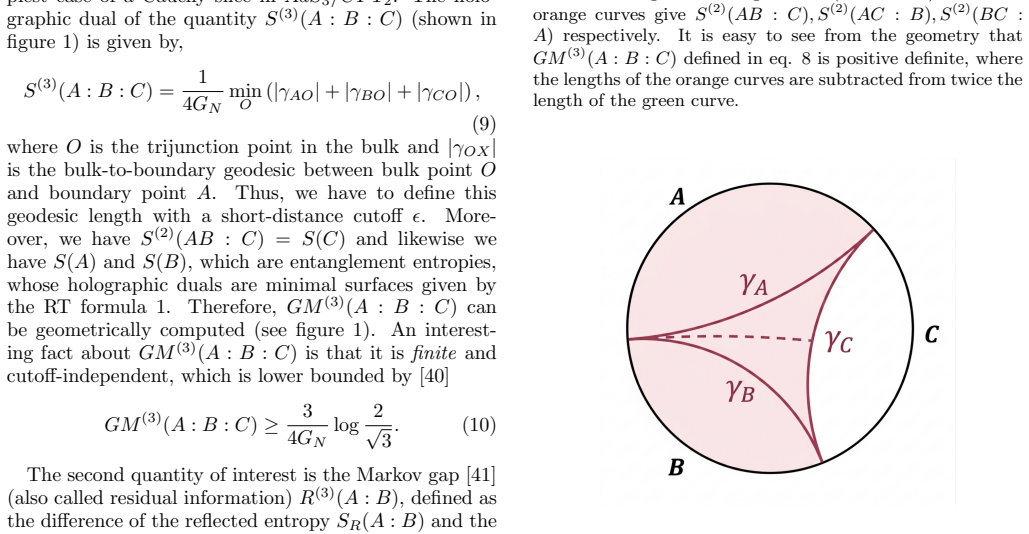
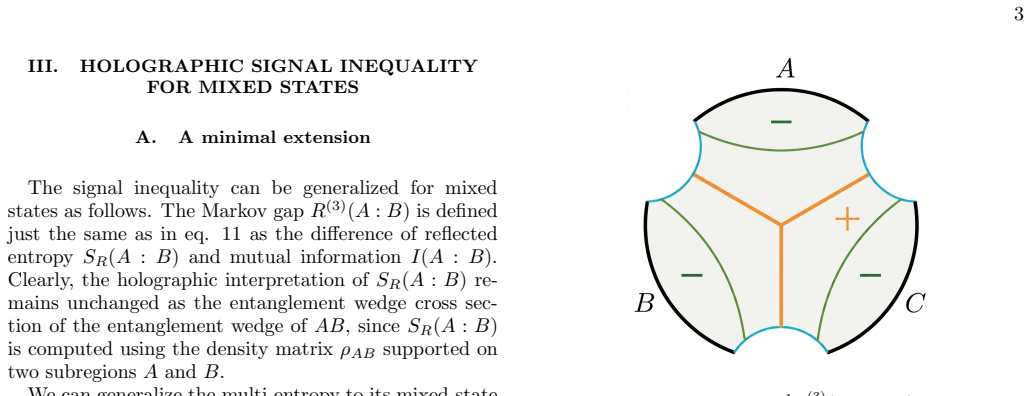
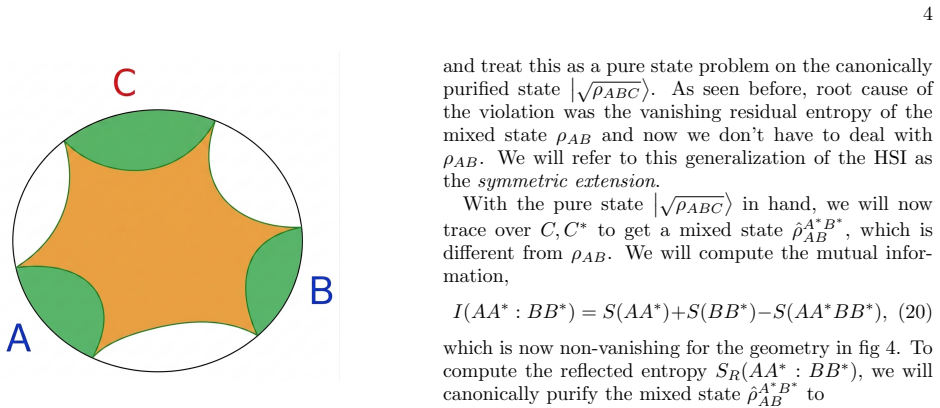
read the original abstract
A novel inequality involving the residual entropy and genuine multi-entropy was proposed in \cite{Balasubramanian:2025hxg} for tripartite holographic pure states, using which it was argued, that purely GHZ-like tripartite entanglement is not allowed in holography. In this work, we generalize this holographic signal inequality to mixed states. In a minimal extension, we compute the reflected genuine multi-entropy following \cite{Yuan:2024yfg} and find a class of holographic geometries that violate this minimally extended inequality due to vanishing Markov gap. We can symmetrize this prescription, where instead of computing the residual entropy on the given mixed state $\rho_{ABC}$, we compute it on its canonical purification. The inequality is restored on the canonically purified state, as expected. Finally, we conjecture a new inequality for tripartite holographic states and give supporting evidence.
Editorial analysis
A structured set of objections, weighed in public.
Referee Report
Summary. The manuscript generalizes the holographic signal inequality (originally for tripartite pure states) to mixed states via the reflected genuine multi-entropy construction. It reports that a class of holographic geometries violate the minimally extended inequality, attributes the violations to a vanishing Markov gap, shows that the inequality is restored when the residual entropy is instead evaluated on the canonical purification, and conjectures a new inequality for tripartite holographic states together with supporting evidence.
Significance. If the central claims hold, the work supplies a concrete mixed-state extension of an entanglement inequality that constrains GHZ-like tripartite entanglement in holography. The explicit link between violations and the Markov gap, together with the restoration under canonical purification, clarifies the role of purification in holographic mixed-state entanglement. The new conjecture, if substantiated, would further restrict allowed entanglement structures for holographic states.
minor comments (2)
- [Abstract / §1] The abstract and introduction should explicitly state the precise form of the original pure-state inequality (including the definition of residual entropy and genuine multi-entropy) so that the minimal extension can be compared term-by-term without consulting the cited reference.
- [Conjecture section] The supporting evidence for the new conjecture is described only qualitatively; a table or plot quantifying the numerical margin by which the inequality holds across the examined geometries would strengthen the claim.
Simulated Author's Rebuttal
We thank the referee for their positive assessment of the manuscript, including the summary of our central claims, the significance evaluation, and the recommendation for minor revision. No specific major comments were listed in the report.
Circularity Check
No significant circularity identified
full rationale
The paper extends the pure-state inequality via an external prescription for reflected genuine multi-entropy cited from Yuan:2024yfg (no author overlap with Naskar), reports concrete violations in chosen holographic geometries due to vanishing Markov gap, and observes restoration under canonical purification. No equation or central claim reduces by construction to the inputs; the 'as expected' restoration is a consistency check on the symmetrized definition rather than a forced prediction. The conjecture is presented separately with supporting evidence and does not rely on self-citation chains or definitional equivalence.
Axiom & Free-Parameter Ledger
Forward citations
Cited by 2 Pith papers
-
Constraints on four-party entanglement in holography
In time-reflection-symmetric holographic states, I3 is necessary for non-vanishing four-party entanglement signals, bounds multi-entropy measures, and implies vanishing of Q4.
-
Constraints on four-party entanglement in holography
In time-reflection-symmetric holographic states, I3 implies vanishing of multiple four-party entanglement measures and bounds those from multi-entropy, though Q4 is not quantitatively bounded by I3.
Reference graph
Works this paper leans on
-
[1]
V. Balasubramanian, M. J. Kang, C. Cummings, C. Murdia, and S. F. Ross, Purely Greenberger-Horne- Zeilinger–like Entanglement is Forbidden in Holography, Phys. Rev. Lett.136, 031602 (2026), arXiv:2509.03621 [hep-th]
- [2]
-
[3]
Horodecki, P
R. Horodecki, P. Horodecki, M. Horodecki, and K. Horodecki, Quantum entanglement, Rev. Mod. Phys. 81, 865 (2009)
2009
-
[4]
N. Bao, S. Nezami, H. Ooguri, B. Stoica, J. Sully, and M. Walter, The Holographic Entropy Cone, JHEP09, 130, arXiv:1505.07839 [hep-th]
work page internal anchor Pith review Pith/arXiv arXiv
- [5]
- [6]
-
[7]
D. Avis and S. Hern´ andez-Cuenca, On the foundations and extremal structure of the holographic entropy cone, Discrete Appl. Math.328, 16 (2023), arXiv:2102.07535 [math.CO]
-
[8]
B. Czech and S. Shuai, Holographic Cone of Average En- tropies, Commun. Phys.5, 244 (2022), arXiv:2112.00763 [hep-th]
-
[9]
S. Hern´ andez-Cuenca, V. E. Hubeny, and M. Rota, The holographic entropy cone from marginal independence, JHEP09, 190, arXiv:2204.00075 [hep-th]
-
[10]
G. Grimaldi, M. Headrick, V. E. Hubeny, and P. Shteyner, Combinatorial properties of holographic en- tropy inequalities, (2026), arXiv:2601.09987 [hep-th]
-
[11]
V. E. Hubeny and M. Rota, On the construction of graph models realizing given entropy vectors, JHEP05, 051, arXiv:2512.18702 [hep-th]
work page internal anchor Pith review Pith/arXiv arXiv
-
[12]
S. Hern´ andez-Cuenca, V. E. Hubeny, and H. F. Jia, Holo- graphic entropy inequalities and multipartite entangle- 7 ment, JHEP08, 238, arXiv:2309.06296 [hep-th]
- [13]
-
[14]
A new characterization of the holographic entropy cone
G. Grimaldi, M. Headrick, and V. E. Hubeny, A new characterization of the holographic entropy cone, SciPost Phys.20, 122 (2026), arXiv:2508.21823 [hep-th]
work page internal anchor Pith review Pith/arXiv arXiv 2026
-
[15]
B. Czech and S. Shuai, Renormalization Group Is the Principle behind the Holographic Entropy Cone, (2026), arXiv:2601.02472 [hep-th]
- [16]
-
[17]
B. Czech and S. Shuai, Nesting is not contracting, JHEP 06, 122, arXiv:2501.17222 [hep-th]
- [18]
- [19]
-
[20]
B. Grado-White, G. Grimaldi, M. Headrick, and V. E. Hubeny, Minimax surfaces and the holographic entropy cone, JHEP05, 104, arXiv:2502.09894 [hep-th]
-
[21]
Graph models for covariant holographic entropy I
B. Zhao, Graph models for covariant holographic entropy I, (2026), arXiv:2602.04888 [hep-th]
work page internal anchor Pith review Pith/arXiv arXiv 2026
- [22]
-
[23]
Considering subleading corrections, if the bulk subregion entropies satisfy the HEC, the boundary subregion en- tropies also satisfy them [51]
-
[24]
It has been shown in [52–54] that these inequalities are satisfied beyond the scope of their original use
-
[25]
J. K. Basak, V. Malvimat, and J. Yoon, A New Gen- uine Multipartite Entanglement Measure: from Qubits to Multiboundary Wormholes, (2024), arXiv:2411.11961 [hep-th]
work page internal anchor Pith review Pith/arXiv arXiv 2024
-
[26]
V. Balasubramanian, M. J. Kang, C. Murdia, and S. F. Ross, Signals of multiparty entanglement and hologra- phy, (2024), arXiv:2411.03422 [hep-th]
-
[27]
N. Bao, K. Furuya, and J. Naskar, Tripartite Correlation Signal from Multipartite Entanglement of Purification, (2025), arXiv:2509.08209 [hep-th]
work page internal anchor Pith review Pith/arXiv arXiv 2025
-
[28]
V. Balasubramanian, H. Jiang, and S. F. Ross, Time Evolution of Multi-Party Entanglement Signals, (2025), arXiv:2511.16729 [hep-th]
- [29]
-
[30]
Gadde, (2026), arXiv:2603.07680 [quant-ph]
A. Gadde, On genuine multipartite entanglement signals, (2026), arXiv:2603.07680 [quant-ph]
- [31]
-
[32]
New multipartite entanglement measure and its holographic dual
A. Gadde, V. Krishna, and T. Sharma, New multipartite entanglement measure and its holographic dual, Phys. Rev. D106, 126001 (2022), arXiv:2206.09723 [hep-th]
- [33]
- [34]
- [35]
- [36]
- [37]
-
[38]
N. Iizuka and M. Nishida, Genuine multi-entropy and holography, (2025), arXiv:2502.07995 [hep-th]
- [39]
- [40]
- [41]
-
[42]
Genuine multientropy, dihedral invariants and Lifshitz theory
C. Berthi` ere and P. Gaudin, Genuine multientropy, dihe- dral invariants, and Lifshitz theory, Phys. Rev. D113, 065029 (2026), arXiv:2509.00593 [hep-th]
work page internal anchor Pith review Pith/arXiv arXiv 2026
-
[43]
Entanglement of Purification for Multipartite States and its Holographic Dual
K. Umemoto and Y. Zhou, Entanglement of Purification for Multipartite States and its Holographic Dual, JHEP 10, 152, arXiv:1805.02625 [hep-th]
work page internal anchor Pith review Pith/arXiv arXiv
-
[44]
Conditional and Multipartite Entanglements of Purification and Holography
N. Bao and I. F. Halpern, Conditional and Multipar- tite Entanglements of Purification and Holography, Phys. Rev. D99, 046010 (2019), arXiv:1805.00476 [hep-th]
work page internal anchor Pith review Pith/arXiv arXiv 2019
-
[45]
Entanglement of purification: from spin chains to holography
P. Nguyen, T. Devakul, M. G. Halbasch, M. P. Zaletel, and B. Swingle, Entanglement of purification: from spin chains to holography, JHEP01, 098, arXiv:1709.07424 [hep-th]
work page internal anchor Pith review Pith/arXiv arXiv
-
[46]
Holographic Entanglement of Purification
T. Takayanagi and K. Umemoto, Entanglement of purifi- cation through holographic duality, Nature Phys.14, 573 (2018), arXiv:1708.09393 [hep-th]
work page internal anchor Pith review Pith/arXiv arXiv 2018
-
[47]
A canonical purification for the entanglement wedge cross-section
S. Dutta and T. Faulkner, A canonical purification for the entanglement wedge cross-section, JHEP03, 178, arXiv:1905.00577 [hep-th]
work page internal anchor Pith review Pith/arXiv arXiv 1905
-
[48]
Classification of Bipartite and Tripartite Qutrit Entanglement under SLOCC
X.-G. Yang, Z.-X. Wang, X.-H. Wang, and S.-M. Fei, Classification of Bipartite and Tripartite Qutrit Entan- glement under SLOCC, Commun. Theor. Phys.50, 651 (2008), arXiv:0809.1556 [quant-ph]
work page internal anchor Pith review Pith/arXiv arXiv 2008
-
[49]
F. Verstraete, J. Dehaene, B. De Moor, and H. Ver- schelde, Four qubits can be entangled in nine differ- ent ways, Phys. Rev. A65, 052112 (2002), arXiv:quant- ph/0109033
-
[50]
P. K. Das and J. Naskar, Allowed and forbidden entan- glement in holography, In progress
- [51]
-
[52]
Topological entanglement entropy meets holographic entropy inequalities
J. Naskar and S. S. Samal, Topological entanglement en- tropy meets holographic entropy inequalities, (2024), arXiv:2412.05484 [quant-ph]
work page internal anchor Pith review Pith/arXiv arXiv 2024
-
[53]
N. Bao, C. Cao, M. Walter, and Z. Wang, Holographic entropy inequalities and gapped phases of matter, JHEP 09, 203, arXiv:1507.05650 [hep-th]. 8
work page internal anchor Pith review Pith/arXiv arXiv
-
[54]
R. Bousso and S. Kaya, Holographic entropy cone be- yond AdS/CFT, Phys. Rev. D111, 086014 (2025), arXiv:2502.03516 [hep-th]
discussion (0)
Sign in with ORCID, Apple, or X to comment. Anyone can read and Pith papers without signing in.