Constraints on four-party entanglement in holography
Pith reviewed 2026-06-30 10:42 UTC · model grok-4.3
The pith
In time-reflection-symmetric holographic states, four-party entanglement signals require non-zero triple information I3.
A machine-rendered reading of the paper's core claim, the machinery that carries it, and where it could break.
Core claim
In pure time-reflection-symmetric holographic states, several known four-party entanglement signals vanish unless the triple information I3 is non-zero. In this sense, the results show that I3 is the strongest known signal of the presence of quadripartite entanglement. Additionally, I3 quantitatively bounds all four-party entanglement signals built from the multi-entropy. However, the residual entropy Q4, also a measure of four-party entanglement, is not bounded by I3, although I3=0 does imply Q4=0 for holographic states except on a set of measure zero for which Q4 is ill-defined.
What carries the argument
The triple information I3, which detects the presence of quadripartite entanglement and supplies bounds on other four-party measures.
If this is right
- If I3 vanishes then known four-party entanglement signals built from the multi-entropy must also vanish.
- I3 supplies explicit quantitative upper bounds on the size of those multi-entropy signals.
- The residual entropy Q4 must vanish whenever I3 vanishes, except on a measure-zero set of states where it is ill-defined.
- These constraints apply uniformly to all pure states obeying time-reflection symmetry in holographic theories.
Where Pith is reading between the lines
- Similar vanishing relations might be tested in non-holographic quantum states that obey the same symmetry.
- The result suggests that computations of multi-region entanglement in AdS/CFT could be simplified by first checking the value of I3.
- The exception set of measure zero for Q4 could be examined explicitly in simple holographic examples to see whether it carries physical content.
Load-bearing premise
The vanishing and bounding relations are derived only for pure time-reflection-symmetric holographic states.
What would settle it
Finding a pure time-reflection-symmetric holographic state in which I3 equals zero yet at least one four-party entanglement signal built from the multi-entropy remains non-zero, or in which Q4 is non-zero.
Figures
read the original abstract
We show that in pure time-reflection-symmetric holographic states several known four-party entanglement signals vanish unless the triple information $I_3$ is non-zero. In this sense, our results show that $I_3$ is the strongest known signal of the presence of quadripartite entanglement. Additionally, $I_3$ quantitatively bounds all four-party entanglement signals built from the multi-entropy. However, the residual entropy $Q_4$, also a measure of four-party entanglement, is not bounded by $I_3$, although $I_3=0$ does imply $Q_4=0$ for holographic states (except on a set of measure zero for which $Q_4$ is ill-defined).
Editorial analysis
A structured set of objections, weighed in public.
Referee Report
Summary. The manuscript examines constraints on four-party entanglement in pure time-reflection-symmetric holographic states. It establishes that several known four-party entanglement signals vanish unless the triple information I3 is non-zero, thereby identifying I3 as the strongest known signal of quadripartite entanglement. I3 is further shown to quantitatively bound all four-party entanglement signals constructed from the multi-entropy. The residual entropy Q4 is not bounded by I3, but I3=0 implies Q4=0 except on a measure-zero set where Q4 is ill-defined.
Significance. If the derivations hold, the results tighten the relationship between known entanglement measures in holography and highlight I3 as a central diagnostic for four-party entanglement under the stated restrictions. The explicit scope limitation to pure time-reflection-symmetric states and the use of standard holographic properties (without ad-hoc parameters or invented entities) are strengths. The one-way implication for Q4 and the measure-zero exception are clearly flagged, supporting falsifiable predictions on vanishing conditions.
minor comments (2)
- [Introduction] §1 (Introduction): the statement that I3 is the 'strongest known signal' would benefit from an explicit comparison table or reference list of the other four-party signals considered, to make the claim easier to verify.
- The multi-entropy bounding relations are stated clearly in the abstract but the precise functional form of the bound (e.g., inequality direction and constants) should be highlighted in the main text near the relevant equations for quick reference.
Simulated Author's Rebuttal
We thank the referee for their positive assessment of our manuscript and for recommending minor revision. The referee summary and significance statement accurately reflect the scope and results of the work. No specific major comments are provided in the report, so we have no points requiring a point-by-point response at this stage.
Circularity Check
No significant circularity; derivation self-contained
full rationale
The abstract and described claims derive vanishing conditions and quantitative bounds on four-party signals from standard holographic entropy properties restricted to pure time-reflection-symmetric states. No equations or steps reduce by construction to fitted inputs, self-definitions, or load-bearing self-citations; the one-way implications and measure-zero exception are explicitly stated without circular reduction. This matches the most common honest non-finding for papers whose central results remain independent of their own fitted values.
Axiom & Free-Parameter Ledger
axioms (2)
- domain assumption Holographic states admit a bulk geometric description via AdS/CFT correspondence
- domain assumption Entanglement measures I3, multi-entropy signals, and Q4 are well-defined for the states under consideration
Forward citations
Cited by 3 Pith papers
-
Complexity Inequalities for Quantum Subsystems
Introduces tripartite complexity and complexity gap for three-region subsystems and reports that the gap has a definite sign in holographic volume complexity, Fisher-Rao Gaussian complexity, and Krylov-space approaches.
-
Detecting Topological Transitions and Anisotropy through Multipartite Entanglement in Holographic Weyl Semimetals
Multipartite entanglement quantities in holographic Weyl semimetals develop features at the topological critical point and distinguish phases through anisotropic large-l scaling.
-
Multi-entropy in heavy local quenches
Genuine multi-entropy in heavy local quenches in 2D holographic CFTs is kinematically fixed to logarithms of rational functions of time, independent of heavy operator dimension, due to global saddle selection in the g...
Reference graph
Works this paper leans on
-
[1]
Theξ A:B andζ A:B sur- faces are also illustrated in Fig
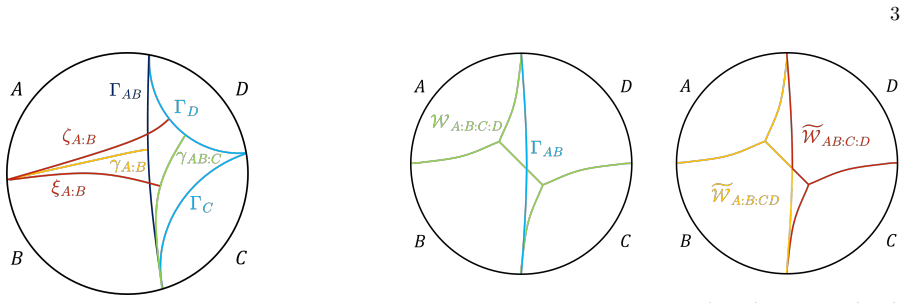
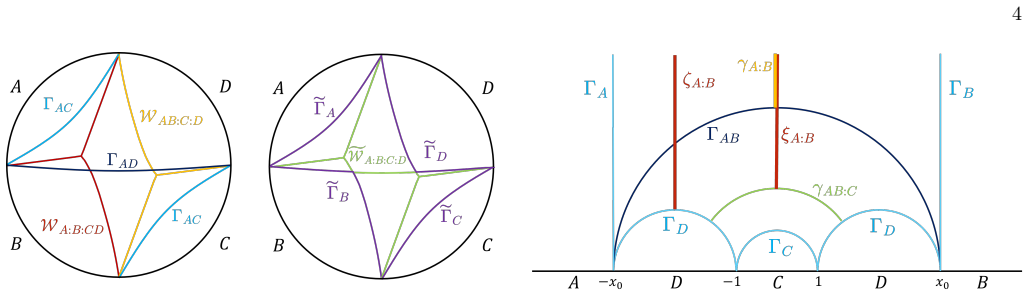
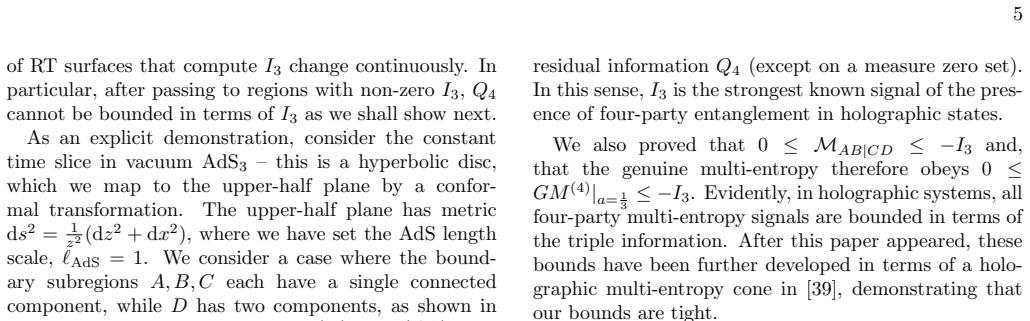
Finally, we introduce an alternate holographic quantity eQ4(A:B) = 1 4G (A[ζA:B]− A[γ A:B]),(12) whereζ A:B is the minimal surface that separatesAandB withinEW(ABC)∩EW(ABD). Theξ A:B andζ A:B sur- faces are also illustrated in Fig. 1. Since we do not have FIG. 2. The brane-webW A:B:C:D (green) and Γ AB (blue) shown on the left can be split into two disjoi...
-
[2]
Above the transition,EW(ABC) =EW(AB)∪EW(C), which im- plies that bothI 3 andQ 4 vanish by the result of [6]
is that there is a phase transition there where EW(D) becomes connected andI 3 vanishes. Above the transition,EW(ABC) =EW(AB)∪EW(C), which im- plies that bothI 3 andQ 4 vanish by the result of [6]. SinceI 3 is built from entanglement entropies, it transi- tions to zero continuously. However,Q 4 and eQ4 involve entanglement wedge cross-sections, and they c...
-
[3]
Holographic Derivation of Entanglement Entropy from AdS/CFT
S. Ryu and T. Takayanagi, Phys. Rev. Lett.96, 181602 (2006), arXiv:hep-th/0603001
work page internal anchor Pith review Pith/arXiv arXiv 2006
-
[4]
V. E. Hubeny, M. Rangamani, and T. Takayanagi, JHEP 07, 062 (2007), arXiv:0705.0016 [hep-th]
work page internal anchor Pith review Pith/arXiv arXiv 2007
-
[5]
A canonical purification for the entanglement wedge cross-section
S. Dutta and T. Faulkner, JHEP03, 178 (2021), arXiv:1905.00577 [hep-th]
work page internal anchor Pith review Pith/arXiv arXiv 2021
-
[6]
C. Akers and P. Rath, JHEP04, 208 (2020), arXiv:1911.07852 [hep-th]
-
[7]
New multipartite entanglement measure and its holographic dual
A. Gadde, V. Krishna, and T. Sharma, Phys. Rev. D 106, 126001 (2022), arXiv:2206.09723 [hep-th]
-
[8]
V. Balasubramanian, M. J. Kang, C. Murdia, and S. F. Ross, JHEP06, 068 (2025), arXiv:2411.03422 [hep-th]
-
[9]
Harper, JHEP03, 116 (2021), arXiv:2006.02899 [hep- th]
J. Harper, JHEP03, 116 (2021), arXiv:2006.02899 [hep- th]
- [10]
- [11]
- [12]
-
[13]
N. Bao, S. Nezami, H. Ooguri, B. Stoica, J. Sully, and M. Walter, JHEP09, 130 (2015), arXiv:1505.07839 [hep- th]
work page internal anchor Pith review Pith/arXiv arXiv 2015
-
[14]
Handlebody phases and the polyhedrality of the holographic entropy cone
D. Marolf, M. Rota, and J. Wien, JHEP10, 069 (2017), arXiv:1705.10736 [hep-th]
work page internal anchor Pith review Pith/arXiv arXiv 2017
-
[15]
D. Avis and S. Hern´ andez-Cuenca, Discrete Appl. Math. 328, 16 (2023), arXiv:2102.07535 [math.CO]
-
[16]
S. Hern´ andez-Cuenca, V. E. Hubeny, and M. Rota, JHEP09, 190 (2022), arXiv:2204.00075 [hep-th]
- [17]
- [18]
-
[19]
V. Balasubramanian, M. J. Kang, C. Cummings, C. Mur- dia, and S. F. Ross, Phys. Rev. Lett.136, 031602 (2026), arXiv:2509.03621 [hep-th]
-
[20]
N. Bao, K. Furuya, and J. Naskar, JHEP05, 236 (2026), arXiv:2509.08209 [hep-th]
work page internal anchor Pith review Pith/arXiv arXiv 2026
-
[21]
B. Ahn, J. K. Basak, K.-Y. Kim, G. B. Koo, V. Malvi- mat, and J. Yoon, (2025), arXiv:2510.19922 [hep-th]
work page internal anchor Pith review Pith/arXiv arXiv 2025
-
[22]
On a mixed-state extension of the holographic signal inequality
J. Naskar, (2026), arXiv:2605.26617 [hep-th]
work page internal anchor Pith review Pith/arXiv arXiv 2026
-
[23]
Holographic Mutual Information is Monogamous
P. Hayden, M. Headrick, and A. Maloney, Phys. Rev. D 87, 046003 (2013), arXiv:1107.2940 [hep-th]
work page internal anchor Pith review Pith/arXiv arXiv 2013
-
[24]
Multiboundary Wormholes and Holographic Entanglement
V. Balasubramanian, P. Hayden, A. Maloney, D. Marolf, and S. F. Ross, Class. Quant. Grav.31, 185015 (2014), arXiv:1406.2663 [hep-th]
work page internal anchor Pith review Pith/arXiv arXiv 2014
-
[25]
G. Penington, M. Walter, and F. Witteveen, JHEP05, 008 (2023), arXiv:2211.16045 [hep-th]
- [26]
- [27]
-
[28]
N. Iizuka and M. Nishida, Phys. Rev. D112, 026011 (2025), arXiv:2502.07995 [hep-th]
- [29]
-
[30]
Gadde, (2026), arXiv:2603.07680 [quant-ph]
A. Gadde, (2026), arXiv:2603.07680 [quant-ph]
-
[31]
W. Dur, G. Vidal, and J. I. Cirac, Phys. Rev. A62, 062314 (2000), arXiv:quant-ph/0005115
work page internal anchor Pith review Pith/arXiv arXiv 2000
-
[32]
The compositional structure of multipartite quantum entanglement
B. Coecke and A. Kissinger, Lect. Notes Comput. Sci. 6199, 297 (2010), arXiv:1002.2540 [quant-ph]
work page internal anchor Pith review Pith/arXiv arXiv 2010
-
[33]
M. Hein, J. Eisert, and H. J. Briegel, Phys. Rev. A69, 062311 (2004), arXiv:quant-ph/0307130
work page internal anchor Pith review Pith/arXiv arXiv 2004
-
[34]
F. Verstraete, J. Dehaene, B. De Moor, and H. Ver- schelde, Phys. Rev. A65, 052112 (2002), arXiv:quant- ph/0109033
- [35]
-
[36]
The Gravity Dual of a Density Matrix
B. Czech, J. L. Karczmarek, F. Nogueira, and M. Van Raamsdonk, Class. Quant. Grav.29, 155009 (2012), arXiv:1204.1330 [hep-th]
work page internal anchor Pith review Pith/arXiv arXiv 2012
-
[37]
Causality & holographic entanglement entropy
M. Headrick, V. E. Hubeny, A. Lawrence, and M. Ranga- mani, JHEP12, 162 (2014), arXiv:1408.6300 [hep-th]
work page internal anchor Pith review Pith/arXiv arXiv 2014
-
[38]
X. Dong, D. Harlow, and A. C. Wall, Phys. Rev. Lett. 117, 021601 (2016), arXiv:1601.05416 [hep-th]
work page internal anchor Pith review Pith/arXiv arXiv 2016
-
[39]
D. L. Jafferis, A. Lewkowycz, J. Maldacena, and S. J. Suh, JHEP06, 004 (2016), arXiv:1512.06431 [hep-th]
work page internal anchor Pith review Pith/arXiv arXiv 2016
-
[40]
For the multi-entropy, [23] points out that the assumption that the dominant bulk saddle is replica symmetric fails forn= 3 in the AdS 3/CFT2 case
In general, the continuation from integernton→1 is a subtle question. For the multi-entropy, [23] points out that the assumption that the dominant bulk saddle is replica symmetric fails forn= 3 in the AdS 3/CFT2 case. Further discussion of replica symmetry for bulk sad- dles in the AdS 3/CFT2 case is given in [24]. The situa- tion is similar to that in [?...
- [41]
-
[42]
V. Balasubramanian, H. Jiang, and S. F. Ross, (2025), arXiv:2511.16729 [hep-th]
-
[43]
V. Balasubramanian, A. Bernamonti, N. Copland, B. Craps, and F. Galli, Phys. Rev. D84, 105017 (2011), arXiv:1110.0488 [hep-th]
work page internal anchor Pith review Pith/arXiv arXiv 2011
discussion (0)
Sign in with ORCID, Apple, or X to comment. Anyone can read and Pith papers without signing in.