Accurate waveforms for generic planar-orbit binary black holes: The multipolar effective-one-body model SEOBNRv6EHM
Pith reviewed 2026-06-29 10:37 UTC · model grok-4.3
The pith
SEOBNRv6EHM produces accurate multipolar waveforms for binary black holes on generic planar orbits with mismatches under 2 percent even at high eccentricity.
A machine-rendered reading of the paper's core claim, the machinery that carries it, and where it could break.
Core claim
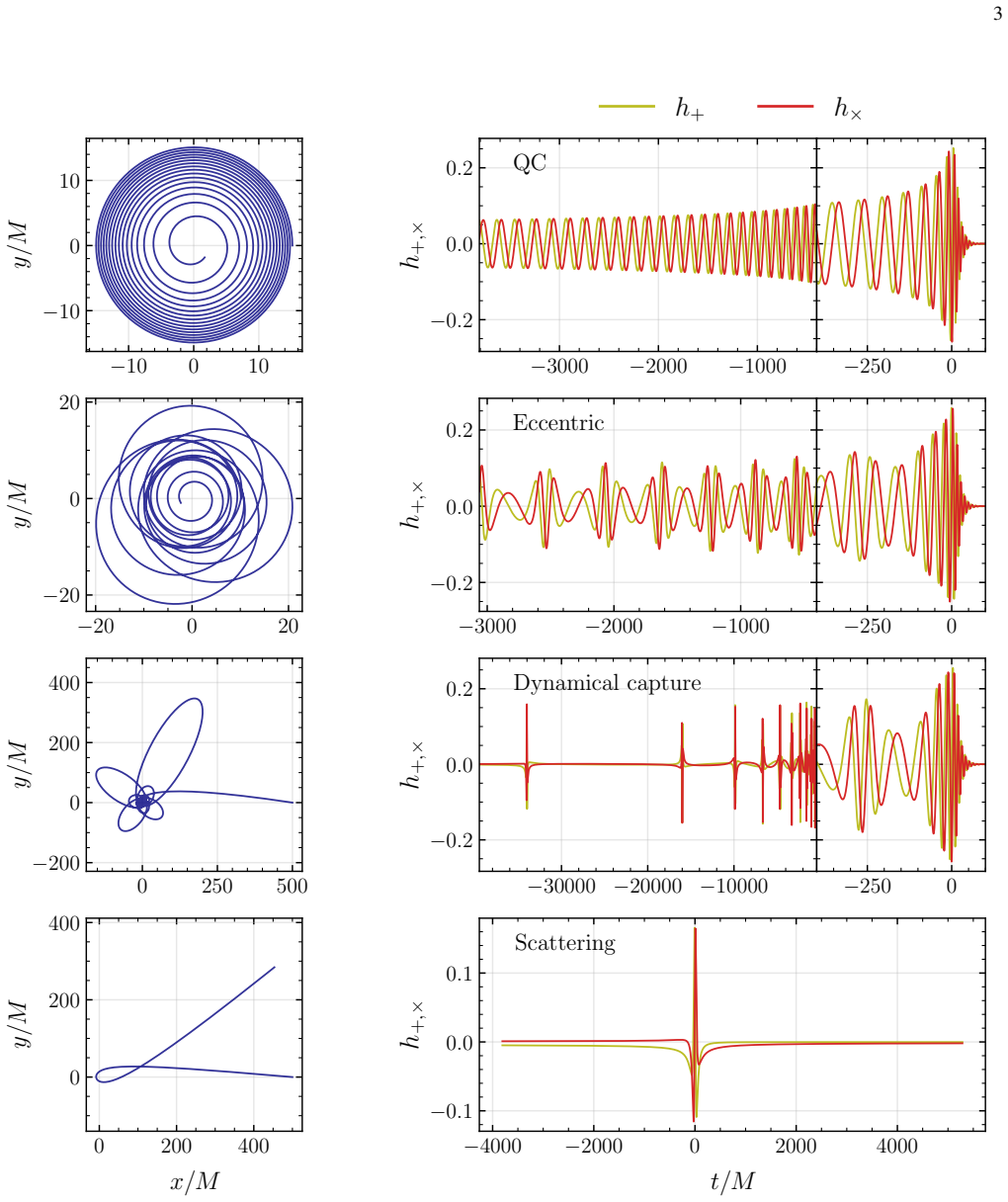
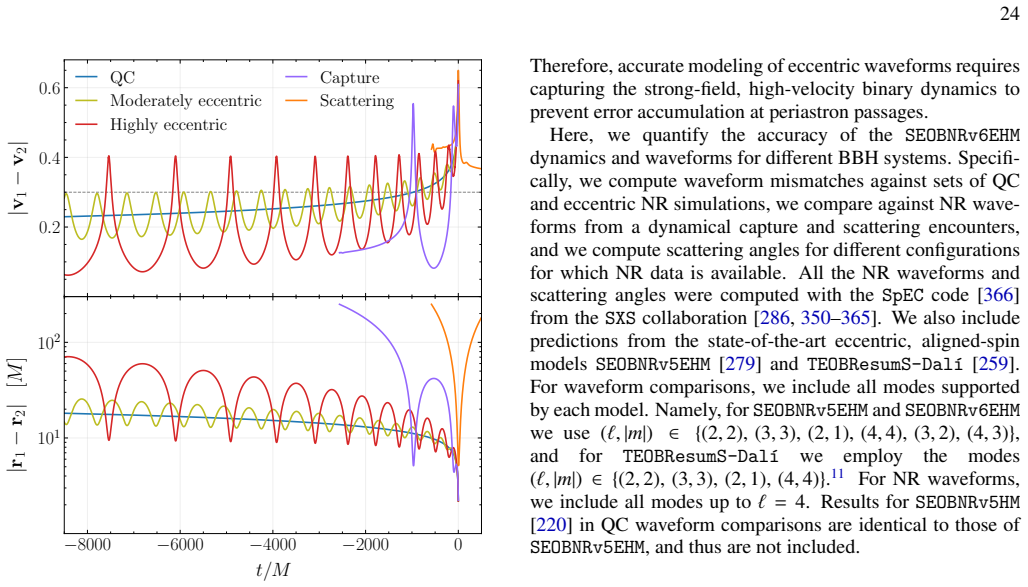
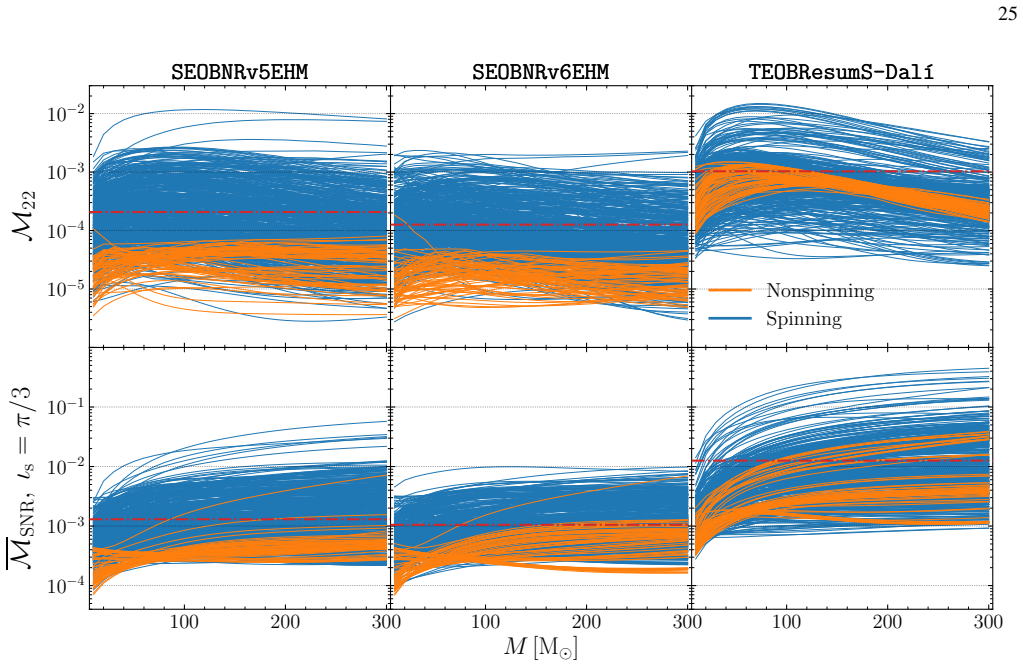
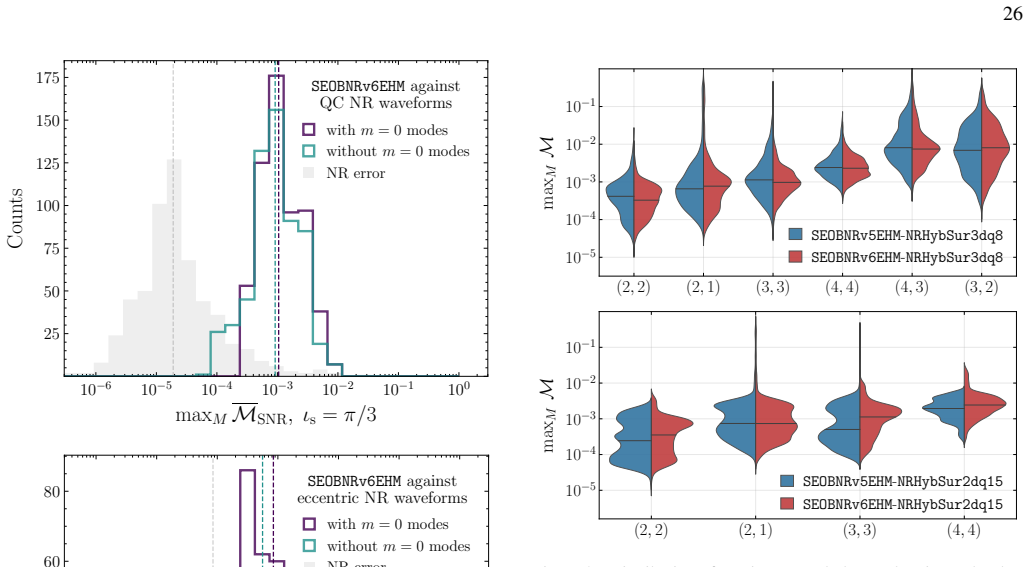
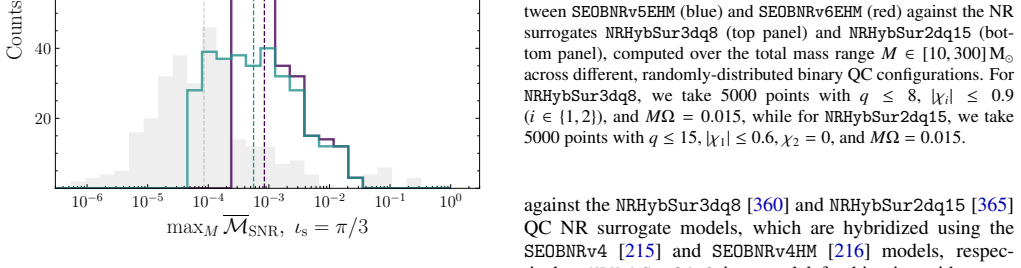
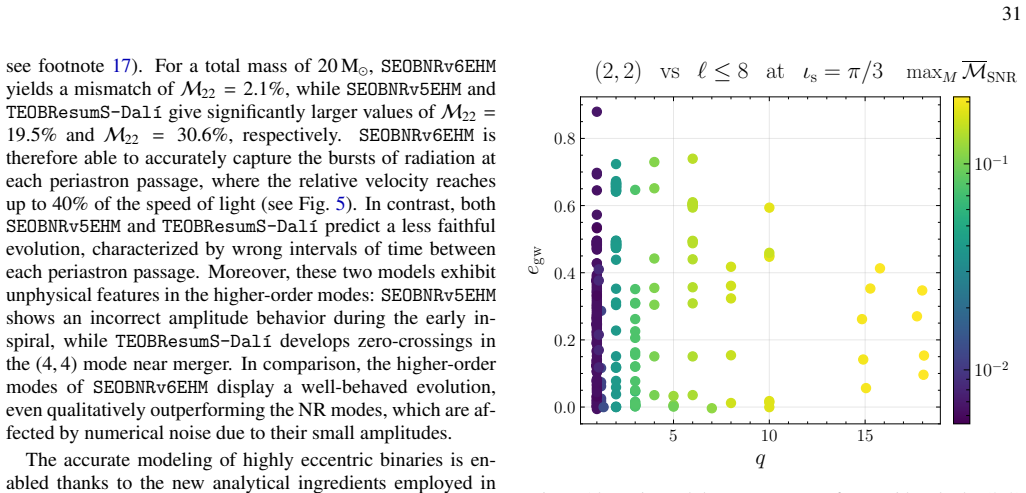
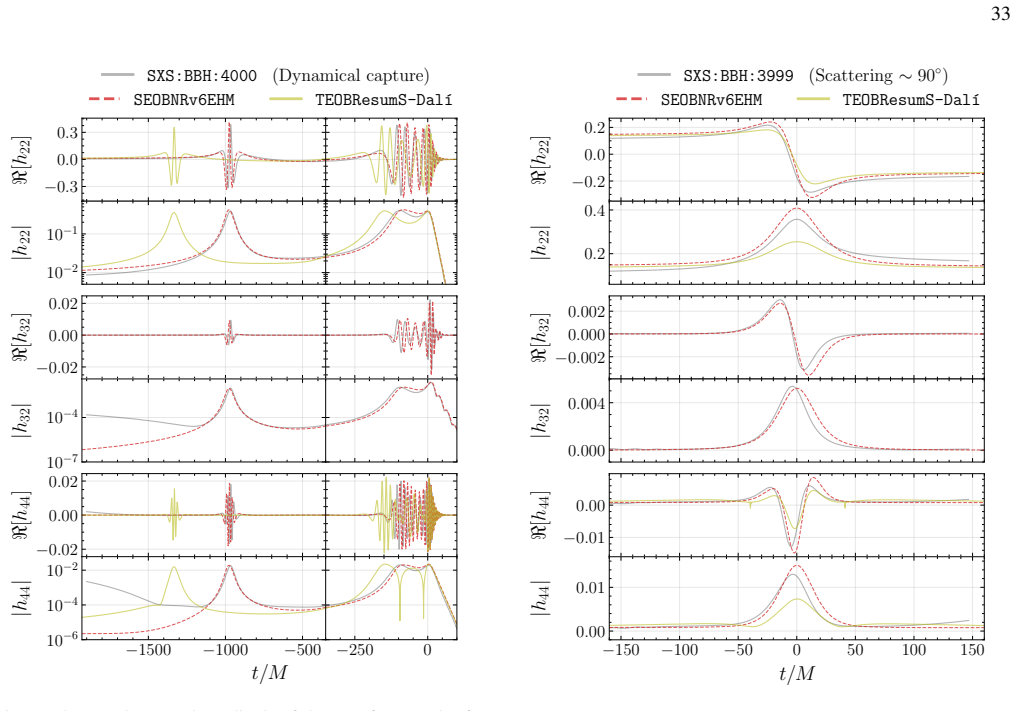
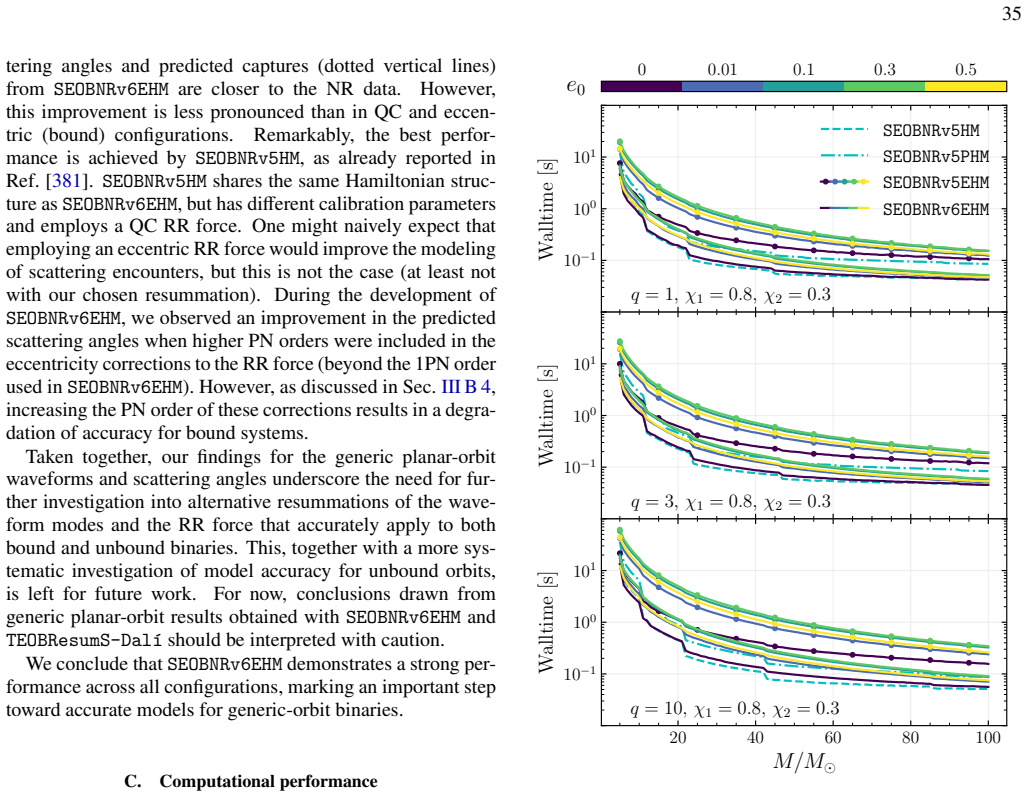
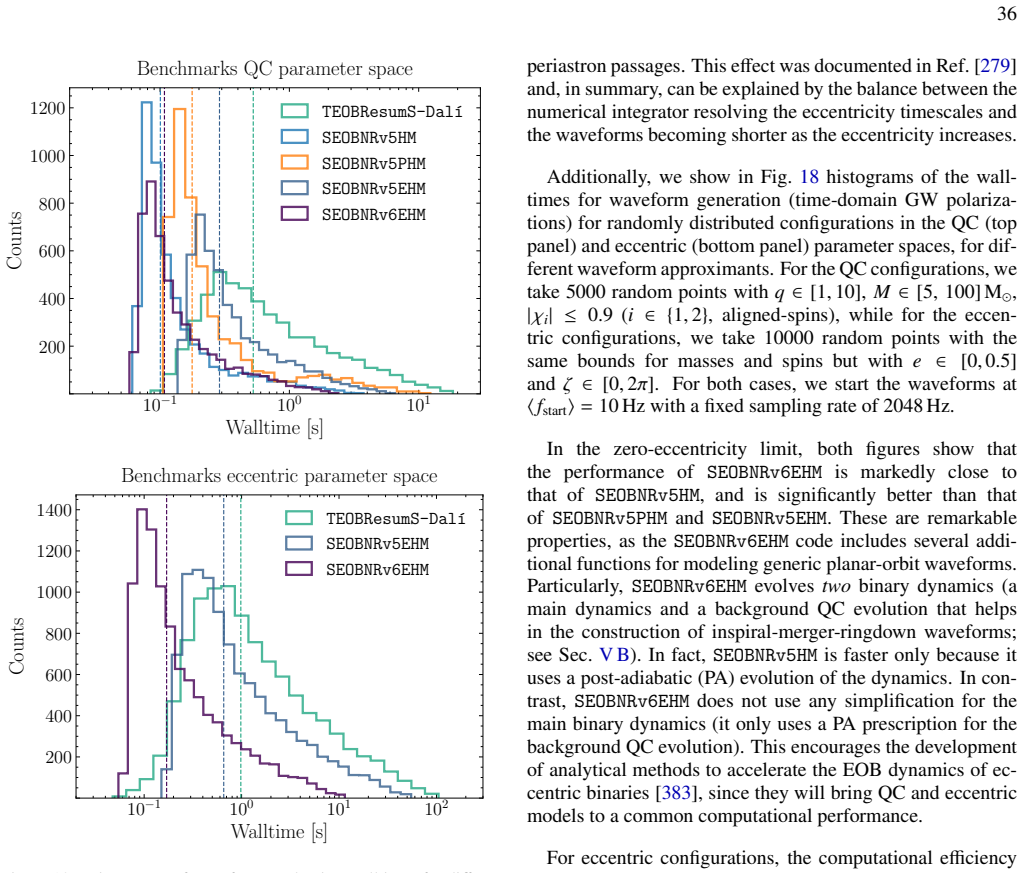
SEOBNRv6EHM is built within the effective-one-body framework and employs novel resummations of the radiation-reaction force and waveform modes. Validated against 592 quasi-circular, 319 eccentric, one dynamical-capture, and two scattering SXS NR waveforms, as well as scattering-angle comparisons, it attains unprecedented accuracy for highly eccentric systems with waveform mismatches remaining below or close to 2 percent across the total mass range 20-200 solar masses for eccentricities up to approximately 0.9 at 14 periastron passages before merger. It also achieves waveform-generation walltimes that are 2-6 times faster than other state-of-the-art EOB eccentric models.
What carries the argument
The multipolar effective-one-body framework with novel resummations of the radiation-reaction force and waveform modes, calibrated to quasi-circular numerical relativity simulations.
If this is right
- Waveform mismatches remain below or close to 2 percent for highly eccentric systems up to eccentricity 0.9 across total masses 20-200 solar masses.
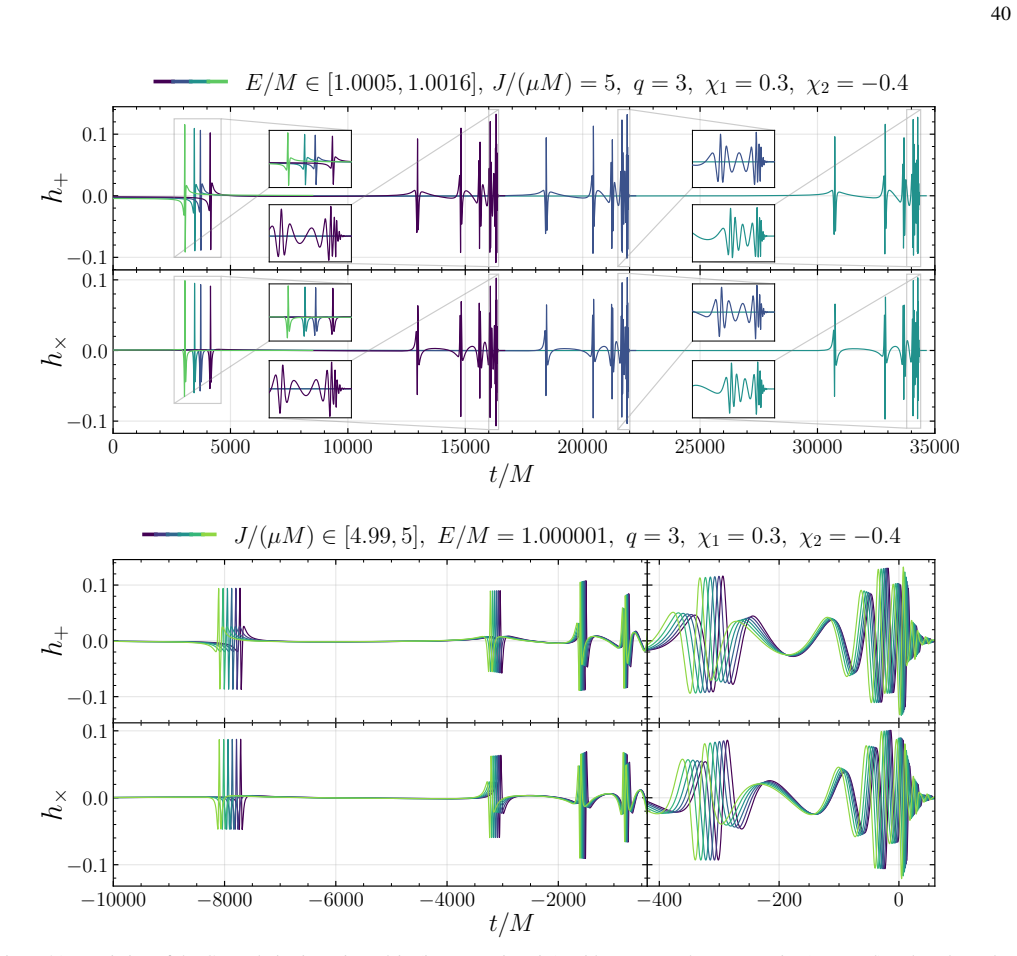
- The model covers the full inspiral-merger-ringdown for dynamical captures and scattering encounters in addition to bound orbits.
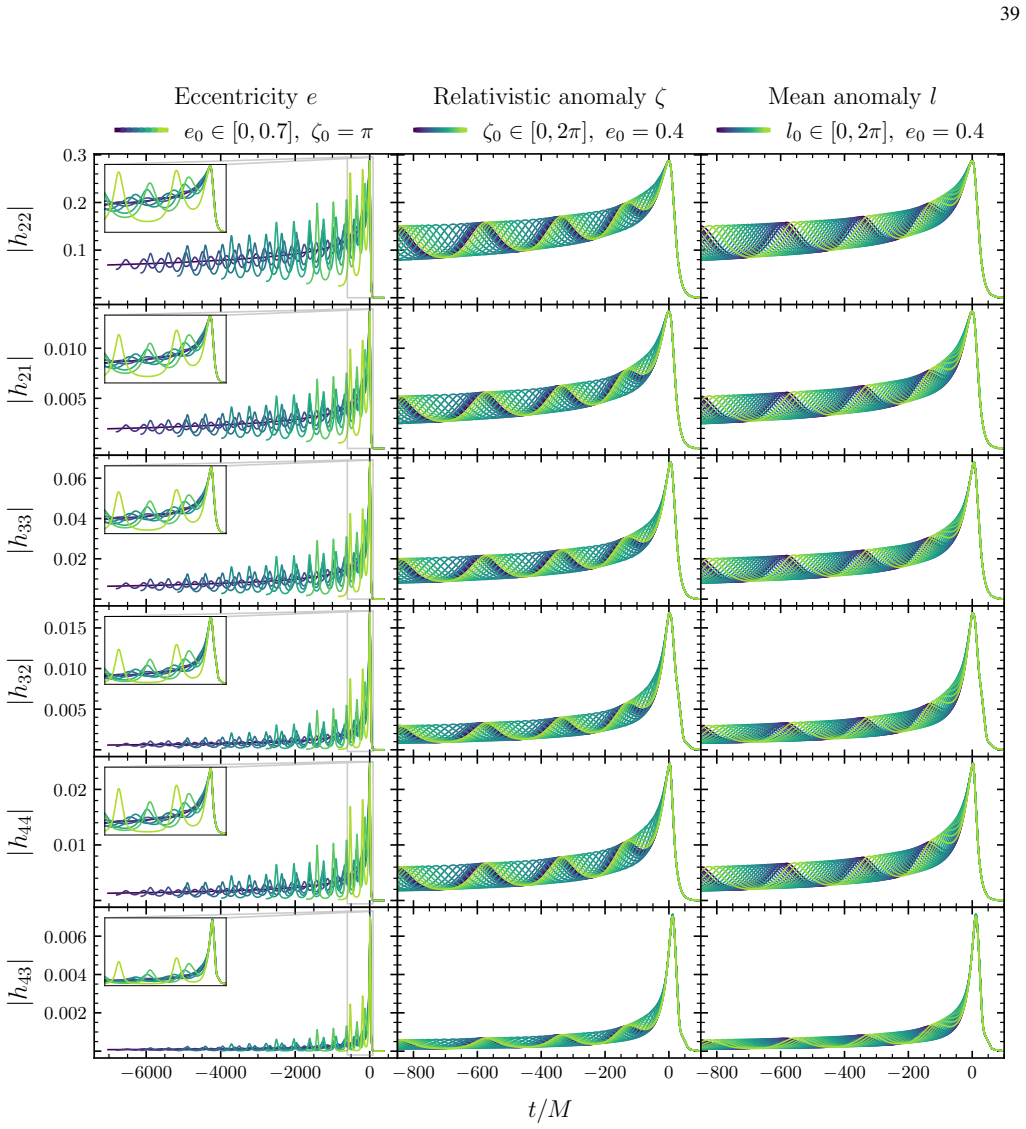
- Higher multipoles including (2,1), (3,3), (3,2), (4,4), and (4,3) are provided alongside the dominant (2,2) mode.
- Waveform generation is 2-6 times faster than other state-of-the-art eccentric EOB models.
- Accuracy remains comparable to previous-generation SEOBNRv5 models for quasi-circular and small-eccentricity cases.
Where Pith is reading between the lines
- Better handling of eccentricity could reduce systematic biases when inferring parameters of binaries formed through dynamical channels in dense environments.
- The speed gain might enable broader use of eccentric templates in large-scale gravitational wave searches and population studies.
- The resummation techniques could be tested for extension to spinning or non-planar configurations in follow-up work.
Load-bearing premise
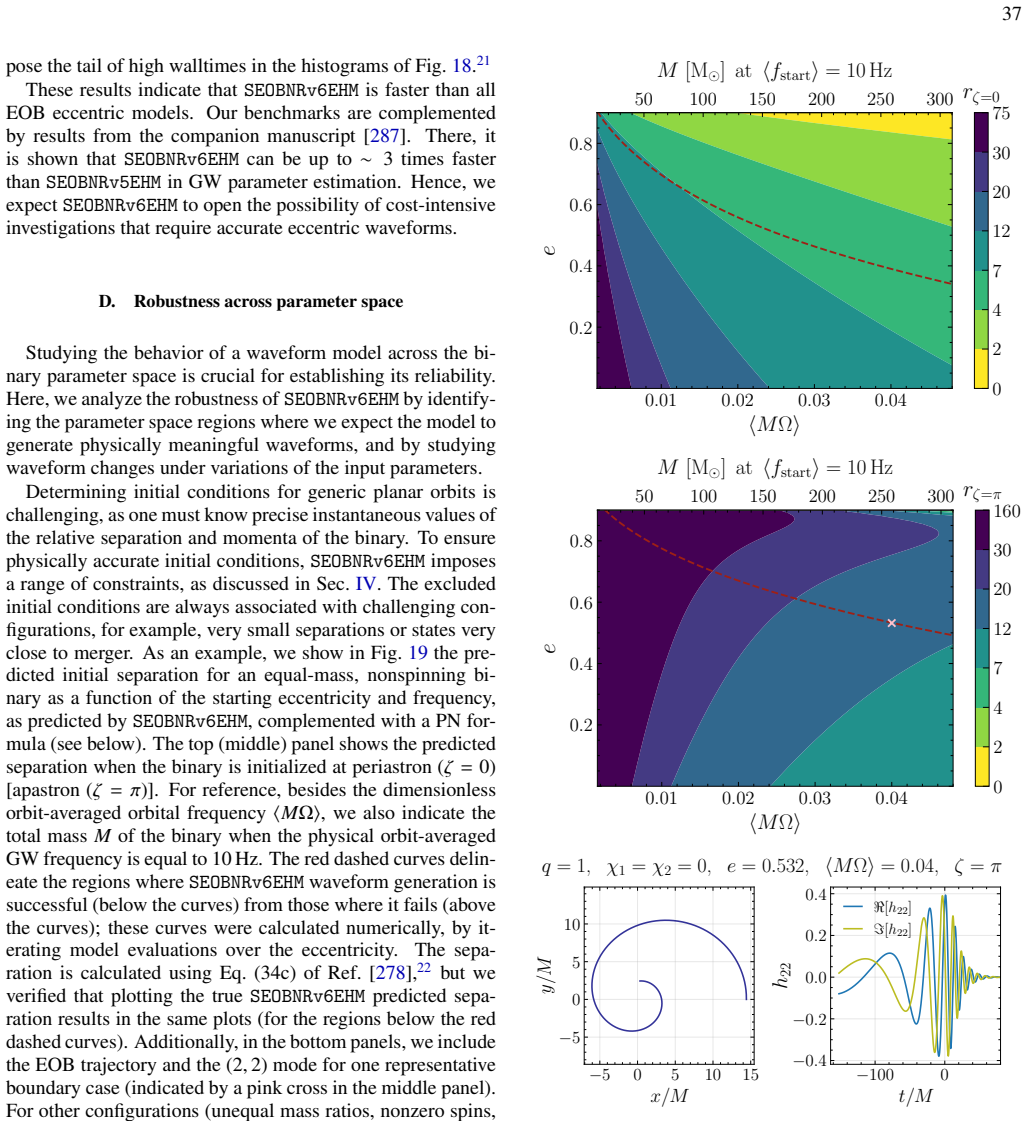
The novel resummations developed and calibrated primarily for quasi-circular orbits remain accurate when applied to highly eccentric orbits and dynamical captures without further tuning.
What would settle it
A numerical relativity simulation of an eccentric binary with eccentricity near 0.9 and 14 periastron passages before merger that produces a mismatch exceeding 2 percent when compared to SEOBNRv6EHM would falsify the accuracy claim.
Figures
read the original abstract
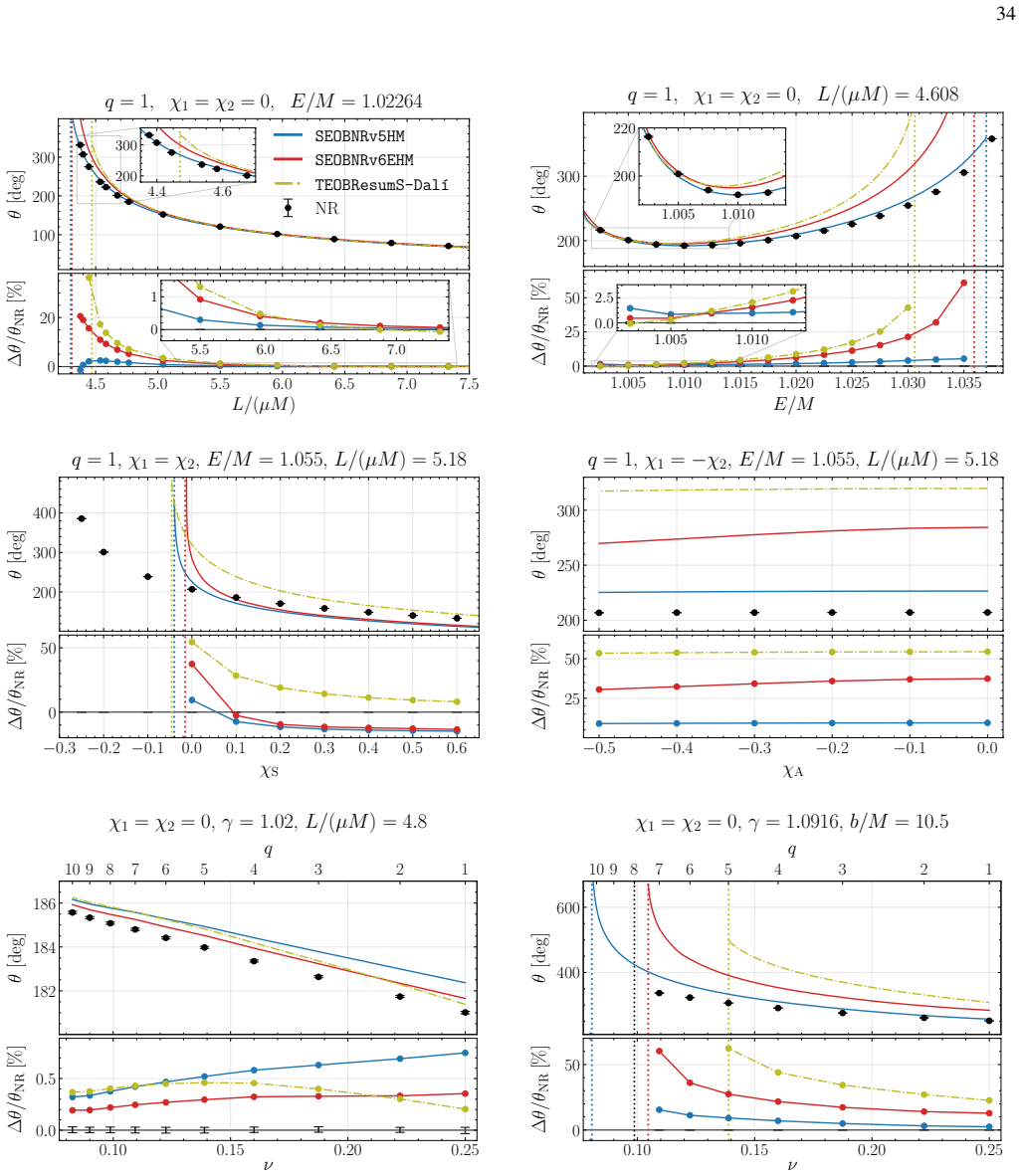
Accurate and computationally efficient waveform models are required to infer the parameters of compact binaries from their gravitational wave (GW) emission. Among these parameters, orbital eccentricity serves as a smoking gun for dynamical formation channels and must be accounted for to avoid systematic errors in GW analyses. Here, we present SEOBNRv6EHM, a time-domain, multipolar waveform model for binaries on generic planar orbits, calibrated to quasi-circular (QC) numerical-relativity (NR) simulations from the SXS collaboration. In addition to the dominant $(2,2)$ mode, the model provides the $(2,1)$, $(3,3)$, $(3,2)$, $(4,4)$, and $(4,3)$ multipoles for the full inspiral-merger-ringdown process of coalescing binaries, as well as for dynamical captures and scattering encounters. The model is built within the effective-one-body (EOB) framework, and it employs novel resummations of the radiation-reaction force and waveform modes. We validate its accuracy through comparisons against 592 QC, 319 eccentric, one dynamical-capture, and two scattering SXS NR waveforms, and through scattering-angle comparisons against 61 SXS NR simulations. For QC and small-eccentricity binaries, its accuracy is comparable to previous-generation SEOBNRv5 models. For highly eccentric systems, however, SEOBNRv6EHM attains unprecedented accuracy, with waveform mismatches remaining below or close to $ 2\% $ across the total mass range $ 20-200\, \mathrm{M}_\odot $ for eccentricities up to $\sim 0.9$ at 14 periastron passages before merger. Additionally, SEOBNRv6EHM achieves waveform-generation walltimes that are $ 2 - 6 $ times faster than other state-of-the-art EOB eccentric models, enabling efficient and accurate applications in GW astronomy.
Editorial analysis
A structured set of objections, weighed in public.
Referee Report
Summary. The manuscript introduces SEOBNRv6EHM, a time-domain multipolar effective-one-body waveform model for generic planar orbits of binary black holes. It is calibrated to quasi-circular SXS NR simulations and provides the (2,2), (2,1), (3,3), (3,2), (4,4), and (4,3) modes for inspiral-merger-ringdown, dynamical captures, and scattering encounters. The central claim is that the model achieves mismatches below or close to 2% against 319 eccentric SXS NR waveforms (plus 592 QC, one capture, and two scattering cases) for eccentricities up to ~0.9 at 14 periastron passages, while being 2-6 times faster than prior eccentric EOB models.
Significance. If the reported accuracy holds, the model would be significant for gravitational-wave astronomy by enabling reliable parameter estimation for eccentric binaries, which serve as indicators of dynamical formation channels. The direct validation against 319 eccentric NR waveforms (rather than extrapolation) provides empirical grounding for the performance on highly eccentric orbits. Credit is given for the scale of the NR comparison set and the reported computational speedup, both of which strengthen the practical utility of the result.
minor comments (2)
- The abstract states mismatches remain below or close to 2% across 20-200 M_⊙ for e up to ~0.9, but the main text should explicitly define the mismatch measure (e.g., which modes are included, frequency range, and noise curve) and report the distribution of mismatches rather than only the upper bound.
- The description of the novel resummations of the radiation-reaction force and waveform modes would benefit from a dedicated subsection or appendix that isolates their functional form and shows how they reduce to the quasi-circular limit.
Simulated Author's Rebuttal
We thank the referee for the positive assessment of SEOBNRv6EHM, the recognition of its potential impact for eccentric binary parameter estimation, and the recommendation for minor revision. We appreciate the credit given to the scale of the NR validation set and the reported computational performance.
Circularity Check
No significant circularity
full rationale
The model is calibrated exclusively to quasi-circular SXS NR simulations and then validated by direct mismatch comparisons against an independent set of 319 eccentric SXS NR waveforms (plus capture and scattering cases) that were not used in the fit. The reported accuracy for e up to ~0.9 is therefore an empirical test rather than a quantity forced by the calibration inputs. No self-definitional equations, fitted-input-called-prediction steps, or load-bearing self-citation chains that reduce the central claim to its own inputs appear in the provided text; the EOB resummations are applied within an existing framework whose eccentric dynamics are already defined independently of the validation data.
Axiom & Free-Parameter Ledger
free parameters (1)
- EOB calibration parameters
axioms (1)
- domain assumption Effective-one-body framework provides an accurate mapping for two-body dynamics in general relativity
Forward citations
Cited by 3 Pith papers
-
Joint inference of line-of-sight acceleration and orbital eccentricity in neutron-star--black-hole binaries
All five NSBH events are consistent with zero line-of-sight acceleration; the joint posterior for GW200105_162426 disfavors both zero LOSA and zero eccentricity at 90% credibility.
-
Horizon absorption in eccentric precessing binary black hole inspirals and its importance for gravitational wave data analysis
First leading-PN derivation of horizon absorption in eccentric precessing BBH inspirals, incorporated into pyEFPEHM, with estimates showing parameter biases in eccentric systems at moderate SNR.
-
Weak-field waveforms for generic relativistic orbits
Outlines a Schwinger-Keldysh path-integral framework that derives worldline equations of motion and computes weak-field gravitational waveforms independently for unspecified relativistic orbits.
Reference graph
Works this paper leans on
-
[1]
B. P. Abbottet al.(LIGO Scientific, Virgo), GWTC-1: A Gravitational-Wave Transient Catalog of Compact Binary Mergers Observed by LIGO and Virgo during the First and Second Observing Runs, Phys. Rev. X9, 031040 (2019), arXiv:1811.12907 [astro-ph.HE]
work page internal anchor Pith review Pith/arXiv arXiv 2019
-
[2]
R. Abbottet al.(LIGO Scientific, Virgo), GWTC-2: Com- pact Binary Coalescences Observed by LIGO and Virgo Dur- ing the First Half of the Third Observing Run, Phys. Rev. X 11, 021053 (2021), arXiv:2010.14527 [gr-qc]
work page internal anchor Pith review Pith/arXiv arXiv 2021
-
[3]
R. Abbottet al.(LIGO Scientific, VIRGO), GWTC-2.1: Deep Extended Catalog of Compact Binary Coalescences Observed by LIGO and Virgo During the First Half of the Third Observ- ing Run, Phys. Rev. D109, 022001 (2024), arXiv:2108.01045 [gr-qc]
work page internal anchor Pith review Pith/arXiv arXiv 2024
-
[4]
R. Abbottet al.(LIGO Scientific, VIRGO, KAGRA), GWTC- 3: Compact Binary Coalescences Observed by LIGO and Virgo During the Second Part of the Third Observing Run, Phys. Rev. X13, 041039 (2023), arXiv:2111.03606 [gr-qc]
work page internal anchor Pith review Pith/arXiv arXiv 2023
-
[5]
GWTC-4.0: Updating the Gravitational-Wave Transient Cata- log with Observations from the First Part of the Fourth LIGO- Virgo-KAGRA Observing Run, (2025), arXiv:2508.18082 [gr-qc]
work page internal anchor Pith review Pith/arXiv arXiv 2025
-
[6]
GWTC-4.0: Population Properties of Merging Compact Bina- ries, (2025), arXiv:2508.18083 [astro-ph.HE]
work page internal anchor Pith review Pith/arXiv arXiv 2025
-
[7]
P. C. Peters and J. Mathews, Gravitational radiation from point masses in a Keplerian orbit, Phys. Rev.131, 435 (1963)
1963
-
[8]
P. C. Peters, Gravitational Radiation and the Motion of Two Point Masses, Phys. Rev.136, B1224 (1964)
1964
-
[9]
Circularization and Final Spin in Eccentric Binary Black Hole Inspirals
I. Hinder, B. Vaishnav, F. Herrmann, D. Shoemaker, and P. La- guna, Universality and final spin in eccentric binary black hole inspirals, Phys. Rev. D77, 081502 (2008), arXiv:0710.5167 [gr-qc]
work page internal anchor Pith review Pith/arXiv arXiv 2008
-
[10]
Eccentric binary black-hole mergers: The transition from inspiral to plunge in general relativity
U. Sperhake, E. Berti, V . Cardoso, J. A. Gonzalez, B. Brueg- mann, and M. Ansorg, Eccentric binary black-hole mergers: The Transition from inspiral to plunge in general relativity, Phys. Rev. D78, 064069 (2008), arXiv:0710.3823 [gr-qc]
work page internal anchor Pith review Pith/arXiv arXiv 2008
- [11]
-
[12]
K. Belczynski, V . Kalogera, and T. Bulik, A Comprehensive study of binary compact objects as gravitational wave sources: Evolutionary channels, rates, and physical properties, Astro- phys. J.572, 407 (2001), arXiv:astro-ph/0111452
work page internal anchor Pith review Pith/arXiv arXiv 2001
-
[13]
The Formation and Gravitational-Wave Detection of Massive Stellar Black-Hole Binaries
K. Belczynski, A. Buonanno, M. Cantiello, C. L. Fryer, D. E. Holz, I. Mandel, M. C. Miller, and M. Walczak, The Formation and Gravitational-Wave Detection of Massive Stellar Black-Hole Binaries, Astrophys. J.789, 120 (2014), arXiv:1403.0677 [astro-ph.HE]
work page internal anchor Pith review Pith/arXiv arXiv 2014
-
[14]
The first gravitational-wave source from the isolated evolution of two 40-100 Msun stars
K. Belczynski, D. E. Holz, T. Bulik, and R. O’Shaughnessy, The first gravitational-wave source from the isolated evo- lution of two 40-100 Msun stars, Nature534, 512 (2016), arXiv:1602.04531 [astro-ph.HE]
work page internal anchor Pith review Pith/arXiv arXiv 2016
-
[15]
Formation of the first three gravitational-wave observations through isolated binary evolution
S. Stevenson, A. Vigna-G ´omez, I. Mandel, J. W. Barrett, C. J. Neijssel, D. Perkins, and S. E. de Mink, Formation of the first three gravitational-wave observations through iso- lated binary evolution, Nature Commun.8, 14906 (2017), arXiv:1704.01352 [astro-ph.HE]
work page internal anchor Pith review Pith/arXiv arXiv 2017
-
[16]
The progenitors of compact-object binaries: impact of metallicity, common envelope and natal kicks
N. Giacobbo and M. Mapelli, The progenitors of compact- object binaries: impact of metallicity, common envelope and natal kicks, Mon. Not. Roy. Astron. Soc.480, 2011 (2018), arXiv:1806.00001 [astro-ph.HE]
work page internal anchor Pith review Pith/arXiv arXiv 2011
-
[17]
I. Mandel and A. Farmer, Merging stellar-mass binary black holes, Phys. Rept.955, 1 (2022), arXiv:1806.05820 [astro- ph.HE]
-
[18]
The Total Merger Rate of Compact Object Binaries In The Local Universe
A. Sadowski, K. Belczynski, T. Bulik, N. Ivanova, F. A. Ra- sio, and R. W. O’Shaughnessy, The Total Merger Rate of Com- pact Object Binaries In The Local Universe, Astrophys. J.676, 1162 (2008), arXiv:0710.0878 [astro-ph]
work page internal anchor Pith review Pith/arXiv arXiv 2008
-
[19]
R. M. O’Leary, B. Kocsis, and A. Loeb, Gravitational waves from scattering of stellar-mass black holes in galac- tic nuclei, Mon. Not. Roy. Astron. Soc.395, 2127 (2009), arXiv:0807.2638 [astro-ph]
work page internal anchor Pith review Pith/arXiv arXiv 2009
-
[20]
C. L. Rodriguez, M. Morscher, B. Pattabiraman, S. Chatterjee, C.-J. Haster, and F. A. Rasio, Binary Black Hole Mergers from Globular Clusters: Implications for Advanced LIGO, Phys. Rev. Lett.115, 051101 (2015), [Erratum: Phys.Rev.Lett. 116, 029901 (2016)], arXiv:1505.00792 [astro-ph.HE]
work page internal anchor Pith review Pith/arXiv arXiv 2015
-
[21]
N. C. Stone, B. D. Metzger, and Z. Haiman, Assisted inspirals of stellar mass black holes embedded in AGN discs: solving the ‘final au problem’, Mon. Not. Roy. Astron. Soc.464, 946 (2017), arXiv:1602.04226 [astro-ph.GA]
work page internal anchor Pith review Pith/arXiv arXiv 2017
-
[22]
L. Gond ´an, B. Kocsis, P. Raffai, and Z. Frei, Eccentric Black Hole Gravitational-Wave Capture Sources in Galactic Nu- clei: Distribution of Binary Parameters, Astrophys. J.860, 5 (2018), arXiv:1711.09989 [astro-ph.HE]
work page internal anchor Pith review Pith/arXiv arXiv 2018
-
[23]
Eccentricity distributions of eccentric binary black holes in galactic nuclei
J. Tak ´atsy, B. B ´ecsy, and P. Raffai, Eccentricity distributions of eccentric binary black holes in galactic nuclei, Mon. Not. Roy. Astron. Soc.486, 570 (2019), arXiv:1812.04012 [astro- ph.HE]
work page internal anchor Pith review Pith/arXiv arXiv 2019
-
[24]
Black hole mergers from an evolving population of globular clusters
G. Fragione and B. Kocsis, Black hole mergers from an evolv- ing population of globular clusters, Phys. Rev. Lett.121, 161103 (2018), arXiv:1806.02351 [astro-ph.GA]
work page internal anchor Pith review Pith/arXiv arXiv 2018
-
[25]
A. Rasskazov and B. Kocsis, The rate of stellar mass black hole scattering in galactic nuclei, Astrophys. J.881, 20 (2019), arXiv:1902.03242 [astro-ph.HE]
-
[26]
M. A. Sedda, A. W. H. Kamlah, R. Spurzem, F. P. Rizzuto, M. Giersz, T. Naab, and P. Berczik, The dragon-II simulations – III. Compact binary mergers in clusters with up to 1 million stars: mass, spin, eccentricity, merger rate, and pair instabil- ity supernovae rate, Mon. Not. Roy. Astron. Soc.528, 5140 (2024), arXiv:2307.04807 [astro-ph.HE]
- [27]
-
[28]
Punturoet al., The Einstein Telescope: A third-generation gravitational wave observatory, Class
M. Punturoet al., The Einstein Telescope: A third-generation gravitational wave observatory, Class. Quant. Grav.27, 194002 (2010)
2010
-
[29]
TianQin: a space-borne gravitational wave detector
J. Luoet al.(TianQin), TianQin: a space-borne gravita- tional wave detector, Class. Quant. Grav.33, 035010 (2016), arXiv:1512.02076 [astro-ph.IM]
work page internal anchor Pith review Pith/arXiv arXiv 2016
-
[30]
Cosmic Explorer: The U.S. Contribution to Gravitational-Wave Astronomy beyond LIGO
D. Reitzeet al., Cosmic Explorer: The U.S. Contribution to 54 Gravitational-Wave Astronomy beyond LIGO, Bull. Am. As- tron. Soc.51, 035 (2019), arXiv:1907.04833 [astro-ph.IM]
work page internal anchor Pith review Pith/arXiv arXiv 2019
-
[31]
M. Colpiet al.(LISA), LISA Definition Study Report, (2024), arXiv:2402.07571 [astro-ph.CO]
work page internal anchor Pith review Pith/arXiv arXiv 2024
-
[32]
von Zeipel, Sur l’application des s ´eries de M
H. von Zeipel, Sur l’application des s ´eries de M. Lindstedt `a l’´etude du mouvement des com `etes p´eriodiques, Astronomis- che Nachrichten183, 345 (1910)
1910
-
[33]
Kozai, Secular perturbations of asteroids with high incli- nation and eccentricity, The Astronomical Journal67, 591 (1962)
Y . Kozai, Secular perturbations of asteroids with high incli- nation and eccentricity, The Astronomical Journal67, 591 (1962)
1962
-
[34]
M. L. Lidov, The evolution of orbits of artificial satellites of planets under the action of gravitational perturbations of ex- ternal bodies, Planetary and Space Science9, 719 (1962)
1962
-
[35]
T. O. Kimpson, M. Spera, M. Mapelli, and B. M. Ziosi, Hi- erarchical black hole triples in young star clusters: impact of Kozai–Lidov resonance on mergers, Mon. Not. Roy. Astron. Soc.463, 2443 (2016), arXiv:1608.05422 [astro-ph.GA]
work page internal anchor Pith review Pith/arXiv arXiv 2016
-
[36]
J. H. VanLandingham, M. C. Miller, D. P. Hamilton, and D. C. Richardson, The Role of the Kozai–lidov Mechanism in Black Hole Binary Mergers in Galactic Centers, Astrophys. J.828, 77 (2016), arXiv:1604.04948 [astro-ph.HE]
work page internal anchor Pith review Pith/arXiv arXiv 2016
-
[37]
Black Hole Mergers in Galactic Nuclei Induced by the Eccentric Kozai-Lidov Effect
B.-M. Hoang, S. Naoz, B. Kocsis, F. A. Rasio, and F. Dosopoulou, Black Hole Mergers in Galactic Nuclei In- duced by the Eccentric Kozai–Lidov Effect, Astrophys. J.856, 140 (2018), arXiv:1706.09896 [astro-ph.HE]
work page internal anchor Pith review Pith/arXiv arXiv 2018
-
[38]
G. Fragione, N. Leigh, and R. Perna, Black hole and neutron star mergers in Galactic Nuclei: the role of triples, Mon. Not. Roy. Astron. Soc.488, 2825 (2019), arXiv:1903.09160 [astro- ph.GA]
- [39]
-
[40]
E. Grishin, I. M. Romero-Shaw, and A. A. Trani, Gravitational-Wave Signatures of Highly Eccentric Stellar- Mass Binary Black Holes in Galactic Nuclei, (2025), arXiv:2510.13066 [astro-ph.HE]
- [41]
-
[42]
M. C. Miller and D. P. Hamilton, Four-body effects in globular cluster black hole coalescence, Astrophys. J.576, 894 (2002), arXiv:astro-ph/0202298
work page internal anchor Pith review Pith/arXiv arXiv 2002
-
[43]
Three-Body Dynamics with Gravitational Wave Emission
K. Gultekin, M. Coleman Miller, and D. P. Hamilton, Three- body dynamics with gravitational wave emission, Astrophys. J.640, 156 (2006), arXiv:astro-ph/0509885
work page internal anchor Pith review Pith/arXiv arXiv 2006
-
[44]
J. Samsing, M. MacLeod, and E. Ramirez-Ruiz, The For- mation of Eccentric Compact Binary Inspirals and the Role of Gravitational Wave Emission in Binary-Single Stellar En- counters, Astrophys. J.784, 71 (2014), arXiv:1308.2964 [astro-ph.HE]
work page internal anchor Pith review Pith/arXiv arXiv 2014
-
[45]
On the Assembly Rate of Highly Eccentric Binary Black Hole Mergers
J. Samsing and E. Ramirez-Ruiz, On the Assembly Rate of Highly Eccentric Binary Black Hole Mergers, Astrophys. J. Lett.840, L14 (2017), arXiv:1703.09703 [astro-ph.HE]
work page internal anchor Pith review Pith/arXiv arXiv 2017
-
[46]
Eccentric Black Hole Mergers Forming in Globular Clusters
J. Samsing, Eccentric Black Hole Mergers Forming in Globular Clusters, Phys. Rev. D97, 103014 (2018), arXiv:1711.07452 [astro-ph.HE]
work page internal anchor Pith review Pith/arXiv arXiv 2018
-
[47]
C. L. Rodriguez, P. Amaro-Seoane, S. Chatterjee, and F. A. Rasio, Post-Newtonian Dynamics in Dense Star Clusters: Highly-Eccentric, Highly-Spinning, and Repeated Binary Black Hole Mergers, Phys. Rev. Lett.120, 151101 (2018), arXiv:1712.04937 [astro-ph.HE]
work page internal anchor Pith review Pith/arXiv arXiv 2018
-
[48]
Eccentric Black Hole Mergers in Dense Star Clusters: The Role of Binary-Binary Encounters
M. Zevin, J. Samsing, C. Rodriguez, C.-J. Haster, and E. Ramirez-Ruiz, Eccentric Black Hole Mergers in Dense Star Clusters: The Role of Binary–Binary Encounters, Astrophys. J.871, 91 (2019), arXiv:1810.00901 [astro-ph.HE]
work page internal anchor Pith review Pith/arXiv arXiv 2019
-
[49]
M. Arca-Sedda, G. Li, and B. Kocsis, Order in the chaos - Eccentric black hole binary mergers in triples formed via strong binary–binary scatterings, Astron. Astrophys.650, A189 (2021), arXiv:1805.06458 [astro-ph.HE]
- [50]
-
[51]
Distinguishing Between Formation Channels for Binary Black Holes with LISA
K. Breivik, C. L. Rodriguez, S. L. Larson, V . Kalogera, and F. A. Rasio, Distinguishing Between Formation Channels for Binary Black Holes with LISA, Astrophys. J. Lett.830, L18 (2016), arXiv:1606.09558 [astro-ph.GA]
work page internal anchor Pith review Pith/arXiv arXiv 2016
-
[52]
Constraining stellar binary black hole formation scenarios with eLISA eccentricity measurements
A. Nishizawa, A. Sesana, E. Berti, and A. Klein, Constrain- ing stellar binary black hole formation scenarios with eLISA eccentricity measurements, Mon. Not. Roy. Astron. Soc.465, 4375 (2017), arXiv:1606.09295 [astro-ph.HE]
work page internal anchor Pith review Pith/arXiv arXiv 2017
-
[53]
J. Samsing and D. J. D’Orazio, Black Hole Mergers From Globular Clusters Observable by LISA I: Eccentric Sources Originating From RelativisticN-body Dynamics, Mon. Not. Roy. Astron. Soc.481, 5445 (2018), arXiv:1804.06519 [astro- ph.HE]
work page internal anchor Pith review Pith/arXiv arXiv 2018
- [54]
-
[55]
N. DePorzio, L. Randall, and Z.-Z. Xianyu, Mass Beyond Measure: Eccentric Searches for Black Hole Populations, (2024), arXiv:2402.09513 [gr-qc]
- [56]
-
[57]
D. A. Brown and P. J. Zimmerman, The Effect of Eccentricity on Searches for Gravitational-Waves from Coalescing Com- pact Binaries in Ground-based Detectors, Phys. Rev. D81, 024007 (2010), arXiv:0909.0066 [gr-qc]
work page internal anchor Pith review Pith/arXiv arXiv 2010
-
[58]
E. A. Huerta and D. A. Brown, Effect of eccentricity on binary neutron star searches in Advanced LIGO, Phys. Rev. D87, 127501 (2013), arXiv:1301.1895 [gr-qc]
work page internal anchor Pith review Pith/arXiv arXiv 2013
-
[59]
Y .-F. Wang and A. H. Nitz, Prospects for detecting gravi- tational waves from eccentric subsolar mass compact bina- ries, Astrophys. J.912, 53 (2021), arXiv:2101.12269 [astro- ph.HE]
-
[60]
B. Gadre, K. Soni, S. Tiwari, A. Ramos-Buades, M. Haney, and S. Mitra, Detectability of eccentric binary black holes with matched filtering and unmodeled pipelines during the third observing run of LIGO-Virgo-KAGRA, Phys. Rev. D110, 044013 (2024), arXiv:2405.04186 [gr-qc]
- [61]
- [62]
- [63]
- [64]
- [65]
- [66]
- [67]
-
[68]
A. Ravichandran, A. Vijaykumar, S. J. Kapadia, and P. Ku- mar, Rapid Identification and Classification of Eccentric Grav- itational Wave Inspirals with Machine Learning, (2023), arXiv:2302.00666 [gr-qc]
- [69]
-
[70]
E. Khalouei, C. G. Sabiu, H. M. Lee, and A. Gopakumar, External Attention Transformer: A Robust AI Model for Identifying Initial Eccentricity Signatures in Binary Black Hole Events in Simulated Advanced LIGO Data, (2025), arXiv:2506.03634 [gr-qc]
-
[71]
Y .-F. Wang and A. H. Nitz, Search for gravitational waves from eccentric binary black holes with an effective-one-body template, (2025), arXiv:2508.05018 [gr-qc]
-
[72]
P. Canizares, S. J. Staelens, and I. Romero-Shaw, The Shape of Eccentricity: Rapid Classification of Eccentric Binaries with the Wavelet Scattering Transform, (2026), arXiv:2602.24079 [gr-qc]
-
[73]
Systematic parameter errors in inspiraling neutron star binaries
M. Favata, Systematic parameter errors in inspiraling neu- tron star binaries, Phys. Rev. Lett.112, 101101 (2014), arXiv:1310.8288 [gr-qc]
work page internal anchor Pith review Pith/arXiv arXiv 2014
-
[74]
A. Ramos-Buades, S. Husa, G. Pratten, H. Estell´es, C. Garc´ıa- Quir´os, M. Mateu-Lucena, M. Colleoni, and R. Jaume, First survey of spinning eccentric black hole mergers: Numerical relativity simulations, hybrid waveforms, and parameter esti- mation, Phys. Rev. D101, 083015 (2020), arXiv:1909.11011 [gr-qc]
-
[75]
E. O’Shea and P. Kumar, Correlations in gravitational-wave reconstructions from eccentric binaries: A case study with GW151226 and GW170608, Phys. Rev. D108, 104018 (2023), arXiv:2107.07981 [astro-ph.HE]
-
[76]
H.-S. Cho, Systematic bias due to eccentricity in parameter estimation for merging binary neutron stars, Phys. Rev. D105, 124022 (2022), arXiv:2205.12531 [gr-qc]
-
[77]
H. Gil Choi, T. Yang, and H. M. Lee, Importance of eccen- tricities in parameter estimation of compact binary inspirals with decihertz gravitational-wave detectors, Phys. Rev. D110, 024025 (2024), arXiv:2210.09541 [gr-qc]
- [78]
- [79]
-
[80]
Divyajyotiet al., Biased parameter inference of eccentric, spin-precessing binary black holes, (2025), arXiv:2510.04332 [gr-qc]
work page internal anchor Pith review Pith/arXiv arXiv 2025
discussion (0)
Sign in with ORCID, Apple, or X to comment. Anyone can read and Pith papers without signing in.