Modular theory and affine representations on the Rindler horizon
Pith reviewed 2026-06-28 16:55 UTC · model grok-4.3
The pith
The affine group supplies the minimal symmetry structure underlying thermality on the Rindler horizon.
A machine-rendered reading of the paper's core claim, the machinery that carries it, and where it could break.
Core claim
For a massless scalar field in two spacetime dimensions, inertial and uniformly accelerated observers select two different flows within the same chiral one-particle structure, respectively null translations and dilations. Minkowski modes are adapted to translations, while Rindler modes are adapted to dilations, with the Mellin transform providing the natural bridge between them. When a Minkowski positive-frequency mode is restricted to a single Rindler wedge, its comparison with Rindler modes is non-unitary within the positive-frequency sector. Modular theory gives the corresponding operator-algebraic interpretation: on the horizon the modular flow of the half-line algebra is implemented by
What carries the argument
The affine group on the light ray, with null translations implementing Minkowski modes and dilations implementing Rindler modes, connected by the Mellin transform and given algebraic meaning by the modular operator of the half-line algebra.
If this is right
- Minkowski and Rindler observers correspond to distinct one-parameter subgroups inside one and the same affine symmetry acting on the light ray.
- The non-unitary character of the mode restriction receives a precise meaning once the modular operator is identified with the dilation generator.
- The KMS condition for the restricted vacuum follows directly once the modular flow is realized by dilations.
- Thermality on the horizon is therefore encoded in the affine symmetry of the light ray without further reference to the full spacetime geometry.
Where Pith is reading between the lines
- The same affine construction might be examined in higher-dimensional or curved backgrounds to isolate which part of the symmetry survives.
- One could test whether the Mellin bridge continues to produce a non-unitary map when interactions or massive fields are introduced.
- The identification of the affine group as minimal symmetry invites a search for analogous minimal groups that govern other horizon thermal effects.
Load-bearing premise
That restricting a Minkowski positive-frequency mode to a single Rindler wedge yields a non-unitary comparison with Rindler modes inside the positive-frequency sector.
What would settle it
An explicit calculation exhibiting a unitary expansion of any restricted Minkowski positive-frequency mode entirely within the Rindler positive-frequency sector would remove the need for modular theory to interpret the restriction.
Figures
read the original abstract
We develop a group-theoretic interpretation of the Unruh effect based on affine symmetry on a light ray and relate it to modular theory. For a massless scalar field in two spacetime dimensions inertial and uniformly accelerated observers select two different flows within the same chiral one-particle structure, respectively, null translations and dilations. Minkowski modes are adapted to translations, while Rindler modes are adapted to dilations, with the Mellin transform providing the natural bridge between them. When a Minkowski positive-frequency mode is restricted to a single Rindler wedge, its comparison with Rindler modes is non-unitary within the positive-frequency sector. Modular theory gives the corresponding operator-algebraic interpretation: on the horizon the modular flow of the half-line algebra is implemented by dilations, and the restricted vacuum satisfies the KMS condition. The affine group thus appears as the minimal symmetry structure underlying thermality on the Rindler horizon.
Editorial analysis
A structured set of objections, weighed in public.
Referee Report
Summary. The paper develops a group-theoretic interpretation of the Unruh effect for a massless scalar field in 1+1 dimensions. It identifies the affine group (null translations and dilations) as the minimal symmetry on the Rindler horizon, with Minkowski modes adapted to translations and Rindler modes to dilations, connected by the Mellin transform. Restricting a Minkowski positive-frequency mode to one Rindler wedge yields a non-unitary comparison in the positive-frequency sector; modular theory supplies the operator-algebraic meaning via the dilation-implemented modular flow of the half-line algebra, which enforces the KMS condition on the restricted vacuum.
Significance. If the central identifications hold, the work offers a clean interpretive unification of the Unruh effect with modular operator theory and affine representations, highlighting how the affine group encodes the minimal symmetry underlying thermality on the horizon. The reliance on standard tools (Mellin transform, known modular action on the half-line) is a strength when derivations are supplied.
major comments (2)
- [Abstract, §3] Abstract (final paragraph) and §3: The claim that restriction of a Minkowski positive-frequency mode to a single Rindler wedge produces a non-unitary comparison within the positive-frequency sector is load-bearing for the subsequent modular identification, yet the manuscript states this without an explicit inner-product calculation or overlap integral between the restricted mode and the Rindler basis. An explicit check (e.g., via the appropriate two-point function or Bogoliubov coefficients restricted to the wedge) is required to substantiate the non-unitarity.
- [§4] §4 (modular identification): The assertion that the modular flow of the half-line algebra is implemented by dilations and directly supplies the operator-algebraic meaning of the non-unitary comparison is presented without a displayed derivation linking the restricted vacuum's two-point function to the KMS condition under the affine action. A concrete computation showing how the dilation generator reproduces the modular operator on the horizon algebra would strengthen the central claim.
minor comments (2)
- [Introduction] Notation for the affine group generators (null translations and dilations) is introduced without an explicit Lie-algebra commutation relation or matrix representation in the opening sections; adding this would improve readability.
- [§4] The manuscript cites standard modular theory results but omits a brief pointer to the precise statement (e.g., the modular operator for the half-line von Neumann algebra) used in the argument.
Simulated Author's Rebuttal
We thank the referee for their careful reading and constructive comments on our manuscript. The suggestions for explicit calculations are helpful for clarifying the central claims. We have revised the manuscript to incorporate the requested derivations and checks in Sections 3 and 4. Our point-by-point responses follow.
read point-by-point responses
-
Referee: [Abstract, §3] Abstract (final paragraph) and §3: The claim that restriction of a Minkowski positive-frequency mode to a single Rindler wedge produces a non-unitary comparison within the positive-frequency sector is load-bearing for the subsequent modular identification, yet the manuscript states this without an explicit inner-product calculation or overlap integral between the restricted mode and the Rindler basis. An explicit check (e.g., via the appropriate two-point function or Bogoliubov coefficients restricted to the wedge) is required to substantiate the non-unitarity.
Authors: We agree that an explicit verification strengthens the argument. While the non-unitarity follows from the distinct adaptation of Minkowski modes to translations versus Rindler modes to dilations (via the Mellin transform bridge), the revised manuscript now includes in §3 an explicit computation of the relevant overlap integrals on the light ray. Using the two-point function, we show that the restriction of a positive-frequency Minkowski mode acquires nonzero projections onto negative-frequency Rindler modes, confirming the comparison is non-unitary within the positive-frequency sector. revision: yes
-
Referee: [§4] §4 (modular identification): The assertion that the modular flow of the half-line algebra is implemented by dilations and directly supplies the operator-algebraic meaning of the non-unitary comparison is presented without a displayed derivation linking the restricted vacuum's two-point function to the KMS condition under the affine action. A concrete computation showing how the dilation generator reproduces the modular operator on the horizon algebra would strengthen the central claim.
Authors: We accept that a displayed derivation improves clarity. In the revised §4 we now provide an explicit computation: starting from the two-point function of the restricted vacuum on the half-line, we verify that the generator of dilations implements the modular operator, and that the resulting flow satisfies the KMS condition with respect to the affine action. This directly connects the non-unitary restriction to the modular identification. revision: yes
Circularity Check
No significant circularity; derivation relies on established external results
full rationale
The paper's central claim is an interpretive unification of the affine group (null translations and dilations) as the minimal symmetry linking Minkowski modes to the modular flow on the Rindler horizon. This rests on the standard Mellin-transform relation between translation- and dilation-adapted bases, together with the known fact (from modular theory) that the modular operator for the half-line algebra acts by dilations and enforces the KMS condition for the restricted vacuum. No step reduces a claimed prediction or first-principles result to a quantity defined by fitting, self-definition, or a load-bearing self-citation chain; the argument invokes pre-existing operator-algebraic facts without internal closure. The derivation is therefore self-contained against external benchmarks.
Axiom & Free-Parameter Ledger
axioms (2)
- standard math The affine group acts on the light ray with null translations and dilations as its two one-parameter subgroups.
- domain assumption Tomita-Takesaki modular theory assigns a flow to the algebra of observables on the half-line that implements the KMS condition for the restricted vacuum.
Forward citations
Cited by 1 Pith paper
-
Quantum Geometry from Area Fluctuations
Derives a thermal fluctuation formula for causal-diamond boundary area with a linear term of Verlinde-Zurek scaling interpreted as statistical evidence for discrete quanta of geometry.
Reference graph
Works this paper leans on
-
[1]
3 And it does when we see the theory on the line as arising from a 1 + 1 theory restricted on the lightray, since it is the Minkowksi vacuum
ifU(γ +)MU †(γ+)⊆ Mforγ + ≥0, then ∆ −it Ω U(γ)∆ it Ω =U(e −2πtγ) andJ ΩU(γ)J Ω =U(−γ); 2 If|b⟩=|a⟩ ∗, their components are complex conjugates to each other:⟨b|e n⟩=⟨e n|a⟩=⇒a n =b ∗ n. 3 And it does when we see the theory on the line as arising from a 1 + 1 theory restricted on the lightray, since it is the Minkowksi vacuum. What we are trying to remark ...
-
[2]
As a result, the modular operator ∆ it Ω acts asγ-dilations
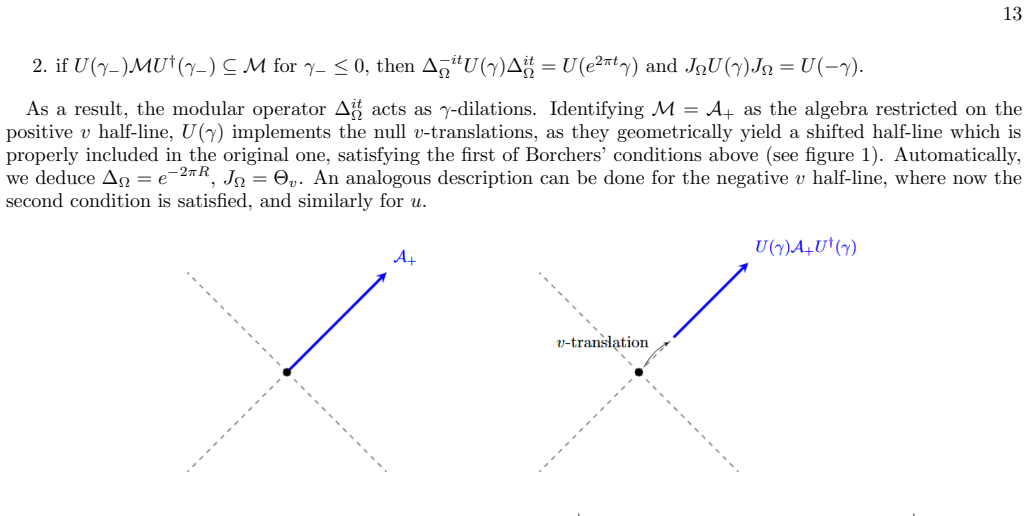
ifU(γ −)MU †(γ−)⊆ Mforγ − ≤0, then ∆ −it Ω U(γ)∆ it Ω =U(e 2πtγ) andJ ΩU(γ)J Ω =U(−γ). As a result, the modular operator ∆ it Ω acts asγ-dilations. IdentifyingM=A + as the algebra restricted on the positivevhalf-line,U(γ) implements the nullv-translations, as they geometrically yield a shifted half-line which is properly included in the original one, sati...
-
[3]
R. M. Wald, Living Rev. Rel.4, 6 (2001), gr-qc/9912119
work page internal anchor Pith review Pith/arXiv arXiv 2001
-
[4]
S. Carlip, Int. J. Mod. Phys. D23, 1430023 (2014), 1410.1486
work page internal anchor Pith review Pith/arXiv arXiv 2014
-
[5]
S. W. Hawking, Phys. Rev. D14, 2460 (1976)
1976
-
[6]
S. D. Mathur, Lect. Notes Phys.769, 3 (2009), 0803.2030
work page internal anchor Pith review Pith/arXiv arXiv 2009
-
[7]
Thermodynamics of Spacetime: The Einstein Equation of State
T. Jacobson, Phys. Rev. Lett.75, 1260 (1995), gr-qc/9504004
work page internal anchor Pith review Pith/arXiv arXiv 1995
-
[8]
Gravity and the Thermodynamics of Horizons
T. Padmanabhan, Phys. Rept.406, 49 (2005), gr-qc/0311036
work page internal anchor Pith review Pith/arXiv arXiv 2005
-
[9]
Non-equilibrium Thermodynamics of Spacetime
C. Eling, R. Guedens, and T. Jacobson, Phys. Rev. Lett.96, 121301 (2006), gr-qc/0602001
work page internal anchor Pith review Pith/arXiv arXiv 2006
-
[10]
Einstein's Equations from the Stretched Future Light Cone
M. Parikh and A. Svesko, Phys. Rev. D98, 026018 (2018), 1712.08475
work page internal anchor Pith review Pith/arXiv arXiv 2018
-
[11]
A. Alonso-Serrano and M. Liˇ ska, Phys. Rev. D102, 104056 (2020), 2008.04805
-
[12]
G. W. Gibbons and S. W. Hawking, Phys. Rev. D15, 2738 (1977)
1977
-
[13]
T. Jacobson and R. Parentani, Found. Phys.33, 323 (2003), gr-qc/0302099
-
[14]
R. Bousso, inWorkshop on Conference on the Future of Theoretical Physics and Cosmology in Honor of Steven Hawking’s 60th Birthday(2002), pp. 539–569, hep-th/0205177
work page internal anchor Pith review Pith/arXiv arXiv 2002
-
[15]
D. Su and T. C. Ralph, Phys. Rev. D93, 044023 (2016), 1507.00423
work page internal anchor Pith review Pith/arXiv arXiv 2016
-
[16]
A. Higuchi, S. Iso, K. Ueda, and K. Yamamoto, Phys. Rev. D96, 083531 (2017), 1709.05757
work page internal anchor Pith review Pith/arXiv arXiv 2017
-
[17]
Arzano, JHEP05, 072 (2020), 2002.01836
M. Arzano, JHEP05, 072 (2020), 2002.01836
-
[18]
Arzano, JHEP07, 003 (2021), 2103.07228
M. Arzano, JHEP07, 003 (2021), 2103.07228
- [19]
-
[20]
W. G. Unruh, Phys. Rev. D14, 870 (1976)
1976
-
[21]
L. C. B. Crispino, A. Higuchi, and G. E. A. Matsas, Rev. Mod. Phys.80, 787 (2008), 0710.5373
work page internal anchor Pith review Pith/arXiv arXiv 2008
- [22]
-
[23]
Horizon temperature on the real line
M. Arzano and J. Kowalski-Glikman, Phys. Lett. B C788, 82 (2019), 1804.10550
work page internal anchor Pith review Pith/arXiv arXiv 2019
-
[24]
Witten, Rev
E. Witten, Rev. Mod. Phys.90, 045003 (2018)
2018
-
[25]
J. J. Bisognano and E. H. Wichmann, J. Math. Phys.16, 985 (1975)
1975
-
[26]
H. E. Moses and A. F. Quesada, J. Math. Phys.15, 748 (1974)
1974
-
[27]
H. J. Borchers, Commun. Math. Phys.143, 315 (1992)
1992
-
[28]
S. J. Summers and R. Verch, Lett. Math. Phys.37, 145 (1996)
1996
-
[29]
An Algebraic Construction of Boundary Quantum Field Theory
R. Longo and E. Witten, Commun. Math. Phys.303, 213 (2011), 1004.0616
work page internal anchor Pith review Pith/arXiv arXiv 2011
-
[30]
Integrable QFT and Longo-Witten endomorphisms
M. Bischoff and Y. Tanimoto, Annales Henri Poincare16, 569 (2015), [Erratum: Annales Henri Poincare 17, 251–252 (2016)], 1305.2171
work page internal anchor Pith review Pith/arXiv arXiv 2015
-
[31]
L. v. Lujik, A. Stottmeister, R. F. Werner, and H. Wilming, Phys. Rev. Lett.133, 261602 (2024)
2024
-
[32]
R. Longo, Expo. Math.38, 240 (2020), 1910.13926. Appendix A: Modular theory and KMS condition It is instructive to introduce modular theory through quantum-mechanical examples. Consider an entangled state in quantum mechanics, say for instance a vector |ω⟩= cos θ 2 |0⟩A |0⟩B + sin θ 2 eiφ |1⟩A |1⟩B (A1) in a two-qubit system. This vector yields a mixed st...
discussion (0)
Sign in with ORCID, Apple, or X to comment. Anyone can read and Pith papers without signing in.