REVIEW 4 major objections 4 minor 2 cited by
A diffusion world model can run closed-loop AV simulation in real time and then be repurposed as a driving policy.
Reviewed by Pith at T0; open to challenge. T0 means a machine referee read the full paper against a public rubric. the ladder, T0–T4 →
T0 review · deepseek-v4-flash
2026-08-02 12:27 UTC pith:JNYZ2CCB
load-bearing objection Real-time generative closed-loop AV sim with genuine engineering and a promising WAM result, but the fidelity and superiority claims rest on internal, censored metrics that need stronger evidence. the 4 major comments →
NVIDIA OmniDreams: Real-Time Generative World Model for Closed-Loop Autonomous Vehicle Simulation
The pith
A machine-rendered reading of the paper's core claim, the machinery that carries it, and where it could break.
Core claim
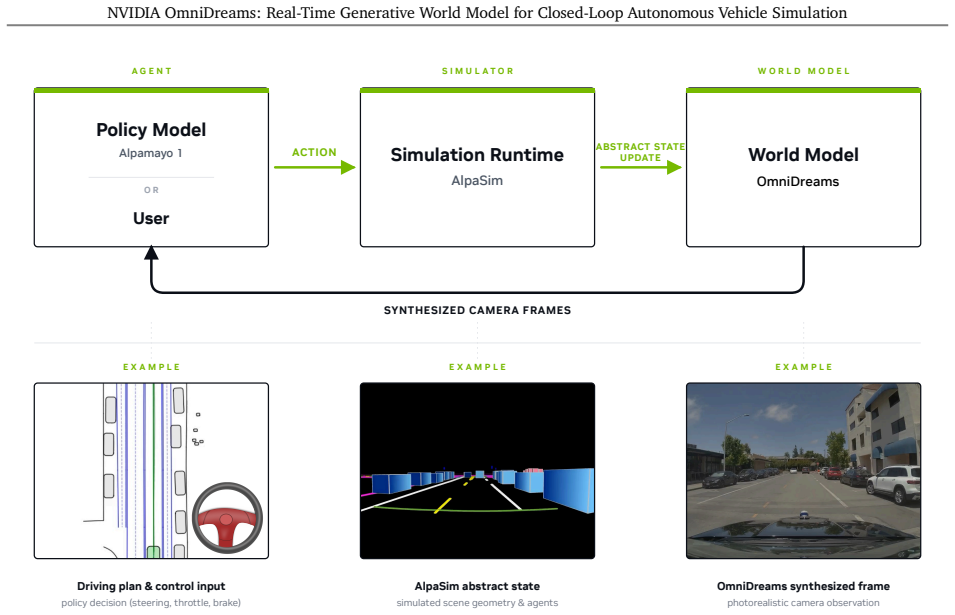
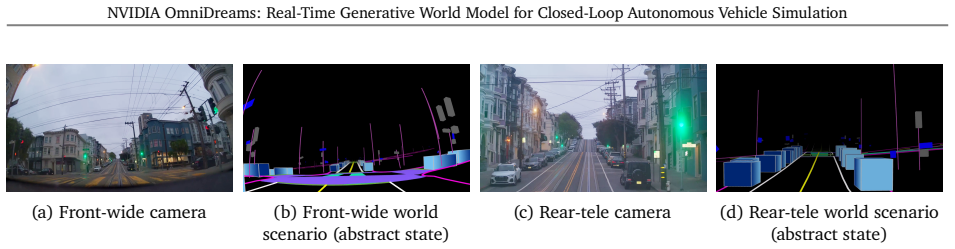
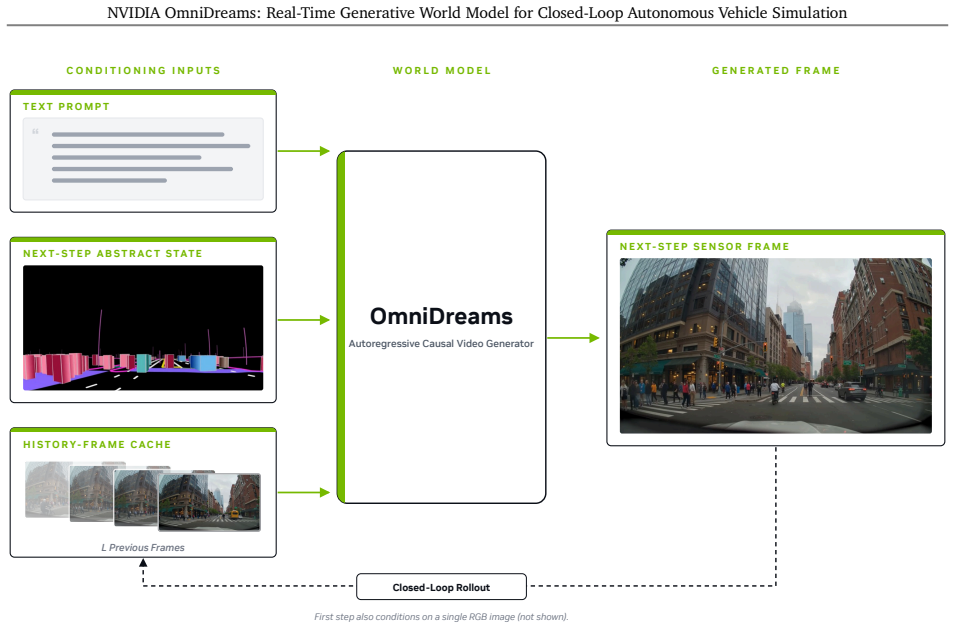
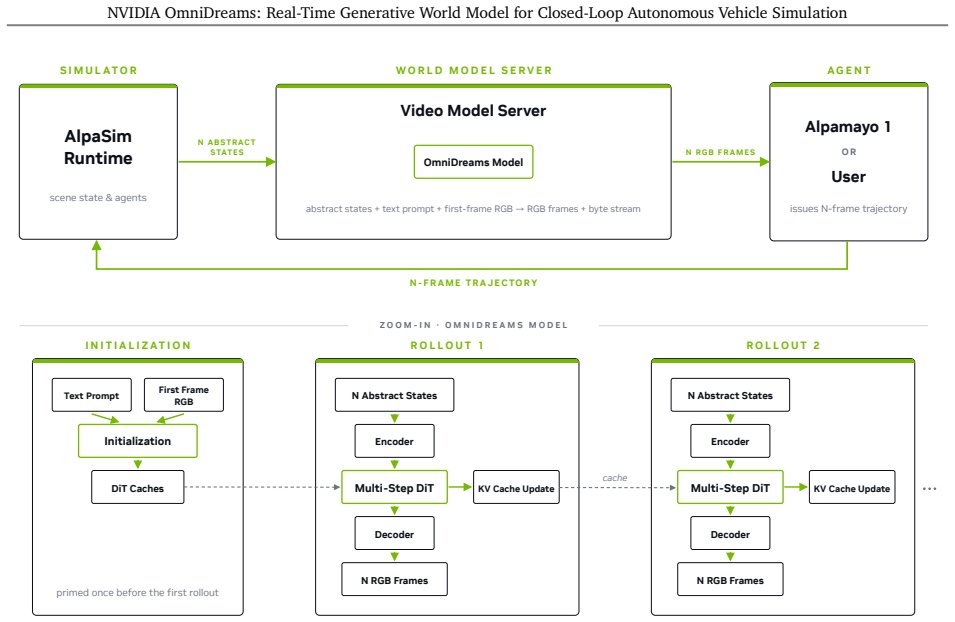
The paper's central claim is that a generative world model can serve as the sensor simulator in a closed-loop AV evaluation loop: OmniDreams conditions frame generation on a text description, a rendered abstract world state (lanes, signs, agent boxes) that encodes the policy's action, and a streaming cache of previous frames, and autoregressively generates the next camera observations at real-time rates. In the closed-loop comparison, switching the simulator from NuRec to OmniDreams preserves the ranking of four policy classes on incident metrics, which the paper reads as evidence that OmniDreams is a faithful proxy for real-world policy evaluation. It additionally claims that the same backb
What carries the argument
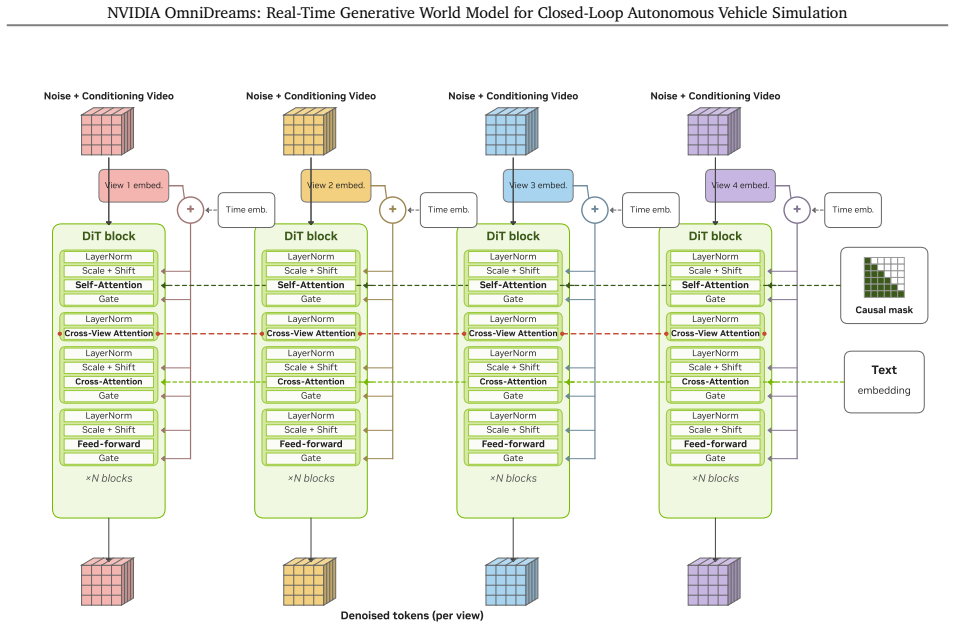
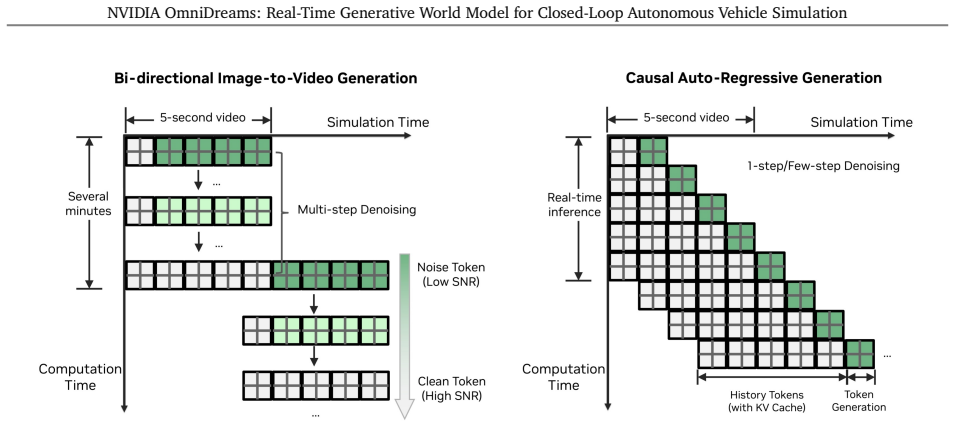
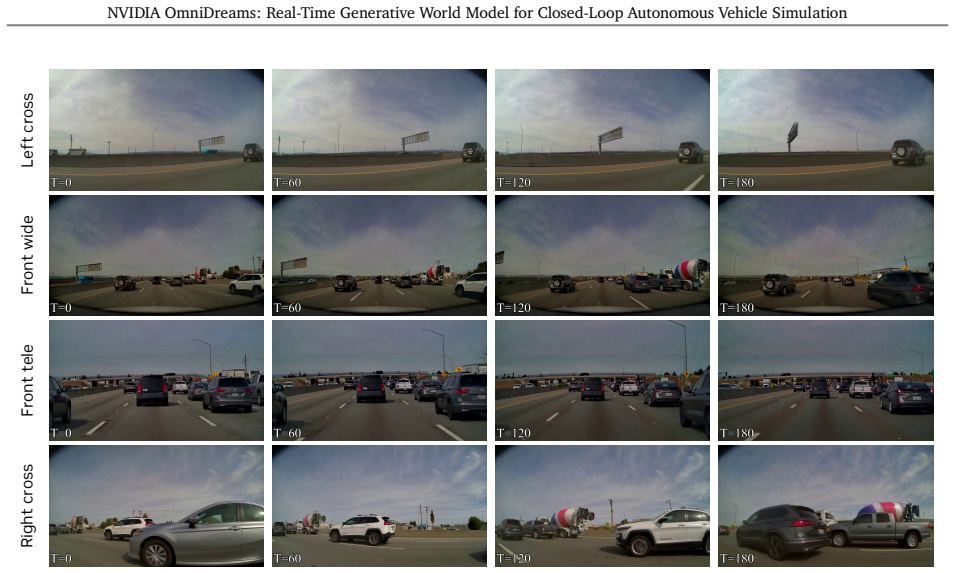
A causal diffusion transformer with block-autoregressive generation. Each generation step denoises a short chunk of frames conditioned on three signals: a text prompt, a rendered 'world-scenario map' abstract state aligned to the policy's intended trajectory, and a streaming KV cache of past latent frames. A lightweight MLP control branch injects the abstract state; for multi-view generation, per-view embeddings plus factored cross-view attention keep four cameras consistent. Self Forcing distillation with a progressive long-context teacher and a rolling KV cache make long rollouts stable, while static-shape caching and CUDA graph capture make inference real-time.
Load-bearing premise
The load-bearing premise is that NuRec, a reconstruction-based simulator fitted to the original capture, is a faithful proxy for real-world driving behavior; if that proxy is not faithful, preserving a policy ranking between two simulators does not establish that OmniDreams is faithful to the real world.
What would settle it
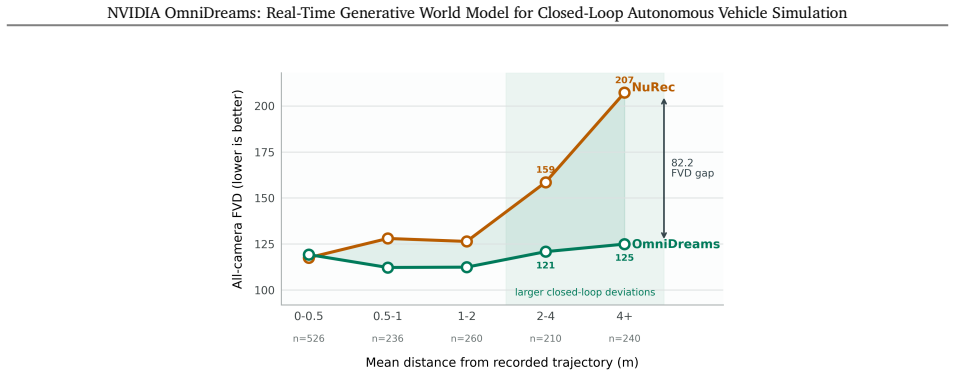
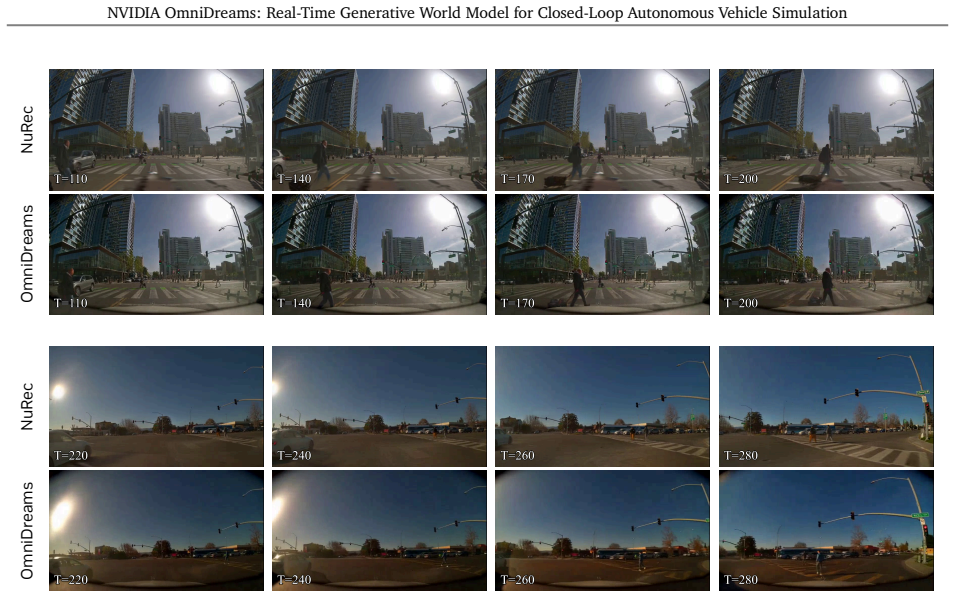
Run the same policies in a real-vehicle or high-fidelity real-world closed-loop setting (or against logged driver outcomes) and compare their incident and off-road rankings to NuRec and OmniDreams; if OmniDreams' ranking diverges from the real-world ranking while NuRec's matches it, the fidelity claim fails. A cheaper check: compute per-scene correlation between OmniDreams and real sensor distributions on held-out scenes far from the recorded trajectory, where NuRec degrades, and see whether the generative model's FVD advantage corresponds to better downstream policy decisions.
If this is right
- Closed-loop AV evaluation no longer requires per-scene neural reconstruction; any scene with a first-frame seed and a rendered map can be simulated.
- Policy rankings measured inside OmniDreams transfer to those measured inside a reconstruction-based simulator, so developers can compare candidate policies without rebuilding scenes.
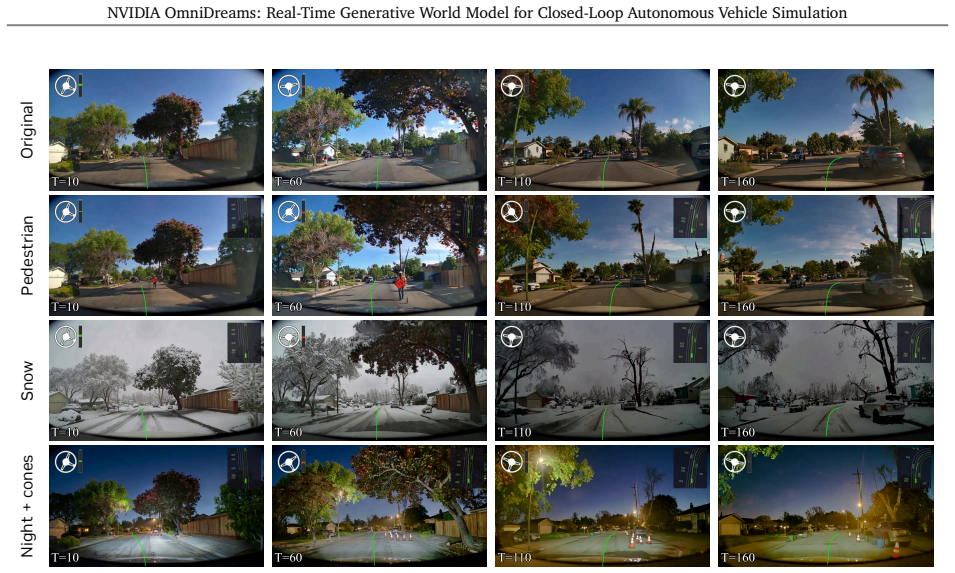
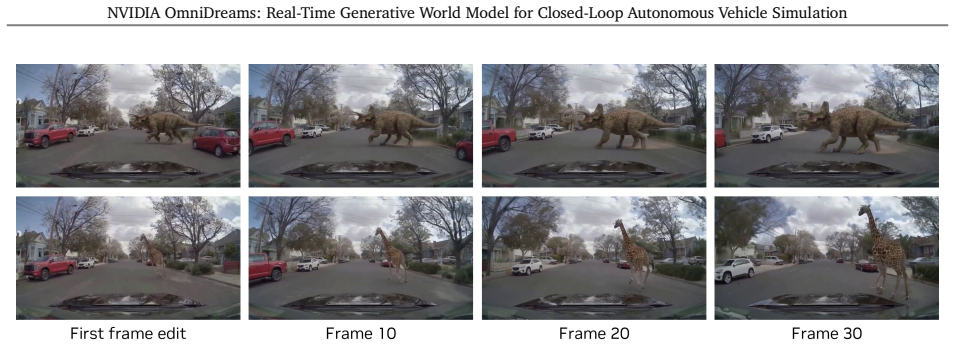
- Rare and counterfactual scenarios—weather edits, inserted out-of-distribution objects, modified trajectories—can be generated on demand for long-tail testing.
- A world model's internal representations can drive a vehicle; the same 2B backbone outperforms a 10B VLA policy on the tested collision metrics, suggesting a shared world-policy backbone.
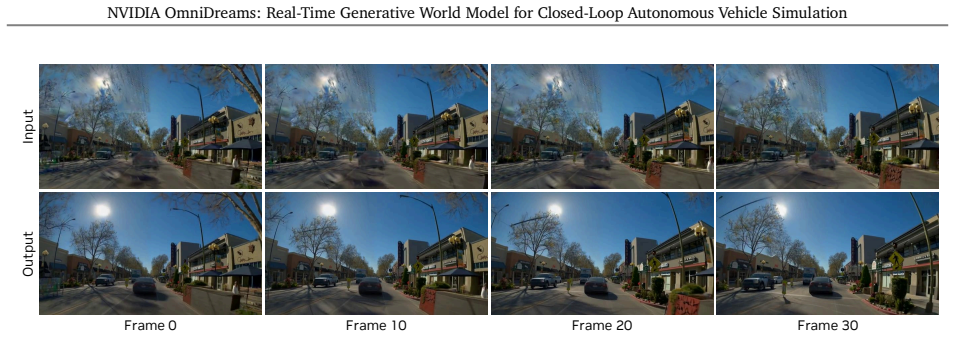
- Reconstruction-based simulators can be upgraded by post-training OmniDreams as a diffusion fixer that removes novel-view artifacts.
Where Pith is reading between the lines
- If ranking preservation extends beyond the 501-scene NuRec subset, generative simulators could become the default for large-scale policy selection, but the paper's evidence anchors fidelity to NuRec's proxy status rather than to on-road outcomes.
- The world-action-model result invites a testable extension: train one model jointly to render and drive, and measure whether shared representations reduce the compute and data needed for policy learning.
- Because incident counts depend on staying within 4m of the recorded trajectory, the simulator's practical value may be highest for near-log evaluation; measuring behavior at larger deviations would probe its true generalization.
- The chunked generation (8–16 frames per step) quantizes time for the policy, so future per-frame generation would remove an interaction latency that currently limits high-frequency control.
Editorial analysis
A structured set of objections, weighed in public.
Referee Report
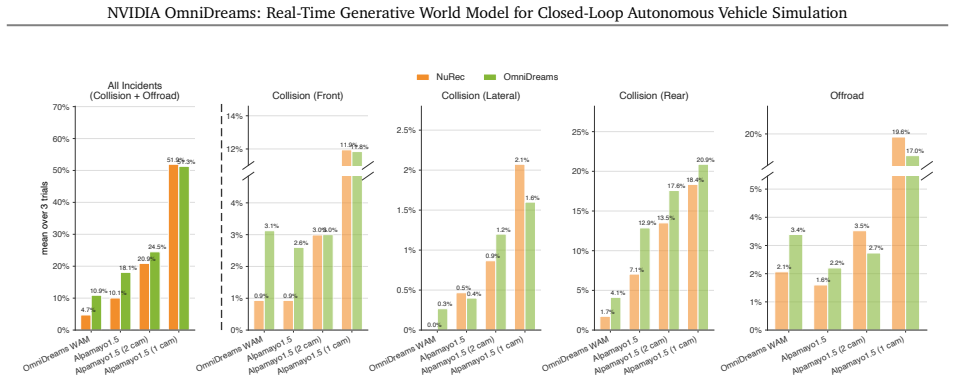
Summary. This paper introduces OmniDreams, a generative world model for closed-loop autonomous-vehicle simulation. OmniDreams is mid- and post-trained from the Cosmos-Predict 2.5 diffusion backbone to autoregressively generate action-conditioned camera videos, conditioned on a text prompt, an abstract world-scenario map, and a streaming KV-cache of past frames. The authors integrate OmniDreams with the AlpaSim orchestrator and report real-time inference (68 FPS single-view, 105 FPS per camera for four views on GB300). The main experimental claims are (i) in closed-loop evaluation on a 501-scene subset of the Physical AI NuRec dataset, the policy ranking under the reconstruction-based NuRec simulator is preserved under OmniDreams (Fig. 13), supporting the claim that OmniDreams is a faithful proxy for closed-loop policy evaluation; and (ii) a world-action model (WAM) post-trained from OmniDreams reduces collision rate from 6.9% to 4.2% compared with Alpamayo 1.5 while using roughly five times fewer parameters (Sec. 7.2). The paper also describes a multi-view attention factorization, a diffusion-forcing mid-training stage, Self-Forcing DMD distillation, and a served-inference stack (FlashDreams).
Significance. If the results hold, this is a significant step toward real-time generative simulation for closed-loop AV evaluation: it would demonstrate that a diffusion-based world model can replace per-scene reconstructions while preserving policy rankings, and that a shared backbone can serve both as simulator and policy. The paper has notable strengths: a detailed architecture and training pipeline, concrete latency measurements on production hardware, a clear multi-view attention design, long-rollout quality analysis with segmented FVD, and named open-source components (AlpaSim, FlashDreams). However, the central fidelity claim rests on the ranking-preservation experiment in Fig. 13, which is statistically thin and potentially confounded by the 4m proximity-censoring rule. The WAM result, while intriguing, is presented without confidence intervals and without a clear statement of dataset overlap. The paper's value will depend on whether these load-bearing issues are resolved with additional analyses.
major comments (4)
- [§9.4.1, Fig. 13] The 4m proximity-censoring rule can bias all incident metrics and therefore the ranking-preservation claim. The rule discards any incident when the ego is more than 4m from the ground-truth trajectory, but the paper provides no per-policy or per-simulator statistics on time spent inside the corridor, lateral deviation distributions, or the number of censored incidents. A policy that deviates off-path can have its crashes excluded, while a policy that stays near the log is fully evaluated. Because Fig. 13 is the primary evidence that OmniDreams is a "faithful proxy," please report time-in-corridor and censored-incident counts, and perform a sensitivity analysis with relaxed thresholds (e.g., 2m/6m/10m) to show the ranking is stable.
- [§7.2 vs §9.4.1] There is a scene-count inconsistency: Sec. 7.2 reports 574 scenes for the WAM comparison, while Sec. 9.4.1 reports 501 scenes for the NuRec/OmniDreams comparison. If these are different subsets, the relationship and the reason for the difference must be stated; if they are meant to be the same, the inconsistency is an error. Moreover, the headline collision reduction (6.9% to 4.2%) is a point estimate with no confidence intervals or per-trial variance. Fig. 13 says "mean over 3 trials" but shows no error bars. Given the strength of the WAM claim, please provide standard deviations or bootstrap CIs.
- [§9.4.1] The premise that NuRec is a "strong reconstruction-based reference of the real recording" is load-bearing for the conclusion that ranking preservation implies real-world fidelity. The 4m rule guarantees that evaluated rollouts stay near the recorded path, but it does not establish that NuRec's closed-loop incident rates correspond to real-world driving behavior. The paper provides no external validation of NuRec against real-world outcomes. Please add such validation or soften the conclusion to "simulator-to-simulator consistency" rather than "direct evidence" of real-world fidelity.
- [§7.1/§7.2] The WAM is post-trained from the OmniDreams backbone, whose generative pre-training corpus (RDS/RDS-HQ-1M) may overlap with the Physical AI NuRec evaluation dataset. The paper only excludes scenes used in WAM training, but if the base OmniDreams model or its pre-training data already contains the same logs or close derivatives, the WAM advantage over Alpamayo 1.5 could be inflated. Please state the overlap between the OmniDreams training corpora and the NuRec benchmark, and clarify the exclusion rule.
minor comments (4)
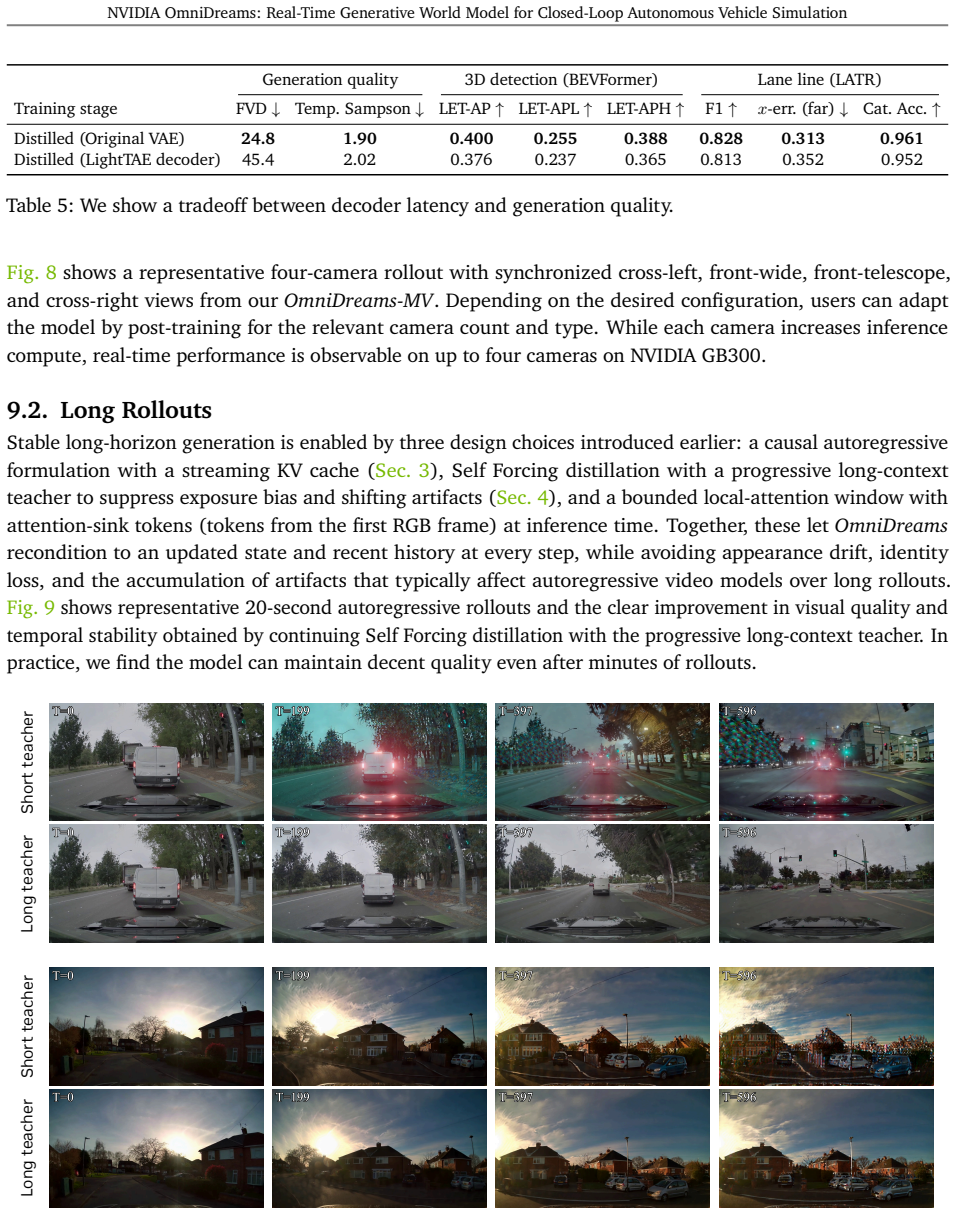
- [§5.1/Table 5] The naming of LightVAE/LightTAE is confusing: Sec. 5.1 says LightVAE is used for encoding and LightTAE for decoding, yet Table 5 compares 'Distilled (LightTAE decoder)' against 'Distilled (Original VAE)'. Clarify which components are swapped and in which variant.
- [§2.1] The text says 'RDS contains 3M20s clips (sic)' followed by 'RDS contains 3M 20s clips' and Table 1 reports 3M clips; the phrasing is inconsistent and should be edited.
- [§4.3] The timestep schedule '[1000,450]' with K=2 is mentioned without context. State whether these are diffusion timestep indices, flow-matching times, or discrete denoising steps to avoid ambiguity.
- [Acknowledgements / §10.1.3] The acknowledgements state that OmniDreams is open-sourced, but no repository link is provided anywhere in the paper. Add a link or remove the claim.
Circularity Check
No significant circularity: the central claims rest on empirical measurements and training objectives, not on definitional reductions or self-citation chains.
full rationale
The paper's principal derivations are empirical: Cosmos is post-trained into OmniDreams with explicit flow-matching/self-forcing objectives, then fine-tuned into a WAM. The WAM's headline improvement (collision 6.9%→4.2%, Sec. 7.2) is reported on the NuRec dataset/simulator under the Alpamayo protocol, and the closed-loop fidelity conclusion (Sec. 9.4.1) is based on a ranking comparison between NuRec and OmniDreams. I found no equation or fitted value that is renamed as a prediction; e.g., the incident rule 'an incident such as a collision or off-road event is only counted when the ego is within 4m of the corresponding ground-truth trajectory' is a censoring/confound concern and a missing-support issue (the paper gives no per-policy corridor statistics), but it does not make the observed ranking or collision numbers follow by construction. The many NVIDIA self-citations (Cosmos, NuRec, AlpaSim, Alpamayo, SIL-Wheel) are provenance and baseline infrastructure, not a uniqueness theorem invoked to force a choice, and the results are anchored by external or held-out benchmarks: FVD on held-out RDS-HQ-1M clips, off-the-shelf BEVFormer/LATR metrics, wall-clock FPS, and a published NuRec protocol. Therefore no significant circularity is present; the fidelity claim is under-supported but not circulary derived.
Axiom & Free-Parameter Ledger
free parameters (5)
- 2-step distillation schedule [1000,450] =
K=2, timesteps [1000,450]
- local temporal attention window =
6 latent frames SV, 8 latent frames MV
- evaluation subset sizes =
574 (Sec 7.2) vs 501 (Sec 9.4.1)
- incident counting threshold =
within 4m of ground-truth trajectory
- caption sampling probabilities =
0.1/0.2/0.7 short/medium/long
axioms (5)
- domain assumption Cosmos-Predict 2.5 provides visual priors that transfer to AV scenes after 21k hours of mid/post-training.
- domain assumption The abstract world-scenario map (rendered lanes/cuboids) plus text prompt is a sufficient conditioning signal for closed-loop sensor generation.
- domain assumption NuRec is a strong reconstruction-based proxy for real recordings, so policy ranking under NuRec can stand in for real-world behavior.
- domain assumption The 501/574-scene Physical AI NuRec subset is disjoint from OmniDreams training data.
- domain assumption FVD, BEVFormer 3D detection, LATR lane metrics on generated frames are valid proxies for downstream policy-relevant fidelity.
read the original abstract
As autonomous vehicle capabilities advance, the safe evaluation of driving policies in long-tail scenarios remains a critical bottleneck. In closed-loop simulation, the driving policy model actively interacts with the environment, where its actions dynamically update the simulator state and directly influence the next set of generated sensor observations. While recent reconstruction-based neural simulators offer photorealism, they are fundamentally constrained by their initial captured data and struggle to generalize to highly dynamic or novel scenes. To overcome these limitations, we introduce OmniDreams, a foundation generative world model mid- and post-trained from the Cosmos diffusion model to autoregressively generate action-conditioned videos in real time. By leveraging the rich visual priors of Cosmos and mid- and post-training on 21k hours of driving scenarios, OmniDreams synthesizes complex, unobserved phenomena that are hard for traditional simulators to capture, such as extreme weather and unpredictable dynamic agent behaviors. Crucially, it autoregressively conditions its photorealistic sensor generation on past frames, the current simulator state, and immediate driving actions. Deployed in a closed-loop system with the Alpamayo 1 policy model and AlpaSim orchestrator, OmniDreams acts as a highly responsive, reactive environment, providing a scalable and comprehensive solution for training and evaluating next-generation autonomous driving policies. We additionally show preliminary results indicating that a world-action model (WAM) post-trained from OmniDreams achieves strong performance on the Physical AI Autonomous Vehicles NuRec dataset, surpassing the VLA-based Alpamayo 1.5 research policy model while using only 1/5 the total parameters. These results highlight the potential for a real-time world model like OmniDreams to also serve as a backbone for policy architectures.
Figures
Forward citations
Cited by 2 Pith papers
-
Mental World Modeling
Coupling physical and mental state in a world model, with target-specific observations and joint transitions, is necessary to predict human decisions across eight LLM backends on a process-annotated benchmark.
-
M$^\text{4}$World: A Multi-view Multimodal Driving World Model for Interactive Object Manipulation and Minute-long Streaming
M4World is a controllable multi-view camera+LiDAR driving world model with object-level appearance control, four-step causal streaming, and few-clip long-tail adaptation.
Reference graph
Works this paper leans on
-
[1]
Cosmos world foundation model platform for physical ai.arXiv preprint arXiv:2501.03575, 2025
Niket Agarwal, Arslan Ali, Maciej Bala, Yogesh Balaji, Erik Barker, Tiffany Cai, Prithvijit Chattopadhyay, Yongxin Chen, Yin Cui, Yifan Ding, et al. Cosmos world foundation model platform for physical ai.arXiv preprint arXiv:2501.03575, 2025. 5, 27
Pith/arXiv arXiv 2025
-
[2]
Jason Ansel, Edward Yang, Horace He, Natalia Gimelshein, Animesh Jain, Michael Voznesensky, Bin Bao, Peter Bell, David Berard, Evgeni Burovski, Geeta Chauhan, Anjali Chourdia, Will Constable, Alban Desmaison, Zachary DeVito, Elias Ellison, Will Feng, Jiong Gong, Michael Gschwind, Brian Hirsh, Sher- lock Huang, Kshiteej Kalambarkar, Laurent Kirsch, Michael...
2024
-
[3]
Qwen technical report.arXiv preprint arXiv:2309.16609, 2023
Jinze Bai, Shuai Bai, Yunfei Chu, Zeyu Cui, Kai Dang, Xiaodong Deng, Yang Fan, Wenbin Ge, Yu Han, Fei Huang, et al. Qwen technical report.arXiv preprint arXiv:2309.16609, 2023. 6
Pith/arXiv arXiv 2023
-
[4]
Jake Bruce, Michael D. Dennis, Ashley Edwards, Jack Parker-Holder, Yuge Shi, Edward Hughes, Matthew Lai, Aditi Mavalankar, Richie Steigerwald, Chris Apps, Yusuf Aytar, Sarah Bechtle, Feryal Behbahani, Stephanie Chan, Nicolas Heess, Lucy Gonzalez, Simon Osindero, Sherjil Ozair, Scott Reed, Jingwei Zhang, Konrad Zolna, Jeff Clune, Nando de Freitas, Satinder...
2024
-
[5]
Diffusion forcing: Next-token prediction meets full-sequence diffusion
Boyuan Chen, Diego Martí Monsó, Yilun Du, Max Simchowitz, Russ Tedrake, and Vincent Sitzmann. Diffusion forcing: Next-token prediction meets full-sequence diffusion. InAdvances in Neural Information Processing Systems (NeurIPS), 2024. 11, 28, 37
2024
-
[6]
PufferDrive: A fast and friendly driving simulator for training and evaluating RL agents, 2025
Daphne Cornelisse, Spencer Cheng, Pragnay Mandavilli, Julian Hunt, Kevin Joseph, Waël Doulazmi, Valentin Charraut, Aditya Gupta, Joseph Suarez, and Eugene Vinitsky. PufferDrive: A fast and friendly driving simulator for training and evaluating RL agents, 2025. URLhttps://github.com/Emerge-Lab/ PufferDrive. 28
2025
-
[7]
Riccardo de Lutio, Tobias Fischer, Yen-Yu Chang, Yuxuan Zhang, Jay Zhangjie Wu, Xuanchi Ren, Tian- chang Shen, Katarina Tothova, Zan Gojcic, and Haithem Turki. Artifixer: Enhancing and extending 3d reconstruction with auto-regressive diffusion models.arXiv preprint arXiv:2603.00492, 2026. 19
Pith/arXiv arXiv 2026
-
[8]
Veo 3: Higher-quality video generation with audio and speech, 2025
Google DeepMind. Veo 3: Higher-quality video generation with audio and speech, 2025. 8, 27
2025
-
[9]
Juechu Dong, Boyuan Feng, Driss Guessous, Yanbo Liang, and Horace He. Flex attention: A programming model for generating optimized attention kernels.arXiv preprint arXiv:2412.05496, 2(3):4, 2024. 12
Pith/arXiv arXiv 2024
-
[10]
CARLA: An open urban driving simulator
Alexey Dosovitskiy, German Ros, Felipe Codevilla, Antonio Lopez, and Vladlen Koltun. CARLA: An open urban driving simulator. InConference on Robot Learning (CoRL), 2017. 28
2017
-
[11]
MagicDrive: Street view generation with diverse 3d geometry control
Ruiyuan Gao, Kai Chen, Enze Xie, Lanqing Hong, Zhenguo Li, Dit-Yan Yeung, and Qiang Xu. MagicDrive: Street view generation with diverse 3d geometry control. InInternational Conference on Learning Representations (ICLR), 2024. 28
2024
-
[12]
Vista: A generalizable driving world model with high fidelity and versatile controllability
Shenyuan Gao, Jiazhi Yang, Li Chen, Kashyap Chitta, Yihang Qiu, Andreas Geiger, Jun Zhang, and Hongyang Li. Vista: A generalizable driving world model with high fidelity and versatile controllability. InAdvances in Neural Information Processing Systems (NeurIPS), 2024. 28 31 NVIDIA OmniDreams: Real-Time Generative World Model for Closed-Loop Autonomous Ve...
2024
-
[13]
Co-Reyes, Rishabh Agarwal, Rebecca Roelofs, Yao Lu, Nico Montali, Paul Mougin, Zoey Yang, Brandyn White, Aleksandra Faust, Rowan McAllister, Dragomir Anguelov, and Benjamin Sapp
Cole Gulino, Justin Fu, Wenjie Luo, George Tucker, Eli Bronstein, Yiren Lu, Jean Harb, Xinlei Pan, Yan Wang, Xiangyu Chen, John D. Co-Reyes, Rishabh Agarwal, Rebecca Roelofs, Yao Lu, Nico Montali, Paul Mougin, Zoey Yang, Brandyn White, Aleksandra Faust, Rowan McAllister, Dragomir Anguelov, and Benjamin Sapp. Waymax: An accelerated, data-driven simulator f...
-
[14]
StreamingT2V: Consistent, dynamic, and extendable long video generation from text
Roberto Henschel, Levon Khachatryan, Daniil Hayrapetyan, Hayk Poghosyan, Vahram Tadevosyan, Zhangyang Wang, Shant Navasardyan, and Humphrey Shi. StreamingT2V: Consistent, dynamic, and extendable long video generation from text. InIEEE/CVF Conference on Computer Vision and Pattern Recognition (CVPR), 2025. 28
2025
-
[15]
GAIA-1: A generative world model for autonomous driving.arXiv preprint arXiv:2309.17080, 2023
Anthony Hu, Lloyd Russell, Hudson Yeo, Zak Murez, George Fedoseev, Alex Kendall, Jamie Shotton, and Gianluca Corrado. GAIA-1: A generative world model for autonomous driving.arXiv preprint arXiv:2309.17080, 2023. 28
Pith/arXiv arXiv 2023
-
[16]
Xun Huang, Zhengqi Li, Guande He, Mingyuan Zhou, and Eli Shechtman. Self forcing: Bridging the train-test gap in autoregressive video diffusion.arXiv preprint arXiv:2506.08009, 2025. 12, 15, 28, 37
Pith/arXiv arXiv 2025
-
[17]
Let-3d-ap: Longitudinal error tolerant 3d average precision for camera-only 3d detection
Wei-Chih Hung, Vincent Casser, Henrik Kretzschmar, Jyh-Jing Hwang, and Dragomir Anguelov. Let-3d-ap: Longitudinal error tolerant 3d average precision for camera-only 3d detection. In2024 IEEE International Conference on Robotics and Automation (ICRA), pages 8272–8279, 2024. doi: 10.1109/ICRA57147.2024. 10609986. 20, 37
arXiv 2024
-
[18]
3d gaussian splatting for real-time radiance field rendering.ACM Transactions on Graphics, 42(4), July 2023
Bernhard Kerbl, Georgios Kopanas, Thomas Leimkühler, and George Drettakis. 3d gaussian splatting for real-time radiance field rendering.ACM Transactions on Graphics, 42(4), July 2023. URLhttps: //repo-sam.inria.fr/fungraph/3d-gaussian-splatting/. 26
2023
-
[19]
FIFO-Diffusion: Generating infinite videos from text without training
Jihwan Kim, Junoh Kang, Jinyoung Choi, and Bohyung Han. FIFO-Diffusion: Generating infinite videos from text without training. InAdvances in Neural Information Processing Systems (NeurIPS), 2024. 28
2024
-
[20]
DriveGAN: Towards a Controllable High-Quality Neural Simulation
Seung Wook Kim, Jonah Philion, Antonio Torralba, and Sanja Fidler. DriveGAN: Towards a Controllable High-Quality Neural Simulation. InIEEE Conference on Computer Vision and Pattern Recognition (CVPR), Jun. 2021. 28
2021
-
[21]
Metadrive: Composing diverse driving scenarios for generalizable reinforcement learning.IEEE Transactions on Pattern Analysis and Machine Intelligence, 2022
Quanyi Li, Zhenghao Peng, Lan Feng, Qihang Zhang, Zhenghai Xue, and Bolei Zhou. Metadrive: Composing diverse driving scenarios for generalizable reinforcement learning.IEEE Transactions on Pattern Analysis and Machine Intelligence, 2022. 28
2022
-
[22]
Zhiqi Li, Wenhai Wang, Hongyang Li, Enze Xie, Chonghao Sima, Tong Lu, Qiao Yu, and Jifeng Dai. BEVFormer: Learning Bird’s-Eye-View representation from multi-camera images via spatiotemporal transformers, 2022. URLhttps://arxiv.org/abs/2203.17270. 20
Pith/arXiv arXiv 2022
-
[23]
Lightx2v: Light video generation inference framework
LightX2V. Lightx2v: Light video generation inference framework. https://github.com/ModelTC/ lightx2v, 2025. 13
2025
-
[24]
Ring attention with blockwise transformers for near-infinite context
Hao Liu, Matei Zaharia, and Pieter Abbeel. Ring attention with blockwise transformers for near-infinite context. InInternational Conference on Learning Representations (ICLR), 2024. 14, 28, 37
2024
-
[25]
Xingchao Liu, Chengyue Gong, and Qiang Liu. Flow straight and fast: Learning to generate and transfer data with rectified flow.arXiv preprint arXiv:2209.03003, 2022. 10, 37
Pith/arXiv arXiv 2022
-
[26]
LATR: 3d lane detection from monocular images with transformer, 2023
Yueru Luo, Chaoda Zheng, Xu Yan, Kun Tang, Chao Zheng, Shuguang Cui, and Zhen Li. LATR: 3d lane detection from monocular images with transformer, 2023. URLhttps://arxiv.org/abs/2308.04583. 20 32 NVIDIA OmniDreams: Real-Time Generative World Model for Closed-Loop Autonomous Vehicle Simulation
Pith/arXiv arXiv 2023
-
[27]
Srinivasan, Matthew Tancik, Jonathan T
Ben Mildenhall, Pratul P. Srinivasan, Matthew Tancik, Jonathan T. Barron, Ravi Ramamoorthi, and Ren Ng. Nerf: Representing scenes as neural radiance fields for view synthesis. InECCV, 2020. 26
2020
-
[28]
3d gaussian ray tracing: Fast tracing of particle scenes.ACM Transactions on Graphics and SIGGRAPH Asia, 2024
Nicolas Moenne-Loccoz, Ashkan Mirzaei, Or Perel, Riccardo de Lutio, Janick Martinez Esturo, Gavriel State, Sanja Fidler, Nicholas Sharp, and Zan Gojcic. 3d gaussian ray tracing: Fast tracing of particle scenes.ACM Transactions on Graphics and SIGGRAPH Asia, 2024. 26
2024
-
[29]
Instant neural graphics primitives with a multiresolution hash encoding.ACM Trans
Thomas Müller, Alex Evans, Christoph Schied, and Alexander Keller. Instant neural graphics primitives with a multiresolution hash encoding.ACM Trans. Graph., 41(4):102:1–102:15, July 2022. doi: 10.1145/ 3528223.3530127. URLhttps://doi.org/10.1145/3528223.3530127. 26
arXiv 2022
-
[30]
NVIDIA Omniverse NuRec: Neural reconstruction for autonomous vehicle simulation.https: //developer.nvidia.com/omniverse/nurec, 2024
NVIDIA. NVIDIA Omniverse NuRec: Neural reconstruction for autonomous vehicle simulation.https: //developer.nvidia.com/omniverse/nurec, 2024. 4, 23, 27, 38
2024
-
[31]
CUDA C++ Programming Guide: CUDA graphs
NVIDIA. CUDA C++ Programming Guide: CUDA graphs. https://docs.nvidia.com/cuda/ cuda-c-programming-guide/index.html#cuda-graphs, 2024. 13, 37
2024
-
[32]
Physical AI autonomous vehicles NuRec dataset.https://huggingface.co/datasets/nvidia/ PhysicalAI-Autonomous-Vehicles-NuRec, October 2025
NVIDIA. Physical AI autonomous vehicles NuRec dataset.https://huggingface.co/datasets/nvidia/ PhysicalAI-Autonomous-Vehicles-NuRec, October 2025. 18, 24
2025
-
[33]
World simulation with video foundation models for physical ai.arXiv preprint arXiv:2511.00062,
NVIDIA. World simulation with video foundation models for physical ai.arXiv preprint arXiv:2511.00062,
-
[34]
AlpaSim: An open-source closed-loop autonomous vehicle simulator.https://github.com/ NVlabs/alpasim, 2025
NVIDIA. AlpaSim: An open-source closed-loop autonomous vehicle simulator.https://github.com/ NVlabs/alpasim, 2025. 5, 16, 23, 27, 28, 37
2025
-
[35]
Flashdreams: A high-performance streaming inference stack for world and video models
NVIDIA. Flashdreams: A high-performance streaming inference stack for world and video models. https://github.com/NVIDIA/flashdreams, 2026. 15
2026
-
[36]
NVIDIA. Alpamayo-R1: Bridging reasoning and action prediction for generalizable autonomous driving in the long tail.arXiv preprint arXiv:2511.00088, 2026. 4, 5, 17, 23, 24, 28, 37
Pith/arXiv arXiv 2026
-
[37]
SIL-Wheel: A multi-modal search and curation platform for autonomous-vehicle video datasets
NVIDIA. SIL-Wheel: A multi-modal search and curation platform for autonomous-vehicle video datasets. NVIDIA technical report, 2026. 7, 38
2026
-
[38]
Video generation models as world simulators.Technical Report, 2024
OpenAI. Video generation models as world simulators.Technical Report, 2024. 8, 27
2024
-
[39]
WorldEngine: Towards the era of post-training for physical ai, 2026
OpenDriveLab. WorldEngine: Towards the era of post-training for physical ai, 2026. URL https: //github.com/OpenDriveLab/WorldEngine. 28
2026
-
[40]
Maxime Oquab, Timothée Darcet, Theo Moutakanni, Huy V. Vo, Marc Szafraniec, Vasil Khalidov, Pierre Fernandez, Daniel Haziza, Francisco Massa, Alaaeldin El-Nouby, Russell Howes, Po-Yao Huang, Hu Xu, VasuSharma,Shang-WenLi,WojciechGaluba,MikeRabbat,MidoAssran,NicolasBallas,GabrielSynnaeve, Ishan Misra, Herve Jegou, Julien Mairal, Patrick Labatut, Armand Jou...
2023
-
[41]
Movie gen: A cast of media foundation models.arXiv preprint arXiv:2410.13720, 2024
Adam Polyak, Amit Zohar, Andrew Brown, Andros Tjandra, Animesh Sinha, Ann Lee, Apoorv Vyas, Bowen Shi, Chih-Yao Ma, Ching-Yao Chuang, et al. Movie gen: A cast of media foundation models.arXiv preprint arXiv:2410.13720, 2024. 8, 27
Pith/arXiv arXiv 2024
-
[42]
Cosmos-Drive-Dreams: Scalable synthetic driving data generation with world foundation models
Xuanchi Ren, Tianshi Cao, Amirmojtaba Sabour, Tianchang Shen, Yifan Lu, Ruiyuan Gao, Tobias Pfaff, Jay Zhangjie Wu, Seung Wook Kim, Shengyu Huang, Laura Leal-Taixé, Jun Gao, Huan Ling, and Sanja Fidler. Cosmos-Drive-Dreams: Scalable synthetic driving data generation with world foundation models. arXiv preprint arXiv:2506.09042, 2025. 4, 5, 28, 37 33 NVIDI...
Pith/arXiv arXiv 2025
-
[43]
Lloyd Russell, Anthony Hu, Lorenzo Bertoni, George Fedoseev, Jamie Shotton, Elahe Arani, and Gianluca Corrado. GAIA-2: A controllable multi-view generative world model for autonomous driving.arXiv preprint arXiv:2503.20523, 2025. 28
Pith/arXiv arXiv 2025
-
[44]
Paul D Sampson. Fitting conic sections to “very scattered” data: An iterative refinement of the bookstein algorithm.Computer Graphics and Image Processing, 18(1):97–108, 1982. ISSN 0146-664X. doi: https://doi.org/10.1016/0146-664X(82)90101-0. URL https://www.sciencedirect.com/science/ article/pii/0146664X82901010. 20
arXiv 1982
-
[45]
Stylegan-v: A continuous video generator with the price, image quality and perks of stylegan2
Ivan Skorokhodov, Sergey Tulyakov, and Mohamed Elhoseiny. Stylegan-v: A continuous video generator with the price, image quality and perks of stylegan2. InProceedings of the IEEE/CVF Conference on Computer Vision and Pattern Recognition, pages 3626–3636, 2022. 20
2022
-
[46]
Advancing open-source world models.arXiv preprint arXiv:2601.20540, 2026
Robbyant Team, Zelin Gao, Qiuyu Wang, Yanhong Zeng, Jiapeng Zhu, Ka Leong Cheng, Yixuan Li, Hanlin Wang, Yinghao Xu, Shuailei Ma, Yihang Chen, Jie Liu, Yansong Cheng, Yao Yao, Jiayi Zhu, Yihao Meng, Kecheng Zheng, Qingyan Bai, Jingye Chen, Zehong Shen, Yue Yu, Xing Zhu, Yujun Shen, and Hao Ouyang. Advancing open-source world models.arXiv preprint arXiv:26...
Pith/arXiv arXiv 2026
-
[47]
NeuRAD: Neural rendering for autonomous driving
Adam Tonderski, Carl Lindström, Georg Hess, William Ljungbergh, Lennart Svensson, and Christoffer Petersson. NeuRAD: Neural rendering for autonomous driving. InIEEE/CVF Conference on Computer Vision and Pattern Recognition (CVPR), 2024. 26
2024
-
[48]
Simuli: Real-time lidar and camera simulation with unscented transforms
Haithem Turki, Qi Wu, Janick Martinez Esturo, Shengyu Huang, Ruilong Li, Zan Gojcic, Xin Kang, and Riccardo de Lutio. Simuli: Real-time lidar and camera simulation with unscented transforms. In International Conference on Learning Representations (ICLR), 2026. 27
2026
-
[49]
Wan: Open and advanced large-scale video generative models.arXiv preprint arXiv:2503.20314, 2025
Team Wan, Ang Wang, Baole Ai, Bin Wen, Chaojie Mao, Chen-Wei Xie, Di Chen, Feiwu Yu, Haiming Zhao, Jianxiao Yang, et al. Wan: Open and advanced large-scale video generative models.arXiv preprint arXiv:2503.20314, 2025. 8, 15, 27
Pith/arXiv arXiv 2025
-
[50]
DriveDreamer: Towards real-world-driven world models for autonomous driving
Xiaofeng Wang, Zheng Zhu, Guan Huang, Xinze Chen, Jiagang Zhu, and Jiwen Lu. DriveDreamer: Towards real-world-driven world models for autonomous driving. InEuropean Conference on Computer Vision (ECCV), 2024. 28
2024
-
[51]
Driving into the future: Multiview visual forecasting and planning with world model for autonomous driving
Yuqi Wang, Jiawei He, Lue Fan, Hongxin Li, Yuntao Chen, and Zhaoxiang Zhang. Driving into the future: Multiview visual forecasting and planning with world model for autonomous driving. InIEEE/CVF Conference on Computer Vision and Pattern Recognition (CVPR), 2024. 28
2024
-
[52]
The Waymo World Model: A new frontier for au- tonomous driving simulation
Waymo. The Waymo World Model: A new frontier for au- tonomous driving simulation. https://waymo.com/blog/2026/02/ the-waymo-world-model-a-new-frontier-for-autonomous-driving-simulation, 2026. 28
2026
-
[53]
Jay Zhangjie Wu, Xuanchi Ren, Tianchang Shen, Tianshi Cao, Kai He, Yifan Lu, Ruiyuan Gao, Enze Xie, Shiyi Lan, Jose M Alvarez, et al. Chronoedit: Towards temporal reasoning for image editing and world simulation.arXiv preprint arXiv:2510.04290, 2025. 22
arXiv 2025
-
[54]
Difix3d+: Improving 3d reconstructions with single-step diffusion models
Jay Zhangjie Wu, Yuxuan Zhang, Haithem Turki, Xuanchi Ren, Jun Gao, Mike Zheng Shou, Sanja Fidler, Zan Gojcic, and Huan Ling. Difix3d+: Improving 3d reconstructions with single-step diffusion models. In Proceedings of the IEEE/CVF Conference on Computer Vision and Pattern Recognition, pages 26024–26035,
-
[55]
3dgut: Enabling distorted cameras and secondary rays in gaussian splatting.Conference on Computer Vision and Pattern Recognition (CVPR), 2025
Qi Wu, Janick Martinez Esturo, Ashkan Mirzaei, Nicolas Moenne-Loccoz, and Zan Gojcic. 3dgut: Enabling distorted cameras and secondary rays in gaussian splatting.Conference on Computer Vision and Pattern Recognition (CVPR), 2025. 26 34 NVIDIA OmniDreams: Real-Time Generative World Model for Closed-Loop Autonomous Vehicle Simulation
2025
-
[56]
Efficient streaming language models with attention sinks
Guangxuan Xiao, Yuandong Tian, Beidi Chen, Song Han, and Mike Lewis. Efficient streaming language models with attention sinks. InInternational Conference on Learning Representations (ICLR), 2024. 28
2024
-
[57]
EmerNeRF: Emergent spatial-temporal scene decomposition via self-supervision
Jiawei Yang, Boris Ivanovic, Or Litany, Xinshuo Weng, Seung Wook Kim, Boyi Li, Tong Che, Danfei Xu, Sanja Fidler, Marco Pavone, and Yue Wang. EmerNeRF: Emergent spatial-temporal scene decomposition via self-supervision. InInternational Conference on Learning Representations (ICLR), 2024. 27
2024
-
[58]
Generalized predictive model for autonomous driving
Jiazhi Yang, Shenyuan Gao, Yihang Qiu, Li Chen, Tianyu Li, Bo Dai, Kashyap Chitta, Penghao Wu, Jia Zeng, Ping Luo, Jun Zhang, Andreas Geiger, Yu Qiao, and Hongyang Li. Generalized predictive model for autonomous driving. InIEEE/CVF Conference on Computer Vision and Pattern Recognition (CVPR), 2024. 28
2024
-
[59]
Xuemeng Yang, Licheng Wen, Yukai Ma, Jianbiao Mei, Xin Li, Tiantian Wei, Wenjie Lei, Daocheng Fu, Pinlong Cai, Min Dou, Botian Shi, Liang He, Yong Liu, and Yu Qiao. Drivearena: A closed-loop generative simulation platform for autonomous driving.arXiv preprint arXiv:2408.00415, 2024. 28
Pith/arXiv arXiv 2024
-
[60]
World action models are zero-shot policies.arXiv preprint arXiv:2602.15922, 2026
Seonghyeon Ye, Yunhao Ge, Kaiyuan Zheng, Shenyuan Gao, Sihyun Yu, George Kurian, Suneel Indupuru, You Liang Tan, Chuning Zhu, Jiannan Xiang, et al. World action models are zero-shot policies.arXiv preprint arXiv:2602.15922, 2026. 5, 18
Pith/arXiv arXiv 2026
-
[61]
One-step diffusion with distribution matching distillation
Tianwei Yin, Michaël Gharbi, Richard Zhang, Eli Shechtman, Fredo Durand, William T Freeman, and Taesung Park. One-step diffusion with distribution matching distillation. InProceedings of the IEEE/CVF conference on computer vision and pattern recognition, pages 6613–6623, 2024. 12, 28, 37
2024
-
[62]
Freeman, Frédo Durand, Eli Shechtman, and Xun Huang
Tianwei Yin, Qiang Zhang, Richard Zhang, William T. Freeman, Frédo Durand, Eli Shechtman, and Xun Huang. From slow bidirectional to fast autoregressive video diffusion models. InIEEE/CVF Conference on Computer Vision and Pattern Recognition (CVPR), 2025. 28
2025
-
[63]
Jingyang Yuan, Huazuo Gao, Damai Dai, Junyu Luo, Liang Zhao, Zhengyan Zhang, Zhenda Xie, Y. X. Wei, Lean Wang, Zhiping Xiao, Yuqing Wang, Chong Ruan, Ming Zhang, Wenfeng Liang, and Wangding Zeng. Native sparse attention: Hardware-aligned and natively trainable sparse attention.arXiv preprint arXiv:2502.11089, 2025. 28
Pith/arXiv arXiv 2025
-
[64]
Yuxuan Zhang, Katarína Tóthová, Zian Wang, Kangxue Yin, Haithem Turki, Riccardo de Lutio, Yen-Yu Chang, Or Litany, Sanja Fidler, and Zan Gojcic. Diffusionharmonizer: Bridging neural reconstruction and photorealistic simulation with online diffusion enhancer.arXiv preprint arXiv:2602.24096, 2026. 19
arXiv 2026
-
[65]
Hongyu Zhou, Longzhong Lin, Jiabao Wang, Yichong Lu, Dongfeng Bai, Bingbing Liu, Yue Wang, Andreas Geiger, and Yiyi Liao. Hugsim: A real-time, photo-realistic and closed-loop simulator for autonomous driving.arXiv preprint arXiv:2412.01718, 2024. 28
Pith/arXiv arXiv 2024
-
[66]
Junhao Zhuang, Shi Guo, Xin Cai, Xiaohui Li, Yihao Liu, Chun Yuan, and Tianfan Xue. FlashVSR: Towards real-time diffusion-based streaming video super-resolution.arXiv preprint arXiv:2510.12747, 2025. 28 35 NVIDIA OmniDreams: Real-Time Generative World Model for Closed-Loop Autonomous Vehicle Simulation B. Glossary This whitepaper draws on terminology from...
arXiv 2025
-
[2025]
5, 6, 8, 9, 10, 27, 28, 37
discussion (0)
Sign in with ORCID, Apple, or X to comment. Anyone can read and Pith papers without signing in.