REVIEW 3 major objections 6 minor 1 cited by
Monte Carlo layer sampling estimates the 10th Dedekind number as M_hat(10) = (8.9360 ± 0.0010) × 10^78.
Reviewed by Pith at T0; open to challenge. T0 means a machine referee read the full paper against a public rubric. the ladder, T0–T4 →
T0 review · deepseek-v4-flash
2026-08-04 04:44 UTC pith:LIRZAW2X
load-bearing objection Serious Monte Carlo estimate of M(10) with an exact layer-ratio identity and strong backtests; the quoted uncertainty is a forecast, not a rigorous CI, and the two-shoulder shape awaits confirmation. the 3 major comments →
Finite-n Estimate of Dedekind Numbers by Layer-Ratio Monte Carlo
The pith
A machine-rendered reading of the paper's core claim, the machinery that carries it, and where it could break.
Core claim
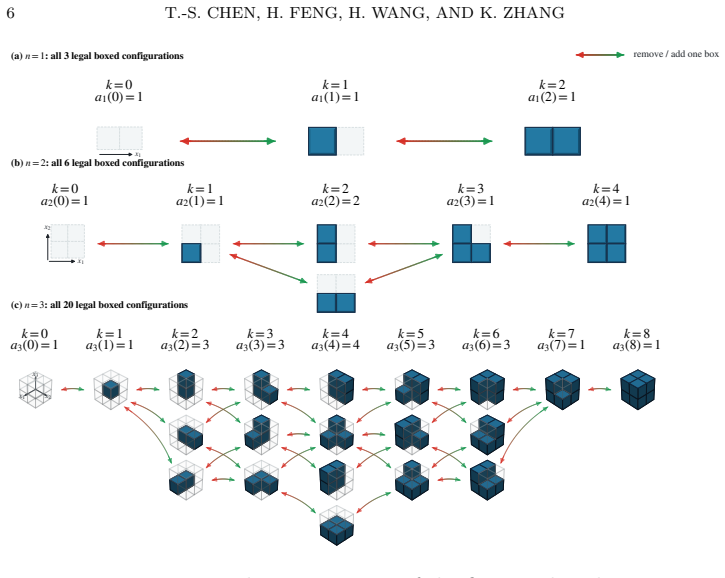
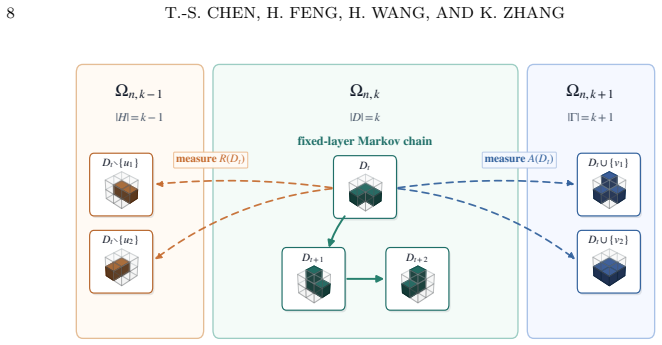
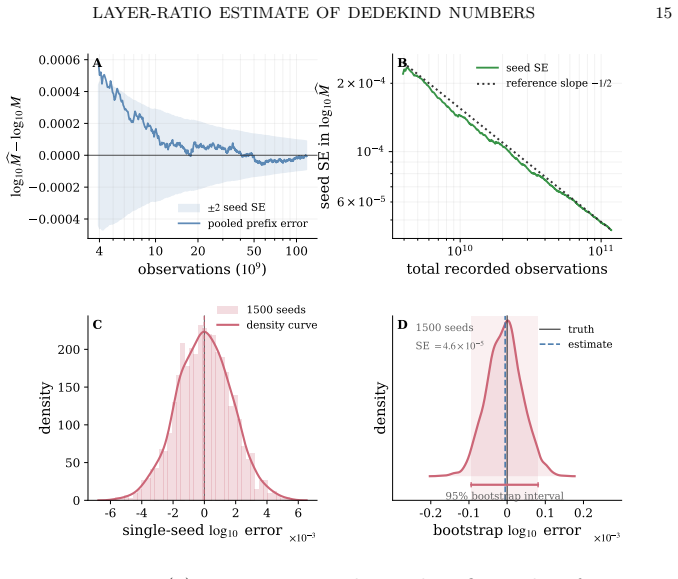
The central claim is that the adjacent-layer identity a_n(k+1)/a_n(k) = E_k A / E_{k+1} R, where A and R count addable and removable elements of a downset, reduces Dedekind-number enumeration to a sequence of fixed-layer expectation estimates. Reversible fixed-layer Markov chains with exchange moves—delete a maximal element, add a minimal element—are uniform-stationary on each layer, and their empirical averages, combined with the exact endpoint a_n(0)=1 and the Boolean duality a_n(k)=a_n(N−k), deterministically reconstruct the Whitney numbers and their sum. Under a fixed protocol (burn-in 2500, thinning 40, 75 recorded states per chain), the estimator reproduces M(8) and M(9) with log10 err
What carries the argument
The engine is the layer-ratio identity combined with the exchange-chain Monte Carlo. For a downset D of size k, A(D) is the number of elements whose addition preserves the downset property and R(D) the number whose removal does; double-counting cover edges between layers k and k+1 gives a_n(k+1)/a_n(k)=E_k A/E_{k+1}R. The fixed-layer chain proposes deleting a uniformly chosen maximal element and then adding a uniformly chosen minimal element of the resulting downset, accepting with Metropolis probability min{1,R(D)/R(Γ)}; this chain is reversible with respect to the uniform measure on each layer. Averaging A and R along these chains, accumulating log-ratios from the exact endpoint, and mirro
Load-bearing premise
The load-bearing premise is that after 2500 burn-in steps and thinning by 40, the fixed-layer Markov chains are effectively sampling from the uniform distribution on each cardinality layer; there is no rigorous mixing-time bound, so the reported uncertainties capture seed-to-seed repeatability but not possible bias from incomplete mixing.
What would settle it
Compute M(10) exactly by an independent certified algorithm and compare with the interval (8.9340–8.9380) × 10^78; a value outside that interval would disprove the central numerical estimate. Alternatively, run the same fixed-layer chains with burn-in of 100,000 instead of 2,500 and check whether the seed-averaged estimate shifts by more than the reported standard error.
If this is right
- A Monte Carlo estimate for the 10th Dedekind number at M_hat(10) = (8.9360 ± 0.0010) × 10^78 is available for independent cross-checking.
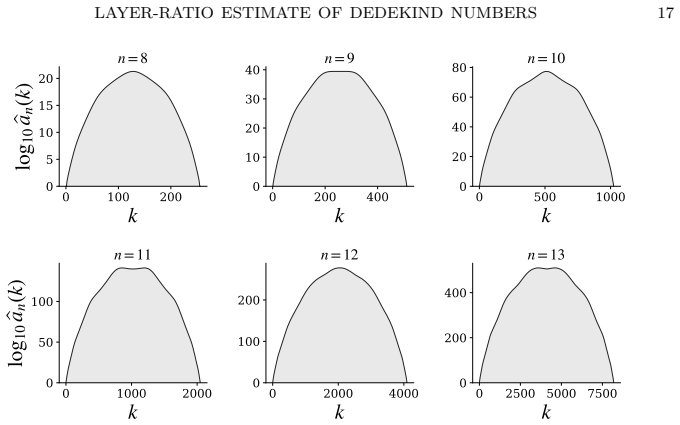
- The layer-ratio reconstruction yields the full Whitney-number profile a_n(k), not just the total count, giving rank-shape information essentially for free.
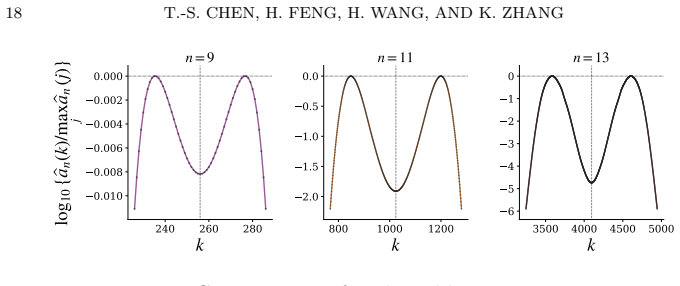
- If the n=9 two-shoulder shape is confirmed exactly, the ideal lattice I(B_n) fails rank-unimodality, ruling out stronger properties such as a symmetric chain decomposition or Peck property.
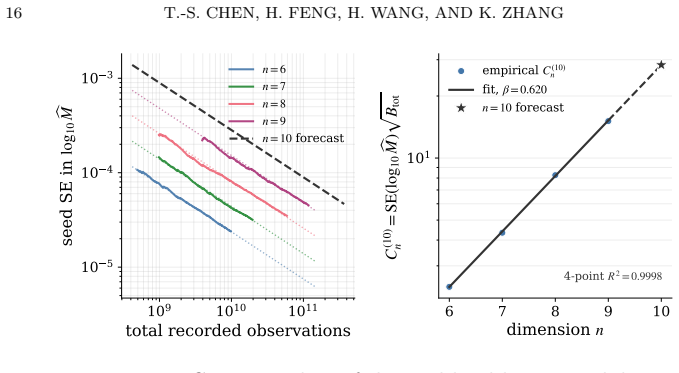
- The cross-n scaling law SE(log10 M) ≈ C_n B^-1/2 with C_{n+1}/C_n ≈ 1.86 provides a quantitative budget rule for estimating higher Dedekind numbers at a targeted precision.
- The backtests at n=8 and n=9 demonstrate that the fixed protocol recovers known values within measured seed-level standard errors, supporting the n=10 forecast.
Where Pith is reading between the lines
- A rigorous mixing-time bound for the exchange chain would be needed to convert the seed-level error bars into a full confidence statement; without it, systematic burn-in bias is invisible to the quoted uncertainty.
- If the two-shoulder pattern is real, it hints at a subtle non-unimodal shape in the distribution of ideal sizes in the Boolean lattice, which may connect to structural questions about free distributive lattices whose empirical profiles are currently documented without explanation.
- The layer-ratio identity is generic to ranked posets with a well-defined add/remove operation, so the same Monte Carlo reconstruction could be applied to other enumeration problems, such as antichains in product posets or higher-dimensional partitions, given suitable mixing analysis.
- An exact computation of M(10) would be the definitive test of this estimate; the scaling law suggests such a computation is costly but conceivable, and the Monte Carlo result can guide expectations for it.
Editorial analysis
A structured set of objections, weighed in public.
Referee Report
Summary. The paper reformulates the enumeration of downsets of the n-dimensional Boolean lattice (Dedekind numbers) as a finite layer-ratio reconstruction problem. For each cardinality layer Ω_{n,k}, the ratio of consecutive Whitney numbers a_n(k+1)/a_n(k) is expressed as E_k A / E_{k+1} R, where A and R are the numbers of addable and removable elements (Theorem 1). The authors design a reversible fixed-layer Markov chain that samples approximately from the uniform measure on each layer, estimate the layer averages, reconstruct the Whitney-number profile in log space, and sum to estimate M(n). They validate against the known values M(8) and M(9), calibrate a cross-n scaling law for the seed-level standard error, and apply the protocol to n=10, obtaining M̂(10)=(8.9360±0.0010)×10^78. They also report a two-shoulder feature in the reconstructed n=9 Whitney profile, contradicting the empirical unimodality description in OEIS A269699, with larger-contrast analogues at n=11 and n=13.
Significance. If the central estimate is correct, this is the first finite-n numerical estimate of M(10) with a quantified uncertainty, obtained by a transparent stochastic algorithm rather than exact enumeration. The method also provides a reconstructed Whitney-number profile, giving information beyond the total count. The mathematical core—the edge double-counting identity and the Metropolis–Hastings chain with uniform stationary measure—is sound and clearly presented. The paper is honest about several limitations, including the absence of a rigorous mixing-time bound and the fact that the quoted uncertainty is a seed-level repeatability measure. The backtests at M(8) and M(9), with log10 errors of −6.2×10⁻⁷ and −5.2×10⁻⁶ at z-scores near zero, are strong empirical evidence that the estimator is well-calibrated at those dimensions. The main value of the paper lies in the practical demonstration that a relatively lightweight Monte Carlo scheme can produce a precise estimate at n=10, and in the unexpected shape observation that, if confirmed, would be of independent combinatorial interest.
major comments (3)
- [§3.2, Table 2, Abstract] The quoted uncertainty for M̂(10) is a seed-level repeatability measure, not a full uncertainty budget. The cross-n budget forecast uses a four-point fit (n=6..9) with no reported confidence interval on β or C_10, and the forecast SE (5.0456×10⁻⁵) is used in the abstract's ±0.0010. More importantly, neither the measured seed SE nor the forecast includes a systematic-error term from possible incomplete mixing of the fixed-layer chains at n=10. The burn-in/thinning drift test (Table 5) is run only at n=8, and the n=10 mixing diagnostic (Table 6) measures within-chain block/group variability, not closeness to the uniform target. Since the headline claim is a precise value with a specific error bar, the authors should either state clearly that the quoted uncertainty is only repeat-to-repeat variability (and not the total error), or add diagnostics that bound the possible mixing bias at n=10—
- [§3.3, Fig. 6] The two-shoulder feature at n=9 is one of the paper's most striking claims, but it is based entirely on Monte Carlo estimates of layer ratios. The backtest for M(9) validates the reconstructed total, not the individual layer means; a layer-dependent bias could cancel in the sum. To make the shape claim credible, the authors should demonstrate that the protocol reproduces the exact layer profile for n≤7 (available in OEIS A269699) without creating spurious shoulders, or provide an independent validation of the central layers at n=9. As written, the sentence 'contrary to the empirical unimodality description in OEIS A269699' overstates the certainty of what is still a numerical observation with a possible hidden systematic bias.
- [§3.1, Fig. 4] The cross-n scaling law is the quantitative basis for the quoted uncertainty. It is fitted from four points (n=6,7,8,9) with two parameters, and no standard errors, confidence intervals, or prediction intervals are reported for β or for the forecast C_10=28.2991. The fit R²=0.9998 is very high, but a four-point extrapolation to n=10 carries nontrivial uncertainty that is not propagated into the abstract's error bar. The authors should report the forecast uncertainty and its effect on the displayed range. They should also clarify why the displayed uncertainty is stated to be the budget-based forecast when the directly measured seed SE from the 1000-seed production run (5.3089×10⁻⁵) is also available and almost identical; this would make the nature of the quoted error bar less ambiguous.
minor comments (6)
- [§3.1, Fig. 3] Panel A axis labels are garbled: 'log10 M log10 M A' appears to be a label error. The x-axis 'observations (10^9)' lacks a clear unit definition; state that it is post-burn-in recorded states.
- [§3.1, Table 1] The column headers and row entries are visually misaligned; for example, 'Chains/layer 2048' and the subsequent numbers appear to run together. Please format the table so that each column is clearly separated, and define the 'z' column explicitly.
- [§A.2, Table 4] The table mixes absolute log10 values and errors without column separators or headers that make clear whether the 'Asymp.' columns are log10 of the asymptotic estimate or the log10 error. Reformat for clarity.
- [§2.2] The sentence 'If v=u, then Γ=D, giving a natural self-loop' is slightly misleading because v is chosen addable in D\{u}, and u is always addable there; the self-loop is not a separate case but a proposal outcome. Consider rephrasing to avoid confusion.
- [Appendix A.1] In Protocol 1, step (1) says sampled layers k=1,...,512 but the ratio reconstruction uses ρ_0 = A_0/R_1; A_0=1 is exact, so R_1 is indeed sampled. However, the reader must infer that layer 0 is not sampled but only the endpoint A_0 is used; please state this explicitly.
- [§4, Discussion] The statement 'The known-value tests and cross-n scaling measure this accumulated error after reconstruction' should be qualified: they measure the seed-level variance, not the total error. This is consistent with the earlier caveat but the wording could be tightened.
Circularity Check
No significant circularity; M(10) point estimate is reconstructed from locally sampled exact ratios, not fit to M(10).
full rationale
The central estimate is built from the exact adjacent-layer identity (Theorem 1), which expresses each Whitney-number ratio as a ratio of expectations of addable/removable counts, and from Monte Carlo averages of those counts on fixed layers. The M(10) value is obtained by plugging sampled A/R means into the deterministic log-space reconstruction and summing; no parameter is fitted to M(10). Validation at M(8) and M(9) is against external exact values, and the cross-n scaling fit affects only the quoted uncertainty scale, which the paper explicitly labels as a budget-based forecast and as repeat-to-repeat variability rather than a full systematic-error account. The only internal citation ([XFZ+26]) is used for boxed-partition terminology and is not load-bearing. The acknowledged absence of a rigorous mixing-time bound is a correctness/validity risk, not a circularity of the derivation chain.
Axiom & Free-Parameter Ledger
free parameters (3)
- β (cross-n scaling slope) =
0.620093
- C_10 (forecast noise constant) =
28.2991
- Protocol hyperparameters (burn-in, thinning, states/chain, chains/layer, seeds) =
2500, 40, 75, 8192, 1000
axioms (4)
- standard math Boolean lattice downset layer state spaces and the exchange chain are finite, irreducible, aperiodic and have uniform stationary distribution.
- ad hoc to paper After 2500 burn-in and thinning 40, each fixed-layer chain is effectively at stationarity for all sampled layers at n=8,9,10.
- ad hoc to paper The log SE growth in n is linear with slope β=0.620 for n=6..9 and remains valid at n=10.
- domain assumption OEIS A269699 rows through n=7 are exact and the sequence is described as empirically unimodal.
read the original abstract
Dedekind's problem counts monotone Boolean functions, equivalently downsets of a Boolean lattice. We recast this enumeration as a finite layer-ratio reconstruction problem for the Whitney numbers of the ranked ideal lattice. An exact adjacent-layer double count expresses each layer ratio through local averages of the number of addable elements and the number of removable elements. Reversible fixed-layer Markov chains estimate these averages and hence estimate the Dedekind number $M(n)$. Backtests at $M(8)$ and $M(9)$ calibrate seed-level variability under the fixed protocol and measure the observed Monte Carlo budget scaling. The resulting estimate probes the Whitney-number sequence of the ideal lattice. Although these rows have previously been described empirically as unimodal, the high-precision $n=9$ estimate has a shallow two-shoulder feature around the central rank, contrary to that empirical description; $n=11$ and $n=13$ center-window estimates show a larger-contrast analogous pattern. The protocol estimate for $M(10)$ is \[ \widehat M(10)=(8.9360\pm0.0010)\times 10^{78}, \] where the displayed uncertainty is the budget-based forecast scale from the cross-$n$ scaling law under the production budget.
Figures
Forward citations
Cited by 1 Pith paper
-
Statistical Estimation of higher Dedekind Numbers
Monte Carlo methods (pair matching, reference subsets, weight-layer branching) give D(10)≈8.93×10^78 through D(15)≈3.81×10^1953 with explicit standard errors, beating Korshunov asymptotics.
Reference graph
Works this paper leans on
-
[1]
Each chain records75post-burn-in states, using burn-in2500and thinning40
(2) Fixed-layer chain layout.For each sampled layer, the protocol runs 4× 2048 = 8192fixed-layer chains. Each chain records75post-burn-in states, using burn-in2500and thinning40. Each chain is initialized by starting from the empty downset and adding uniformly chosen addable vertices until the target layerkis reached. (3) Fixed-layer transition.Within a s...
2048
-
[8]
Here(b,t)is the burn-in/thinning pair
Entries compare meanlog10 errors using the same 40 seeds in each setting. Here(b,t)is the burn-in/thinning pair. Comparison Mean diff. SEzMax abs. diff. (5000,80)−(2500,40)−1.7455×10 −3 1.3538×10 −3 −1.29 1.7668×10 −2 (10000,120)−(2500,40) 4.6248×10 −4 1.0337×10 −3 0.45 1.9154×10 −2 (10000,120)−(5000,80) 2.2080×10 −3 1.3151×10 −3 1.68 1.9773×10 −2 nFormul...
2080
-
[9]
Entry A269699. URL:https: //oeis.org/A269699. [Jäk23] Christian Jäkel. A computation of the ninth Dedekind number.Journal of Computational Algebra, 6–7:100006, 2023.arXiv:2304.00895, doi:10. 1016/j.jaca.2023.100006. [JMP24] Matthew Jenssen, Alexandru Malekshahian, and Jinyoung Park. On Dedekind’s problem, a sparse version of Sperner’s theorem, and anticha...
Pith/arXiv arXiv 2023
-
[11]
URL:https://arxiv.org/abs/2601.07650, arXiv:2601.07650. [Kah02] Jeff Kahn. Entropy, independent sets and antichains: a new approach to Dedekind’s problem.Proceedings of the American Mathematical Society, 130(2):371–378, 2002.doi:10.1090/S0002-9939-01-06058-0. [Kle69] Daniel J. Kleitman. On Dedekind’s problem: the number of monotone Boolean functions.Proce...
arXiv 2002
-
[16]
[MRR+53] Nicholas Metropolis, Arianna W
URL:https://escholarship.org/uc/item/8wh6f7rc. [MRR+53] Nicholas Metropolis, Arianna W. Rosenbluth, Marshall N. Rosenbluth, Augusta H. Teller, and Edward Teller. Equation of state calculations by fast computing machines.Journal of Chemical Physics, 21(6):1087–1092, 1953.doi:10.1063/1.1699114. [Paw22] Bartłomiej Pawelski. On the number of inequivalent mono...
-
[17]
URL: https://cs.uwaterloo.ca/journals/JIS/VOL25/Pawelski/ pawelski7.html
Article 22.7.7. URL: https://cs.uwaterloo.ca/journals/JIS/VOL25/Pawelski/ pawelski7.html. [Paw24] Bartłomiej Pawelski. On the number of inequivalent monotone Boolean func- tions of 9 variables.IEEE Transactions on Information Theory, 70(7):5358– 5364, 2024.doi:10.1109/TIT.2024.3379594. [PS23] Bartłomiej Pawelski and Andrzej Szepietowski. Divisibility prop...
arXiv 2024
-
[18]
URL: https://cs.uwaterloo.ca/journals/JIS/VOL28/Pawelski/ pawelski22.html
Article 25.6.5. URL: https://cs.uwaterloo.ca/journals/JIS/VOL28/Pawelski/ pawelski22.html. [PSS80] Robert A. Proctor, Michael E. Saks, and Dean G. Sturtevant. Product partial orders with the Sperner property.Discrete Mathematics, 30(2):173– 180, 1980.doi:10.1016/0012-365X(80)90118-1. LAYER-RATIO ESTIMATE OF DEDEKIND NUMBERS 23 [PST25] Jinyoung Park, Micha...
-
[19]
URL: https://escholarship.org/uc/item/1cp4b92v, arXiv: 2305.16520,doi:10.5070/c65165018. [Sta86] Richard P. Stanley.Enumerative Combinatorics, volume 1 ofThe Wadsworth & Brooks/Cole Mathematics Series. Wadsworth & Brooks/Cole, Monterey, CA, 1986.doi:10.1007/978-1-4615-9763-6. [SY14] Tamon Stephen and Timothy Yusun. Counting inequivalent monotone Boolean f...
Pith/arXiv arXiv 1986
-
[20]
arXiv:2304.03039,doi:10.1145/3674147. [War46] Morgan Ward. Note on the order of the free distributive lattice.Bulletin of the American Mathematical Society, 52(5):423,
-
[22]
URL: https://arxiv.org/abs/2512.07758, arXiv:2512.07758,doi:10.1007/JHEP05(2026)141. [Yam54] Koichi Yamamoto. Logarithmic order of free distributive lattice.Journal of the Mathematical Society of Japan, 6(3–4):343–353, 1954.doi:10.2969/ jmsj/00630343. AppendixA.Protocol and Numerical V alidation Details This appendix records theM(10)production protocol an...
Pith/arXiv arXiv 2026
-
[24]
Accumulate log Whitney numbers from the endpoint: x0,s = 0, x k,s = k−1∑ j=0 ˆyj,s (1≤k≤512)
Form the adjacent log-ratios on the sampled side: ˆyk,s = log ˆAk,s−log ˆRk+1,s,0≤k<512. Accumulate log Whitney numbers from the endpoint: x0,s = 0, x k,s = k−1∑ j=0 ˆyj,s (1≤k≤512). Complete the full row by exact rank duality: ˆxk,s = { xk,s,0≤k≤512, x1024−k,s,512<k≤1024. The seed-level reconstructed Whitney numbers are ˆa10,s(k) = exp(ˆxk,s). The seed-l...
2048
-
[1899]
doi:10.1098/rspl.1898.0095. [Mac12] P. A. MacMahon. Ix. memoir on the theory of the partitions of numbers. Part VI. partitions in two-dimensional space, to which is added an adumbration of the theory of the partitions in three-dimensional space.Philosophical Transactions of the Royal Society of London. Series A, 211(471–483):345– 373, 1912.doi:10.1098/rst...
arXiv 1912
-
[1946]
Abstract 135.doi: 10.1090/s0002-9904-1946-08566-3. [Wie91] Doug Wiedemann. A computation of the eighth Dedekind number.Order, 8(1):5–6, 1991.doi:10.1007/BF00385808. [XFZ+26] Shang Xiang, Hao Feng, Keyou Zhuo, Tian-Shun Chen, and Kilar Zhang. Charge functions for odd dimensional partitions.Journal of High Energy Physics, 2026(5):141,
-
[1970]
[IK13] Liviu Ilinca and Jeff Kahn
doi:10.1093/biomet/ 57.1.97. [IK13] Liviu Ilinca and Jeff Kahn. Counting maximal antichains and indepen- dent sets.Order, 30(2):427–435,
-
[1975]
[Kor77] A
doi:10.1090/ s0002-9947-1975-0382107-0. [Kor77] A. D. Korshunov. Solution of Dedekind’s problem on the number of mono- tonic Boolean functions.Doklady Akademii Nauk SSSR, 233(4):543–546,
1975
-
[1977]
URL:https://www.mathnet.ru/eng/dan40395
English translation: Soviet Mathematics Doklady 18 (1977), 442–445. URL:https://www.mathnet.ru/eng/dan40395. [Kor03] A. D. Korshunov. Monotone Boolean functions.Russian Mathematical Surveys, 58(5):929–1001, 2003.doi:10.1070/rm2003v058n05abeh000667. [KS02] A. D. Korshunov and I. Shmulevich. On the distribution of the number of monotone Boolean functions re...
-
[1996]
[Eng97] Konrad Engel.Sperner Theory
URL: https://arxiv.org/abs/cond-mat/9610041,arXiv:cond-mat/9610041. [Eng97] Konrad Engel.Sperner Theory. Cambridge University Press, Cambridge, 1997.doi:10.1017/CBO9780511574719. [ET93] Bradley Efron and Robert J. Tibshirani.An Introduction to the Bootstrap. Chapman & Hall/CRC, New York, 1993.doi:10.1201/9780429246593. [FMSS01] Robert Fidytek, Andrzej W. ...
Pith/arXiv arXiv 1997
-
[2001]
[FRRT26] Victor Falgas-Ravry, Eero Räty, and István Tomon
doi:10.1016/S0020-0190(00) 00230-1. [FRRT26] Victor Falgas-Ravry, Eero Räty, and István Tomon. Dedekind’s problem in the hypergrid.Advances in Mathematics, 488:110796, 2026.arXiv:2310. 12946,doi:10.1016/j.aim.2026.110796. [GK76] Curtis Greene and Daniel J. Kleitman. Strong versions of Sperner’s theorem. Journal of Combinatorial Theory, Series A, 20(1):80–88,
arXiv 2026
-
[2009]
doi:10.1090/mbk/058. [Mac99] P. A. MacMahon. Memoir on the theory of the partitions of numbers. Part II.Proceedings of the Royal Society of London, 64(402–411):224–227,
-
[2013]
[Inc26] The OEIS Foundation Inc
arXiv:1202.4427, doi:10.1007/ s11083-012-9253-5. [Inc26] The OEIS Foundation Inc. A269699: Irregular triangle read by rows: number of k-element proper ideals of then-dimensional Boolean lattice. The On- Line Encyclopedia of Integer Sequences,
-
[2014]
LAYER-RATIO ESTIMATE OF DEDEKIND NUMBERS 21 [DCVH26] Patrick De Causmaecker and Lennart Van Hirtum
URL:https://arxiv.org/abs/ 1407.4288,arXiv:1407.4288. LAYER-RATIO ESTIMATE OF DEDEKIND NUMBERS 21 [DCVH26] Patrick De Causmaecker and Lennart Van Hirtum. Solving systems of equations on antichains for the computation of the ninth Dedekind number. Journal of Combinatorial Optimization, 51(1),
-
[2022]
URL:https://arxiv.org/abs/ 2206.10293,arXiv:2206.10293. [BK21] J. Berman and P. Koehler. On Dedekind numbers and two sequences of Knuth.Journal of Integer Sequences, 24,
-
[2024]
[JPS26] Matthew Jenssen, Jinyoung Park, and Michail Sarantis
URL:https://arxiv.org/abs/ 2411.03400,arXiv:2411.03400. [JPS26] Matthew Jenssen, Jinyoung Park, and Michail Sarantis. On the number of antichains in{0, 1, 2}n,
-
[2025]
URL:https://arxiv.org/abs/ 2508.05901,arXiv:2508.05901. [Chu40] Randolph Church. Numerical analysis of certain free distributive struc- tures.Duke Mathematical Journal, 6(3):732–734,
-
[2026]
20904,doi:10.1007/s10878-025-01361-9
Article 5.arXiv:2405. 20904,doi:10.1007/s10878-025-01361-9. [Ded97] Richard Dedekind. Über zerlegungen von zahlen durch ihre grössten gemein- samen theiler. InFest-Schrift der Herzoglichen Technischen Hochschule Carolo-Wilhelmina, pages 1–40. Vieweg+Teubner Verlag,
discussion (0)
Sign in with ORCID, Apple, or X to comment. Anyone can read and Pith papers without signing in.