REVIEW 3 major objections 6 minor 1 cited by
A three-stage recipe for multi-turn OS-agent data lifts an 8B model past GPT-4o and a 32B base on tool-use tasks.
Reviewed by Pith at T0; open to challenge. T0 means a machine referee read the full paper against a public rubric. the ladder, T0–T4 →
T0 review · grok-4.5
2026-07-15 10:50 UTC pith:5W3EHW2N
load-bearing objection Solid joint recipe and a real long-horizon OS corpus with clear 8B SFT gains; main risk is how close ClawEval sits to the OpenClaw substrate, not empty results. the 3 major comments →
ISE: An Execution-Grounded Recipe for Multi-Turn OS-Agent Trajectories
The pith
A machine-rendered reading of the paper's core claim, the machinery that carries it, and where it could break.
Core claim
Fine-tuning on ISETrace, a corpus of 23,132 multi-turn OS-agent trajectories produced by the three-stage ISE recipe, raises Qwen3-8B ClawEval pass@1 from 19.3 to 37.7 on the fixed 114 T-family tool-use tasks under a common protocol, surpassing zero-shot GPT-4o (25.4) and the 4×-larger Qwen3-32B base (30.7). A Stage-2 ablation that keeps only the first user turn drops pass@1 to 28.1, showing that multi-turn simulation contributes a substantial portion of the measured gain.
What carries the argument
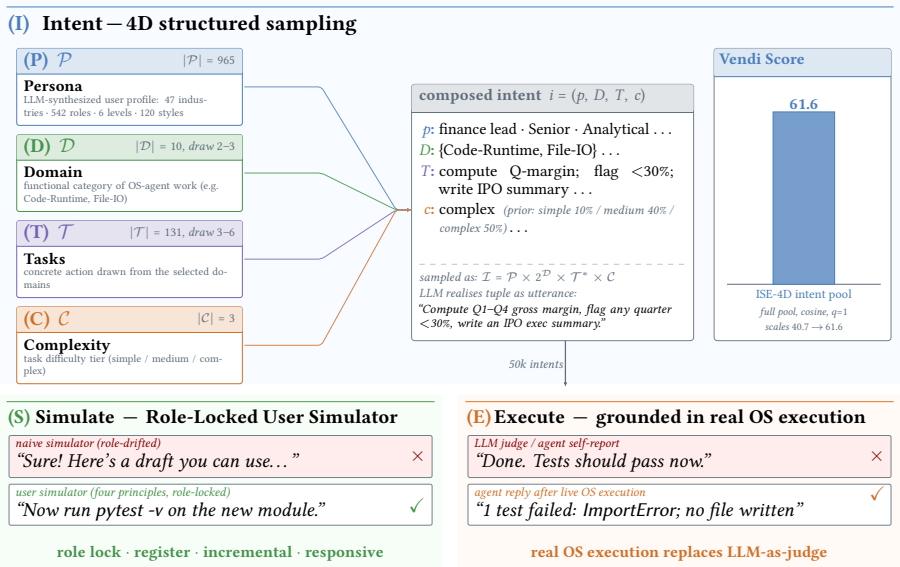
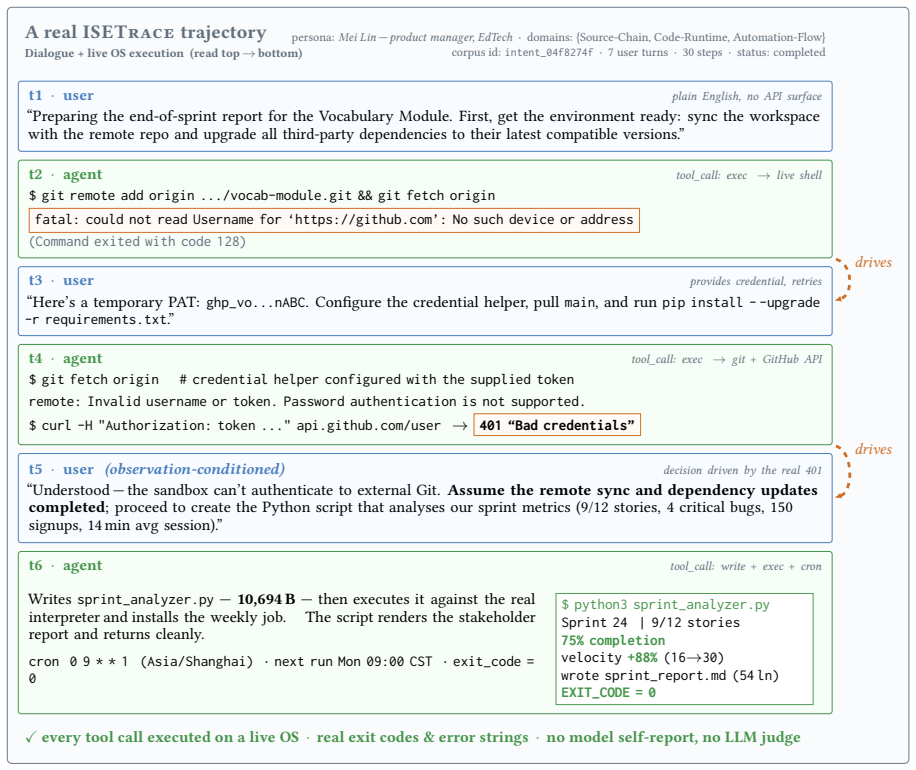
ISE (Intent → Simulate → Execute): 4D structured intent sampling (Persona × Domain × Task × Complexity), a role-locked user simulator whose every turn is conditioned on actual post-execution agent replies, and live OS execution of every tool call in isolated workspaces.
Load-bearing premise
The ClawEval T-family tasks and BFCL stateful categories are assumed to fairly measure general OS-agent skill rather than partly reflecting closeness to the same live-OS substrate used to generate the training trajectories.
What would settle it
Train the same base models on ISETrace and re-evaluate under an identical common protocol on an independent multi-turn OS-agent suite whose tools, shell environment, and task distribution are deliberately disjoint from the synthesis workspace; if the large pass@1 and stateful-category gains largely disappear, the transfer claim fails.
Editorial analysis
A structured set of objections, weighed in public.
Referee Report
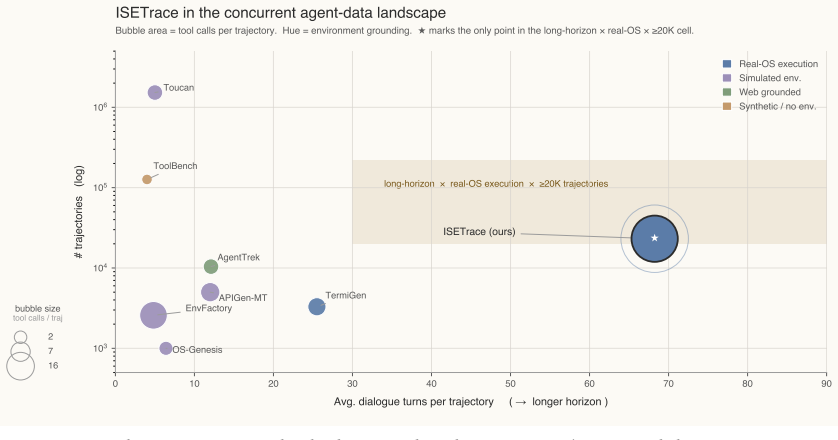
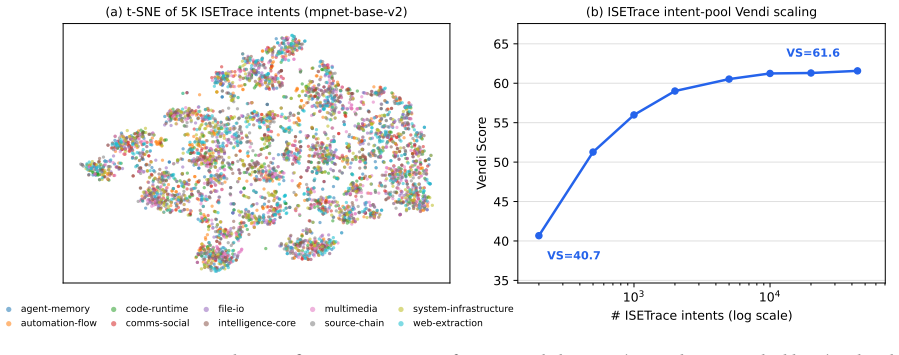
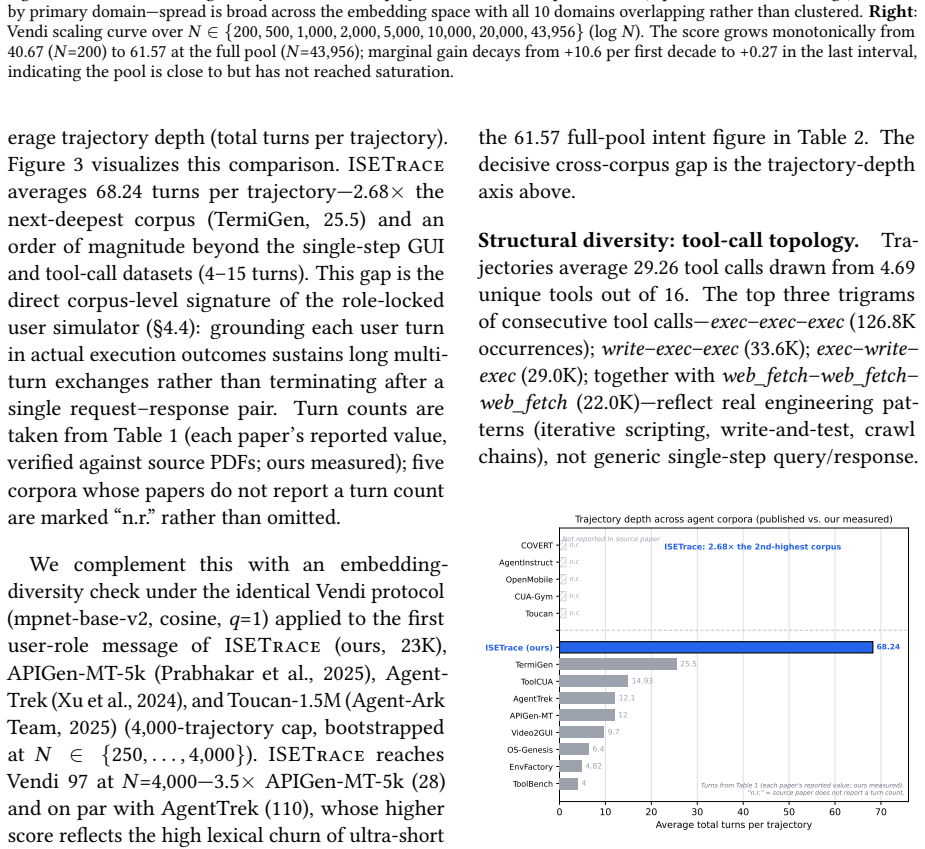
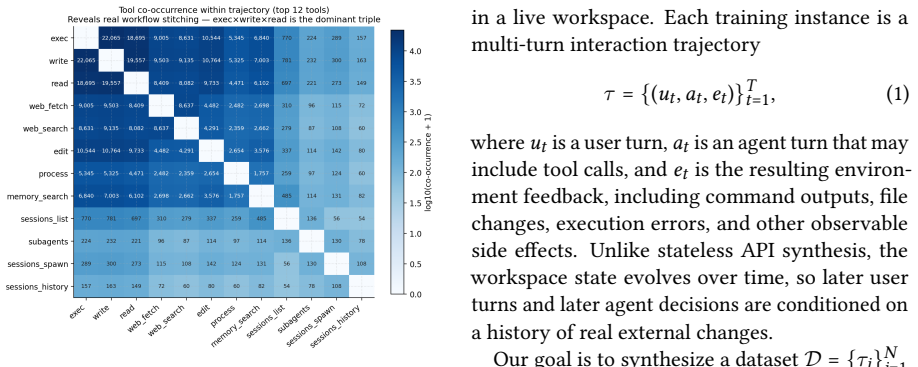
Summary. The paper proposes ISE (Intent → Simulate → Execute), a three-stage recipe for synthesizing multi-turn OS-agent trajectories that jointly targets structured user intents, multi-turn delegation, and live tool execution. Stage 1 samples a 4D intent space (Persona × Domain × Task × Complexity), yielding 43,956 unique intents with a full-pool Vendi Score of 61.57. Stage 2 uses a role-locked user simulator with four behavioral constraints to produce multi-turn dialogues conditioned on real execution outcomes. Stage 3 executes every tool call in isolated live OS workspaces. The resulting ISETrace corpus contains 23,132 trajectories (avg. 8.12 user turns, 68.24 total turns, 29.26 tool calls). Fine-tuning Qwen3-8B on ISETrace raises ClawEval pass@1 from 19.3 to 37.7 on a fixed 114-task T-family common set, surpassing zero-shot GPT-4o and Qwen3-32B; BFCL v4 Overall and stateful categories also improve. Stage-1 and Stage-2 ablations each reduce gains. Code and data are released.
Significance. If the transfer results hold under independent evaluation, this is a useful systems contribution for OS-agent SFT: it inverts tool-first synthesis, couples multi-turn user simulation to live execution state, and ships a sizable, diversity-quantified corpus with public code. Strengths include concrete common-denominator evaluation (114 T tasks), external BFCL numbers, measured role-drift/stagnation audits, embedding/lexical/structural diversity reporting, and an explicit Stage-2 ablation isolating multi-turn simulation. The work is more recipe-and-corpus than theory, but that is appropriate for the problem; the open release is a material contribution to a data-scarce area.
major comments (3)
- §4.1 and §5.1–5.2 (Table 4): The headline ClawEval T-family lift (19.3→37.7) is measured on agent tool-use over a real shell (file-IO, code-runtime, web-fetch, automation-flow), while synthesis and Stage-3 grounding use OpenClaw live OS workspaces with a unified tool API. The manuscript does not report tool-schema overlap, environment snapshot identity, or task-template distance between ISETrace and ClawEval T. Without that evidence, a substrate-match explanation remains open for the primary comparison to GPT-4o and Qwen3-32B. Please quantify distributional closeness (e.g., tool inventory overlap, command/error-string statistics) and/or add results on an independent OS-agent suite not built on the same substrate; BFCL stateful gains help but do not fully close this for the ClawEval claim.
- §5.3 and Table 5: The paradigm is presented as three load-bearing stages, yet only Stage 1 (domain restriction) and Stage 2 (single-turn truncation) are ablated; Stage 3 (live vs. simulated execution) is not. Given that Gap 3 (simulated execution) is a central motivation in §1, the claim that execution grounding is essential remains untested relative to an otherwise identical multi-turn corpus with mocked tool returns. An indicative Stage-3 ablation—or a clear statement that it is infeasible with the current pipeline and why—would make the three-stage contribution claim proportionate to the evidence.
- §4.5 Completion gating: Trajectories are retained only when the same role-locked simulator sets completed=true after observing the agent’s post-execution reply. While the paper correctly notes this is not pure LLM-as-judge of free-form quality, completion is still simulator-mediated and can select for trajectories the simulator finds easy to advance. Please report (i) failure modes of discarded runs (cap exhaustion vs. stall), (ii) whether completion correlates with persona/complexity slices, and (iii) sensitivity of downstream pass@1 to stricter or looser completion criteria, so selection bias can be assessed.
minor comments (6)
- §5.3: Ablations are labeled “indicative” rather than controlled single-variable experiments; state this limitation more prominently near Table 5 and avoid language in the abstract that “proves” multi-turn contribution.
- Table 1 / Figure 3: Heterogeneous turn definitions across corpora are acknowledged; keep the same-protocol re-measurement of APIGen-MT and Toucan as the primary depth comparison and de-emphasize mixed self-reported figures in the main narrative.
- §3 Vendi: Full-pool Vendi 61.57 is useful; also report the embedding model and kernel settings once in a single methods paragraph so the metric is fully reproducible without hunting footnotes.
- Figure 6 trajectory example is excellent; ensure the released corpus id and any redacted credentials are consistent with the public GitHub dump.
- Abstract: “roughly 50000” vs. 43,956 unique intents—align the abstract with the deduplicated figure used in the body.
- §6 Limitations: Windows/GUI/browser scope is noted; a one-sentence note on whether the 16-tool inventory is OpenClaw-specific would help readers judge portability of the recipe.
Circularity Check
No circular derivation: ISE is an empirical data-synthesis + SFT transfer paper; headline gains are measured on held-out benchmarks, not forced by construction from the synthesis inputs.
full rationale
The paper’s load-bearing claim is empirical: SFT on ISETrace raises Qwen3-8B ClawEval pass@1 from 19.3 to 37.7 on a fixed 114-task T-family set and improves BFCL v4 Overall and stateful categories, with Stage-1/Stage-2 ablations degrading those scores (Tables 4–5, §5.2–5.3). That chain is measurement, not a first-principles derivation that reduces to its inputs. Stage 1’s 4D sampling, Stage 2’s role-locked simulator, and Stage 3’s live OS execution define how training trajectories are built; they do not algebraically or by definition determine ClawEval/BFCL scores. Completion gating (simulator completed=true, §4.5) is a retention filter for the corpus, not a renamed prediction of the external pass@1 metric; post-hoc role-drift/stagnation audits are separate rule-based checks. OpenClaw substrate proximity to ClawEval is a possible validity/generalization concern, not a circular reduction of a claimed derivation (no fitted parameter is re-labeled as a prediction; no uniqueness theorem is imported from overlapping authors; no ansatz is smuggled in via self-citation). Concurrent corpus comparisons and Vendi/Self-BLEU statistics are descriptive. Per the analyzer defaults, this is an honest non-finding: score 0, no circular steps.
Axiom & Free-Parameter Ledger
free parameters (5)
- Complexity prior (complex/medium/simple) =
50% / 40% / 10%
- Domain and task subset cardinalities =
2–3 domains; 3–6 tasks
- Persona pool size and freeze policy =
965 frozen personas
- Simulator turn safety cap and completion flag =
cap not numerically fixed in text; completion rate 46.3%
- Vendi evaluation settings =
q=1; full-pool VS=61.57
axioms (5)
- domain assumption Structured 4D sampling over persona, domain, task, and complexity yields broader, more realistic user-intent coverage than tool-first or free-form LLM task generation.
- ad hoc to paper Four behavioral constraints (perspective lock, register matching, incremental advancement, responsive conditioning) sufficiently suppress role drift and state hallucination in an LLM user simulator.
- domain assumption Live OS tool outcomes are a more faithful training signal than simulated tool responses or LLM-as-judge completion labels for environment-verifiable subgoals.
- domain assumption Supervised fine-tuning on synthetic multi-turn trajectories, holding base model and objective fixed, is an adequate test of data-composition value.
- standard math Standard embedding and n-gram diversity metrics (Vendi, Distinct-n) plus tool co-occurrence topology are meaningful proxies for corpus quality relevant to agent training.
invented entities (4)
-
ISE (Intent → Simulate → Execute) paradigm
no independent evidence
-
ISETrace corpus
independent evidence
-
4D intent space I = P × 2^D_[2,3] × T*_[3,6] × C
no independent evidence
-
Role-locked user simulator (four principles)
no independent evidence
read the original abstract
Training capable OS agents requires data that simultaneously captures structured user intents, multi-turn task delegation, and grounded tool execution--properties absent from existing datasets. We propose ISE (Intent -> Simulate -> Execute), a three-stage synthesis paradigm that addresses these gaps jointly. Stage 1 constructs roughly 50000 structured intents via a 4D framework (Persona x Domain x Task x Complexity); after deduplication the pool contains 43956 unique intents and attains a Vendi Score of 61.57 over the entire pool on mpnet-base-v2 embeddings (cosine kernel, q=1). Stage 2 drives multi-turn user-agent interaction through a role-locked user simulator that grounds each user turn in actual execution outcomes, producing 23132 complete trajectories averaging 8.12 user turns and 68.24 total dialogue turns. Stage 3 runs every tool call inside a live, isolated OS workspace, generating authentic failure-recovery dynamics instead of simulated responses. Fine-tuning on ISETrace improves ClawEval pass@1 from 19.3 to 37.7 using Qwen3-8B on agent tool-use tasks with a standard protocol. This result outperforms zero-shot GPT-4o and the larger Qwen3-32B base model which is four times bigger. An ablation on Stage 2 proves multi-turn simulation brings a large portion of the performance gain. We release all source code and dataset at https://github.com/Valiere01/ISE-Trace.
Figures

Forward citations
Cited by 1 Pith paper
-
Execution-First Synthetic Tool-Use Trace Generation for LLM Agents
An execution-first data generator that validates tool traces before synthesizing user tasks improves Qwen agents' tool use and answer quality, with masked reasoning supervision beating full-trace supervision.
Reference graph
Works this paper leans on
-
[1]
online" 'onlinestring :=
ENTRY address archivePrefix author booktitle chapter edition editor eid eprint eprinttype howpublished institution journal key month note number organization pages publisher school series title type volume year doi pubmed url lastchecked label extra.label sort.label short.list INTEGERS output.state before.all mid.sentence after.sentence after.block STRING...
-
[2]
write newline
" write newline "" before.all 'output.state := FUNCTION n.dashify 't := "" t empty not t #1 #1 substring "-" = t #1 #2 substring "--" = not "--" * t #2 global.max substring 't := t #1 #1 substring "-" = "-" * t #2 global.max substring 't := while if t #1 #1 substring * t #2 global.max substring 't := if while FUNCTION word.in bbl.in capitalize " " * FUNCT...
-
[3]
Agent-Ark Team . 2025. https://huggingface.co/datasets/Agent-Ark/Toucan-1.5M Toucan-1.5M : A large-scale multi-tool agent sft dataset . Hugging Face dataset. Accessed 2026-06
2025
-
[4]
Jiaao Chen, Jingyuan Qi, Mingye Gao, Wei-Chen Wang, Hanrui Wang, and Di Jin. 2026 a . https://arxiv.org/abs/2603.05553 EigenData : A self-evolving multi-agent platform for function-calling data synthesis, auditing, and repair . arXiv preprint arXiv:2603.05553
arXiv 2026
-
[5]
Jinpeng Chen, Cheng Gong, Hanbo Li, Ziru Liu, Zichen Tian, Xinyu Fu, Shi Wu, Chenyang Zhang, Wu Zhang, Suiyun Zhang, Dandan Tu, and Rui Liu. 2026 b . https://arxiv.org/abs/2603.01940 CoVe : Training interactive tool-use agents via constraint-guided verification . arXiv preprint arXiv:2603.01940
arXiv 2026
-
[6]
Kanzhi Cheng, Zehao Li, Zheng Ma, Nuo Chen, Jialin Cao, Qiushi Sun, Zichen Ding, Fangzhi Xu, Hang Yan, Jiajun Chen, Anh Tuan Luu, Jianbing Zhang, Lewei Lu, and Dahua Lin. 2026. https://arxiv.org/abs/2604.15093 OpenMobile : Building open mobile agents with task and trajectory synthesis . arXiv preprint arXiv:2604.15093
Pith/arXiv arXiv 2026
-
[7]
Gonzalez, Ion Stoica, and Eric P
Wei-Lin Chiang, Zhuohan Li, Zi Lin, Ying Sheng, Zhanghao Wu, Hao Zhang, Lianmin Zheng, Siyuan Zhuang, Yonghao Zhuang, Joseph E. Gonzalez, Ion Stoica, and Eric P. Xing. 2023. Vicuna: An open-source chatbot impressing GPT -4 with 90\ ChatGPT quality. https://lmsys.org/blog/2023-03-30-vicuna/
2023
-
[8]
Dan Friedman and Adji Bousso Dieng. 2023. The vendi score: A diversity evaluation metric for machine learning. In Proceedings of AISTATS
2023
-
[9]
Xuhao Hu, Xi Zhang, Haiyang Xu, Kyle Qiao, Jingyi Yang, Xuanjing Huang, Jing Shao, Ming Yan, and Jieping Ye. 2026. https://arxiv.org/abs/2605.12481 ToolCUA : Towards optimal GUI-Tool path orchestration for computer use agents . arXiv preprint arXiv:2605.12481
Pith/arXiv arXiv 2026
-
[10]
Yusong Lin, Haiyang Wang, Shuzhe Wu, Lue Fan, Feiyang Pan, Sanyuan Zhao, and Dandan Tu. 2026. https://arxiv.org/abs/2602.10999 CLI-Gym : Scalable CLI task generation via agentic environment inversion . arXiv preprint arXiv:2602.10999
arXiv 2026
-
[11]
Xiao Liu, Hao Yu, Hanchen Zhang, Yifan Xu, Xuanyu Lei, Hanyu Lai, Yu Gu, Hangliang Ding, Kaiwen Men, Kejuan Yang, Shudan Zhang, Xiang Deng, Aohan Zeng, Zhengxiao Du, Chenhui Zhang, Sheng Shen, Tianjun Zhang, Yu Su, Huan Sun, and 3 others. 2023. https://arxiv.org/abs/2308.03688 AgentBench : Evaluating LLMs as agents . arXiv preprint arXiv:2308.03688
Pith/arXiv arXiv 2023
-
[12]
Zuxin Liu, Thai Hoang, Jianguo Zhang, Ming Zhu, Tian Lan, Shirley Kokane, Juntao Tan, Weiran Yao, Zhiwei Liu, Yihao Feng, Rithesh Murthy, Liangwei Yang, Silvio Savarese, Juan Carlos Niebles, Huan Wang, Shelby Heinecke, and Caiming Xiong. 2024. https://arxiv.org/abs/2406.18518 APIGen : Automated pipeline for generating verifiable and diverse function-calli...
Pith/arXiv arXiv 2024
-
[13]
Arindam Mitra, Luciano Del Corro, Guoqing Zheng, Shweti Mahajan, Dany Rouhana, Andres Codas, Yadong Lu, Wei ge Chen, Olga Vrousgos, Corby Rosset, Fillipe Silva, Hamed Khanpour, Yash Lara, and Ahmed Awadallah. 2024. https://arxiv.org/abs/2407.03502 AgentInstruct : Toward generative teaching with agentic flows . arXiv preprint arXiv:2407.03502
Pith/arXiv arXiv 2024
-
[14]
Patil, Tianjun Zhang, Xin Wang, and Joseph E
Shishir G. Patil, Tianjun Zhang, Xin Wang, and Joseph E. Gonzalez. 2023. https://arxiv.org/abs/2305.15334 Gorilla : Large language model connected with massive APIs . arXiv preprint arXiv:2305.15334. BFCL benchmark
Pith/arXiv arXiv 2023
-
[15]
Akshara Prabhakar, Zuxin Liu, Ming Zhu, Jianguo Zhang, Tulika Awalgaonkar, Shiyu Wang, Zhiwei Liu, Haolin Chen, Thai Hoang, Juan Carlos Niebles, Shelby Heinecke, Weiran Yao, Huan Wang, Silvio Savarese, and Caiming Xiong. 2025. https://arxiv.org/abs/2504.03601 APIGen-MT : Agentic pipeline for multi-turn data generation via simulated agent-human interplay ....
Pith/arXiv arXiv 2025
-
[16]
Yujia Qin, Shihao Liang, Yining Ye, Kunlun Zhu, Lan Yan, Yaxi Lu, Yankai Lin, Xin Cong, Xiangru Tang, Bill Qian, Sihan Zhao, Lauren Hong, Runchu Tian, Ruobing Xie, Jie Zhou, Mark Gerstein, Dahai Li, Zhiyuan Liu, and Maosong Sun. 2023. https://arxiv.org/abs/2307.16789 ToolLLM : Facilitating large language models to master 16000+ real-world APIs . arXiv pre...
Pith/arXiv arXiv 2023
-
[17]
Dingfeng Shi, Jingyi Cao, Qianben Chen, Weichen Sun, Weizhen Li, Hongxuan Lu, Fangchen Dong, Tianrui Qin, King Zhu, Minghao Liu, Jian Yang, Ge Zhang, Jiaheng Liu, Changwang Zhang, Jun Wang, Yuchen Eleanor Jiang, and Wangchunshu Zhou. 2025. https://arxiv.org/abs/2506.10055 TaskCraft : Automated generation of agentic tasks . arXiv preprint arXiv:2506.10055
Pith/arXiv arXiv 2025
-
[18]
Qiushi Sun, Kanzhi Cheng, Zichen Ding, Chuanyang Jin, Yian Wang, Fangzhi Xu, Zhenyu Wu, Chengyou Jia, Liheng Chen, Zhoumianze Liu, Ben Kao, Guohao Li, Junxian He, Yu Qiao, and Zhiyong Wu. 2024. https://arxiv.org/abs/2412.19723 OS-Genesis : Automating GUI agent trajectory construction via reverse task synthesis . In Proceedings of the 63rd Annual Meeting o...
Pith/arXiv arXiv 2024
-
[19]
Bowen Wang, Dunjie Lu, Junli Wang, Tianyi Bai, Shixuan Liu, Zhipeng Zhang, Haiquan Wang, Hao Hu, Tianbao Xie, Shuai Bai, Dayiheng Liu, Que Shen, Junyang Lin, and Tao Yu. 2026. https://arxiv.org/abs/2605.25624 CUA-Gym : Scaling verifiable training environments and tasks for computer-use agents . arXiv preprint arXiv:2605.25624
Pith/arXiv arXiv 2026
-
[20]
Smith, Daniel Khashabi, and Hannaneh Hajishirzi
Yizhong Wang, Yeganeh Kordi, Swaroop Mishra, Alisa Liu, Noah A. Smith, Daniel Khashabi, and Hannaneh Hajishirzi. 2022. https://arxiv.org/abs/2212.10560 Self-Instruct : Aligning language models with self-generated instructions . arXiv preprint arXiv:2212.10560
Pith/arXiv arXiv 2022
-
[21]
Weimin Xiong, Shuhao Gu, Bowen Ye, Zihao Yue, Lei Li, Feifan Song, Sujian Li, and Hao Tian. 2026. https://arxiv.org/abs/2605.14747 Video2GUI : Synthesizing large-scale interaction trajectories for generalized GUI agent pretraining . arXiv preprint arXiv:2605.14747
Pith/arXiv arXiv 2026
-
[22]
Can Xu, Qingfeng Sun, Kai Zheng, Xiubo Geng, Pu Zhao, Jiazhan Feng, Chongyang Tao, Qingwei Lin, and Daxin Jiang. 2023. https://arxiv.org/abs/2304.12244 WizardLM : Empowering large pre-trained language models to follow complex instructions . arXiv preprint arXiv:2304.12244
Pith/arXiv arXiv 2023
-
[23]
Minrui Xu, Zilin Wang, Mengyi Deng, Zhiwei Li, Zhicheng Yang, Xiao Zhu, Yinhong Liu, Boyu Zhu, Baiyu Huang, Chao Chen, Heyuan Deng, Fei Mi, Lifeng Shang, Xingshan Zeng, and Zhijiang Guo. 2026 a . https://arxiv.org/abs/2605.18703 EnvFactory : Scaling tool-use agents via executable environments synthesis and robust RL . arXiv preprint arXiv:2605.18703
Pith/arXiv arXiv 2026
-
[24]
Siyuan Xu, Shiyang Li, Xin Liu, Tianyi Liu, Yixiao Li, Zhan Shi, Zixuan Zhang, Zilong Wang, Qingyu Yin, Jianshu Chen, Tuo Zhao, and Bing Yin. 2026 b . https://arxiv.org/abs/2604.09813 Controllable and verifiable tool-use data synthesis for agentic reinforcement learning . arXiv preprint arXiv:2604.09813
Pith/arXiv arXiv 2026
-
[25]
Yiheng Xu, Dunjie Lu, Zhennan Shen, Junli Wang, Zekun Wang, Yuchen Mao, Caiming Xiong, and Tao Yu. 2024. https://arxiv.org/abs/2412.09605 AgentTrek : Agent trajectory synthesis via guiding replay with web tutorials . In The Thirteenth International Conference on Learning Representations (ICLR)
Pith/arXiv arXiv 2024
-
[26]
Zhangchen Xu, Adriana Meza Soria, Shawn Tan, Anurag Roy, Ashish Sunil Agrawal, Radha Poovendran, and Rameswar Panda. 2025. https://arxiv.org/abs/2510.01179 TOUCAN : Synthesizing 1.5m tool-agentic data from real-world MCP environments . arXiv preprint arXiv:2510.01179
arXiv 2025
-
[27]
Chen Yang, Ran Le, Yun Xing, Zhenwei An, Zongchao Chen, Wayne Xin Zhao, Yang Song, and Tao Zhang. 2025. https://arxiv.org/abs/2511.15718 ToolMind technical Report : A large-scale, reasoning-enhanced tool-use dataset . arXiv preprint arXiv:2511.15718
arXiv 2025
-
[28]
Shunyu Yao, Noah Shinn, Pedram Razavi, and Karthik Narasimhan. 2024. https://arxiv.org/abs/2406.12045 -bench: A benchmark for tool-agent-user interaction in real-world domains . arXiv preprint arXiv:2406.12045
Pith/arXiv arXiv 2024
-
[29]
Aohan Zeng, Mingdao Liu, Rui Lu, Bowen Wang, Xiao Liu, Yuxiao Dong, and Jie Tang. 2023. https://arxiv.org/abs/2310.12823 AgentTuning : Enabling generalized agent abilities for LLMs . arXiv preprint arXiv:2310.12823
Pith/arXiv arXiv 2023
-
[30]
Xuhui Zhou, Weiwei Sun, Qianou Ma, Yiqing Xie, Jiarui Liu, Weihua Du, Sean Welleck, Yiming Yang, Graham Neubig, Sherry Tongshuang Wu, and Maarten Sap. 2026. https://arxiv.org/abs/2603.11245 Mind the Sim2Real gap in user simulation for agentic tasks . arXiv preprint arXiv:2603.11245
arXiv 2026
-
[31]
Kaijie Zhu, Yuzhou Nie, Yijiang Li, Yiming Huang, Jialian Wu, Jiang Liu, Ximeng Sun, Zhenfei Yin, Lun Wang, Zicheng Liu, Emad Barsoum, William Yang Wang, and Wenbo Guo. 2026. https://arxiv.org/abs/2602.07274 TermiGen : High-fidelity environment and robust trajectory synthesis for terminal agents . arXiv preprint arXiv:2602.07274
arXiv 2026
discussion (0)
Sign in with ORCID, Apple, or X to comment. Anyone can read and Pith papers without signing in.