REVIEW 2 major objections 2 minor 4 cited by
Exact analytic solutions govern linear dynamics of curvature and isocurvature perturbations in two-field inflation for arbitrary coupling.
Reviewed by Pith at T0; open to challenge. T0 means a machine referee read the full paper against a public rubric. the ladder, T0–T4 →
T0 review · grok-4.3
2026-06-26 23:11 UTC pith:XAC3YKTT
load-bearing objection This paper supplies exact closed-form solutions to the coupled linear perturbation equations in a two-field model for arbitrary μ and λ on quasi-de Sitter, plus a closed-form power spectrum. the 2 major comments →
Pushing the Primordial Frontier: Exact Linear Solutions in Multifield Inflation
The pith
A machine-rendered reading of the paper's core claim, the machinery that carries it, and where it could break.
Core claim
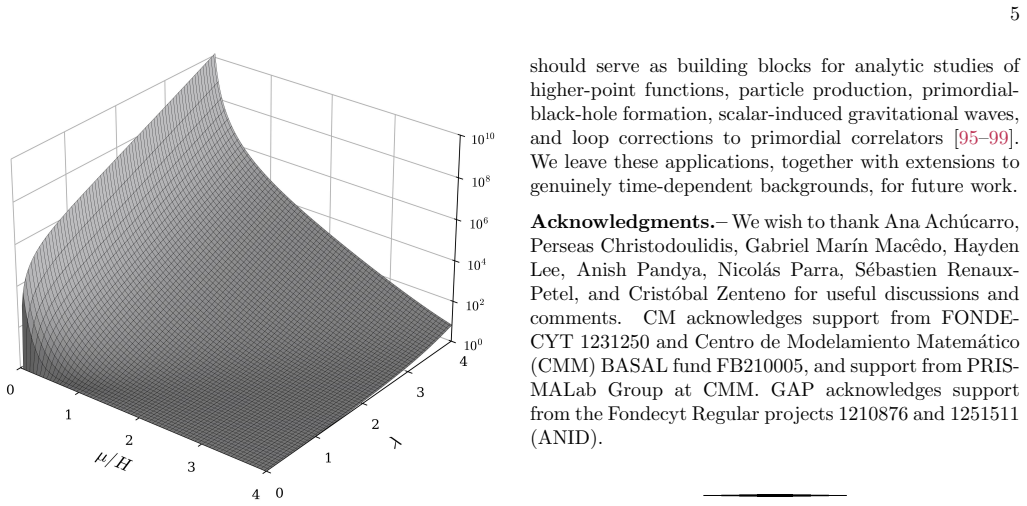
The authors present exact analytic solutions for the linear dynamics of a two-field inflationary system in which the primordial curvature perturbation is coupled to an isocurvature perturbation of entropy mass. The solutions are valid for arbitrary values of the mass and the dimensionless interaction strength within a quasi-de Sitter background. As a first application they obtain the amplitude of the primordial power spectrum in closed form, yielding an expression that interpolates between the weakly coupled, strongly coupled, light-field, and heavy-field regimes.
What carries the argument
Exact closed-form solutions to the coupled linear mode equations for the curvature and isocurvature perturbations.
Load-bearing premise
The background expansion must stay close to de Sitter and the perturbations must remain small enough that linear theory applies.
What would settle it
A direct numerical integration of the perturbation equations for chosen values of the mass and coupling, compared to the claimed closed-form power spectrum to test for any mismatch.
If this is right
- The power spectrum amplitude follows from a single expression valid in every coupling and mass regime.
- Analytic calculations of non-Gaussianity, particle production, and loop corrections become possible without further approximations.
- Rapid-turn inflation scenarios can be studied with full analytic control over the linear stage.
Where Pith is reading between the lines
- The closed-form solutions could supply templates for isocurvature contributions when fitting CMB data.
- They open a route to analytic estimates of higher-order statistics in potentials that realize strong turning.
- Numerical checks in backgrounds that deviate mildly from de Sitter would test how far the quasi-de Sitter assumption can stretch.
Editorial analysis
A structured set of objections, weighed in public.
Referee Report
Summary. The manuscript claims to derive exact analytic solutions for the linear dynamics of a two-field inflationary system, with the curvature perturbation ζ coupled to an isocurvature perturbation σ of entropy mass μ and dimensionless interaction strength λ, on a quasi-de Sitter background. The solutions are obtained by reducing the coupled perturbation equations to a solvable fourth-order ODE whose characteristic equation yields the mode functions, valid for arbitrary μ and λ. As an application, a closed-form expression for the amplitude of the primordial power spectrum is derived that interpolates between the weakly coupled, strongly coupled, light-field, and heavy-field regimes.
Significance. If the exact solutions and closed-form spectrum hold without hidden restrictions, the work would provide valuable analytic control over the strongly coupled regime in multifield inflation, including rapid-turn models. The explicit derivation via the fourth-order ODE and the parameter-free interpolation of the power spectrum amplitude represent a concrete advance that could enable further analytic studies of non-Gaussianity and loop corrections. The absence of ad-hoc parameters or fitted inputs in the central derivation is a notable strength.
major comments (2)
- [§3.2, Eq. (18)] §3.2, Eq. (18): The reduction of the coupled system to the fourth-order ODE is presented as exact, but the quasi-de Sitter approximation for the background scale factor is used without a quantitative error estimate in the superhorizon limit; this approximation is load-bearing for the claimed validity at arbitrary μ.
- [§4.1, Eq. (27)] §4.1, Eq. (27): The closed-form power spectrum amplitude is stated to interpolate between regimes, but the superhorizon freezing assumption for the isocurvature mode when μ is small is not verified against the full time-dependent solution, which could affect the ζ spectrum extraction.
minor comments (2)
- [§2] The notation for the interaction term λ is introduced without an explicit definition of its relation to the potential derivatives; a brief equation linking it to the background would improve clarity.
- [Figure 2] Figure 2 caption does not specify the numerical values of μ and λ used for the comparison curves; adding these would aid reproducibility.
Simulated Author's Rebuttal
We thank the referee for their positive assessment and constructive comments. We respond to each major comment below.
read point-by-point responses
-
Referee: [§3.2, Eq. (18)] The reduction of the coupled system to the fourth-order ODE is presented as exact, but the quasi-de Sitter approximation for the background scale factor is used without a quantitative error estimate in the superhorizon limit; this approximation is load-bearing for the claimed validity at arbitrary μ.
Authors: The quasi-de Sitter background is the standard leading-order approximation in inflationary perturbation theory, with corrections suppressed by the slow-roll parameters. We agree that an explicit quantitative error estimate would strengthen the presentation for arbitrary μ. We will add a derivation of the leading error term in the superhorizon limit to §3.2 in the revised manuscript. revision: yes
-
Referee: [§4.1, Eq. (27)] The closed-form power spectrum amplitude is stated to interpolate between regimes, but the superhorizon freezing assumption for the isocurvature mode when μ is small is not verified against the full time-dependent solution, which could affect the ζ spectrum extraction.
Authors: The closed-form spectrum follows directly from the exact time-dependent mode functions of the fourth-order ODE; no separate freezing assumption is imposed beyond the analytic solution itself. The interpolation for small μ is a direct consequence of those solutions. We will add a brief numerical cross-check of the superhorizon isocurvature evolution against the original coupled system in an appendix. revision: partial
Circularity Check
No significant circularity; derivation self-contained
full rationale
The manuscript reduces the coupled linear perturbation equations for ζ and σ to a solvable fourth-order ODE whose characteristic equation directly supplies the mode functions for arbitrary μ and λ. The closed-form power-spectrum amplitude follows from the superhorizon limit of those modes. No parameter is fitted and then relabeled as a prediction, no self-citation supplies a load-bearing uniqueness theorem, and the quasi-de Sitter assumption is stated explicitly rather than smuggled in. The central results are therefore independent of the inputs they are derived from.
Axiom & Free-Parameter Ledger
axioms (1)
- domain assumption The inflationary background is quasi-de Sitter.
read the original abstract
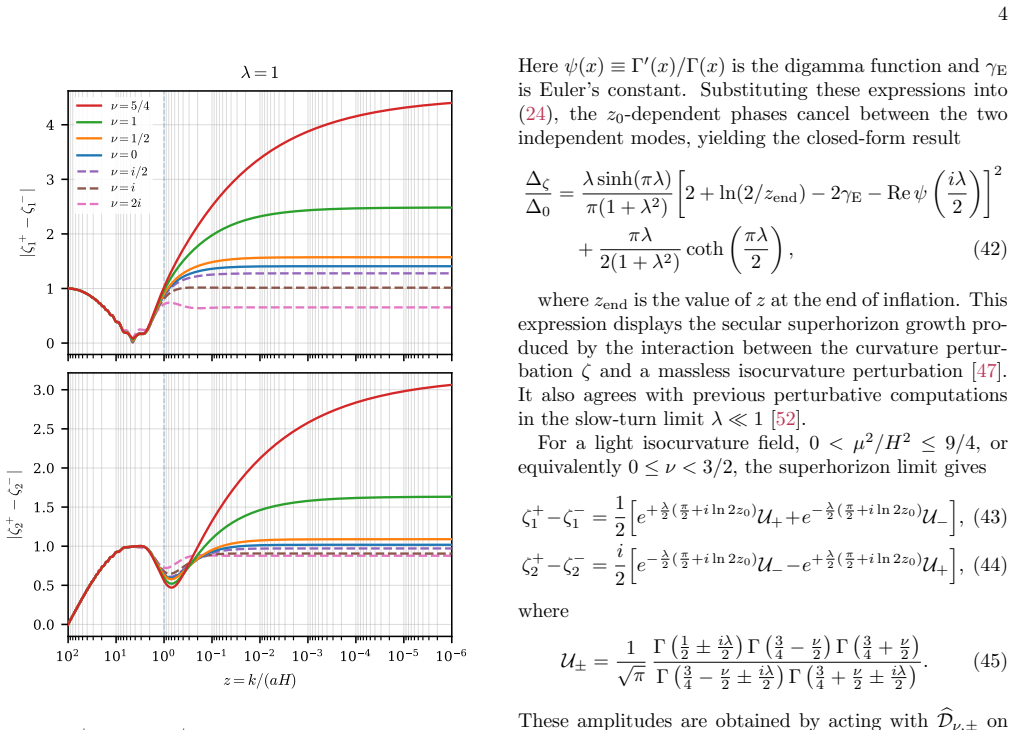
We present exact analytic solutions for the linear dynamics of a two-field inflationary system in which the primordial curvature perturbation $\zeta$ is coupled to an isocurvature perturbation $\sigma$ of entropy mass $\mu$. The solutions are valid for arbitrary values of $\mu$ and the dimensionless interaction strength $\lambda$, within a quasi-de Sitter background. They therefore provide analytic control over the strong mixing regime in which $\zeta$ interacts with light isocurvature fields, commonly associated with rapid-turn inflation. As a first application, we derive the amplitude of the primordial power spectrum in closed form, obtaining an expression that interpolates between the weakly mixed, strongly mixed, light-field, and heavy-field regimes. These results open the way to analytic studies of multifield observables beyond the power spectrum, including non-Gaussianity, particle production, and loop corrections.
Figures
Forward citations
Cited by 4 Pith papers
-
New exact bispectrum shapes in multifield inflation
Exact analytic bispectrum shapes are derived for multifield inflation at arbitrary quadratic mixing strength, showing a strong-mixing collider signal with frequency μ_eff = sqrt(m²/H² + λ² − 9/4).
-
Dissecting the Scalar Cosmological Collider with the Cosmic Microwave Background
A joint Bayesian fit of the multi-field inflationary Lagrangian to Planck bispectrum data finds no cosmological collider signal (max Δχ²=5.3) and shows weak-mixing template searches are invalid except at the smallest masses.
-
Pushing the Primordial Frontier: Cosmological Collider Signatures at Strong Mixing
Exact analytic squeezed-limit bispectra for strongly mixed two-field inflation, nonperturbative in the curvature-isocurvature mixing λ.
-
Cosmological Collider Signals at Strong Mixing
The squeezed-limit cosmological collider signal is computed nonperturbatively in the mixing strength as an absolutely convergent series, with a JWKB expansion of the oscillation phase.
discussion (0)
Sign in with ORCID, Apple, or X to comment. Anyone can read and Pith papers without signing in.