REVIEW 3 major objections 5 minor 176 references
Fitting the full two-field inflationary Lagrangian to Planck CMB bispectrum data, this paper finds no evidence for cosmological-collider particle exchange, with a maximum Δχ² of 5.3.
Reviewed by Pith at T0; open to challenge. T0 means a machine referee read the full paper against a public rubric. the ladder, T0–T4 →
T0 review · deepseek-v4-flash
2026-08-01 15:33 UTC pith:3OAQGBO7
load-bearing objection A careful null result that likely closes the simplest single-scalar collider in Planck, but the headline 'much tighter than theory' is prior-dependent and the squeezed-limit fits need validation. the 3 major comments →
Dissecting the Scalar Cosmological Collider with the Cosmic Microwave Background
The pith
A machine-rendered reading of the paper's core claim, the machinery that carries it, and where it could break.
Core claim
On its own terms, the paper's central discovery is that the strongly-mixed cosmological collider — where the quadratic mixing between the Goldstone mode and a massive scalar is treated non-perturbatively — can now be confronted with data, and that Planck's measured bispectrum shape shows no sign of it. The author computes all seven tree-level bispectrum templates for the two-field EFT, parameterized by two sound-speeds, a scalar mass, a mixing coefficient, and four cubic couplings. Against the binned Planck shape measurements, no parameter combination produces a significant detection: maximum Δχ² of 5.3 over the null hypothesis and 3.3 over the single-field model, signal-to-noise never above
What carries the argument
The load-bearing object is the tree-level bispectrum shape function Sζ(x,y) of the curvature perturbation, assembled from a seven-term cubic Lagrangian whose amplitudes are partially fixed by non-linearly realized symmetries. In the weak-mixing limit, the exchange templates come from an analytic cosmological bootstrap, factorized in the couplings; for arbitrary mixing, the paper solves the time evolution numerically with a flow-based method, treating the quadratic π–σ mixing non-perturbatively. The computational simplification is that the likelihood is linear in the four cubic amplitudes, allowing analytic marginalization down to a four-dimensional space of quadratic parameters (sound-speeds
Load-bearing premise
The constraints rest on the numerical strong-mixing bispectrum templates being accurate in exactly the regimes that are hardest to compute — highly squeezed triangles (x<0.01, filled by analytic fits) and very large mixing (modeled through a non-local effective Lagrangian) — since those regimes set the reported bounds.
What would settle it
A direct numerical recomputation of the strong-mixing templates using an independent in-in solver that resolves squeezing down to x = 10⁻⁴, without analytic fitting, and re-evaluating the ρ-only likelihood near m ≈ H: if Δχ² moves substantially from 5.3 (say, below 2 or above 10), the paper's constraints would need revision. Observationally, a future CMB or 21-cm measurement with roughly five times better equilateral sensitivity that finds Δχ² > 10 at any fixed mass would falsify the paper's claim that no scalar collider signal is present in the allowed parameter space.
If this is right
- Weak-mixing cosmological-collider templates cannot be detected in current data: the coupling required for a visible signal violates perturbativity for most masses, so earlier template searches implicitly probed an inconsistent regime.
- Strong-mixing analyses place the tightest data-driven bounds to date on the multi-field Lagrangian, with ρ ≲ 170H at 95% and the cubic exchange amplitudes bounded orders of magnitude below unitarity limits.
- The oscillatory collider features are exponentially suppressed whenever the mixing is large enough to be theoretically allowed, meaning the same physics that could make the signal detectable also damps the oscillations.
- No mass point in either the complementary or principal series shows detection above about 2σ, and Bayesian evidence disfavors the multi-field model against the null at all masses.
- Future probes with improved equilateral-type sensitivity — for example, next-generation CMB or 21-cm observations — are needed to reach the strong-mixing region, since current data already sit at the theoretical edge.
- Beyond the paper's claims: because the null persists under both linear and logarithmic priors on the mixing, the no-detection verdict is probably stable, but the headline bounds (ρ ≲ 170H versus ρ ≲ 50H) are prior-dependent and should not be over-interpreted.
- The analytic marginalization over cubic amplitudes is a reusable technique: any bispectrum analysis whose model is linear in a subset of couplings can be reduced to a low-dimensional quadratic-parameter scan, which is what makes an eight-parameter likelihood feasible in milliseconds.
- A testable extension: applying the same Lagrangian-level scan to the CMB trispectrum or to large-scale structure bispectra with a few-fold better sensitivity would either sharpen the ρ bound or begin resolving the suppressed oscillations, distinguishing a strict null from a faint signal.
Editorial analysis
A structured set of objections, weighed in public.
Referee Report
Summary. This paper performs a joint Bayesian analysis of the two-field inflationary effective field theory, coupling the Goldstone mode to a massive scalar. It builds a library of tree-level bispectrum templates: analytic self-interaction shapes, weak-mixing single-exchange shapes from the cosmological bootstrap, and strong-mixing shapes from the CosmoFlow numerical solver (supplemented by a non-local single-field Lagrangian at large mixing). These are compared to the binned Planck primordial bispectrum shape measurements of Ref. [44] using a likelihood with analytic marginalization over the cubic couplings, sampled with nested sampling and HMC. The main results are: no evidence for new physics across the full parameter space, with a maximum chi-squared improvement of 5.3; 95% bounds in the strong-mixing regime (rho less than about 170H under a flat prior, with bounds on Delta-rho, alpha, and mu); and a demonstration that weak-mixing templates require couplings in tension with perturbativity except at the smallest masses. The paper also reports that in the strong-mixing regime Planck constraints are much tighter than the theoretical unitarity bounds, although the oscillatory collider signatures are exponentially suppressed.
Significance. If the central claims hold, this is a substantial step forward for the cosmological collider program. It is, to my knowledge, the first analysis that treats the strongly-mixed scalar collider with CMB data, jointly constraining all four quadratic and four cubic operators rather than fitting a single f_NL template. The paper makes good use of public data and modern tools, and it contains genuine cross-checks: bootstrap versus CosmoFlow agreement at weak mixing, analytic self-interaction shapes, and two independent samplers. The central null result — no evidence for new physics — appears robust. The quantitative bounds on rho, Delta-rho, alpha, and mu are potentially useful and go beyond existing work, but they rest on numerical templates in a regime where some approximations are not fully validated.
major comments (3)
- [III A 2, p. 10] The strong-mixing templates are evaluated only for x >= 0.01; configurations with x < 0.01 are filled using analytic squeezed-limit fits to Eq. (16), anchored on x in [0.01, 0.1]. The Planck binned shape data extend to x = 10^{-3}. The paper's strong-mixing constraints (Fig. 8: rho less than about 170H, Delta-rho, alpha, mu bounds) and the quoted maximum Delta-chi^2 = 5.3 are computed from these filled templates. This is load-bearing because the leading x^{1/2 ± i mu} scaling and any collider oscillations live at exactly these small-x bins. The manuscript does not validate the extrapolation against direct CosmoFlow evaluations at x<0.01, nor does it report whether the constraints survive if the x<0.01 bins are simply excluded. I ask the authors to add such a validation (e.g. evaluate a subset of templates at x = 10^{-3} or show that dropping all x<0.01 bins leaves the quoted bounds and D
- [IV C / Appendix A] The headline constraints are strongly prior-dependent. With the flat prior on rho used in the main text, rho_95 is about 170H and the maximum signal-to-noise is about 2.0 sigma. Appendix A shows that a log-uniform prior on rho gives rho_95 about 50H and a maximum signal-to-noise of 0.6 sigma. The main text does mention this sensitivity, but the abstract's positive claim that 'Planck constraints are much tighter than the theoretical bounds' is stated without this caveat. Given the factor of three difference in the central bound and the reduction of the detection significance to below 1 sigma, the abstract and conclusions should state the prior choice explicitly and note that the quantitative bounds are prior-dependent.
- [III A 2 / Fig. 3] The paper's validation of the CosmoFlow pipeline is shown in Fig. 3 only for the (d_mu pi)^2 sigma channel. The text states that the other channels (pi-dot^2 sigma, self-interactions, and the non-local large-rho regime) were checked, but no quantitative comparison is shown. The strong-mixing likelihood uses all seven templates, and the non-local Lagrangian (17) is used for rho up to 10^3 H. Please provide a figure or table comparing local and non-local templates and bootstrap/analytic shapes at the overlap boundaries, or at least state the obtained agreement quantitatively. Without this, it is difficult to assess the systematic error in the reported bounds from template error.
minor comments (5)
- [Eq. (22)] The likelihood is written as log L(Theta_2, Theta_2) but should be log L(Theta_2, Theta_3).
- [Fig. 8 / Fig. 11] The axis labels for the Delta-rho panels show '2|Delta-rho|/H' while the text quotes '2 pi Delta_zeta |Delta-rho| less than about 150H'. Please make the normalization consistent.
- [Appendix A] The phrase 'Non-unitarty' appears in the figure; should be 'Non-unitary'.
- [References] The analysis depends on the companion paper [99] and the binned-shape data paper [44], both unpublished and by the same author. Please state clearly in the text which results are self-contained and which depend on these papers, and confirm that the data and code will be publicly released.
- [IV C] The maximum Delta-chi^2 of 5.3 is reported without an associated p-value or number of trials over the mass grid and analysis variants. The AIC/BIC statements are helpful, but a look-elsewhere-corrected significance would strengthen the null conclusion.
Circularity Check
No significant circularity: theory templates are computed from the Lagrangian and compared to external Planck bispectrum measurements; fπ calibration is a standard normalization that cancels in the shape.
full rationale
The paper's chain is: (i) write the two-field Lagrangian (Eq. 5) with quadratic and cubic couplings; (ii) compute tree-level bispectrum templates — analytically/bootstrap for weak mixing and numerically with CosmoFlow for strong mixing (Eq. 15); (iii) compare these templates with the binned Planck shape measurements of [44] via the likelihood (Eqs. 22-24); (iv) report no detection. The templates are theory outputs, not fits to the bispectrum data. The parameter fπ is calibrated to the observed power-spectrum amplitude (Sec. II B: "we define fπ using the best-fit Planck amplitude via 4π^2Δζ^2(fπ/H)^4 = ⟨πcπc⟩/⟨πcπc⟩ideal"), but this is a standard normalization that cancels in the dimensionless shape Sζ of Eq. (10), so it does not inject the target bispectrum into the model. Strong-mixing shapes are cross-validated against bootstrap results in the weak-mixing limit (Fig. 3) and against analytic self-interaction shapes, giving independent checks. The main self-citations are the binned shape dataset [44] and the companion weak-mixing study [99]; [44] is an external measurement of Planck maps rather than a theoretical input, and the weak-mixing incompatibility claim in [99] is also re-derived in this paper (Fig. 6). The filling of the squeezed x<0.01 region with analytic fits to Eq. (16) anchored to x∈[0.01,0.1] is an approximation to the theory templates, not a fit to the CMB data; it is a possible robustness limitation but does not make the prediction equal to an input. No step reduces by construction to a fitted parameter, a definitional identity, or a self-citation chain.}
Axiom & Free-Parameter Ledger
free parameters (3)
- ρ prior choice (flat vs log) =
95% bound ρ≲170H (flat) vs ρ≲50H (log)
- Gaussian prior widths on cubic couplings =
σ = Δρ_max(Θ2), α_max(Θ2), μ_max(Θ2) from unitarity bounds (19)
- mass grid points =
m/H ∈ {0.2..5.2}; 15 complementary + 51 principal-series points
axioms (6)
- domain assumption De Sitter limit with ns=1 for all shape computations
- domain assumption Bunch-Davies initial vacuum for the numerical flow
- domain assumption Tree-level bispectra; cubic interactions perturbative even for large quadratic mixing
- domain assumption The binned shape measurements of [44] are unbiased with correct covariance
- domain assumption Unitarity/perturbativity formulas (18)-(20) from [120] are sufficient as prior bounds
- domain assumption Non-linear realization of symmetries fixes λ, κ, β in terms of quadratic parameters
read the original abstract
The cosmological collider program probes ultra-high-energy physics by searching for subtle oscillatory signatures induced by inflationary particle exchange. Due to the non-linear symmetries usually assumed in inflation, these signals do not appear in isolation; moreover, their amplitudes are bounded by perturbativity and unitarity. To comprehensively probe cosmological collider physics, we must jointly analyze the full multi-field inflationary Lagrangian: in this work, we conduct such a study, probing single, double, and triple scalar field exchange and self-interactions across a wide range of masses (in both the complementary and principal series), mixings, and sound-speeds. Using modern theoretical tools (including the cosmological bootstrap and the cosmological flow), we construct a vast library of tree-level primordial bispectra: combining these with recent measurements of the inflationary shape function from Planck and modern sampling techniques, we perform Bayesian exploration of the eight-parameter multi-field likelihood. Most previous studies of cosmological collider physics assume weak mixing, such that the coupling between the scalar field and the Goldstone mode can be treated perturbatively: in our companion study, we demonstrate that this assumption is incompatible with current datasets except at the smallest masses. By solving for the inflationary bispectra numerically using CosmoFlow, we perform the first analysis of the strongly-mixed collider, demonstrating that the Planck constraints are much tighter than the theoretical bounds, though the oscillatory contributions are heavily suppressed. Across the full multi-field landscape, we find no evidence for new physics with a maximal $\chi^2$ improvement of $5.3$.
Figures




Reference graph
Works this paper leans on
-
[1]
In this case, non-Gaussianity is generated by the two cubic self-interactions, ( ∂µπ)2 ˙πand ˙π3, with amplitudes set by λ and ∆λ
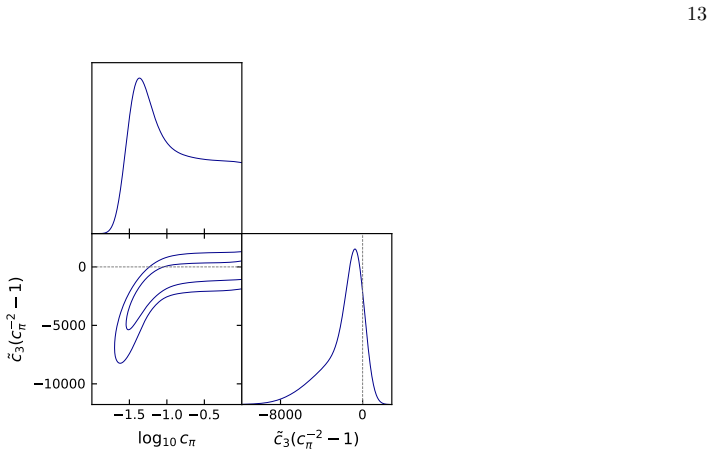
No Mixing(ρ= 0) For ρ = 0, π and σ decouple, thus (5) reduces to the single-field EFT Lagrangian. In this case, non-Gaussianity is generated by the two cubic self-interactions, ( ∂µπ)2 ˙πand ˙π3, with amplitudes set by λ and ∆λ. Explicitly, the tree-level bispectrum is given by Sno ζ (x, y;cπ,˜c3) =λ(c π, cσ)S(λ) ζ (x, y;crel) + ∆λ(cπ, cσ,˜c3)S(∆λ) ζ (x, ...
-
[2]
Since the double- and triple exchange diagrams shown in Fig
Weak Mixing(ρ≪H) Next, we allow for a small mixing of the Goldstone mode with the massive scalar, σ. Since the double- and triple exchange diagrams shown in Fig. 1 require additional ˙πσmixings (each of which is suppressed by ρ/H), we focus on the single exchange diagrams arising from ( ∂µπ)2σ and ˙π2σ, whose amplitudes scale as ρκ∝ρ 2 and ρ∆κ∝ρ ∆ρ respec...
-
[3]
1), each of which can be written in terms of a 6 We defineS (ρκ) ζ ≡∂S ζ /∂(ρκ) ρ=λ=∆λ=∆κ=0, working in theρ→0 limit
Strong Mixing(ρ≳H) Finally, we consider the full tree-level bispectrum, incorporating all terms in the Lagrangian of (5) and allowing for arbitrary values of the mixing coefficient ρ.7 The combined bispectrum shape is the sum of two self-interactions, two single exchanges, two double exchanges and one triple exchange (see Fig. 1), each of which can be wri...
2000
-
[4]
A. H. Guth, Phys. Rev. D23, 347 (1981)
1981
-
[5]
A. A. Starobinsky, Phys. Lett. B91, 99 (1980)
1980
-
[6]
A. D. Linde, Phys. Lett. B108, 389 (1982)
1982
-
[7]
Albrecht and P
A. Albrecht and P. J. Steinhardt, Phys. Rev. Lett.48, 1220 (1982)
1982
-
[8]
V. F. Mukhanov and G. V. Chibisov, JETP Lett.33, 532 (1981)
1981
-
[9]
A. A. Starobinsky, Phys. Lett. B117, 175 (1982)
1982
-
[10]
R. Flauger, L. McAllister, E. Pajer, A. Westphal, and G. Xu, JCAP06, 009 (2010), arXiv:0907.2916 [hep-th]
Pith/arXiv arXiv 2010
-
[11]
R. Flauger and E. Pajer, JCAP01, 017 (2011), arXiv:1002.0833 [hep-th]
Pith/arXiv arXiv 2011
-
[12]
P. Adshead, C. Dvorkin, W. Hu, and E. A. Lim, Phys. Rev. D85, 023531 (2012), arXiv:1110.3050 [astro-ph.CO]
Pith/arXiv arXiv 2012
-
[13]
A. Ach´ ucarro, J.-O. Gong, G. A. Palma, and S. P. Patil, Phys. Rev. D87, 121301 (2013), arXiv:1211.5619 [astro-ph.CO]
Pith/arXiv arXiv 2013
-
[14]
D. Langlois, S. Renaux-Petel, D. A. Steer, and T. Tanaka, Phys. Rev. D78, 063523 (2008), arXiv:0806.0336 [hep-th]
Pith/arXiv arXiv 2008
-
[15]
L. Senatore and M. Zaldarriaga, JHEP04, 024 (2012), arXiv:1009.2093 [hep-th]
Pith/arXiv arXiv 2012
-
[16]
C. T. Byrnes and K.-Y. Choi, Adv. Astron.2010, 724525 (2010), arXiv:1002.3110 [astro-ph.CO]
Pith/arXiv arXiv 2010
- [17]
-
[18]
R. Flauger, M. Mirbabayi, L. Senatore, and E. Silverstein, JCAP10, 058 (2017), arXiv:1606.00513 [hep-th]
Pith/arXiv arXiv 2017
-
[19]
C. M. Sou, X. Tong, and Y. Wang, JHEP06, 129 (2021), arXiv:2104.08772 [hep-th]
Pith/arXiv arXiv 2021
-
[20]
J. H. Kim, S. Kumar, A. Martin, and Y. Tsai, JHEP11, 158 (2021), arXiv:2107.09061 [hep-ph]
Pith/arXiv arXiv 2021
-
[21]
N. Barnaby and Z. Huang, Phys. Rev. D80, 126018 (2009), arXiv:0909.0751 [astro-ph.CO]
Pith/arXiv arXiv 2009
-
[22]
H. Lee, D. Baumann, and G. L. Pimentel, JHEP12, 040 (2016), arXiv:1607.03735 [hep-th]. 21 1 2 3 4 5 m/H 100 101 102 103 95% bound Weak Strong /H Free 1 2 3 4 5 m/H Weak Strong Non-unitarty 2 | /H| + free , , 1 2 3 4 5 m/H Weak Strong Non-unitarty | | + free c , c3 1 2 3 4 5 m/H Weak Strong Non-unitarty | /H| + free c 1 2 3 4 5 m/H -2 0 2 X/ (X) /H Free 1 ...
Pith/arXiv arXiv 2016
-
[23]
Cosmological Collider Physics,
N. Arkani-Hamed and J. Maldacena, “Cosmological Collider Physics,” (2015), arXiv:1503.08043 [hep-th]
Pith/arXiv arXiv 2015
-
[24]
A. Berera, Phys. Rev. Lett.75, 3218 (1995), arXiv:astro-ph/9509049
Pith/arXiv arXiv 1995
-
[25]
D. Lopez Nacir, R. A. Porto, L. Senatore, and M. Zaldarriaga, JHEP01, 075 (2012), arXiv:1109.4192 [hep-th]
Pith/arXiv arXiv 2012
-
[26]
S. A. Salcedo, T. Colas, and E. Pajer, JHEP10, 248 (2024), arXiv:2404.15416 [hep-th]
Pith/arXiv arXiv 2024
-
[27]
X. Chen, Adv. Astron.2010, 638979 (2010), arXiv:1002.1416 [astro-ph.CO]
Pith/arXiv arXiv 2010
-
[28]
X. Chen, M. H. Namjoo, and Y. Wang, JCAP02, 013 (2016), arXiv:1509.03930 [astro-ph.CO]
Pith/arXiv arXiv 2016
-
[29]
J. M. Maldacena, JHEP05, 013 (2003), arXiv:astro-ph/0210603
Pith/arXiv arXiv 2003
-
[30]
N. Bartolo, E. Komatsu, S. Matarrese, and A. Riotto, Phys. Rept.402, 103 (2004), arXiv:astro-ph/0406398
Pith/arXiv arXiv 2004
-
[31]
E. Komatsu, Class. Quant. Grav.27, 124010 (2010), arXiv:1003.6097 [astro-ph.CO]. 22 2 0 2 log10 0.8 0.6 0.4 0.2 log10 c 1.5 1.0 0.5 log10 c 2 0 2 c3(c 2 1) (scaled) 2 0 2 (scaled) 2 0 2 (scaled) 2 0 2 (scaled) 2 0 2 (scaled) 2 0 2 (scaled) 2 0 2 (scaled) 2 0 2 c3(c 2 1) (scaled) 1.5 1.0 0.5 log10 c 0.9 0.5 0.1 log10 c m = 0.2H m = 5.2H Prior FIG. 12.Joint...
Pith/arXiv arXiv 2010
-
[32]
M. Liguori, E. Sefusatti, J. R. Fergusson, and E. P. S. Shellard, Adv. Astron.2010, 980523 (2010), arXiv:1001.4707 [astro-ph.CO]
Pith/arXiv arXiv 2010
-
[33]
P. D. Meerburget al., Bull. Am. Astron. Soc.51, 107 (2019), arXiv:1903.04409 [astro-ph.CO]
Pith/arXiv arXiv 2019
- [34]
-
[35]
D. H. Lyth and D. Wands, Phys. Lett. B524, 5 (2002), arXiv:hep-ph/0110002
Pith/arXiv arXiv 2002
-
[36]
G. Dvali, A. Gruzinov, and M. Zaldarriaga, Phys. Rev. D69, 023505 (2004), arXiv:astro-ph/0303591
Pith/arXiv arXiv 2004
-
[37]
N. Bartolo, S. Matarrese, and A. Riotto, Phys. Rev. D69, 043503 (2004), arXiv:hep-ph/0309033. 23
Pith/arXiv arXiv 2004
-
[38]
M. Sasaki, J. Valiviita, and D. Wands, Phys. Rev. D74, 103003 (2006), arXiv:astro-ph/0607627
Pith/arXiv arXiv 2006
-
[39]
T. Suyama and M. Yamaguchi, Phys. Rev. D77, 023505 (2008), arXiv:0709.2545 [astro-ph]
Pith/arXiv arXiv 2008
-
[40]
P. Creminelli, A. Nicolis, L. Senatore, M. Tegmark, and M. Zaldarriaga, JCAP05, 004 (2006), arXiv:astro-ph/0509029
Pith/arXiv arXiv 2006
-
[41]
E. Komatsu, D. N. Spergel, and B. D. Wandelt, Astrophys. J.634, 14 (2005), arXiv:astro-ph/0305189
Pith/arXiv arXiv 2005
-
[42]
L. Senatore, K. M. Smith, and M. Zaldarriaga, JCAP01, 028 (2010), arXiv:0905.3746 [astro-ph.CO]
Pith/arXiv arXiv 2010
-
[43]
O. H. E. Philcox, Phys. Rev. D111, 123534 (2025), arXiv:2502.06931 [astro-ph.CO]
Pith/arXiv arXiv 2025
-
[44]
O. H. E. Philcox, S. Kumar, and J. C. Hill, Phys. Rev. D111, 103523 (2025), arXiv:2405.03738 [astro-ph.CO]
Pith/arXiv arXiv 2025
-
[45]
L. H. A. El-Haj, O. H. E. Philcox, and J. C. Hill, Phys. Rev. D113, 103518 (2026), arXiv:2509.23123 [astro-ph.CO]
Pith/arXiv arXiv 2026
-
[46]
Optimal Trispectrum Estimators and WMAP Constraints,
J. R. Fergusson, D. M. Regan, and E. P. S. Shellard, “Optimal Trispectrum Estimators and WMAP Constraints,” (2010), arXiv:1012.6039 [astro-ph.CO]
Pith/arXiv arXiv 2010
-
[47]
O. H. E. Philcox, (2026), arXiv:2603.17004 [astro-ph.CO]
Pith/arXiv arXiv 2026
-
[48]
Planck Collaboration, P. A. R. Ade, N. Aghanim, C. Armitage-Caplan, M. Arnaud, M. Ashdown, F. Atrio-Barandela, J. Aumont, C. Baccigalupi, A. J. Banday,et al., A&A571, A24 (2014), arXiv:1303.5084 [astro-ph.CO]
Pith/arXiv arXiv 2014
-
[49]
P. A. R. Adeet al.(Planck), Astron. Astrophys.594, A17 (2016), arXiv:1502.01592 [astro-ph.CO]
Pith/arXiv arXiv 2016
-
[50]
Y. Akramiet al.(Planck), Astron. Astrophys.641, A9 (2020), arXiv:1905.05697 [astro-ph.CO]
Pith/arXiv arXiv 2020
-
[51]
W. Sohn, D.-G. Wang, J. R. Fergusson, and E. P. S. Shellard, JCAP09, 016 (2024), arXiv:2404.07203 [astro-ph.CO]
Pith/arXiv arXiv 2024
-
[52]
G. Jung, M. Citran, B. van Tent, L. Dumilly, and N. Aghanim, Astron. Astrophys.702, A204 (2025), arXiv:2504.00884 [astro-ph.CO]
arXiv 2025
-
[53]
Primordial non-Gaussianity constraints on dissipative inflation,
S. A. Salcedo, T. Colas, P. Suman, B. Zhang, J. Fergusson, and E. P. S. Shellard, “Primordial non-Gaussianity constraints on dissipative inflation,” (2026), arXiv:2603.13473 [astro-ph.CO]
arXiv 2026
-
[54]
How Significant are Cosmological Collider Signals in the Planck Data?
P. Suman, D.-G. Wang, W. Sohn, J. R. Fergusson, and E. P. S. Shellard, “How Significant are Cosmological Collider Signals in the Planck Data?” (2025), arXiv:2511.17500 [astro-ph.CO]
arXiv 2025
-
[55]
P. Suman, D.-G. Wang, W. Sohn, J. R. Fergusson, and E. P. S. Shellard, “Searching for Cosmological Collider in the Planck CMB Data II: collider templates and Modal analysis,” (2025), arXiv:2512.22085 [astro-ph.CO]
arXiv 2025
-
[56]
Cosmological Collider Searches beyond the Hubble Scale with Planck Data,
S. Kumar, Q. Lu, Z.-Z. Xianyu, and Y. Zhang, “Cosmological Collider Searches beyond the Hubble Scale with Planck Data,” (2026), arXiv:2603.15728 [hep-ph]
arXiv 2026
-
[57]
S. Kumar, Q. Lu, Z.-Z. Xianyu, and Y. Zhang, (2026), arXiv:2604.07434 [hep-ph]
Pith/arXiv arXiv 2026
-
[58]
O. H. E. Philcox, K. Zhong, and S. S. Sirletti, (2025), arXiv:2511.19179 [astro-ph.CO]
arXiv 2025
-
[59]
O. H. E. Philcox, G. L. Pimentel, and C. Yang, (2026), arXiv:2603.13486 [astro-ph.CO]
arXiv 2026
-
[60]
G. Cabass, M. M. Ivanov, O. H. E. Philcox, M. Simonovi´ c, and M. Zaldarriaga, Phys. Rev. Lett.129, 021301 (2022), arXiv:2201.07238 [astro-ph.CO]
Pith/arXiv arXiv 2022
-
[61]
G. Cabass, M. M. Ivanov, O. H. E. Philcox, M. Simonovi´ c, and M. Zaldarriaga, Phys. Rev. D106, 043506 (2022), arXiv:2204.01781 [astro-ph.CO]
Pith/arXiv arXiv 2022
-
[62]
G. D’Amico, M. Lewandowski, L. Senatore, and P. Zhang, (2022), arXiv:2201.11518 [astro-ph.CO]
Pith/arXiv arXiv 2022
-
[63]
D. Green, Y. Guo, J. Han, and B. Wallisch, JCAP05, 090 (2024), arXiv:2311.04882 [astro-ph.CO]
Pith/arXiv arXiv 2024
-
[64]
G. Cabass, O. H. E. Philcox, M. M. Ivanov, K. Akitsu, S.-F. Chen, M. Simonovi´ c, and M. Zaldarriaga, Phys. Rev. D111, 063510 (2025), arXiv:2404.01894 [astro-ph.CO]
Pith/arXiv arXiv 2025
-
[65]
A. Chudaykin, M. M. Ivanov, and O. H. E. Philcox, Phys. Rev. D113, 063552 (2026), arXiv:2512.04266 [astro-ph.CO]
arXiv 2026
- [66]
-
[67]
Chaussidonet al., JCAP06, 029 (2025), arXiv:2411.17623 [astro-ph.CO]
E. Chaussidonet al., JCAP06, 029 (2025), arXiv:2411.17623 [astro-ph.CO]
Pith/arXiv arXiv 2025
-
[68]
C. Cheung, P. Creminelli, A. L. Fitzpatrick, J. Kaplan, and L. Senatore, JHEP03, 014 (2008), arXiv:0709.0293 [hep-th]
Pith/arXiv arXiv 2008
-
[69]
S. Weinberg, Phys. Rev. D77, 123541 (2008), arXiv:0804.4291 [hep-th]
Pith/arXiv arXiv 2008
-
[70]
X. Chen and Y. Wang, Phys. Rev. D81, 063511 (2010), arXiv:0909.0496 [astro-ph.CO]
Pith/arXiv arXiv 2010
-
[71]
D. Baumann and D. Green, Phys. Rev. D85, 103520 (2012), arXiv:1109.0292 [hep-th]
Pith/arXiv arXiv 2012
-
[72]
V. Assassi, D. Baumann, and D. Green, JCAP11, 047 (2012), arXiv:1204.4207 [hep-th]
Pith/arXiv arXiv 2012
-
[73]
T. Noumi, M. Yamaguchi, and D. Yokoyama, JHEP06, 051 (2013), arXiv:1211.1624 [hep-th]
Pith/arXiv arXiv 2013
- [74]
- [75]
-
[76]
D. Green, M. Lewandowski, L. Senatore, E. Silverstein, and M. Zaldarriaga, JHEP10, 171 (2013), arXiv:1301.2630 [hep-th]
Pith/arXiv arXiv 2013
-
[77]
E. Sefusatti, J. R. Fergusson, X. Chen, and E. P. S. Shellard, JCAP08, 033 (2012), arXiv:1204.6318 [astro-ph.CO]
Pith/arXiv arXiv 2012
-
[78]
J.-O. Gong, S. Pi, and M. Sasaki, JCAP11, 043 (2013), arXiv:1306.3691 [hep-th]
Pith/arXiv arXiv 2013
-
[79]
X. Chen, Y. Wang, and Z.-Z. Xianyu, (2016), arXiv:1612.08122
Pith/arXiv arXiv 2016
-
[80]
N. Arkani-Hamed, D. Baumann, H. Lee, and G. L. Pimentel, JHEP04, 105 (2020), arXiv:1811.00024 [hep-th]
Pith/arXiv arXiv 2020
discussion (0)
Sign in with ORCID, Apple, or X to comment. Anyone can read and Pith papers without signing in.