Laplace Space for Cosmological Correlators
Reviewed by Pith T0 review T1 audit T2 compute T3 formal T4 kernel 2026-06-26 02:21 UTCgrok-4.3pith:LJSNKMCUrecord.jsonopen to challenge →
The pith
A Laplace transform resolves each cosmological mode into a superposition of flat-space plane waves, allowing cosmological correlators to be computed via flat-space integrals against geometry-encoding kernels.
A machine-rendered reading of the paper's core claim, the machinery that carries it, and where it could break.
Core claim
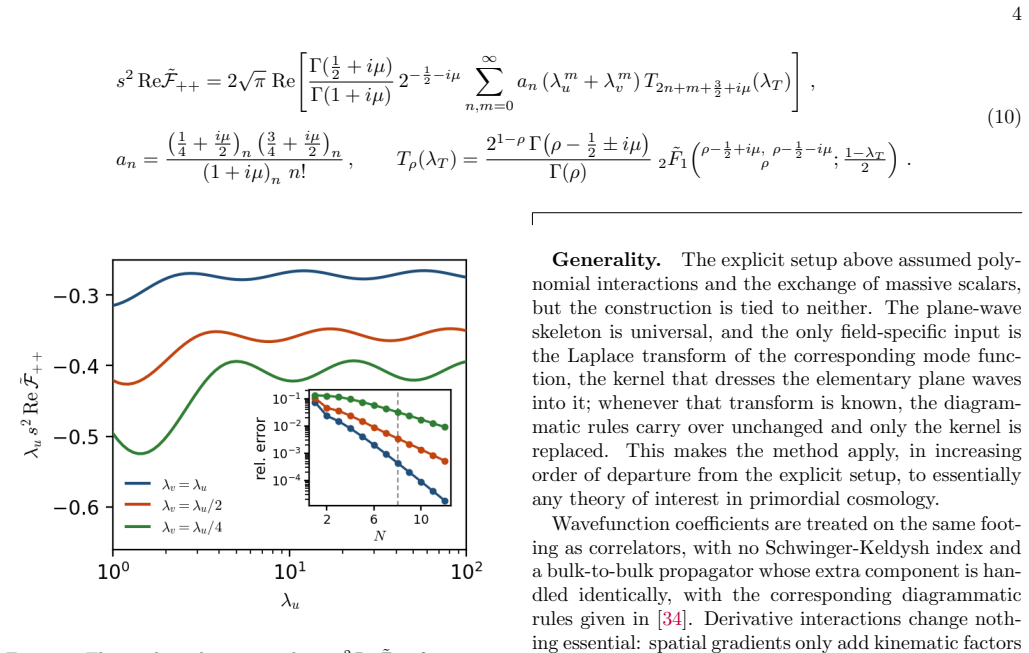
The Laplace transform provides an integral representation for cosmological modes that encodes the spacetime geometry, field content and dynamics in kernels, collapsing time integrals onto flat-space ones and supplying diagrammatic rules that map cosmological correlator diagrams to flat-space counterparts integrated against Laplace-space kernels. On the massive single exchange this yields a closed-form single rapidly convergent series valid throughout the kinematic domain that makes the energy singularities manifest.
What carries the argument
The Laplace transform that resolves each curved-space mode into a superposition of plane waves dressed by a kernel encoding the spacetime geometry, field content and dynamics.
If this is right
- Cosmological correlator diagrams reduce to flat-space ones integrated against Laplace kernels.
- Energy singularities appear manifestly in the integral representation for massive single exchange.
- The result for massive single exchange is a single series valid in the entire kinematic domain without needing patched expansions.
- The approach applies to virtually any theory of the early universe.
Where Pith is reading between the lines
- This mapping could allow reuse of existing flat-space QFT techniques for cosmological calculations.
- Similar transform methods might simplify computations in other spacetime backgrounds.
- Explicit series forms could enable analytic studies of correlator properties like analytic continuation.
Load-bearing premise
Deep inside the horizon, every cosmological mode oscillates exactly as a flat-space plane wave.
What would settle it
A numerical evaluation of the massive single exchange correlator using the derived series in a kinematic regime previously requiring multiple expansions, compared against an independent method such as direct numerical integration of the time integrals.
Figures
read the original abstract
Deep inside the horizon, every cosmological mode oscillates as a flat-space plane wave. A Laplace transform turns this fact into a general method: it resolves each curved-space mode into a superposition of plane waves dressed by a kernel that encodes the spacetime geometry, field content and dynamics, collapsing the time integrals onto flat-space ones. This provides simple diagrammatic rules that turn cosmological correlator diagrams into their flat-space counterparts integrated against Laplace-space kernels. On the paradigmatic massive single exchange, this integral representation makes the energy singularities manifest and evaluates in closed form as a single, rapidly convergent series valid throughout the kinematic domain, with no patching of separate expansions. The Laplace approach sheds conceptual and computational light on cosmological correlators in virtually any theory of the early universe.
Editorial analysis
A structured set of objections, weighed in public.
Referee Report
Summary. The paper claims that a Laplace transform applied to cosmological modes (which oscillate exactly as flat-space plane waves deep inside the horizon) resolves each mode into a superposition of plane waves dressed by geometry/field kernels. This maps cosmological correlator diagrams to flat-space counterparts integrated against Laplace kernels, yielding simple diagrammatic rules. For the massive single-exchange diagram, the representation makes energy singularities manifest and evaluates to a single rapidly convergent series valid throughout the kinematic domain without patching separate expansions.
Significance. If the central construction holds, the method offers a unified computational framework for cosmological correlators that avoids regime-specific expansions and directly exposes singularities, with potential applicability across early-universe models. The claimed single-series evaluation for the paradigmatic diagram would be a concrete technical advance.
major comments (1)
- [Abstract] Abstract (opening sentence and central claim): the premise that 'deep inside the horizon, every cosmological mode oscillates as a flat-space plane wave' is used to collapse all time integrals onto exact flat-space ones and to obtain the claimed closed-form series. The manuscript provides no error estimate, regime of validity, or derivation showing that WKB/large-k corrections remain controlled and do not propagate into the energy singularities or series coefficients; this premise is load-bearing for the integral representation and the 'no patching' claim.
Simulated Author's Rebuttal
We thank the referee for their careful reading of the manuscript and for highlighting this important point regarding the central premise. We respond to the major comment below.
read point-by-point responses
-
Referee: [Abstract] Abstract (opening sentence and central claim): the premise that 'deep inside the horizon, every cosmological mode oscillates as a flat-space plane wave' is used to collapse all time integrals onto exact flat-space ones and to obtain the claimed closed-form series. The manuscript provides no error estimate, regime of validity, or derivation showing that WKB/large-k corrections remain controlled and do not propagate into the energy singularities or series coefficients; this premise is load-bearing for the integral representation and the 'no patching' claim.
Authors: We agree that the manuscript would be strengthened by an explicit derivation of the error estimates and regime of validity for the plane-wave approximation. The Laplace representation is constructed from the exact mode functions, with the flat-space identification entering through the leading WKB behavior at large k. We will add a dedicated appendix deriving the O(1/k) and higher WKB corrections, demonstrating that they are suppressed by the exponential decay of the Laplace kernel and do not shift the locations of the energy singularities or modify the coefficients of the convergent series. This will also make the domain of validity for the single-series representation fully explicit. revision: yes
Circularity Check
No circularity: Laplace method applies external premise to flat-space integrals
full rationale
The derivation begins from the stated physical premise that sub-horizon modes oscillate exactly as flat-space plane waves, applies the Laplace transform to produce kernels and diagrammatic rules, and obtains the single convergent series for the massive single-exchange diagram by integrating the resulting flat-space expressions. This premise is an input from cosmology rather than a result derived inside the paper; the output series and singularities are generated by the transform acting on external flat-space quantities. No self-definitional reduction, fitted parameter renamed as prediction, or load-bearing self-citation chain appears in the provided claims. The method remains self-contained against the external flat-space benchmark.
Axiom & Free-Parameter Ledger
axioms (1)
- domain assumption Deep inside the horizon, every cosmological mode oscillates as a flat-space plane wave.
Forward citations
Cited by 1 Pith paper
-
Cosmological Correlators in KLF and the Double-Exchange
The double-exchange cosmological correlator is computed in KLF space, yielding a double series over hypergeometric functions that improves on prior four-layer representations.
Reference graph
Works this paper leans on
-
[1]
Inflation: Theory and Observations
A. Ach´ ucarroet al., Inflation: Theory and Observations, (2022), arXiv:2203.08128 [astro-ph.CO]
work page Pith review arXiv 2022
-
[2]
The Cosmological Bootstrap: Inflationary Correlators from Symmetries and Singularities
N. Arkani-Hamed, D. Baumann, H. Lee, and G. L. Pi- mentel, The Cosmological Bootstrap: Inflationary Corre- lators from Symmetries and Singularities, JHEP04, 105, arXiv:1811.00024 [hep-th]
-
[3]
The Cosmological Bootstrap: Weight-Shifting Operators and Scalar Seeds
D. Baumann, C. Duaso Pueyo, A. Joyce, H. Lee, and G. L. Pimentel, The cosmological bootstrap: weight- shifting operators and scalar seeds, JHEP12, 204, arXiv:1910.14051 [hep-th]
work page Pith review arXiv 1910
-
[4]
The Cosmological Bootstrap: Spinning Correlators from Symmetries and Factorization
D. Baumann, C. Duaso Pueyo, A. Joyce, H. Lee, and G. L. Pimentel, The Cosmological Bootstrap: Spinning Correlators from Symmetries and Factorization, SciPost Phys.11, 071 (2021), arXiv:2005.04234 [hep-th]
work page Pith review arXiv 2021
-
[5]
Building a Boostless Bootstrap for the Bispectrum
E. Pajer, Building a Boostless Bootstrap for the Bispec- trum, JCAP01, 023, arXiv:2010.12818 [hep-th]
work page Pith review arXiv 2010
-
[6]
Cosmological Bootstrap in Slow Motion
S. Jazayeri and S. Renaux-Petel, Cosmological bootstrap in slow motion, JHEP12, 137, arXiv:2205.10340 [hep- th]
-
[7]
Bootstrapping Inflationary Correlators in Mellin Space
C. Sleight and M. Taronna, Bootstrapping Inflation- ary Correlators in Mellin Space, JHEP02, 098, arXiv:1907.01143 [hep-th]
work page Pith review arXiv 1907
-
[8]
A Mellin Space Approach to Cosmological Correlators
C. Sleight, A Mellin Space Approach to Cosmological Correlators, JHEP01, 090, arXiv:1906.12302 [hep-th]
work page Pith review arXiv 1906
-
[9]
Helical Inflation Correlators: Partial Mellin-Barnes and Bootstrap Equations
Z. Qin and Z.-Z. Xianyu, Helical inflation correlators: partial Mellin-Barnes and bootstrap equations, JHEP 04, 059, arXiv:2208.13790 [hep-th]
-
[10]
The Cosmological Optical Theorem
H. Goodhew, S. Jazayeri, and E. Pajer, The Cosmological Optical Theorem, JCAP04, 021, arXiv:2009.02898 [hep- th]
work page Pith review arXiv 2009
-
[11]
From Locality and Unitarity to Cosmological Correlators
S. Jazayeri, E. Pajer, and D. Stefanyszyn, From locality and unitarity to cosmological correlators, JHEP10, 065, arXiv:2103.08649 [hep-th]
-
[12]
S. Melville and E. Pajer, Cosmological Cutting Rules, JHEP05, 249, arXiv:2103.09832 [hep-th]
work page internal anchor Pith review Pith/arXiv arXiv
-
[13]
Towards the non-perturbative cosmological bootstrap
M. Hogervorst, J. Penedones, and K. S. Vaziri, Towards the non-perturbative cosmological bootstrap, JHEP02, 162, arXiv:2107.13871 [hep-th]
-
[14]
The K¨ all´ en-Lehmann representation in de Sitter spacetime,
M. Loparco, J. Penedones, K. Salehi Vaziri, and Z. Sun, The K¨ all´ en-Lehmann representation in de Sitter space- time, JHEP12, 159, arXiv:2306.00090 [hep-th]
-
[15]
Z.-Z. Xianyu and H. Zhang, Bootstrapping one-loop infla- tion correlators with the spectral decomposition, JHEP 04, 103, arXiv:2211.03810 [hep-th]
-
[16]
Inflation Correlators with Multiple Massive Exchanges
Z.-Z. Xianyu and J. Zang, Inflation correlators with mul- tiple massive exchanges, JHEP03, 070, arXiv:2309.10849 [hep-th]
-
[17]
Massive Inflationary Amplitudes: Differential Equations and Complete Solutions for General Trees
H. Liu and Z.-Z. Xianyu, Massive inflationary ampli- tudes: differential equations and complete solutions for general trees, JHEP09, 183, arXiv:2412.07843 [hep-th]
-
[18]
Differential Equations for Cosmological Correlators
N. Arkani-Hamed, D. Baumann, A. Hillman, A. Joyce, H. Lee, and G. L. Pimentel, Differential equations for cos- mological correlators, JHEP09, 009, arXiv:2312.05303 [hep-th]
-
[19]
Kinematic Flow and the Emergence of Time
N. Arkani-Hamed, D. Baumann, A. Hillman, A. Joyce, H. Lee, and G. L. Pimentel, Kinematic Flow and the Emergence of Time, Phys. Rev. Lett.135, 031602 (2025), arXiv:2312.05300 [hep-th]
work page Pith review arXiv 2025
-
[20]
A de Sitter S-matrix from amputated cosmological correlators
S. Melville and G. L. Pimentel, A de Sitter S-matrix from amputated cosmological correlators, JHEP08, 211, arXiv:2404.05712 [hep-th]. 6
-
[21]
Spectral Representation of Cosmological Correlators
D. Werth, Spectral representation of cosmological corre- lators, JHEP12, 017, arXiv:2409.02072 [hep-th]
-
[22]
M. Arundine, D. Baumann, M. H. G. Lee, G. L. Pimentel, and F. Rost, The Cosmological Grassmannian, (2026), arXiv:2602.07117 [hep-th]
work page internal anchor Pith review Pith/arXiv arXiv 2026
-
[23]
N. Belrhali, A. Poisson, S. Renaux-Petel, and D. Werth, De Sitter Momentum Space, (2026), arXiv:2601.15228 [hep-th]
work page internal anchor Pith review Pith/arXiv arXiv 2026
-
[24]
Kontorovich-Lebedev-Fourier Space for de Sitter Correlators
N. Belrhali, A. Poisson, S. Renaux-Petel, and D. Werth, Kontorovich-Lebedev-Fourier Space for de Sitter Corre- lators, (2026), arXiv:2604.15251 [hep-th]
work page internal anchor Pith review Pith/arXiv arXiv 2026
- [25]
- [26]
-
[27]
C. Chowdhury, A. Lipstein, J. Mei, I. Sachs, and P. Van- hove, The subtle simplicity of cosmological correlators, JHEP03, 007, arXiv:2312.13803 [hep-th]
-
[28]
C. Chowdhury, A. Lipstein, J. Marshall, J. Mei, and I. Sachs, Cosmological dressing rules, JHEP03, 076, arXiv:2503.10598 [hep-th]
-
[29]
C. Chowdhury, S. Jazayeri, A. Lipstein, J. Mar- shall, J. Mei, and I. Sachs, Cosmological Correlator Discontinuities from Scattering Amplitudes, (2026), arXiv:2602.03841 [hep-th]
- [30]
- [31]
-
[32]
Cosmological Cutting Rules from Flat-Space Unitarity via Dressing
A. Ansari, S. Jain, and D. Mazumdar, Cosmological Cutting Rules from Flat-Space Unitarity via Dressing, (2026), arXiv:2601.08917 [hep-th]
work page internal anchor Pith review Pith/arXiv arXiv 2026
-
[33]
Unitarity, Recursion and Soft Limits in (EA)dS through Dressing
A. Ansari, D. Mazumdar, and B. Thakkar, Unitarity, Recursion and Soft Limits in (EA)dS through Dressing, (2026), arXiv:2606.05289 [hep-th]
work page internal anchor Pith review Pith/arXiv arXiv 2026
-
[34]
Belrhali, A
N. Belrhali, A. Poisson, and S. Renaux-Petel, Massive Cosmological Correlators from Flat Space: a Laplace- Space Approach, (2026), arXiv:2606.XXXXX [hep-th]
2026
-
[35]
Weinberg, Quantum contributions to cosmological cor- relations, Phys
S. Weinberg, Quantum contributions to cosmological cor- relations, Phys. Rev. D72, 043514 (2005), arXiv:hep- th/0506236
-
[36]
X. Chen, Y. Wang, and Z.-Z. Xianyu, Schwinger-Keldysh Diagrammatics for Primordial Perturbations, JCAP12, 006, arXiv:1703.10166 [hep-th]
work page internal anchor Pith review Pith/arXiv arXiv
-
[37]
J. M. Maldacena and G. L. Pimentel, On gravi- ton non-Gaussianities during inflation, JHEP09, 045, arXiv:1104.2846 [hep-th]
work page internal anchor Pith review Pith/arXiv arXiv
-
[38]
New Recursion Relations and a Flat Space Limit for AdS/CFT Correlators
S. Raju, New Recursion Relations and a Flat Space Limit for AdS/CFT Correlators, Phys. Rev. D85, 126009 (2012), arXiv:1201.6449 [hep-th]
work page internal anchor Pith review Pith/arXiv arXiv 2012
-
[39]
Quasi-Single Field Inflation and Non-Gaussianities
X. Chen and Y. Wang, Quasi-Single Field Inflation and Non-Gaussianities, JCAP04, 027, arXiv:0911.3380 [hep- th]
work page internal anchor Pith review Pith/arXiv arXiv
-
[40]
Large non-Gaussianities with Intermediate Shapes from Quasi-Single Field Inflation
X. Chen and Y. Wang, Large non-Gaussianities with Intermediate Shapes from Quasi-Single Field Inflation, Phys. Rev. D81, 063511 (2010), arXiv:0909.0496 [astro- ph.CO]
work page internal anchor Pith review Pith/arXiv arXiv 2010
-
[41]
Effective field theory approach to quasi-single field inflation and effects of heavy fields
T. Noumi, M. Yamaguchi, and D. Yokoyama, Effective field theory approach to quasi-single field inflation and effects of heavy fields, JHEP06, 051, arXiv:1211.1624 [hep-th]
work page internal anchor Pith review Pith/arXiv arXiv
-
[42]
N. Arkani-Hamed and J. Maldacena, Cosmological Col- lider Physics, (2015), arXiv:1503.08043 [hep-th]
work page internal anchor Pith review Pith/arXiv arXiv 2015
discussion (0)
Sign in with ORCID, Apple, or X to comment. Anyone can read and Pith papers without signing in.