REVIEW 2 major objections 6 minor 1 cited by
Rapid mixing of long-range Lindbladians forces polynomial decay of mutual and conditional mutual information in their fixed points.
Reviewed by Pith at T0; open to challenge. T0 means a machine referee read the full paper against a public rubric. the ladder, T0–T4 →
T0 review · grok-4.5
2026-07-12 11:33 UTC pith:6D2T64R7
load-bearing objection Solid dynamical-to-static theorems for long-range open systems; the RM/FF hypotheses are load-bearing but honestly flagged, and the proofs hold under them. the 2 major comments →
Static features from mixing in short- and long-range Lindbladians: Markov property and correlations
The pith
A machine-rendered reading of the paper's core claim, the machinery that carries it, and where it could break.
Core claim
Local Lindbladians that are globally rapidly mixing and frustration-free have fixed points obeying a global Markov property: the conditional mutual information I(A:C|B) is bounded by a polynomial in the subsystem sizes times a power of the interaction F-function evaluated at the shielding distance R. For power-law interactions this becomes a pure polynomial decay once α is large enough. Independently, local rapid mixing plus primitivity and regularity imply global decay of mutual information, and Gibbs states of k-local long-range non-commuting Hamiltonians satisfy a local Markov property at every inverse temperature.
What carries the argument
A recovery map built from the finite-time evolution of a truncated Lindbladian (or of the CKG Gibbs sampler for thermal states). Rapid mixing supplies exponential convergence of the global dynamics to the fixed point; Lieb–Robinson bounds convert that into a spatially localized recovery error that decays with the buffer width R, which the Fawzi–Renner inequality then turns into a bound on conditional mutual information.
Load-bearing premise
The Lindbladian is assumed to mix globally and rapidly (or locally and rapidly), a dynamical hypothesis that is taken as given rather than proved for the systems under study and that forces polynomial prefactors in system size.
What would settle it
Compute the CMI of the fixed point of an explicitly constructed long-range, rapidly mixing, frustration-free Lindbladian (for example a long-range Davies or CKG generator known to mix) and check whether the observed decay rate with buffer size matches or violates the predicted power of α.
Editorial analysis
A structured set of objections, weighed in public.
Referee Report
Summary. The paper shows that dynamical properties of Lindbladians imply static information-theoretic features of their fixed points, with emphasis on long-range interactions. Under global rapid mixing and frustration-freeness, fixed points of k-local Lindbladians satisfy a global Markov property: the CMI decays as a polynomial in |A|,|C| times a power of the F-function of the shielding distance R (Theorem 3.3 / informal 1.1); for power-law F_α this is polynomial decay once α exceeds a threshold set by the mixing rate and Lieb–Robinson velocity (Corollary 3.4). Independently, local rapid mixing plus primitivity and regularity yield global decay of mutual information without frustration-freeness (Theorem 3.8). The authors further extend the Chen–Rouzé local Markov property to Gibbs states of k-local long-range non-commuting Hamiltonians at all temperatures, via a quasi-local CKG recovery map and long-range imaginary-time and real-time Lieb–Robinson bounds (Theorem 4.6). Numerical exact diagonalization of the classical and transverse-field long-range Ising chains illustrates polynomial CMI decay in regimes consistent with the analytic bounds.
Significance. If the theorems hold as stated, the work supplies a clean dynamical-to-static dictionary for mixed-state phase criteria (Markov length / CMI and MI) that is especially useful for long-range platforms (Rydberg arrays, trapped ions, dipolar gases) where exponential clustering is not expected. The CMI result under rapid mixing plus frustration-freeness, the global MI decay under weaker hypotheses, and the all-temperature local Markov property for long-range non-commuting Gibbs states are concrete advances beyond short-range and commuting settings. Strengths include explicit recovery-map constructions, careful long-range boundary-term splitting (Theorems 3.5–3.7), and transparent α-thresholds collected in Table 1.1. The authors themselves flag non-optimality of the thresholds and the open status of removing frustration-freeness, which is appropriate. The numerics, though small, give a concrete classical example of polynomial CMI decay.
major comments (2)
- [Theorem 3.3, Definition 2.8] Theorem 3.3 and Definition 2.8: the CMI bound relies on global rapid mixing RM(n,λ), which supplies a prefactor p(|Λ|) and, after |B|∼ R^D, an R^{nD} factor that is square-rooted into the final CMI estimate. Global RM is vacuous in the thermodynamic limit and is a strictly stronger hypothesis than the local RM used for MI (Theorem 3.8). The manuscript should state more sharply for which finite-volume scalings (e.g. |Λ| poly in R, or fixed |Λ| with R growing) the “global Markov property” claim is intended, and whether a local-RM route to CMI under frustration-freeness is expected or blocked.
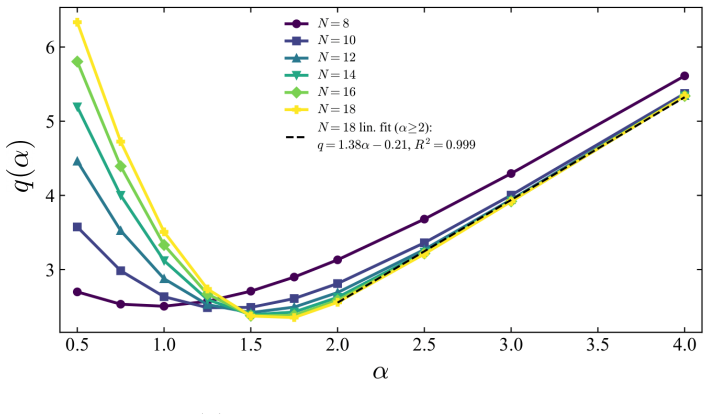
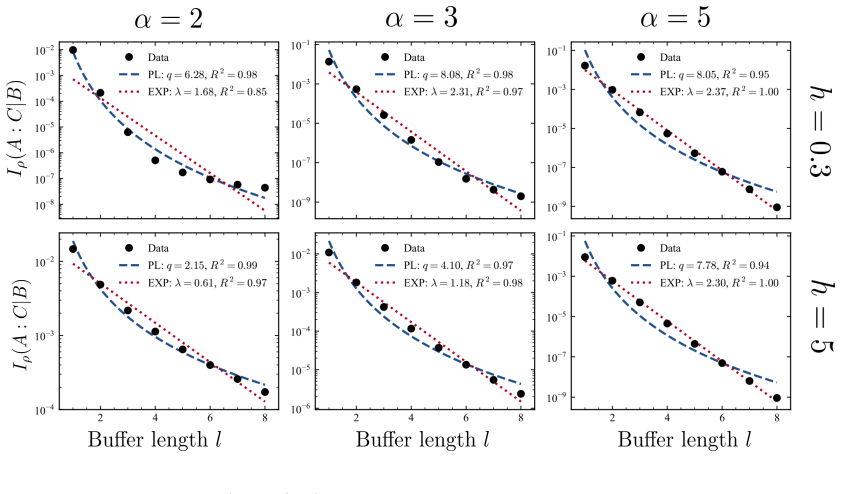
- [Section 4.4.2, Figure 4.2, Abstract] Section 4.4.2 and Figure 4.2: for the long-range TFIM at N=10 the maximum buffer is R_max=8, and the text itself notes that power-law versus exponential fits cannot be distinguished quantitatively. The abstract and conclusions nevertheless state that regimes of polynomial CMI decay are found “in accordance with the bounds proven.” That claim is well-supported for the classical Ising chain (Sec. 4.4.1) but overstated for the quantum TFIM data; the wording should be restricted to the classical case or qualified as qualitative only.
minor comments (6)
- [Table 1.1] Table 1.1 is very useful; consider adding a column that records whether frustration-freeness is required, so the contrast between the CMI and MI rows is immediate.
- [Theorem 3.7, Eqs. 3.57–3.58] In the proof of Theorem 3.7, the condition α>3D−1 arises from needing F_{α−2D+1} to be an F-function for the convolution step (around Eqs. 3.57–3.58). A short remark pointing to this step would help readers who only consult the informal statements.
- [Lemma 4.1] Lemma 4.1 / Appendix A.1: the temperature threshold β_max=1/(8guk) is stated clearly, but a one-line comparison with the short-range threshold of Chen–Rouzé would orient the reader.
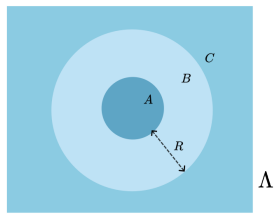
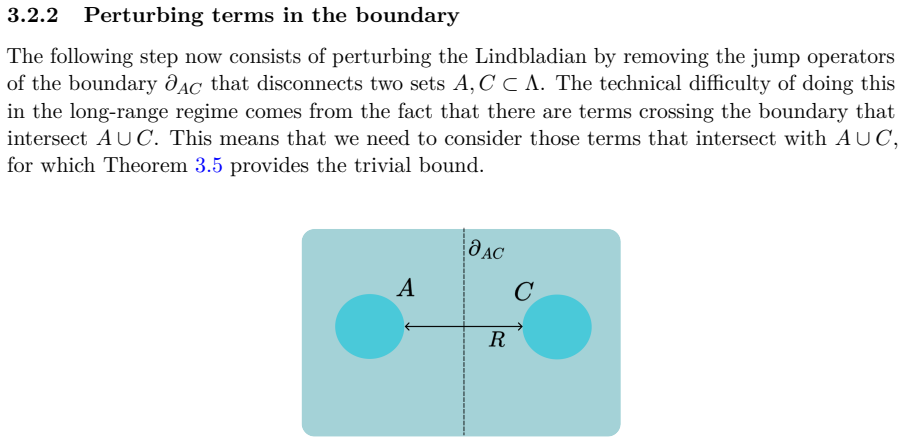
- [Figures 1.1, 3.1] Figure 1.1 and Figure 3.1: the geometry of the tripartition and of ∂AC is clear, but labeling R=d(A,C) on the figures themselves would reduce cross-referencing.
- [Throughout] Minor typos: “I is introduced” (p. 13, after Def. 2.7); “appplied” (Lemma 3.2 statement); “Duhamell’s” (Eq. 3.36); “Additionaly” (p. 6). Standard copy-edit pass will catch these.
- [Section 1.2, Table 1.2] References: the comparison table (Table 1.2) is helpful; ensuring that the most recent concurrent works on long-range thermalization and CMI (if any appeared after the arXiv posting) are noted in the final version would strengthen the related-work section.
Circularity Check
No significant circularity: CMI/MI bounds are conditional implications from stated dynamical hypotheses (RM, FF, primitivity) via standard recovery maps and LR estimates; numerics are post-hoc illustrations only.
full rationale
The central claims (Theorems 3.3/3.8/4.6 and informal 1.1–1.4) are one-directional implications: global/local rapid mixing + frustration-freeness/primitivity/regularity imply polynomial (or local) decay of CMI/MI for fixed points, and the same for long-range Gibbs states via an adapted CKG recovery map. The proofs construct an explicit recovery map (time-averaged or truncated evolution), control its locality error with long-range Lieb–Robinson bounds (Thms 2.7–2.9, Lems 3.1–3.2, A.3–A.4), and convert the resulting 1-norm error into CMI/MI via Fawzi–Renner and Hiai–Ohya–Tsukada; none of these steps redefine the target quantities in terms of themselves or fit free parameters to the claimed decay. Numerical q(α) fits in Sec. 4.4 are measured from exact diagonalization of the classical/long-range TFIM and are never fed back into the theorems. Self-citations (e.g. to prior mixing/MLSI or CKG work by overlapping authors) supply background tools or known high-T rapid-mixing regimes; they are not load-bearing uniqueness theorems that force the present statements. The α thresholds and polynomial prefactors are method artefacts that the authors themselves flag as non-optimal (Conclusions, open problems 1 and 3). The derivation is therefore self-contained under its explicit hypotheses and exhibits no circular reduction.
Axiom & Free-Parameter Ledger
free parameters (1)
- numerical inverse temperature β and transverse field h in §4.4
axioms (9)
- domain assumption Global rapid mixing RM(n,λ): η(T_t^Λ) ≤ p(|Λ|) e^{-λt} (Def. 2.8)
- domain assumption Local rapid mixing LRM(λ) (Def. 2.9)
- domain assumption Frustration-freeness: L_Z^*(σ)=0 for every local term and every fixed point σ (Def. 2.10)
- domain assumption Primitivity and regularity of the Lindbladian (Defs. 2.11–2.12)
- domain assumption Doubly-anchored interactions governed by an F-function with finite ||L||_F and C_F (Defs. 2.2–2.3)
- standard math Open-system and long-range Lieb–Robinson bounds (Theorems 2.7–2.9, after Nachtergaele et al., Hastings–Koma, Kuwahara–Saito)
- standard math Fawzi–Renner bound relating CMI to recovery fidelity (Prop. 2.5)
- domain assumption CKG Lindbladian has the Gibbs state as fixed point and is quasi-local for long-range H (Chen–Kastoryano–Gilyén; Lemmas 4.4–4.5)
- ad hoc to paper Imaginary-time LR bound with temperature threshold β_max = 1/(8 g u k) for long-range H (Lemma 4.1)
Cite this review
Pith. "Pith review of Static features from mixing in short- and long-range Lindbladians: Markov property and correlations." pith.science (2026). https://pith.science/paper/6D2T64R7
@misc{pith2026260628054,
  author       = {Pith},
  title        = {Pith review of: Static features from mixing in short- and long-range Lindbladians: Markov property and correlations},
  year         = {2026},
  howpublished = {\url{https://pith.science/paper/6D2T64R7}},
  note         = {Machine review of arXiv:2606.28054}
}
read the original abstract
The classification of mixed-state phases requires criteria beyond two-point correlation functions, such as the decay of the mutual information (MI) and the conditional mutual information (CMI), with the latter encapsulated in the notion of Markov length. Here we show how such static properties of the fixed point of a Lindbladian follow from natural dynamical features of its generators: rapid mixing and frustration-freeness. We focus on systems with long-range interactions, and prove (i) that local Lindbladians satisfying (global) rapid mixing and frustration-freeness have fixed-points whose CMI decays with the shielding distance, and (ii) that (local) rapid mixing together with primitivity and regularity implies global decay of MI. For long-range interactions decaying with a power law with rate $\alpha$, both quantities decay polynomially rather than exponentially, in contrast to the finite- and short-range regimes where exponential decay (a finite Markov length) is expected within a phase. We further show that Gibbs states of long-range, non-commuting Hamiltonians satisfy a local Markov property at any temperatures, extending the recent results (Chen--Rouz\'e, 2025) for short-range systems to the long-range regime relevant to a variety of experimental platforms. As a numerical example, we study the long-range Ising model both with and without a transverse field. We find regimes in which the polynomial decay of the CMI holds, in accordance with the bounds proven.
Figures
Forward citations
Cited by 1 Pith paper
-
When quantum thermal states look classical
Long-range Pauli Gibbs states lose entanglement, magic, and infinite-temperature analyticity at distinct constant inverse temperatures Θ(1/sk), Θ(log(1/ε)/sk), and Θ(1/s√k), with matching classical algorithms.
Reference graph
Works this paper leans on
-
[1]
Hastings, M. B. & Koma, T. Spectral Gap and Exponential Decay of Correlations. en. Communications in Mathematical Physics265.arXiv:math-ph/0507008, 781–804.issn: 0010-3616, 1432-0916.http://arxiv.org/abs/math-ph/0507008(2026) (Aug. 2006)
Pith/arXiv arXiv 2026
-
[2]
& Sims, R
Nachtergaele, B. & Sims, R. Lieb-Robinson bounds and the exponential clustering theorem.Communications in Mathematical Physics265,119–130 (2006)
2006
-
[3]
Cramer, M., Eisert, J., Plenio, M. B. & Dreißig, J. Entanglement-area law for general bosonic harmonic lattice systems.Physical Review A73.issn: 1094-1622. http://dx. doi.org/10.1103/PhysRevA.73.012309(Jan. 2006)
-
[4]
Hastings, M. B. An area law for one-dimensional quantum systems.Journal of Statistical Mechanics: Theory and Experiment2007,P08024 (2007)
2007
-
[5]
& Vazirani, U.An area law and sub-exponential algorithm for 1D systems2013
Arad, I., Kitaev, A., Landau, Z. & Vazirani, U.An area law and sub-exponential algorithm for 1D systems2013. arXiv: 1301.1162 [quant-ph]. https://arxiv.org/abs/1301. 1162
-
[6]
Anshu, A., Arad, I. & Gosset, D.An area law for 2d frustration-free spin systemsin Proceedings of the 54th Annual ACM SIGACT Symposium on Theory of Computing (ACM, 2022), 12–18.http://dx.doi.org/10.1145/3519935.3519962
-
[7]
Bao, Y., Fan, R., Vishwanath, A. & Altman, E. Mixed-state topological order and the errorfield double formulation of decoherence-induced transitions. arXiv:2301.05687 [quant-ph](2023)
Pith/arXiv arXiv 2023
-
[8]
Y., Jian, C.-M
Lee, J. Y., Jian, C.-M. & Xu, C. Quantum Criticality Under Decoherence or Weak Measurement.PRX Quantum4.issn: 2691-3399. http : / / dx . doi . org / 10 . 1103 / PRXQuantum.4.030317(Aug. 2023)
2023
-
[9]
& Vishwanath, A
Fan, R., Bao, Y., Altman, E. & Vishwanath, A. Diagnostics of mixed-state topological order and breakdown of quantum memory.PRX Quantum5,020343 (2024)
2024
-
[10]
Chen, Y.-H. & Grover, T. Separability Transitions in Topological States Induced by Local Decoherence.Physical Review Letters132.issn: 1079-7114. http://dx.doi.org/ 10.1103/PhysRevLett.132.170602(Apr. 2024)
-
[11]
Sang, S., Zou, Y. & Hsieh, T. H.Mixed-state Quantum Phases: Renormalization and Quantum Error Correction2026. arXiv:2310.08639 [quant-ph]. https://arxiv.org/ abs/2310.08639
-
[12]
Wang, Z., Fan, R., Wang, T., Garratt, S. J. & Altman, E.Fractional quantum Hall states under density decoherence2025. arXiv:2510.08490 [cond-mat.str-el]. https: //arxiv.org/abs/2510.08490
-
[13]
Buča, B. & Prosen, T. A note on symmetry reductions of the Lindblad equation: transport in constrained open spin chains.New Journal of Physics14,073007.issn: 1367-2630. http://dx.doi.org/10.1088/1367-2630/14/7/073007(2012)
-
[14]
http://dx.doi.org/10.1103/PhysRevLett
Lieu, S.et al.Symmetry Breaking and Error Correction in Open Quantum Systems.Phys- ical Review Letters125.issn: 1079-7114. http://dx.doi.org/10.1103/PhysRevLett. 125.240405(Dec. 2020)
-
[15]
De Groot, C., Turzillo, A. & Schuch, N. Symmetry Protected Topological Order in Open Quantum Systems.Quantum6,856.issn: 2521-327X. http://dx.doi.org/10.22331/q- 2022-11-10-856(Nov. 2022)
doi:10.22331/q- 2022
-
[16]
Sala, P., Gopalakrishnan, S., Oshikawa, M. & You, Y. Spontaneous strong symmetry breaking in open systems: Purification perspective.Phys. Rev. B110,155150. https: //link.aps.org/doi/10.1103/PhysRevB.110.155150(15 Oct. 2024). 43
-
[17]
Ma, R., Zhang, J.-H., Bi, Z., Cheng, M. & Wang, C. Topological Phases with Average Symmetries: The Decohered, the Disordered, and the Intrinsic.Physical Review X15. issn: 2160-3308.http://dx.doi.org/10.1103/PhysRevX.15.021062(May 2025)
-
[18]
Lessa, L. A.et al.Strong-to-Weak Spontaneous Symmetry Breaking in Mixed Quantum States.PRX Quantum6.issn: 2691-3399. http://dx.doi.org/10.1103/PRXQuantum. 6.010344(Mar. 2025)
-
[19]
arXiv:2606.02555 [quant-ph].https://arxiv.org/abs/2606.02555
Wang, C.Strong-to-Weak Spontaneous Symmetry Breaking2026. arXiv:2606.02555 [quant-ph].https://arxiv.org/abs/2606.02555
-
[20]
Dennis, E., Kitaev, A., Landahl, A. & Preskill, J. Topological quantum memory.Journal of Mathematical Physics43,4452–4505. arXiv:quant-ph/0110143(2002)
Pith/arXiv arXiv 2002
-
[21]
& Hsieh, T
Sang, S., Zou, Y. & Hsieh, T. H. Mixed-State Quantum Phases: Renormalization and Quantum Error Correction.Phys. Rev. X14,031044. https://link.aps.org/doi/10. 1103/PhysRevX.14.031044(3 Sept. 2024)
2024
-
[22]
Observation of Strong-to-Weak Spontaneous Symmetry Breaking in a Dephased Fermi Gas2026
Wang, S.et al. Observation of Strong-to-Weak Spontaneous Symmetry Breaking in a Dephased Fermi Gas2026. arXiv:2604.16137 [cond-mat.quant-gas]. https://arxiv. org/abs/2604.16137
-
[23]
Zhang, Y., Hsieh, T. H., Kim, Y. B. & Zou, Y.Probing mixed-state phases on a quantum computer via Renyi correlators and variational decoding2025. arXiv: 2505 . 02900 [quant-ph].https://arxiv.org/abs/2505.02900
-
[24]
Coser, A. & Perez-Garcia, D. Classification of phases for mixed states via fast dissipative evolution. en.Quantum3.arXiv:1810.05092 [quant-ph], 174.issn: 2521-327X. http: //arxiv.org/abs/1810.05092(2025) (Aug. 2019)
Pith/arXiv arXiv 2025
-
[25]
Rakovszky, T., Gopalakrishnan, S. & Von Keyserlingk, C. Defining Stable Phases of Open Quantum Systems. en.Physical Review X14.Publisher: American Physical Society (APS).issn: 2160-3308. https://link.aps.org/doi/10.1103/PhysRevX.14.041031 (2025) (Nov. 2024)
-
[26]
Mixed-state phases from local reversibilityarXiv:2507.02292 [quant-ph]
Sang, S.et al. Mixed-state phases from local reversibilityarXiv:2507.02292 [quant-ph]. July 2025.http://arxiv.org/abs/2507.02292(2026)
Pith/arXiv arXiv 2025
-
[27]
Li, Z., Firanko, R. & Hsieh, T. H.A Unified Framework for Locally Stable Phases arXiv:2605.00088 [quant-ph]. Apr. 2026.http://arxiv.org/abs/2605.00088(2026)
Pith/arXiv arXiv 2026
-
[28]
& Turzillo, A
Ma, R. & Turzillo, A. Symmetry-Protected Topological Phases of Mixed States in the Doubled Space.PRX Quantum6,010348. https://link.aps.org/doi/10.1103/ PRXQuantum.6.010348(1 Mar. 2025)
2025
-
[29]
Shu, C., Zhang, K., Luo, Z.-X., You, Y. & Sun, K.Universal Dynamical Scaling of Strong-to-Weak Spontaneous Symmetry Breaking in Open Quantum Systems2026. arXiv: 2603.06363 [cond-mat.mes-hall].https://arxiv.org/abs/2603.06363
-
[30]
Weinstein, Z. Efficient Detection of Strong-to-Weak Spontaneous Symmetry Breaking via the Rényi-1 Correlator.Physical Review Letters134.issn: 1079-7114. http://dx. doi.org/10.1103/PhysRevLett.134.150405(Apr. 2025)
-
[31]
Liu, Z., Chen, L., Zhang, Y., Zhou, S. & Zhang, P. Diagnosing strong-to-weak symmetry breaking via Wightman correlators.Communications Physics8,274.issn: 2399-3650. https://doi.org/10.1038/s42005-025-02199-7(July 2025)
-
[32]
Zhang, J.-H., Qi, Y. & Bi, Z. Fidelity strange correlators for average symmetry-protected topological phases.Science Bulletin71,688–691.issn: 2095-9273. http://dx.doi.org/ 10.1016/j.scib.2025.12.041(Feb. 2026). 44
-
[33]
Groisman, B., Popescu, S. & Winter, A. Quantum, classical, and total amount of correlations in a quantum state.Physical Review A72.issn: 1094-1622. http://dx. doi.org/10.1103/PhysRevA.72.032317(2005)
-
[34]
Melko, R. G., Kallin, A. B. & Hastings, M. B. Finite-size scaling of mutual information in Monte Carlo simulations: Application to the spin-1 2 XXZ model.Phys. Rev. B82, 100409(R). https://link.aps.org/doi/10.1103/PhysRevB.82.100409 (10 Sept. 2010)
-
[35]
Scalet, S. O., Alhambra, Á. M., Styliaris, G. & Cirac, J. I. Computable Rényi mutual information: Area laws and correlations.Quantum5,541.issn: 2521-327X. http : //dx.doi.org/10.22331/q-2021-09-14-541(2021)
-
[36]
Bluhm, A., Capel, Á. & Pérez-Hernández, A. Exponential decay of mutual information for Gibbs states of local Hamiltonians.Quantum6,650.issn: 2521-327X. http://dx. doi.org/10.22331/q-2022-02-10-650(Feb. 2022)
-
[37]
Yi, J., Li, K., Liu, C., Li, Z. & Zou, L. Universal Decay of Mutual Information and Conditional Mutual Information in Gapped Pure- and Mixed-State Quantum Matter. Physical Review Letters136.issn: 1079-7114.http://dx.doi.org/10.1103/mqp8-y1m7 (Mar. 2026)
-
[38]
M., Verstraete, F., Hastings, M
Wolf, M. M., Verstraete, F., Hastings, M. B. & Cirac, J. I. Area Laws in Quantum Systems: Mutual Information and Correlations.Physical Review Letters100,070502 (2008)
2008
-
[39]
Hastings, M. B. Entropy and entanglement in quantum ground states.Phys. Rev. B76, 035114 (2007)
2007
-
[40]
Hayden, P., Leung, D., Shor, P. W. & Winter, A. Randomizing quantum states: Con- structions and applications.Commun. Math. Phys.250,371–391 (2004)
2004
-
[41]
& Renner, R
Sutter, D. & Renner, R. Necessary criterion for approximate recoverability.Ann. Henri Poincaré19,3007–3029 (2018)
2018
-
[42]
& Renner, R
Fawzi, O. & Renner, R. Quantum conditional mutual information and approximate Markov chains.Communications in Mathematical Physics340,575–611 (2015)
2015
-
[43]
& Hsieh, T
Sang, S. & Hsieh, T. H. Stability of Mixed-State Quantum Phases via Finite Markov Length.Physical Review Letters134.issn: 1079-7114. http://dx.doi.org/10.1103/ PhysRevLett.134.070403(Feb. 2025)
2025
-
[45]
& Rouzé, C.Quantum Gibbs states are locally MarkovianarXiv:2504.02208 [quant-ph]
Chen, C.-F. & Rouzé, C.Quantum Gibbs states are locally MarkovianarXiv:2504.02208 [quant-ph]. Apr. 2025.http://arxiv.org/abs/2504.02208(2025)
Pith/arXiv arXiv 2025
-
[46]
& Grover, T.Local Reversibility and Divergent Markov Length in 1+1-D Directed Percolation2026
Chen, Y.-H. & Grover, T.Local Reversibility and Divergent Markov Length in 1+1-D Directed Percolation2026. arXiv:2512.07220 [cond-mat.stat-mech]. https://arxiv. org/abs/2512.07220
-
[47]
Ma, R., Khemani, V. & Sang, S.Circuit-based characterization of finite-temperature quan- tum phases and self-correcting quantum memory2025. arXiv:2509.15204 [quant-ph]. https://arxiv.org/abs/2509.15204
-
[48]
Kuwahara, T.Clustering of conditional mutual information for quantum Gibbs states above a threshold temperature2024. arXiv:2407.05835 [quant-ph]
-
[49]
& Vazirani, U.A Structural Theory of Quantum Metasta- bility: Markov Properties and Area Laws2025
Bergamaschi, T., Chen, C.-F. & Vazirani, U.A Structural Theory of Quantum Metasta- bility: Markov Properties and Area Laws2025. arXiv:2510.08538 [quant-ph].https: //arxiv.org/abs/2510.08538. 45
-
[50]
& Kuwahara, T.On the Clustering of Conditional Mutual Information via Dissipative Dynamicsen
Kato, K. & Kuwahara, T.On the Clustering of Conditional Mutual Information via Dissipative Dynamicsen. arXiv:2504.02235 [quant-ph]. Apr. 2025.http://arxiv.org/ abs/2504.02235(2025)
arXiv 2025
-
[51]
Bakshi, A., Liu, A., Moitra, A. & Tang, E.A Dobrushin condition for quantum Markov chains: Rapid mixing and conditional mutual information at high tempera- tureen. arXiv:2510.08542 [quant-ph]. Oct. 2025.http://arxiv.org/abs/2510.08542 (2026)
arXiv 2025
-
[52]
& Brandão, F
Kato, K. & Brandão, F. G. S. L. Quantum Approximate Markov Chains are Thermal. Commun. Math. Phys.370,117–149 (2019)
2019
-
[53]
Chen, C.-F.Note on Strong Quantum Markov Properties2026. arXiv: 2605 . 02877 [quant-ph].https://arxiv.org/abs/2605.02877
-
[54]
Scalet, S. O.et al. Classical Estimation of the Free Energy and Quantum Gibbs Sampling from the Markov Entropy Decomposition2025. arXiv:2504.17405 [quant-ph]. https: //arxiv.org/abs/2504.17405
-
[55]
& Pérez-Hernández, A
Bluhm, A., Capel, Á. & Pérez-Hernández, A. Strong decay of correlations for Gibbs states in any dimension.J. Stat. Phys.192(2025)
2025
-
[56]
Gibbs states of a one dimensional quantum lattice.Communications in Mathematical Physics14,120–157 (1969)
Araki, H. Gibbs states of a one dimensional quantum lattice.Communications in Mathematical Physics14,120–157 (1969)
1969
-
[57]
M., Capel, Á., Gondolf, P., Ruiz-de-Alarcón, A
Alhambra, A. M., Capel, Á., Gondolf, P., Ruiz-de-Alarcón, A. & Scalet, S. O. Conditional Independence of 1D Gibbs States with Applications to Efficient Learning.Annales Henri Poincaré.issn: 1424-0661. http://dx.doi.org/10.1007/s00023-026-01655-6 (May 2026)
-
[58]
Kliesch,M.,Gogolin,C.,Kastoryano,M.J.,Riera,A.&Eisert,J.LocalityofTemperature. Phys. Rev. X4,031019 (2014)
2014
-
[59]
Cluster expansions&correlation functions.Mosc
Ueltschi, D. Cluster expansions&correlation functions.Mosc. Math. J.4,511–522 (2004)
2004
-
[60]
Kimura, Y. & Kuwahara, T. Clustering theorem in 1D long-range interacting sys- tems at arbitrary temperatures. en.Communications in Mathematical Physics406. arXiv:2403.11431 [quant-ph], 65.issn: 0010-3616, 1432-0916.http://arxiv.org/abs/ 2403.11431(2026) (Mar. 2025)
Pith/arXiv arXiv 2026
-
[61]
& Wessel, T.Uniform-in-temperature locality estimates for weakly interacting quantum systems2026
Adhikari, A., Henheik, J., Lemm, M. & Wessel, T.Uniform-in-temperature locality estimates for weakly interacting quantum systems2026. arXiv:2508.15907 [math-ph]. https://arxiv.org/abs/2508.15907
-
[62]
& Petruccione, F.The Theory of Open Quantum Systemsisbn: 978-0-19-852063-4 (Oxford University Press, Oxford, New York, June 2002)
Breuer, H.-P., Petruccione, F., Breuer, H.-P. & Petruccione, F.The Theory of Open Quantum Systemsisbn: 978-0-19-852063-4 (Oxford University Press, Oxford, New York, June 2002)
2002
-
[63]
A short introduction to the Lindblad master equation
Manzano, D. A short introduction to the Lindblad master equation. en.AIP Advances 10,025106.issn: 2158-3226. https://pubs.aip.org/adv/article/10/2/025106/ 1021638/A-short-introduction-to-the-Lindblad-master(2025) (Feb. 2020)
2025
-
[64]
& Lahaye, T
Browaeys, A. & Lahaye, T. Many-body physics with individually controlled Rydberg atoms.Nature Physics16,132–142 (2020)
2020
-
[65]
Foss-Feig, M., Pagano, G., Potter, A. C. & Yao, N. Y. Progress in Trapped-Ion Quantum Simulation. en.Annual Review of Condensed Matter Physics16.Publisher: Annual Reviews, 145–172.issn: 1947-5454, 1947-5462.https://www.annualreviews.org/ content / journals / 10 . 1146 / annurev - conmatphys - 032822 - 045619(2025) (Mar. 2025). 46
1947
-
[66]
Reports on Progress in Physics86,026401 (2023)
Chomaz, L.et al.Dipolar physics: a review of experiments with magnetic quantum gases. Reports on Progress in Physics86,026401 (2023)
2023
-
[67]
http://dx.doi.org/10.1103/PhysRevLett.130
Bardet, I.et al.Rapid Thermalization of Spin Chain Commuting Hamiltonians.Physical Review Letters130.issn: 1079-7114. http://dx.doi.org/10.1103/PhysRevLett.130. 060401(Feb. 2023)
-
[68]
Bardet, I.et al.Entropy Decay for Davies Semigroups of a One Dimensional Quantum Lattice.Communications in Mathematical Physics405.issn: 1432-0916. http://dx. doi.org/10.1007/s00220-023-04869-5(Feb. 2024)
-
[69]
Kochanowski, J., Alhambra, Á. M., Capel, Á. & Rouzé, C. Rapid Thermalization of Dissipative Many-Body Dynamics of Commuting Hamiltonians. en.Communications in Mathematical Physics406,176.issn: 1432-0916. https://doi.org/10.1007/s00220- 025-05353-y(2025) (July 2025)
doi:10.1007/s00220- 2025
-
[70]
& Rouzé, C
Capel, A., Gondolf, P., Kochanowski, J. & Rouzé, C. Quasi-optimal sampling from Gibbs states via non-commutative optimal transport metrics.Ann. Henri Poincaré(2025)
2025
-
[71]
Kastoryano, M. J. & Brandão, F. G. S. L. Quantum Gibbs samplers: the commuting case.Communications in Mathematical Physics344,915–957. arXiv: 1409.3435 (2016)
Pith/arXiv arXiv 2016
-
[72]
Capel, Á., Rouzé, C. & França, D. S. The modified logarithmic Sobolev inequality for quantum spin systems: classical and commuting nearest neighbour interactions. arXiv:2009.11817.https://arxiv.org/abs/2009.11817(2020)
Pith/arXiv arXiv 2009
-
[73]
& Rouzé, C
Bardet, I., Capel, Á., Lucia, A., Pérez-García, D. & Rouzé, C. On the modified logarithmic Sobolev inequality for the heat-bath dynamics for 1D systems.Journal of Mathematical Physics62,061901 (2021)
2021
-
[74]
& Chen, C.-F.Fast Mixing of Quantum Spin Chains at All Temperatures
Bergamaschi, T. & Chen, C.-F.Fast Mixing of Quantum Spin Chains at All Temperatures
-
[75]
arXiv:2510.08533 [quant-ph].https://arxiv.org/abs/2510.08533
-
[76]
Roon, E. B. & Sims, R. On quasi-locality and decay of correlations for long-range models of open quantum spin systems. en.Journal of Physics A: Mathematical and Theoretical 57.Publisher: IOP Publishing, 445206.issn: 1751-8121. https://dx.doi.org/10. 1088/1751-8121/ad8609(2025) (Oct. 2024)
2025
-
[77]
Kastoryano, M. J. & Eisert, J. Rapid mixing implies exponential decay of correlations. Journal of Mathematical Physics54,102201.issn: 0022-2488. https://doi.org/10. 1063/1.4822481(2025) (Oct. 2013)
2025
-
[78]
Brandão, F. G. S. L., Cubitt, T. S., Lucia, A., Michalakis, S. & Perez-Garcia, D. Area law for fixed points of rapidly mixing dissipative quantum systems.Journal of Mathematical Physics56,102202.issn: 0022-2488. https://doi.org/10.1063/1.4932612 (2025) (Oct. 2015)
-
[79]
Cubitt, T. S., Lucia, A., Michalakis, S. & Perez-Garcia, D. Stability of Local Quantum Dissipative Systems. en.Communications in Mathematical Physics337,1275–1315.issn: 1432-0916.https://doi.org/10.1007/s00220-015-2355-3(2025) (Aug. 2015)
-
[80]
Gleason, A. M. Measures on the Closed Subspaces of a Hilbert Space.Journal of Mathematics and Mechanics6,885–893.issn: 0095-9057. https://www.jstor.org/ stable/24900629(2026) (1957)
arXiv 2026
-
[81]
& Sudarshan, E
Gorini, V., Kossakowski, A. & Sudarshan, E. C. G. Completely Positive Dynamical Semigroups of N Level Systems.J. Math. Phys.17,821 (1976)
1976
discussion (0)
Sign in with ORCID, Apple, or X to comment. Anyone can read and Pith papers without signing in.