REVIEW 2 minor 2 cited by
Bichromatic Floquet driving with Rashba spin-orbit coupling generates giant perpendicular Edelstein polarizations in 2D altermagnets by creating an effective in-plane Zeeman-like field.
Reviewed by Pith at T0; open to challenge. T0 means a machine referee read the full paper against a public rubric. the ladder, T0–T4 →
T0 review · grok-4.3
2026-07-01 04:11 UTC pith:WKMVF7RQ
load-bearing objection Bichromatic Floquet driving plus Rashba SOC generates giant perpendicular Edelstein polarizations in 2D altermagnets by breaking C2 symmetry, where monochromatic driving is blocked by symmetry.
Giant perpendicular Edelstein polarization in 2D compensated magnets via bichromatic Floquet driving
The pith
A machine-rendered reading of the paper's core claim, the machinery that carries it, and where it could break.
Core claim
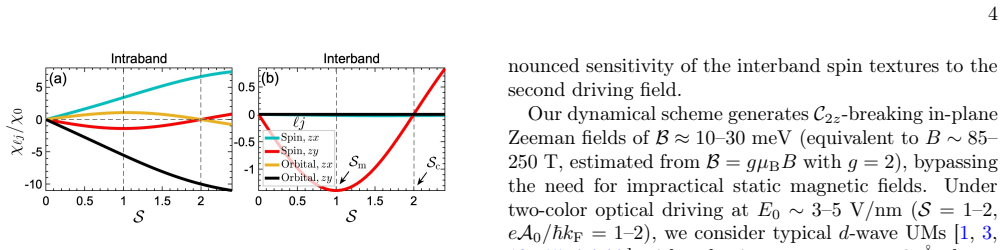
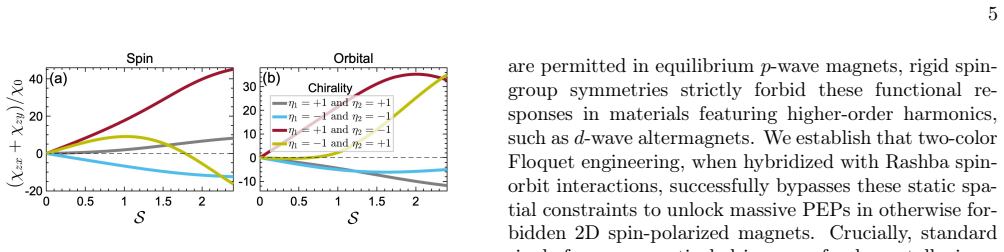
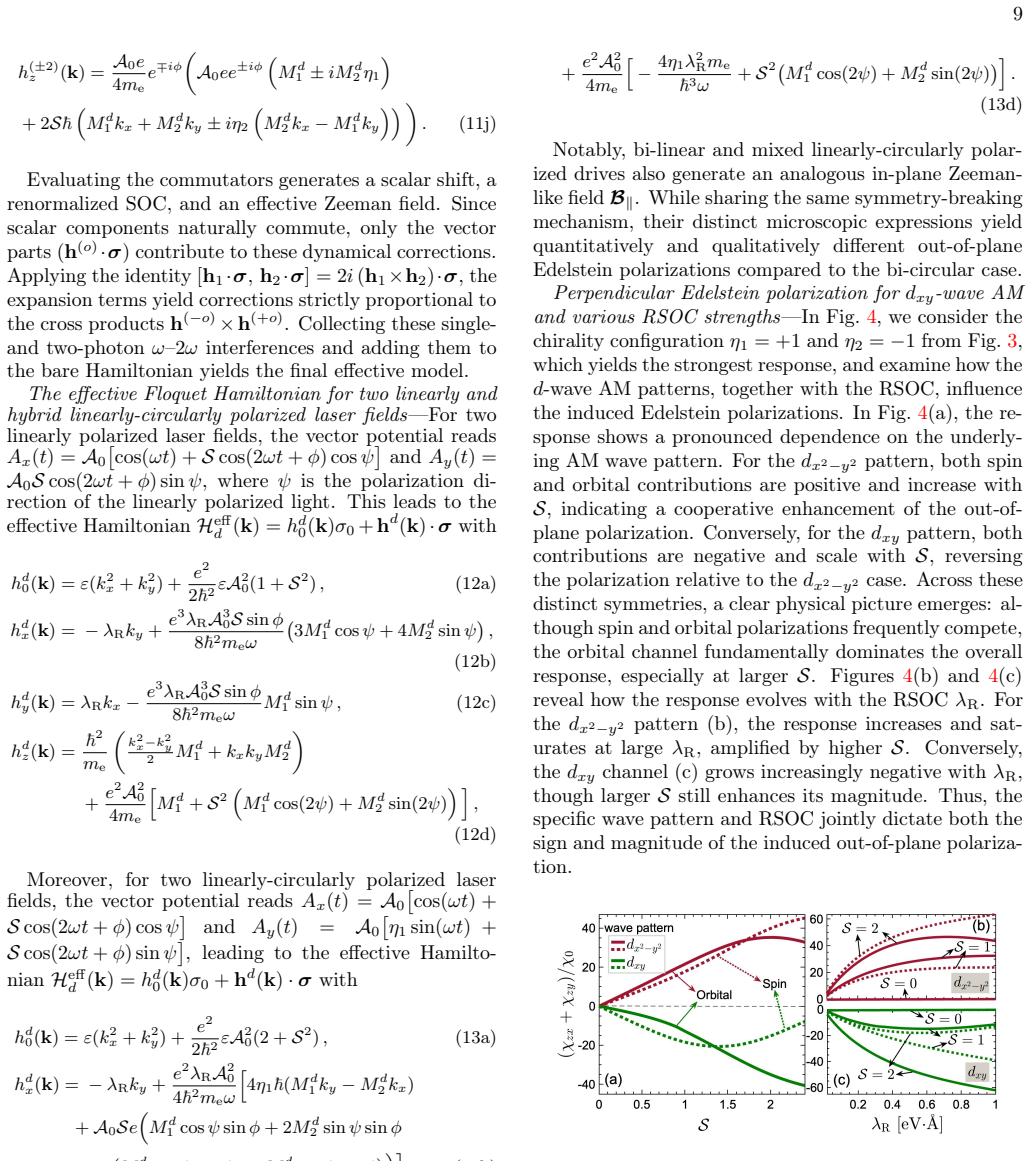
Combining Rashba spin-orbit coupling with bichromatic Floquet driving activates giant perpendicular Edelstein polarizations across 2D altermagnets and broader classes of unconventional spin-polarized magnets, a feat monochromatic driving cannot achieve. By dynamically breaking two-fold rotational symmetry, the two-frequency drive induces a stray-field-free in-plane Zeeman-like field that generates orbitally dominated PEPs of 0.5--1.5 μ_B. These emergent PEPs are governed by universal selection rules tied to the system's magnetic parity and the second beam's harmonics and provide a mechanism for perpendicular memory writing.
What carries the argument
Bichromatic Floquet driving (bilinear, bicircular, or circular-linear configurations) that dynamically breaks two-fold rotational symmetry to induce an in-plane Zeeman-like field.
Load-bearing premise
The bichromatic drive configurations break two-fold rotational symmetry in a way that produces the Zeeman-like field without introducing other effects that cancel or suppress the perpendicular polarization in the 2D system.
What would settle it
A numerical simulation or experiment on a 2D altermagnet model showing perpendicular Edelstein polarization remaining below 0.1 μ_B under any of the listed bichromatic drive configurations would falsify the central claim.
If this is right
- The induced PEPs enable stray-field-free perpendicular memory writing in compensated magnets.
- The response magnitude reaches 0.5--1.5 μ_B and is orbitally dominated.
- The effect extends to wider classes of unconventional spin-polarized magnets beyond altermagnets.
- Response strength and sign follow selection rules fixed by magnetic parity and second-beam harmonics.
Where Pith is reading between the lines
- The same symmetry-breaking principle might be tested in other 2D van der Waals magnets that host Rashba coupling.
- Dual-frequency optical control could reduce the need for external magnetic fields in spintronic devices.
- Time-resolved Kerr or Faraday measurements under two-color illumination would provide a direct experimental test.
Editorial analysis
A structured set of objections, weighed in public.
Referee Report
Summary. The manuscript claims that combining Rashba spin-orbit coupling with bichromatic Floquet driving (in bilinear, bicircular, and circular-linear configurations) dynamically breaks two-fold rotational symmetry in 2D altermagnets and related unconventional magnets, inducing a stray-field-free in-plane Zeeman-like field that generates orbitally dominated perpendicular Edelstein polarizations (PEPs) of 0.5--1.5 μ_B; this is impossible with monochromatic driving and is governed by universal selection rules based on magnetic parity and the second beam's harmonics, enabling perpendicular memory writing.
Significance. If the central symmetry-breaking mechanism and resulting PEP magnitudes hold, the work would provide a general route to activate forbidden responses in compensated magnets, with direct relevance to stray-field-free spintronic devices.
minor comments (2)
- [Abstract] Abstract: the quoted PEP range (0.5--1.5 μ_B) should be tied explicitly to the model parameters or specific lattice examples used in the calculations.
- The manuscript should clarify whether the orbitally dominated character of the PEP is shown via explicit decomposition of the response function or via orbital-projected quantities.
Simulated Author's Rebuttal
We thank the referee for the positive summary of our work and the recommendation of minor revision. No specific major comments were provided in the report.
Circularity Check
No significant circularity; derivation self-contained via symmetry and driving configurations
full rationale
The paper's central claim rests on symmetry arguments showing that bichromatic Floquet driving (bilinear, bicircular, circular-linear) plus Rashba SOC dynamically breaks C2 symmetry to induce an in-plane Zeeman-like field, yielding PEPs that monochromatic driving cannot produce. This follows directly from the two-frequency construction and magnetic parity selection rules without any reduction to fitted parameters, self-definitional loops, or load-bearing self-citations. No equations rename inputs as predictions or smuggle ansatzes via prior work by the same authors. The derivation is externally falsifiable via the stated driving configurations and remains independent of the target PEP magnitudes.
Axiom & Free-Parameter Ledger
axioms (2)
- domain assumption The presence of Rashba spin-orbit coupling in the 2D compensated magnets
- standard math Floquet theory applies to the periodic driving in the system
read the original abstract
While unconventional $p$-wave magnets can generate nonrelativistic Edelstein polarizations, spin-group symmetries strictly forbid these responses in unconventional magnets with higher-order harmonics, such as $d$-wave altermagnets. Here, we demonstrate that combining Rashba spin-orbit coupling with bichromatic Floquet driving activates giant perpendicular Edelstein polarizations (PEPs) across 2D altermagnets and broader classes of unconventional spin-polarized magnets -- a feat monochromatic driving cannot achieve. By dynamically breaking two-fold rotational symmetry, the two-frequency drive (including bilinear, bicircular, and circular-linear configurations) induces a stray-field-free in-plane Zeeman-like field that generates orbitally dominated PEPs (0.5--1.5 $\mu_{\rm B}$). This massive response is governed by universal selection rules tied to the system's magnetic parity and the second beam's harmonics. These emergent PEPs provide a powerful mechanism for perpendicular memory writing.
Figures
Forward citations
Cited by 2 Pith papers
-
Parity-selective spin splitting in coplanar antiferromagnets via bichromatic driving
In a bilayer coplanar antiferromagnet, ω–2ω bichromatic light generates odd- and mixed-parity spin splittings, while n≥3 harmonics yield only even-parity states.
-
Chirped Floquet linear drives activate forbidden charge-to-spin conversions in Rashba two-dimensional electron gases
Chirped Floquet linear drives generate in-plane Floquet-Zeeman fields and odd-parity momentum drifts that break T and C2z symmetries, activating previously forbidden Edelstein charge-to-spin channels in Rashba 2DEGs.
Reference graph
Works this paper leans on
-
[1]
L. Šmejkal, R. González-Hernández, T. Jungwirth, and J. Sinova, Crystal time-reversal symmetry breaking and spontaneousHalleffectincollinearantiferromagnets,Sci- ence Advances6, eaaz8809 (2020)
work page 2020
- [2]
-
[3]
L. Šmejkal, J. Sinova, and T. Jungwirth, Beyond conven- tional ferromagnetism and antiferromagnetism: A phase with nonrelativistic spin and crystal rotation symmetry, Phys. Rev. X12, 031042 (2022)
work page 2022
-
[4]
L. Šmejkal, J. Sinova, and T. Jungwirth, Emerging re- search landscape of altermagnetism, Phys. Rev. X12, 040501 (2022)
work page 2022
-
[5]
L. Bai, W. Feng, S. Liu, L. Šmejkal, Y. Mokrousov, and Y.Yao,Altermagnetism: Exploringnewfrontiersinmag- netism and spintronics, Advanced Functional Materials 34, 2409327 (2024)
work page 2024
-
[6]
Q. Liu, X. Dai, and S. Blügel, Different facets of uncon- ventional magnetism, Nature Physics21, 329 (2025)
work page 2025
-
[7]
J. Krempaský, L. Šmejkal, S. W. D’Souza, M. Hajlaoui, G. Springholz, K. Uhlířová, F. Alarab, P. C. Constanti- nou, V. Strocov, D. Usanov,et al., Altermagnetic lifting of Kramers spin degeneracy, Nature626, 517 (2024)
work page 2024
-
[8]
S. Lee, S. Lee, S. Jung, J. Jung, D. Kim, Y. Lee, B. Seok, J. Kim, B. G. Park, L. Šmejkal, C.-J. Kang, and C. Kim, Broken Kramers degeneracy in altermag- netic MnTe, Phys. Rev. Lett.132, 036702 (2024)
work page 2024
- [9]
-
[10]
M. Naka, S. Hayami, H. Kusunose, Y. Yanagi, Y. Mo- tome, and H. Seo, Spin current generation in organic an- tiferromagnets, Nature Communications10, 4305 (2019)
work page 2019
-
[11]
I. I. Mazin, K. Koepernik, M. D. Johannes, R. González- Hernández, and L. Šmejkal, Prediction of unconventional magnetism in doped FeSb2, Proceedings of the National Academy of Sciences118, e2108924118 (2021)
work page 2021
-
[12]
D.-F. Shao, S.-H. Zhang, M. Li, C.-B. Eom, and E. Y. Tsymbal, Spin-neutral currents for spintronics, Nature Communications12, 7061 (2021)
work page 2021
-
[13]
Z. Feng, X. Zhou, L. Šmejkal, L. Wu, Z. Zhu, H. Guo, R. González-Hernández, X. Wang, H. Yan, P. Qin,et al., An anomalous Hall effect in altermagnetic ruthenium dioxide, Nature Electronics5, 735 (2022)
work page 2022
-
[14]
R. González-Hernández, L. Šmejkal, K. Výborný, Y. Ya- hagi, J. Sinova, T. Jungwirth, and J. Železný, Ef- ficient electrical spin splitter based on nonrelativis- tic collinear antiferromagnetism, Phys. Rev. Lett.126, 127701 (2021)
work page 2021
-
[15]
H. Bai, L. Han, X. Y. Feng, Y. J. Zhou, R. X. Su, Q. Wang, L. Y. Liao, W. X. Zhu, X. Z. Chen,et al., Observation of spin splitting torque in a collinear anti- ferromagnet RuO2, Phys. Rev. Lett.128, 197202 (2022)
work page 2022
- [16]
-
[17]
V. M. Edelstein, Spin polarization of conduction elec- trons induced by electric current in two-dimensional asymmetric electron systems, Solid State Communica- tions73, 233 (1990)
work page 1990
-
[18]
Y. A. Bychkov and É. I. Rashba, Properties of a 2D elec- tron gas with lifted spectral degeneracy, Soviet Journal of Experimental and Theoretical Physics Letters39, 78 (1984)
work page 1984
-
[19]
A. Manchon, H. C. Koo, J. Nitta, S. M. Frolov, and R. A. Duine, New perspectives for Rashba spin–orbit coupling, Nature Materials14, 871 (2015)
work page 2015
-
[20]
A. Johansson, J. Henk, and I. Mertig, Theoretical aspects of the Edelstein effect for anisotropic two-dimensional electron gas and topological insulators, Phys. Rev. B93, 195440 (2016)
work page 2016
-
[21]
I. Gaiardoni, M. Trama, A. Maiellaro, C. Guarcello, F. Romeo, and R. Citro, Edelstein effect in isotropic and anisotropic Rashba models, Condensed Matter10, 10.3390/condmat10010015 (2025)
-
[22]
A. B. Hellenes, T. Jungwirth, R. Jaeschke-Ubiergo, A. Chakraborty, J. Sinova, and L. Šmejkal, P-wave mag- nets, (2024), arXiv:2309.01607
work page internal anchor Pith review Pith/arXiv arXiv 2024
-
[23]
A. Chakraborty, A. Birk Hellenes, R. Jaeschke-Ubiergo, T. Jungwirth, L. Šmejkal, and J. Sinova, Highly efficient non-relativistic Edelstein effect in nodalp-wave magnets, Nature Communications16, 7270 (2025)
work page 2025
-
[24]
N. A. A. Pari, R. Jaeschke-Ubiergo, A. Chakraborty, L. Šmejkal, and J. Sinova, Nonrelativistic linear Edel- steineffectinhelicalEuIn 2As2,Phys.Rev.B112,024404 (2025)
work page 2025
-
[25]
Q. Shao, P. Li, L. Liu, H. Yang, S. Fukami, A. Razavi, H. Wu, K. Wang, F. Freimuth, Y. Mokrousov,et al., Roadmap of spin–orbit torques, IEEE Transactions on Magnetics57, 1 (2021)
work page 2021
-
[26]
M.-G. Kang, S. Lee, and B.-G. Park, Field-free spin-orbit torques switching and its applications, npj Spintronics3, 8 (2025)
work page 2025
-
[27]
V. D. Nguyen, S. Rao, K. Wostyn, and S. Couet, Recent progress in spin-orbit torque magnetic random-access memory, npj Spintronics2, 48 (2024)
work page 2024
-
[28]
H. Wu, J. Zhang, B. Cui, S. A. Razavi, X. Che, Q. Pan, D. Wu, G. Yu, X. Han, and K. L. Wang, Field-free ap- proaches for deterministic spin-orbit torque switching of the perpendicular magnet, Materials Futures1, 022201 (2022)
work page 2022
-
[29]
A. Manchon, J. Železný, I. M. Miron, T. Jungwirth, J. Sinova, A. Thiaville, K. Garello, and P. Gambardella, Current-induced spin-orbit torques in ferromagnetic and antiferromagnetic systems, Rev. Mod. Phys.91, 035004 (2019)
work page 2019
-
[30]
M. Wang, J. Zhou, X. Xu, T. Zhang, Z. Zhu, Z. Guo, Y. Deng, M. Yang, K. Meng, B. He,etal., Field-free spin- orbit torque switching via out-of-plane spin-polarization induced by an antiferromagnetic insulator/heavy metal interface, Nature Communications14, 2871 (2023)
work page 2023
-
[31]
I.-H. Kao, R. Muzzio, H. Zhang, M. Zhu, J. Gobbo, S. Yuan, D. Weber, R. Rao, J. Li, J. H. Edgar,et al., De- terministic switching of a perpendicularly polarized mag- net using unconventional spin–orbit torques in WTe2, Nature Materials21, 1029 (2022)
work page 2022
- [32]
-
[33]
R. Fukunaga, S. Haku, H. Hayashi, and K. Ando, Orbital torque originating from orbital Hall effect in Zr, Physical Review Research5, 023054 (2023)
work page 2023
-
[34]
Y. Yang, P. Wang, J. Chen, D. Zhang, C. Pan, S. Hu, T. Wang, W. Yue, C. Chen, W. Jiang,et al., Orbital torque switching in perpendicularly magnetized materi- als, Nature Communications15, 8645 (2024)
work page 2024
-
[35]
S. Ding, M.-G. Kang, W. Legrand, and P. Gambardella, Orbital torque in rare-earth transition-metal ferrimag- 7 nets, Physical Review Letters132, 236702 (2024)
work page 2024
-
[36]
A. Fert, R. Ramesh, V. Garcia, F. Casanova, and M. Bibes, Electrical control of magnetism by electric field and current-induced torques, Rev. Mod. Phys.96, 015005 (2024)
work page 2024
- [37]
-
[38]
G. Ji, Y. Zhang, Y. Chai, and T. Nan, Recent progress on controlling spin-orbit torques by materials design, npj Spintronics2, 56 (2024)
work page 2024
-
[39]
S. Yu, J. Tang, Y. Wang, F. Xu, X. Li, and X. Wang, Recent advances in two-dimensional ferromagnetism: strain-, doping-, structural- and electric field-engineering toward spintronic applications, Science and Technology of Advanced Materials23, 140 (2022)
work page 2022
-
[40]
A. Zunger and O. I. Malyi, Understanding doping of quantum materials, Chemical Reviews121, 3031 (2021)
work page 2021
-
[41]
F. Matsukura, Y. Tokura, and H. Ohno, Control of mag- netism by electric fields, Nature Nanotechnology10, 209 (2015)
work page 2015
- [42]
-
[43]
L. E. Golub and L. Šmejkal, Spin orientation by electric current in altermagnets, (2025), arXiv:2503.12203 [cond- mat.mes-hall]
work page Pith review arXiv 2025
-
[44]
A. D. Din, D. A. Usanov, L. Šmejkal, S. W. D’Souza, F. Guo, O. J. Amin, E. M. Dawa, R. P. Campion, K. W. Edmonds, B. Kiraly, A. W. Rushforth, C. Pol- ley, M. Leandersson, E. Golias, Y. Niu, S. Telkamp, F. Krizek, A. B. Hellenes, J. Priessnitz, W. H. Cam- pos, J. Krempaský, J. Minár, T. Jungwirth, J. H. Dil, and P. Wadley, Unconventional relativistic spin ...
- [45]
-
[46]
F. Freimuth, S. Blügel, and Y. Mokrousov, Laser-induced torques in metallic antiferromagnets, Phys. Rev. B103, 174429 (2021)
work page 2021
-
[47]
A. V. Kimel and M. Li, Writing magnetic memory with ultrashort light pulses, Nature Reviews Materials4, 189 (2019)
work page 2019
-
[48]
M. Yarmohammadi, M. Berritta, M. Bukov, L. Šme- jkal, J. Linder, and P. M. Oppeneer, Spin polarization engineering ind-wave altermagnets, Phys. Rev. B113, L060403 (2026)
work page 2026
-
[49]
M. Yarmohammadi, P. M. Gunnink, J. Sinova, and J. K. Freericks, Floquet-induced anisotropic magnetore- sistance and anomalous Hall effect in 2Dd-wave al- termagnets with Rashba spin-orbit coupling, (2026), arXiv:2606.21281
work page internal anchor Pith review Pith/arXiv arXiv 2026
-
[50]
M. Yarmohammadi, P.-H. Fu, and J. K. Freericks, Effi- cient two-color floquet control of the rkky interaction in altermagnets, (2026), arXiv:2602.20862
-
[51]
Ezawa, Tunneling magnetoresistance in a junction made ofx-wave magnets withx=p, d, f, g, i, Phys
M. Ezawa, Tunneling magnetoresistance in a junction made ofx-wave magnets withx=p, d, f, g, i, Phys. Rev. B113, 155303 (2026)
work page 2026
-
[52]
Ezawa, Almost half-quantized planar Hall effects in x-wave magnets withx=p, d, f, g, i, Phys
M. Ezawa, Almost half-quantized planar Hall effects in x-wave magnets withx=p, d, f, g, i, Phys. Rev. B112, 235307 (2025)
work page 2025
-
[53]
M. Ezawa, Third-order and fifth-order nonlinear spin- current generation ing-wave andi-wave altermagnets and perfectly nonreciprocal spin current inf-wave mag- nets, Phys. Rev. B111, 125420 (2025)
work page 2025
- [54]
-
[55]
J. Mitscherling, J. Priessnitz, C. K. Geschner, and L. Šmejkal, Microscopic origin ofp-wave magnetism, (2026), arXiv:2603.09736
-
[56]
M. Sato and T. N. Ikeda, Floquet theory and applications in open quantum and classical systems, Journal of the Physical Society of Japan94, 111007 (2025)
work page 2025
- [57]
- [58]
-
[59]
M. S. Rudner and N. H. Lindner, Band structure engi- neering and non-equilibrium dynamics in Floquet topo- logical insulators, Nature Reviews Physics2, 229 (2020)
work page 2020
-
[60]
U. D. Giovannini and H. Hübener, Floquet analysis of excitations in materials, Journal of Physics: Materials3, 012001 (2019)
work page 2019
- [61]
-
[62]
Eckardt, Colloquium: Atomic quantum gases in pe- riodically driven optical lattices, Rev
A. Eckardt, Colloquium: Atomic quantum gases in pe- riodically driven optical lattices, Rev. Mod. Phys.89, 011004 (2017)
work page 2017
- [63]
-
[64]
T. Kitagawa, E. Berg, M. Rudner, and E. Demler, Topo- logical characterization of periodically driven quantum systems, Phys. Rev. B82, 235114 (2010)
work page 2010
-
[65]
M. S. Rudner, N. H. Lindner, E. Berg, and M. Levin, Anomalous edge states and the bulk-edge correspondence for periodically driven two-dimensional systems, Phys. Rev. X3, 031005 (2013)
work page 2013
-
[66]
M. Grifoni and P. Hänggi, Driven quantum tunneling, Physics Reports304, 229 (1998)
work page 1998
-
[67]
G. Platero and R. Aguado, Photon-assisted transport in semiconductor nanostructures, Physics Reports395, 1 (2004)
work page 2004
-
[68]
P.-H. Fu, S. Mondal, J.-F. Liu, and J. Cayao, Light- induced Floquet spin-triplet cooper pairs in unconven- tional magnets, SciPost Phys.20, 059 (2026)
work page 2026
-
[69]
P.-H. Fu, S. Mondal, J.-F. Liu, Y. Tanaka, and J. Cayao, Floquet engineering spin triplet states in unconventional magnets, Phys. Rev. Lett.136, 066703 (2026)
work page 2026
-
[70]
See Supplemental Material at [URL will be inserted by publisher] for providing effective Hamiltonians of 2D Rashbaℓ-wave magnets driven by two-color polarized light fields
-
[71]
A. Johansson, Theory of spin and orbital Edelstein ef- fects, Journal of Physics: Condensed Matter36, 423002 (2024)
work page 2024
-
[72]
L.Salemi, M.Berritta,andP.M.Oppeneer,Quantitative comparison of electrically induced spin and orbital po- 8 larizations in heavy-metal/3d-metal bilayers, Phys. Rev. Mater.5, 074407 (2021)
work page 2021
-
[73]
D. Xiao, J. Shi, and Q. Niu, Berry phase correction to electron density of states in solids, Phys. Rev. Lett.95, 137204 (2005)
work page 2005
- [74]
-
[75]
M. Weber, K. Leckron, L. F. Haag, R. Jaeschke-Ubiergo, L. Šmejkal, J. Sinova, and H. C. Schneider, Ultrafast elec- tron dynamics in a planard-wave altermagnet, Newton 1, 10.1016/j.newton.2025.100266 (2025)
-
[76]
H. Reichlova, R. Lopes Seeger, R. González-Hernández, I. Kounta, R. Schlitz, D. Kriegner, P. Ritzinger, M. Lam- mel, M. Leiviskä, A. Birk Hellenes,et al., Observation of a spontaneous anomalous Hall response in the Mn5Si3 d-wave altermagnet candidate, Nature Communications 15, 4961 (2024)
work page 2024
-
[77]
All optical excitation of spin polarization in d-wave altermagnets
M. Weber, S. Wust, L. Haag, A. Akashdeep, K. Leckron, C. Schmitt, R. Ramos, T. Kikkawa, E. Saitoh, M. Kläui, et al., All optical excitation of spin polarization ind-wave altermagnets, (2024), arXiv:2408.05187
work page internal anchor Pith review Pith/arXiv arXiv 2024
-
[78]
J. A. Mendoza-Rodarte, M. Cosset-Chéneau, B. J. van Wees, and M. H. D. Guimarães, Efficient magnon injec- tion and detection via the orbital Rashba-Edelstein ef- fect, Phys. Rev. Lett.132, 226704 (2024)
work page 2024
- [79]
-
[80]
S. Ding, M.-G. Kang, W. Legrand, and P. Gambardella, Orbital torque in rare-earth transition-metal ferrimag- nets, Phys. Rev. Lett.132, 236702 (2024)
work page 2024
discussion (0)
Sign in with ORCID, Apple, or X to comment. Anyone can read and Pith papers without signing in.