REVIEW 4 major objections 5 minor 1 cited by
Learning reorganizes quantum representations into measurable spectral geometry, readable by two-boson interference and Bloch-space drift.
Reviewed by Pith at T0; open to challenge. T0 means a machine referee read the full paper against a public rubric. the ladder, T0–T4 →
T0 review · grok-4.5
2026-07-12 10:06 UTC pith:7BVDQNR3
load-bearing objection Useful dual diagnostics for hybrid quantum learners, oversold as one unified geometric mechanism. the 4 major comments →
Spectral Geometry and Bosonic-Bloch Probes: Explorations in Quantum Learning
The pith
A machine-rendered reading of the paper's core claim, the machinery that carries it, and where it could break.
Core claim
Training induces spectral organization in hybrid quantum representations, and that organization is experimentally accessible: graph-regularized learning reshapes the output Laplacian (including an effective spectral-dimension increase of about +0.23) so that edge-resolved bosonic enhancement correlates with the Fiedler edge split (r = −0.50), while in a hybrid quantum autoencoder absolute Bloch drift—not consecutive drift—discriminates anomalies, establishing a unified spectral-geometric diagnostic framework using bosonic and Bloch probes.
What carries the argument
Edge-resolved two-boson enhancement ΔP_uv (bosonic minus distinguishable coincidence probability on a graph edge) together with absolute Bloch drift from the benign mean Pauli vector; both act as local probes of learning-induced partitions and manifold displacements encoded by the Laplacian spectrum and reduced single-qubit states.
Load-bearing premise
The moderate interference–Fiedler correlation on a fixed 15-node synthetic graph and the separate Bloch-drift results on intrusion data are taken to establish one shared geometric mechanism rather than two loosely analogous diagnostics.
What would settle it
On the same 15-node graph, scramble the Fiedler partition or replace the learned similarity weights with a null model that preserves degrees but destroys spectral cuts: if the reported r ≈ −0.50 between ΔP_uv and |Δv₂| collapses to noise while training still converges, the claimed link between spectral partitions and bosonic probes fails.
Editorial analysis
A structured set of objections, weighed in public.
Referee Report
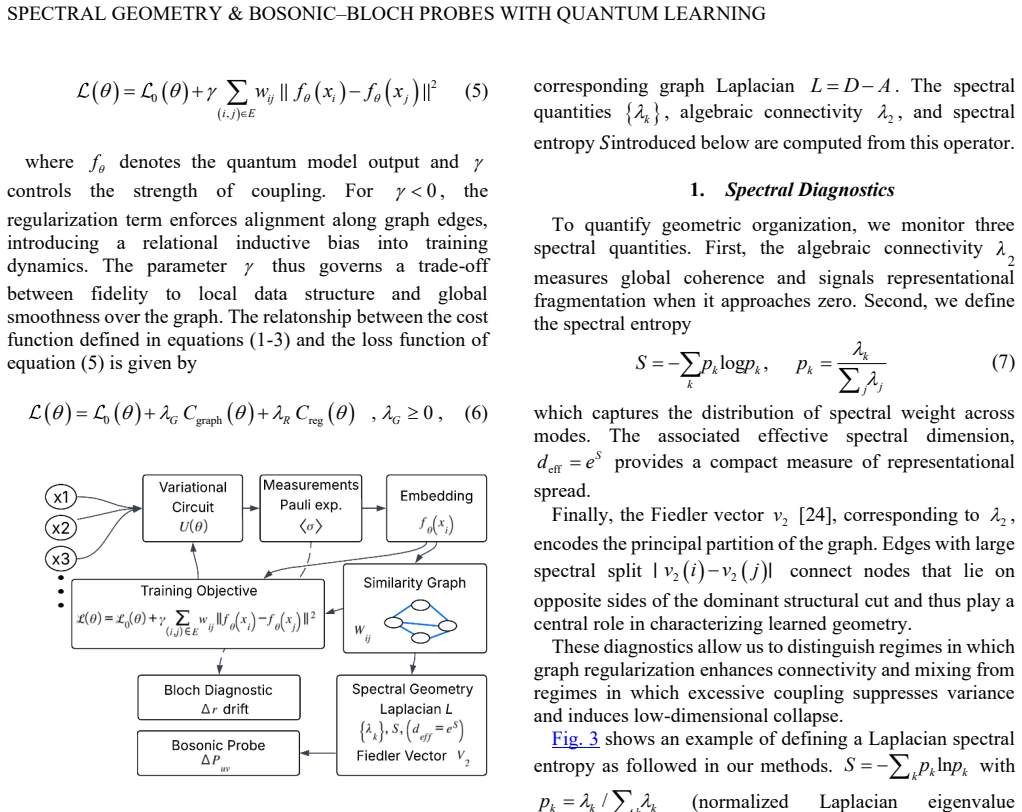
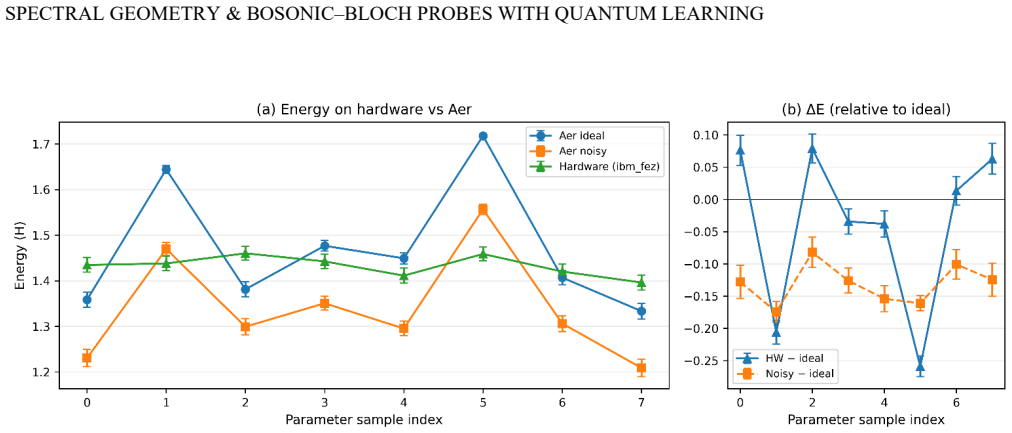
Summary. The paper claims that hybrid quantum learning induces measurable spectral geometry in representation manifolds, diagnosable by physically grounded probes. In graph-regularized quantum networks on a fixed 15-node similarity graph, training reorganizes the output Laplacian (effective spectral dimension increase ΔS ≈ +0.23, algebraic connectivity and Fiedler structure), and edge-resolved two-boson enhancement ΔP_uv correlates with the Fiedler edge split |Δv_{2}| (r = −0.50). A phase diagram in γ and noise is asserted to show non-monotonic fidelity gains from regularization only in a restricted regime, with hardware (ibm_fez) confirming interference trends within shot noise. Separately, a hybrid quantum autoencoder on CIC-IDS2018 DrDoS_SSDP flows achieves ROC-AUC ≈ 0.99 under a benign-only 95th-percentile threshold; absolute Bloch drift (from Pauli expectations relative to the benign mean) yields ROC-AUC ≳ 0.9 while consecutive drift is near-random (≈ 0.5), with QFI spectra supporting trainability. The authors interpret both settings as complementary projections of one learned quantum manifold, establishing a unified spectral–geometric diagnostic framework via bosonic and Bloch probes.
Significance. If the diagnostics hold under broader conditions, the work supplies concrete, model-agnostic observables (edge-resolved ΔP_uv and absolute vs. consecutive Bloch drift) that link spectral graph theory to multiphoton interference and reduced-state geometry, improving interpretability of hybrid QML beyond aggregate ROC metrics. Hardware validation of interference signatures and the unsupervised benign-threshold protocol are genuine strengths; the absolute/consecutive drift contrast cleanly rules out local-fluctuation explanations and is supported by QFI rank/condition diagnostics. The contribution is primarily diagnostic rather than a performance advantage (Table II shows near-identical ranking and error rates to a classical autoencoder). The claimed unification, if made rigorous, would be a useful conceptual bridge for quantum learning systems; as written it remains largely interpretive.
major comments (4)
- [§I.E, Conclusions] The central unification claim (§I.E Contributions and Conclusions) asserts that Laplacian spectral organization of the 15-node output graph and Bloch-space drift of the hybrid QAE latent states are “complementary projections of the same physical object” / “one learned quantum manifold.” Theorems 1–2 and B1–B2 formalize each setting separately; no shared quantitative map, common manifold construction, transfer experiment, or joint observable is provided that would force the two diagnostics to be instances of a single mechanism rather than two loosely analogous geometric tools. The moderate r = −0.50 correlation and the Bloch AUCs can stand independently; the “unified spectral–geometric framework” language therefore overstates what the data jointly establish and should be either demonstrated or rephrased as complementary diagnostics.
- [Theorem 2, Fig. 7] Theorem 2 and Fig. 7 report corr(ΔP_uv, |Δv_{2}|) = −0.50 on a single fixed 15-node synthetic graph and state that r is intended only to show “systematic alignment” rather than statistical inference. With one small graph, no ensemble over graph realizations or input configurations, and no null-model comparison, the claimed quantitative link between learned spectral partitions and bosonic edge enhancement remains under-supported for a load-bearing result. Robustness checks (multiple graphs, higher photon numbers, or bootstrap intervals) are needed, or the claim should be qualified as exploratory.
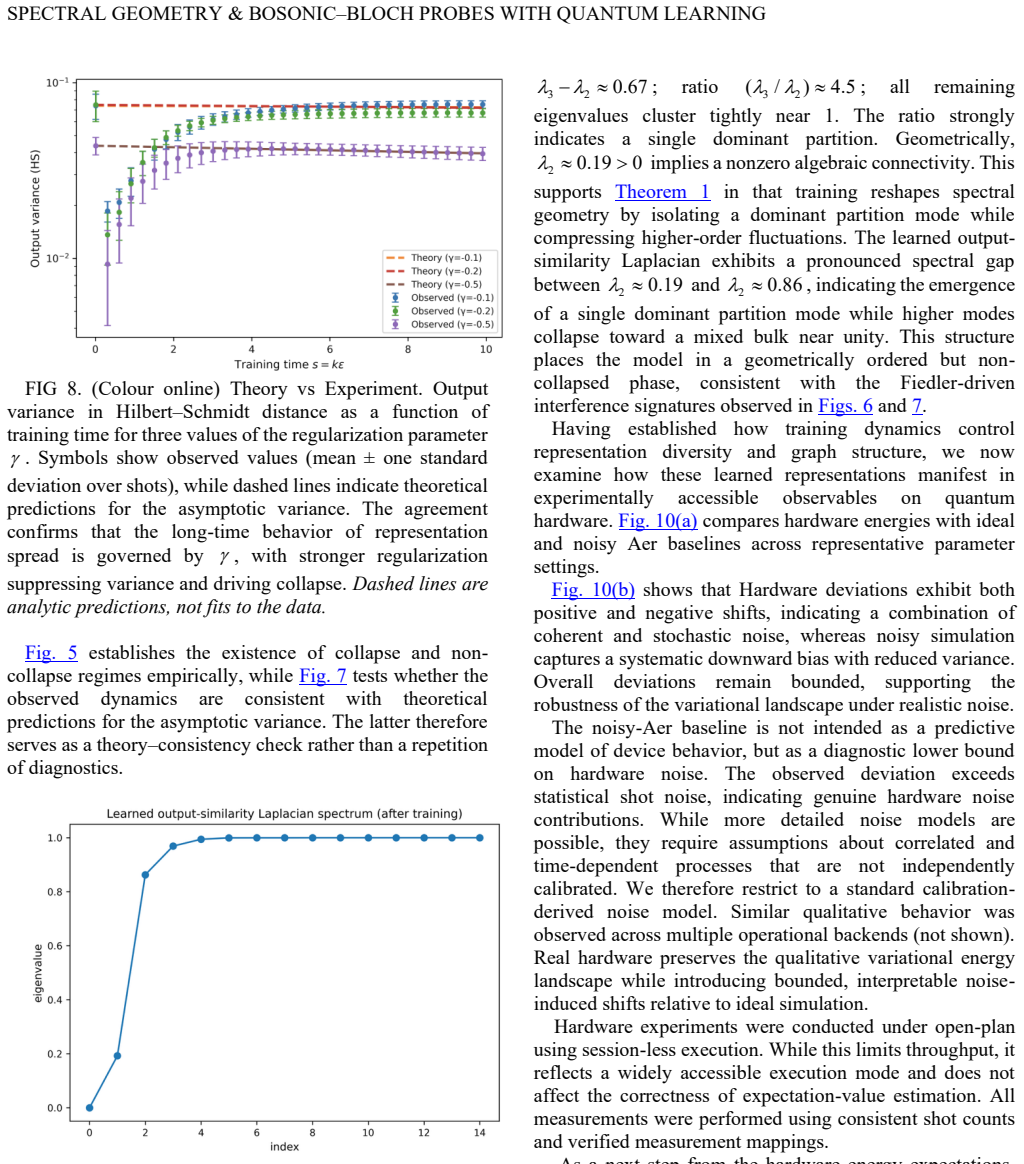
- [Abstract, §III.A] Abstract and §I assert a phase diagram with non-monotonic performance dependence on coupling γ and noise δ, graph regularization improving fidelity only in a restricted regime. The main-text figures (Fig. 6 training dynamics for two γ values; Fig. 8 variance vs. γ) show collapse vs. stable regimes but do not display a full (γ, δ) phase diagram or the corresponding fidelity surface. Either the missing panel must be supplied with quantitative boundaries or the abstract claim must be aligned with the actual figures.
- [§I.E (3), Table II] Contribution (3) and Table II state that the hybrid QAE matches classical ranking metrics while improving robustness at the operational boundary. The reported numbers are essentially identical (ROC-AUC 0.988 vs 0.987; FPR 0.057 vs 0.058; FNR both ~6 imes10^{-4}). The claimed robustness gain is therefore not visible in the tabulated metrics; either additional boundary-specific statistics (e.g., threshold-sweep stability or calibration) must be shown or the wording should be corrected to “matches classical performance while adding geometric diagnostics.”
minor comments (5)
- [§II, Appendices A–B] Several statements labeled “Theorem” / “Proposition” (Prop. 1, Thm. 1–2, A1, B1–B2) are formalized claims without self-contained proofs or clear hypotheses/assumptions in the main text; Appendix material restates rather than derives them. Either supply proofs or relabel as Propositions/Claims.
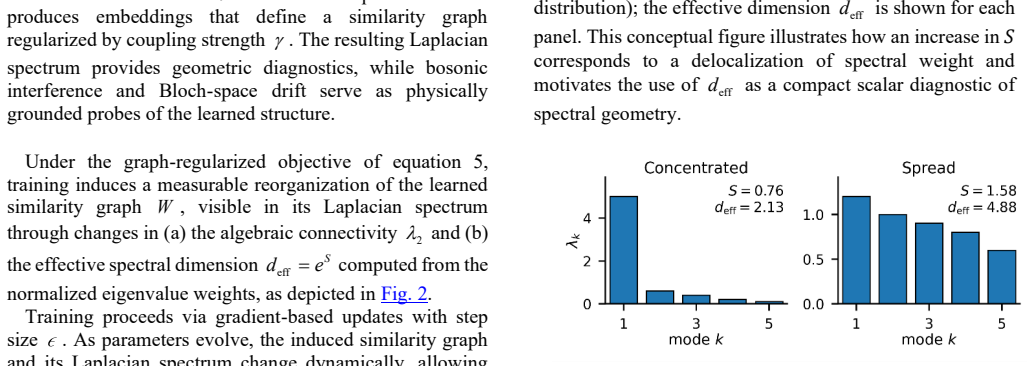
- [Abstract, Eq. (7)] Notation for spectral entropy / effective dimension is inconsistent (ΔS = +0.23 in abstract vs. S and d_eff = e^S in body). Standardize and define the precise pre/post-training difference used for ΔS.
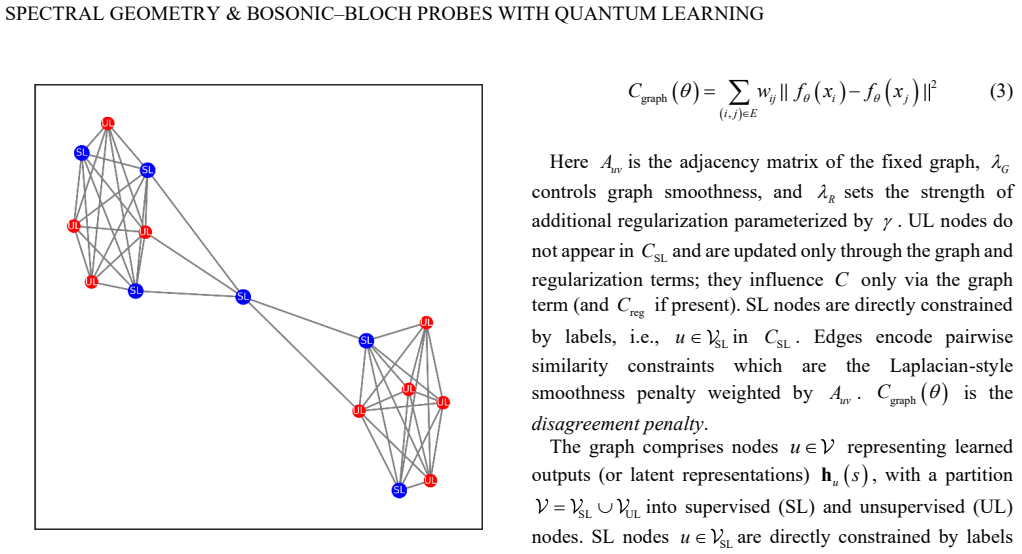
- [§II.A, Fig. 1] Fig. 1 caption and text refer to a 15-node SL/UL partition; the precise generation procedure for the synthetic similarity graph (kernel, edge weights) is only sketched. A short algorithmic box or pseudocode would aid reproducibility.
- [§II.A.6, Table I] Hardware section mixes EstimatorV2 / SamplerV2 and 2000 vs 8192 shots; clarify which primitive and shot count apply to the energy scans of Figs. 10–11.
- [Throughout] Minor typos and formatting: “relatonship”, “beningn”, duplicated sentences in §II.A, and occasional missing spaces around math. A careful copy-edit pass is needed.
Circularity Check
Mild circularity limited to a data-extracted asymptotic variance formula and a near-definitional Bloch-drift separation theorem; the core empirical correlations (r = −0.50) and ROC-AUCs remain independent measurements.
specific steps
-
fitted input called prediction
[Sec. II.A.5 / Eq. (11) and Fig. 8 caption]
"This yields a stationary variance (Var ∞(γ) = Var ∞(0)/(1 + γ/γc)) where (Var ∞(0)) and the characteristic scale γc are extracted from data. … Theoretical curves shown in the main text are evaluated using these measured prefactors and are not fits to transient dynamics."
The asymptotic plateaus that the theory is said to “predict” are fixed by parameters (Var∞(0), γc) measured from the same late-time variance data; agreement of the long-time values is therefore largely by construction, leaving only the transient approach as an independent check.
-
self definitional
[Appendix B, Theorem B2]
"Then, if attack samples satisfy E[||rq(x)−μB||2]>δ for some δ>0, absolute Bloch drift yields separability proportional to δ. Under the same stability condition, consecutive drift … does not separate classes unless instability is present."
Absolute Bloch drift is defined as d(x)=||r(x)−μB||; the theorem therefore asserts that a score equal to the displacement will separate classes that are assumed to be displaced by more than δ—i.e., the claimed geometric separation is true by the definition of the metric under the stated assumption.
full rationale
The paper’s load-bearing empirical results—the measured Laplacian restructuring (ΔS ≈ +0.23), the edge-wise correlation of bosonic enhancement ΔP_uv with Fiedler split, the hardware energy landscape, and the absolute-vs-consecutive Bloch-drift AUCs—are obtained by direct computation or experiment on constructed graphs and CIC-IDS2018 flows; they are not forced by the definitions of the observables themselves. ΔP_uv is the standard interference term 2 Re(U_us U_vt U*_ut U*_vs) relative to a distinguishable baseline, and absolute Bloch drift is the Euclidean distance of Pauli expectations from a benign mean fixed on validation data only. Reconstruction thresholds use the 95th percentile of benign scores without attack labels. The two mild circular steps identified are peripheral: (i) the stationary-variance “theory” inserts prefactors extracted from the same late-time data it is compared against, and (ii) Theorem B2 restates that a metric defined as displacement from the benign mean will separate classes that are assumed displaced. Neither step collapses the central claims. The interpretive bridge equating Laplacian spectra and Bloch trajectories as “complementary projections of the same physical object” is an untested analogy rather than a circular derivation; it does not raise the score further. No self-citation is load-bearing for uniqueness, no ansatz is smuggled via prior author work, and no known empirical pattern is merely renamed. Score 3 reflects two minor, non-central reductions while the bulk of the evidence remains self-contained and externally checkable.
Axiom & Free-Parameter Ledger
free parameters (5)
- graph coupling strength γ
- graph smoothness / regularization weights λ_G, λ_R
- unsupervised anomaly threshold (95th percentile of benign validation scores)
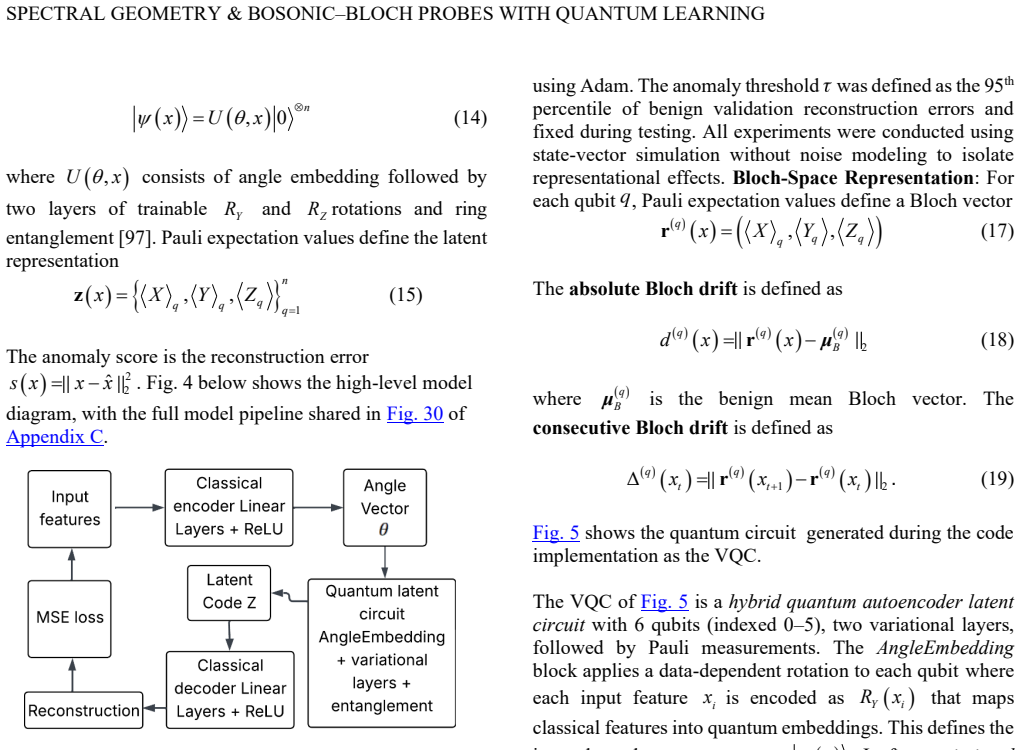
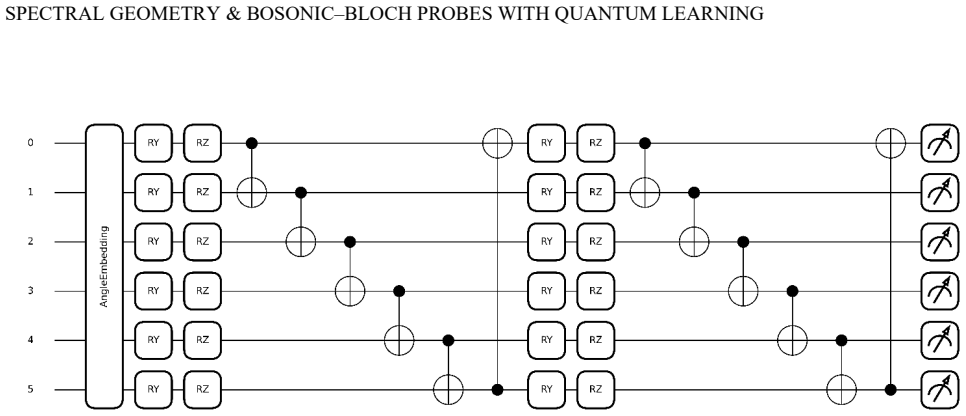
- hybrid QAE circuit depth/width (6-qubit, two RY–RZ layers, ring CNOTs) and classical bottleneck sizes
- effective stationary-variance scale γ_c (and Var_∞(0))
axioms (6)
- standard math Graph Laplacian L = D − A and Fiedler vector encode the principal partition relevant to learned similarity geometry.
- standard math Two-photon coincidence difference bosonic vs distinguishable isolates the interference term 2 Re(U_us U_vt U*_ut U*_vs).
- domain assumption Mapping graph adjacency into a continuous-time quantum-walk unitary U(t)=exp(itA) makes edge coincidences faithful probes of learned graph structure.
- domain assumption Training dynamics of representation variance are well approximated by an effective linear stochastic (Ornstein–Uhlenbeck) process controlled by γ.
- domain assumption Shallow hardware-efficient VQC latent states yield Lipschitz Bloch embeddings with non-vanishing QFI, so absolute drift is a stable anomaly geometry score.
- ad hoc to paper Benign-only unsupervised thresholding on CIC-IDS2018 DrDoS_SSDP flows is a fair operational proxy for intrusion detection geometry claims.
invented entities (3)
-
Edge-resolved bosonic enhancement probe ΔP_uv as diagnostic of learned spectral partitions
independent evidence
-
Absolute vs consecutive Bloch-space drift metrics for hybrid QAE anomaly geometry
independent evidence
-
Unified spectral–geometric framework equating Laplacian organization and Bloch manifold deformation
no independent evidence
read the original abstract
This paper studies how spectral geometry emerges in quantum learning models and how it can be diagnosed with physically grounded probes. In graph-regularized quantum networks, training reorganizes the output similarity graph, increases the effective spectral dimension Delta S = +0.23, and reshapes the Laplacian spectrum. Edge-resolved two-boson interference directly probes this restructuring: the bosonic enhancement Delta P_uv correlates with the Fiedler edge split |Delta v_2| (r = -0.50), linking learned spectral partitions to interference signatures. A phase diagram shows a nonmonotonic dependence of performance on coupling strength gamma and noise delta, with graph regularization improving fidelity only in a restricted regime; hardware experiments confirm the predicted interference behavior within shot-noise uncertainty. We also analyze a hybrid quantum autoencoder and introduce Bloch-space drift as a geometric diagnostic of its latent representation. With an unsupervised benign-data threshold, the model achieves high ranking performance (ROC-AUC about 0.99) and negligible false-negative rates. Absolute Bloch drift strongly discriminates anomalies (ROC-AUC at least about 0.9), while consecutive drift is near random (ROC-AUC about 0.5), showing that detection arises from persistent state-space displacement rather than local fluctuations. Through the geometry of reduced single-qubit states and associated quantum Fisher information, these results show that learning-induced spectral organization appears as measurable quantum-state structure, establishing a unified spectral-geometric framework for diagnosing quantum learning systems with bosonic and Bloch probes.
Figures
Forward citations
Cited by 1 Pith paper
-
Intelligence-Guided Adaptive Purification for DDoS-Resilient Quantum Networks: A CUDA-Q based Study
IDS-driven adaptive purification in a simulated 8-node quantum repeater chain restores fidelity-qualified entanglement delivery under SSDP-induced degradation (0.098 to 0.344 above-target; oracle 0.335).
Reference graph
Works this paper leans on
-
[1]
C. H. Valahu, M. P. Stafford, Z. Huang, V. G. Matsos, M. J. Millican, T. Chalermpusitarak, N. C. Menicucci, J. Combes, B. Q. Baragiola, and T. R. Tan, Quantum-Enhanced Multiparameter Sensing in a Single Mode, Science Advances 11, (2025)
2025
-
[2]
G. S. Hartnett, D. Kielpinski, S. Maity, P. S. Mundada, Y. Baum, and M. R. Hush, Automated discovery of heralded ballistic graph state generators for fusion-based photonic quantum computation, arXiv:2508.16505v1 [quant-ph] (2025), last accessed 2026/02/01. SPECTRAL GEOMETRY & BOSONIC–BLOCH PROBES WITH QUANTUM LEARNING
Pith/arXiv arXiv 2025
-
[3]
H. Yamauchi, S. Kanno, Y. Sato, H. Tezuka, Y.-A. Shimada, E. Kaminishi, and N. Yamamoto, Quantum spectroscopy of topological dynamics via a supersymmetric Hamiltonian, arXiv:2511.23169 [quant-ph] (2025), last accessed 2026/03/25
arXiv 2025
-
[4]
Qiskit: An Open- source Framework for Quantum Computing,
G. Aleksandrowicz et al., “Qiskit: An Open- source Framework for Quantum Computing,” Zenodo (2019), https://doi.org/10.5281/zenodo.2562111
-
[5]
The computational complexity of linear optics,
S. Aaronson and A. Arkhipov, “The computational complexity of linear optics,” Theory Comput. 9, 143 (2013)
2013
-
[6]
The power of quantum neural networks,
A. Abbas et al., “The power of quantum neural networks,” Nat. Comput. Sci. 1, 403 (2021), https://doi.org/10.1038/s43588-021- 00084-1
-
[7]
Björklund, J
A. Björklund, J. Mäkelä, and K. Puolamäki, SLISEMAP: Supervised Dimensionality Reduction through Local Explanations, Machine Learning 112, 1 (2022)
2022
-
[8]
J. B. Spring et al., Boson Sampling on a Photonic Chip, Science 339, 798 (2013)
2013
-
[9]
J. Biamonte et al., “Quantum machine learning,” Nature 549, 195 (2017), https://doi.org/10.1038/nature23474
-
[10]
A. M. Bishop, Pattern Recognition and Machine Learning (Springer, New York, 2006)
2006
-
[11]
Graph Kernels for Disease Outcome Prediction from Protein-Protein Interaction Networks,
K. M. Borgwardt, H.-P. Kriegel, S. V. N. Vishwanathan, and N. N. Schraudolph, “Graph Kernels for Disease Outcome Prediction from Protein-Protein Interaction Networks,” in Pacific Symposium on Biocomputing 12, 4–15 (2007), https://doi.org/10.1142/9789812772435_0002
-
[12]
Geometric deep learning: going beyond Euclidean data,
M. M. Bronstein, J. Bruna, Y. LeCun, A. Szlam, and P. Vandergheynst, “Geometric deep learning: going beyond Euclidean data,” IEEE Signal Process. Mag. 34, 18 (2017), https://doi.org/10.1109/MSP.2017.2693418
-
[13]
Theory of phase ordering kinetics,
A. J. Bray, “Theory of phase ordering kinetics,” Adv. Phys. 43, 357 (1994)
1994
-
[14]
Qiskit Aer: High-performance quantum circuit simulators,
Bauer et al., “Qiskit Aer: High-performance quantum circuit simulators,” arXiv:2108.08870, https://doi.org/10.48550/arXiv.2108.08870
-
[15]
Relational inductive biases, deep learning, and graph networks,
P. W. Battaglia et al., “Relational inductive biases, deep learning, and graph networks,” Nature 588, 429 (2020)
2020
-
[16]
Universality in distribution of monogamy scores for random multiqubit pure states,
Soorya Rethinasamy, Saptarshi Roy, Titas Chanda, Aditi Sen(De), and Ujjwal Sen, “Universality in distribution of monogamy scores for random multiqubit pure states,” Phys. Rev. A 99, 042302 (2019), https://doi.org/10.1103/PhysRevA.99.042302
-
[17]
Variational quantum algorithms,
M. Cerezo et al., “Variational quantum algorithms,” Nat. Rev. Phys. 3, 625 (2021), https://doi.org/10.1038/s42254-021-00348-9
-
[18]
A. Chicco and G. Jurman, “The advantages of the Matthews correlation coefficient (MCC) over F1 score and accuracy in binary classification evaluation,” BMC Genomics 21, 6 (2020), https://doi.org/10.1186/s12864-019- 6413-7
-
[19]
F. R. K. Chung, Spectral Graph Theory (American Mathematical Society, Providence, RI, 1997)
1997
-
[20]
Open Quantum Assembly Language,
A. W. Cross et al., “Open Quantum Assembly Language,” arXiv:1707.03429, https://doi.org/10.48550/arXiv.1707.03429
-
[21]
Convolutional neural networks on graphs with fast localized spectral filtering,
M. Defferrard, X. Bresson, and P. Vandergheynst, “Convolutional neural networks on graphs with fast localized spectral filtering,” in Adv. Neural Inf. Process. Syst. 29, 3844 (2016)
2016
-
[22]
Entanglement purification and quantum error correction,
W. Dür and H.-J. Briegel, “Entanglement purification and quantum error correction,” Rep. Prog. Phys. 70, 1381 (2007), https://doi.org/10.1088/0034-4885/70/8/R03
-
[23]
Classification with quantum neural networks on near-term processors,
A. Farhi and H. Neven, “Classification with quantum neural networks on near-term processors,” arXiv:1802.06002, https://doi.org/10.48550/arXiv.1802.06002
-
[24]
Algebraic connectivity of graphs,
M. Fiedler, “Algebraic connectivity of graphs,” Czechoslovak Math. J. 23, 298 (1973)
1973
-
[25]
Fösel, P
T. Fösel, P. Tighineanu, T. Weiss, and F. Marquardt, Reinforcement Learning with Neural Networks for Quantum Feedback, Physical Review X 8, (2018)
2018
-
[26]
Gardiner, Stochastic Methods (Springer, Berlin, 2009),
W. Gardiner, Stochastic Methods (Springer, Berlin, 2009),
2009
-
[27]
Gyongyosi and S
L. Gyongyosi and S. Imre, Networked Quantum Services†, Quantum Information & Computation 25, 97 (2025)
2025
-
[28]
C. S. Hamilton, R. Kruse, L. Sansoni, S. Barkhofen, C. Silberhorn, and I. Jex, “Gaussian Boson Sampling,” Phys. Rev. Lett. 119, 170501 (2017), https://doi.org/10.1103/PhysRevLett.119.1705 01
-
[29]
Inductive Representation Learning on Large Graphs,
W. L. Hamilton, Z. Ying, and J. Leskovec, “Inductive Representation Learning on Large Graphs,” in Advances in Neural Information Processing Systems 30 (NeurIPS 2017), 1024–1034 (2017); arXiv:1706.02216
Pith/arXiv arXiv 2017
-
[30]
Marginalized Kernels Between Labeled Graphs,
H. Kashima, K. Tsuda, and A. Inokuchi, “Marginalized Kernels Between Labeled Graphs,” in Proc. 20th Int. Conf. Mach. Learn. (ICML 2003) (AAAI Press, 2003), pp. 321–328. SPECTRAL GEOMETRY & BOSONIC–BLOCH PROBES WITH QUANTUM LEARNING
2003
-
[31]
H. J. Kimble, “The quantum internet,” Nature 453, 1023 (2008), https://doi.org/10.1038/nature07127
-
[32]
Quantum machine learning in feature Hilbert spaces,
M. Schuld and N. Killoran, “Quantum machine learning in feature Hilbert spaces,” Phys. Rev. Lett. 122, 040504 (2019), https://doi.org/10.1103/PhysRevLett.122.0405 04
-
[33]
Semi-supervised classification with graph convolutional networks,
T. N. Kipf and M. Welling, “Semi-supervised classification with graph convolutional networks,” in Proc. ICLR (2017)
2017
-
[34]
J. Wen, X. Kong, S. Wei, B. Wang, T. Xin, and G. Long, Experimental Realization of Quantum Algorithms for a Linear System Inspired by Adiabatic Quantum Computing, Physical Review. A/Physical Review, A 99, (2019)
2019
-
[35]
A deep learning approach for network intrusion detection system,
A. Javaid, Q. Niyaz, and W. Sun, “A deep learning approach for network intrusion detection system,” EAI Endorsed Trans. Security and Safety (2016),
2016
-
[36]
A comparative study of anomaly detection schemes in network intrusion detection,
Lazarevic, L. Ertöz, and V. Kumar, “A comparative study of anomaly detection schemes in network intrusion detection,” in Proc. SIAM Int. Conf. Data Mining (2005),
2005
-
[37]
J. Li et al., npj Quantum Inf. 7, 60 (2021), https://doi.org/10.1038/s41534-021-00398-9
-
[38]
Stochastic Gradient Descent as Approximate Bayesian Inference,
S. Mandt et al., “Stochastic Gradient Descent as Approximate Bayesian Inference,” J. Mach. Learn. Res. 18, 1 (2017)
2017
-
[39]
M. A. Nielsen and I. L. Chuang, Quantum Computation and Quantum Information (Cambridge University Press, Cambridge, 2000)
2000
-
[40]
Unsupervised machine learning on a hybrid quantum computer,
J. S. Otterbach et al., “Unsupervised machine learning on a hybrid quantum computer,” arXiv:1712.05771, https://doi.org/10.48550/arXiv.1712.05771
-
[41]
Routing entanglement in the quantum internet,
M. Pant, H. Krovi, D. Towsley, L. Tassiulas, L. Jiang, P. Basu, D. Englund, and S. Guha, “Routing entanglement in the quantum internet,” npj Quantum Inf. 5, 25 (2019), https://doi.org/10.1038/s41534-019-0139-x
-
[42]
Quantum computing in the NISQ era and beyond,
J. Preskill, “Quantum computing in the NISQ era and beyond,” Quantum 2, 79 (2018), https://doi.org/10.22331/q-2018-08-06-79
-
[43]
Quesada, J
N. Quesada, J. M. Arrazola, and N. Killoran, Gaussian Boson Sampling Using Threshold Detectors, Physical Review A 98, (2018)
2018
-
[44]
A survey of network-based intrusion detection data sets,
M. Ring et al., “A survey of network-based intrusion detection data sets,” Comput. Secur. 86, 147 (2019), https://doi.org/10.1016/j.cose.2019.06.005
-
[45]
Quantum autoencoders for efficient compression of quantum data,
J. Romero et al., “Quantum autoencoders for efficient compression of quantum data,” Quantum Sci. Technol. 2, 045001 (2017), https://doi.org/10.1088/2058-9565/aa8072
-
[46]
Anomaly detection using autoencoders with nonlinear dimensionality reduction,
M. Sakurada and T. Yairi, “Anomaly detection using autoencoders with nonlinear dimensionality reduction,” in Proc. MLSDA Workshop (2014)
2014
-
[47]
Sangouard, C
N. Sangouard, C. Simon, H. de Riedmatten, and N. Gisin, Quantum Repeaters Based on Atomic Ensembles and Linear Optics, Reviews of Modern Physics 83, 33 (2011)
2011
-
[48]
Circuit-centric quantum classifiers,
M. Schuld et al., “Circuit-centric quantum classifiers,” Phys. Rev. A 101, 032308 (2020), https://doi.org/10.1103/PhysRevA.101.03230 8
-
[49]
Schuld and F
M. Schuld and F. Petruccione, Supervised Learning with Quantum Computers (Springer, Cham, 2018),
2018
-
[50]
Weisfeiler-Lehman Graph Kernels,
N. Shervashidze, P. Schweitzer, E. J. van Leeuwen, K. Mehlhorn, and K. M. Borgwardt, “Weisfeiler-Lehman Graph Kernels,” J. Mach. Learn. Res. 12, 2539–2561 (2011)
2011
-
[51]
A deep learning approach to network intrusion detection,
N. Shone, T. Ngoc, V. Phai, and Q. Shi, “A deep learning approach to network intrusion detection,” IEEE Trans. Emerg. Top. Comput. Intell. 2, 41 (2018), https://doi.org/10.1109/TETCI.2017.2772792
-
[52]
Spielman, Spectral and Algebraic Graph Theory (lecture notes, 2019),
A. Spielman, Spectral and Algebraic Graph Theory (lecture notes, 2019),
2019
-
[53]
Outside the closed world: On using machine learning for network intrusion detection,
R. Sommer and V. Paxson, “Outside the closed world: On using machine learning for network intrusion detection,” in IEEE Symp. Security and Privacy (2010), https://doi.org/10.1109/SP.2010.25
-
[54]
Network intrusion detection using deep learning: A survey,
W. Wang et al., “Network intrusion detection using deep learning: A survey,” IEEE Commun. Surv. Tutor. 24, 684 (2022), https://doi.org/10.1109/COMST.2021.313452 4
-
[55]
H. Wang, J. Qin, X. Ding, M.-C. Chen, S. Chen, X. You, Y.-M. He, X. Jiang, L. You, Z. Wang, C. Schneider, J. J. Renema, S. Höfling, C.-Y. Lu, and J.-W. Pan, “Boson Sampling with 20 Input Photons and a 60-Mode Interferometer in a 1014-Dimensional Hilbert Space,” Phys. Rev. Lett. 123, 250503 (2019), https://doi.org/10.1103/PhysRevLett.123.2505 03
-
[56]
Wehner, D
S. Wehner, D. Elkouss, and R. Hanson, Quantum Internet: A Vision for the Road Ahead, Science 362, (2018)
2018
-
[57]
A comprehensive survey on graph neural networks,
Z. Wu et al., “A comprehensive survey on graph neural networks,” IEEE Trans. Neural Netw. Learn. Syst. 32, 4 (2021), https://doi.org/10.1109/TNNLS.2020.297838 6. SPECTRAL GEOMETRY & BOSONIC–BLOCH PROBES WITH QUANTUM LEARNING
-
[58]
A quantum graph neural network,
R. Verdon et al., “A quantum graph neural network,” arXiv:1909.12264, https://doi.org/10.48550/arXiv.1909.12264
-
[59]
The complexity of enumeration and reliability problems,
L. G. Valiant, “The complexity of enumeration and reliability problems,” Theor. Comput. Sci. 8, 189 (1979), https://doi.org/10.1016/0304-3975(79)90024- 6
-
[60]
Quantum-inspired algorithms in practice,
J. M. Arrazola et al., “Quantum-inspired algorithms in practice,” Nat. Mach. Intell. 2, 393 (2020), https://doi.org/10.1038/s42256- 020-00201-3
doi:10.1038/s42256- 2020
-
[61]
Quantum circuits with many photons on a programmable nanophotonic chip,
J. M. Arrazola et al., “Quantum circuits with many photons on a programmable nanophotonic chip,” Nature 591, 54 (2021), https://doi.org/10.1038/s41586-021-03202-1
-
[62]
Zinn-Justin, Quantum Field Theory and Critical Phenomena (Oxford University Press, Oxford, 2002)
J. Zinn-Justin, Quantum Field Theory and Critical Phenomena (Oxford University Press, Oxford, 2002)
2002
-
[63]
Bloch Sphere-Based Representation for Quantum Emotion Space,
Yan, A. M. Iliyasu, Z. Liu, A. S. Salama, F. Dong, and K. Hirota, “Bloch Sphere-Based Representation for Quantum Emotion Space,” J. Adv. Comput. Intell. Intell. Inform. 19, 134– 142 (2015), https://doi.org/10.20965/jaciii.2015.p0134
-
[64]
Quantum circuits for incompletely specified two-qubit operators,
V. V. Shende and I. L. Markov, “Quantum circuits for incompletely specified two-qubit operators,” Quantum Inf. Comput. 5(1), 48–56 (2005),
2005
-
[65]
Parameterized quantum circuits as machine learning models,
M. Benedetti, E. Lloyd, S. Sack, and M. Fiorentini, “Parameterized quantum circuits as machine learning models,” Quantum Sci. Technol. 4, 043001 (2019), https://doi.org/10.1088/2058-9565/ab4eb5
-
[66]
Power of data in quantum machine learning,
Huang, M. Broughton, M. Mohseni, R. Babbush, S. Boixo, H. Neven, and J. R. McClean, “Power of data in quantum machine learning,” Nat. Commun. 12, 2631 (2021), https://doi.org/10.1038/s41467-021-22539-9
-
[67]
Ganguly, Quantum Machine Learning: An Applied Approach: The Theory and Application of Quantum Machine Learning in Science and Industry (Apress, 2021)
S. Ganguly, Quantum Machine Learning: An Applied Approach: The Theory and Application of Quantum Machine Learning in Science and Industry (Apress, 2021)
2021
-
[68]
Supervised learning with quantum-enhanced feature spaces,
V. Havlíček, A. D. Córcoles, K. Temme, A. W. Harrow, A. Kandala, J. M. Chow, and J. M. Gambetta, “Supervised learning with quantum-enhanced feature spaces,” Nature 567, 209–212 (2019), https://doi.org/10.1038/s41586-019-0980-2
-
[69]
Unitary evolution recurrent neural networks,
M. Arjovsky, A. Shah, and Y. Bengio, “Unitary evolution recurrent neural networks,” in Proc. 33rd Int. Conf. Mach. Learn. (ICML 2016), 1120–1128 (2016),
2016
-
[70]
17, 2025)
Qiskit API documentation, https://qiskit.org/documentation/ (accessed Dec. 17, 2025)
2025
-
[71]
Quantum computing with Qiskit,
A. Javadi-Abhari et al., “Quantum computing with Qiskit,” arXiv:2405.08810 (2024), https://doi.org/10.48550/arXiv.2405.08810
-
[72]
A. Gong et al., “Memorizing Normality to Detect Anomaly: Memory-augmented Deep Autoencoder for Unsupervised Anomaly Detection,” arXiv:1904.02639 (2019), https://doi.org/10.48550/arXiv.1904.02639
-
[73]
Autoencoder-based network anomaly detection,
Z. Chen, C. Yeo, B. Lee, and C. T. Lau, “Autoencoder-based network anomaly detection,” in 2018 Wireless Telecommunications Symposium (WTS), 1–5 (2018), https://doi.org/10.1109/WTS.2018.8363930
-
[74]
PennyLane: Automatic differentiation of hybrid quantum-classical computations,
V. Bergholm et al., “PennyLane: Automatic differentiation of hybrid quantum-classical computations,” arXiv:1811.04968 (2018), https://doi.org/10.48550/arXiv.1811.04968
-
[75]
J. Basit, D. Hanif, and M. Arshad, “Quantum Variational Autoencoders for Predictive Analytics in High Frequency Trading Enhancing Market Anomaly Detection,” Int. J. Emerg. Multidisciplinaries: Comput. Sci. Artif. Intell. 3(1), 21 (2024), https://doi.org/10.54938/ijemdcsai.2024.03.1. 319
-
[76]
Quantum autoencoders with enhanced data encoding,
C. Bravo-Prieto, “Quantum autoencoders with enhanced data encoding,” Mach. Learn.: Sci. Technol. 2, 035028 (2021), https://doi.org/10.1088/2632-2153/ac0616
-
[77]
Hybrid classical- quantum autoencoder for anomaly detection,
A. Sakhnenko et al., “Hybrid classical- quantum autoencoder for anomaly detection,” Quantum Mach. Intell. 4, 2 (2022), https://doi.org/10.1007/s42484-022-00075-z
-
[78]
The role of data embedding in quantum autoencoders for improved anomaly detection,
J. Y. Araz and M. Spannowsky, “The role of data embedding in quantum autoencoders for improved anomaly detection,” arXiv:2409.04519 (2024), https://doi.org/10.48550/arXiv.2409.04519 (accessed Nov. 10, 2025)
-
[79]
Applying a Parameterized Quantum Circuit to Anomaly Detection,
J.-R. Jiang and J.-S. Li, “Applying a Parameterized Quantum Circuit to Anomaly Detection,” Eng. Proc. 3, 3 (2025), https://doi.org/10.3390/engproc2025092003
-
[80]
A. Elsharkawy et al., “Integration of Quantum Accelerators with High Performance Computing—A Review of Quantum Programming Tools,” ACM Trans. Quantum Comput. (2025), https://doi.org/10.1145/3743149
doi:10.1145/3743149 2025
discussion (0)
Sign in with ORCID, Apple, or X to comment. Anyone can read and Pith papers without signing in.