REVIEW 3 major objections 6 minor 1 cited by
An exact analytic model traces a star collapsing from no horizon through a growing apparent horizon to a Schwarzschild black hole while hiding an integrable central singularity.
Reviewed by Pith at T0; open to challenge. T0 means a machine referee read the full paper against a public rubric. the ladder, T0–T4 →
T0 review · grok-4.5
2026-07-10 13:17 UTC pith:S4M33TX3
load-bearing objection Exact growing-horizon collapse ansatz that works classically, with a real but limited SEC gap and the usual hand-chosen dynamics caveat. the 3 major comments →
An analytic model for a total process of gravitational collapse: From star to Schwarzschild black hole
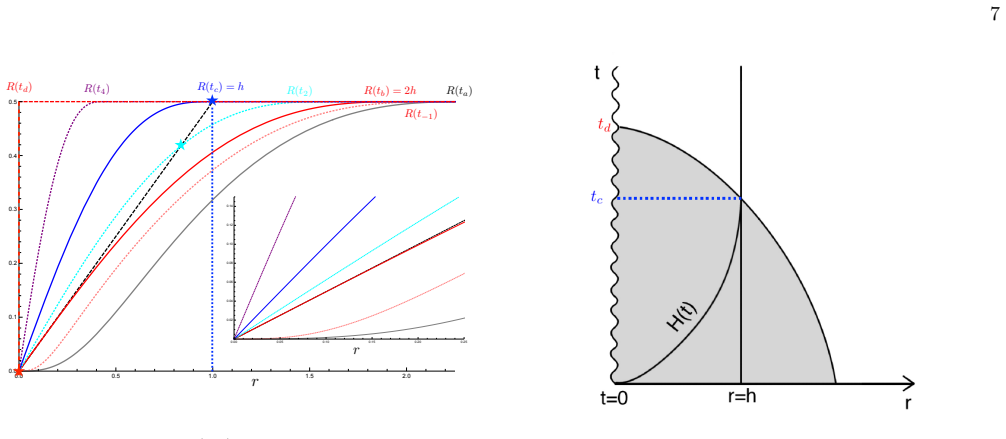
The pith
A machine-rendered reading of the paper's core claim, the machinery that carries it, and where it could break.
Core claim
There exists an exact analytic family of collapsing spacetimes, built from a prescribed mass function m(r,t) with a suitably chosen stellar radius R(t), in which an apparent horizon H(t) is born at finite time with vanishing size, grows monotonically to the final Schwarzschild value h=2M, and thereafter the geometry approaches the Schwarzschild black hole while an integrable Ricci singularity at r=0 remains hidden behind the horizon, all without exotic matter and while preserving the null and weak energy conditions for a range of collapse times.
What carries the argument
The time-dependent mass function m(r,t)=h f(X(r,t)) together with the causal stellar boundary R(t)=T(1-b1 T) (2h≤td≤4h); this single object generates the metric, the energy-momentum tensor, the dynamical horizon H(t), and the integrable singularity, while the auxiliary factor Q(t) for t<0 removes the naked singularity before horizon birth.
Load-bearing premise
The entire collapse is imposed by a hand-chosen ansatz for the mass function and the surface radius rather than being derived from a realistic equation of state or free evolution of initial data.
What would settle it
Compute the null and weak energy conditions (or the causal character of the stellar surface) for the given R(t) outside the interval 2h<td≤4h, or replace the ansatz with free evolution of a perfect-fluid star of comparable mass and check whether an apparent horizon still forms at finite time and cloaks an integrable singularity.
If this is right
- Trapped surfaces can form dynamically in finite time from initially horizon-free matter without exotic stress-energy.
- Weak cosmic censorship can be realised by horizon growth that hides an integrable central singularity, not by forbidding the singularity altogether.
- The model supplies an explicit classical bridge from microscopic horizon scales to macroscopic black-hole geometry, controlled by a single timescale parameter td.
- Energy is conserved throughout: the final black-hole mass equals the total initial mass of the collapsing matter.
Where Pith is reading between the lines
- Because the horizon starts at zero size, the same family could be used as a classical seed for studying the quantum-to-classical transition once Planck-scale corrections are added near H(t) o0.
- The necessity of eta=2 to keep both regularity and the null energy condition suggests that the leading near-centre density profile of any “censoring” collapse may be tightly constrained.
- If the ansatz family is representative, similar growing-horizon constructions should exist for charged or slowly rotating matter, offering analytic tests of censorship beyond spherical symmetry.
Editorial analysis
A structured set of objections, weighed in public.
Referee Report
Summary. The manuscript constructs an exact, spherically symmetric analytic solution of Einstein’s equations that describes a complete collapse process: from a horizonless matter configuration of total mass M, through the birth and growth of an apparent horizon H(t) from H(tb)=0 to H(tc)=h=2M, to a late-time approach to the Schwarzschild geometry. The dynamics are encoded in a prescribed mass function m(r,t)=h f(X(r,t)) with a time-dependent stellar surface R(t)=T(1−b1 T) (2h≤td≤4h) chosen so that the matter–vacuum interface remains causal, and with a pre-horizon regularizer Q(t) (β=2) that removes a naked singularity for t<0. The authors verify continuity of the energy-momentum tensor at the interfaces, show that the apparent horizon is spacelike for tb≤t<tc and null at tc, and check energy conditions in Appendix A. They conclude that an integrable Ricci singularity (∼r−2) forms at r=0 but remains hidden by the growing horizon, thereby illustrating weak cosmic censorship without exotic matter, and suggest the model as a framework for the quantum-to-classical transition when H(t)∼ℓPlanck.
Significance. Exact analytic models that track horizon formation from zero size through to a macroscopic Schwarzschild end-state are scarce; most classical collapse solutions either start with a horizon already present or leave the horizon dynamics implicit. Within a controlled ansatz the paper delivers a continuous, explicit H(t), a careful causality analysis of the stellar surface, and a transparent treatment of EMT continuity and energy conditions. These are genuine technical contributions that can serve as a concrete laboratory for questions about trapped-surface formation and the causal structure of integrable singularities. The construction is openly ansatz-driven rather than free evolution from an equation of state, so the generic lessons about horizon birth and censorship are illustrative rather than universal; that limitation is standard for exact-solution work and does not erase the value of a fully explicit, checkable model.
major comments (3)
- [Abstract; §III.C; Appendix A.3] Abstract and §III.C claim that the model preserves weak cosmic censorship “without exotic matter” for the full process. Appendix A.3 shows that for ta≤t<0 (the phase required to eliminate the naked singularity) one has limX→0(−κr4C/hX(1−X))=−β(β+1)=−6 at the forced value β=2, so the strong energy condition is violated throughout the pre-horizon era. NEC and WEC hold for 2h<td<4h (with suitable a0,a1), but SEC does not. In the GR literature “exotic matter” is often reserved for NEC violation, yet the abstract’s unqualified phrasing is stronger than the energy-condition results support. The claim must be restated precisely (e.g., “NEC and WEC hold; SEC holds only after tb”) or the pre-horizon construction revised so that SEC is not forced to fail.
- [Abstract; §III.A–B (Eqs. 23–25, 34–38); §IV] The entire evolution is imposed by the hand-chosen mass function (Eqs. 13, 24, 34–38) and the surface law R(t)=T(1−b1T) with free parameters td, a0, a1 and the choice of f(x). Energy conditions and causality are verified a posteriori. While this is legitimate for an exact-solution paper, the abstract and conclusion present the construction as demonstrating “how trapped surfaces form dynamically in finite time” and as a framework for the quantum-to-classical transition. Those interpretive claims should be explicitly scoped to the ansatz family, and the free-parameter dependence (especially td controlling the collapse timescale) should be stated up front rather than left implicit.
- [§III.C (Penrose-diagram discussion); Fig. 3] In the discussion of the Penrose diagram (§III.C, final paragraphs) the authors note that the central singularity is spacelike except possibly at its onset (t=0), where r=0 appears null, but they state that a definitive geodesic analysis is unavailable and leave the issue open. Because the causal character of the singularity at formation is part of the claimed “naked-singularity resolution,” either a partial null-geodesic argument or a clear statement that the null character remains unproven should be added; the present wording risks overstating what has been established.
minor comments (6)
- [Abstract] The abstract’s parenthetical “{naked-}singularity resolution” is awkward; rephrase to “resolution of a would-be naked singularity” or similar.
- [Figs. 1–2] Fig. 1 and Fig. 2 captions refer to several sample times (t1…t4, t−1) that are defined only in the main text; a short legend or explicit numerical values in the caption would improve readability.
- [§III] Notation switches between H(t) (apparent horizon) and h (final horizon radius) without a single defining sentence early in §III; a one-line glossary would help.
- [§I] The phrase “Minkowski breaking” is cited via Ref. [34] but never explained; either define it briefly or drop the parenthetical.
- [Throughout; Appendix A] Typos / style: “ther-dependent” → “the r-dependent” (p. 2); “thank to” → “thanks to” (several places); “W eak” → “Weak” (App. A.2 heading); “att a” spacing inconsistencies.
- [Abstract; §IV] The quantum-to-classical remark (H(t)∼ℓPlanck) appears in the abstract and conclusion but is not developed; either expand with a short paragraph on how td could be matched to a Planck-scale seed or move the remark to a speculative outlook sentence.
Circularity Check
Open ansatz construction of m(r,t) and R(t) that forces horizon growth and singularity hiding by design; self-citations supply the static seed but do not reduce the new dynamical claims to tautologies.
specific steps
-
self citation load bearing
[§II.A–B and opening of §III (citing [32,35])]
"Building upon these considerations ho a recent extension of the Schwarzschild solution has been proposed [32,33] ho In Ref. [35], we analyzed gravitational collapse models departing from the revisited Schwarzschild BH. The present work extends this framework ho"
The static integrable-singularity interior and the constant-horizon dynamical model that seed the entire construction are taken from the authors’ own prior papers. While the new growing-horizon R(t) and the t<0 regularization are original, the load-bearing claim that the matter is “physically admissible (there is no exotic matter)” and that the singularity is only integrable rests on the EMT properties already engineered in [32,35]. This is ordinary sequential self-citation rather than a closed definitional loop, hence only a mild contribution to the score.
full rationale
The paper constructs an exact solution of Einstein’s equations by freely choosing a mass function m(r,t) (Eqs. 13, 24, 34–38) and a stellar surface R(t)=T(1-b1 T) with 2h≤td≤4h so that an apparent horizon H(t) appears at tb=0 with H(tb)=0, grows to h, and hides an integrable singularity. Energy conditions and causality are verified a posteriori (Appendix A). This is an explicit ansatz, not a derivation from an equation of state or free evolution; the abstract’s “demonstrating how trapped surfaces form” and “naked-singularity resolution ho without exotic matter” are therefore properties of the chosen family rather than independent predictions. Self-citations to the authors’ prior static integrable-singularity solutions [32] and constant-horizon collapse [35] supply the seed metric and the late-time limit, but those works are used as building blocks, not as uniqueness theorems that force the present results. No fitted parameter is later called a prediction, no ratio is recovered by construction from its own fit, and no external uniqueness claim is imported to forbid alternatives. The construction is therefore self-contained as a model; the only mild circularity is the ordinary reliance on the authors’ own prior ansätze. Score 2 reflects that minor self-citation load without elevating it to a definitional reduction of the central claims.
Axiom & Free-Parameter Ledger
free parameters (4)
- td (total collapse duration) =
example td=3h used in figures
- a0, a1 in Q(t) =
a0=a1=h/10 in Fig. 2
- choice of f(x) (e.g. f0(x)=x−x³+x⁴/2) =
f0(x)
- β in X(r,t) for t<0 =
2
axioms (5)
- standard math Einstein equations with spherical symmetry and the Type-II EMT classification for energy conditions
- domain assumption Weak cosmic censorship is imposed as a selection principle: the horizon must form before a naked central singularity appears
- domain assumption All matter collapses into the final BH (M=M0); no residual exterior matter or accretion disk
- ad hoc to paper Mass function ansatz m(r,t)=h f(X(r,t)) with prescribed R(t) and Q(t) fully determines the dynamics
- domain assumption Static integrable-singularity interior of Ref. [32] is a valid classical seed (no exotic matter, EMT continuous at the horizon)
invented entities (1)
-
Time-dependent mass function with growing apparent horizon H(t) and pre-horizon regularizer Q(t)
no independent evidence
read the original abstract
We present an exact analytical model describing a complete gravitational collapse of matter from horizonless initial conditions to black hole formation, tracing the full evolution of the horizon $H(t)$ from its formation at microscopic scales to macroscopic stabilization. The solution reveals two main stages: (i) a dynamical horizon growth, where an apparent horizon $H(t)$ emerges at a critical time $t_b$ until reaching its final size $h=2 M$, demonstrating how trapped surfaces form dynamically in finite time, and (ii) a {naked-}singularity resolution, where an integrable Ricci curvature singularity ($R^\mu{}_\nu \sim r^{-2}$) develops at $r=0$, but remains causally hidden by the horizon growth, preserving weak cosmic censorship without exotic matter. The model could offer a framework to study the quantum-to-classical transition ($H(t) \sim \ell_{\rm Planck}$).
Figures


Forward citations
Cited by 1 Pith paper
-
Entropy dynamics in gravitational collapse: From Minkowski breaking to de Sitter thermodynamics
The sign of the Hubble parameter unifies OCK entropy release and Volovik de Sitter thermodynamics as complementary pictures of entropy flow in collapse, without a classical bridge between them.
Reference graph
Works this paper leans on
-
[1]
The exterior region [r > R(t)] remains Schwarzschild vacuum
Pre-Horizon Phase (ta ≤t < t b): The collapse initi- ates att a with a spherically symmetric, horizon-free matter distribution of radiusR(t a)>2h, whereh denotes the final horizon size. The exterior region [r > R(t)] remains Schwarzschild vacuum. As mat- ter collapses inward,R(t) monotonically decreases while the vacuum region expands, culminating at tb w...
-
[2]
Horizon Growth Phase (t b ≤t≤t c): A dynamical (micro) horizonH(t) emerges att b (H(t b) = 0) and grows, partitioning spacetime into: •A BH interior (0< r≤H(t)) •An exterior matter shell (H(t)< r≤R(t)) •A Schwarzschild vacuum atr > R(t) The phase concludes att c whenH(t c) =R(t c) =h, with all matter fully contained within the horizon
-
[3]
[35], the system evolves toward a Schwarzschild BH with massM=h/2 ast→t d, wheret d =∞in Ref
Final Phase (t c < t≤t d): As in the case of Ref. [35], the system evolves toward a Schwarzschild BH with massM=h/2 ast→t d, wheret d =∞in Ref. [35]. We emphasize that the horizon sizeH(t) evolves continu- ously from the formation (t b) to its maximum value (t c), i.e., from a micro BH to a macroscopic configuration. A. Causality problem and improved mode...
-
[4]
The total process of collapse starts att=t a, when ˙R(ta) = 0
-
[5]
Only the Schwarzschild BH remains att≥t d
The collapse ends att=t d, whenR(t d) = 0. Only the Schwarzschild BH remains att≥t d. 3.R(t) is monotonically decreasing: ˙R≤0 for all ta ≤t≤t d
-
[6]
The apparent horizon starts forming att=t b, so thatR(t b) = 2h. Without loss of generality, we taket b = 0.i.e.,R(0) = 2h, using a freedom to shift the origin oft. Under these conditions, we determineR(t), in order to satisfy thatN 2(t)≥0 fort a ≤t≤t d, so that the hypersurface defined byr=R(t) is time-like or null. Using the condition 2,R(t d) = 0, we w...
-
[7]
Form(r, t), we take the simplest functionf(x) =f 0(x) in Eq
Cases att <0 will be considered later. Form(r, t), we take the simplest functionf(x) =f 0(x) in Eq. (4) witht d = 3handh= 1. The inset in the bottom-right of Fig. 1 shows the time dependence of the horizon size H(t) att≥0, which reaches to the maximum sizehat t=t c. Zero Horizon (t=t b = 0):Att=t b = 0, the matter boundaryR(t 0) = 2hcauses the mass profil...
-
[8]
Absence of singularities att <0 Derivatives of the mass function in Eqs. (18) and (19) can be easily generalized to the present case as ma(r, t) =hf ′ (X(r, t))X a(r, t),(39) mab(r, t) =hf ′ (X(r, t))X ab(r, t) +hf ′′ (X(r, t))X a(r, t)Xb(r, t) (40) For a negativet(t <0),Xand its derivatives near r= 0 behaves as X, Xt, Xtt ∼r 1+β, X r, Xrt ∼r β, X rr ∼r β...
-
[9]
Since the EMT vanishes atX(r, t)>1, the EMT should also vanish atX(r, t) = 1
Continuity of the EMT atX(r, t) = 1 We next check continuity of the EMT atX(r, t) = 1 in bothrandt. Since the EMT vanishes atX(r, t)>1, the EMT should also vanish atX(r, t) = 1. Denotingr s is a solution toX(r s, t) = 1 fort <0, we see that ma(rs, t) =hX a(rs, t)f ′(1) = 0,(43) mab(rs, t) =h[f ′(1)Xab(rs, t) +f ′′(1)Xab(rs, t)] = 0, (44) where we use prop...
-
[10]
Therefore the EMT vanishes atr=r s and thus is continuous to the Schwarzschild vacuum atr > r s
-
[11]
Continuity of the EMT att= 0 We also need to check continuity of the EMT att= 0. Using properties ofQ(t), we can explicitly show that X(r,0 −) := lim t→0− X(r, t) =x(r,0 +), Xr(r,0 −) =x r(r,0) =x r(r,0 +), Xrr(r,0 −) = 0 =x rr(r,0 +), Xt(r,0 −) =x t(r,0) =x t(r,0 +), Xtt(r,0 −) =x tt(r,0) =x tt(r,0 +), Xtr(r,0 −) =x tr(r,0) =x tr(r,0 +).(45) The EMT in t...
-
[12]
Energy conditions We investigate energy conditions for the EMT. While details will be given in the appendix A, we here present only results without derivations. A condition thatβ≤2 is necessary for the NEC to be satisfied. Combining the condition thatβ≥2 for the absence of the naked singularity, we obtainβ= 2. We have found that NEC and SEC are satisfied ...
-
[13]
Mass function during a whole process of the gravitational collapse Fig. 2 showsm(r, t) atβ= 2 as a function ofr for several values oftduring a whole process of the collapse att a ≤t≤t d. where the simplest function f(x) =f 0(x) is adopted and parameters are taken to be h= 1,t d = 3handa 0 =a 1 =h/10. In the figure we add two values of negativetsuch ast=t ...
-
[14]
Null Energy Condition (NEC) The NEC requires YNEC (r, t) := κr3(A−B−C) hX(1−X) =d 1 ˙R2r2 R2 +d 2 ¨Rr2 R + 2d3 ˙Rr R +d 4 ≥0,(A4) 9 where d1 = 2(5X 2 −X−1), d 2 = 1 +X−2X 2,(A5) d3 = = 6X 2 + (8X2 −X−1) βQ g + ˙Qr g ! ,(A6) d4 = 2(1 +X+X 2) +{(1 +β)(1 +X) + 2(5−β)X 2} βQ g + 2(5X 2 −X−1) βQ g + ˙Qr g !2 + (1−X)(2X+ 1) ¨Qr2 g + 2{β(1 +X) + (6−2β)X 2} ˙Qr g...
-
[15]
Furthermore, the above condition is satisfied asr→0
W eak Energy Condition (WEC) In addition toY NEC(r, t)≥0, the WEC requires YWEC(r, t) := κr3(A−B) 2hXf ′(X) = 1 + 2Q g + ˙Qr g + ˙Rr R ≥0,(A13) which is satisfied at 0≤t≤t d since 1 + ˙Rx≥1 + ˙R= 2b1T≥0. Furthermore, the above condition is satisfied asr→0. An explicit calculation by Mathematica for 0< X(r, t)≤1 tells us that the WEC is always satisfied at...
-
[16]
Strong Energy Condition (SEC) In addition to the NEC, the SEC requires YSEC := −κr2RC 2hx(1−x) = ˜c1 ˙R2 + 2˜c2 ˙R+ ˜c3 ≥0(A14) for 0≤t≤t d, where ˜c1 = 3x(2x−1)(3x+ 1),˜c 2 = 2(8x2 −x−1), ˜c3 =x(2x 2 −x+ 11).(A15) SinceY SEC takes the minimum value at ˙R= 1, we show min −1≤ ˙R≤0 YSEC = 4(1−x) 2(5x+ 1)≥0.(A16) The SEC is satisfied at 0≤t≤t d. At the negat...
-
[17]
J. R. Oppenheimer and H. Snyder, Phys. Rev.56, 455 (1939)
work page 1939
- [18]
- [19]
-
[20]
P. S. Joshi and I. H. Dwivedi, Phys. Rev. D47, 5357 (1993), arXiv:gr-qc/9303037
work page internal anchor Pith review Pith/arXiv arXiv 1993
- [21]
-
[22]
P. S. Joshi, N. Dadhich, and R. Maartens, Phys. Rev. D 65, 101501 (2002), arXiv:gr-qc/0109051
work page internal anchor Pith review Pith/arXiv arXiv 2002
-
[23]
Gravitational collapse of barotropic spherical fluids
R. Giambo, F. Giannoni, G. Magli, and P. Piccione, Gen. Rel. Grav.36, 1279 (2004), arXiv:gr-qc/0303043
work page internal anchor Pith review Pith/arXiv arXiv 2004
-
[24]
Black hole formation in perfect fluid collapse
R. Goswami and P. S. Joshi, Phys. Rev. D69, 027502 (2004), arXiv:gr-qc/0310122
work page internal anchor Pith review Pith/arXiv arXiv 2004
-
[25]
P. D. Lasky and A. W. C. Lun, Phys. Rev. D74, 084013 (2006), arXiv:gr-qc/0606055
work page internal anchor Pith review Pith/arXiv arXiv 2006
-
[26]
Strong curvature naked singularities in spherically symmetric perfect fluid collapse
K. Mosani, D. Dey, and P. S. Joshi, Phys. Rev. D 101, 044052 (2020), [Erratum: Phys.Rev.D 107, 069903 (2023)], arXiv:2001.04367 [gr-qc]
work page internal anchor Pith review Pith/arXiv arXiv 2020
-
[27]
Towards consistent black-to-white hole bounces from matter collapse
J. Ben Achour, S. Brahma, S. Mukohyama, and J. P. Uzan, JCAP09, 020 (2020), arXiv:2004.12977 [gr-qc]
work page internal anchor Pith review Pith/arXiv arXiv 2020
-
[28]
P. S. Joshi and D. Malafarina, Int. J. Mod. Phys. D20, 2641 (2011), arXiv:1201.3660 [gr-qc]
work page internal anchor Pith review Pith/arXiv arXiv 2011
-
[29]
Quantum gravitational collapse: non-singularity and non-locality
E. Greenwood and D. Stojkovic, JHEP06, 042 (2008), arXiv:0802.4087 [gr-qc]
work page internal anchor Pith review Pith/arXiv arXiv 2008
-
[30]
J. E. Wang, E. Greenwood, and D. Stojkovic, Phys. Rev. D80, 124027 (2009), arXiv:0906.3250 [hep-th]
work page internal anchor Pith review Pith/arXiv arXiv 2009
-
[31]
Singularity avoidance for collapsing quantum dust in the Lemaitre-Tolman-Bondi model
C. Kiefer and T. Schmitz, Phys. Rev. D99, 126010 (2019), arXiv:1904.13220 [gr-qc]
work page internal anchor Pith review Pith/arXiv arXiv 2019
-
[32]
Black hole singularity resolution via the modified Raychaudhuri equation in loop quantum gravity
K. Blanchette, S. Das, S. Hergott, and S. Rastgoo, Phys. Rev. D103, 084038 (2021), arXiv:2011.11815 [gr-qc]
work page internal anchor Pith review Pith/arXiv arXiv 2021
-
[33]
Quantum Oppenheimer-Snyder model
W. Piechocki and T. Schmitz, Phys. Rev. D102, 046004 (2020), arXiv:2004.02939 [gr-qc]
work page internal anchor Pith review Pith/arXiv arXiv 2020
-
[34]
J. G. Kelly, R. Santacruz, and E. Wilson-Ewing, Class. Quant. Grav.38, 04LT01 (2021), arXiv:2006.09325 [gr- qc]
work page internal anchor Pith review Pith/arXiv arXiv 2021
-
[35]
Quantum gravity of dust collapse: shock waves from black holes
V. Husain, J. G. Kelly, R. Santacruz, and E. Wilson-Ewing, Phys. Rev. Lett.128, 121301 (2022), arXiv:2109.08667 [gr-qc]
work page internal anchor Pith review Pith/arXiv arXiv 2022
-
[36]
On the fate of quantum black holes
V. Husain, J. G. Kelly, R. Santacruz, and E. Wilson-Ewing, Phys. Rev. D106, 024014 (2022), arXiv:2203.04238 [gr-qc]
work page internal anchor Pith review Pith/arXiv arXiv 2022
-
[37]
Configurational entropy of black hole quantum cores
R. Casadio, R. da Rocha, P. Meert, L. Tabarroni, and W. Barreto, Class. Quant. Grav.40, 075014 (2023), arXiv:2206.10398 [gr-qc]
work page internal anchor Pith review Pith/arXiv arXiv 2023
-
[38]
Gravitational collapse in effective loop quantum gravity: beyond marginally bound configurations
L. Cipriani, F. Fazzini, and E. Wilson-Ewing, Phys. Rev. D110, 066004 (2024), arXiv:2404.04192 [gr-qc]
work page internal anchor Pith review Pith/arXiv arXiv 2024
-
[39]
On gravitational collapse and integrable singularities
R. Casadio, A. Giusti, A. Kamenshchik, and J. Ovalle, (2026), arXiv:2605.01808 [gr-qc]
work page internal anchor Pith review Pith/arXiv arXiv 2026
- [40]
-
[41]
First M87 Event Horizon Telescope Results. I. The Shadow of the Supermassive Black Hole
K. Akiyamaet al.(Event Horizon Telescope), Astrophys. J. Lett.875, L1 (2019), arXiv:1906.11238 [astro-ph.GA]
work page internal anchor Pith review Pith/arXiv arXiv 2019
-
[42]
K. Akiyamaet al.(Event Horizon Telescope), Astrophys. J. Lett.930, L12 (2022), arXiv:2311.08680 [astro-ph.HE]
work page internal anchor Pith review Pith/arXiv arXiv 2022
- [43]
- [44]
- [45]
-
[46]
Penrose, inGeneral Relativity: An Einstein Cente- nary Survey, edited by S
R. Penrose, inGeneral Relativity: An Einstein Cente- nary Survey, edited by S. W. Hawking and W. Israel (Cambridge University Press, 1979) pp. 581–638
work page 1979
-
[47]
R. M. Wald,General Relativity(Chicago Univ. Pr., Chicago, USA, 1984)
work page 1984
- [48]
-
[49]
Interior Dynamics of Regular Schwarzschild Black Holes
J. Ovalle, (2025), arXiv:2509.00816 [gr-qc]
work page internal anchor Pith review Pith/arXiv arXiv 2025
- [50]
- [51]
- [52]
- [53]
-
[54]
V. N. Lukash and V. N. Strokov, Int. J. Mod. Phys. A 28, 1350007 (2013), arXiv:1301.5544 [gr-qc]
work page internal anchor Pith review Pith/arXiv arXiv 2013
- [55]
-
[56]
J. Arrechea, S. Liberati, H. Neshat, and V. Vellucci, Phys. Rev. D112, 044024 (2025)
work page 2025
-
[57]
K. Schwarzschild, Sitzungsber. Preuss. Akad. Wiss. Berlin (Math. Phys.)1916, 424 (1916)
work page 1916
-
[58]
S. Aoki, T. Onogi, and S. Yokoyama, Int. J. Mod. Phys. A36, 2150201 (2021), arXiv:2010.07660 [gr-qc]
work page internal anchor Pith review Pith/arXiv arXiv 2021
-
[59]
Conserved non-Noether charge in general relativity: Physical definition vs. Noether's 2nd theorem
S. Aoki and T. Onogi, Int. J. Mod. Phys. A37, 2250129 (2022), arXiv:2201.09557 [hep-th]
work page internal anchor Pith review Pith/arXiv arXiv 2022
-
[60]
S. Aoki, T. Onogi, and S. Yokoyama, Int. J. Mod. Phys. A36, 2150098 (2021), arXiv:2005.13233 [gr-qc]
work page internal anchor Pith review Pith/arXiv arXiv 2021
-
[61]
Generic Naked Singularities in Vaidya Spacetimes
J. Wheeler, Class. Quant. Grav.39, 197001 (2022), arXiv:2205.11639 [gr-qc]
work page internal anchor Pith review Pith/arXiv arXiv 2022
-
[62]
Trapped surfaces in Oppenheimer-Snyder black holes
I. Bengtsson, E. Jakobsson, and J. M. M. Senovilla, Phys. Rev. D88, 064012 (2013), arXiv:1306.6486 [gr-qc]
work page internal anchor Pith review Pith/arXiv arXiv 2013
- [63]
-
[64]
S. W. Hawking and G. F. R. Ellis,The Large Scale Struc- ture of Space-Time, Cambridge Monographs on Mathe- matical Physics (Cambridge University Press, 2011)
work page 2011
-
[65]
Classical and semi-classical energy conditions
P. Martin-Moruno and M. Visser, Fundam. Theor. Phys. 189, 193 (2017), arXiv:1702.05915 [gr-qc]
work page internal anchor Pith review Pith/arXiv arXiv 2017
-
[66]
Energy conditions in arbitrary dimensions
H. Maeda and C. Martinez, PTEP2020, 043E02 (2020), arXiv:1810.02487 [gr-qc]
work page internal anchor Pith review Pith/arXiv arXiv 2020
-
[67]
Criteria for energy conditions
H. Maeda and T. Harada, Class. Quant. Grav.39, 195002 (2022), arXiv:2205.12993 [gr-qc]
work page internal anchor Pith review Pith/arXiv arXiv 2022
-
[68]
Energy conditions in static, spherically symmetric spacetimes and effective geometries
Z.-L. Wang and E. Battista, (2026), arXiv:2604.16545 [gr-qc]
work page internal anchor Pith review Pith/arXiv arXiv 2026
-
[69]
Families of regular spacetimes and energy conditions
Z.-L. Wang and E. Battista, (2026), arXiv:2605.03428 [gr-qc]
work page internal anchor Pith review Pith/arXiv arXiv 2026
discussion (0)
Sign in with ORCID, Apple, or X to comment. Anyone can read and Pith papers without signing in.