REVIEW 3 major objections 6 minor 1 cited by
Robustness in world action models can be steered at inference time without retraining.
Reviewed by Pith at T0; open to challenge. T0 means a machine referee read the full paper against a public rubric. the ladder, T0–T4 →
T0 review · deepseek-v4-flash
2026-08-02 00:37 UTC pith:O2T4BEDX
load-bearing objection Worth a real look: the separability-predicts-steerability claim is solid, but the LQR contribution is undersold and under-validated. the 3 major comments →
Steering Robustness into World Action Models via Mechanistic Interpretability and Optimal Control
The pith
A machine-rendered reading of the paper's core claim, the machinery that carries it, and where it could break.
Core claim
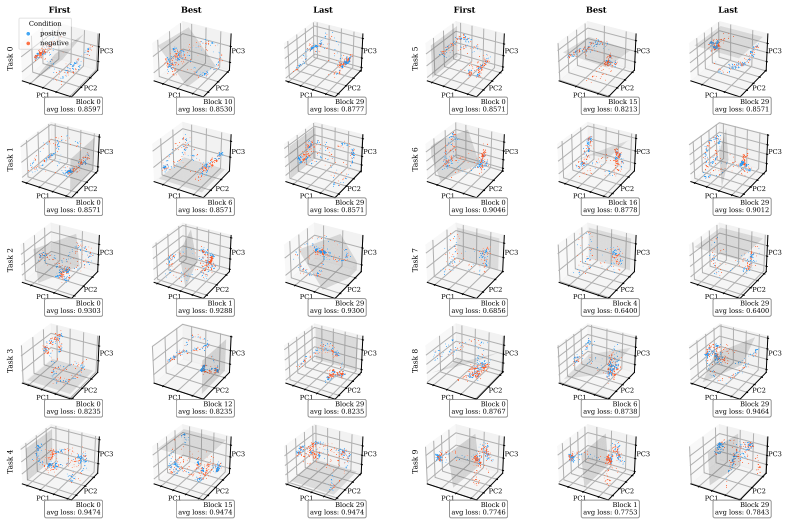
Mechanistically comparing activations from clean versus perturbed or successful versus unsuccessful rollouts, the paper finds that robustness-relevant factors are sometimes encoded as low-dimensional, linearly separable directions in WAM activation space. This structure is architecture- and perturbation-dependent: Cosmos-Policy and DiT4DiT exhibit strong linear separability, while LingBot-VA does not. The central discovery is that this separability is not merely descriptive — it predicts steering outcomes and can be exploited directly. Contrastive activations yield steering vectors, and local linearity of the diffusion-transformer block dynamics within a low-dimensional contrastive subspace
What carries the argument
The central objects are contrastive activation directions (differences between hidden states from paired nominal/perturbed inputs), a low-dimensional latent subspace built by randomized SVD of those directions, and an SVM hinge loss on the top three principal components that quantifies linear separability. WA-LQR (World-Action Linear Quadratic Regulator) treats the steered diffusion-transformer block as the locally linear system δz_{l+1,t,τ} ≈ Ã_{l,t} δz_{l,t,τ} + B̃_{l,t} δu_{l,t,τ}, with Jacobian-vector products used to avoid materializing full Jacobians. For each action-chunk timestep and denoising timestep it solves an L-step LQR tracking problem that penalizes deviations from a contrast
Load-bearing premise
The load-bearing premise is that robustness-relevant perturbations live in a low-dimensional contrastive subspace and that the projected diffusion-transformer block dynamics stay approximately linear over the steering corrections actually applied, allowing one nominal Jacobian pair to be reused across inputs and tasks.
What would settle it
Measure the norm of the actual WA-LQR corrections injected during a rollout, feed perturbations of that size through the diffusion-transformer block, and compare the actual latent transition with the linear approximation used to compute the gains; if cosine similarity or magnitude ratio departs substantially from 1 in that regime, the linearity premise is violated and WA-LQR's gain computation no longer tracks the feature setpoint.
If this is right
- A cheap diagnostic: measuring hinge loss on the top three principal components of contrastive activation directions predicts whether inference-time steering will help a given model and perturbation type.
- Cross-task transfer: contrastive directions and LQR gains computed on one LIBERO-10 task can be applied to other tasks in the same feature cluster, improving success rates without finetuning.
- Closed-loop beats open-loop when oversteering is a risk: WA-LQR modulates correction magnitude based on realized activations, whereas activation addition needs careful tuning of the steering strength γ and can degrade performance.
- Architecture matters: models like LingBot-VA, whose activations are not linearly separable under perturbations, do not benefit from these training-free steering methods, so robustness must be designed in rather than steered in.
- On the evaluated WAMs, prompt steering is ineffective (matching or degrading baseline), while activation steering adds value.
Where Pith is reading between the lines
- A natural next experiment is to scan a candidate WAM's activations on a small perturbed set before deployment; low hinge loss would suggest steering is viable, but the paper leaves open how to discover shared feature clusters automatically without per-setting mechanistic analysis.
- The same reduced-order latent dynamics could support other linear-control tools beyond LQR, such as disturbance observers or model-predictive control, which the paper does not explore.
- Because linearity was validated with small random perturbations, the method's behavior at the actual steering magnitudes used at inference is a testable gap; if those corrections leave the linear regime, the reported robustness gains could weaken sharply.
Editorial analysis
A structured set of objections, weighed in public.
Referee Report
Summary. The paper studies activation-space geometry in three World Action Models (Cosmos-Policy, DiT4DiT, LingBot-VA) under camera-orientation, gripper-position, and Gaussian-noise perturbations on LIBERO-10. It finds low-dimensional linear separability for Cosmos-Policy and DiT4DiT but not LingBot-VA, proposes a hinge-loss-based steerability predictor, uses contrastive directions for open-loop ActAdd, and introduces WA-LQR, a reduced-order LQR that projects activations into a rank-64 SVD subspace and steers toward a feature setpoint using locally linearized DiT block dynamics. Experiments report robustness improvements on Cosmos-Policy for camera and gripper shifts, mixed results on Gaussian noise, and no meaningful gains on LingBot-VA, consistent with the mechanistic predictions.
Significance. If the claims hold, the paper contributes a useful diagnostic—separability loss as a steerability predictor—and a training-free feedback steering method for WAMs, which is a relatively new area. The architecture-dependence finding is valuable, and the evaluation spans three models and three perturbation classes. The negative LingBot-VA result is an honest strength. However, the empirical support for the optimal-control component is incomplete: the linearity assumption is validated only with random perturbations, task groups are selected post hoc, and statistical significance is not reported. The correlation in Fig. 7 is moderate (r=0.63), so calling it a 'strong predictor' overstates the evidence.
major comments (3)
- [Sec. 6.1, Eq. (11), Fig. 5(a)] The reduced-order linearity assumption underlying WA-LQR is validated only with random perturbations ε whose norm scales with ||x_l,t||, not with the actual contrastive direction v^z_{l,t} at the magnitudes α_{l,t,τ} produced by Eq. (14). Fig. 5(a) is shown only for camera orientation, and a rank-64 projection can discard activation drift orthogonal to the contrastive subspace. The reuse of a single Jacobian pair (Ã_l,t, B̃_l,t) across tasks and inputs is also supported only by subspace overlap of top-16 singular vectors (Fig. 5(b)), not by prediction error on actual steered rollouts. Please add linearity checks along the steering direction at realized LQR strengths for all three perturbation classes, and provide an ablation showing that the closed-loop feedback term, rather than the open-loop setpoint term, is responsible for the reported gains.
- [Sec. 6.2, Tables 1–3] Task groups are selected after inspecting pairwise separability (Sec. 4, Figs. 18–20), and only tasks within these groups are evaluated. The abstract claims WA-LQR 'generalizes contrastive directions to new tasks,' but the reported averages are over a chosen subset; e.g., Table 1 camera orientation average excludes tasks 1,3,6,7,8, and Gaussian noise average excludes tasks 2,3,5,8,9. This post-hoc selection weakens the transfer claim. Please report results on all tasks (or at least on all non-source tasks) or specify a pre-defined grouping rule; otherwise the generalization statement is not supported.
- [Abstract, Sec. 4, Fig. 7] The claim that 'linear separability loss is a strong predictor of steering performance' is supported by r=0.63, which is a moderate correlation, and it is computed on the same tasks and contrastive definitions used to construct the steering directions. Several per-task comparisons in Tables 1–3 are within one standard error (e.g., Table 1 camera Task0→Task4: WA-LQR 13.3±6.2 vs. no steering 10.0±5.5; gripper Task1→Task3: 60.0±8.9 vs. 46.7±9.1). Please provide confidence intervals for the correlation, per-perturbation correlation values, and significance tests for the main success-rate differences. This is needed to support the 'strong predictor' and 'improves robustness' claims.
minor comments (6)
- [Table 3] The row 'T0→T255.0%' appears to be a formatting error; it should read 'T0→T2 55.0%'.
- [Table 2] The entry 'T0→T1 69.6%' lacks the error bar format used in all other cells; please make the table formatting consistent.
- [Fig. 5(a)] The caption says 'under change in camera orientation,' but the text describes random perturbation ε. Please clarify whether the linearity check is performed on clean or camera-perturbed activations.
- [Sec. 4 and Sec. 5.1] Section 4 says activations are average-pooled over action-chunk timesteps, while Sec. 5.1 defines per-chunk contrastive directions. Please reconcile this notation.
- [App. D.2] LQR hyperparameters (λ, R_init, R_final, τ_R, SVD rank) are selected by a per-source-task search. An sensitivity analysis analogous to App. C (for ActAdd γ) would strengthen the claim that WA-LQR is robust to these choices.
- [Header / Reproducibility] The header lists website/GitHub/video icons, but no URLs appear in the text. Please include links to the code and project page for reproducibility.
Circularity Check
No significant circularity: the derivation is self-contained and the central claims are validated by external benchmarks and held-out task transfer, not entailed by the definitions.
full rationale
The paper's main derivations are not circular by construction. The contrastive directions (Eqs. 8-10, 12) are computed from the same positive/negative activation sets used to define the target feature, so pushing activations along those directions is partly a self-consistency check in isolation. However, the load-bearing claims are (i) that low hinge loss predicts steerability and (ii) that WA-LQR improves robustness. Both are evaluated on LIBERO-10 success rates, an external metric, including cross-task transfer (Table 1, e.g., Task 0 to Task 2), and the hinge-loss/steerability correlation (Fig. 7, r=0.63) is an empirical finding, not an identity. The reduced-order dynamics assumption in Eq. 11 is validated in Sec. 6.1 with random perturbations; the concern that this does not test actual steering magnitudes is a support gap, not a definitional reduction. Citations [51] and [55] are from the same author group, but the local-linearity premise is independently tested (Fig. 5a, 5b) and WA-LQR is tested against external baselines, so the self-citations are not load-bearing. The feature setpoint beta* = lambda ||e_z|| involves a tuned lambda, but tuning a scalar gain does not make the success-rate outcome a mathematical consequence of the input equations. No step in the derivation reduces to its own inputs; hence score 0.
Axiom & Free-Parameter Ledger
free parameters (5)
- lambda (feature setpoint strength) =
not reported
- LQR cost schedule R_init, R_final, tau_R =
not reported
- gamma (ActAdd steering strength) =
0.1 for Cosmos Gaussian noise (App. C)
- SVD subspace rank dz =
64 for all models
- SVM regularization C =
10 (App. D.1)
axioms (6)
- standard math LQR/Riccati theory gives the optimal linear feedback for the quadratic cost in Eq. (1)-(2).
- domain assumption Contrastive directions from successful vs unsuccessful (or clean vs noisy) rollouts encode a robustness feature that, when amplified, improves success (Eq. 8, App. A).
- domain assumption Top-64 SVD subspace of contrastive directions preserves all steering-relevant activation information (Sec. 5.2, Fig. 6).
- domain assumption Projected DiT block dynamics are locally linear: delta z_{l+1} ≈ eA_l,t delta z_l + eB_l,t delta u_l (Eq. 11).
- domain assumption Jacobians and subspaces computed from one task's nominal rollouts transfer to other tasks (Fig. 5b).
- domain assumption Hinge loss in the top-3 PCA subspace is a faithful proxy for full-space linear separability of the feature (Eq. 7).
read the original abstract
World Action Models (WAMs) enable semantically- and physically-informed control but are brittle under distribution shift. In this work, we use mechanistic interpretability to study how robustness-relevant perturbations are represented in WAM activation space. Comparing activations across successful and unsuccessful rollouts, we find some WAM architectures exhibit low-dimensional linear separability for robustness-critical features, while others do not. This motivates the use of contrastive activation directions for training-free WAM steering. We also show that local linearity in WAM activation dynamics enables efficient feedback steering via model-based optimal control, yielding World-Action Linear Quadratic Regulator (WA-LQR), a minimally-invasive reduced-order LQR controller. Via mechanistic evaluations, we predict strong steerability in the Cosmos-Policy and DiT4DiT models but weak steerability in LingBot-VA, consistent with steering intervention results. On Cosmos-Policy and DiT4DiT, WA-LQR generalizes contrastive directions to new tasks and improves robustness to camera, gripper, and visual-noise perturbations over unsteered and prompt steering baselines.
Figures




Forward citations
Cited by 1 Pith paper
-
FBFM: A Training-Free Asynchronous Feedback Mechanism for Flow-Matching in World-Action Models Execution
A training-free masked pseudoinverse-guidance mechanism injects newly observed states and committed actions into the active flow-matching chunk of world-action models, improving long-horizon execution on selected mani...
Reference graph
Works this paper leans on
-
[1]
M. J. Kim, K. Pertsch, S. Karamcheti, T. Xiao, A. Balakrishna, S. Nair, R. Rafailov, E. Foster, G. Lam, P. Sanketi, et al. Openvla: An open-source vision-language-action model.arXiv preprint arXiv:2406.09246, 2024
Pith/arXiv arXiv 2024
-
[2]
M. J. Kim, Y . Gao, T.-Y . Lin, Y .-C. Lin, Y . Ge, G. Lam, P. Liang, S. Song, M.-Y . Liu, C. Finn, et al. Cosmos policy: Fine-tuning video models for visuomotor control and planning.arXiv preprint arXiv:2601.16163, 2026
Pith/arXiv arXiv 2026
-
[3]
S. Ye, Y . Ge, K. Zheng, S. Gao, S. Yu, G. Kurian, S. Indupuru, Y . L. Tan, C. Zhu, J. Xiang, et al. World action models are zero-shot policies.arXiv preprint arXiv:2602.15922, 2026
Pith/arXiv arXiv 2026
-
[4]
A. Ye, B. Wang, C. Ni, G. Huang, G. Zhao, H. Li, H. Li, J. Li, J. Lv, J. Liu, et al. Gigaworld- policy: An efficient action-centered world–action model.arXiv preprint arXiv:2603.17240, 2026
arXiv 2026
-
[5]
Z. Zhang, Z. Li, B. Rahmati, R. H. Yang, Y . Ma, A. Rasouli, S. Pakdamansavoji, Y . Wu, L. Zhang, T. Cao, et al. Do world action models generalize better than vlas? a robustness study.arXiv preprint arXiv:2603.22078, 2026
Pith/arXiv arXiv 2026
-
[6]
T. Ma, J. Zheng, Z. Wang, C. Jiang, A. Cui, J. Liang, and S. Yang. Dit4dit: Jointly modeling video dynamics and actions for generalizable robot control.arXiv preprint arXiv:2603.10448, 2026
arXiv 2026
-
[8]
A. Brohan, N. Brown, J. Carbajal, Y . Chebotar, J. Dabis, C. Finn, K. Gopalakrishnan, K. Haus- man, A. Herzog, J. Hsu, et al. Rt-1: Robotics transformer for real-world control at scale.arXiv preprint arXiv:2212.06817, 2022
Pith/arXiv arXiv 2022
-
[9]
Zitkovich, T
B. Zitkovich, T. Yu, S. Xu, P. Xu, T. Xiao, F. Xia, J. Wu, P. Wohlhart, S. Welker, A. Wahid, et al. Rt-2: Vision-language-action models transfer web knowledge to robotic control. In Conference on Robot Learning, pages 2165–2183. PMLR, 2023
2023
-
[10]
O. M. Team, D. Ghosh, H. Walke, K. Pertsch, K. Black, O. Mees, S. Dasari, J. Hejna, T. Kreiman, C. Xu, et al. Octo: An open-source generalist robot policy.arXiv preprint arXiv:2405.12213, 2024
Pith/arXiv arXiv 2024
-
[11]
O’Neill, A
A. O’Neill, A. Rehman, A. Maddukuri, A. Gupta, A. Padalkar, A. Lee, A. Pooley, A. Gupta, A. Mandlekar, A. Jain, et al. Open x-embodiment: Robotic learning datasets and rt-x models: Open x-embodiment collaboration 0. In2024 IEEE International Conference on Robotics and Automation (ICRA), pages 6892–6903. IEEE, 2024
2024
-
[12]
K. Black, N. Brown, D. Driess, A. Esmail, M. Equi, C. Finn, N. Fusai, L. Groom, K. Hausman, B. Ichter, et al.π 0: A vision-language-action flow model for general robot control.arXiv preprint arXiv:2410.24164, 2024
Pith/arXiv arXiv 2024
-
[13]
M. J. Kim, C. Finn, and P. Liang. Fine-tuning vision-language-action models: Optimizing speed and success.arXiv preprint arXiv:2502.19645, 2025
Pith/arXiv arXiv 2025
-
[14]
K. Pertsch, K. Stachowicz, B. Ichter, D. Driess, S. Nair, Q. Vuong, O. Mees, C. Finn, and S. Levine. Fast: Efficient action tokenization for vision-language-action models.arXiv preprint arXiv:2501.09747, 2025
Pith/arXiv arXiv 2025
-
[15]
B. Hou, G. Li, J. Jia, T. An, X. Guo, S. Leng, H. Geng, Y . Ze, T. Harada, P. Torr, et al. World model for robot learning: A comprehensive survey.arXiv preprint arXiv:2605.00080, 2026. 12
Pith/arXiv arXiv 2026
-
[16]
S. Wang, J. Shi, Z. Fu, X. He, F. Liu, C. Yang, Y . Zhou, Z. Fei, J. Gong, J. Fu, et al. World action models: The next frontier in embodied ai.arXiv preprint arXiv:2605.12090, 2026
Pith/arXiv arXiv 2026
-
[17]
Y . Du, S. Yang, B. Dai, H. Dai, O. Nachum, J. Tenenbaum, D. Schuurmans, and P. Abbeel. Learning universal policies via text-guided video generation.Advances in neural information processing systems, 36:9156–9172, 2023
2023
-
[18]
Y . Wen, J. Lin, Y . Zhu, J. Han, H. Xu, S. Zhao, and X. Liang. Vidman: Exploiting implicit dynamics from video diffusion model for effective robot manipulation.Advances in Neural Information Processing Systems, 37:41051–41075, 2024
2024
-
[19]
Y . Hu, Y . Guo, P. Wang, X. Chen, Y .-J. Wang, J. Zhang, K. Sreenath, C. Lu, and J. Chen. Video prediction policy: A generalist robot policy with predictive visual representations.arXiv preprint arXiv:2412.14803, 2024
Pith/arXiv arXiv 2024
-
[20]
Y . Jia, J. Liu, S. Liu, R. Zhou, W. Yu, Y . Yan, X. Chi, Y . Guo, B. Shi, and S. Zhang. Video2act: A dual-system video diffusion policy with robotic spatio-motional modeling.arXiv preprint arXiv:2512.03044, 2025
arXiv 2025
-
[21]
L. Li, Q. Zhang, Y . Luo, S. Yang, R. Wang, F. Han, M. Yu, Z. Gao, N. Xue, X. Zhu, et al. Causal world modeling for robot control.arXiv preprint arXiv:2601.21998, 2026
Pith/arXiv arXiv 2026
-
[22]
B. Liu, Y . Zhu, C. Gao, Y . Feng, Q. Liu, Y . Zhu, and P. Stone. Libero: Benchmarking knowl- edge transfer for lifelong robot learning.Advances in Neural Information Processing Systems, 36:44776–44791, 2023
2023
-
[23]
X. Li, K. Hsu, J. Gu, K. Pertsch, O. Mees, H. R. Walke, C. Fu, I. Lunawat, I. Sieh, S. Kir- mani, et al. Evaluating real-world robot manipulation policies in simulation.arXiv preprint arXiv:2405.05941, 2024
Pith/arXiv arXiv 2024
-
[24]
Z. Wang, Z. Zhou, J. Song, Y . Huang, Z. Shu, and L. Ma. Vlatest: Testing and evaluating vision-language-action models for robotic manipulation.Proceedings of the ACM on Software Engineering, 2(FSE):1615–1638, 2025
2025
-
[25]
W. Pumacay, I. Singh, J. Duan, R. Krishna, J. Thomason, and D. Fox. The colosseum: A bench- mark for evaluating generalization for robotic manipulation.arXiv preprint arXiv:2402.08191, 2024
Pith/arXiv arXiv 2024
-
[26]
S. Fei, S. Wang, J. Shi, Z. Dai, J. Cai, P. Qian, L. Ji, X. He, S. Zhang, Z. Fei, et al. Libero-plus: In-depth robustness analysis of vision-language-action models.arXiv preprint arXiv:2510.13626, 2025
Pith/arXiv arXiv 2025
-
[27]
J. Zhou, K. Ye, J. Liu, T. Ma, Z. Wang, R. Qiu, K.-Y . Lin, Z. Zhao, and J. Liang. Exploring the limits of vision-language-action manipulations in cross-task generalization, 2025. URL https://arxiv.org/abs/2505.15660
arXiv 2025
-
[28]
J. Liu, F. Gao, B. Wei, X. Chen, Q. Liao, Y . Wu, C. Yu, and Y . Wang. What can rl bring to vla generalization? an empirical study.Advances in Neural Information Processing Systems, 38: 97121–97151, 2026
2026
-
[29]
S. Tan, K. Dou, Y . Zhao, and P. Kr ¨ahenb¨uhl. Interactive post-training for vision-language- action models.arXiv preprint arXiv:2505.17016, 2025
Pith/arXiv arXiv 2025
-
[30]
Y . Guo, J. Zhang, X. Chen, X. Ji, Y .-J. Wang, Y . Hu, and J. Chen. Improving vision-language- action model with online reinforcement learning. In2025 IEEE International Conference on Robotics and Automation (ICRA), pages 15665–15672. IEEE, 2025
2025
-
[31]
T. Yuan, Z. Dong, Y . Liu, and H. Zhao. Fast-wam: Do world action models need test-time future imagination?arXiv preprint arXiv:2603.16666, 2026. 13
Pith/arXiv arXiv 2026
-
[32]
Bereska and S
L. Bereska and S. Gavves. Mechanistic interpretability for AI safety - a review.Transactions on Machine Learning Research, 2024. ISSN 2835-8856. URLhttps://openreview.net/ forum?id=ePUVetPKu6. Survey Certification, Expert Certification
2024
-
[33]
L. Sharkey, B. Chughtai, J. Batson, J. Lindsey, J. Wu, L. Bushnaq, N. Goldowsky-Dill, S. Heimersheim, A. Ortega, J. Bloom, et al. Open problems in mechanistic interpretability. arXiv preprint arXiv:2501.16496, 2025
Pith/arXiv arXiv 2025
-
[34]
N. Elhage, T. Hume, C. Olsson, N. Schiefer, T. Henighan, S. Kravec, Z. Hatfield-Dodds, R. Lasenby, D. Drain, C. Chen, R. Grosse, S. McCandlish, J. Kaplan, D. Amodei, M. Wat- tenberg, and C. Olah. Toy models of superposition. (arXiv:2209.10652), 2022. doi:10.48550/ arXiv.2209.10652. URLhttp://arxiv.org/abs/2209.10652. arXiv:2209.10652
-
[35]
K. Park, Y . J. Choe, and V . Veitch. The linear representation hypothesis and the geometry of large language models.arXiv preprint arXiv:2311.03658, 2023
Pith/arXiv arXiv 2023
-
[36]
Marks and M
S. Marks and M. Tegmark. The geometry of truth: Emergent linear structure in large language model representations of true/false datasets. InFirst Conference on Language Modeling, 2024. URLhttps://openreview.net/forum?id=aajyHYjjsk
2024
-
[37]
A. Zou, L. Phan, S. Chen, J. Campbell, P. Guo, R. Ren, A. Pan, X. Yin, M. Mazeika, A.- K. Dombrowski, et al. Representation engineering: A top-down approach to ai transparency. arXiv preprint arXiv:2310.01405, 2023
Pith/arXiv arXiv 2023
-
[38]
B. W. Lee, I. Padhi, K. N. Ramamurthy, E. Miehling, P. Dognin, M. Nagireddy, and A. Dhu- randhar. Programming refusal with conditional activation steering. InThe Thirteenth Inter- national Conference on Learning Representations, 2025. URLhttps://openreview.net/ forum?id=Oi47wc10sm
2025
-
[39]
Dathathri, A
S. Dathathri, A. Madotto, J. Lan, J. Hung, E. Frank, P. Molino, J. Yosinski, and R. Liu. Plug and play language models: A simple approach to controlled text generation. InInternational Conference on Learning Representations, 2020. URLhttps://openreview.net/forum? id=H1edEyBKDS
2020
-
[40]
K. Li, O. Patel, F. Vi´egas, H. Pfister, and M. Wattenberg. Inference-time intervention: Eliciting truthful answers from a language model.Advances in Neural Information Processing Systems, 36:41451–41530, 2023
2023
-
[41]
A. M. Turner, L. Thiergart, G. Leech, D. Udell, U. Mini, and M. MacDiarmid. Activation addition: Steering language models without optimization. 2024
2024
-
[42]
Rimsky, N
N. Rimsky, N. Gabrieli, J. Schulz, M. Tong, E. Hubinger, and A. Turner. Steering llama 2 via contrastive activation addition. InProceedings of the 62nd Annual Meeting of the Association for Computational Linguistics (V olume 1: Long Papers), pages 15504–15522, 2024
2024
-
[43]
Arditi, O
A. Arditi, O. Obeso, A. Syed, D. Paleka, N. Panickssery, W. Gurnee, and N. Nanda. Refusal in language models is mediated by a single direction.Advances in Neural Information Processing Systems, 37:136037–136083, 2024
2024
-
[44]
Rodriguez, A
P. Rodriguez, A. Blaas, M. Klein, L. Zappella, N. Apostoloff, X. Suau, et al. Controlling language and diffusion models by transporting activations. InInternational Conference on Learning Representations, volume 2025, pages 89812–89855, 2025
2025
-
[45]
Z. Wu, A. Arora, Z. Wang, A. Geiger, D. Jurafsky, C. D. Manning, and C. Potts. Reft: Repre- sentation finetuning for language models.Advances in Neural Information Processing Systems, 37:63908–63962, 2024
2024
-
[46]
H. M. Vu and T. M. Nguyen. Angular steering: Behavior control via rotation in activa- tion space. (arXiv:2510.26243), Oct. 2025. doi:10.48550/arXiv.2510.26243. URLhttp: //arxiv.org/abs/2510.26243. arXiv:2510.26243. 14
-
[47]
A. Bhargava, C. Witkowski, S.-Z. Looi, and M. Thomson. What’s the magic word? a control theory of llm prompting.arXiv preprint arXiv:2310.04444, 2023
Pith/arXiv arXiv 2023
-
[48]
L. Kong, H. Wang, W. Mu, Y . Du, Y . Zhuang, Y . Zhou, Y . Song, R. Zhang, K. Wang, and C. Zhang. Aligning large language models with representation editing: A control perspective. (arXiv:2406.05954), Nov. 2024. doi:10.48550/arXiv.2406.05954. URLhttp://arxiv.org/ abs/2406.05954. arXiv:2406.05954
-
[49]
E. Cheng and C. A. Alonso. Linearly controlled language generation with performative guarantees. (arXiv:2405.15454), Sept. 2025. doi:10.48550/arXiv.2405.15454. URLhttp: //arxiv.org/abs/2405.15454. arXiv:2405.15454
-
[50]
D. V . Nguyen, H. M. Vu, N. Y . Pham, L. Zhang, and T. M. Nguyen. Activation steering with a feedback controller. (arXiv:2510.04309), Oct. 2025. doi:10.48550/arXiv.2510.04309. URL http://arxiv.org/abs/2510.04309. arXiv:2510.04309
-
[51]
J. Skifstad, X. A. Yang, and G. Chou. Local linearity of llms enables activation steering via model-based linear optimal control.arXiv preprint arXiv:2604.19018, 2026
Pith/arXiv arXiv 2026
-
[52]
P. Rodriguez, M. Klein, E. Gualdoni, V . Maiorca, A. Blaas, L. Zappella, M. Cuturi, and X. Suau. Lineas: End-to-end learning of activation steering with a distributional loss.arXiv preprint arXiv:2503.10679, 2025
arXiv 2025
-
[53]
S. Facchiano, S. Saravalle, M. Migliarini, E. De Matteis, A. Sampieri, A. Pilzer, E. Rodol `a, I. Spinelli, L. Franco, and F. Galasso. Video unlearning via low-rank refusal vector.arXiv preprint arXiv:2506.07891, 2025
arXiv 2025
-
[54]
Y . Ekin and Y . Gandelsman. The unreasonable effectiveness of text embedding interpolation for continuous image steering.arXiv preprint arXiv:2603.17998, 2026
arXiv 2026
-
[55]
J. Hong, A. Chan, Q. Dai, J. Skifstad, and G. Chou. Activation steering of video generation models via reduced-order linear optimal control. 2026
2026
-
[56]
H ¨aon, K
B. H ¨aon, K. C. Stocking, I. Chuang, and C. Tomlin. Mechanistic interpretability for steering vision-language-action models. In J. Lim, S. Song, and H.-W. Park, editors,Proceedings of The 9th Conference on Robot Learning, volume 305 ofProceedings of Machine Learning Research, pages 2743–2762. PMLR, 27–30 Sep 2025. URLhttps://proceedings.mlr. press/v305/h...
2025
-
[57]
H. Buurmeijer, C. A. Alonso, A. Swann, and M. Pavone. Observing and controlling features in vision-language-action models.arXiv preprint arXiv:2603.05487, 2026
arXiv 2026
- [58]
-
[59]
A. Swann, L. McGranahan, H. Buurmeijer, M. Kennedy III, and M. Schwager. Sparse autoencoders reveal interpretable and steerable features in vla models.arXiv preprint arXiv:2603.19183, 2026
Pith/arXiv arXiv 2026
-
[60]
H. Zhang, M. Xu, A. Dhafer, S. Yue, H. Dong, and Z. D. Hao. Embodied interpretability: Link- ing causal understanding to generalization in vision-language-action models.arXiv preprint arXiv:2605.00321, 2026
Pith/arXiv arXiv 2026
- [61]
-
[62]
M. A. Khan, N. Boskov, F. M. Anwar, and M. A. Khan. Controlling vision–language–action policies through sparse latent directions. InMechanistic Interpretability Workshop at NeurIPS 2025. 15
2025
-
[63]
M. M. Miao, S. Kim, B. Yang, and L. Ungar. Contrastive conceptor activation steering (coast): Unlocking vision-language-action models through hidden states.arXiv preprint arXiv:2605.17144, 2026
Pith/arXiv arXiv 2026
-
[64]
J. P. Hespanha.Linear systems theory. Princeton university press, 2018
2018
-
[65]
Peebles and S
W. Peebles and S. Xie. Scalable diffusion models with transformers. InProceedings of the IEEE/CVF international conference on computer vision, pages 4195–4205, 2023
2023
-
[66]
S. Marks and M. Tegmark. The geometry of truth: Emergent linear structure in large language model representations of true/false datasets.arXiv preprint arXiv:2310.06824, Aug. 2024. doi:10.48550/arXiv.2310.06824. URLhttp://arxiv.org/abs/2310.06824
-
[67]
C. Huang, M. M. Zhang, R. Azarcon, G. Chou, and Z. Kira. Maps: Preserving vision-language representations via module-wise proximity scheduling for better vision-language-action gener- alization.arXiv preprint arXiv:2511.19878, Nov. 2025. doi:10.48550/arXiv.2511.19878. URL http://arxiv.org/abs/2511.19878
-
[68]
Kecman.Support V ector Machines – An Introduction, page 1–47
V . Kecman.Support V ector Machines – An Introduction, page 1–47. Springer, Berlin, Heidel- berg, 2005. ISBN 9783540323846. doi:10.1007/10984697 1. URLhttps://doi.org/10. 1007/10984697_1
-
[69]
Halko, P.-G
N. Halko, P.-G. Martinsson, and J. A. Tropp. Finding structure with randomness: Probabilistic algorithms for constructing approximate matrix decompositions.SIAM review, 53(2):217–288, 2011
2011
-
[70]
J. B. Rawlings, D. Q. Mayne, M. Diehl, et al.Model predictive control: theory, computation, and design, volume 2. Nob Hill Publishing Madison, WI, 2020
2020
-
[71]
J. Fang and G. Chou. Safe large-scale robust nonlinear mpc in milliseconds via reachability- constrained system level synthesis on the gpu.arXiv preprint arXiv:2604.07644, 2026
Pith/arXiv arXiv 2026
-
[72]
Z. Wang, Y . Chen, Y . Liu, J. Ye, P. Chen, C. Lu, S. Liu, B. Yu, and J. Jia. Vp- vla: Visual prompting as an interface for vision-language-action models.arXiv preprint arXiv:2603.22003, May 2026. doi:10.48550/arXiv.2603.22003. URLhttp://arxiv.org/ abs/2603.22003. arXiv:2603.22003. 16 Appendices In the following, we provide an overview of our appendices. ...
discussion (0)
Sign in with ORCID, Apple, or X to comment. Anyone can read and Pith papers without signing in.