Visual Adversarial Attack on Vision-Language Models for Autonomous Driving
Pith reviewed 2026-05-23 16:33 UTC · model grok-4.3
The pith
ADvLM is the first visual adversarial attack framework designed for vision-language models in autonomous driving to handle variable instructions and time-series scenes.
A machine-rendered reading of the paper's core claim, the machinery that carries it, and where it could break.
Core claim
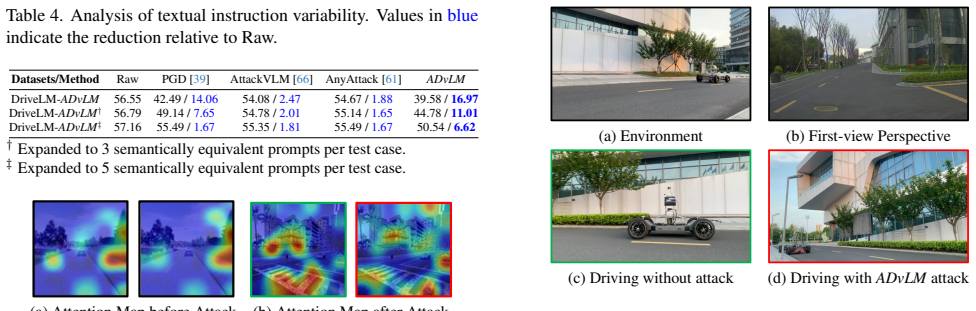
By combining Semantic-Invariant Induction to generate diverse yet semantically equivalent textual instructions through an LLM and semantic entropy with Scenario-Associated Enhancement that selects critical frames and perspectives via attention, ADvLM produces visual perturbations that remain effective against AD VLMs despite instruction variability and the sequential character of driving scenarios, attaining state-of-the-art results on multiple benchmarks and showing applicability in real-world tests.
What carries the argument
Semantic-Invariant Induction paired with Scenario-Associated Enhancement, which together generate and focus adversarial perturbations that generalize across textual variation and time-series driving inputs.
If this is right
- Perturbations created this way succeed across many different textual instructions without needing to match any single one exactly.
- Optimizing on a subset of attention-selected frames and perspectives makes the attack effective over entire time-series scenarios.
- The method records higher attack success rates than prior approaches on several AD VLMs across multiple benchmarks.
- Real-world experiments confirm that the generated perturbations transfer to practical driving settings.
Where Pith is reading between the lines
- Safety testing protocols for autonomous driving systems would need to incorporate attacks that explicitly vary instructions and span full sequences.
- Model developers might add checks for semantic consistency in prompts and robustness around attention mechanisms to reduce such vulnerabilities.
- If the generalization holds, regulatory evaluations of autonomous vehicles could require explicit testing against scenario-associated visual perturbations.
Load-bearing premise
The assumption that an LLM prompt library built with semantic entropy plus attention-selected frames will yield perturbations effective across unseen instructions and full driving sequences without benchmark-specific overfitting.
What would settle it
Running ADvLM on a new AD VLM or driving benchmark outside the paper's tested set and finding attack success rates no higher than existing general VLM attacks, or real-world physical tests showing no transfer of the claimed effectiveness.
Figures


read the original abstract
Vision-language models (VLMs) have significantly advanced autonomous driving (AD) by enhancing reasoning capabilities. However, these models remain highly vulnerable to adversarial attacks. While existing research has primarily focused on general VLM attacks, the development of attacks tailored to the safety-critical AD context has been largely overlooked. In this paper, we take the first step toward designing adversarial attacks specifically targeting VLMs in AD, exposing the substantial risks these attacks pose within this critical domain. We identify two unique challenges for effective adversarial attacks on AD VLMs: the variability of textual instructions and the time-series nature of visual scenarios. To this end, we propose ADvLM, the first visual adversarial attack framework specifically designed for VLMs in AD. Our framework introduces Semantic-Invariant Induction, which uses a large language model to create a diverse prompt library of textual instructions with consistent semantic content, guided by semantic entropy. Building on this, we introduce Scenario-Associated Enhancement, an approach where attention mechanisms select key frames and perspectives within driving scenarios to optimize adversarial perturbations that generalize across the entire scenario. Extensive experiments on several AD VLMs over multiple benchmarks show that ADvLM achieves state-of-the-art attack effectiveness. Moreover, real-world attack studies further validate its applicability and potential in practice.
Editorial analysis
A structured set of objections, weighed in public.
Referee Report
Summary. The paper introduces ADvLM as the first visual adversarial attack framework tailored to vision-language models (VLMs) used in autonomous driving (AD). It identifies two AD-specific challenges—variability in textual instructions and the time-series nature of driving scenarios—and proposes Semantic-Invariant Induction (LLM-generated diverse prompt library guided by semantic entropy) to handle instruction variability plus Scenario-Associated Enhancement (attention-based selection of key frames and perspectives) to optimize perturbations that generalize across scenarios. The central claims are that ADvLM achieves state-of-the-art attack success rates on multiple AD VLMs across benchmarks and that real-world studies confirm practical applicability.
Significance. If the generalization and SOTA claims hold under rigorous transfer testing, the work would be significant for exposing concrete safety risks in AD systems that rely on VLMs for reasoning. It is the first paper to target this domain specifically rather than applying generic VLM attacks, and the combination of LLM-driven semantic invariance with attention-driven scenario enhancement offers a plausible empirical construction for handling AD variability.
major comments (1)
- [Abstract / method description] Abstract and method description: the central effectiveness claim requires that perturbations generated via the entropy-guided prompt library and attention-selected frames/perspectives remain effective on unseen instructions and non-selected frames in driving sequences, yet no explicit transfer metrics (e.g., ASR on held-out instructions outside the library or on frames below the attention threshold) are reported. Without these, benchmark results may reflect selection bias rather than robustness to the stated AD challenges.
Simulated Author's Rebuttal
We thank the referee for the constructive feedback on our manuscript. We address the single major comment below.
read point-by-point responses
-
Referee: [Abstract / method description] Abstract and method description: the central effectiveness claim requires that perturbations generated via the entropy-guided prompt library and attention-selected frames/perspectives remain effective on unseen instructions and non-selected frames in driving sequences, yet no explicit transfer metrics (e.g., ASR on held-out instructions outside the library or on frames below the attention threshold) are reported. Without these, benchmark results may reflect selection bias rather than robustness to the stated AD challenges.
Authors: We agree that explicit transfer metrics on held-out instructions and non-selected frames would provide stronger direct evidence of generalization and help rule out selection bias. While the reported benchmarks already evaluate across diverse instructions and full driving sequences, the manuscript does not include the specific held-out tests suggested. In the revised version we will add experiments reporting ASR on instructions excluded from the prompt library and on frames below the attention threshold. revision: yes
Circularity Check
No circularity detected; empirical construction validated on external benchmarks
full rationale
The paper presents ADvLM as an empirical framework with two components (Semantic-Invariant Induction via LLM prompt library and Scenario-Associated Enhancement via attention selection) to address variability challenges in AD VLMs. All claims rest on experimental results across multiple benchmarks and real-world studies rather than any derivation that reduces to its own inputs by construction, fitted parameters renamed as predictions, or load-bearing self-citations. The central results are measured against external data and models, rendering the chain self-contained with no identifiable circular steps.
Axiom & Free-Parameter Ledger
Lean theorems connected to this paper
-
IndisputableMonolith/Cost/FunctionalEquation.leanwashburn_uniqueness_aczel unclear?
unclearRelation between the paper passage and the cited Recognition theorem.
Semantic-Invariant Induction... guided by semantic entropy... Scenario-Associated Enhancement... attention mechanisms select key frames... Lattack = (1-λ)Limage + λ Lscene
-
IndisputableMonolith/Foundation/AbsoluteFloorClosure.leanreality_from_one_distinction unclear?
unclearRelation between the paper passage and the cited Recognition theorem.
variability of textual instructions and the time-series nature of visual scenarios
What do these tags mean?
- matches
- The paper's claim is directly supported by a theorem in the formal canon.
- supports
- The theorem supports part of the paper's argument, but the paper may add assumptions or extra steps.
- extends
- The paper goes beyond the formal theorem; the theorem is a base layer rather than the whole result.
- uses
- The paper appears to rely on the theorem as machinery.
- contradicts
- The paper's claim conflicts with a theorem or certificate in the canon.
- unclear
- Pith found a possible connection, but the passage is too broad, indirect, or ambiguous to say the theorem truly supports the claim.
Forward citations
Cited by 7 Pith papers
-
Challenging Vision-Language Models with Physically Deployable Multimodal Semantic Lighting Attacks
MSLA is the first physically deployable attack that uses adversarial lighting to break semantic alignment in VLMs such as CLIP, LLaVA, and BLIP, causing classification failures and hallucinations in real scenes.
-
WMAttack: Automated Attack Search for Adversarial Evaluation of World-Model Agents
WMAttack automates finite-budget attack search for world-model agents via SCAS and RGAR, reporting higher normalized reward drops than baselines on Atari and DMC tasks.
-
GuardAD: Safeguarding Autonomous Driving MLLMs via Markovian Safety Logic
GuardAD reduces accident rates by 32% in autonomous driving MLLMs by using n-th order Markovian logic to infer latent hazards and revise actions.
-
High-Entropy Tokens as Multimodal Failure Points in Vision-Language Models
High-entropy tokens act as concentrated multimodal failure points in VLMs, enabling sparse Entropy-Guided Attacks that achieve 93-95% success and 30-38% harmful rates with cross-model transfer.
-
Lost in Fog: Sensor Perturbations Expose Reasoning Fragility in Driving VLAs
Sensor perturbations in driving VLAs cause Chain-of-Causation reasoning changes that correlate strongly with 5.3x higher trajectory deviation, while enabling such reasoning improves accuracy by 11.8%.
-
Adversarial Flow Matching for Imperceptible Attacks on End-to-End Autonomous Driving
AFM is a novel gray-box adversarial attack using flow matching to create visually imperceptible perturbations that degrade performance of Vision-Language-Action and modular end-to-end autonomous driving models while s...
-
A Patch-based Cross-view Regularized Framework for Backdoor Defense in Multimodal Large Language Models
A patch-augmented cross-view regularization method reduces backdoor attack success rates in multimodal LLMs by enforcing output differences between original and perturbed views while using entropy constraints to prese...
Reference graph
Works this paper leans on
-
[1]
Josh Achiam, Steven Adler, Sandhini Agarwal, Lama Ah- mad, Ilge Akkaya, Florencia Leoni Aleman, Diogo Almeida, Janko Altenschmidt, Sam Altman, Shyamal Anadkat, et al. Gpt-4 technical report. arXiv preprint arXiv:2303.08774 ,
work page internal anchor Pith review Pith/arXiv arXiv
-
[2]
Image hijacks: Adversarial images can control generative models at runtime
Luke Bailey, Euan Ong, Stuart Russell, and Scott Emmons. Image hijacks: Adversarial images can control generative models at runtime. arXiv preprint arXiv:2309.00236, 2023. 2
-
[3]
Driving with llms: Fusing object-level vec- tor modality for explainable autonomous driving
Long Chen, Oleg Sinavski, Jan H ¨unermann, Alice Karnsund, Andrew James Willmott, Danny Birch, Daniel Maund, and Jamie Shotton. Driving with llms: Fusing object-level vec- tor modality for explainable autonomous driving. In ICRA,
- [4]
-
[5]
Carla: An open urban driving simulator
Alexey Dosovitskiy, German Ros, Felipe Codevilla, Antonio Lopez, and Vladlen Koltun. Carla: An open urban driving simulator. In Conference on robot learning, 2017. 5
work page 2017
-
[6]
Detecting hallucinations in large language models using semantic entropy
Sebastian Farquhar, Jannik Kossen, Lorenz Kuhn, and Yarin Gal. Detecting hallucinations in large language models using semantic entropy. Nature, 2024. 4
work page 2024
-
[7]
Sensen Gao, Xiaojun Jia, Xuhong Ren, Ivor Tsang, and Qing Guo. Boosting transferability in vision-language attacks via diversification along the intersection region of adversarial trajectory. In ECCV, 2025. 2
work page 2025
-
[8]
Multimodal-gpt: A vision and language model for dialogue with humans
Tao Gong, Chengqi Lyu, Shilong Zhang, Yudong Wang, Miao Zheng, Qian Zhao, Kuikun Liu, Wenwei Zhang, Ping Luo, and Kai Chen. Multimodal-gpt: A vision and lan- guage model for dialogue with humans. arXiv preprint arXiv:2305.04790, 2023. 5, 6, 7
-
[9]
Explaining and Harnessing Adversarial Examples
Ian J Goodfellow, Jonathon Shlens, and Christian Szegedy. Explaining and harnessing adversarial examples. arXiv preprint arXiv:1412.6572, 2014. 5, 6, 7
work page internal anchor Pith review Pith/arXiv arXiv 2014
-
[10]
A comprehensive evaluation framework for deep model robustness
Jun Guo, Wei Bao, Jiakai Wang, Yuqing Ma, Xinghai Gao, Gang Xiao, Aishan Liu, Jian Dong, Xianglong Liu, and Wen- jun Wu. A comprehensive evaluation framework for deep model robustness. PR, 2023. 2
work page 2023
-
[11]
Generating transferable 3d adversarial point cloud via random perturbation factoriza- tion
Bangyan He, Jian Liu, Yiming Li, Siyuan Liang, Jingzhi Li, Xiaojun Jia, and Xiaochun Cao. Generating transferable 3d adversarial point cloud via random perturbation factoriza- tion. In Proceedings of the AAAI Conference on Artificial Intelligence, 2023. 1
work page 2023
-
[12]
Exploring the physical- world adversarial robustness of vehicle detection
Wei Jiang, Tianyuan Zhang, Shuangcheng Liu, Weiyu Ji, Zichao Zhang, and Gang Xiao. Exploring the physical- world adversarial robustness of vehicle detection. Electron- ics, 2023. 2
work page 2023
-
[13]
Robuste2e: Exploring the robustness of end-to-end autonomous driving
Wei Jiang, Lu Wang, Tianyuan Zhang, Yuwei Chen, Jian Dong, Wei Bao, Zichao Zhang, and Qiang Fu. Robuste2e: Exploring the robustness of end-to-end autonomous driving. Electronics, 2024. 2
work page 2024
-
[14]
Environmen- tal matching attack against unmanned aerial vehicles object detection
Dehong Kong, Siyuan Liang, and Wenqi Ren. Environmen- tal matching attack against unmanned aerial vehicles object detection. arXiv preprint arXiv:2405.07595, 2024. 1
-
[15]
Patch is enough: Naturalistic ad- versarial patch against vision-language pre-training models
Dehong Kong, Siyuan Liang, Xiaopeng Zhu, Yuansheng Zhong, and Wenqi Ren. Patch is enough: Naturalistic ad- versarial patch against vision-language pre-training models. arXiv preprint arXiv:2410.04884, 2024. 1
-
[16]
Towards benchmarking and assessing visual naturalness of physical world adversarial attacks
Simin Li, Shuning Zhang, Gujun Chen, Dong Wang, Pu Feng, Jiakai Wang, Aishan Liu, Xin Yi, and Xianglong Liu. Towards benchmarking and assessing visual naturalness of physical world adversarial attacks. In CVPR, 2023. 2
work page 2023
-
[17]
Efficient adversarial attacks for visual object tracking
Siyuan Liang, Xingxing Wei, Siyuan Yao, and Xiaochun Cao. Efficient adversarial attacks for visual object tracking. In Computer Vision–ECCV 2020: 16th European Confer- ence, Glasgow, UK, August 23–28, 2020, Proceedings, Part XXVI 16, 2020. 1
work page 2020
-
[18]
Generate more imperceptible adversarial examples for object detec- tion
Siyuan Liang, Xingxing Wei, and Xiaochun Cao. Generate more imperceptible adversarial examples for object detec- tion. In ICML, 2021
work page 2021
-
[19]
A large-scale multiple- objective method for black-box attack against object detec- tion
Siyuan Liang, Longkang Li, Yanbo Fan, Xiaojun Jia, Jingzhi Li, Baoyuan Wu, and Xiaochun Cao. A large-scale multiple- objective method for black-box attack against object detec- tion. In European Conference on Computer Vision, 2022
work page 2022
-
[20]
Siyuan Liang, Baoyuan Wu, Yanbo Fan, Xingxing Wei, and Xiaochun Cao. Parallel rectangle flip attack: A query-based black-box attack against object detection. arXiv preprint arXiv:2201.08970, 2022. 1
-
[21]
Badclip: Dual- embedding guided backdoor attack on multimodal con- trastive learning
Siyuan Liang, Mingli Zhu, Aishan Liu, Baoyuan Wu, Xiaochun Cao, and Ee-Chien Chang. Badclip: Dual- embedding guided backdoor attack on multimodal con- trastive learning. arXiv preprint arXiv:2311.12075 , 2023. 2
-
[22]
Perceptual-sensitive gan for generating adversarial patches
Aishan Liu, Xianglong Liu, Jiaxin Fan, Yuqing Ma, Anlan Zhang, Huiyuan Xie, and Dacheng Tao. Perceptual-sensitive gan for generating adversarial patches. In AAAI, 2019. 2
work page 2019
-
[23]
Spatiotemporal attacks for embodied agents
Aishan Liu, Tairan Huang, Xianglong Liu, Yitao Xu, Yuqing Ma, Xinyun Chen, Stephen J Maybank, and Dacheng Tao. Spatiotemporal attacks for embodied agents. In ECCV, 2020
work page 2020
-
[24]
Bias-based universal adver- sarial patch attack for automatic check-out
Aishan Liu, Jiakai Wang, Xianglong Liu, Bowen Cao, Chongzhi Zhang, and Hang Yu. Bias-based universal adver- sarial patch attack for automatic check-out. In ECCV, 2020
work page 2020
-
[25]
Training robust deep neu- ral networks via adversarial noise propagation
Aishan Liu, Xianglong Liu, Hang Yu, Chongzhi Zhang, Qiang Liu, and Dacheng Tao. Training robust deep neu- ral networks via adversarial noise propagation. IEEE TIP, 2021
work page 2021
-
[26]
{X-Adv}: Physical adversarial object attacks against x-ray prohibited item detection
Aishan Liu, Jun Guo, Jiakai Wang, Siyuan Liang, Renshuai Tao, Wenbo Zhou, Cong Liu, Xianglong Liu, and Dacheng Tao. {X-Adv}: Physical adversarial object attacks against x-ray prohibited item detection. In USENIX, 2023. 1
work page 2023
-
[27]
Towards defend- ing multiple lp-norm bounded adversarial perturbations via gated batch normalization
Aishan Liu, Shiyu Tang, Xinyun Chen, Lei Huang, Haotong Qin, Xianglong Liu, and Dacheng Tao. Towards defend- ing multiple lp-norm bounded adversarial perturbations via gated batch normalization. IJCV, 2023
work page 2023
-
[28]
Exploring the rela- tionship between architectural design and adversarially ro- bust generalization
Aishan Liu, Shiyu Tang, Siyuan Liang, Ruihao Gong, Boxi Wu, Xianglong Liu, and Dacheng Tao. Exploring the rela- tionship between architectural design and adversarially ro- bust generalization. In Proceedings of the IEEE/CVF Con- ference on Computer Vision and Pattern Recognition, 2023. 2
work page 2023
-
[29]
Pre-trained trojan attacks for visual recog- nition
Aishan Liu, Xinwei Zhang, Yisong Xiao, Yuguang Zhou, Siyuan Liang, Jiakai Wang, Xianglong Liu, Xiaochun Cao, and Dacheng Tao. Pre-trained trojan attacks for visual recog- nition. arXiv preprint arXiv:2312.15172, 2023. 2
-
[30]
Haotian Liu, Chunyuan Li, Qingyang Wu, and Yong Jae Lee. Visual instruction tuning. NeurIPS, 2024. 5, 6, 7
work page 2024
-
[31]
Mtd-gpt: A multi-task decision-making gpt model for autonomous driving at unsignalized intersections
Jiaqi Liu, Peng Hang, Xiao Qi, Jianqiang Wang, and Jian Sun. Mtd-gpt: A multi-task decision-making gpt model for autonomous driving at unsignalized intersections. In ITSC,
-
[32]
Improving adversarial transferability by stable diffusion.arXiv preprint arXiv:2311.11017, 2023
Jiayang Liu, Siyu Zhu, Siyuan Liang, Jie Zhang, Han Fang, Weiming Zhang, and Ee-Chien Chang. Improving adver- sarial transferability by stable diffusion. arXiv preprint arXiv:2311.11017, 2023. 1
-
[33]
Harnessing percep- tual adversarial patches for crowd counting
Shunchang Liu, Jiakai Wang, Aishan Liu, Yingwei Li, Yijie Gao, Xianglong Liu, and Dacheng Tao. Harnessing percep- tual adversarial patches for crowd counting. In ACM CCS,
-
[34]
Tianrui Lou, Xiaojun Jia, Jindong Gu, Li Liu, Siyuan Liang, Bangyan He, and Xiaochun Cao. Hide in thicket: Gener- ating imperceptible and rational adversarial perturbations on 3d point clouds. arXiv preprint arXiv:2403.05247, 2024. 1
-
[35]
Poisoning attack against estimating from pairwise comparisons
Ke Ma, Qianqian Xu, Jinshan Zeng, Xiaochun Cao, and Qingming Huang. Poisoning attack against estimating from pairwise comparisons. IEEE Transactions on Pattern Analy- sis and Machine Intelligence, 44(10):6393–6408, 2021
work page 2021
-
[36]
Ke Ma, Qianqian Xu, Jinshan Zeng, Guorong Li, Xiaochun Cao, and Qingming Huang. A tale of hodgerank and spectral method: Target attack against rank aggregation is the fixed point of adversarial game. IEEE Transactions on Pattern Analysis and Machine Intelligence, 45(4):4090–4108, 2022
work page 2022
-
[37]
Sequential manipula- tion against rank aggregation: theory and algorithm
Ke Ma, Qianqian Xu, Jinshan Zeng, Wei Liu, Xiaochun Cao, Yingfei Sun, and Qingming Huang. Sequential manipula- tion against rank aggregation: theory and algorithm. IEEE TPAMI, 2024. 1
work page 2024
-
[38]
Dolphins: Multimodal language model for driving
Yingzi Ma, Yulong Cao, Jiachen Sun, Marco Pavone, and Chaowei Xiao. Dolphins: Multimodal language model for driving. arXiv preprint arXiv:2312.00438, 2023. 2, 5, 6
-
[39]
Towards Deep Learning Models Resistant to Adversarial Attacks
Aleksander Madry, Aleksandar Makelov, Ludwig Schmidt, Dimitris Tsipras, and Adrian Vladu. Towards deep learn- ing models resistant to adversarial attacks. arXiv preprint arXiv:1706.06083, 2017. 5, 6, 7, 8
work page internal anchor Pith review Pith/arXiv arXiv 2017
-
[40]
GPT-Driver: Learning to Drive with GPT
Jiageng Mao, Yuxi Qian, Junjie Ye, Hang Zhao, and Yue Wang. Gpt-driver: Learning to drive with gpt.arXiv preprint arXiv:2310.01415, 2023. 1, 2
work page internal anchor Pith review Pith/arXiv arXiv 2023
-
[41]
Lingoqa: Video question answering for autonomous driving
Ana-Maria Marcu, Long Chen, Jan H ¨unermann, Alice Karn- sund, Benoit Hanotte, Prajwal Chidananda, Saurabh Nair, Vijay Badrinarayanan, Alex Kendall, Jamie Shotton, et al. Lingoqa: Video question answering for autonomous driving. arXiv preprint arXiv:2312.14115, 2023. 2
-
[42]
Reason2drive: Towards interpretable and chain-based reasoning for au- tonomous driving
Ming Nie, Renyuan Peng, Chunwei Wang, Xinyue Cai, Jianhua Han, Hang Xu, and Li Zhang. Reason2drive: Towards interpretable and chain-based reasoning for au- tonomous driving. arXiv preprint arXiv:2312.03661, 2023. 2
- [43]
-
[44]
Takami Sato, Junjie Shen, Ningfei Wang, Yunhan Jia, Xue Lin, and Qi Alfred Chen. Dirty road can attack: Secu- rity of deep learning based automated lane centering under {Physical-World} attack. In USENIX, 2021. 8
work page 2021
-
[45]
Lmdrive: Closed-loop end-to-end driving with large language models
Hao Shao, Yuxuan Hu, Letian Wang, Guanglu Song, Steven L Waslander, Yu Liu, and Hongsheng Li. Lmdrive: Closed-loop end-to-end driving with large language models. In CVPR, 2024. 1, 2, 5, 6
work page 2024
-
[46]
Drivelm: Driving with graph visual question answering.arXiv preprint arXiv:2312.14150,
Chonghao Sima, Katrin Renz, Kashyap Chitta, Li Chen, Hanxue Zhang, Chengen Xie, Ping Luo, Andreas Geiger, and Hongyang Li. Drivelm: Driving with graph visual ques- tion answering. arXiv preprint arXiv:2312.14150, 2023. 2, 5, 6
-
[47]
Trans- ferable multimodal attack on vision-language pre-training models
Haodi Wang, Kai Dong, Zhilei Zhu, Haotong Qin, Aishan Liu, Xiaolin Fang, Jiakai Wang, and Xianglong Liu. Trans- ferable multimodal attack on vision-language pre-training models. In S&P, 2024. 2
work page 2024
-
[48]
Dual attention suppression at- tack: Generate adversarial camouflage in physical world
Jiakai Wang, Aishan Liu, Zixin Yin, Shunchang Liu, Shiyu Tang, and Xianglong Liu. Dual attention suppression at- tack: Generate adversarial camouflage in physical world. In CVPR, 2021. 2
work page 2021
-
[49]
Attack end-to-end autonomous driving through module-wise noise
Lu Wang, Tianyuan Zhang, Yikai Han, Muyang Fang, Ting Jin, and Jiaqi Kang. Attack end-to-end autonomous driving through module-wise noise. In CVPRW, 2024. 2
work page 2024
-
[50]
Wenhai Wang, Jiangwei Xie, ChuanYang Hu, Haoming Zou, Jianan Fan, Wenwen Tong, Yang Wen, Silei Wu, Hanming Deng, Zhiqi Li, et al. Drivemlm: Aligning multi-modal large language models with behavioral planning states for au- tonomous driving. arXiv preprint arXiv:2312.09245, 2023. 2
-
[51]
Image quality assessment: from error visibility to structural similarity
Zhou Wang, Alan C Bovik, Hamid R Sheikh, and Eero P Simoncelli. Image quality assessment: from error visibility to structural similarity. IEEE TIP, 2004. 5, 8
work page 2004
-
[52]
Zhiyuan Wang, Zeliang Zhang, Siyuan Liang, and Xiaosen Wang. Diversifying the high-level features for better ad- versarial transferability. arXiv preprint arXiv:2304.10136 ,
-
[53]
Transferable Adversarial Attacks for Image and Video Object Detection
Xingxing Wei, Siyuan Liang, Ning Chen, and Xiaochun Cao. Transferable adversarial attacks for image and video object detection. arXiv preprint arXiv:1811.12641, 2018. 1
work page internal anchor Pith review Pith/arXiv arXiv 2018
-
[54]
Wenzhuo Xu, Kai Chen, Ziyi Gao, Zhipeng Wei, Jingjing Chen, and Yu-Gang Jiang. Highly transferable diffusion- based unrestricted adversarial attack on pre-trained vision- language models. In ACM MM, 2024. 2
work page 2024
-
[55]
Drivegpt4: Interpretable end-to-end autonomous driving via large language model
Zhenhua Xu, Yujia Zhang, Enze Xie, Zhen Zhao, Yong Guo, Kwan-Yee K Wong, Zhenguo Li, and Hengshuang Zhao. Drivegpt4: Interpretable end-to-end autonomous driving via large language model. IEEE Robotics and Automation Let- ters, 2024. 1, 2
work page 2024
-
[56]
Vlattack: Multimodal adversarial attacks on vision-language tasks via pre-trained models
Ziyi Yin, Muchao Ye, Tianrong Zhang, Tianyu Du, Jinguo Zhu, Han Liu, Jinghui Chen, Ting Wang, and Fenglong Ma. Vlattack: Multimodal adversarial attacks on vision-language tasks via pre-trained models. Advances in Neural Informa- tion Processing Systems, 36, 2024. 1, 2
work page 2024
-
[57]
Safebench: A safety evaluation framework for multimodal large language models
Zonghao Ying, Aishan Liu, Siyuan Liang, Lei Huang, Jinyang Guo, Wenbo Zhou, Xianglong Liu, and Dacheng Tao. Safebench: A safety evaluation framework for multimodal large language models. arXiv preprint arXiv:2410.18927, 2024
-
[58]
Jailbreak vision language models via bi-modal adversarial prompt
Zonghao Ying, Aishan Liu, Tianyuan Zhang, Zhengmin Yu, Siyuan Liang, Xianglong Liu, and Dacheng Tao. Jailbreak vision language models via bi-modal adversarial prompt. arXiv preprint arXiv:2406.04031, 2024. 1, 2
-
[59]
Interpreting and im- proving adversarial robustness of deep neural networks with neuron sensitivity
Chongzhi Zhang, Aishan Liu, Xianglong Liu, Yitao Xu, Hang Yu, Yuqing Ma, and Tianlin Li. Interpreting and im- proving adversarial robustness of deep neural networks with neuron sensitivity. IEEE TIP, 2021. 2
work page 2021
-
[60]
Towards adversarial attack on vision-language pre-training models
Jiaming Zhang, Qi Yi, and Jitao Sang. Towards adversarial attack on vision-language pre-training models. In ACM MM,
-
[61]
Jiaming Zhang, Junhong Ye, Xingjun Ma, Yige Li, Yunfan Yang, Jitao Sang, and Dit-Yan Yeung. Anyattack: Towards large-scale self-supervised generation of targeted adversar- ial examples for vision-language models. arXiv preprint arXiv:2410.05346, 2024. 2, 5, 6, 7, 8
-
[62]
Benchmarking the physical-world ad- versarial robustness of vehicle detection
Tianyuan Zhang, Yisong Xiao, Xiaoya Zhang, Hao Li, and Lu Wang. Benchmarking the physical-world ad- versarial robustness of vehicle detection. arXiv preprint arXiv:2304.05098, 2023. 2
-
[63]
Module-wise adaptive adversarial training for end-to-end au- tonomous driving
Tianyuan Zhang, Lu Wang, Jiaqi Kang, Xinwei Zhang, Siyuan Liang, Yuwei Chen, Aishan Liu, and Xianglong Liu. Module-wise adaptive adversarial training for end-to-end au- tonomous driving. arXiv preprint arXiv:2409.07321, 2024. 2
-
[64]
Lanevil: Benchmarking the robustness of lane detection to environmental illusions
Tianyuan Zhang, Lu Wang, Hainan Li, Yisong Xiao, Siyuan Liang, Aishan Liu, Xianglong Liu, and Dacheng Tao. Lanevil: Benchmarking the robustness of lane detection to environmental illusions. arXiv preprint arXiv:2406.00934 ,
-
[65]
Towards robust physical-world backdoor attacks on lane detection
Xinwei Zhang, Aishan Liu, Tianyuan Zhang, Siyuan Liang, and Xianglong Liu. Towards robust physical-world backdoor attacks on lane detection. arXiv preprint arXiv:2405.05553,
-
[66]
On evaluat- ing adversarial robustness of large vision-language models
Yunqing Zhao, Tianyu Pang, Chao Du, Xiao Yang, Chongx- uan Li, Ngai-Man Man Cheung, and Min Lin. On evaluat- ing adversarial robustness of large vision-language models. NeurIPS, 2024. 2, 5, 6, 7, 8
work page 2024
-
[67]
Advclip: Downstream-agnostic adversarial examples in multimodal contrastive learning
Ziqi Zhou, Shengshan Hu, Minghui Li, Hangtao Zhang, Yechao Zhang, and Hai Jin. Advclip: Downstream-agnostic adversarial examples in multimodal contrastive learning. In ACM MM, 2023. 2
work page 2023
-
[68]
MiniGPT-4: Enhancing Vision-Language Understanding with Advanced Large Language Models
Deyao Zhu, Jun Chen, Xiaoqian Shen, Xiang Li, and Mo- hamed Elhoseiny. Minigpt-4: Enhancing vision-language understanding with advanced large language models. arXiv preprint arXiv:2304.10592, 2023. 5, 6, 7
work page internal anchor Pith review Pith/arXiv arXiv 2023
discussion (0)
Sign in with ORCID, Apple, or X to comment. Anyone can read and Pith papers without signing in.