High-order fluctuations of temperature in hot QCD matter
Pith reviewed 2026-05-22 20:03 UTC · model grok-4.3
The pith
A new thermodynamic state function shows temperature fluctuations in hot QCD matter are suppressed during the transition from hadron resonance gas to quark-gluon plasma.
A machine-rendered reading of the paper's core claim, the machinery that carries it, and where it could break.
Core claim
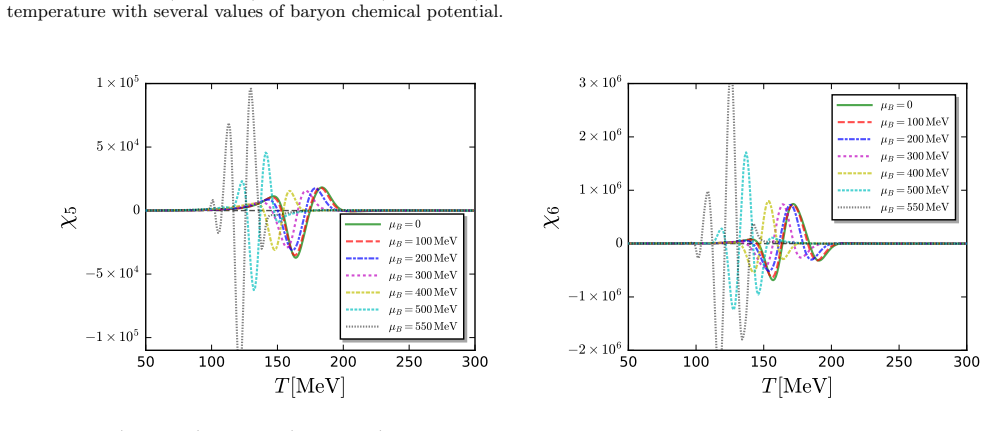
By introducing a new thermodynamic state function that describes the thermodynamics relevant for the mean transverse momentum fluctuations of charged particles, temperature fluctuations of different orders can be computed in hot QCD matter for the first time. These fluctuations are suppressed remarkably as the system transitions from the hadron resonance gas to the quark-gluon plasma with increasing temperature or baryon chemical potential, accompanied by negative skewness. The increase in heat capacity of QCD matter in the QGP compared to the HRG accounts for the suppression.
What carries the argument
The newly introduced thermodynamic state function that encodes the thermodynamics of mean transverse momentum fluctuations, allowing extraction of temperature fluctuation moments of different orders.
Load-bearing premise
The new thermodynamic state function accurately encodes the thermodynamics relevant for mean transverse momentum fluctuations of charged particles without significant contamination from other dynamical effects in the collision evolution.
What would settle it
Measurements in heavy-ion collisions that fail to show suppressed temperature fluctuations with negative skewness when the system reaches higher temperatures or baryon chemical potentials corresponding to the QGP phase would falsify the central claim.
Figures



read the original abstract
A new thermodynamic state function is introduced to describe the thermodynamics relevant for the mean transverse momentum fluctuations of charged particles in heavy-ion collisions, which allows us to compute the temperature fluctuations of different orders in hot quantum chromodynamics (QCD) matter for the first time. Consequently, it is found that the temperature fluctuations are suppressed remarkably as the system transitions from the hadron resonance gas (HRG) to the quark-gluon plasma (QGP) with increasing temperature or baryon chemical potential, alongside a negative skewness. This is attributed to the general fact that the heat capacity of QCD matter increases significantly in QGP in comparison to that in HRG. These predictions provide a unique signature to discover the thermodynamical temperature fluctuations in upcoming heavy-ion collision experiments, which also paves a novel way to study QCD thermodynamics and QCD phase diagram through measurements of the mean transverse momentum fluctuations of charged particles.
Editorial analysis
A structured set of objections, weighed in public.
Referee Report
Summary. The manuscript introduces a new thermodynamic state function intended to connect mean transverse momentum fluctuations of charged particles in heavy-ion collisions to the thermodynamics of hot QCD matter. Using this function, the authors compute higher-order moments of temperature fluctuations and report that these fluctuations are strongly suppressed, accompanied by negative skewness, as the system evolves from the hadron resonance gas to the quark-gluon plasma with rising temperature or baryon chemical potential. The suppression is attributed to the known increase in heat capacity across this transition, and the results are presented as a potential experimental signature for thermodynamic temperature fluctuations.
Significance. If the new state function correctly isolates thermodynamic temperature fluctuations, the work would supply a concrete, falsifiable prediction for mean-p_T fluctuation measurements in upcoming heavy-ion runs and a new route to constrain the QCD equation of state. The attribution to heat capacity is standard, but the higher-order fluctuation results and the proposed mapping constitute the novel element.
major comments (2)
- [Abstract / state-function introduction] The central claim that temperature-fluctuation moments can be extracted directly from mean-p_T fluctuations rests on the newly introduced state function. No derivation, explicit definition, or validation against non-equilibrium effects (collective flow, viscous corrections, resonance decays, initial-state fluctuations) is supplied in the abstract; without such justification the reported suppression cannot be attributed solely to the increase in heat capacity.
- [Results section (implied by abstract claims)] The manuscript provides neither error estimates on the computed moments nor any comparison with existing fluctuation data or hydrodynamic simulations, leaving the quantitative size of the reported suppression and the sign of the skewness untested.
Simulated Author's Rebuttal
We thank the referee for their careful reading of our manuscript and for providing constructive comments. We respond to each major comment below and describe the revisions we intend to make.
read point-by-point responses
-
Referee: [Abstract / state-function introduction] The central claim that temperature-fluctuation moments can be extracted directly from mean-p_T fluctuations rests on the newly introduced state function. No derivation, explicit definition, or validation against non-equilibrium effects (collective flow, viscous corrections, resonance decays, initial-state fluctuations) is supplied in the abstract; without such justification the reported suppression cannot be attributed solely to the increase in heat capacity.
Authors: The derivation and explicit definition of the new thermodynamic state function are presented in detail in Section II of the manuscript. We agree with the referee that the abstract would benefit from a concise mention of this. In the revised version, we will modify the abstract to briefly describe the state function and its connection to mean-p_T fluctuations. Concerning validation against non-equilibrium effects, the present study is grounded in equilibrium thermodynamics under the assumption of local equilibrium, which is a standard approximation in the hydrodynamic modeling of heavy-ion collisions. We will add a discussion of these assumptions and their validity range in the revised manuscript, emphasizing that the reported suppression arises from the thermodynamic relation to the heat capacity, independent of the specific non-equilibrium details to leading order. revision: yes
-
Referee: [Results section (implied by abstract claims)] The manuscript provides neither error estimates on the computed moments nor any comparison with existing fluctuation data or hydrodynamic simulations, leaving the quantitative size of the reported suppression and the sign of the skewness untested.
Authors: We accept this criticism and will improve the results section accordingly. We will incorporate error estimates by propagating the uncertainties from the lattice QCD equation of state and other inputs used in the calculations. Additionally, we will include comparisons with available data on mean transverse momentum fluctuations from heavy-ion experiments and discuss consistency with hydrodynamic model predictions. This will allow us to better quantify the suppression and the negative skewness, providing a more robust test of our predictions. revision: yes
Circularity Check
No circularity detected; derivation relies on independent thermodynamic relations
full rationale
The paper introduces a new thermodynamic state function as an enabling construct to connect mean transverse momentum fluctuations to temperature fluctuation moments. The reported suppression of fluctuations and negative skewness upon transition to QGP is explicitly attributed to the independent general fact of increased heat capacity in QGP versus HRG, rather than any fitted parameter or self-referential definition. No load-bearing step reduces by construction to its own inputs, no self-citation chains are invoked for uniqueness, and the central claim remains self-contained against external thermodynamic benchmarks. This is the expected honest non-finding for a paper whose key attribution rests on standard thermodynamic properties.
Axiom & Free-Parameter Ledger
axioms (1)
- standard math Thermodynamic identity linking heat capacity to the magnitude of temperature fluctuations
invented entities (1)
-
New thermodynamic state function
no independent evidence
Forward citations
Cited by 2 Pith papers
-
Non-Monotonicity of Transverse Momentum Correlations in Au + Au Collisions at RHIC
First measurements of pT correlations in Au+Au collisions at 3-7.7 GeV reveal non-monotonic energy dependence in central events with 5 sigma significance, breaking 1/sqrt(N_part) scaling.
-
Fluctuations of Temperature in the Polyakov-loop extended Nambu--Jona-Lasinio Model
High-order cumulant ratios of temperature fluctuations in the 3-flavor PNJL model show non-monotonic peak-dip structures associated with the deconfinement phase transition.
Reference graph
Works this paper leans on
-
[1]
Event-by-event physics in relativistic heavy ion collisions
H. Heiselberg, Event-by-event physics in relativistic heavy ion collisions, Phys. Rept. 351, 161 (2001), arXiv:nucl-th/0003046
work page internal anchor Pith review Pith/arXiv arXiv 2001
-
[2]
Charged Particle Ratio Fluctuation as a Signal for QGP
S. Jeon and V. Koch, Charged particle ratio fluctuation as a signal for QGP, Phys. Rev. Lett. 85, 2076 (2000), arXiv:hep-ph/0003168
work page internal anchor Pith review Pith/arXiv arXiv 2076
-
[3]
S. A. Voloshin, V. Koch, and H. G. Ritter, Event-by- event fluctuations in collective quantities, Phys. Rev. C 60, 024901 (1999), arXiv:nucl-th/9903060
work page internal anchor Pith review Pith/arXiv arXiv 1999
-
[4]
Fluctuation Probes of Quark Deconfinement
M. Asakawa, U. W. Heinz, and B. Muller, Fluctuation probes of quark deconfinement, Phys. Rev. Lett.85, 2072 (2000), arXiv:hep-ph/0003169
work page internal anchor Pith review Pith/arXiv arXiv 2072
-
[5]
E. V. Shuryak, Quantum Chromodynamics and the The- ory of Superdense Matter, Phys. Rept. 61, 71 (1980)
work page 1980
-
[6]
J. Adams et al. (STAR), Experimental and theoretical challenges in the search for the quark gluon plasma: The STAR Collaboration’s critical assessment of the evidence from RHIC collisions, Nucl. Phys. A 757, 102 (2005), arXiv:nucl-ex/0501009
work page internal anchor Pith review Pith/arXiv arXiv 2005
-
[7]
K. Adcox et al. (PHENIX), Formation of dense partonic matter in relativistic nucleus-nucleus collisions at RHIC: Experimental evaluation by the PHENIX collaboration, Nucl. Phys. A 757, 184 (2005), arXiv:nucl-ex/0410003
work page internal anchor Pith review Pith/arXiv arXiv 2005
-
[8]
C. W. Fabjan et al. (ALICE), ALICE: Physics Perfor- mance Report, J. Phys. G 32, 1295 (2006)
work page 2006
-
[9]
Heavy Ion Collisions: The Big Picture, and the Big Questions
W. Busza, K. Rajagopal, and W. van der Schee, Heavy Ion Collisions: The Big Picture, and the Big Questions, Ann. Rev. Nucl. Part. Sci. 68, 339 (2018), arXiv:1802.04801 [hep-ph]
work page internal anchor Pith review Pith/arXiv arXiv 2018
-
[10]
M. A. Stephanov, K. Rajagopal, and E. V. Shuryak, Sig- natures of the tricritical point in QCD, Phys. Rev. Lett. 81, 4816 (1998), arXiv:hep-ph/9806219
work page internal anchor Pith review Pith/arXiv arXiv 1998
-
[11]
M. A. Stephanov, K. Rajagopal, and E. V. Shuryak, Event-by-event fluctuations in heavy ion collisions and the QCD critical point, Phys. Rev. D 60, 114028 (1999), arXiv:hep-ph/9903292
work page internal anchor Pith review Pith/arXiv arXiv 1999
- [12]
- [13]
- [14]
-
[15]
M. M. Aggarwal et al. (STAR), An Experimental Explo- ration of the QCD Phase Diagram: The Search for the Critical Point and the Onset of De-confinement, (2010), arXiv:1007.2613 [nucl-ex]
work page internal anchor Pith review Pith/arXiv arXiv 2010
- [16]
-
[17]
J. Chen et al. , Properties of the QCD matter: review of selected results from the relativistic heavy ion collider beam energy scan (RHIC BES) program, Nucl. Sci. Tech. 35, 214 (2024), arXiv:2407.02935 [nucl-ex]
-
[18]
J. Adam et al. (STAR), Nonmonotonic Energy Depen- dence of Net-Proton Number Fluctuations, Phys. Rev. Lett. 126, 092301 (2021), arXiv:2001.02852 [nucl-ex]
- [19]
-
[20]
B. Aboona et al. (STAR), Beam Energy Dependence of Fifth and Sixth-Order Net-proton Number Fluctuations in Au+Au Collisions at RHIC, Phys. Rev. Lett. 130, 082301 (2023), arXiv:2207.09837 [nucl-ex]
-
[21]
M. Abdallah et al. (STAR), Higher-order cumulants 6 and correlation functions of proton multiplicity distri- butions in sNN=3 GeV Au+Au collisions at the RHIC STAR experiment, Phys. Rev. C 107, 024908 (2023), arXiv:2209.11940 [nucl-ex]
- [22]
-
[23]
W.-j. Fu, J. M. Pawlowski, F. Rennecke, and B.-J. Schaefer, Baryon number fluctuations at finite temper- ature and density, Phys. Rev. D 94, 116020 (2016), arXiv:1608.04302 [hep-ph]
work page internal anchor Pith review Pith/arXiv arXiv 2016
- [24]
- [25]
- [26]
-
[27]
Traces of Thermalization from Transverse Momentum Fluctuations in Nuclear Collisions
S. Gavin, Traces of thermalization from transverse mo- mentum fluctuations in nuclear collisions, Phys. Rev. Lett. 92, 162301 (2004), arXiv:nucl-th/0308067
work page internal anchor Pith review Pith/arXiv arXiv 2004
-
[28]
F. G. Gardim, F. Grassi, M. Luzum, and J.-Y. Ollitrault, Mapping the hydrodynamic response to the initial ge- ometry in heavy-ion collisions, Phys. Rev. C 85, 024908 (2012), arXiv:1111.6538 [nucl-th]
work page internal anchor Pith review Pith/arXiv arXiv 2012
-
[29]
Initial state geometry and fluctuations in Au+Au, Cu+Au and U+U collisions at RHIC
B. Schenke, P. Tribedy, and R. Venugopalan, Initial-state geometry and fluctuations in Au + Au, Cu + Au, and U + U collisions at energies available at the BNL Relativis- tic Heavy Ion Collider, Phys. Rev. C 89, 064908 (2014), arXiv:1403.2232 [nucl-th]
work page internal anchor Pith review Pith/arXiv arXiv 2014
- [30]
- [31]
- [32]
-
[33]
H. Appelsh¨ auseret al. (NA49), Event-by-event fluctua- tions of average transverse momentum in central Pb + Pb collisions at 158-GeV per nucleon, Phys. Lett. B 459, 679 (1999), arXiv:hep-ex/9904014
work page internal anchor Pith review Pith/arXiv arXiv 1999
-
[34]
D. Adamova et al. (CERES), Event by event fluctuations of the mean transverse momentum in 40, 80 and 158 A GeV / c Pb - Au collisions, Nucl. Phys. A727, 97 (2003), arXiv:nucl-ex/0305002
work page internal anchor Pith review Pith/arXiv arXiv 2003
- [35]
-
[36]
Incident energy dependence of pt correlations at relativistic energies
J. Adams et al. (STAR), Incident energy dependence of pt correlations at RHIC, Phys. Rev. C72, 044902 (2005), arXiv:nucl-ex/0504031
work page internal anchor Pith review Pith/arXiv arXiv 2005
-
[37]
T. Anticic et al. (NA49), Energy dependence of trans- verse momentum fluctuations in Pb+Pb collisions at the CERN Super Proton Synchrotron (SPS) at 20A to 158A GeV, Phys. Rev. C 79, 044904 (2009), arXiv:0810.5580 [nucl-ex]
work page internal anchor Pith review Pith/arXiv arXiv 2009
-
[38]
S. Acharya et al. (ALICE), Skewness and kurtosis of mean transverse momentum fluctuations at the LHC energies, Phys. Lett. B 850, 138541 (2024), arXiv:2308.16217 [nucl-ex]
-
[39]
R. Arnaldi et al. (NA60), Evidence for the production of thermal-like muon pairs with masses above 1-GeV/c**2 in 158-A-GeV Indium-Indium Collisions, Eur. Phys. J. C 59, 607 (2009), arXiv:0810.3204 [nucl-ex]
work page internal anchor Pith review Pith/arXiv arXiv 2009
-
[40]
J. Adamczewski-Musch et al. (HADES), Probing dense baryon-rich matter with virtual photons, Nature Phys. 15, 1040 (2019)
work page 2019
-
[41]
J. Churchill, L. Du, C. Gale, G. Jackson, and S. Jeon, Virtual Photons Shed Light on the Early Temperature of Dense QCD Matter, Phys. Rev. Lett.132, 172301 (2024), arXiv:2311.06951 [nucl-th]
- [42]
- [43]
-
[44]
J. Braun, W.-j. Fu, J. M. Pawlowski, F. Rennecke, D. Rosenbl¨ uh, and S. Yin, Chiral susceptibility in ( 2+1 )-flavor QCD, Phys. Rev. D 102, 056010 (2020), arXiv:2003.13112 [hep-ph]
-
[45]
Braun et al., Soft modes in hot QCD matter, (2023), arXiv:2310.19853 [hep-ph]
J. Braun et al., Soft modes in hot QCD matter, (2023), arXiv:2310.19853 [hep-ph]
- [46]
- [47]
- [48]
-
[49]
Fu, QCD at finite temperature and density within the fRG approach: an overview, Commun
W.-j. Fu, QCD at finite temperature and density within the fRG approach: an overview, Commun. Theor. Phys. 74, 097304 (2022), arXiv:2205.00468 [hep-ph]
-
[50]
P. Braun-Munzinger, B. Friman, K. Redlich, A. Rus- tamov, and J. Stachel, Relativistic nuclear collisions: Establishing a non-critical baseline for fluctuation measurements, Nucl. Phys. A 1008, 122141 (2021), arXiv:2007.02463 [nucl-th]
-
[51]
V. Vovchenko, V. Koch, and C. Shen, Proton number cumulants and correlation functions in Au-Au collisions at sNN=7.7–200 GeV from hydrodynamics, Phys. Rev. C 105, 014904 (2022), arXiv:2107.00163 [hep-ph]
- [52]
-
[53]
fQCD collaboration, https://fqcd-collaboration.github.io
-
[54]
P. M. Lo, B. Friman, O. Kaczmarek, K. Redlich, and C. Sasaki, Polyakov loop fluctuations in SU(3) lattice gauge theory and an effective gluon potential, Phys. Rev. D88, 074502 (2013), arXiv:1307.5958 [hep-lat]. 7 Supplemental Materials The supplemental materials provide some details of the 2+1 flavor low energy effective field theory within the functional...
work page internal anchor Pith review Pith/arXiv arXiv 2013
discussion (0)
Sign in with ORCID, Apple, or X to comment. Anyone can read and Pith papers without signing in.