Assisted Fibre Inflation in Perturbative LVS
Pith reviewed 2026-05-19 07:18 UTC · model grok-4.3
The pith
Multiple fibre moduli in a K3-fibred Calabi-Yau create an assisted inflation scenario that produces viable cosmological observables while keeping each individual field displacement sub-Planckian.
A machine-rendered reading of the paper's core claim, the machinery that carries it, and where it could break.
Core claim
In a K3-fibred Calabi-Yau threefold with h^{1,1}=3 and suitable underlying symmetries, the multi-fibre moduli produce an assisted inflation scenario in which multiple fields collectively generate cosmological observables consistent with current bounds; each individual inflaton field then traverses a reduced range given by Δφ_n = Δφ / √n, where Δφ is the effective single-field range required for the same observables.
What carries the argument
Assisted multi-fibre inflation arising from the collective dynamics of the three Kähler moduli in the chosen perturbative LVS geometry, which distributes the required field excursion across n fields so that each moves only Δφ/√n.
If this is right
- The spectral index and tensor-to-scalar ratio remain compatible with ACT data for a range of benchmark parameter choices.
- Individual field excursions stay below the Planck scale even though the collective motion produces the necessary number of e-folds.
- The volume modulus stays fixed throughout inflation because the underlying symmetries protect the large-volume minimum.
- The construction extends the single-field fibre inflation models by replacing one large displacement with several smaller ones.
Where Pith is reading between the lines
- The same assisted mechanism could be tested in other Calabi-Yau threefolds that admit multiple fibre moduli and similar symmetries.
- Precision measurements of the tensor-to-scalar ratio or non-Gaussianity parameters could distinguish this multi-field dynamics from single-field fibre inflation.
- The scaling Δφ_n = Δφ/√n suggests that adding still more fibre moduli would further suppress individual displacements, provided stabilization remains intact.
Load-bearing premise
The specific symmetries of the chosen K3-fibred Calabi-Yau threefold with three Kähler moduli keep the multi-field dynamics stable and do not introduce destabilizing corrections that would spoil volume stabilization.
What would settle it
An explicit computation of higher-order corrections or loop effects in the same K3-fibred geometry that either drives one of the moduli tachyonic or pushes the volume modulus away from its stabilized minimum during inflation.
Figures


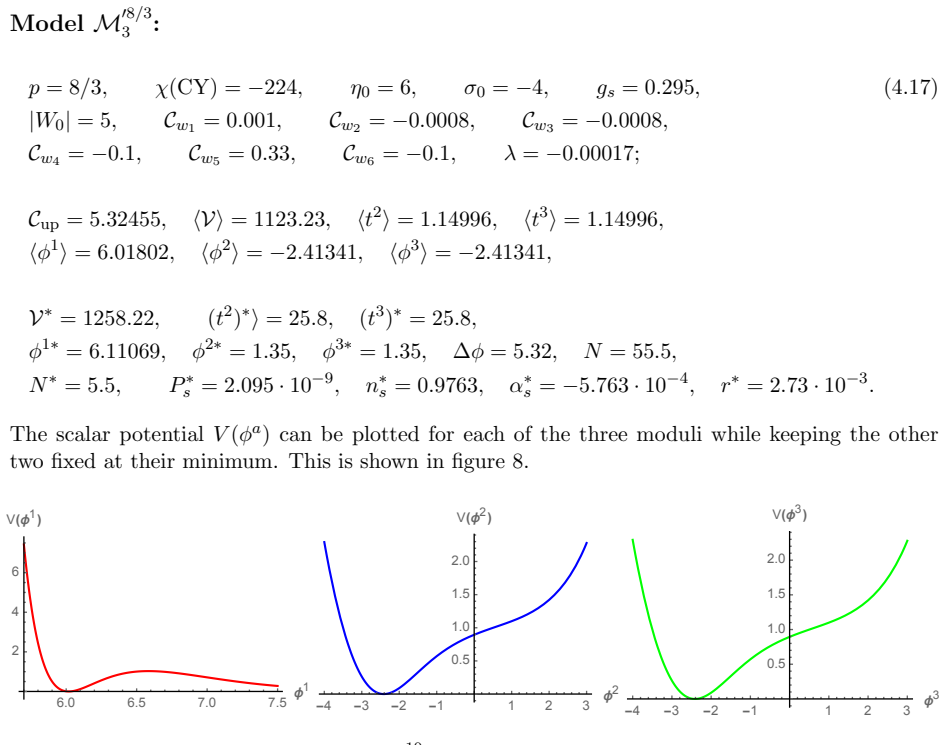


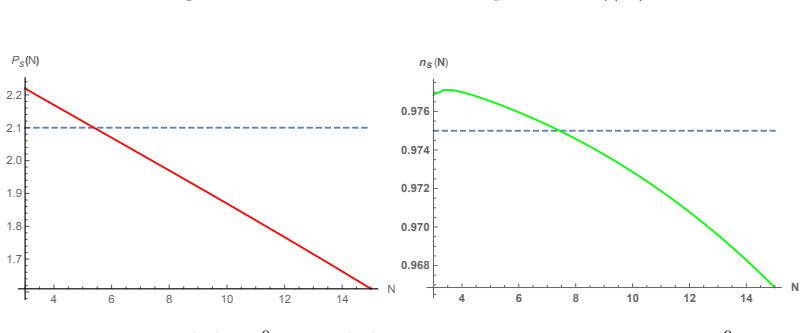
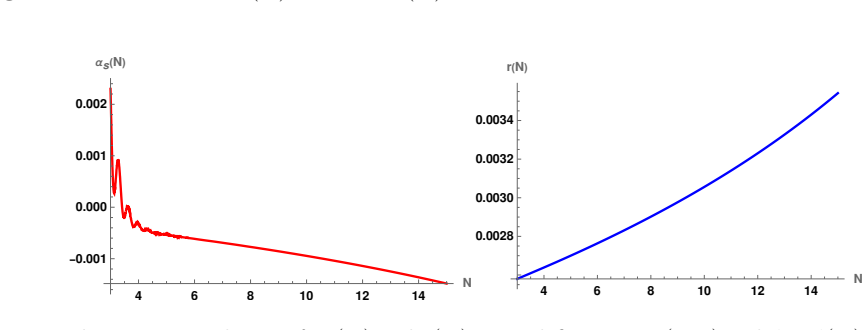


read the original abstract
We propose a multi-field fibre inflation scenario in type IIB perturbative large volume compactifications, showing that the multi-field dynamics suppresses trans-Planckian displacements of the canonical inflaton. Considering a concrete K3-fibred Calabi-Yau (CY) threefold with $h^{1,1}({\rm CY})=3$ and having certain underlying symmetries, we show that the presence of multi-fibre moduli creates an assisted inflation scenario where multiple moduli collectively help in producing the cosmological observables consistent with the current experimental bounds. We further argue that individual field range excursions $(\Delta\phi_n)$ corresponding to each of the inflaton fields can be estimated as $\Delta\phi_n = \Delta\phi/\sqrt{n}$, where $\Delta\phi$ denotes the effective single-field inflaton range needed to generate the desired cosmological observables, and $n$ is the number of moduli assisting the multi-fibre inflation. We also present various numerical benchmark models consistently producing cosmological observables in light of the recent ACT experiments.
Editorial analysis
A structured set of objections, weighed in public.
Referee Report
Summary. The paper proposes a multi-field fibre inflation scenario in type IIB perturbative large volume scenarios (LVS). Considering a concrete K3-fibred Calabi-Yau threefold with h^{1,1}(CY)=3 and underlying symmetries, it argues that multiple fibre moduli create an assisted inflation setup where the moduli collectively produce cosmological observables consistent with ACT data. Individual field range excursions are estimated as Δφ_n = Δφ/√n, and various numerical benchmark models are presented.
Significance. If the assisted scaling and multi-field stability hold after proper canonical normalization, the result would offer a controlled string-theoretic mechanism to realize fibre inflation with reduced individual displacements, addressing trans-Planckian issues while remaining within perturbative LVS. The numerical benchmarks provide concrete illustrations, though their robustness requires further verification.
major comments (2)
- [Setup of the K3-fibred CY and Kähler metric] The volume form for the h^{1,1}=3 K3-fibred CY is stated as V = √(τ_f1 τ_f2) (something + τ_b). This implies non-zero off-diagonal entries in the Kähler metric G_ij = ∂_i ∂_j K. The manuscript invokes underlying symmetries for stability in perturbative LVS but provides no explicit diagonalization of the metric or mass matrix along the multi-field trajectory. Consequently the claim that the assisted scaling Δφ_n = Δφ/√n survives canonical normalization is not demonstrated and is load-bearing for the central multi-fibre claim.
- [Numerical benchmark models] The abstract and numerical sections assert that benchmark models produce observables consistent with ACT data, yet no explicit scalar potential, parameter values, error analysis, or stability checks for the multi-field trajectory are supplied. This leaves the support for the central claim only moderately grounded.
minor comments (1)
- [Volume form] Clarify the precise volume form and the definition of the fibre moduli τ_f1, τ_f2 with an explicit equation in the setup section.
Simulated Author's Rebuttal
We thank the referee for their careful reading of the manuscript and for the constructive comments. We address each major point below and have revised the manuscript to incorporate additional details where appropriate.
read point-by-point responses
-
Referee: [Setup of the K3-fibred CY and Kähler metric] The volume form for the h^{1,1}=3 K3-fibred CY is stated as V = √(τ_f1 τ_f2) (something + τ_b). This implies non-zero off-diagonal entries in the Kähler metric G_ij = ∂_i ∂_j K. The manuscript invokes underlying symmetries for stability in perturbative LVS but provides no explicit diagonalization of the metric or mass matrix along the multi-field trajectory. Consequently the claim that the assisted scaling Δφ_n = Δφ/√n survives canonical normalization is not demonstrated and is load-bearing for the central multi-fibre claim.
Authors: We agree that an explicit diagonalization would make the argument more transparent. In the revised manuscript we add an appendix that performs the canonical normalization of the Kähler metric along the multi-field trajectory, explicitly showing that the off-diagonal terms do not alter the assisted scaling Δφ_n = Δφ/√n once the symmetries of the K3-fibred geometry are taken into account. The mass matrix is also diagonalized at the inflationary minimum to confirm stability. revision: yes
-
Referee: [Numerical benchmark models] The abstract and numerical sections assert that benchmark models produce observables consistent with ACT data, yet no explicit scalar potential, parameter values, error analysis, or stability checks for the multi-field trajectory are supplied. This leaves the support for the central claim only moderately grounded.
Authors: We acknowledge that the numerical section would benefit from greater explicitness. In the revision we supply the full scalar potential used for the benchmarks, list the concrete parameter values, include a short error analysis on the predicted observables, and add a brief numerical check confirming that the multi-field trajectory remains stable throughout the inflationary phase. revision: yes
Circularity Check
Δφ_n = Δφ/√n is the standard assisted-inflation scaling, not independently derived from the K3-fibred CY or perturbative LVS equations.
specific steps
-
fitted input called prediction
[Abstract]
"We further argue that individual field range excursions (Δφ_n) corresponding to each of the inflaton fields can be estimated as Δφ_n = Δφ/√n, where Δφ denotes the effective single-field inflaton range needed to generate the desired cosmological observables, and n is the number of moduli assisting the multi-fibre inflation."
Once Δφ is determined by fitting to ACT bounds and other observables, the per-field excursion Δφ_n = Δφ/√n follows at once from the standard assisted-inflation ansatz for n identical fields. The relation is therefore statistically forced by the input data and the generic multi-field formula; it does not constitute an independent prediction extracted from the perturbative LVS potential or the concrete CY volume form.
full rationale
The paper's central quantitative claim reduces to the generic assisted-inflation result once an effective single-field range Δφ is fixed by matching to cosmological observables. The specific volume form and Kähler metric of the h^{1,1}=3 threefold are not shown to produce or modify the 1/√n factor; the estimate is therefore a renaming of known multi-field dynamics rather than a first-principles output of the model. No explicit canonical-normalization calculation along the multi-field trajectory is provided to confirm decoupling or control of corrections.
Axiom & Free-Parameter Ledger
free parameters (1)
- Moduli vacuum expectation values and potential coefficients
axioms (1)
- domain assumption Perturbative large volume scenario stabilizes the overall volume and fibre moduli appropriately
Lean theorems connected to this paper
-
IndisputableMonolith/Foundation/AlexanderDuality.leanalexander_duality_circle_linking (D=3 from linking) echoes?
echoesECHOES: this paper passage has the same mathematical shape or conceptual pattern as the Recognition theorem, but is not a direct formal dependency.
Considering a concrete K3-fibred Calabi-Yau (CY) threefold with h^{1,1}(CY)=3 and having certain underlying symmetries... V ∝ √τ1 τ2 τ3 ... exchange symmetry 1↔2↔3
-
IndisputableMonolith/Cost/FunctionalEquation.leanwashburn_uniqueness_aczel (J-cost uniqueness) unclear?
unclearRelation between the paper passage and the cited Recognition theorem.
effective single field scalar potential V ≃ C0 (RLVS + R0 e^{-2γϕ} − e^{-γϕ} + ... ) with γ=1/√3
What do these tags mean?
- matches
- The paper's claim is directly supported by a theorem in the formal canon.
- supports
- The theorem supports part of the paper's argument, but the paper may add assumptions or extra steps.
- extends
- The paper goes beyond the formal theorem; the theorem is a base layer rather than the whole result.
- uses
- The paper appears to rely on the theorem as machinery.
- contradicts
- The paper's claim conflicts with a theorem or certificate in the canon.
- unclear
- Pith found a possible connection, but the passage is too broad, indirect, or ambiguous to say the theorem truly supports the claim.
Forward citations
Cited by 1 Pith paper
-
On Global Embedding of Assisted Fibre Inflation
Assisted multi-fibre inflation distributes the required field range across several moduli in global CY orientifolds, overcoming single-field Kähler cone obstructions to realize viable inflation.
Reference graph
Works this paper leans on
-
[1]
A. A. Starobinsky, A New Type of Isotropic Cosmological Models Without Singularity , Phys. Lett. B 91 (1980) 99–102
work page 1980
-
[2]
A. H. Guth, The Inflationary Universe: A Possible Solution to the Horizon and Flatness Problems, Phys. Rev. D 23 (1981) 347–356
work page 1981
-
[3]
A. D. Linde, A New Inflationary Universe Scenario: A Possible Solution of the Horizon, Flatness, Homogeneity, Isotropy and Primordial Monopole Problems , Phys. Lett. B 108 (1982) 389–393
work page 1982
-
[4]
The String Landscape and the Swampland
C. Vafa, The String landscape and the swampland , hep-th/0509212
work page internal anchor Pith review Pith/arXiv arXiv
-
[5]
On the Geometry of the String Landscape and the Swampland
H. Ooguri and C. Vafa, On the Geometry of the String Landscape and the Swampland , Nucl. Phys. B 766 (2007) 21–33, [ hep-th/0605264]
work page internal anchor Pith review Pith/arXiv arXiv 2007
-
[6]
De Sitter Space and the Swampland
G. Obied, H. Ooguri, L. Spodyneiko and C. Vafa, De Sitter Space and the Swampland , 1806.08362
work page internal anchor Pith review Pith/arXiv arXiv
- [7]
-
[8]
Distance and de Sitter Conjectures on the Swampland
H. Ooguri, E. Palti, G. Shiu and C. Vafa, Distance and de Sitter Conjectures on the Swampland, Phys. Lett. B 788 (2019) 180–184, [ 1810.05506]
work page internal anchor Pith review Pith/arXiv arXiv 2019
-
[9]
The Refined Swampland Distance Conjecture in Calabi-Yau Moduli Spaces
R. Blumenhagen, D. Kl¨ awer, L. Schlechter and F. Wolf,The Refined Swampland Distance Conjecture in Calabi-Yau Moduli Spaces, JHEP 06 (2018) 052, [ 1803.04989]
work page internal anchor Pith review Pith/arXiv arXiv 2018
- [10]
-
[11]
Swampland distance conjecture, inflation and α-attractors,
M. Scalisi and I. Valenzuela, Swampland distance conjecture, inflation and α-attractors, JHEP 08 (2019) 160, [ 1812.07558]
-
[12]
A. Bedroya, R. Brandenberger, M. Loverde and C. Vafa, Trans-Planckian Censorship and Inflationary Cosmology, Phys. Rev. D 101 (2020) 103502, [ 1909.11106]
-
[13]
The Swampland: Introduction and Review
E. Palti, The Swampland: Introduction and Review , Fortsch. Phys. 67 (2019) 1900037, [1903.06239]
work page internal anchor Pith review Pith/arXiv arXiv 2019
-
[14]
M. van Beest, J. Calder´ on-Infante, D. Mirfendereski and I. Valenzuela, Lectures on the Swampland Program in String Compactifications, Phys. Rept. 989 (2022) 1–50, [2102.01111]
- [15]
-
[16]
L. McAllister and F. Quevedo, Moduli Stabilization in String Theory , 2310.20559. 38
-
[17]
de Sitter Vacua in String Theory
S. Kachru, R. Kallosh, A. D. Linde and S. P. Trivedi, De Sitter vacua in string theory , Phys. Rev. D68 (2003) 046005, [ hep-th/0301240]
work page internal anchor Pith review Pith/arXiv arXiv 2003
-
[18]
Systematics of Moduli Stabilisation in Calabi-Yau Flux Compactifications
V. Balasubramanian, P. Berglund, J. P. Conlon and F. Quevedo, Systematics of moduli stabilisation in Calabi-Yau flux compactifications , JHEP 03 (2005) 007, [ hep-th/0502058]
work page internal anchor Pith review Pith/arXiv arXiv 2005
-
[19]
M Theory, Orientifolds and G-Flux
K. Dasgupta, G. Rajesh and S. Sethi, M theory, orientifolds and G - flux , JHEP 08 (1999) 023, [hep-th/9908088]
work page internal anchor Pith review Pith/arXiv arXiv 1999
-
[20]
CFT's From Calabi-Yau Four-folds
S. Gukov, C. Vafa and E. Witten, CFT’s from Calabi-Yau four folds , Nucl. Phys. B584 (2000) 69–108, [ hep-th/9906070]
work page internal anchor Pith review Pith/arXiv arXiv 2000
-
[21]
T. R. Taylor and C. Vafa, R R flux on Calabi-Yau and partial supersymmetry breaking , Phys.Lett. B474 (2000) 130–137, [ hep-th/9912152]
work page internal anchor Pith review Pith/arXiv arXiv 2000
-
[22]
Moduli Stabilization in Chiral Type IIB Orientifold Models with Fluxes
R. Blumenhagen, D. Lust and T. R. Taylor, Moduli stabilization in chiral type IIB orientifold models with fluxes , Nucl.Phys. B663 (2003) 319–342, [ hep-th/0303016]
work page internal anchor Pith review Pith/arXiv arXiv 2003
-
[23]
Supersymmetry Breaking and alpha'-Corrections to Flux Induced Potentials
K. Becker, M. Becker, M. Haack and J. Louis, Supersymmetry breaking and alpha-prime corrections to flux induced potentials , JHEP 06 (2002) 060, [ hep-th/0204254]
work page internal anchor Pith review Pith/arXiv arXiv 2002
-
[24]
Non-Perturbative Superpotentials In String Theory
E. Witten, Nonperturbative superpotentials in string theory , Nucl. Phys. B 474 (1996) 343–360, [hep-th/9604030]
work page internal anchor Pith review Pith/arXiv arXiv 1996
-
[25]
M. B. Green and P. Vanhove, D instantons, strings and M theory , Phys. Lett. B 408 (1997) 122–134, [ hep-th/9704145]
work page internal anchor Pith review Pith/arXiv arXiv 1997
-
[26]
D-brane Instantons in Type II String Theory
R. Blumenhagen, M. Cvetic, S. Kachru and T. Weigand, D-Brane Instantons in Type II Orientifolds, Ann. Rev. Nucl. Part. Sci. 59 (2009) 269–296, [ 0902.3251]
work page internal anchor Pith review Pith/arXiv arXiv 2009
-
[27]
GUTs in Type IIB Orientifold Compactifications
R. Blumenhagen, V. Braun, T. W. Grimm and T. Weigand, GUTs in Type IIB Orientifold Compactifications, Nucl.Phys. B815 (2009) 1–94, [ 0811.2936]
work page internal anchor Pith review Pith/arXiv arXiv 2009
-
[28]
Magnetized E3-brane instantons in F-theory
M. Bianchi, A. Collinucci and L. Martucci, Magnetized E3-brane instantons in F-theory , JHEP 12 (2011) 045, [ 1107.3732]
work page internal anchor Pith review Pith/arXiv arXiv 2011
-
[29]
A Note on Poly-Instanton Effects in Type IIB Orientifolds on Calabi-Yau Threefolds
R. Blumenhagen, X. Gao, T. Rahn and P. Shukla, A Note on Poly-Instanton Effects in Type IIB Orientifolds on Calabi-Yau Threefolds , JHEP 06 (2012) 162, [ 1205.2485]
work page internal anchor Pith review Pith/arXiv arXiv 2012
-
[30]
Freezing E3-brane instantons with fluxes
M. Bianchi, A. Collinucci and L. Martucci, Freezing E3-brane instantons with fluxes , Fortsch. Phys. 60 (2012) 914–920, [ 1202.5045]
work page internal anchor Pith review Pith/arXiv arXiv 2012
-
[31]
Building an explicit de Sitter
J. Louis, M. Rummel, R. Valandro and A. Westphal, Building an explicit de Sitter , JHEP 10 (2012) 163, [ 1208.3208]
work page internal anchor Pith review Pith/arXiv arXiv 2012
-
[32]
Moduli Stabilisation versus Chirality for MSSM like Type IIB Orientifolds
R. Blumenhagen, S. Moster and E. Plauschinn, Moduli Stabilisation versus Chirality for MSSM like Type IIB Orientifolds , JHEP 01 (2008) 058, [ 0711.3389]
work page internal anchor Pith review Pith/arXiv arXiv 2008
-
[33]
On Seven-Brane Dependent Instanton Prefactors in F-theory
M. Cvetic, R. Donagi, J. Halverson and J. Marsano, On Seven-Brane Dependent Instanton Prefactors in F-theory, JHEP 11 (2012) 004, [ 1209.4906]
work page internal anchor Pith review Pith/arXiv arXiv 2012
-
[34]
Higher-Derivative Supergravity and Moduli Stabilization
D. Ciupke, J. Louis and A. Westphal, Higher-Derivative Supergravity and Moduli Stabilization, JHEP 10 (2015) 094, [ 1505.03092]. 39
work page internal anchor Pith review Pith/arXiv arXiv 2015
-
[35]
M. Berg, M. Haack and B. Kors, Loop corrections to volume moduli and inflation in string theory, Phys. Rev. D71 (2005) 026005, [ hep-th/0404087]
work page internal anchor Pith review Pith/arXiv arXiv 2005
-
[36]
Kaehler Corrections for the Volume Modulus of Flux Compactifications
G. von Gersdorff and A. Hebecker, Kahler corrections for the volume modulus of flux compactifications, Phys. Lett. B 624 (2005) 270–274, [ hep-th/0507131]
work page internal anchor Pith review Pith/arXiv arXiv 2005
-
[37]
M. Berg, M. Haack and B. Kors, String loop corrections to Kahler potentials in orientifolds , JHEP 11 (2005) 030, [ hep-th/0508043]
work page internal anchor Pith review Pith/arXiv arXiv 2005
-
[38]
M. Berg, M. Haack and B. Kors, On volume stabilization by quantum corrections , Phys. Rev. Lett. 96 (2006) 021601, [ hep-th/0508171]
work page internal anchor Pith review Pith/arXiv arXiv 2006
-
[39]
Systematics of String Loop Corrections in Type IIB Calabi-Yau Flux Compactifications
M. Cicoli, J. P. Conlon and F. Quevedo, Systematics of String Loop Corrections in Type IIB Calabi-Yau Flux Compactifications, JHEP 01 (2008) 052, [ 0708.1873]
work page internal anchor Pith review Pith/arXiv arXiv 2008
- [40]
-
[41]
Perturbative moduli stabilisation in type IIB/F-theory framework
I. Antoniadis, Y. Chen and G. K. Leontaris, Perturbative moduli stabilisation in type IIB/F-theory framework, Eur. Phys. J. C78 (2018) 766, [ 1803.08941]
work page internal anchor Pith review Pith/arXiv arXiv 2018
-
[42]
I. Antoniadis, Y. Chen and G. K. Leontaris, Logarithmic loop corrections, moduli stabilisation and de Sitter vacua in string theory , 1909.10525
-
[43]
I. Antoniadis, Y. Chen and G. K. Leontaris, String loop corrections and de Sitter vacua , PoS CORFU2019 (2020) 099
work page 2020
-
[44]
More Dual Fluxes and Moduli Fixing
G. Aldazabal, P. G. Camara, A. Font and L. Ibanez, More dual fluxes and moduli fixing , JHEP 0605 (2006) 070, [ hep-th/0602089]
work page internal anchor Pith review Pith/arXiv arXiv 2006
-
[45]
Flux moduli stabilisation, Supergravity algebras and no-go theorems
B. de Carlos, A. Guarino and J. M. Moreno, Flux moduli stabilisation, Supergravity algebras and no-go theorems , JHEP 01 (2010) 012, [ 0907.5580]
work page internal anchor Pith review Pith/arXiv arXiv 2010
-
[46]
Complete classification of Minkowski vacua in generalised flux models
B. de Carlos, A. Guarino and J. M. Moreno, Complete classification of Minkowski vacua in generalised flux models, JHEP 1002 (2010) 076, [ 0911.2876]
work page internal anchor Pith review Pith/arXiv arXiv 2010
-
[47]
A Flux-Scaling Scenario for High-Scale Moduli Stabilization in String Theory
R. Blumenhagen, A. Font, M. Fuchs, D. Herschmann, E. Plauschinn, Y. Sekiguchi et al., A Flux-Scaling Scenario for High-Scale Moduli Stabilization in String Theory , Nucl. Phys. B 897 (2015) 500–554, [ 1503.07634]
work page internal anchor Pith review Pith/arXiv arXiv 2015
-
[48]
Revisiting the two formulations of Bianchi identities and their implications on moduli stabilization
P. Shukla, Revisiting the two formulations of Bianchi identities and their implications on moduli stabilization, JHEP 08 (2016) 146, [ 1603.08545]
work page internal anchor Pith review Pith/arXiv arXiv 2016
-
[49]
E. Plauschinn, Moduli Stabilization with Non-Geometric Fluxes — Comments on Tadpole Contributions and de-Sitter Vacua , Fortsch. Phys. 69 (2021) 2100003, [ 2011.08227]
-
[50]
C. Damian and O. Loaiza-Brito, Galois groups of uplifted de Sitter vacua , 2307.08468
-
[51]
Shukla, On stable type IIA de-Sitter vacua with geometric flux , Eur
P. Shukla, On stable type IIA de-Sitter vacua with geometric flux , Eur. Phys. J. C 83 (2023) 196, [ 2202.12840]
- [52]
-
[53]
G. K. Leontaris and P. Shukla, Perturbative LVS and Inflation: A Review of Volume Modulus and Fibre Scenarios , in 24th Hellenic School and Workshops on Elementary Particle Physics and Gravity , 5, 2025, 2505.01246
work page internal anchor Pith review Pith/arXiv arXiv 2025
-
[54]
J. P. Conlon, R. Kallosh, A. D. Linde and F. Quevedo, Volume Modulus Inflation and the Gravitino Mass Problem, JCAP 09 (2008) 011, [ 0806.0809]
work page internal anchor Pith review Pith/arXiv arXiv 2008
-
[55]
J. P. Conlon, F. Quevedo and K. Suruliz, Large-volume flux compactifications: Moduli spectrum and D3/D7 soft supersymmetry breaking , JHEP 08 (2005) 007, [hep-th/0505076]
work page internal anchor Pith review Pith/arXiv arXiv 2005
-
[56]
J. J. Blanco-Pillado, D. Buck, E. J. Copeland, M. Gomez-Reino and N. J. Nunes, Kahler Moduli Inflation Revisited, JHEP 01 (2010) 081, [ 0906.3711]
work page internal anchor Pith review Pith/arXiv arXiv 2010
-
[57]
Global Orientifolded Quivers with Inflation
M. Cicoli, I. Garc` ıa-Etxebarria, C. Mayrhofer, F. Quevedo, P. Shukla and R. Valandro, Global Orientifolded Quivers with Inflation , JHEP 11 (2017) 134, [ 1706.06128]
work page internal anchor Pith review Pith/arXiv arXiv 2017
-
[58]
Fibre Inflation: Observable Gravity Waves from IIB String Compactifications
M. Cicoli, C. P. Burgess and F. Quevedo, Fibre Inflation: Observable Gravity Waves from IIB String Compactifications, JCAP 0903 (2009) 013, [ 0808.0691]
work page internal anchor Pith review Pith/arXiv arXiv 2009
-
[59]
$\alpha'$ Inflation: Moduli Stabilisation and Observable Tensors from Higher Derivatives
M. Cicoli, D. Ciupke, S. de Alwis and F. Muia, α′ Inflation: moduli stabilisation and observable tensors from higher derivatives , JHEP 09 (2016) 026, [ 1607.01395]
work page internal anchor Pith review Pith/arXiv arXiv 2016
-
[60]
Global Embedding of Fibre Inflation Models
M. Cicoli, F. Muia and P. Shukla, Global Embedding of Fibre Inflation Models , JHEP 11 (2016) 182, [ 1611.04612]
work page internal anchor Pith review Pith/arXiv arXiv 2016
-
[61]
Chiral Global Embedding of Fibre Inflation Models
M. Cicoli, D. Ciupke, V. A. Diaz, V. Guidetti, F. Muia and P. Shukla, Chiral Global Embedding of Fibre Inflation Models , JHEP 11 (2017) 207, [ 1709.01518]
work page internal anchor Pith review Pith/arXiv arXiv 2017
-
[62]
Chiral global embedding of Fibre Inflation with $\overline{\rm D3}$ uplift
M. Cicoli, A. Grassi, O. Lacombe and F. G. Pedro, Chiral global embedding of Fibre Inflation with D3 uplift, JHEP 06 (2025) 090, [ 2412.08723]
work page internal anchor Pith review Pith/arXiv arXiv 2025
-
[63]
M. Cicoli, F. G. Pedro and G. Tasinato, Poly-instanton Inflation, JCAP 12 (2011) 022, [1110.6182]
work page internal anchor Pith review Pith/arXiv arXiv 2011
-
[64]
Moduli Stabilization and Inflationary Cosmology with Poly-Instantons in Type IIB Orientifolds
R. Blumenhagen, X. Gao, T. Rahn and P. Shukla, Moduli Stabilization and Inflationary Cosmology with Poly-Instantons in Type IIB Orientifolds , JHEP 11 (2012) 101, [1208.1160]
work page internal anchor Pith review Pith/arXiv arXiv 2012
-
[65]
On Non-Gaussianities in Two-Field Poly-Instanton Inflation
X. Gao and P. Shukla, On Non-Gaussianities in Two-Field Poly-Instanton Inflation , JHEP 03 (2013) 061, [ 1301.6076]
work page internal anchor Pith review Pith/arXiv arXiv 2013
-
[66]
X. Gao, T. Li and P. Shukla, Cosmological observables in multi-field inflation with a non-flat field space, JCAP 10 (2014) 008, [ 1403.0654]
work page internal anchor Pith review Pith/arXiv arXiv 2014
- [67]
- [68]
- [69]
- [70]
-
[71]
D. Chakraborty and R. O. Ramos, Warming up the Fibres , 2505.04447
-
[72]
J. R. Bond, L. Kofman, S. Prokushkin and P. M. Vaudrevange, Roulette inflation with Kahler moduli and their axions , Phys. Rev. D 75 (2007) 123511, [ hep-th/0612197]
work page internal anchor Pith review Pith/arXiv arXiv 2007
-
[73]
A. R. Liddle, A. Mazumdar and F. E. Schunck, Assisted inflation, Phys. Rev. D 58 (1998) 061301, [astro-ph/9804177]
work page internal anchor Pith review Pith/arXiv arXiv 1998
-
[74]
S. Dimopoulos, S. Kachru, J. McGreevy and J. G. Wacker, N-flation, JCAP 08 (2008) 003, [hep-th/0507205]
work page internal anchor Pith review Pith/arXiv arXiv 2008
-
[75]
Planck 2018 results. X. Constraints on inflation
Planck collaboration, Y. Akrami et al., Planck 2018 results. X. Constraints on inflation , Astron. Astrophys. 641 (2020) A10, [ 1807.06211]
work page internal anchor Pith review Pith/arXiv arXiv 2018
-
[76]
Planck 2018 results. VI. Cosmological parameters
Planck collaboration, N. Aghanim et al., Planck 2018 results. VI. Cosmological parameters, Astron. Astrophys. 641 (2020) A6, [ 1807.06209]
work page internal anchor Pith review Pith/arXiv arXiv 2018
-
[77]
The Atacama Cosmology Telescope: DR6 Constraints on Extended Cosmological Models
ACT collaboration, E. Calabrese et al., The Atacama Cosmology Telescope: DR6 Constraints on Extended Cosmological Models , 2503.14454
work page internal anchor Pith review Pith/arXiv arXiv
-
[78]
The Atacama Cosmology Telescope: DR6 Power Spectra, Likelihoods and $\Lambda$CDM Parameters
ACT collaboration, T. Louis et al., The Atacama Cosmology Telescope: DR6 Power Spectra, Likelihoods and ΛCDM Parameters, 2503.14452
work page internal anchor Pith review Pith/arXiv arXiv
-
[79]
DESI collaboration, A. G. Adame et al., DESI 2024 VI: cosmological constraints from the measurements of baryon acoustic oscillations , JCAP 02 (2025) 021, [ 2404.03002]
work page internal anchor Pith review Pith/arXiv arXiv 2024
-
[80]
Are single-field models of inflation and PBH production ruled out by ACT observations?
D. Frolovsky and S. V. Ketov, Are single-field models of inflation and PBH production ruled out by ACT observations? , 2505.17514
discussion (0)
Sign in with ORCID, Apple, or X to comment. Anyone can read and Pith papers without signing in.