Generalized Perturbed Kepler Problem: Gravitational Wave Imprints from Eccentric Compact Binaries
Pith reviewed 2026-05-19 00:22 UTC · model grok-4.3
The pith
A general perturbed potential modifies eccentric binary orbits and imprints on their gravitational wave signals in a source-specific way.
A machine-rendered reading of the paper's core claim, the machinery that carries it, and where it could break.
Core claim
Starting from a general perturbed potential, the modified orbit is derived and the associated gravitational fluxes and phase evolution are computed. The framework assesses their observational relevance for both current and future detectors and supplies a general, physically transparent toolkit for probing deviations from standard dynamics in gravitational wave data.
What carries the argument
The unified framework built on a general perturbed potential within the perturbed Kepler problem, which generates the altered orbital motion and the resulting gravitational-wave fluxes and phase for eccentric binaries.
If this is right
- Modified orbital dynamics produce altered gravitational wave fluxes from the binary system.
- The accumulated phase evolution encodes the effects of the perturbation over the inspiral.
- The source-specific parametrization allows direct mapping of wave signatures to particular physical causes.
- The same fluxes and phase can be used to evaluate detectability thresholds in both present and next-generation detectors.
Where Pith is reading between the lines
- The same perturbative treatment could be specialized to concrete cases such as dark-matter-induced forces or specific modified-gravity corrections to predict distinct waveform deviations.
- The framework might be combined with numerical-relativity simulations of eccentric mergers to test consistency of the analytic phase evolution.
- Similar methods could address other environmental influences on binary dynamics, such as gas drag or external tidal fields, by choosing appropriate forms of the perturbed potential.
Load-bearing premise
A general perturbed potential can be introduced and treated perturbatively to produce observable gravitational-wave effects whose physical origins can be traced in a source-specific manner.
What would settle it
High-precision gravitational-wave observations of an eccentric compact binary that show phase evolution and fluxes indistinguishable from the unperturbed Keplerian case, with no measurable room for the derived corrections, would falsify the claim that such perturbations yield observable imprints.
Figures



read the original abstract
Observations of astrophysical binaries may reveal departures from pure Keplerian orbits due to environmental influences, modifications to the underlying gravitational dynamics, or signatures of new physics. In this work, we develop a unified framework to systematically study such perturbations in the ambit of the perturbed Kepler problem and explore their impact on eccentric orbital dynamics and gravitational wave emission. Unlike traditional parametrized frameworks such as post-Newtonian and post-Einsteinian expansions, our approach offers a more source-specific modeling strategy, making it more natural to trace the physical origins of eccentric binary model parameters. Starting from a general perturbed potential, we derive the modified orbit and compute the associated gravitational fluxes and phase evolution, assessing their observational relevance for both current and future detectors. This framework thus offers a general and physically transparent toolkit for probing such subtle deviations from standard dynamics in gravitational wave data.
Editorial analysis
A structured set of objections, weighed in public.
Referee Report
Summary. The manuscript develops a unified framework for the perturbed Kepler problem applied to eccentric compact binaries. Starting from a general perturbed potential, it derives the modified orbit, computes the associated gravitational-wave fluxes and phase evolution, and assesses observational relevance for current and future detectors. The approach is positioned as more source-specific and physically transparent than traditional post-Newtonian or post-Einsteinian parametrizations.
Significance. If the derivations hold, the framework supplies a physically transparent toolkit for modeling deviations from Keplerian dynamics in gravitational-wave signals from eccentric binaries. It enables tracing the physical origins of model parameters in a source-specific manner, which could aid interpretation of environmental influences or new-physics signatures in data from LIGO/Virgo/KAGRA and future detectors such as LISA.
minor comments (3)
- The abstract would benefit from a single illustrative equation (e.g., the form of the perturbed potential or the leading-order flux correction) to convey the concrete output of the framework.
- Section 2 (or equivalent): the transition from the general perturbed potential to the explicit orbit solution should include a brief statement of the small-parameter ordering and the domain of validity.
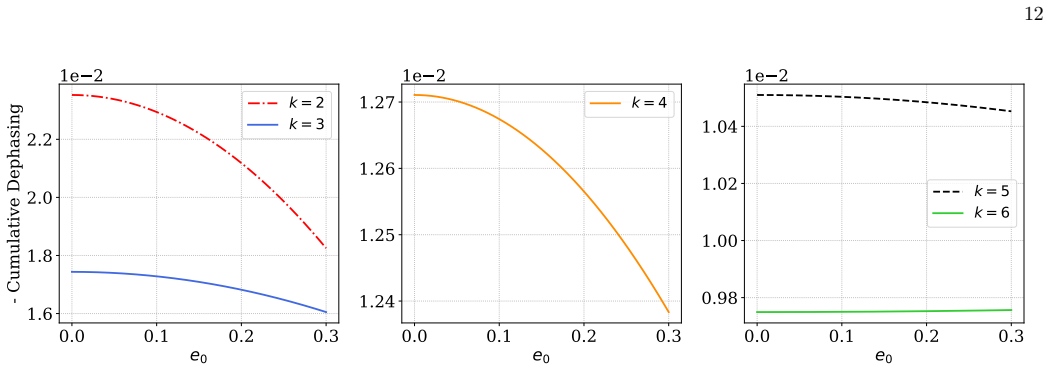
- The comparison of phase evolution to unperturbed or post-Newtonian cases is mentioned but would be strengthened by a short table or plot showing the fractional difference for representative eccentricities and perturbation strengths.
Simulated Author's Rebuttal
We thank the referee for their positive and constructive review of our manuscript on the generalized perturbed Kepler problem. We appreciate the recognition that our framework provides a physically transparent, source-specific approach to modeling deviations from Keplerian dynamics in eccentric compact binaries and their gravitational-wave signatures, as an alternative to traditional post-Newtonian or post-Einsteinian parametrizations. The recommendation for minor revision is noted, and we will incorporate any necessary clarifications in the revised version.
Circularity Check
No significant circularity; derivation is self-contained
full rationale
The paper begins with an arbitrary general perturbed potential as an explicit input assumption and proceeds to derive the modified orbit, gravitational fluxes, and phase evolution using standard perturbative methods in orbital mechanics. No equation or step reduces a prediction to a fitted parameter by construction, nor does any load-bearing claim rely on a self-citation chain that itself lacks independent verification. The framework is presented as a source-specific modeling strategy distinct from PN/PE expansions, with all outputs traceable to the initial potential without renaming known results or smuggling ansatze. This constitutes a normal, non-circular perturbative derivation.
Axiom & Free-Parameter Ledger
axioms (1)
- domain assumption Small deviations from Keplerian orbits can be treated using perturbative methods to obtain modified orbital elements and gravitational-wave fluxes.
Lean theorems connected to this paper
-
IndisputableMonolith/Foundation/RealityFromDistinction.leanreality_from_one_distinction unclear?
unclearRelation between the paper passage and the cited Recognition theorem.
Starting from a general perturbed potential, we derive the modified orbit and compute the associated gravitational fluxes and phase evolution
-
IndisputableMonolith/Cost/FunctionalEquation.leanwashburn_uniqueness_aczel unclear?
unclearRelation between the paper passage and the cited Recognition theorem.
V(r) = -N0μ/r + Σ ε Nk μ/r^k
What do these tags mean?
- matches
- The paper's claim is directly supported by a theorem in the formal canon.
- supports
- The theorem supports part of the paper's argument, but the paper may add assumptions or extra steps.
- extends
- The paper goes beyond the formal theorem; the theorem is a base layer rather than the whole result.
- uses
- The paper appears to rely on the theorem as machinery.
- contradicts
- The paper's claim conflicts with a theorem or certificate in the canon.
- unclear
- Pith found a possible connection, but the passage is too broad, indirect, or ambiguous to say the theorem truly supports the claim.
Forward citations
Cited by 1 Pith paper
-
Distinguishability of magnetic massive black holes from environmental mimics with inspiral gravitational waves
Magnetic field corrections to inspiral waveforms appear at -2 PN and -3 PN orders and mimic power-law environmental gravity but can be distinguished above a transition density of about 10^{-4} kg/m^3 for Bonnor-Melvin...
Reference graph
Works this paper leans on
-
[1]
B. P. Abbottet al.[LIGO Scientific and Virgo], Phys. Rev. D100, no.10, 104036 (2019) doi:10.1103/PhysRevD.100.104036 [arXiv:1903.04467 15 [gr-qc]]
work page internal anchor Pith review Pith/arXiv arXiv doi:10.1103/physrevd.100.104036 2019
-
[2]
R. Abbottet al.[LIGO Scientific and Virgo], Phys. Rev. D103, no.12, 122002 (2021) doi:10.1103/PhysRevD.103.122002 [arXiv:2010.14529 [gr-qc]]
work page internal anchor Pith review Pith/arXiv arXiv doi:10.1103/physrevd.103.122002 2021
-
[3]
Tests of General Relativity with GWTC-3
R. Abbottet al.[LIGO Scientific, VIRGO and KAGRA], [arXiv:2112.06861 [gr-qc]]
work page internal anchor Pith review Pith/arXiv arXiv
-
[4]
B. P. Abbottet al.[LIGO Scientific and Virgo], Phys. Rev. X9, no.3, 031040 (2019) doi:10.1103/PhysRevX.9.031040 [arXiv:1811.12907 [astro-ph.HE]]
work page internal anchor Pith review Pith/arXiv arXiv doi:10.1103/physrevx.9.031040 2019
-
[5]
R. Abbottet al.[LIGO Scientific and Virgo], Phys. Rev.X11, 021053(2021)doi:10.1103/PhysRevX.11.021053 [arXiv:2010.14527 [gr-qc]]
work page internal anchor Pith review Pith/arXiv arXiv doi:10.1103/physrevx.11.021053 2021
-
[6]
R. Abbottet al.[KAGRA, VIRGO and LIGO Sci- entific], Phys. Rev. X13, no.4, 041039 (2023) doi:10.1103/PhysRevX.13.041039 [arXiv:2111.03606 [gr-qc]]
work page internal anchor Pith review Pith/arXiv arXiv doi:10.1103/physrevx.13.041039 2023
-
[7]
B. P. Abbottet al.[LIGO Scientific and Virgo], Phys. Rev. Lett.116, no.6, 061102 (2016) doi:10.1103/PhysRevLett.116.061102 [arXiv:1602.03837 [gr-qc]]
work page internal anchor Pith review Pith/arXiv arXiv doi:10.1103/physrevlett.116.061102 2016
-
[8]
B. P. Abbottet al.[KAGRA, LIGO Scientific and Virgo], Living Rev. Rel.19, 1 (2016) doi:10.1007/s41114-020- 00026-9 [arXiv:1304.0670 [gr-qc]]
work page internal anchor Pith review Pith/arXiv arXiv doi:10.1007/s41114-020- 2016
-
[9]
B. P. Abbottet al.[LIGO Scientific and Virgo], Astro- phys. J. Lett.882, no.2, L24 (2019) doi:10.3847/2041- 8213/ab3800 [arXiv:1811.12940 [astro-ph.HE]]
-
[10]
2021, ApJL, 913, L7, doi: 10.3847/2041-8213/abe949
R. Abbottet al.[LIGO Scientific and Virgo], Astrophys. J. Lett.913, no.1, L7 (2021) doi:10.3847/2041-8213/abe949 [arXiv:2010.14533 [astro-ph.HE]]
-
[11]
The population of merging compact binaries inferred using gravitational waves through GWTC-3
R. Abbottet al.[KAGRA, VIRGO and LIGO Sci- entific], Phys. Rev. X13, no.1, 011048 (2023) doi:10.1103/PhysRevX.13.011048 [arXiv:2111.03634 [astro-ph.HE]]
work page internal anchor Pith review Pith/arXiv arXiv doi:10.1103/physrevx.13.011048 2023
-
[12]
B. P. Abbottet al.[LIGO Scientific, Virgo, 1M2H, Dark Energy Camera GW-E, DES, DLT40, Las Cumbres Obser- vatory, VINROUGE and MASTER], Nature551, no.7678, 85-88 (2017) doi:10.1038/nature24471 [arXiv:1710.05835 [astro-ph.CO]]
work page internal anchor Pith review Pith/arXiv arXiv doi:10.1038/nature24471 2017
-
[14]
R. Abbottet al.[LIGO Scientific, Virgo and KAGRA], Astrophys. J.949, no.2, 76 (2023) doi:10.3847/1538- 4357/ac74bb [arXiv:2111.03604 [astro-ph.CO]]
-
[15]
Laser Interferometer Space Antenna
P. Amaro-Seoane, H. Audley, S. Babak, J. Baker, E. Ba- rausse,et al., [arXiv:1702.00786 [astro-ph]]
work page internal anchor Pith review Pith/arXiv arXiv
-
[16]
A. Abac, R. Abramo, S. Albanesi, A. Albertini, A. Agapito, et al.[arXiv:2503.12263 [gr-qc]]
work page internal anchor Pith review Pith/arXiv arXiv
-
[17]
Parametric Statistical Inference
M. Maggiore, Oxford University Press, 2007, ISBN 978-0-19-171766-6, 978-0-19-852074-0 doi:10.1093/acprof:oso/9780198570745.001.0001
work page doi:10.1093/acprof:oso/9780198570745.001.0001 2007
-
[18]
Maggiore, Oxford University Press, 2018, ISBN 978-0- 19-857089-9
M. Maggiore, Oxford University Press, 2018, ISBN 978-0- 19-857089-9
work page 2018
-
[19]
Post-Newtonian Theory for Gravitational Waves
L. Blanchet, Living Rev. Rel.17, 2 (2014) doi:10.12942/lrr- 2014-2 [arXiv:1310.1528 [gr-qc]]
work page internal anchor Pith review Pith/arXiv arXiv doi:10.12942/lrr- 2014
-
[20]
The motion of point particles in curved spacetime
E. Poisson, A. Pound and I. Vega, Living Rev. Rel.14, 7 (2011) doi:10.12942/lrr-2011-7 [arXiv:1102.0529 [gr-qc]]
work page internal anchor Pith review Pith/arXiv arXiv doi:10.12942/lrr-2011-7 2011
-
[21]
S. Banerjee, H. Baumgardt, and P. Kroupa, Mon. Not. R. Astron. Soc. 402, 371 (2010)
work page 2010
-
[22]
C. L. Rodriguez, M. Morscher, B. Pattabiraman, S. Chat- terjee, C. J. Haster and F. A. Rasio, Phys. Rev. Lett. 115, no.5, 051101 (2015) [erratum: Phys. Rev. Lett.116, no.2, 029901 (2016)] doi:10.1103/PhysRevLett.115.051101 [arXiv:1505.00792 [astro-ph.HE]]
work page internal anchor Pith review Pith/arXiv arXiv doi:10.1103/physrevlett.115.051101 2015
- [23]
-
[24]
A. Coogan, G. Bertone, D. Gaggero, B. J. Kavanagh and D. A. Nichols, Phys. Rev. D105, no.4, 043009 (2022) doi:10.1103/PhysRevD.105.043009 [arXiv:2108.04154 [gr- qc]]
- [25]
-
[26]
M. A. Sedda, S. Naoz and B. Kocsis, Universe9, no.3, 138 (2023) doi:10.3390/universe9030138 [arXiv:2302.14071 [astro-ph.GA]]
-
[27]
N. Yunes and F. Pretorius, Phys. Rev. D80, 122003 (2009) doi:10.1103/PhysRevD.80.122003 [arXiv:0909.3328 [gr-qc]]
work page internal anchor Pith review Pith/arXiv arXiv doi:10.1103/physrevd.80.122003 2009
-
[28]
Theoretical Physics Implications of Gravitational Wave Observation with Future Detectors
K. Chamberlain and N. Yunes, Phys. Rev. D96, no.8, 084039 (2017) doi:10.1103/PhysRevD.96.084039 [arXiv:1704.08268 [gr-qc]]
work page internal anchor Pith review Pith/arXiv arXiv doi:10.1103/physrevd.96.084039 2017
-
[29]
T. Liu, X. Zhang, W. Zhao, K. Lin, C. Zhang, S. Zhang, X. Zhao, T. Zhu and A. Wang, Phys. Rev. D 98, no.8, 083023 (2018) doi:10.1103/PhysRevD.98.083023 [arXiv:1806.05674 [gr-qc]]
work page internal anchor Pith review Pith/arXiv arXiv doi:10.1103/physrevd.98.083023 2018
-
[30]
E. Battista and V. De Falco, Phys. Rev. D104, no.8, 084067 (2021) doi:10.1103/PhysRevD.104.084067 [arXiv:2109.01384 [gr-qc]]
-
[31]
V. De Falco, E. Battista, D. Usseglio and S. Capozziello, Eur. Phys. J. C84, no.2, 137 (2024) doi:10.1140/epjc/s10052-024-12476-4 [arXiv:2401.13374 [gr-qc]]
-
[32]
S. Barsanti, N. Franchini, L. Gualtieri, A. Maselli and T. P. Sotiriou, Phys. Rev. D106, no.4, 044029 (2022) doi:10.1103/PhysRevD.106.044029 [arXiv:2203.05003 [gr- qc]]
-
[33]
E. Payne, M. Isi, K. Chatziioannou, L. Lehner, Y. Chen and W. M. Farr, Phys. Rev. Lett.133, no.25, 251401 (2024) doi:10.1103/PhysRevLett.133.251401 [arXiv:2407.07043 [gr-qc]]
-
[34]
D. Trestini, Phys. Rev. D109, no.10, 104003 (2024) doi:10.1103/PhysRevD.109.104003 [arXiv:2401.06844 [gr- qc]]
-
[35]
L. Liu, Ø. Christiansen, W. H. Ruan, Z. K. Guo, R. G. Cai and S. P. Kim, Eur. Phys. J. C81, no.11, 1048 (2021) doi:10.1140/epjc/s10052-021-09849-4 [arXiv:2011.13586 [gr-qc]]
-
[36]
Z. Carson and K. Yagi, Phys. Rev. D101, 084050 (2020) doi:10.1103/PhysRevD.101.084050 [arXiv:2003.02374 [gr- qc]]
-
[37]
D. Psaltis, C. Talbot, E. Payne and I. Mandel, Phys. Rev. D103, 104036 (2021) doi:10.1103/PhysRevD.103.104036 [arXiv:2012.02117 [gr-qc]]
-
[38]
Gravitational waves from inspiralling compact binaries with magnetic dipole moments
K. Ioka and K. Taniguchi, Astrophys. J.537, 327 (2000) doi:10.1086/309004 [arXiv:astro-ph/0001218 [astro-ph]]
work page internal anchor Pith review Pith/arXiv arXiv doi:10.1086/309004 2000
-
[39]
T. Hinderer, B. D. Lackey, R. N. Lang and J. S. Read, Phys. Rev. D81, 123016 (2010) doi:10.1103/PhysRevD.81.123016 [arXiv:0911.3535 [astro- ph.HE]]
work page internal anchor Pith review Pith/arXiv arXiv doi:10.1103/physrevd.81.123016 2010
-
[40]
J. P. Bernaldez and S. Datta, Phys. Rev. D108, no.12, 124014 (2023) doi:10.1103/PhysRevD.108.124014 [arXiv:2303.01398 [gr-qc]]
- [41]
-
[42]
F. Camilloni, G. Grignani, T. Harmark, R. Oliv- eri, M. Orselli and D. Pica, Phys. Rev. D107, no.8, 084011 (2023) doi:10.1103/PhysRevD.107.084011 [arXiv:2301.04879 [gr-qc]]
-
[43]
Q. Henry, F. Larrouturou and C. Le Poncin- Lafitte, Phys. Rev. D108, no.2, 024020 (2023) doi:10.1103/PhysRevD.108.024020 [arXiv:2303.17536 [gr-qc]]
-
[44]
Q. Henry, F. Larrouturou and C. Le Poncin- Lafitte, Phys. Rev. D109, no.8, 084048 (2024) doi:10.1103/PhysRevD.109.084048 [arXiv:2310.03785 [gr-qc]]
-
[45]
E. Grilli, M. Orselli, D. Pereñiguez and D. Pica, JCAP02, 028 (2025) doi:10.1088/1475-7516/2025/02/028 [arXiv:2411.08089 [gr-qc]]
-
[46]
1943, ApJ, 97, 255, doi: 10.1086/144517
S. Chandrasekhar, Astrophys. J.97, 255 (1943) doi:10.1086/144517
-
[47]
Can environmental effects spoil precision gravitational-wave astrophysics?
E. Barausse, V. Cardoso and P. Pani, Phys. Rev. D 89, no.10, 104059 (2014) doi:10.1103/PhysRevD.89.104059 [arXiv:1404.7149 [gr-qc]]
work page internal anchor Pith review Pith/arXiv arXiv doi:10.1103/physrevd.89.104059 2014
-
[48]
J. M. Fedrow, C. D. Ott, U. Sperhake, J. Black- man, R. Haas, C. Reisswig and A. De Fe- lice, Phys. Rev. Lett.119, no.17, 171103 (2017) doi:10.1103/PhysRevLett.119.171103 [arXiv:1704.07383 [astro-ph.HE]]
work page internal anchor Pith review Pith/arXiv arXiv doi:10.1103/physrevlett.119.171103 2017
-
[49]
V. Cardoso and C. F. B. Macedo, Mon. Not. Roy. Astron. Soc.498, no.2, 1963-1972 (2020) doi:10.1093/mnras/staa2396 [arXiv:2008.01091 [astro- ph.HE]]
-
[50]
Observable Signatures of EMRI Black Hole Binaries Embedded in Thin Accretion Disks
B. Kocsis, N. Yunes and A. Loeb, Phys. Rev. D84, 024032 (2011) doi:10.1103/PhysRevD.86.049907 [arXiv:1104.2322 [astro-ph.GA]]
work page internal anchor Pith review Pith/arXiv arXiv doi:10.1103/physrevd.86.049907 2011
-
[51]
Imprint of Accretion Disk-Induced Migration on Gravitational Waves from Extreme Mass Ratio Inspirals
N. Yunes, B. Kocsis, A. Loeb and Z. Haiman, Phys. Rev. Lett.107, 171103 (2011) doi:10.1103/PhysRevLett.107.171103 [arXiv:1103.4609 [astro-ph.CO]]
work page internal anchor Pith review Pith/arXiv arXiv doi:10.1103/physrevlett.107.171103 2011
-
[52]
A. Toubiana, L. Sberna, A. Caputo, G. Cusin, S. Marsat, K. Jani, S. Babak, E. Barausse, C. Caprini and P. Pani, et al.Phys. Rev. Lett.126, no.10, 101105 (2021) doi:10.1103/PhysRevLett.126.101105 [arXiv:2010.06056 [astro-ph.HE]]
-
[53]
V. Cardoso and A. Maselli, Astron. Astrophys. 644, A147 (2020) doi:10.1051/0004-6361/202037654 [arXiv:1909.05870 [astro-ph.HE]]
-
[54]
V. Cardoso, K. Destounis, F. Duque, R. Panosso Macedo and A. Maselli, Phys. Rev. Lett.129, no.24, 241103 (2022) doi:10.1103/PhysRevLett.129.241103 [arXiv:2210.01133 [gr-qc]]
-
[55]
N. Speeney, A. Antonelli, V. Baibhav and E. Berti, Phys. Rev. D106, no.4, 044027 (2022) doi:10.1103/PhysRevD.106.044027 [arXiv:2204.12508 [gr-qc]]
-
[56]
A. Boudon, P. Brax, P. Valageas and L. K. Wong, Phys. Rev. D109, no.4, 043504 (2024) doi:10.1103/PhysRevD.109.043504 [arXiv:2305.18540 [astro-ph.CO]]
-
[57]
2023, The Astrophysical Journal, 954, 105, doi: 10.3847/1538-4357/acd77d
A. Vijaykumar, A. Tiwari, S. J. Kapadia, K. G. Arun and P. Ajith, Astrophys. J.954, no.1, 105 (2023) doi:10.3847/1538-4357/acd77d [arXiv:2302.09651 [astro- ph.HE]]
-
[58]
F. Duque, C. F. B. Macedo, R. Vicente and V. Car- doso, Phys. Rev. Lett.133, no.12, 121404 (2024) doi:10.1103/PhysRevLett.133.121404 [arXiv:2312.06767 [gr-qc]]
-
[59]
V. Cardoso, K. Destounis, F. Duque, R. P. Macedo and A. Maselli, Phys. Rev. D105, no.6, L061501 (2022) doi:10.1103/PhysRevD.105.L061501 [arXiv:2109.00005 [gr- qc]]
-
[60]
N. Speeney, E. Berti, V. Cardoso and A. Maselli, Phys. Rev. D109, no.8, 084068 (2024) doi:10.1103/PhysRevD.109.084068 [arXiv:2401.00932 [gr-qc]]
-
[61]
P. C. Peters and J. Mathews, Phys. Rev.131, 435-439 (1963) doi:10.1103/PhysRev.131.435
-
[62]
LISA—Mission Summary (2021), https://sci.esa.int/s/ w5qyMBw
work page 2021
-
[63]
S. Kawamura, M. Ando, N. Seto, S. Sato, T. Nakamura, K. Tsubono, N. Kanda, T. Tanaka, J. Yokoyama and I. Funaki,et al.Class. Quant. Grav.28, 094011 (2011) doi:10.1088/0264-9381/28/9/094011
-
[64]
A. Cardenas-Avendano, S. Nampalliwar and N. Yunes, Class. Quant. Grav.37, no.13, 135008 (2020) doi:10.1088/1361-6382/ab8f64 [arXiv:1912.08062 [gr-qc]]
-
[65]
C. M. Will, Theory and experiments in gravitational physics (Cambridge University Press, New York, USA, 1981)
work page 1981
-
[66]
C. K. Mishra, K. G. Arun, B. R. Iyer and B. S. Sathyaprakash, Phys. Rev. D82, 064010 (2010) doi:10.1103/PhysRevD.82.064010 [arXiv:1005.0304 [gr-qc]]
work page internal anchor Pith review Pith/arXiv arXiv doi:10.1103/physrevd.82.064010 2010
-
[67]
Gravity: Newtonian, Post- Newtonian, Relativistic,
E. Poisson and C. M. Will, “Gravity: Newtonian, Post- Newtonian, Relativistic,” Cambridge University Press, ISBN 9781107032866 (2014)
work page 2014
-
[68]
Gravitational-wave phasing for low-eccentricity inspiralling compact binaries to 3PN order
B. Moore, M. Favata, K. G. Arun and C. K. Mishra, Phys. Rev. D93, no.12, 124061 (2016) doi:10.1103/PhysRevD.93.124061 [arXiv:1605.00304 [gr- qc]]
work page internal anchor Pith review Pith/arXiv arXiv doi:10.1103/physrevd.93.124061 2016
-
[69]
E. A. Huerta, P. Kumar, B. Agarwal, D. George, H. Y. Schive, H. P. Pfeiffer, R. Haas, W. Ren, T. Chu and M. Boyle,et al.Phys. Rev. D95, no.2, 024038 (2017) doi:10.1103/PhysRevD.95.024038 [arXiv:1609.05933 [gr-qc]]
work page internal anchor Pith review Pith/arXiv arXiv doi:10.1103/physrevd.95.024038 2017
-
[70]
A. Nagar, S. Bernuzzi, W. Del Pozzo, G. Riemenschnei- der, S. Akcay, G. Carullo, P. Fleig, S. Babak, K. W. Tsang and M. Colleoni,et al.Phys. Rev. D98, no.10, 104052 (2018) doi:10.1103/PhysRevD.98.104052 [arXiv:1806.01772 [gr-qc]]
work page internal anchor Pith review Pith/arXiv arXiv doi:10.1103/physrevd.98.104052 2018
-
[71]
M. van de Meent, A. Buonanno, D. P. Mihaylov, S. Ossokine, L. Pompili, N. Warburton, A. Pound, B. Wardell, L. Durkan and J. Miller, Phys. Rev. D108, no.12, 124038 (2023) doi:10.1103/PhysRevD.108.124038 [arXiv:2303.18026 [gr-qc]]
-
[72]
L. Pompili, A. Buonanno, H. Estellés, M. Khalil, M. van de Meent, D. P. Mihaylov, S. Ossokine, M. Pürrer, A. Ramos- Buades and A. K. Mehta,et al.Phys. Rev. D108, no.12, 124035 (2023) doi:10.1103/PhysRevD.108.124035 [arXiv:2303.18039 [gr-qc]]
-
[73]
C. A. Benavides-Gallego and W. B. Han, Symme- try15, no.2, 537 (2023) doi:10.3390/sym15020537 [arXiv:2209.00874 [gr-qc]]
-
[74]
Z. C. Chen, S. P. Kim and L. Liu, Commun. Theor. Phys. 75, no.6, 065401 (2023) doi:10.1088/1572-9494/acce98 [arXiv:2210.15564 [gr-qc]]
-
[75]
R. K. Nagle, E. B. Saff, and A. D. Snider,Fundamentals of differential equations and boundary value problems, 6th 17 ed., (Pearson Addison-Wesley, 2012)
work page 2012
-
[76]
Verhulst,Nonlinear Differential Equations and Dynam- ical Systems, Universitext
F. Verhulst,Nonlinear Differential Equations and Dynam- ical Systems, Universitext. Berlin, Heidelberg: Springer Berlin Heidelberg (1996)
work page 1996
- [77]
-
[78]
P. Gondolo and J. Silk, Phys. Rev. Lett.83, 1719- 1722(1999)doi:10.1103/PhysRevLett.83.1719[arXiv:astro- ph/9906391 [astro-ph]]
-
[79]
Dark matter distributions around massive black holes: A general relativistic analysis
L. Sadeghian, F. Ferrer and C. M. Will, Phys. Rev. D 88, no.6, 063522 (2013) doi:10.1103/PhysRevD.88.063522 [arXiv:1305.2619 [astro-ph.GA]]
work page internal anchor Pith review Pith/arXiv arXiv doi:10.1103/physrevd.88.063522 2013
-
[80]
B. J. Kavanagh, D. A. Nichols, G. Bertone and D. Gaggero, Phys. Rev. D102, no.8, 083006 (2020) doi:10.1103/PhysRevD.102.083006 [arXiv:2002.12811 [gr- qc]]
-
[81]
D. A. Nichols, B. A. Wade and A. M. Grant, Phys. Rev. D108, no.12, 124062 (2023) doi:10.1103/PhysRevD.108.124062 [arXiv:2309.06498 [gr-qc]]
discussion (0)
Sign in with ORCID, Apple, or X to comment. Anyone can read and Pith papers without signing in.