REVIEW 3 major objections 6 minor 7 cited by
Virga v1, an open-source cloud model for substellar atmospheres, reproduces benchmark cloud detections in exoplanets and brown dwarfs when given self-consistent inputs.
Reviewed by Pith at T0; open to challenge. T0 means a machine referee read the full paper against a public rubric. the ladder, T0–T4 →
The Virga-v1 code reproduces the WASP-17 b SiO2 cloud detection and the Diamondback brown dwarf cloud models, with new fall-speed and optical-constant updates.
T0 review reviewed 2026-08-05 challenge →
load-bearing objection A genuinely useful open-source cloud code release with an honest but over-claimed benchmark; the brown dwarf reproduction requires private EGP logs, so the abstract promises more than public inputs deliver. the 3 major comments →
Condensation Clouds in Substellar Atmospheres with Virga
The pith
A machine-rendered reading of the paper's core claim, the machinery that carries it, and where it could break.
The reading
Core claim
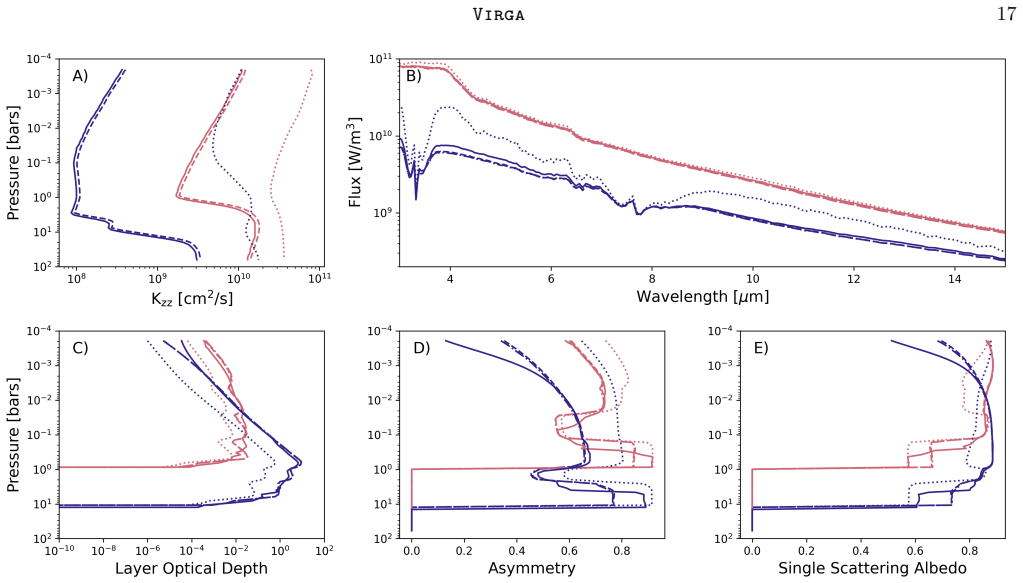
On its own terms, the paper claims that Virga-v1, with updated optical constants, Mie machinery, saturation vapor pressure curves, and fall-speed treatment, reproduces key literature results: the WASP-17 b SiO2 cloud detection and the Diamondback-Sonora brown dwarf model grid. The WASP-17 b reproduction requires deliberately choosing only the condensates supported by the detection, rather than every species that thermodynamically condenses, because adding Mg-clouds creates a second deck that flattens the observed water feature. The Diamondback reproduction is near-exact only when the original climate model's convective heat flux, and hence its Kzz profile, is supplied; approximating Kzz from
What carries the argument
The load-bearing object is the one-dimensional eddy-sedimentation balance, -Kzz dqt/dz - f_sed w* qc = 0, with w* = Kzz/L. It states that upward turbulent mixing of condensate and vapor is balanced by downward sedimentation, controlled by the sedimentation efficiency f_sed. Virga solves this equation layer by layer, computes a fall-speed particle radius by balancing the particle's terminal velocity against the convective velocity scale, maps that radius onto a lognormal size distribution, subdivides the pressure grid until the layer optical depth converges, and outputs extinction, single-scattering albedo, and asymmetry for radiative transfer. The fall-speed calculation uses Reynolds-number
Load-bearing premise
The benchmark results are only as reproducible as the unpublished climate-model log files that supply the convective heat flux; without them, Kzz is wrong by up to two orders of magnitude and cloud bases shift.
What would settle it
Run Virga v1 using only the publicly archived Diamondback Zenodo pressure-temperature profiles and a temperature-only estimate for convective heat flux, then compare the resulting T=900 K cloud optical depth profile with the published Diamondback profile. If the cloud base does not fall within the published high-opacity region, or if the WASP-17 b SiO2 spectral fit loses the observed water feature, the central reproducibility claim fails.
If this is right
- Users can reproduce the WASP-17 b SiO2 cloud and Diamondback cloud optical properties with Virga v1 when the input P-T, f_sed, and Kzz profiles match the original studies.
- The choice of condensate set is physically consequential: including all condensing species can introduce a spurious Mg-silicate cloud deck that flattens the 10-12 micron water feature in transit spectra.
- A crude estimate of Kzz from temperature alone is not adequate; self-consistent convective heat flux from a climate model is needed to reproduce cloud profiles to the claimed fidelity.
- The new slip-corrected fall speed removes the unphysical drop in terminal velocity between the Stokes and intermediate Reynolds regimes, and the Khan-Richardson alternative may become the default in future versions.
- Virga's ongoing development, including a planned aggregate-particle version, builds directly on this v1 foundation.
Where Pith is reading between the lines
- The reproducibility claim is conditional on access to unpublished climate-model log files; publishing those convective heat flux and Kzz profiles would make the benchmark independently reproducible.
- If Kzz uncertainty of two orders of magnitude is generic, spectral retrievals that parameterize Kzz as a free variable should treat cloud optical depth predictions as highly sensitive to that parameter.
- The Cunningham slip correction applied to the intermediate Reynolds regime could also improve other sedimentation and cloud-microphysics codes that use Davies-type drag fits.
- A direct testable consequence is that Virga v1 run on only public Diamondback inputs should show the stated ~0.5 dex cloud-base shift for T=900 K but still match high-opacity regions; users relying on public archives should expect this offset.
Editorial analysis
A structured set of objections, weighed in public.
Referee Report
Summary. The paper presents Virga-v1, the first officially released version of the open-source Python implementation of the Ackerman & Marley (2001) eddysed cloud model. It documents the code workflow, the updated optical-constants and Mie-property databases, the condensation chemistry and saturation vapor pressure curves, the treatment of Kzz and mixing length, and a revised fall-speed calculation that adds a Cunningham slip correction in the intermediate Reynolds-number regime and offers an optional Khan-Richardson drag law. The paper benchmarks Virga-v1 against two literature results: the SiO2 cloud detection in WASP-17 b (Grant et al. 2023) and the Diamondback-Sonora brown dwarf model grid (Morley et al. 2024). The authors are transparent in Section 5 that the near-exact Diamondback match is obtained only when unpublished EGP log-file profiles (P-T, net fluxes, and Kzz) are supplied, and that the public Diamondback Zenodo P-T profiles produce a ~0.5 dex cloud-base offset at Teff = 900 K (Figure 11).
Significance. If the benchmarks hold, Virga-v1 is a valuable community resource: it is open source, has Zenodo releases of both code and optical/Mie data, includes tutorials and an IOR factory for reproducible optical-constant processing, and its WASP-17b comparison against an observed spectrum provides an externally anchored check. The fall-speed discontinuity analysis and the proposed Cunningham-correction fix are genuine improvements over the original AM01 formulation. However, the flagship brown-dwarf benchmark is currently a private-data consistency check rather than a public reproduction: the abstract's unqualified claim of reproducing the Diamondback-Sonora model series is not something an independent user can verify from the released code and public inputs. This does not invalidate the code or the paper's contribution, but it does require a qualification or an archival fix before publication.
major comments (3)
- [§5 (Figures 10, 11) and Abstract] The central claim that Virga-v1 'reproduc[es] ... the brown dwarf Diamondback-Sonora model series' is supported only when unpublished EGP log-file profiles are used. The paper itself shows in Figure 11 that the public Diamondback Zenodo P-T profile leads to a ~0.5 dex shift of the T=900 K cloud base, and Figure 10A shows that a temperature-based estimate of the convective heat flux gives Kzz values that differ by up to two orders of magnitude from the EGP values. An independent user cannot verify the headline result with public data alone. Please archive the EGP log files (or machine-readable equivalents) with the Zenodo release, and either remove or explicitly qualify the abstract's reproduction claim to state that the close match requires the self-consistent EGP inputs, with the public-input result presented as the reproducible benchmark.
- [§3.5.4 and §3.5.7] The claimed removal of the Regime 1–2 discontinuity is not fully specified. The text says the Regime 2 drag coefficient is divided by the Cunningham correction β (Eq. 27), but the Davies/Best-number method (Eq. 28) and the polynomial fit in log(Re) vs. log(Cd Re^2) were calibrated for continuum drag. The manuscript does not state whether the inversion is performed on (Cd Re^2)/β or whether Re is then recomputed consistently, nor does it quantify the impact of this correction on particle radii or cloud optical depths in the benchmarks. Please provide the exact modified algorithm and a quantitative verification (e.g., terminal-velocity curves across the relevant pressure/temperature range compared with the Khan-Richardson model) so the smoothness claim is reproducible and not just visual.
- [§3.5.6 and §3.5.3] The Regime 3 calculation is internally inconsistent: Step 2 decides the regime from a Stokes-law Reynolds number, but Step 4 can produce a terminal velocity whose corresponding Reynolds number is below 1000, as the authors acknowledge in §3.5.6. This means the default fall speed is not self-consistent in part of parameter space. Since the fall-speed calculation is a core component of the code, please either fix the iteration by solving v_f and Re jointly with the selected Cd(Re), or document the affected particle-size/pressure range and mark the Regime 3 result as provisional in the default v1 release.
minor comments (6)
- [Abstract] The phrase 'Here we present an open-source cloud model' should clarify that this paper presents the official v1 release of an already existing v0 code base, to avoid the impression that the code is first introduced here.
- [§3.5.4] Text near Figure 5 says 'The resulting fall speeds and subsequent Reynolds numbers are plotted in Figure 3. The results are plotted in Figure 5.' This is confusing; the corrected curves are in Figure 5 and should be cited there.
- [Figure 11 caption] The phrase 'lower in pressure by ~0.5 dex bar' should be '~0.5 dex in pressure' (or '~0.5 bar') to avoid an ambiguous unit.
- [References] Gao et al. 2020a and 2020b appear to share the same DOI (10.1038/s41550-020-1114-3). Please verify and distinguish the two entries, or merge them if they are the same work.
- [§3.3] The example gas_mmr={'H2O':1e6} does not state the units of the number 1e6 (presumably ppm). Please state the expected unit in the text or in a code docstring reference.
- [§5] The EGP log files are described as 'available upon request (priv. comm. C. Morley).' For a reproducibility-focused paper, this should be replaced by an archived public dataset or a permanent Zenodo link, consistent with the paper's open-science emphasis.
Circularity Check
Diamondback 'reproduction' is a self-consistency check using unpublished EGP inputs from a co-author; the WASP-17b benchmark reuses retrieval parameters from the same Virga model family.
specific steps
-
fitted input called prediction
[Section 4 (Exoplanet Benchmarks), Fig. 8-9]
"We use the max loglikelihood pressure-temperature profile published in D. Grant et al. (2023) along with associated max loglikelihood model values for f sed and K zz."
The benchmark's inputs (P-T, f_sed, K_zz) are the maximum-likelihood values from the Grant et al. (2023) retrieval, which used the Virga-v0 code base. Virga's equations (Eqs. 1-15) deterministically map these inputs to cloud optical depths and spectra. Re-running Virga-v1 with the same fitted inputs therefore returns the same model by construction; it cannot independently confirm or falsify the SiO2 detection, only test whether v1 reproduces v0. The paper itself notes a factor-of-2 optical depth change from an updated Al2O3 mixing ratio, confirming that this benchmark is a code-regression check rather than a first-principles prediction.
-
self citation load bearing
[Section 5 (Brown Dwarf Benchmarks with Diamondback), Figs. 10-11]
"We first take the pressure-temperature profiles, net fluxes, and K zz profiles from the original climate model log files (EGP, in this case) generated for the Diamondback grid, which are available upon request (priv. comm. C. Morley). ... This near exact matching example shown in Figure 10 relies on unpublished pressure-temperature profiles."
The Diamondback models were generated by EGP, whose cloud module uses the same AM01/eddysed methodology Virga implements, and C. Morley is a co-author of this paper. Feeding the exact EGP-generated K_zz and P-T profiles back into Virga makes the matching of cloud optical depths a self-consistency check: the generative inputs determine the outputs by construction. The paper concedes that using the public Zenodo P-T profiles shifts the T=900 K cloud base by ~0.5 dex, so the abstract's claim to reproduce the Diamondback-Sonora model series is only achieved with unpublished, same-group data. This does not validate the cloud physics externally; it verifies code fidelity to its own heritage.
full rationale
The paper is primarily a code-description and benchmarking paper, and its fall-speed improvement is validated against external data (Khan & Richardson 1987), which is not circular. However, the two headline benchmarks are both self-referential. The WASP-17b SiO2 benchmark reuses the maximum-likelihood f_sed and K_zz values from a retrieval that already used Virga-v0; the reproduction is therefore a regression test of code changes, not an independent prediction of the cloud detection. The Diamondback benchmark goes further: the 'near exact matching' is achieved only by using unpublished EGP log files (pressure-temperature, net fluxes, K_zz) privately supplied by a co-author. Since Virga implements the same AM01/eddysed equation solved by EGP, running Virga with the original EGP inputs forces agreement. The paper honestly discloses this limitation and shows that public inputs yield a ~0.5 dex cloud-base shift at T=900 K, but the abstract's wording 'reproduc[es] key results in the literature' overstates what is actually demonstrated. No parameter is fitted in this paper to force agreement, and the code itself is open-source, so the circularity is partial rather than total. Score 5 reflects that the central reproducibility claims reduce, in part, to self-consistency checks with same-group inputs, while the code release and fall-speed fix retain independent content.
Axiom & Free-Parameter Ledger
free parameters (4)
- f_sed (sedimentation efficiency) =
user-defined; example values from Grant et al. 2023 in benchmark
- Kzz (eddy diffusion coefficient) =
user-supplied or computed via Gierasch-Conrath (Eq. 20)
- sigma_g (lognormal width) =
user-defined; default not specified numerically
- S (supersaturation parameter) =
default S=0
axioms (5)
- domain assumption One-dimensional vertical column with no horizontal transport
- domain assumption Vapor pressure saturation equilibrium for condensates
- ad hoc to paper Constant-with-altitude ratio qc/qt
- domain assumption Lognormal particle size distribution
- domain assumption Gas mixing ratios scale linearly with M/H below the cloud base
Cite this review
Pith. "Pith review of Condensation Clouds in Substellar Atmospheres with Virga." pith.science (2026). https://pith.science/paper/CTN2EK2I
@misc{pith2026250815102,
  author       = {Pith},
  title        = {Pith review of: Condensation Clouds in Substellar Atmospheres with Virga},
  year         = {2026},
  howpublished = {\url{https://pith.science/paper/CTN2EK2I}},
  note         = {Machine review of arXiv:2508.15102}
}
read the original abstract
Here we present an open-source cloud model for substellar atmospheres, called Virga. The Virga-v0 series has already been widely adopted in the literature. It is written in Python and has heritage from the Ackerman & Marley (2001) model (often referred to as eddysed), used to study clouds on both exoplanets and brown dwarfs. In the development of the official Virga-v1 we have retained all the original functionality of eddysed and updated/expanded several components including the back-end optical constants data, calculations of the Mie properties, available condensate species, saturation vapor pressure curves and formalism for fall speeds calculations. Here we benchmark Virga by reproducing key results in the literature, including the SiO2 cloud detection in WASP-17 b and the brown dwarf Diamondback-Sonora model series. Development of Virga is ongoing, with future versions already planned and ready for release. We encourage community feedback and collaborations within the GitHub code repository.
Figures



Forward citations
Cited by 7 Pith papers
-
Mitigating Charge Migration in JWST NIRISS Reveals That KELT-7 b is a Metal-enriched Ultra-hot Jupiter Orbiting a Young Metal-rich Star
Correcting NIRISS charge migration reveals KELT-7 b as a metal-enriched (~92x solar) ultra-hot Jupiter with H2O, CO2 and TiO but no H- or clouds, orbiting a young metal-rich star.
-
Magnesium Silicate Clouds in the Atmosphere of HD 209458b from a Rule-Based Tree-Structured Data Reduction
JWST MIRI/LRS data combined with archival observations detect magnesium silicate clouds (likely Mg2SiO4) in HD 209458b at 1-10 mbar with ~0.1 micron particles using a new rule-based data reduction approach.
-
Hydrolyzed Hazes on Water-rich Exoplanets: Optical Constants and Detectability
Hydrolyzed haze analogs from water-rich exoplanet conditions show higher absorptivity and a high imaginary refractive index that flattens spectral features in atmospheric models.
-
Fractal Aggregate Aerosols in the Virga Cloud Code I: Model Description and Application to a Benchmark Cloudy Exoplanet
Virga 2.0 now models fractal aggregate aerosols in both cloud dynamics and opacity, reproducing prior aggregate spectra while adding an analytic explanation for why fluffy clouds can appear transparent.
-
Impact of Clouds on the Atmosphere-Mantle Interface of Sub-Neptunes
Clouds drive over 1000 K heating at depth in sub-Neptune atmospheres, producing molten mantle interfaces for most planets in the sample and increasing abundances of O2, SiH4, and SiO by at least 36 percent.
-
Pre-computed aerosol extinction, scattering and asymmetry grids for scalable atmospheric retrievals
Pre-computed grids of aerosol optical properties reduce computation time in exoplanet retrievals by 1.4-17x with negligible impact on retrieved parameters and scale to multiple species.
-
CARMApy: An Open-Source Python Framework for Simulating Microphysical Clouds in Planetary Atmospheres
CARMApy provides a Python interface to the ExoCARMA microphysics code, enabling simulation of cloud particle size distributions and rates in exoplanet atmospheres with claimed consistency to prior versions and speed g...
Reference graph
Works this paper leans on
-
[1]
(** D!؍ Dłj DXbCQ &&/ 6wwgvw3;wn9 t=͌ @ RTt/T @ @ @ eB
thebibliography [1] 20pt to REFERENCES 6pt =0pt \@twocolumntrue 12pt -12pt 10pt plus 3pt =0pt =0pt =1pt plus 1pt =0pt =0pt -12pt =13pt plus 1pt =20pt =13pt plus 1pt \@M =10000 =-1.0em =0pt =0pt 0pt =0pt =1.0em @enumiv\@empty 10000 10000 `\.\@m \@noitemerr \@latex@warning Empty `thebibliography' environment \@ifnextchar \@reference \@latexerr Missing key o...
arXiv 2017
-
[2]
Ackerman , A. S., & Marley , M. S. 2001, title Precipitating Condensation Clouds in Substellar Atmospheres , , 556, 872, 10.1086/321540
doi:10.1086/321540 2001
-
[3]
Adams , D. J., Kataria , T., Batalha , N. E., Gao , P., & Knutson , H. A. 2022, title Spatially Resolved Modeling of Optical Albedos for a Sample of Six Hot Jupiters , , 926, 157, 10.3847/1538-4357/ac3d32
-
[4]
2019, title natashabatalha/picaso: Initial Publication Release, 10.5281/zenodo.2647593
Batalha, N. 2019, title natashabatalha/picaso: Initial Publication Release, 10.5281/zenodo.2647593
-
[5]
2020, title natashabatalha/picaso: Functionality Expanded, , v1.0 Zenodo, 10.5281/zenodo.3659311
Batalha, N. 2020, title natashabatalha/picaso: Functionality Expanded, , v1.0 Zenodo, 10.5281/zenodo.3659311
-
[6]
2025 a , title Resampled Opacity Database for PICASO, Zenodo, 10.5281/zenodo.14861730
Batalha, N., Freedman, R., Gharib-Nezhad, E., & Lupu, R. 2025 a , title Resampled Opacity Database for PICASO, Zenodo, 10.5281/zenodo.14861730
-
[7]
Batalha, N., Lodge, M., & Moran, S. E. 2025 b , title Refractive Indices For Virga Exoplanet Cloud Model, , v2 Zenodo, 10.5281/zenodo.15886530
-
[8]
2020, title natashabatalha/virga: Initial Release , , v0.0 Zenodo, 10.5281/zenodo.3759888
Batalha , N., Rooney , C., & Mukherjee , S. 2020, title natashabatalha/virga: Initial Release , , v0.0 Zenodo, 10.5281/zenodo.3759888
-
[9]
2025 c , title natashabatalha/virga: v1.0.0, , v1.0 Zenodo, 10.5281/zenodo.16914937
Batalha, N., Rooney, C., Mukherjee, S., et al. 2025 c , title natashabatalha/virga: v1.0.0, , v1.0 Zenodo, 10.5281/zenodo.16914937
-
[10]
Batalha , N. E., Marley , M. S., Lewis , N. K., & Fortney , J. J. 2019, title Exoplanet Reflected-light Spectroscopy with PICASO , , 878, 70, 10.3847/1538-4357/ab1b51
-
[11]
K., & Batchelor, G
Batchelor, C. K., & Batchelor, G. 2000, An introduction to fluid dynamics (Cambridge university press)
2000
-
[12]
Begemann , B., Dorschner , J., Henning , T., et al. 1997, title Aluminum Oxide and the Opacity of Oxygen-rich Circumstellar Dust in the 12-17 Micron Range , , 476, 199, 10.1086/303597
doi:10.1086/303597 1997
-
[13]
Boehm , V. A., Lewis , N. K., Fairman , C. E., et al. 2025, title The HUSTLE Program: The UV to Near-infrared HST WFC3/UVIS G280 Transmission Spectrum of WASP-127b , , 169, 23, 10.3847/1538-3881/ad8dde
-
[14]
2014, Bokeh: Python library for interactive visualization
Bokeh Development Team . 2014, Bokeh: Python library for interactive visualization. http://www.bokeh.pydata.org
2014
-
[15]
Buck, A. L. 1981, title New equations for computing vapor pressure and enhancement factor, Journal of Applied Meteorology and Climatology, 20, 1527
1981
-
[16]
Burningham , B., Marley , M. S., Line , M. R., et al. 2017, title Retrieval of atmospheric properties of cloudy L dwarfs , , 470, 1177, 10.1093/mnras/stx1246
-
[17]
I., Lustig-Yaeger , J., Tsai , S.-M., et al
Ca \ n as , C. I., Lustig-Yaeger , J., Tsai , S.-M., et al. 2025, title GEMS JWST: Transmission spectroscopy of TOI-5205b reveals significant stellar contamination and a metal-poor atmosphere , arXiv e-prints, arXiv:2502.06966, 10.48550/arXiv.2502.06966
-
[18]
Chen , X., Biller , B. A., Vos , J. M., et al. 2024, title Global weather map reveals persistent top-of-atmosphere features on the nearest brown dwarfs , , 533, 3114, 10.1093/mnras/stae1995
-
[19]
1910, title On the velocity of steady fall of spherical particles through fluid medium, Proceedings of the Royal Society of London
Cunningham, E. 1910, title On the velocity of steady fall of spherical particles through fluid medium, Proceedings of the Royal Society of London. Series A, Containing Papers of a Mathematical and Physical Character, 83, 357
1910
-
[20]
2021, title OpTool: Command-line driven tool for creating complex dust opacities , , Astrophysics Source Code Library, record ascl:2104.010
Dominik , C., Min , M., & Tazaki , R. 2021, title OpTool: Command-line driven tool for creating complex dust opacities , , Astrophysics Source Code Library, record ascl:2104.010
2021
-
[21]
J., Walko, R
Flatau, P. J., Walko, R. L., & Cotton, W. R. 1992, title Polynomial fits to saturation vapor pressure, Journal of Applied Meteorology, 31, 1507
1992
-
[22]
Fortney , J. J. 2005, title The effect of condensates on the characterization of transiting planet atmospheres with transmission spectroscopy , , 364, 649, 10.1111/j.1365-2966.2005.09587.x
arXiv 2005
-
[23]
Fortney , J. J., Lodders , K., Marley , M. S., & Freedman , R. S. 2008, title A Unified Theory for the Atmospheres of the Hot and Very Hot Jupiters: Two Classes of Irradiated Atmospheres , , 678, 1419, 10.1086/528370
doi:10.1086/528370 2008
-
[24]
Gao , P., Marley , M. S., & Ackerman , A. S. 2018, title Sedimentation Efficiency of Condensation Clouds in Substellar Atmospheres , , 855, 86, 10.3847/1538-4357/aab0a1
-
[25]
Gao , P., Wakeford , H. R., Moran , S. E., & Parmentier , V. 2021, title Aerosols in Exoplanet Atmospheres , Journal of Geophysical Research (Planets), 126, e06655, 10.1029/2020JE006655
-
[27]
Gao , P., Thorngren , D. P., Lee , G. K. H., et al. 2020 b , title Aerosol composition of hot giant exoplanets dominated by silicates and hydrocarbon hazes , Nature Astronomy, 4, 951, 10.1038/s41550-020-1114-3
-
[28]
J., & Conrath , B
Gierasch , P. J., & Conrath , B. J. 1985, Energy conversion processes in the outer planets. , ed. G. E. Hunt , 121--146
1985
-
[29]
Gordon, I., Rothman, L., Hargreaves, R., et al. 2022, title The HITRAN2020 molecular spectroscopic database, Journal of Quantitative Spectroscopy and Radiative Transfer, 277, 107949, https://doi.org/10.1016/j.jqsrt.2021.107949
arXiv 2022
-
[30]
Grant , D., Lewis , N. K., Wakeford , H. R., et al. 2023, title JWST-TST DREAMS: Quartz Clouds in the Atmosphere of WASP-17b , , 956, L32, 10.3847/2041-8213/acfc3b10.3847/2041-8213/acfdab
-
[31]
Hamill , C. D., Johnson , A. V., Batalha , N., et al. 2024, title Reflected-light Phase Curves with PICASO: A Kepler-7b Case Study , , 976, 181, 10.3847/1538-4357/ad7de6
-
[32]
Hansen , J. E., & Travis , L. D. 1974, title Light scattering in planetary atmospheres , , 16, 527, 10.1007/BF00168069
- [33]
-
[34]
2004, title Dust in brown dwarfs
Helling , C., Klein , R., Woitke , P., Nowak , U., & Sedlmayr , E. 2004, title Dust in brown dwarfs. IV. Dust formation and driven turbulence on mesoscopic scales , , 423, 657, 10.1051/0004-6361:20034514
-
[35]
Helling , C., Oevermann , M., L \"u ttke , M. J. H., Klein , R., & Sedlmayr , E. 2001, title Dust in brown dwarfs. I. Dust formation under turbulent conditions on microscopic scales , , 376, 194, 10.1051/0004-6361:20010937
-
[36]
2017, title Dust in brown dwarfs and extrasolar planets
Helling , C., Tootill , D., Woitke , P., & Lee , E. 2017, title Dust in brown dwarfs and extrasolar planets. V. Cloud formation in carbon- and oxygen-rich environments , , 603, A123, 10.1051/0004-6361/201629696
-
[37]
2006, title Dust in brown dwarfs
Helling , C., & Woitke , P. 2006, title Dust in brown dwarfs. V. Growth and evaporation of dirty dust grains , , 455, 325, 10.1051/0004-6361:20054598
-
[38]
Huffman, D. R., & Wild, R. L. 1967, title Optical Properties of - MnS , Phys. Rev., 156, 989, 10.1103/PhysRev.156.989
-
[39]
Inglis , J., Batalha , N. E., Lewis , N. K., et al. 2024, title Quartz Clouds in the Dayside Atmosphere of the Quintessential Hot Jupiter HD 189733 b , , 973, L41, 10.3847/2041-8213/ad725e
-
[40]
J\"ager, C. , Dorschner, J. , Mutschke, H. , Posch, Th. , & Henning, Th. 2003, title Steps toward interstellar silicate mineralogy* - VII. Spectral properties and crystallization behaviour of magnesium silicates produced by the sol-gel method, A&A, 408, 193, 10.1051/0004-6361:20030916
-
[41]
Khachai, H., Khenata, R., Bouhemadou, A., et al. 2009, title FP - APW lo calculations of the electronic and optical properties of alkali metal sulfides under pressure, Journal of Physics: Condensed Matter, 21, 095404, 10.1088/0953-8984/21/9/095404
-
[42]
1987, title The resistance to motion of a solid sphere in a fluid, Chemical Engineering Communications, 62, 135
Khan, A., & Richardson, J. 1987, title The resistance to motion of a solid sphere in a fluid, Chemical Engineering Communications, 62, 135
1987
-
[43]
Kitzmann , D., & Heng , K. 2018, title Optical properties of potential condensates in exoplanetary atmospheres , , 475, 94, 10.1093/mnras/stx3141
-
[44]
2016, in ELPUB, 87--90
Kluyver, T., Ragan-Kelley, B., P \'e rez, F., et al. 2016, in ELPUB, 87--90
2016
-
[45]
1995, title Extinction spectra of corundum in the wavelengths from UV to FIR
Koike , C., Kaito , C., Yamamoto , T., et al. 1995, title Extinction spectra of corundum in the wavelengths from UV to FIR. , , 114, 203, 10.1006/icar.1995.1055
arXiv 1995
-
[46]
Lam, S. K., Pitrou, A., & Seibert, S. 2015, in Proceedings of the Second Workshop on the LLVM Compiler Infrastructure in HPC, LLVM '15 (New York, NY, USA: ACM), 7:1--7:6, 10.1145/2833157.2833162
arXiv 2015
-
[47]
Lindzen , R. S. 1981, title Turbulence and stress owing to gravity wave and tidal breakdown , , 86, 9707, 10.1029/JC086iC10p09707
-
[48]
2002, title Titanium and Vanadium Chemistry in Low-Mass Dwarf Stars , , 577, 974, 10.1086/342241
Lodders , K. 2002, title Titanium and Vanadium Chemistry in Low-Mass Dwarf Stars , , 577, 974, 10.1086/342241
doi:10.1086/342241 2002
-
[49]
Lodders , K. 2010, title Solar System Abundances of the Elements , Astrophysics and Space Science Proceedings, 16, 379, 10.1007/978-3-642-10352-0_8
-
[50]
1998, The planetary scientist's companion / Katharina Lodders, Bruce Fegley
Lodders , K., & Fegley , B. 1998, The planetary scientist's companion / Katharina Lodders, Bruce Fegley
1998
-
[51]
Luna , J. L., & Morley , C. V. 2021, title Empirically Determining Substellar Cloud Compositions in the Era of the James Webb Space Telescope , , 920, 146, 10.3847/1538-4357/ac1865
-
[52]
MacDonald , R. J. 2023, title POSEIDON: A Multidimensional Atmospheric Retrieval Code for Exoplanet Spectra , The Journal of Open Source Software, 8, 4873, 10.21105/joss.04873
-
[53]
Madurowicz , A., Mukherjee , S., Batalha , N., et al. 2023, title The Infrared Colors of 51 Eridani b: Micrometeoroid Dust or Chemical Disequilibrium? , , 165, 238, 10.3847/1538-3881/acca7a
-
[54]
Mang , J., Morley , C. V., Robinson , T. D., & Gao , P. 2024, title Microphysical Prescriptions for Parameterized Water Cloud Formation on Ultra-cool Substellar Objects , , 974, 190, 10.3847/1538-4357/ad6c4c
-
[55]
2000, in Astronomical Society of the Pacific Conference Series, Vol
Marley , M. 2000, in Astronomical Society of the Pacific Conference Series, Vol. 212, From Giant Planets to Cool Stars, ed. C. A. Griffith & M. S. Marley , 152
2000
-
[56]
Marley , M. S., & McKay , C. P. 1999, title Thermal Structure of Uranus' Atmosphere , , 138, 268, 10.1006/icar.1998.6071
arXiv 1999
-
[57]
S., Saumon , D., Cushing , M., et al
Marley , M. S., Saumon , D., Cushing , M., et al. 2012, title Masses, Radii, and Cloud Properties of the HR 8799 Planets , , 754, 135, 10.1088/0004-637X/754/2/135
-
[58]
S., Seager , S., Saumon , D., et al
Marley , M. S., Seager , S., Saumon , D., et al. 2002, title Clouds and Chemistry: Ultracool Dwarf Atmospheric Properties from Optical and Infrared Colors , , 568, 335, 10.1086/338800
doi:10.1086/338800 2002
-
[59]
S., Saumon , D., Visscher , C., et al
Marley , M. S., Saumon , D., Visscher , C., et al. 2021, title The Sonora Brown Dwarf Atmosphere and Evolution Models. I. Model Description and Application to Cloudless Atmospheres in Rainout Chemical Equilibrium , , 920, 85, 10.3847/1538-4357/ac141d
-
[60]
Martonchik, J. V., & Orton, G. S. 1994, title Optical constants of liquid and solid methane, Appl. Opt., 33, 8306, 10.1364/AO.33.008306
-
[61]
Martonchik, J. V., Orton, G. S., & Appleby, J. F. 1984, title Optical properties of NH3 ice from the far infrared to the near ultraviolet, Appl. Opt., 23, 541, 10.1364/AO.23.000541
-
[62]
McKay , C. P., Pollack , J. B., & Courtin , R. 1989, title The thermal structure of Titan's atmosphere , , 80, 23, 10.1016/0019-1035(89)90160-7
-
[63]
2010, in Proceedings of the 9th Python in Science Conference, ed
McKinney, W. 2010, in Proceedings of the 9th Python in Science Conference, ed. S. van der Walt & J. Millman, 51 -- 56
2010
-
[64]
Mollière, P., Wardenier, J. P., van Boekel, R., et al. 2019, title petitRADTRANS: A Python radiative transfer package for exoplanet characterization and retrieval, Astronomy & Astrophysics, 627, A67, 10.1051/0004-6361/201935470
-
[65]
1979, title Optical constants of sodium sulphide, Physica Status Solidi.A, Applied Research, 52, 597
Montaner, A., Galtier, M., Benoit, C., & Bill, H. 1979, title Optical constants of sodium sulphide, Physica Status Solidi.A, Applied Research, 52, 597. https://archive-ouverte.unige.ch/unige:3131
1979
-
[66]
Moran , S. E., Marley , M. S., & Crossley , S. D. 2024, title Neglected Silicon Dioxide Polymorphs as Clouds in Substellar Atmospheres , , 973, L3, 10.3847/2041-8213/ad72e7
-
[67]
2024, title The Sonora Substellar Atmosphere Models: Diamondback, Zenodo, 10.5281/zenodo.12735103
Morley, C., Mukherjee, S., Marley, M., et al. 2024, title The Sonora Substellar Atmosphere Models: Diamondback, Zenodo, 10.5281/zenodo.12735103
-
[68]
Morley , C. V., Fortney , J. J., Marley , M. S., et al. 2012, title Neglected Clouds in T and Y Dwarf Atmospheres , , 756, 172, 10.1088/0004-637X/756/2/172
-
[69]
Morley , C. V., Fortney , J. J., Marley , M. S., et al. 2015, title Thermal Emission and Reflected Light Spectra of Super Earths with Flat Transmission Spectra , , 815, 110, 10.1088/0004-637X/815/2/110
-
[70]
V., Mukherjee , S., Marley , M
Morley , C. V., Mukherjee , S., Marley , M. S., et al. 2024, title The Sonora Substellar Atmosphere Models. III. Diamondback: Atmospheric Properties, Spectra, and Evolution for Warm Cloudy Substellar Objects , , 975, 59, 10.3847/1538-4357/ad71d5
-
[71]
Mukherjee , S., Batalha , N. E., Fortney , J. J., & Marley , M. S. 2023, title PICASO 3.0: A One-dimensional Climate Model for Giant Planets and Brown Dwarfs , , 942, 71, 10.3847/1538-4357/ac9f48
-
[72]
Mullens , E., Lewis , N. K., & MacDonald , R. J. 2024, title Implementation of Aerosol Mie Scattering in POSEIDON with Application to the Hot Jupiter HD 189733 b's Transmission, Emission, and Reflected Light Spectrum , , 977, 105, 10.3847/1538-4357/ad8575
-
[73]
Nasedkin , E., Molli \`e re , P., & Blain , D. 2024, title Atmospheric Retrievals with petitRADTRANS , The Journal of Open Source Software, 9, 5875, 10.21105/joss.05875
-
[74]
Palik , E. D. 1985, Handbook of optical constants of solids
1985
-
[75]
Palik, E. D. 1991, Handbook of optical constants of solids, Vol. 2 (Academic press)
1991
-
[76]
P \'e rez, F., & Granger, B. E. 2007, title IPython: a system for interactive scientific computing, Computing in Science & Engineering, 9
2007
-
[77]
Posch , T., Kerschbaum , F., Fabian , D., et al. 2003, title Infrared Properties of Solid Titanium Oxides: Exploring Potential Primary Dust Condensates , , 149, 437, 10.1086/379167
doi:10.1086/379167 2003
-
[78]
Powell , D., Zhang , X., Gao , P., & Parmentier , V. 2018, title Formation of Silicate and Titanium Clouds on Hot Jupiters , , 860, 18, 10.3847/1538-4357/aac215
-
[79]
Prahl , S. 2025, title miepython: Pure python calculation of Mie scattering , , 3.0.2 Zenodo, 10.5281/zenodo.7949263
-
[80]
R., & Klett, J
Pruppacher, H. R., & Klett, J. D. 1980, title Microphysics of clouds and precipitation, Nature, 284, 88
1980
-
[81]
Querry, M. R. 1987, Optical constants of minerals and other materials from the millimeter to the ultraviolet (Chemical Research, Development & Engineering Center, US Army Armament …)
1987
This paper was first reviewed by deepseek-v4-flash on August 5, 2026.
discussion (0)
Sign in with ORCID, Apple, or X to comment. Anyone can read and Pith papers without signing in.