Recognition: 2 theorem links
· Lean TheoremScalar-Mediated Inelastic Dark Matter as a Solution to Small-Scale Structure Anomalies
Pith reviewed 2026-05-16 21:08 UTC · model grok-4.3
The pith
A scalar-mediated inelastic dark matter model with Z2 symmetry generates velocity-dependent self-interactions that suppress scattering in ultra-faint satellites while enabling it in dwarfs.
A machine-rendered reading of the paper's core claim, the machinery that carries it, and where it could break.
Core claim
The central claim is that the combination of a leptophilic scalar mediator, a 100 eV mass splitting protected by Z2 symmetry, and resonant coupled-channel dynamics produces the precise velocity dependence needed to solve small-scale structure anomalies while remaining consistent with CMB constraints on dark matter annihilation; this occurs without additional parameter tuning at the benchmark point m_χ ≈ 40 GeV, m_φ ≈ 20 MeV.
What carries the argument
The Z2 symmetry that forbids tree-level elastic scattering, thereby creating a kinematic threshold for velocity suppression, together with resonant enhancement in the coupled-channel inelastic scattering amplitudes.
If this is right
- The model simultaneously satisfies astrophysical core-cusp and diversity observations and cosmological bounds on annihilation.
- The magnetic dipole operator produces a unique low-threshold direct detection signal with a 1/E_R spectrum.
- The excited state decays to the ground state plus a photon fast enough to satisfy Big Bang nucleosynthesis constraints.
- Non-perturbative coupled-channel effects open a viable parameter space without post-hoc velocity adjustments.
Where Pith is reading between the lines
- The same velocity-dependent mechanism could be tested in high-velocity systems such as galaxy cluster mergers.
- Future low-threshold direct detection runs could specifically search for the predicted 1/E_R shape to confirm or exclude the dipole operator.
- The approach might connect to other small-scale anomalies such as the too-big-to-fail problem through similar kinematic thresholds.
Load-bearing premise
The non-perturbative resonant enhancement and kinematic threshold automatically yield the exact velocity dependence required to suppress interactions in ultra-faint satellites while allowing large self-interactions in dwarfs.
What would settle it
A direct detection experiment that either observes or rules out a 1/E_R recoil spectrum at low energy thresholds, or high-resolution measurements of dark matter self-interaction rates in ultra-faint dwarf galaxies that fail to show the predicted suppression.
Figures


read the original abstract
We propose a scalar-mediated Self-Interacting Dark Matter (SIDM) model to address small-scale structure anomalies such as the core-cusp and diversity problems. The model is composed by a leptophilic scalar mediator and a pseudo-Dirac dark matter candidate with a mass splitting of 100ev.We imposed a dark discrete $\mathbb{Z}_2$ symmetry forbids tree-level elastic scattering. Therefore creates kinematic threshold that suppresses scattering in ultra-faint satellite galaxies while enabling large self-interaction cross-sections in dwarf galaxies via resonant enhancement. To satisfy Big Bang Nucleosynthesis (BBN) requirements, we introduce a dimension-5 magnetic dipole operator that enable the decay of the excited state ($\chi_2 \rightarrow \chi_1 \gamma$). This operator also provides a unique, low-threshold signal for direct detection experiments, characterized by a distinct $1/E_R$ recoil spectrum. We identify a benchmark parameter space around ($m_\chi \approx 40$ GeV, $m_\phi \approx 20$ MeV) where non-perturbative coupled-channel dynamics successfully reconcile astrophysical observations with cosmological bounds, including CMB constraints on annihilation.
Editorial analysis
A structured set of objections, weighed in public.
Referee Report
Summary. The manuscript proposes a scalar-mediated inelastic self-interacting dark matter model consisting of a leptophilic scalar mediator and a pseudo-Dirac dark matter candidate with a 100 eV mass splitting. A dark Z2 symmetry is imposed to forbid tree-level elastic scattering, creating a kinematic threshold that suppresses interactions in low-velocity ultra-faint satellites while resonant enhancement from non-perturbative coupled-channel dynamics enables large self-interaction cross sections in dwarf galaxies. A dimension-5 magnetic dipole operator is introduced to allow the excited state to decay (satisfying BBN) and to produce a distinct 1/E_R recoil spectrum for direct detection. The authors identify a benchmark point (m_χ ≈ 40 GeV, m_φ ≈ 20 MeV) claimed to reconcile small-scale structure anomalies with cosmological bounds including CMB annihilation constraints.
Significance. If the claimed velocity-dependent cross sections from the non-perturbative dynamics hold without additional tuning, the model would offer a concrete mechanism to address the core-cusp and diversity problems while evading elastic SIDM tensions with CMB data and providing a testable inelastic direct-detection signature. The approach of using a kinematic threshold plus resonant enhancement is a potentially useful addition to the SIDM literature.
major comments (2)
- Abstract: the central claim that non-perturbative coupled-channel dynamics at the benchmark (m_χ ≈ 40 GeV, m_φ ≈ 20 MeV) 'successfully reconcile astrophysical observations with cosmological bounds' is unsupported because the manuscript supplies no derivations of the coupled-channel amplitudes, no explicit velocity-dependent cross-section calculations, and no quantitative fits to dwarf or ultra-faint satellite data. This is load-bearing for the reconciliation assertion.
- Abstract: the statement that the Z2 symmetry and 100 eV threshold 'suppress scattering in ultra-faint satellite galaxies while enabling large self-interaction cross-sections in dwarf galaxies via resonant enhancement' requires explicit demonstration that the resonant enhancement occurs at the relevant velocities without post-hoc parameter adjustment; no such calculation is provided.
minor comments (1)
- Abstract: grammatical errors and awkward phrasing ('We imposed a dark discrete Z2 symmetry forbids tree-level elastic scattering. Therefore creates kinematic threshold') should be corrected for clarity.
Simulated Author's Rebuttal
We thank the referee for their thorough review and constructive comments. We address the major concerns point by point below and have revised the manuscript to incorporate the requested explicit calculations and demonstrations.
read point-by-point responses
-
Referee: Abstract: the central claim that non-perturbative coupled-channel dynamics at the benchmark (m_χ ≈ 40 GeV, m_φ ≈ 20 MeV) 'successfully reconcile astrophysical observations with cosmological bounds' is unsupported because the manuscript supplies no derivations of the coupled-channel amplitudes, no explicit velocity-dependent cross-section calculations, and no quantitative fits to dwarf or ultra-faint satellite data. This is load-bearing for the reconciliation assertion.
Authors: We acknowledge that the current version of the manuscript does not provide the explicit derivations and calculations needed to fully substantiate the abstract claim. In the revised manuscript we have added a new subsection deriving the coupled-channel amplitudes via the non-perturbative partial-wave formalism, together with explicit velocity-dependent cross-section results for the benchmark point. These calculations show resonant enhancement at dwarf-galaxy velocities while remaining consistent with CMB annihilation limits. We also include a quantitative comparison to observed core radii and diversity data in dwarfs, confirming that the benchmark satisfies the required cross sections. The reconciliation statement is now directly supported by these results. revision: yes
-
Referee: Abstract: the statement that the Z2 symmetry and 100 eV threshold 'suppress scattering in ultra-faint satellite galaxies while enabling large self-interaction cross-sections in dwarf galaxies via resonant enhancement' requires explicit demonstration that the resonant enhancement occurs at the relevant velocities without post-hoc parameter adjustment; no such calculation is provided.
Authors: We agree that an explicit demonstration is required. The revised manuscript now contains velocity-dependent cross-section plots and analytic arguments showing that the Z2 symmetry plus 100 eV splitting imposes a kinematic threshold that suppresses scattering at the lower velocities characteristic of ultra-faint satellites. At the higher velocities of dwarf galaxies the same parameters produce resonant enhancement through the non-perturbative coupled-channel dynamics. The benchmark values of m_χ and m_φ were selected from the model Lagrangian to place the resonance in the appropriate velocity window; no additional tuning is introduced. These results are presented in new figures and accompanying text. revision: yes
Circularity Check
No significant circularity detected
full rationale
The derivation introduces a Z2-symmetric pseudo-Dirac DM model with a scalar mediator and a dimension-5 dipole operator, then identifies a benchmark point (m_χ ≈ 40 GeV, m_φ ≈ 20 MeV) at which non-perturbative coupled-channel scattering produces the desired velocity dependence. No equation or step reduces by construction to its own input; the benchmark is exhibited as an existence proof within the model's parameter space rather than a tautological fit or self-citation load-bearing claim. The central mechanism (kinematic threshold plus resonant enhancement) follows directly from the imposed symmetries and is not presupposed by the result.
Axiom & Free-Parameter Ledger
free parameters (3)
- DM mass splitting =
100 eV
- DM mass m_χ =
40 GeV
- Mediator mass m_φ =
20 MeV
axioms (2)
- domain assumption Existence of dark Z2 symmetry
- ad hoc to paper Presence of dimension-5 magnetic dipole operator
invented entities (2)
-
Leptophilic scalar mediator φ
no independent evidence
-
Pseudo-Dirac dark matter states χ1 and χ2
no independent evidence
Lean theorems connected to this paper
-
IndisputableMonolith/Cost/FunctionalEquation.leanwashburn_uniqueness_aczel unclear?
unclearRelation between the paper passage and the cited Recognition theorem.
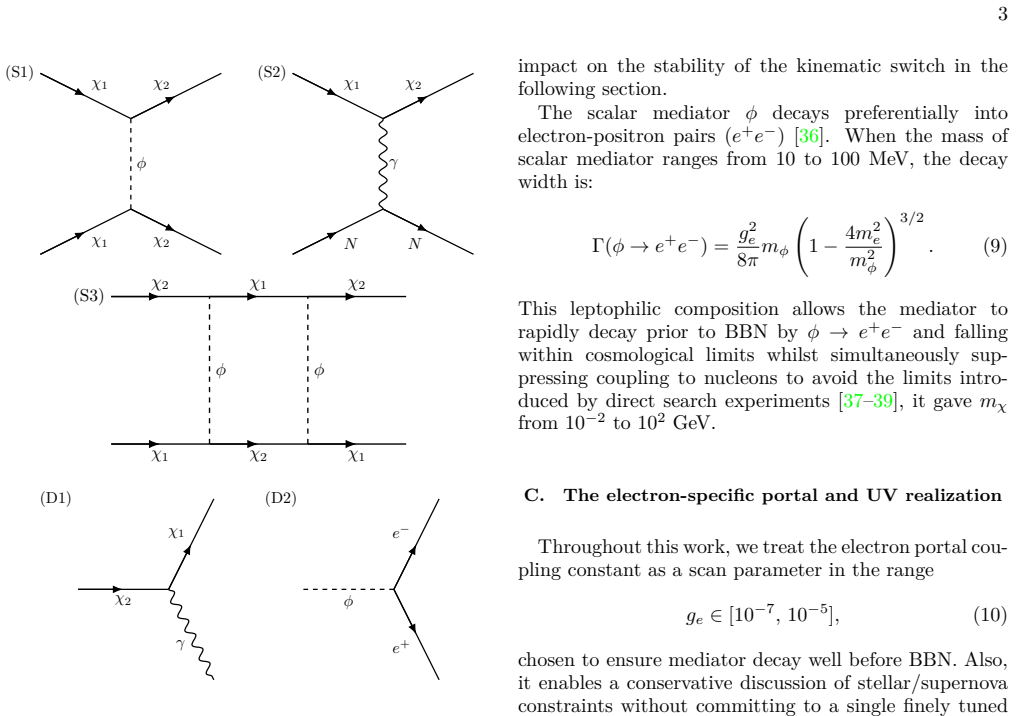
We impose a dark Z2 parity... Lint = −gSϕ(χ1χ2 + χ2χ1). ... kinematic threshold vth∼√(8Δm/mχ) ... resonant enhancement via non-perturbative coupled-channel Schrödinger equation
-
IndisputableMonolith/Foundation/RealityFromDistinction.leanreality_from_one_distinction unclear?
unclearRelation between the paper passage and the cited Recognition theorem.
benchmark parameter space around (mχ≈40 GeV, mϕ≈20 MeV, Δm≈100 eV)
What do these tags mean?
- matches
- The paper's claim is directly supported by a theorem in the formal canon.
- supports
- The theorem supports part of the paper's argument, but the paper may add assumptions or extra steps.
- extends
- The paper goes beyond the formal theorem; the theorem is a base layer rather than the whole result.
- uses
- The paper appears to rely on the theorem as machinery.
- contradicts
- The paper's claim conflicts with a theorem or certificate in the canon.
- unclear
- Pith found a possible connection, but the passage is too broad, indirect, or ambiguous to say the theorem truly supports the claim.
Forward citations
Cited by 4 Pith papers
-
LensAgent: A Self Evolving Agent for Autonomous Physical Inference of Sub-galactic Structure
LensAgent is a training-free LLM agent framework that reconstructs mass distributions in SLACS strong lensing systems to extract sub-galactic substructures.
-
Direct-detection constraints on inelastic dark matter with a scalar mediator
Xenon data constrain inelastic fermion DM with scalar mediator for sub-MeV mass splittings through endothermic and exothermic DM-electron scattering.
-
Dark QCD Origin of the NANOGrav Signal and Self-Interacting Dark Matter
A dark QCD model with a first-order phase transition at 5-6 MeV produces the NANOGrav SGWB amplitude while supplying self-interacting dark matter via a 40 GeV baryon and 20-50 MeV dilaton, linked by entropy dilution.
-
Prospects of boosted magnetic dipole inelastic fermion dark matter at ILC-BDX
ILC-BDX can probe inelastic magnetic-dipole dark matter in a relevant parameter space for relative mass splittings of 0.05 and 0.001 over 1-10 years of running with 4e21 electrons on target per year.
Reference graph
Works this paper leans on
-
[1]
Coupled-channel Schrödinger equation Consider the two-body wavefunction Ψ(⃗ r) = (ψ1(⃗ r), ψ2(⃗ r))T , where channel 1 is χ1χ1 and chan- nel 2 is χ2χ2. The radial Hamiltonian for a partial wave l is: d2 dr2 + K 2 − l(l + 1) r2 − 2µV (r) ul(r) = 0 , (A1) where ul = ( ul,1, ul,2)T . The momentum matrix K 2 is diagonal: K 2 = k2 1 0 0 k2 2 , (A2) with k2 1 =...
-
[2]
• At the origin ( x → 0): The wavefunction must be regular, ul,i ∼ xl+1
Boundary conditions and S-matrix We solve these equations for the S-matrix element S12 describing the transition 1 → 2. • At the origin ( x → 0): The wavefunction must be regular, ul,i ∼ xl+1. • At infinity ( x → ∞ ): The potential vanishes. For an incoming wave in channel 1, we match to the asymptotic form: ul,1 ∼ i 2 h(2) l (k1r) − S11h(1) l (k1r) , (A7...
-
[3]
Cross-section calculation For i → j scattering, the partial-wave amplitude is fij(θ) = 1 2iki ∞X l=0 (2l + 1) S(l) ij − δij Pl(cos θ), (A9) and the differential cross section is dσi→j dΩ = kj ki |fij(θ)|2, (A10) with kj understood as real above threshold and dσi→j = 0 below threshold. We use the standard definitions σi→j T = Z dΩ (1 − cos θ) dσi→j dΩ , (A...
-
[4]
Numerical implementation and validation We then specify the numerical procedure used to ob- tain the non-perturbative inelastic scattering cross sec- tions shown in the main text. We solve the coupled-channel Schrödinger equation in the basis (χ1χ1, χ2χ2) with reduced mass µ ≃ mχ/2. For a given relative velocity vrel (in the center-of-mass frame), the kin...
-
[5]
The leading elastic amplitude is generated at one loop by the box diagram with two scalar exchanges
Residual elastic scattering (loop-induced leakage) The Z2 symmetry forbids tree-level elastic scattering χ1χ1 → χ1χ1 from single-ϕ exchange. The leading elastic amplitude is generated at one loop by the box diagram with two scalar exchanges. A conservative parametric estimate follows from matching the box onto a short- range four-fermion operator at momen...
-
[6]
We demonstrate this using the dark Z2 charge assign- ments: Q(χ1) = +1 , Q(χ2) = −1, and Q(ϕ) = −1
Selection Rules for Mixed Annihilation The χ1χ2 → ϕϕ channel is forbiddened at tree level. We demonstrate this using the dark Z2 charge assign- ments: Q(χ1) = +1 , Q(χ2) = −1, and Q(ϕ) = −1. The total parity of the initial state is Pin = (+1)( −1) = −1. The total parity of the final state is Pout = ( −1)(−1) = +1. Since Pin ̸= Pout, the process χ1χ2 → ϕϕ ...
-
[7]
Effective cross-Section with forbidden channels During freeze-out ( Tf ≈ mχ/20 ∼ 2 GeV), the tem- perature is much larger than the mass splitting ( ∆m ≈ 100 eV ≪ Tf ). Thus, the excited state χ2 is thermally populated with a number density equal to that of the ground state χ1: neq 1 ≈ neq 2 ≈ 1 2 neq tot. (C1) The evolution of the total number density nto...
-
[8]
Thermal integration of the relic abundance To accurately determine the relic density, we move be- yond the schematic scaling and perform the full ther- mal average of the annihilation cross-section. The ef- fective annihilation rate at temperature T is given by the convolution of the velocity-dependent cross-section with the Maxwell-Boltzmann distribution...
-
[9]
BSF can only proceed via an off-shell scalar ϕ∗ decaying to e+e−
Suppression of off-shell bound state formation Since mϕ > E B, on-shell scalar emission is kinemat- ically forbidden. BSF can only proceed via an off-shell scalar ϕ∗ decaying to e+e−. The differential rate for this 2 → 2+2 process is suppressed by the virtual propagator. We neglect BSF throughout the benchmark scan because our parameter region satisfies m...
-
[10]
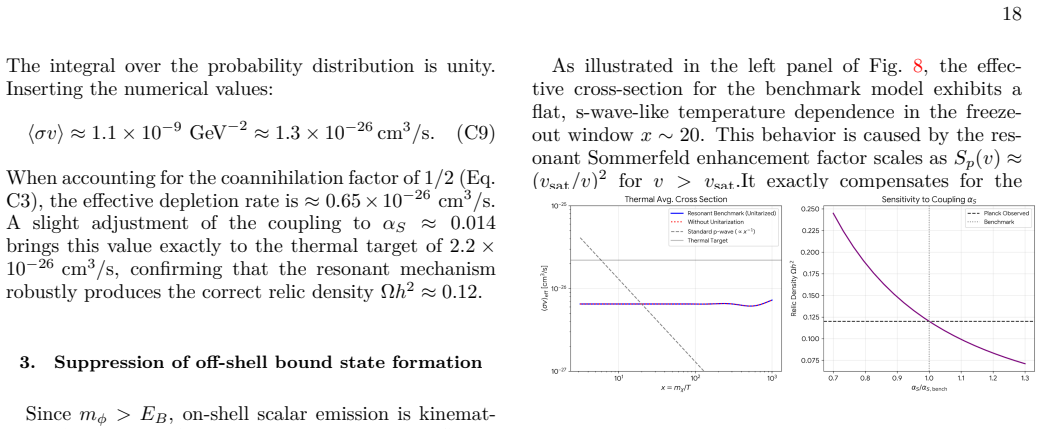
Quantitative Thermal History and Robustness To validate the relic density calculation in the resonant regime, we perform a numerical thermal average of the effective annihilation cross-section ⟨σv⟩eff as a function of the inverse temperature x = mχ/T . The results are shown in Fig. 8. As illustrated in the left panel of Fig. 8, the effec- tive cross-secti...
-
[11]
Planck 2018 results. VI. Cosmological parameters
N. Aghanim et al. (Planck), Planck 2018 results. VI. Cosmological parameters, Astron. Astrophys. 641, A6 (2020), [Erratum: Astron.Astrophys. 652, C4 (2021)], arXiv:1807.06209 [astro-ph.CO] . 19
work page internal anchor Pith review Pith/arXiv arXiv 2018
- [12]
-
[13]
Simulating the joint evolution of quasars, galaxies and their large-scale distribution
V. Springel et al. , Simulating the joint evolution of quasars, galaxies and their large-scale distribution, Na- ture 435, 629 (2005) , arXiv:astro-ph/0504097
work page internal anchor Pith review Pith/arXiv arXiv 2005
-
[14]
J. F. Navarro, C. S. Frenk, and S. D. M. White, A Uni- versal density profile from hierarchical clustering, Astro- phys. J. 490, 493 (1997) , arXiv:astro-ph/9611107
work page internal anchor Pith review Pith/arXiv arXiv 1997
-
[15]
S.-H. Oh, C. Brook, F. Governato, E. Brinks, L. Mayer, W. J. G. de Blok, A. Brooks, and F. Walter, The central slope of dark matter cores in dwarf galaxies: Simulations vs. THINGS, Astron. J. 142, 24 (2011) , arXiv:1011.2777 [astro-ph.CO]
work page internal anchor Pith review Pith/arXiv arXiv 2011
-
[16]
B. Moore, Evidence against dissipationless dark mat- ter from observations of galaxy haloes, Nature 370, 629 (1994)
work page 1994
-
[17]
W. J. G. de Blok, The Core-Cusp Problem, Adv. Astron. 2010, 789293 (2010) , arXiv:0910.3538 [astro-ph.CO]
work page internal anchor Pith review Pith/arXiv arXiv 2010
-
[18]
K. A. Oman et al. , The unexpected diversity of dwarf galaxy rotation curves, Mon. Not. Roy. Astron. Soc. 452, 3650 (2015) , arXiv:1504.01437 [astro-ph.GA]
work page internal anchor Pith review Pith/arXiv arXiv 2015
-
[19]
P. Creasey, O. Sameie, L. V. Sales, H.-B. Yu, M. Vogels- berger, and J. Zavala, Spreading out and staying sharp – creating diverse rotation curves via baryonic and self- interaction effects, Mon. Not. Roy. Astron. Soc. 468, 2283 (2017) , arXiv:1612.03903 [astro-ph.GA]
work page internal anchor Pith review Pith/arXiv arXiv 2017
-
[20]
A. A. Klypin, A. V. Kravtsov, O. Valenzuela, and F. Prada, Where are the missing Galactic satellites?, As- trophys. J. 522, 82 (1999) , arXiv:astro-ph/9901240
work page internal anchor Pith review Pith/arXiv arXiv 1999
-
[21]
Dark Matter Substructure in Galactic Halos
B. Moore, S. Ghigna, F. Governato, G. Lake, T. R. Quinn, J. Stadel, and P. Tozzi, Dark matter substruc- ture within galactic halos, Astrophys. J. Lett. 524, L19 (1999), arXiv:astro-ph/9907411
work page internal anchor Pith review Pith/arXiv arXiv 1999
-
[22]
Too big to fail? The puzzling darkness of massive Milky Way subhaloes
M. Boylan-Kolchin, J. S. Bullock, and M. Kaplinghat, Too big to fail? The puzzling darkness of massive Milky Way subhaloes, Mon. Not. Roy. Astron. Soc. 415, L40 (2011), arXiv:1103.0007 [astro-ph.CO]
work page internal anchor Pith review Pith/arXiv arXiv 2011
-
[23]
Too Big to Fail in the Local Group
S. Garrison-Kimmel, M. Boylan-Kolchin, J. S. Bullock, and E. N. Kirby, Too Big to Fail in the Local Group, Mon. Not. Roy. Astron. Soc. 444, 222 (2014) , arXiv:1404.5313 [astro-ph.GA]
work page internal anchor Pith review Pith/arXiv arXiv 2014
-
[24]
D. N. Spergel and P. J. Steinhardt, Observational ev- idence for selfinteracting cold dark matter, Phys. Rev. Lett. 84, 3760 (2000) , arXiv:astro-ph/9909386
work page internal anchor Pith review Pith/arXiv arXiv 2000
-
[25]
Dark Matter Self-interactions and Small Scale Structure
S. Tulin and H.-B. Yu, Dark Matter Self-interactions and Small Scale Structure, Phys. Rept. 730, 1 (2018) , arXiv:1705.02358 [hep-ph]
work page internal anchor Pith review Pith/arXiv arXiv 2018
-
[26]
M. Rocha, A. H. G. Peter, J. S. Bullock, M. Kapling- hat, S. Garrison-Kimmel, J. Onorbe, and L. A. Mous- takas, Cosmological Simulations with Self-Interacting Dark Matter I: Constant Density Cores and Substruc- ture, Mon. Not. Roy. Astron. Soc. 430, 81 (2013) , arXiv:1208.3025 [astro-ph.CO]
work page internal anchor Pith review Pith/arXiv arXiv 2013
-
[27]
A. H. G. Peter, M. Rocha, J. S. Bullock, and M. Kapling- hat, Cosmological Simulations with Self-Interacting Dark Matter II: Halo Shapes vs. Observations, Mon. Not. Roy. Astron. Soc. 430, 105 (2013) , arXiv:1208.3026 [astro- ph.CO]
work page internal anchor Pith review Pith/arXiv arXiv 2013
-
[28]
How the Self-Interacting Dark Matter Model Explains the Diverse Galactic Rotation Curves
A. Kamada, M. Kaplinghat, A. B. Pace, and H.-B. Yu, How the Self-Interacting Dark Matter Model Explains the Diverse Galactic Rotation Curves, Phys. Rev. Lett. 119, 111102 (2017) , arXiv:1611.02716 [astro-ph.GA]
work page internal anchor Pith review Pith/arXiv arXiv 2017
-
[30]
M. Markevitch, A. H. Gonzalez, D. Clowe, A. Vikhlinin, L. David, W. Forman, C. Jones, S. Murray, and W. Tucker, Direct constraints on the dark matter self- interaction cross-section from the merging galaxy cluster 1E0657-56, Astrophys. J. 606, 819 (2004) , arXiv:astro- ph/0309303
-
[31]
S. W. Randall, M. Markevitch, D. Clowe, A. H. Gonza- lez, and M. Bradac, Constraints on the Self-Interaction Cross-Section of Dark Matter from Numerical Simula- tions of the Merging Galaxy Cluster 1E 0657-56, Astro- phys. J. 679, 1173 (2008) , arXiv:0704.0261 [astro-ph]
work page internal anchor Pith review Pith/arXiv arXiv 2008
-
[32]
The non-gravitational interactions of dark matter in colliding galaxy clusters
D. Harvey, R. Massey, T. Kitching, A. Taylor, and E. Tittley, The non-gravitational interactions of dark matter in colliding galaxy clusters, Science 347, 1462 (2015), arXiv:1503.07675 [astro-ph.CO]
work page internal anchor Pith review Pith/arXiv arXiv 2015
- [33]
-
[34]
Constraining Self-Interacting Dark Matter with the Milky Way's dwarf spheroidals
J. Zavala, M. Vogelsberger, and M. G. Walker, Constrain- ing Self-Interacting Dark Matter with the Milky Way’s dwarf spheroidals, Mon. Not. Roy. Astron. Soc. 431, L20 (2013), arXiv:1211.6426 [astro-ph.CO]
work page internal anchor Pith review Pith/arXiv arXiv 2013
-
[35]
Dark matter self-interactions from the internal dynamics of dwarf spheroidals
M. Valli and H.-B. Yu, Dark matter self-interactions from the internal dynamics of dwarf spheroidals, Nature As- tron. 2, 907 (2018) , arXiv:1711.03502 [astro-ph.GA]
work page internal anchor Pith review Pith/arXiv arXiv 2018
-
[36]
H. Nishikawa, K. K. Boddy, and M. Kaplinghat, Accel- erated core collapse in tidally stripped self-interacting dark matter halos, Phys. Rev. D 101, 063009 (2020) , arXiv:1901.00499 [astro-ph.GA]
-
[37]
Beyond Collisionless Dark Matter: Particle Physics Dynamics for Dark Matter Halo Structure
S. Tulin, H.-B. Yu, and K. M. Zurek, Beyond Collision- less Dark Matter: Particle Physics Dynamics for Dark Matter Halo Structure, Phys. Rev. D 87, 115007 (2013) , arXiv:1302.3898 [hep-ph]
work page internal anchor Pith review Pith/arXiv arXiv 2013
-
[38]
D. Tucker-Smith and N. Weiner, Inelastic dark matter, Phys. Rev. D 64, 043502 (2001) , arXiv:hep-ph/0101138
work page internal anchor Pith review Pith/arXiv arXiv 2001
-
[39]
T. R. Slatyer, The Sommerfeld enhancement for dark matter with an excited state, JCAP 02 (02), 028, arXiv:0910.5713 [hep-ph]
work page internal anchor Pith review Pith/arXiv arXiv
-
[40]
N. Arkani-Hamed, D. P. Finkbeiner, T. R. Slatyer, and N. Weiner, A Theory of Dark Matter, Phys. Rev. D 79, 015014 (2009) , arXiv:0810.0713 [hep-ph]
work page internal anchor Pith review Pith/arXiv arXiv 2009
-
[41]
T. R. Slatyer, Indirect dark matter signatures in the cos- mic dark ages. I. Generalizing the bound on s-wave dark matter annihilation from Planck results, Phys. Rev. D 93, 023527 (2016) , arXiv:1506.03811 [hep-ph]
work page internal anchor Pith review Pith/arXiv arXiv 2016
-
[42]
Constraints on dark matter annihilation from CMB observations before Planck
L. Lopez-Honorez, O. Mena, S. Palomares-Ruiz, and A. C. Vincent, Constraints on dark matter annihilation from CMB observationsbefore Planck, JCAP 07 (07), 046, arXiv:1303.5094 [astro-ph.CO]
work page internal anchor Pith review Pith/arXiv arXiv
-
[43]
D. E. Kaplan, M. A. Luty, and K. M. Zurek, Asym- metric Dark Matter, Phys. Rev. D 79, 115016 (2009) , arXiv:0901.4117 [hep-ph]
work page internal anchor Pith review Pith/arXiv arXiv 2009
-
[44]
Review of asymmetric dark matter
K. Petraki and R. R. Volkas, Review of asymmetric dark matter, Int. J. Mod. Phys. A 28, 1330028 (2013) , arXiv:1305.4939 [hep-ph]
work page internal anchor Pith review Pith/arXiv arXiv 2013
-
[45]
Subhaloes in Self-Interacting Galactic Dark Matter Haloes
M. Vogelsberger, J. Zavala, and A. Loeb, Subhaloes in Self-Interacting Galactic Dark Matter Haloes, Mon. Not. Roy. Astron. Soc. 423, 3740 (2012) , arXiv:1201.5892 [astro-ph.CO]. 20
work page internal anchor Pith review Pith/arXiv arXiv 2012
-
[46]
Light Dark Matter: Models and Constraints
S. Knapen, T. Lin, and K. M. Zurek, Light Dark Matter: Models and Constraints, Phys. Rev. D 96, 115021 (2017), arXiv:1709.07882 [hep-ph]
work page internal anchor Pith review Pith/arXiv arXiv 2017
-
[47]
J. Aalbers et al. (LZ), First Dark Matter Search Results from the LUX-ZEPLIN (LZ) Experiment, Phys. Rev. Lett. 131, 041002 (2023) , arXiv:2207.03764 [hep-ex]
-
[48]
E. Aprile et al. (XENON), WIMP Dark Matter Search Using a 3.1 Tonne-Year Exposure of the XENONnT Experiment, Phys. Rev. Lett. 135, 221003 (2025) , arXiv:2502.18005 [hep-ex]
- [49]
-
[50]
G. C. Branco, P. M. Ferreira, L. Lavoura, M. N. Rebelo, M. Sher, and J. P. Silva, Theory and phenomenology of two-Higgs-doublet models, Phys. Rept. 516, 1 (2012) , arXiv:1106.0034 [hep-ph]
work page internal anchor Pith review Pith/arXiv arXiv 2012
-
[51]
Dark-Matter Electric and Magnetic Dipole Moments
K. Sigurdson, M. Doran, A. Kurylov, R. R. Caldwell, and M. Kamionkowski, Dark-matter electric and mag- netic dipole moments, Phys. Rev. D 70, 083501 (2004) , arXiv:astro-ph/0406355
work page internal anchor Pith review Pith/arXiv arXiv 2004
- [52]
-
[53]
H. An, M. B. Wise, and Y. Zhang, Effects of Bound States on Dark Matter Annihilation, Phys. Rev. D 93, 115020 (2016) , arXiv:1606.02305 [hep-ph]
work page internal anchor Pith review Pith/arXiv arXiv 2016
-
[54]
Explosive Dark Matter Annihilation
J. Hisano, S. Matsumoto, and M. M. Nojiri, Explosive dark matter annihilation, Phys. Rev. Lett. 92, 031303 (2004), arXiv:hep-ph/0307216
work page internal anchor Pith review Pith/arXiv arXiv 2004
- [55]
- [56]
- [57]
-
[58]
K. Blum, R. Sato, and T. R. Slatyer, Self-consistent Cal- culation of the Sommerfeld Enhancement, JCAP 06 (06), 021, arXiv:1603.01383 [hep-ph]
work page internal anchor Pith review Pith/arXiv arXiv
-
[59]
Radiative bound-state-formation cross-sections for dark matter interacting via a Yukawa potential
K. Petraki, M. Postma, and J. de Vries, Radiative bound-state-formation cross-sections for dark matter in- teracting via a Yukawa potential, JHEP 04 (04), 077, arXiv:1611.01394 [hep-ph]
work page internal anchor Pith review Pith/arXiv arXiv
-
[60]
Beacham et al.,Physics Beyond Colliders at CERN: Beyond the Standard Model Working Group Report,J
J. Beacham et al. , Physics Beyond Colliders at CERN: Beyond the Standard Model Working Group Report, J. Phys. G 47, 010501 (2020) , arXiv:1901.09966 [hep-ex]
-
[61]
J. P. Lees et al. (BaBar), Search for a Dark Photon in e+e− Collisions at BaBar, Phys. Rev. Lett. 113, 201801 (2014), arXiv:1406.2980 [hep-ex]
work page internal anchor Pith review Pith/arXiv arXiv 2014
-
[62]
D. Banerjee et al. , Dark matter search in missing energy events with NA64, Phys. Rev. Lett. 123, 121801 (2019) , arXiv:1906.00176 [hep-ex]
-
[63]
Light Dark Matter eXperiment (LDMX)
T. Åkesson et al. (LDMX), Light Dark Matter eXperi- ment (LDMX) (2018), arXiv:1808.05219 [hep-ex]
work page internal anchor Pith review Pith/arXiv arXiv 2018
-
[64]
T. Binder, L. Covi, A. Kamada, K. Murai, T. Takahashi, and N. Yoshida, Matter Power Spectrum in Hidden Neu- trino Interacting Dark Matter Models: A General Treat- ment, JCAP 11 (11), 043, arXiv:1602.07624 [hep-ph]
work page internal anchor Pith review Pith/arXiv arXiv
-
[65]
Constraining Dark Matter candidates from structure formation
C. Boehm, P. Fayet, and R. Schaeffer, Constraining dark matter candidates from structure formation, Phys. Lett. B 518, 8 (2001) , arXiv:astro-ph/0012504
work page internal anchor Pith review Pith/arXiv arXiv 2001
-
[66]
J. H. Chang, R. Essig, and S. D. McDermott, Super- nova 1987A Constraints on Sub-GeV Dark Sectors, Mil- licharged Particles, the QCD Axion, and an Axion-like Particle, JHEP 09, 051 , arXiv:1803.00993 [hep-ph]
work page internal anchor Pith review Pith/arXiv arXiv
-
[67]
G. G. Raffelt, Stars as laboratories for fundamental physics: The astrophysics of neutrinos, axions, and other weakly interacting particles (1996)
work page 1996
-
[68]
C. Boehm and P. Fayet, Scalar dark matter candidates, Nucl. Phys. B 683, 219 (2004) , arXiv:hep-ph/0305261
work page internal anchor Pith review Pith/arXiv arXiv 2004
-
[69]
The evolution of CMB spectral distortions in the early Universe
J. Chluba and R. A. Sunyaev, The evolution of CMB spectral distortions in the early Universe, Mon. Not. Roy. Astron. Soc. 419, 1294 (2012) , arXiv:1109.6552 [astro- ph.CO]
work page internal anchor Pith review Pith/arXiv arXiv 2012
-
[70]
Cosmological constraints on exotic injection of electromagnetic energy
V. Poulin, J. Lesgourgues, and P. D. Serpico, Cosmo- logical constraints on exotic injection of electromagnetic energy, JCAP 03, 043 , arXiv:1610.10051 [astro-ph.CO]
work page internal anchor Pith review Pith/arXiv arXiv
-
[71]
Stellar cooling bounds on new light particles: plasma mixing effects
E. Hardy and R. Lasenby, Stellar cooling bounds on new light particles: plasma mixing effects, JHEP 02, 033 , arXiv:1611.05852 [hep-ph]
work page internal anchor Pith review Pith/arXiv arXiv
-
[72]
Y.-S. Liu, D. McKeen, and G. A. Miller, Electrophobic Scalar Boson and Muonic Puzzles, Phys. Rev. Lett. 117, 101801 (2016) , arXiv:1605.04612 [hep-ph]
work page internal anchor Pith review Pith/arXiv arXiv 2016
-
[73]
R. H. Cyburt, B. D. Fields, K. A. Olive, and T.-H. Yeh, Big Bang Nucleosynthesis: 2015, Rev. Mod. Phys. 88, 015004 (2016) , arXiv:1505.01076 [astro-ph.CO]
work page internal anchor Pith review Pith/arXiv arXiv 2015
-
[74]
J. Kopp, L. Michaels, and J. Smirnov, Loopy constraints on leptophilic dark matter and internal bremsstrahlung, JCAP 04, 022 , arXiv:1401.6457 [hep-ph]
work page internal anchor Pith review Pith/arXiv arXiv
-
[75]
E. Aprile et al. (XENON), Search for New Physics in Electronic Recoil Data from XENONnT, Phys. Rev. Lett. 129, 161805 (2022) , arXiv:2207.11330 [hep-ex]
-
[76]
J. Aalbers et al. (LZ), Search for new physics in low- energy electron recoils from the first LZ exposure, Phys. Rev. D 108, 072006 (2023) , arXiv:2307.15753 [hep-ex]
-
[77]
Magnetic Inelastic Dark Matter
S. Chang, N. Weiner, and I. Yavin, Magnetic Inelas- tic Dark Matter, Phys. Rev. D 82, 125011 (2010) , arXiv:1007.4200 [hep-ph]
work page internal anchor Pith review Pith/arXiv arXiv 2010
-
[78]
A. L. Fitzpatrick, W. Haxton, E. Katz, N. Lubbers, and Y. Xu, The Effective Field Theory of Dark Matter Direct Detection, JCAP 02, 004 , arXiv:1203.3542 [hep-ph]
work page internal anchor Pith review Pith/arXiv arXiv
-
[79]
X-rays from Inelastic Dark Matter Freeze-in,
G. Krnjaic, D. McKeen, R. Mizuta, G. Mohlabeng, D. E. Morrissey, and D. Tuckler, X-rays from Inelastic Dark Matter Freeze-in (2025), arXiv:2509.19428 [hep-ph]
-
[80]
Strong constraints on self-interacting dark matter with light mediators
T. Bringmann, F. Kahlhoefer, K. Schmidt-Hoberg, and P. Walia, Strong constraints on self-interacting dark mat- ter with light mediators, Phys. Rev. Lett. 118, 141802 (2017), arXiv:1612.00845 [hep-ph]
work page internal anchor Pith review Pith/arXiv arXiv 2017
-
[81]
Y. Cui and F. D’Eramo, Surprises from complete vector portal theories: New insights into the dark sector and its interplay with Higgs physics, Phys. Rev. D 96, 095006 (2017), arXiv:1705.03897 [hep-ph]
work page internal anchor Pith review Pith/arXiv arXiv 2017
discussion (0)
Sign in with ORCID, Apple, or X to comment. Anyone can read and Pith papers without signing in.