Recognition: 1 theorem link
· Lean TheoremVecSet-Edit: Unleashing Pre-trained LRM for Mesh Editing from Single Image
Pith reviewed 2026-05-16 07:59 UTC · model grok-4.3
The pith
VecSet-Edit adapts a pre-trained VecSet LRM to perform precise 3D mesh edits from a single image by manipulating token subsets that control distinct geometry regions.
A machine-rendered reading of the paper's core claim, the machinery that carries it, and where it could break.
Core claim
VecSet-Edit exploits the spatial property that subsets of VecSet tokens govern distinct geometric regions; this property is used to localize edits through Mask-guided Token Seeding and Attention-aligned Token Gating, while Drift-aware Token Pruning rejects geometric outliers that arise in the VecSet diffusion process and Detail-preserving Texture Baking transfers both geometry and texture from the original mesh, all driven by 2D image conditions alone.
What carries the argument
The spatial correspondence between VecSet token subsets and distinct geometric regions, localized and edited via Mask-guided Token Seeding, Attention-aligned Token Gating, Drift-aware Token Pruning, and Detail-preserving Texture Baking.
If this is right
- Mesh edits can be performed from a single 2D image without requiring multi-view inputs or manual 3D masks.
- Geometric outliers introduced by the diffusion process are rejected, yielding cleaner edited shapes.
- Both geometric detail and texture information from the original mesh are retained after editing.
- The approach achieves higher resolution than prior voxel-based methods such as VoxHammer.
Where Pith is reading between the lines
- If the token-to-region mapping proves consistent across different objects, the same localization strategy could be tested on other pre-trained reconstruction models.
- Single-image control might shorten iteration cycles in 3D content pipelines where acquiring multiple views is costly.
- The drift-pruning step could be examined for use in other diffusion-based 3D generation tasks that suffer from outlier geometry.
Load-bearing premise
Subsets of VecSet tokens reliably correspond to distinct geometric regions and can be accurately localized and altered using only 2D image conditions without creating artifacts or losing fidelity.
What would settle it
Apply the full pipeline to a single image of an object with fine surface details and measure whether the output mesh preserves those details without visible distortion or loss of resolution compared with the source.
Figures




read the original abstract
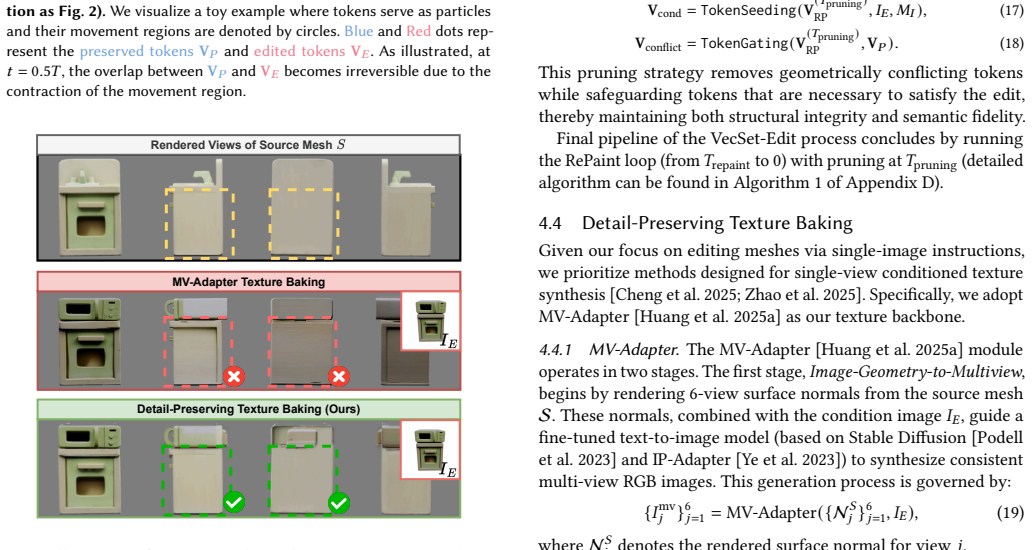
3D editing has emerged as a critical research area to provide users with flexible control over 3D assets. While current editing approaches predominantly focus on 3D Gaussian Splatting or multi-view images, the direct editing of 3D meshes remains underexplored. Prior attempts, such as VoxHammer, rely on voxel-based representations that suffer from limited resolution and necessitate labor-intensive 3D mask. To address these limitations, we propose \textbf{VecSet-Edit}, the first pipeline that leverages the high-fidelity VecSet Large Reconstruction Model (LRM) as a backbone for mesh editing. Our approach is grounded on a analysis of the spatial properties in VecSet tokens, revealing that token subsets govern distinct geometric regions. Based on this insight, we introduce Mask-guided Token Seeding and Attention-aligned Token Gating strategies to precisely localize target regions using only 2D image conditions. Also, considering the difference between VecSet diffusion process versus voxel we design a Drift-aware Token Pruning to reject geometric outliers during the denoising process. Finally, our Detail-preserving Texture Baking module ensures that we not only preserve the geometric details of original mesh but also the textural information. More details can be found in our project page: https://github.com/BlueDyee/VecSet-Edit/tree/main
Editorial analysis
A structured set of objections, weighed in public.
Referee Report
Summary. The manuscript introduces VecSet-Edit, the first pipeline to adapt a pre-trained VecSet Large Reconstruction Model (LRM) for single-image 3D mesh editing. It grounds the approach in an analysis of spatial properties of VecSet tokens, claiming that distinct token subsets control separate geometric regions. This enables Mask-guided Token Seeding and Attention-aligned Token Gating to localize edits from 2D image conditions, Drift-aware Token Pruning to handle diffusion-induced outliers, and Detail-preserving Texture Baking to retain original geometry and texture details. The work contrasts with prior voxel-based methods like VoxHammer that require 3D masks and suffer resolution limits.
Significance. If the spatial-locality assumption holds and the token-level controls prove accurate, the pipeline could meaningfully advance single-image mesh editing by leveraging high-fidelity pre-trained LRMs without multi-view input or labor-intensive 3D annotations. The GitHub release noted in the abstract supports reproducibility, which strengthens the contribution if quantitative results and ablations are added.
major comments (2)
- [Analysis of spatial properties in VecSet tokens] The core claim that VecSet token subsets govern distinct geometric regions (and can be localized accurately from 2D masks) is load-bearing for Mask-guided Token Seeding and Attention-aligned Token Gating, yet the manuscript supplies no quantitative validation such as token-to-voxel correspondence metrics, ablation on mask accuracy, or view-dependency tests. Without these, the localization fidelity remains unanchored and the editing claims cannot be assessed.
- [Method and Experiments] No quantitative results, ablation studies, or implementation details appear for the proposed strategies or the final editing performance. This absence prevents evaluation of whether Drift-aware Token Pruning successfully rejects outliers or whether Texture Baking preserves fidelity without artifacts.
minor comments (2)
- [Abstract] Abstract contains a grammatical error: 'a analysis' should read 'an analysis'.
- [Overall presentation] The manuscript would benefit from explicit section numbering and clearer cross-references when describing the four proposed modules.
Simulated Author's Rebuttal
We thank the referee for the detailed and constructive review of our manuscript. We address each of the major comments below and have made revisions to incorporate additional quantitative validations and experimental results as suggested.
read point-by-point responses
-
Referee: [Analysis of spatial properties in VecSet tokens] The core claim that VecSet token subsets govern distinct geometric regions (and can be localized accurately from 2D masks) is load-bearing for Mask-guided Token Seeding and Attention-aligned Token Gating, yet the manuscript supplies no quantitative validation such as token-to-voxel correspondence metrics, ablation on mask accuracy, or view-dependency tests. Without these, the localization fidelity remains unanchored and the editing claims cannot be assessed.
Authors: We appreciate the referee pointing out the need for quantitative validation of our core spatial locality assumption. Although the original manuscript focused on qualitative demonstrations through visualizations and editing examples, we agree that metrics are essential to substantiate the claims. In the revised version, we have added quantitative analyses including token-to-voxel correspondence metrics, where we measure the alignment between token subsets and corresponding 3D geometric regions using IoU scores. We also provide ablations on mask accuracy by introducing controlled noise to the 2D masks and evaluating the impact on editing quality. Furthermore, view-dependency tests across multiple camera angles confirm the robustness of the localization. These additions provide a solid foundation for the Mask-guided Token Seeding and Attention-aligned Token Gating strategies. revision: yes
-
Referee: [Method and Experiments] No quantitative results, ablation studies, or implementation details appear for the proposed strategies or the final editing performance. This absence prevents evaluation of whether Drift-aware Token Pruning successfully rejects outliers or whether Texture Baking preserves fidelity without artifacts.
Authors: We acknowledge that the initial submission lacked sufficient quantitative results and ablations, which limits the assessment of the individual components. In the revised manuscript, we have included extensive quantitative evaluations of the full pipeline using metrics such as Chamfer Distance for geometry, PSNR and LPIPS for texture fidelity, and perceptual user studies. Ablation studies are presented for each proposed module, demonstrating the contribution of Drift-aware Token Pruning in reducing outliers (with before/after statistics on token drift) and Detail-preserving Texture Baking in maintaining original details without introducing artifacts (supported by difference maps and quantitative similarity scores). Detailed implementation specifics, including network architectures, hyperparameters, and diffusion settings, have been added to the main text and supplementary material. We believe these revisions enable a thorough evaluation of the method's effectiveness. revision: yes
Circularity Check
No circularity; pipeline extends pre-trained LRM with independent analysis and heuristics
full rationale
The paper grounds its approach on an internal analysis of VecSet token spatial properties (token subsets governing distinct regions) and introduces Mask-guided Token Seeding, Attention-aligned Token Gating, Drift-aware Token Pruning, and Detail-preserving Texture Baking as extensions to a pre-trained external LRM backbone. No equations, fitting procedures, or self-referential reductions are present that would make any prediction equivalent to its inputs by construction. The analysis is presented as a contribution rather than a self-citation chain or ansatz smuggled from prior work by the same authors. The method remains self-contained against external benchmarks with no load-bearing circular steps.
Axiom & Free-Parameter Ledger
axioms (1)
- domain assumption Subsets of VecSet tokens govern distinct geometric regions of the reconstructed mesh
Lean theorems connected to this paper
-
IndisputableMonolith/Cost/FunctionalEquation.leanwashburn_uniqueness_aczel unclear?
unclearRelation between the paper passage and the cited Recognition theorem.
token subsets govern distinct geometric regions... Mask-guided Token Seeding and Attention-aligned Token Gating... Drift-aware Token Pruning
What do these tags mean?
- matches
- The paper's claim is directly supported by a theorem in the formal canon.
- supports
- The theorem supports part of the paper's argument, but the paper may add assumptions or extra steps.
- extends
- The paper goes beyond the formal theorem; the theorem is a base layer rather than the whole result.
- uses
- The paper appears to rely on the theorem as machinery.
- contradicts
- The paper's claim conflicts with a theorem or certificate in the canon.
- unclear
- Pith found a possible connection, but the passage is too broad, indirect, or ambiguous to say the theorem truly supports the claim.
Forward citations
Cited by 1 Pith paper
-
Velocity-Space 3D Asset Editing
VS3D performs local 3D asset editing by injecting reconstruction-anchored source signals, partial-mean guidance, and twin-agreement residuals into the velocity sampler to control edit strength and preserve identity.
Reference graph
Works this paper leans on
-
[1]
Amir Barda, Matheus Gadelha, Vladimir G Kim, Noam Aigerman, Amit H Bermano, and Thibault Groueix
EditP23: 3D Editing via Propagation of Image Prompts to Multi-View.arXiv preprint arXiv:2506.20652(2025). Amir Barda, Matheus Gadelha, Vladimir G Kim, Noam Aigerman, Amit H Bermano, and Thibault Groueix
-
[2]
InProceedings of the IEEE/CVF international conference on computer vision
Masactrl: Tuning-free mutual self-attention control for consistent image synthesis and editing. InProceedings of the IEEE/CVF international conference on computer vision. 22560–22570. Hansheng Chen, Bokui Shen, Yulin Liu, Ruoxi Shi, Linqi Zhou, Connor Z Lin, Jiayuan Gu, Hao Su, Gordon Wetzstein, and Leonidas Guibas. 2024b. 3d-adapter: Geometry- consistent...
-
[3]
Yiftach Edelstein, Or Patashnik, Dana Cohen-Bar, and Lihi Zelnik-Manor
Vica-nerf: View-consistency-aware 3d editing of neural radiance fields.Advances in Neural Information Processing Systems36 (2023), 61466–61477. Yiftach Edelstein, Or Patashnik, Dana Cohen-Bar, and Lihi Zelnik-Manor
work page 2023
-
[4]
Teng-Fang Hsiao, Bo-Kai Ruan, Yi-Lun Wu, Tzu-Ling Lin, and Hong-Han Shuai
3545–3553. Teng-Fang Hsiao, Bo-Kai Ruan, Yi-Lun Wu, Tzu-Ling Lin, and Hong-Han Shuai. 2025b. Tf-ti2i: Training-free text-and-image-to-image generation via multi-modal implicit- context learning in text-to-image models.arXiv preprint arXiv:2503.15283(2025). Junchao Huang, Xinting Hu, Shaoshuai Shi, Zhuotao Tian, and Li Jiang. 2025b. Edit360: 2d image edits...
-
[5]
Hunyuan3d- omni: A unified framework for controllable generation of 3d assets.arXiv preprint arXiv:2509.21245(2025). Heewoo Jun and Alex Nichol
-
[6]
Shap-E: Generating Conditional 3D Implicit Functions
Shap-E: Generating Conditional 3D Implicit Functions. arXiv:2305.02463 Vladimir Kulikov, Matan Kleiner, Inbar Huberman-Spiegelglas, and Tomer Michaeli
work page internal anchor Pith review arXiv
-
[7]
Flowedit: Inversion-free text-based editing using pre-trained flow models. InProceedings of the IEEE/CVF International Conference on Computer Vision. 19721– 19730. Lin Li, Zehuan Huang, Haoran Feng, Gengxiong Zhuang, Rui Chen, Chunchao Guo, and Lu Sheng. 2025a. Voxhammer: Training-free precise and coherent 3d editing in native 3d space.arXiv preprint arXi...
-
[8]
arXiv preprint arXiv:2405.14979 , year=
Craftsman3d: High-fidelity mesh generation with 3d native generation and interactive geometry refiner.arXiv preprint arXiv:2405.14979(2024). Weiyu Li, Xuanyang Zhang, Zheng Sun, Di Qi, Hao Li, Wei Cheng, Weiwei Cai, Shihao Wu, Jiarui Liu, Zihao Wang, et al . 2025c. Step1x-3d: Towards high-fidelity and controllable generation of textured 3d assets.arXiv pr...
-
[9]
Chenlin Meng, Yutong He, Yang Song, Jiaming Song, Jiajun Wu, Jun-Yan Zhu, and Stefano Ermon
Feedforward 3D Editing via Text-Steerable Image-to-3D.arXiv preprint arXiv:2512.13678(2025). Chenlin Meng, Yutong He, Yang Song, Jiaming Song, Jiajun Wu, Jun-Yan Zhu, and Stefano Ermon
-
[10]
Ipek Oztas, Duygu Ceylan, and Aysegul Dundar
DINOv2: Learning Robust Visual Features without Supervision.Transactions on Machine Learning Research(2024). Ipek Oztas, Duygu Ceylan, and Aysegul Dundar
work page 2024
-
[11]
SDXL: Improving Latent Diffusion Models for High-Resolution Image Synthesis
Sdxl: Improving latent diffusion models for high-resolution image synthesis.arXiv preprint arXiv:2307.01952(2023). Yansong Qu, Dian Chen, Xinyang Li, Xiaofan Li, Shengchuan Zhang, Liujuan Cao, and Rongrong Ji
work page internal anchor Pith review Pith/arXiv arXiv 2023
-
[12]
3dsceneeditor: Controllable 3d scene editing with gaussian splatting.arXiv preprint arXiv:2412.01583(2024). Xianghui Yang, Huiwen Shi, Bowen Zhang, Fan Yang, Jiacheng Wang, Hongxu Zhao, Xinhai Liu, Xinzhou Wang, Qingxiang Lin, Jiaao Yu, Lifu Wang, Jing Xu, Zebin He, Zhuo Chen, Sicong Liu, Junta Wu, Yihang Lian, Shaoxiong Yang, Yuhong Liu, Yong SIGGRAPH Co...
-
[13]
Hunyuan3d-1.0: A unified framework for text-to-3d and image-to-3d generation
Hunyuan3D 1.0: A Unified Framework for Text-to-3D and Image-to-3D Generation. arXiv:2411.02293 Hu Ye, Jun Zhang, Sibo Liu, Xiao Han, and Wei Yang
-
[14]
IP-Adapter: Text Compatible Image Prompt Adapter for Text-to-Image Diffusion Models
Ip-adapter: Text com- patible image prompt adapter for text-to-image diffusion models.arXiv preprint arXiv:2308.06721(2023). Junliang Ye, Shenghao Xie, Ruowen Zhao, Zhengyi Wang, Hongyu Yan, Wenqiang Zu, Lei Ma, and Jun Zhu
work page internal anchor Pith review Pith/arXiv arXiv 2023
-
[15]
NANO3D: A Training-Free Approach for Efficient 3D Editing Without Masks.arXiv preprint arXiv:2510.15019(2025). Xianfang Zeng, Xin Chen, Zhongqi Qi, Wen Liu, Zibo Zhao, Zhibin Wang, Bin Fu, Yong Liu, and Gang Yu
-
[16]
IEEE Transactions on Pattern Analysis and Machine Intelligence(2025)
Stylizedgs: Controllable stylization for 3d gaussian splatting. IEEE Transactions on Pattern Analysis and Machine Intelligence(2025). Longwen Zhang, Ziyu Wang, Qixuan Zhang, Qiwei Qiu, Anqi Pang, Haoran Jiang, Wei Yang, Lan Xu, and Jingyi Yu. 2024b. Clay: A controllable large-scale generative model for creating high-quality 3d assets.ACM Transactions on G...
work page 2025
-
[17]
Hunyuan3D 2.0: Scaling Diffusion Models for High Resolution Textured 3D Assets Generation
Hunyuan3d 2.0: Scaling diffusion models for high resolution textured 3d assets generation.arXiv preprint arXiv:2501.12202(2025). Yang Zheng, Hao Tan, Kai Zhang, Peng Wang, Leonidas Guibas, Gordon Wetzstein, and Wang Yifan
work page internal anchor Pith review Pith/arXiv arXiv 2025
-
[18]
Zijun Zhou, Yingying Deng, Xiangyu He, Weiming Dong, and Fan Tang
SplatPainter: Interactive Authoring of 3D Gaussians from 2D Edits via Test-Time Training.arXiv preprint arXiv:2512.05354(2025). Zijun Zhou, Yingying Deng, Xiangyu He, Weiming Dong, and Fan Tang
-
[19]
Jingyu Zhuang, Di Kang, Yan-Pei Cao, Guanbin Li, Liang Lin, and Ying Shan
Multi- turn Consistent Image Editing.arXiv preprint arXiv:2505.04320(2025). Jingyu Zhuang, Di Kang, Yan-Pei Cao, Guanbin Li, Liang Lin, and Ying Shan
-
[20]
ACM Transactions on Graphics (TOG)43, 4 (2024), 1–12
Tip-editor: An accurate 3d editor following both text-prompts and image-prompts. ACM Transactions on Graphics (TOG)43, 4 (2024), 1–12. Jingyu Zhuang, Chen Wang, Liang Lin, Lingjie Liu, and Guanbin Li
work page 2024
-
[21]
InSIGGRAPH Asia 2023 Conference Papers
Dreameditor: Text-driven 3d scene editing with neural fields. InSIGGRAPH Asia 2023 Conference Papers. 1–10. SIGGRAPH Conference Papers ’26, July 19–23, 2026, Los Angeles, CA, USA. VecSet-Edit: Unleashing Pre-trained LRM for Mesh Editing from Single Image•13 A Details of VecSet-based LRM The illustration of overall VecSet Encoding and Diffusion process can...
work page 2023
-
[22]
3 D.1 LRM Backbone Classifier-free Guidance Scale (𝑟= 10).This parameter controls the alignment of the generated mesh with the condition image. 3Sensitivity experiments were conducted on a randomly selected50%subset of the Edit3D-Bench to reduce computational overhead SIGGRAPH Conference Papers ’26, July 19–23, 2026, Los Angeles, CA, USA. VecSet-Edit: Unl...
work page 2026
-
[23]
SIGGRAPH Conference Papers ’26, July 19–23, 2026, Los Angeles, CA, USA
More qualitative demonstration. SIGGRAPH Conference Papers ’26, July 19–23, 2026, Los Angeles, CA, USA. 18•Teng-Fang Hsiao, Bo-Kai Ruan, Yu-Lun Liu, and Hong-Han Shuai Fig
work page 2026
-
[24]
SIGGRAPH Conference Papers ’26, July 19–23, 2026, Los Angeles, CA, USA
More qualitative demonstration. SIGGRAPH Conference Papers ’26, July 19–23, 2026, Los Angeles, CA, USA
work page 2026
discussion (0)
Sign in with ORCID, Apple, or X to comment. Anyone can read and Pith papers without signing in.