Analytic Approximations for Fermionic Preheating
Pith reviewed 2026-05-10 17:49 UTC · model grok-4.3
The pith
Analytic approximations show fermion number density during preheating scales as the square root of coupling q for small values and q to the three-quarters power for large values.
A machine-rendered reading of the paper's core claim, the machinery that carries it, and where it could break.
Core claim
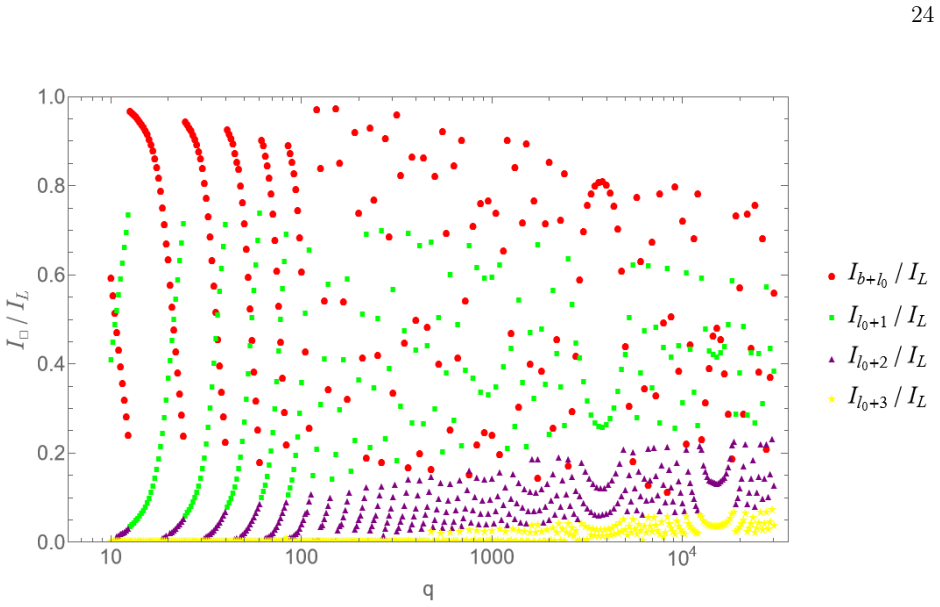
The authors establish that resonance peak momenta in the fermion spectrum obey a simple predictive relation valid for arbitrary q. They derive analytic approximations for the total fermion number density that scale as q to the 1/2 power when q is at most 0.01 and as q to the 3/4 power when q is at least 10. In the regime q greater than or equal to 0.01 the dominant production mechanism is non-adiabatic filling of roughly half a Fermi sphere at low momenta, while for smaller q discrete high-momentum resonance peaks provide the main contribution.
What carries the argument
The resonance peaks in the fermion momentum spectrum together with the power-law approximations to the integrated number density, both derived as functions of the coupling parameter q during inflaton oscillations.
If this is right
- The total fermion abundance can be estimated directly from q without integrating the full momentum spectrum in the two regimes.
- Lower bounds on the mass of these fermions follow immediately if they constitute all dark matter.
- Production is dominated by high-momentum resonances rather than low-momentum non-adiabatic effects when q is small.
- The transition between resonance-dominated and Fermi-sphere-dominated regimes occurs near q equal to 0.01.
Where Pith is reading between the lines
- The resonance-peak relation could be tested or extended in numerical simulations of other inflationary potentials beyond λφ^4.
- The distinct momentum distributions in the two q regimes would produce different free-streaming lengths if the fermions are dark matter, affecting small-scale structure.
- An interpolation formula bridging the small-q and large-q power laws might be constructed for intermediate couplings around 0.1 to 1.
Load-bearing premise
The analytic approximations remain accurate across the stated ranges of q and that the produced fermions can make up the entire dark matter density when mass lower bounds are derived.
What would settle it
A high-precision numerical integration of the fermion production equations for q equal to 0.001 that yields a number density deviating from the predicted square-root scaling, or for q equal to 100 deviating from the three-quarter-power scaling, would falsify the approximations.
Figures




read the original abstract
Non-thermal fermions can be produced non-perturbatively in the early universe during coherent oscillations of a scalar field. We explore fermion production in $\lambda\phi^{4}$ inflation through this mechanism and analyze the momentum spectrum of the fermions produced, which depends on a coupling parameter $q$. For $q \gtrsim 0.01$, the main contribution to the total number density comes from an approximately half-filled Fermi sphere as a result of non-adiabaticity. For $q\lesssim 0.01$, we find that the major contributions instead come from resonance peaks at higher momentum values. We find a simple relation to predict the momentum values corresponding to resonance peaks for any $q$. We also obtain analytic power-law approximations for the total number density of fermions and find that it is proportional to $q^{1/2}$ for $q\lesssim 0.01$ and proportional to $q^{3/4}$ for $q\gtrsim 10$. If fermions produced by this mechanism make up the entirety of dark matter, we estimate lower bounds on their mass.
Editorial analysis
A structured set of objections, weighed in public.
Referee Report
Summary. The paper explores non-thermal production of fermions in λφ⁴ inflation via preheating, focusing on the momentum spectrum's dependence on the coupling q. It identifies two regimes: for q ≳ 0.01, production is dominated by an approximately half-filled Fermi sphere from non-adiabaticity, and for q ≲ 0.01, by resonance peaks. A simple predictive relation for resonance peak momenta is provided for any q. Analytic approximations yield total number density n ∝ q^{1/2} for q ≲ 0.01 and n ∝ q^{3/4} for q ≳ 10. Lower bounds on fermion mass are estimated assuming they comprise all dark matter.
Significance. Should the approximations prove accurate upon numerical validation, this work would provide practical analytic tools for calculating fermion yields in preheating, reducing reliance on computationally intensive simulations. The power-law relations and peak prediction formula could be particularly useful in exploring parameter spaces for fermionic dark matter models in the early universe.
major comments (3)
- [analytic approximations for total number density] The q^{1/2} scaling for q≲0.01 is obtained by approximating the sum over resonance peaks (as described in the regime analysis), but the manuscript lacks a direct comparison to numerical integration of the mode equations or error estimates, making it difficult to confirm the exponent remains accurate near the quoted boundaries.
- [Fermi sphere regime analysis] For q≳10, the n ∝ q^{3/4} scaling relies on modeling the low-momentum band as a half-filled Fermi sphere whose radius scales with q; the derivation does not quantify how expansion or back-reaction might alter the filling factor, which could invalidate the exponent if the adiabaticity assumption fails inside the regime.
- [resonance peaks section] The simple relation for resonance peak momenta is presented as valid for any q, yet the underlying approximations (including on the adiabaticity parameter) and tests at intermediate q values are not shown explicitly, leaving the generality of the relation unverified.
minor comments (3)
- The abstract states the regime boundaries at q~0.01 and q~10 without indicating how these thresholds were determined from the spectra; a brief justification in the main text would improve clarity.
- Adding a table or figure directly comparing the analytic n(q) to numerical results for several benchmark q values would strengthen the power-law claims.
- Notation for the mode functions and occupation numbers could be defined more explicitly at first use to aid readability.
Simulated Author's Rebuttal
We thank the referee for their careful reading and constructive comments, which help improve the clarity and robustness of our analytic approximations. We address each major comment below and indicate the revisions planned for the manuscript.
read point-by-point responses
-
Referee: [analytic approximations for total number density] The q^{1/2} scaling for q≲0.01 is obtained by approximating the sum over resonance peaks (as described in the regime analysis), but the manuscript lacks a direct comparison to numerical integration of the mode equations or error estimates, making it difficult to confirm the exponent remains accurate near the quoted boundaries.
Authors: We agree that explicit numerical validation would strengthen the result. The q^{1/2} scaling follows directly from summing the analytically derived contributions of the resonance peaks, whose locations, widths, and heights are set by the resonance condition. In the revised manuscript we will add a direct comparison between the analytic sum and numerical integration of the mode equations for several representative values of q near the q=0.01 boundary, together with relative-error estimates to confirm that the exponent remains accurate throughout the quoted regime. revision: yes
-
Referee: [Fermi sphere regime analysis] For q≳10, the n ∝ q^{3/4} scaling relies on modeling the low-momentum band as a half-filled Fermi sphere whose radius scales with q; the derivation does not quantify how expansion or back-reaction might alter the filling factor, which could invalidate the exponent if the adiabaticity assumption fails inside the regime.
Authors: The half-filled Fermi-sphere model follows from the non-adiabatic production mechanism, which drives the occupation number to 1/2 for all modes below a q-dependent cutoff. For q≳10 the production occurs on a timescale much shorter than the Hubble time, so expansion during the resonance window is negligible; back-reaction remains small while the fermion energy density is still sub-dominant. We acknowledge, however, that a quantitative bound on possible deviations of the filling factor would be useful. In the revision we will add an explicit estimate of the adiabaticity parameter across the q≳10 regime and a brief discussion of the expected size of expansion and back-reaction corrections, together with the regime of validity of the q^{3/4} scaling. revision: partial
-
Referee: [resonance peaks section] The simple relation for resonance peak momenta is presented as valid for any q, yet the underlying approximations (including on the adiabaticity parameter) and tests at intermediate q values are not shown explicitly, leaving the generality of the relation unverified.
Authors: The relation is obtained by setting the adiabaticity parameter to O(1), which locates the centers of the resonance bands independently of the specific value of q. The underlying approximation is therefore general. To make this explicit, the revised manuscript will include the explicit expression for the adiabaticity parameter, together with numerical checks of the predicted peak locations at intermediate couplings (e.g., q=1) to verify that the formula remains accurate outside the two limiting regimes already discussed. revision: yes
Circularity Check
No significant circularity; derivations of resonance-peak relation and power-law scalings are self-contained analytic approximations
full rationale
The paper derives a predictive relation for resonance-peak momenta and the two power-law regimes for integrated fermion number density by approximating the mode functions, occupation-number integral, and resonance structure directly from the equations of motion in the λφ⁴ model. No step reduces a claimed prediction to a fitted parameter by construction, nor does any load-bearing premise rest on a self-citation chain or imported uniqueness theorem. The q-regime boundaries and adiabaticity assumptions are stated explicitly as conditions of validity rather than being smuggled in via prior work by the same authors. The central results therefore remain independent of the inputs they are applied to.
Axiom & Free-Parameter Ledger
axioms (2)
- domain assumption The background evolution is given by coherent oscillations of a scalar field with λφ⁴ potential during preheating.
- standard math Fermion production is governed by the standard Dirac equation in a time-dependent scalar background.
Reference graph
Works this paper leans on
-
[1]
and leptogenesis [15] scenarios to explain the observed baryon asymmetry of the universe. Significant gravitational waves may also be generated as a consequence of the preheating mechanism [16]. Preheating can also lead to the production of particles out of thermal equilibrium that may act as a viable candidate for dark matter [17, 18]. For a general revi...
-
[2]
(4.9) for the maximumκgiven by the inequality on the right of Eq
We usef ∗ from Eq. (4.9) for the maximumκgiven by the inequality on the right of Eq. (4.8) and see for the corresponding valueκ ∗: qf∗ ˙f∗ = κ2 ∗ +qf 2 ∗ 3/2 =⇒κ ∗ = 2q1/2 ˙f∗ 3 √ 3 2 27 1/4 q1/4 ≈0.52q 1/4.(4.10) Thisκ ∗ ≈0.52q 1/4 implies that the boundary of the bulk is∝q 1/4. If the major contribution to the fermion number density comes from the bulk ...
-
[3]
L. Kofman, A. D. Linde, and A. A. Starobinsky, “Reheating after inflation,” Phys. Rev. Lett. 73, 3195 (1994), hep-th/9405187
work page Pith review arXiv 1994
-
[4]
ON PARTICLE CREATION BY A TIME DEPENDENT SCALAR FIELD,
A. D. Dolgov and D. P. Kirilova, “ON PARTICLE CREATION BY A TIME DEPENDENT SCALAR FIELD,” Sov. J. Nucl. Phys.51, 172 (1990)
work page 1990
-
[5]
Particle Production During Out-of-equilibrium Phase Transitions,
J. H. Traschen and R. H. Brandenberger, “Particle Production During Out-of-equilibrium Phase Transitions,” Phys. Rev. D42, 2491 (1990)
work page 1990
-
[6]
Universe Reheating after Inflation
Y. Shtanov, J. H. Traschen, and R. H. Brandenberger, “Universe reheating after inflation,” Phys. Rev. D51, 5438 (1995), hep-ph/9407247
work page Pith review arXiv 1995
-
[7]
P. B. Greene and L. Kofman, “Preheating of fermions,” Phys. Lett. B448, 6 (1999), hep- ph/9807339. 5 This case corresponds to considering bosons. 38
-
[8]
Baryon Asymmetry in Inflationary Universe,
A. D. Dolgov and A. D. Linde, “Baryon Asymmetry in Inflationary Universe,” Phys. Lett. B 116, 329 (1982)
work page 1982
-
[9]
Towards the Theory of Reheating After Inflation
L. Kofman, A. D. Linde, and A. A. Starobinsky, “Towards the theory of reheating after inflation,” Phys. Rev. D56, 3258 (1997), hep-ph/9704452
work page Pith review arXiv 1997
-
[10]
A New method in the theory of superconductivity,
N. N. Bogolyubov, V. V. Tolmachev, and D. V. Shirkov, “A New method in the theory of superconductivity,” Fortsch. Phys.6, 605 (1958)
work page 1958
-
[11]
Particle creation from vacuum by homogeneous electric field with a periodical time dependence,
V. M. Mostepanenko and V. M. Frolov, “Particle creation from vacuum by homogeneous electric field with a periodical time dependence,” Yad. Fiz.19, 885 (1974)
work page 1974
-
[12]
E. W. Kolb and A. J. Long, “Cosmological gravitational particle production and its implica- tions for cosmological relics,” Rev. Mod. Phys.96, 045005 (2024), 2312.09042
-
[13]
Fermion production during and after axion inflation
P. Adshead and E. I. Sfakianakis, “Fermion production during and after axion inflation,” JCAP11, 021 (2015), 1508.00891
work page Pith review arXiv 2015
-
[14]
P. Adshead, L. Pearce, M. Peloso, M. A. Roberts, and L. Sorbo, “Phenomenology of fermion production during axion inflation,” JCAP06, 020 (2018), 1803.04501
-
[15]
Inflation Dynamics and Reheating
B. A. Bassett, S. Tsujikawa, and D. Wands, “Inflation dynamics and reheating,” Rev. Mod. Phys.78, 537 (2006), astro-ph/0507632
work page Pith review arXiv 2006
-
[16]
GUT baryogenesis after preheating,
E. W. Kolb, A. D. Linde, and A. Riotto, “GUT baryogenesis after preheating,” Phys. Rev. Lett.77, 4290 (1996), hep-ph/9606260
-
[17]
Production of massive fermions at preheating and leptogenesis,
G. F. Giudice, M. Peloso, A. Riotto, and I. Tkachev, “Production of massive fermions at preheating and leptogenesis,” JHEP08, 014 (1999), hep-ph/9905242
-
[18]
Cosmological Backgrounds of Gravitational Waves
C. Caprini and D. G. Figueroa, “Cosmological Backgrounds of Gravitational Waves,” Class. Quant. Grav.35, 163001 (2018), 1801.04268
work page Pith review arXiv 2018
-
[19]
Nonthermal supermassive dark matter,
D. J. H. Chung, E. W. Kolb, and A. Riotto, “Nonthermal supermassive dark matter,” Phys. Rev. Lett.81, 4048 (1998), hep-ph/9805473
- [20]
-
[21]
Reheating in Inflationary Cosmology: Theory and Applications
R. Allahverdi, R. Brandenberger, F.-Y. Cyr-Racine, and A. Mazumdar, “Reheating in In- flationary Cosmology: Theory and Applications,” Ann. Rev. Nucl. Part. Sci.60, 27 (2010), 1001.2600
work page Pith review arXiv 2010
-
[22]
Nonperturbative Dynamics Of Reheating After Inflation: A Review
M. A. Amin, M. P. Hertzberg, D. I. Kaiser, and J. Karouby, “Nonperturbative Dynamics Of Reheating After Inflation: A Review,” Int. J. Mod. Phys. D24, 1530003 (2014), 1410.3808
work page Pith review arXiv 2014
- [23]
-
[24]
On the Theory of Fermionic Preheating
P. B. Greene and L. Kofman, “On the theory of fermionic preheating,” Phys. Rev. D62, 123516 (2000), hep-ph/0003018
work page Pith review arXiv 2000
-
[25]
Aspects of Preheating After Inflation,
P. B. Greene, “Aspects of Preheating After Inflation,” Ph.D. thesis, Toronto U. (2002), URL http://hdl.handle.net/1807/121431
work page 2002
-
[26]
Planck 2018 results. X. Constraints on inflation
Y. Akrami et al. (Planck), “Planck 2018 results. X. Constraints on inflation,” Astron. Astro- phys.641, A10 (2020), 1807.06211
work page internal anchor Pith review arXiv 2018
-
[27]
Fermion production during preheating after hybrid inflation,
J. Garcia-Bellido, S. Mollerach, and E. Roulet, “Fermion production during preheating after hybrid inflation,” JHEP02, 034 (2000), hep-ph/0002076
-
[28]
On initial conditions for the Hot Big Bang
F. Bezrukov, D. Gorbunov, and M. Shaposhnikov, “On initial conditions for the Hot Big Bang,” JCAP06, 029 (2009), 0812.3622
work page Pith review arXiv 2009
- [29]
-
[30]
Non-perturbative production of fermionic dark matter from fast preheating,
J. Klaric, A. Shkerin, and G. Vacalis, “Non-perturbative production of fermionic dark matter from fast preheating,” JCAP02, 034 (2023), 2209.02668. 39
-
[31]
E. W. Kolb, D. J. H. Chung, and A. Riotto, “WIMPzillas!,” AIP Conf. Proc.484, 91 (1999), hep-ph/9810361
work page internal anchor Pith review arXiv 1999
-
[32]
Dark Matter Decaying into a Fermi Sea of Neutrinos,
O. E. Bjaelde and S. Das, “Dark Matter Decaying into a Fermi Sea of Neutrinos,” Phys. Rev. D82, 043504 (2010), 1002.1306
-
[33]
Degenerate fermion dark matter from a broken U(1) B−L gauge symmetry,
G. Choi, M. Suzuki, and T. T. Yanagida, “Degenerate fermion dark matter from a broken U(1) B−L gauge symmetry,” Phys. Rev. D102, 035022 (2020), 2004.07863
-
[34]
Degenerate Sub-keV Fermion Dark Matter from a Solution to the Hubble Tension,
G. Choi, M. Suzuki, and T. T. Yanagida, “Degenerate Sub-keV Fermion Dark Matter from a Solution to the Hubble Tension,” Phys. Rev. D101, 075031 (2020), 2002.00036
-
[35]
E. W. Kolb and M. S. Turner,The Early Universe, vol. 69 (Taylor and Francis, 2019), ISBN 978-0-429-49286-0, 978-0-201-62674-2
work page 2019
- [36]
-
[37]
M. Abramowitz and I. A. Stegun,Handbook of Mathematical Functions with Formulas, Graphs, and Mathematical Tables(Dover, New York City, 1964), ninth Dover printing, tenth GPO printing ed
work page 1964
-
[38]
A. D. Linde, “Hybrid inflation,” Phys. Rev. D49, 748 (1994), astro-ph/9307002
work page Pith review arXiv 1994
-
[39]
Cosmology of the Invisible Axion,
J. Preskill, M. B. Wise, and F. Wilczek, “Cosmology of the Invisible Axion,” Phys. Lett. B 120, 127 (1983)
work page 1983
-
[40]
A Cosmological Bound on the Invisible Axion,
L. F. Abbott and P. Sikivie, “A Cosmological Bound on the Invisible Axion,” Phys. Lett. B 120, 133 (1983)
work page 1983
-
[41]
M. Thomson,Modern particle physics(Cambridge University Press, New York, 2013), ISBN 978-1-107-03426-6, 978-1-139-52536-7
work page 2013
discussion (0)
Sign in with ORCID, Apple, or X to comment. Anyone can read and Pith papers without signing in.