Bayesian inference constraints on jet quenching across centrality, beam energy, and observable classes in LHC heavy-ion collisions
Pith reviewed 2026-05-10 08:46 UTC · model grok-4.3
The pith
Bayesian posteriors from JETSCAPE jet-quenching model are largely compatible across centrality but exhibit shifts across beam energy and observable class, with varying ability to predict complementary datasets.
A machine-rendered reading of the paper's core claim, the machinery that carries it, and where it could break.
Core claim
We find that centrality-dependent posteriors are largely compatible, whereas beam-energy and observable-class splits exhibit moderate shifts within overlapping credible regions, indicating that posterior overlap alone does not guarantee predictive universality. This is further examined by propagating subset posteriors to complementary datasets without refitting, where predictive performance varies across subsets.
Load-bearing premise
The six-parameter JETSCAPE effective energy-loss model is assumed to capture the dominant physics across all centrality, energy, and observable classes without needing additional parameters or different functional forms for each subset.
Figures




read the original abstract
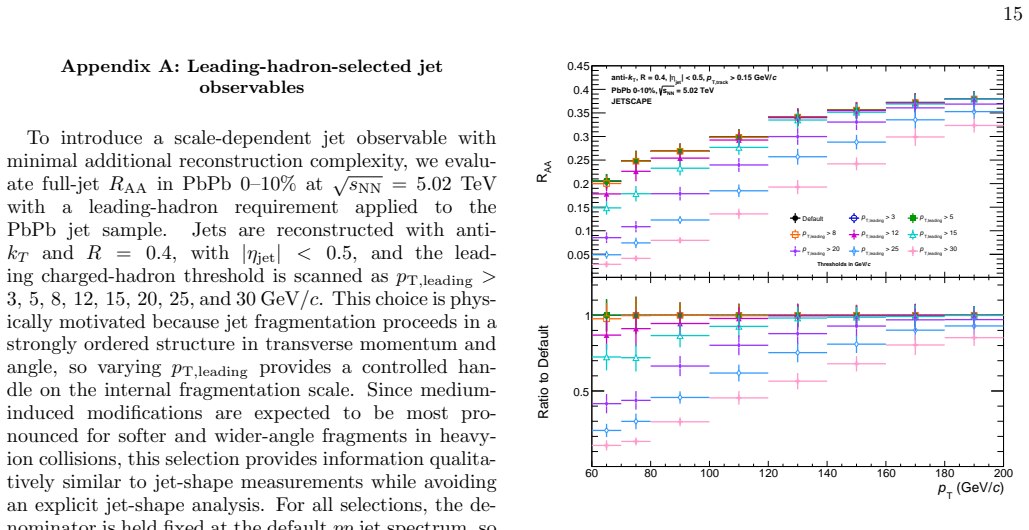
Jet quenching in heavy-ion collisions probes parton energy loss in the quark--gluon plasma (QGP), but the extracted transport properties may not be universally constrained across centrality, beam energy, and observable class. In this work, we perform an analysis of the compatibility and predictive transferability of Bayesian constraints obtained from a six-parameter JETSCAPE effective energy-loss model across these subsets. The model is calibrated to charged-hadron and inclusive-jet data from ALICE, ATLAS, and CMS in PbPb collisions at $\sqrt{s_{\mathrm{NN}}}=5.02$ and $2.76$ TeV. We find that centrality-dependent posteriors are largely compatible, whereas beam-energy and observable-class splits exhibit moderate shifts within overlapping credible regions, indicating that posterior overlap alone does not guarantee predictive universality. This is further examined by propagating subset posteriors to complementary datasets without refitting, where predictive performance varies across subsets. These results indicate that different observables probe distinct aspects of jet--medium interactions and motivate leading-hadron-selected jet observables to bridge hadron-biased and jet-inclusive constraints.
Editorial analysis
A structured set of objections, weighed in public.
Circularity Check
No significant circularity; transferability tests are independent of fitting inputs
full rationale
The paper calibrates a fixed six-parameter JETSCAPE energy-loss model to experimental datasets split by centrality, beam energy, and observable class, then propagates the resulting posteriors to held-out complementary datasets without refitting to assess predictive performance. This procedure is a standard cross-validation check whose outcomes (varying predictive accuracy) are empirical results, not definitions or tautologies. No equations reduce a claimed prediction to the fit by construction, no self-citation chain bears the central claim, and the model form is treated as an external assumption rather than derived from the target observables. The abstract and described workflow remain self-contained against the external LHC data.
Axiom & Free-Parameter Ledger
free parameters (1)
- six-parameter JETSCAPE effective energy-loss model parameters
axioms (1)
- domain assumption The JETSCAPE effective energy-loss model captures the dominant jet-medium interactions across the probed kinematic ranges
Reference graph
Works this paper leans on
-
[1]
Hard-process stitching and smoothing Because the charged-hadron and inclusive-jet observ- ables used in this work extend to relatively high trans- verse momentum, the event generation is performed in ˆpT-binned samples rather than in a single fully inclusive sample. This improves the statistical coverage of the rare high-pT region while keeping the total ...
-
[2]
Background generation settings The event-by-event initial entropy-density profiles used for the medium background are generated with the TRENTo model [21, 22]. In the present analysis, the TRENTo events are generated in advance and stored as HDF5 files, which are then used as the initial-condition ensemble for the later medium-evolution stage. For both Pb...
-
[3]
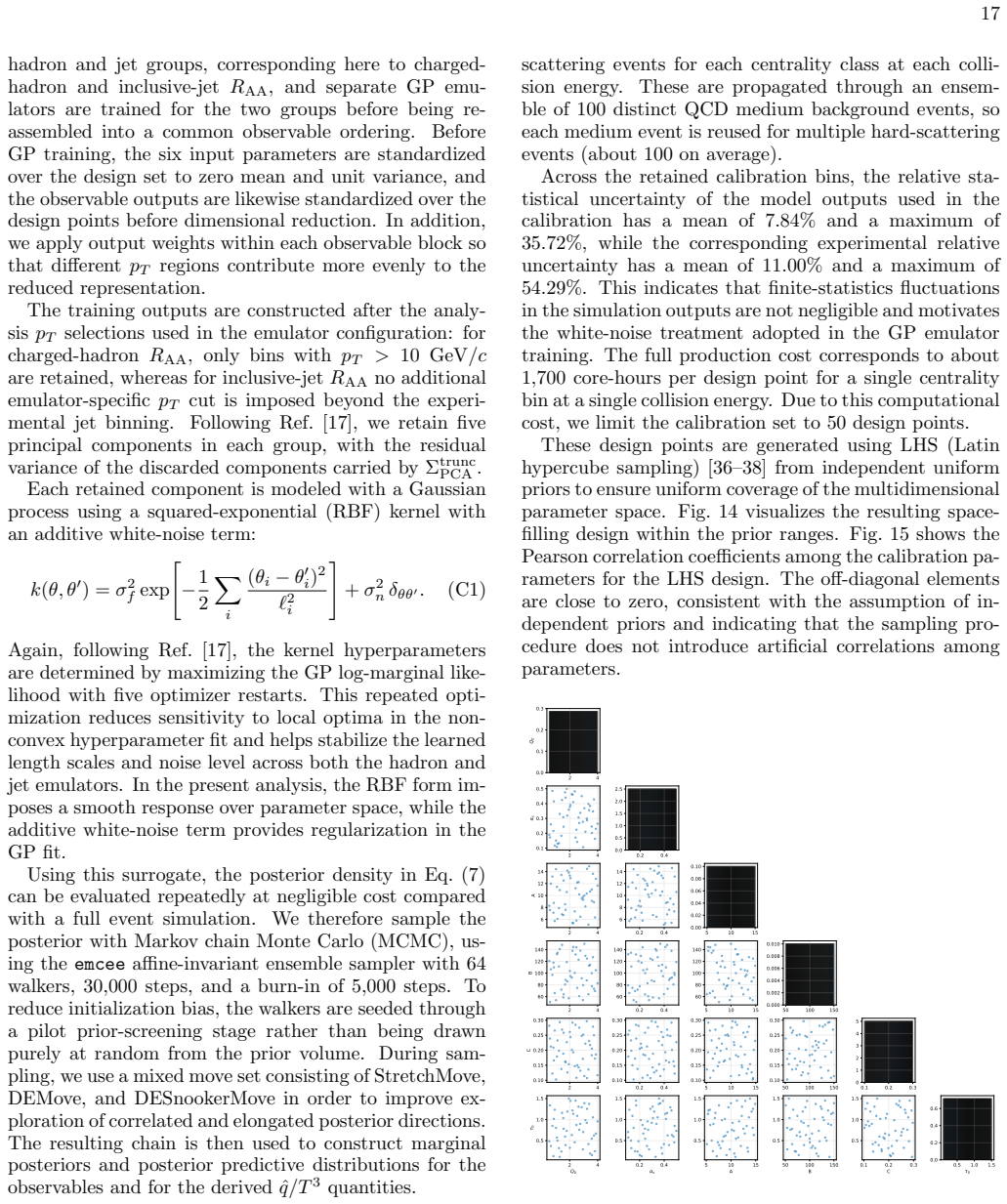
Simulation statistics and design coverage A design point denotes a unique parameter vector (Q0, τ0,A,B,C,α s) at which a full event simulation is per- formed. For each design point, we generate 10,000 hard- scattering events for each centrality class at each colli- sion energy. These are propagated through an ensem- ble of 100 distinct QCD medium backgrou...
-
[4]
J. Adamset al.(STAR), Nucl. Phys.A757, 102 (2005), arXiv:nucl-ex/0501009 [nucl-ex]
work page Pith review arXiv 2005
-
[5]
K. Adcoxet al.(PHENIX), Nucl. Phys.A757, 184 (2005), arXiv:nucl-ex/0410003 [nucl-ex]
work page Pith review arXiv 2005
-
[6]
I. Arseneet al.(BRAHMS), Nucl. Phys.A757, 1 (2005), arXiv:nucl-ex/0410020 [nucl-ex]
-
[7]
B. B. Backet al.(PHOBOS), Nucl. Phys.A757, 28 (2005), arXiv:nucl-ex/0410022 [nucl-ex]
work page Pith review arXiv 2005
-
[8]
Heavy Ion Collisions: The Big Picture, and the Big Questions
W. Busza, K. Rajagopal, and W. van der Schee, Ann. Rev. Nucl. Part. Sci.68, 339 (2018), arXiv:1802.04801 [hep-ph]
work page Pith review arXiv 2018
-
[9]
Properties of hot and dense matter from relativistic heavy ion collisions
P. Braun-Munzinger, V. Koch, T. Sch¨ afer, and J. Stachel, Phys. Rept.621, 76 (2016), arXiv:1510.00442 [nucl-th]
work page Pith review arXiv 2016
-
[10]
E. Shuryak, Prog. Part. Nucl. Phys.62, 48 (2009), arXiv:0807.3033 [hep-ph]
-
[11]
Collective flow and viscosity in relativistic heavy-ion collisions
U. Heinz and R. Snellings, Ann. Rev. Nucl. Part. Sci. 63, 123 (2013), arXiv:1301.2826 [nucl-th]
work page Pith review arXiv 2013
- [12]
- [13]
-
[14]
The theory and phenomenology of perturbative QCD based jet quenching
A. Majumder and M. van Leeuwen, Prog. Part. Nucl. Phys.66, 41 (2011), arXiv:1002.2206 [hep-ph]
work page Pith review arXiv 2011
-
[15]
Jet quenching in high-energy heavy-ion collisions
G.-Y. Qin and X.-N. Wang, Int. J. Mod. Phys. E24, 1530014 (2015), arXiv:1511.00790 [hep-ph]
work page Pith review arXiv 2015
-
[16]
S. Cao and X.-N. Wang, Rept. Prog. Phys.84, 024301 (2021), arXiv:2002.04028 [hep-ph]
- [17]
-
[18]
K. M. Burkeet al.(JET), Phys. Rev. C90, 014909 (2014), arXiv:1312.5003 [nucl-th]
work page Pith review arXiv 2014
-
[19]
S. Caoet al.(JETSCAPE), Phys. Rev. C104, 024905 (2021), arXiv:2102.11337 [nucl-th]
-
[20]
W. Fanet al.(JETSCAPE), Phys. Rev. C109, 064903 (2024), arXiv:2307.09641 [hep-ph]
-
[21]
R. Ehlerset al.(JETSCAPE), Phys. Rev. C111, 054913 (2025), arXiv:2408.08247 [hep-ph]
-
[22]
D. Everettet al.(JETSCAPE), Phys. Rev. C103, 054904 (2021), arXiv:2011.01430 [hep-ph]
-
[23]
T. Sj¨ ostrand, S. Ask, J. R. Christiansen, R. Corke, N. Desai, P. Ilten, S. Mrenna, S. Prestel, and P. Skands, Comput. Phys. Commun.191, 159 (2015), arXiv:1410.3012 [hep-ph]
work page internal anchor Pith review arXiv 2015
-
[24]
J. S. Moreland, J. E. Bernhard, and S. A. Bass, Phys. Rev. C92, 011901 (2015), arXiv:1412.4708 [nucl-th]
work page Pith review arXiv 2015
-
[25]
J. E. Bernhard, J. S. Moreland, S. A. Bass, J. Liu, and U. Heinz, Phys. Rev. C94, 024907 (2016), arXiv:1605.03954 [nucl-th]
work page Pith review arXiv 2016
-
[26]
Causal viscous hydrodynamics in 2+1 dimensions for relativistic heavy-ion collisions
H. Song and U. W. Heinz, Phys. Rev. C77, 064901 (2008), arXiv:0712.3715 [nucl-th]
work page Pith review arXiv 2008
-
[27]
S. Acharyaet al.(ALICE), JHEP11(11), 013, arXiv:1802.09145 [nucl-ex]
-
[28]
G. Aadet al.(ATLAS), JHEP09(09), 050, arXiv:1504.04337 [hep-ex]
-
[29]
Charged-particle nuclear modification factors in PbPb and pPb collisions at sqrt(s[NN]) = 5.02 TeV
V. Khachatryanet al.(CMS), JHEP04(04), 039, arXiv:1611.01664 [nucl-ex]
-
[30]
S. Chatrchyanet al.(CMS), Eur. Phys. J. C72, 1945 (2012), arXiv:1202.2554 [nucl-ex]
work page Pith review arXiv 1945
-
[31]
S. Acharyaet al.(ALICE), Phys. Rev. C101, 034911 (2020), arXiv:1909.09718 [nucl-ex]
-
[32]
M. Aaboudet al.(ATLAS), Phys. Lett. B790, 108 (2019), arXiv:1805.05635 [nucl-ex]
work page Pith review arXiv 2019
-
[33]
G. Aadet al.(ATLAS), Phys. Rev. Lett.114, 072302 (2015), arXiv:1411.2357 [hep-ex]
work page Pith review arXiv 2015
- [34]
-
[35]
Measurement of inclusive jet cross sections in pp and PbPb collisions at sqrt(s[NN]) = 2.76 TeV
V. Khachatryanet al.(CMS), Phys. Rev. C96, 015202 (2017), arXiv:1609.05383 [nucl-ex]
work page Pith review arXiv 2017
-
[36]
J. Casalderrey-Solana, Z. Hulcher, G. Milhano, D. Pab- los, and K. Rajagopal, Phys. Rev. C99, 051901 (2019)
work page 2019
-
[37]
Y.-L. Du, D. Pablos, and K. Tywoniuk, Phys. Rev. Lett. 128, 012301 (2022)
work page 2022
-
[38]
Y. He, S. Cao, W. Chen, T. Luo, L.-G. Pang, and X.-N. Wang, Phys. Rev. C99, 054911 (2019)
work page 2019
-
[39]
M. D. McKay, R. J. Beckman, and W. J. Conover, Tech- nometrics21, 239 (1979)
work page 1979
-
[40]
Tang, Journal of the American Statistical Association 88, 1392 (1993)
B. Tang, Journal of the American Statistical Association 88, 1392 (1993)
work page 1993
-
[41]
M. D. Morris and T. J. Mitchell, Journal of Statistical Planning and Inference43, 381 (1995)
work page 1995
-
[42]
Abelevet al.(ALICE), JHEP09, 049, arXiv:1307.1249 [nucl-ex]
B. Abelevet al.(ALICE), JHEP09, 049, arXiv:1307.1249 [nucl-ex]
-
[43]
B. Abelevet al.(ALICE), Phys. Lett. B741, 38 (2015), arXiv:1406.5463 [nucl-ex]
-
[44]
Viscosity in Strongly Interacting Quantum Field Theories from Black Hole Physics
P. Kovtun, D. T. Son, and A. O. Starinets, Phys. Rev. Lett.94, 111601 (2005), arXiv:hep-th/0405231 [hep-th]
work page internal anchor Pith review arXiv 2005
-
[45]
J. E. Bernhard, J. S. Moreland, and S. A. Bass, Nature Physics15, 1113 (2019)
work page 2019
-
[46]
Flow analysis from multiparticle azimuthal correlations
N. Borghini, P. M. Dinh, and J.-Y. Ollitrault, Phys. Rev. C64, 054901 (2001), arXiv:nucl-th/0105040
work page Pith review arXiv 2001
- [47]
-
[48]
A. Bilandzic, M. Lesch, and S. F. Taghavi, Phys. Rev. C102, 024910 (2020), arXiv:2004.01066 [nucl-ex]
-
[49]
A. Bilandzic, M. Lesch, C. Mordasini, and S. F. Taghavi, arXiv (2021), arXiv:2101.05619 [physics.data-an]
-
[50]
C. Mordasini, A. Bilandzic, D. Karako¸ c, and S. F. Taghavi, Phys. Rev. C102, 024907 (2020), arXiv:1901.06968 [nucl-ex]
-
[51]
The equation of state in (2+1)-flavor QCD
A. Bazavovet al.(HotQCD), Phys. Rev. D90, 094503 (2014), arXiv:1407.6387 [hep-lat]
work page Pith review arXiv 2014
-
[52]
New method for measuring azimuthal distributions in nucleus-nucleus collisions
N. Borghini, P. M. Dinh, and J.-Y. Ollitrault, Phys. Rev. C63, 054906 (2001), arXiv:nucl-th/0007063
work page Pith review arXiv 2001
-
[53]
Generic framework for anisotropic flow analyses with multi-particle azimuthal correlations
A. Bilandzic, C. H. Christensen, K. Gulbrandsen, A. Hansen, and Y. Zhou, Phys. Rev. C89, 064904 (2014), arXiv:1312.3572 [nucl-ex]
work page Pith review arXiv 2014
-
[54]
N. Y. Astrakhantsev, V. V. Braguta, and A. Y. Kotov, Phys. Rev. D98, 054515 (2018), arXiv:1804.02382 [hep- lat]
work page Pith review arXiv 2018
-
[55]
H. B. Meyer, Phys. Rev. Lett.100, 162001 (2008), arXiv:0710.3717 [hep-lat]
work page Pith review arXiv 2008
-
[56]
Temperature dependence of shear viscosity of $SU(3)$--gluodynamics within lattice simulation
N. Astrakhantsev, V. Braguta, and A. Kotov, JHEP04, 101, arXiv:1701.02266 [hep-lat]
-
[57]
H. B. Meyer, Phys. Rev. D76, 101701 (2007), arXiv:0704.1801 [hep-lat]
work page Pith review arXiv 2007
-
[58]
A. Bazavov, F. Karsch, S. Mukherjee, and P. Pe- treczky (USQCD), Eur. Phys. J. A55, 194 (2019), arXiv:1904.09951 [hep-lat]. 23
-
[59]
Full result for the QCD equation of state with 2+1 flavors
S. Borsanyi, Z. Fodor, C. Hoelbling, S. D. Katz, S. Krieg, and K. K. Szabo, Phys. Lett. B730, 99 (2014), arXiv:1309.5258 [hep-lat]
work page Pith review arXiv 2014
-
[60]
C. Shen, Z. Qiu, H. Song, J. Bernhard, S. Bass, and U. Heinz, Comput. Phys. Commun.199, 61 (2016), arXiv:1409.8164 [nucl-th]
work page Pith review arXiv 2016
-
[61]
S. Acharyaet al.(ALICE), Phys. Lett. B818, 136354 (2021), arXiv:2102.12180 [nucl-ex]
-
[62]
S. Acharyaet al.(ALICE), Phys. Rev. Lett.127, 092302 (2021), arXiv:2101.02579 [nucl-ex]
-
[63]
Acharyaet al.(ALICE), JHEP05, 085, arXiv:2002.00633 [nucl-ex]
S. Acharyaet al.(ALICE), JHEP05, 085, arXiv:2002.00633 [nucl-ex]
- [64]
-
[65]
Hamby, Environ Monit Assess32, 135 (1994)
D. Hamby, Environ Monit Assess32, 135 (1994)
work page 1994
-
[66]
J. Adamet al.(ALICE), Phys. Rev. C94, 034903 (2016), arXiv:1603.04775 [nucl-ex]
work page Pith review arXiv 2016
-
[67]
B. H. Alver, C. Gombeaud, M. Luzum, and J.-Y. Olli- trault, Phys. Rev. C82, 034913 (2010), arXiv:1007.5469 [nucl-th]
work page Pith review arXiv 2010
-
[68]
Elliptic flow of charged particles in Pb-Pb collisions at 2.76 TeV
K. Aamodtet al.(ALICE), Phys. Rev. Lett.105, 252302 (2010), arXiv:1011.3914 [nucl-ex]
work page Pith review arXiv 2010
-
[69]
P. Di Francesco, M. Guilbaud, M. Luzum, and J.-Y. Ollitrault, Phys. Rev. C95, 044911 (2017), arXiv:1612.05634 [nucl-th]
- [70]
- [71]
-
[72]
Anisotropic flow of charged particles in Pb-Pb collisions at $\sqrt{s_{\rm NN}}=5.02$ TeV
J. Adamet al.(ALICE), Phys. Rev. Lett.116, 132302 (2016), arXiv:1602.01119 [nucl-ex]
work page Pith review arXiv 2016
-
[73]
J. Adamet al.(ALICE), Phys. Rev. Lett.116, 222302 (2016), arXiv:1512.06104 [nucl-ex]
work page Pith review arXiv 2016
-
[74]
B. B. Abelevet al.(ALICE), Eur. Phys. J. C74, 3077 (2014), arXiv:1407.5530 [nucl-ex]
work page Pith review arXiv 2014
-
[75]
B. Abelevet al.(ALICE), Phys. Rev. C88, 044910 (2013), arXiv:1303.0737 [hep-ex]
work page Pith review arXiv 2013
-
[76]
K. Aamodtet al.(ALICE), Phys. Rev. Lett.106, 032301 (2011), arXiv:1012.1657 [nucl-ex]
work page Pith review arXiv 2011
-
[77]
S. Pratt and G. Torrieri, Phys. Rev. C82, 044901 (2010), arXiv:1003.0413 [nucl-th]
-
[78]
S. Acharyaet al.(ALICE), Phys. Rev. C97, 024906 (2018), arXiv:1709.01127 [nucl-ex]
-
[79]
S. A. Basset al., Prog. Part. Nucl. Phys.41, 255 (1998), arXiv:nucl-th/9803035
work page Pith review arXiv 1998
-
[80]
M. Bleicheret al., J. Phys. G25, 1859 (1999), arXiv:hep-ph/9909407
work page Pith review arXiv 1999
discussion (0)
Sign in with ORCID, Apple, or X to comment. Anyone can read and Pith papers without signing in.