Calibrating the Brody exponent as a quantitative measure of short-range exclusion in 2D spatial point processes
Pith reviewed 2026-06-27 02:30 UTC · model grok-4.3
The pith
The Brody exponent, recalibrated for two dimensions, quantifies short-range exclusion strength in spatial point processes.
A machine-rendered reading of the paper's core claim, the machinery that carries it, and where it could break.
Core claim
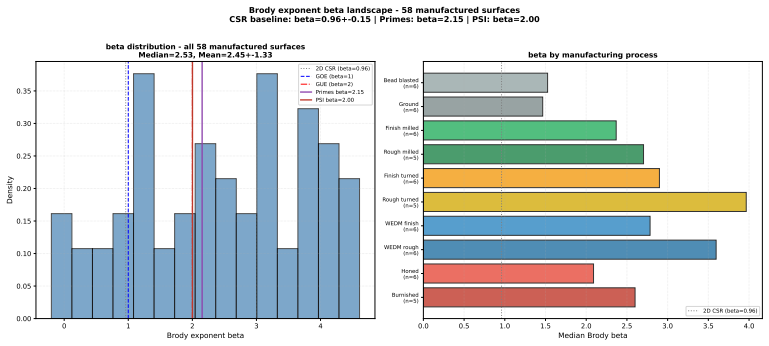
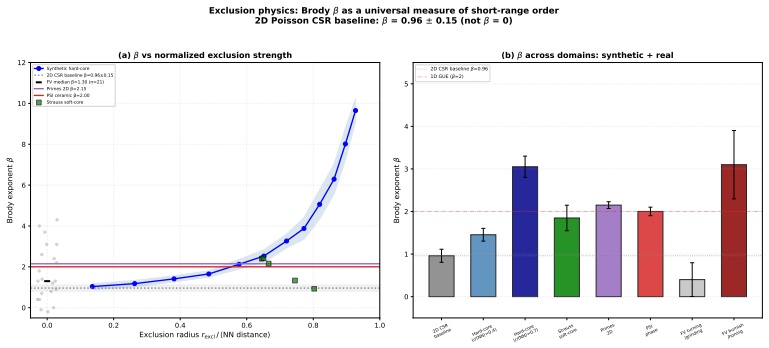
The Brody distribution, after empirical recalibration on 2D complete spatial randomness to β=0.96±0.15 and validation of the β--r_excl relation at Spearman ρ=0.988, functions as a quantitative measure of short-range exclusion that remains consistent across generation processes and density regimes when the supplied controls are applied.
What carries the argument
The Brody distribution (phenomenological interpolation between Poisson and Wigner spacing laws) recalibrated via 2D CSR baseline correction and β--r_excl regression.
If this is right
- The β--r_excl calibration converts observed Brody values into an effective exclusion radius for any 2D pattern obeying the tested controls.
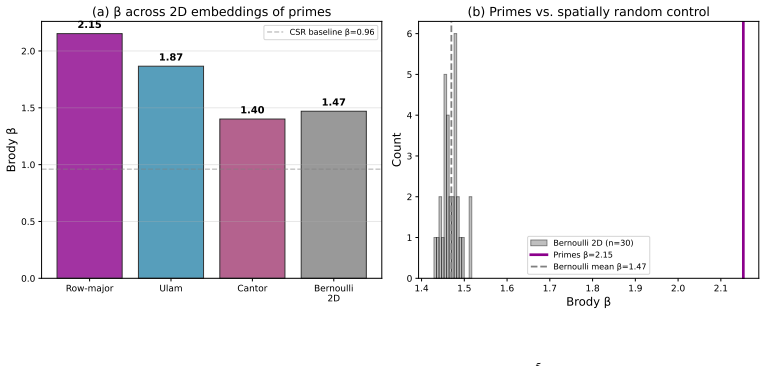
- Sparse-integer and Cantor-embedding controls distinguish intrinsic arithmetic signals from embedding-induced exclusion.
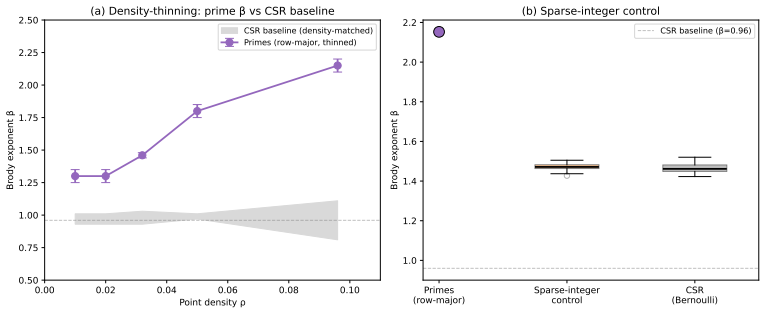
- Density thinning isolates exclusion strength from density dependence, though absolute β remains density-sensitive.
- A separate CSR baseline applies to binary fields at low fill fraction, supplied with an explicit decision table.
Where Pith is reading between the lines
- The same recalibration procedure could be repeated in three or higher dimensions to produce dimension-specific baselines.
- The framework offers a bridge between level-spacing methods in quantum chaos and classical spatial statistics without requiring new distribution families.
- Applications to ecological or materials data could test whether β tracks physical repulsion mechanisms more directly than nearest-neighbor distances alone.
Load-bearing premise
That the recalibrated Brody form supplies a process-independent measure of exclusion once the 2D baseline and control protocols are used.
What would settle it
A new collection of 2D point patterns with independently measured hard-core radii that yields Spearman correlation below 0.9 between β and r_excl, or a CSR baseline outside the reported 0.96±0.15 interval.
Figures
read the original abstract
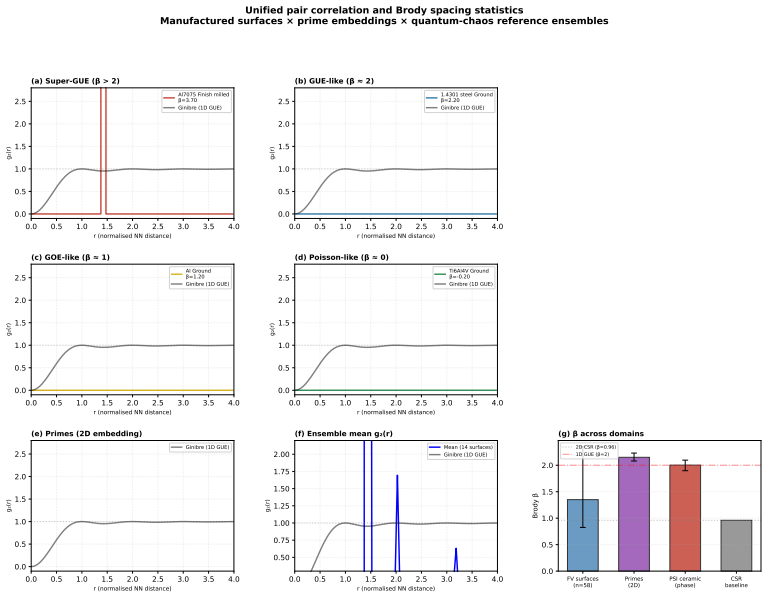
The Brody distribution, originally a phenomenological interpolation between Poisson and Wigner level-spacing statistics in quantum chaos, is calibrated here as a quantitative measure of short-range exclusion in 2D spatial point processes. Two results form the core. First, the 2D complete-spatial-randomness baseline is recalibrated to $\beta=0.96\pm0.15$, correcting the inappropriate 1D Poisson reference. Second, an empirical $\beta$--$r_{\text{excl}}$ calibration is validated against the effective hard-core radius with Spearman $\rho=0.988$. The framework is demonstrated on 58 manufactured surfaces (10 materials, 10 processes), phase-extracted interferometric profilometry of a certified roundness standard, and 2D binary embeddings of prime numbers. A sparse-integer control proves the prime $\beta=2.15$ signal is genuinely arithmetic ($\Delta\beta=+0.68$ over random-integer control), while a Cantor-embedding null result ($\beta=1.40$, TOST $p<0.01$) demonstrates that 2D exclusion is embedding-created rather than intrinsic. Density-thinning experiments establish that $\beta$ captures exclusion strength rather than point density, while absolute values are density-dependent. A distinct CSR baseline for binary fields at low fill fraction is identified, with a decision table provided. The $\beta$--$r_{\text{excl}}$ calibration, the CSR baseline correction, and the control protocols together constitute a calibrated measurement framework for reproducible characterisation of short-range exclusion in 2D spatial point processes.
Editorial analysis
A structured set of objections, weighed in public.
Referee Report
Summary. The manuscript calibrates the Brody exponent β (originally from 1D quantum level statistics) as a quantitative measure of short-range exclusion in 2D spatial point processes. It reports a recalibrated 2D CSR baseline of β=0.96±0.15, an empirical β–r_excl relation validated by Spearman ρ=0.988 on 58 manufactured surfaces (10 materials, 10 processes), phase-extracted profilometry, and prime-number embeddings, plus controls including sparse-integer arithmetic signal (Δβ=+0.68), Cantor-embedding null (β=1.40, TOST p<0.01), and density-thinning experiments showing β captures exclusion strength (though absolute values remain density-dependent). A decision table for binary fields at low fill fraction is provided, and the combination is presented as a calibrated measurement framework.
Significance. If the empirical calibration and controls hold, the work supplies a practical, reproducible tool for quantifying short-range exclusion in 2D point patterns, with direct relevance to materials characterization and spatial statistics. Strengths include the multiple independent controls (arithmetic vs. embedding, density thinning) and explicit correction of the 1D Poisson reference for 2D CSR; these provide concrete evidence that β responds to exclusion rather than density or embedding artifacts alone.
major comments (1)
- [Abstract] Abstract: the claim that the β–r_excl calibration and CSR baseline correction 'constitute a calibrated measurement framework' for general use is load-bearing for the central contribution, yet rests on empirical validation limited to the 58 surfaces, prime embeddings, and thinning experiments; no derivation or additional process-independence test is indicated to show why the recalibrated Brody form must capture exclusion strength outside this tested set.
Simulated Author's Rebuttal
We thank the referee for the detailed review and the recognition of the multiple controls. We address the single major comment below and will revise the manuscript accordingly.
read point-by-point responses
-
Referee: [Abstract] Abstract: the claim that the β–r_excl calibration and CSR baseline correction 'constitute a calibrated measurement framework' for general use is load-bearing for the central contribution, yet rests on empirical validation limited to the 58 surfaces, prime embeddings, and thinning experiments; no derivation or additional process-independence test is indicated to show why the recalibrated Brody form must capture exclusion strength outside this tested set.
Authors: We agree that the abstract claim is strong and that the supporting evidence is empirical rather than derived from first principles. The validation set comprises 58 surfaces spanning 10 materials and 10 distinct manufacturing processes, together with prime-number embeddings (with sparse-integer arithmetic control), Cantor-set null embedding, and systematic density-thinning experiments. These controls demonstrate that β responds to exclusion strength across both physical and mathematical generation mechanisms and is not an artifact of density or embedding alone. Nevertheless, no general derivation is provided, and the tested processes do not exhaust all possible 2D point processes. In revision we will (i) qualify the abstract sentence to read that the calibration and controls “provide an empirically validated measurement framework” and (ii) add an explicit limitations paragraph in the discussion stating the empirical scope and recommending further process-independence tests on additional point-process families. revision: yes
Circularity Check
No circularity: empirical calibration is data-driven without reduction to inputs
full rationale
The paper reports an empirical recalibration of the Brody exponent β on 2D CSR data to 0.96±0.15 and an empirical β–r_excl relation validated by Spearman ρ=0.988 on 58 surfaces plus controls (primes, Cantor, thinning). These are presented as measured correlations and baselines rather than a first-principles derivation; β is obtained by fitting the distribution form to point patterns while r_excl is computed separately via effective hard-core radius, with the relation then observed rather than forced by construction. No self-citations, uniqueness theorems, or ansatzes are invoked as load-bearing; the controls (arithmetic signal, embedding null, density independence) are independent checks. The framework is therefore self-contained as an empirical measurement protocol without any step reducing to its own fitted inputs by definition.
Axiom & Free-Parameter Ledger
free parameters (1)
- 2D CSR baseline β =
0.96
axioms (1)
- domain assumption The Brody distribution form remains a valid phenomenological interpolation for short-range exclusion statistics when applied to 2D spatial point processes.
Reference graph
Works this paper leans on
-
[1]
T. A. Brody, J. Flores, J. B. French, P. A. Mello, A. Pandey, S. S. M. Wong, Random- matrix physics: spectrum and strength fluctuations, Rev. Mod. Phys. 53 (1981) 385–479. doi:10.1103/RevModPhys.53.385
-
[2]
Stöckmann, Quantum chaos: an introduction, Cambridge University Press (1999)
H.-J. Stöckmann, Quantum chaos: an introduction, Cambridge University Press (1999). doi:10.1017/CBO9780511524622
-
[3]
Alhassid, The statistical theory of quantum dots, Rev
Y . Alhassid, The statistical theory of quantum dots, Rev. Mod. Phys. 72 (2000) 895–968. doi:10.1103/RevModPhys.72.895
-
[4]
R. L. Weaver, Spectral statistics in elastodynamics, J. Acoust. Soc. Am. 85 (1989) 1005– 1013.doi:10.1121/1.397484
-
[5]
L. Laloux, P. Cizeau, J.-P. Bouchaud, M. Potters, Noise dressing of financial correlation matrices, Phys. Rev. Lett. 83 (1999) 1467–1470.doi:10.1103/PhysRevLett.83.1467
-
[6]
H. L. Montgomery, The pair correlation of zeros of the zeta function, Proc. Symp. Pure Math. 24 (1973) 181–193
1973
-
[7]
A. M. Odlyzko, On the distribution of spacings between zeros of the zeta function, Math. Comp. 48 (1987) 273–308
1987
-
[8]
M. V . Berry, Riemann’s zeta function: a model for quantum chaos?, Lecture Notes in Physics 263 (1986) 1–17.doi:10.1007/3-540-17171-1_1
-
[9]
E. B. Bogomolny, J. P. Keating, Gutzwiller’s trace formula and spectral statistics: be- yond the diagonal approximation, Phys. Rev. Lett. 77 (1996) 1472–1475.doi:10.1103/ PhysRevLett.77.1472
1996
-
[10]
J. P. Keating, N. C. Snaith, Random matrix theory andζ(1/2+it), Commun. Math. Phys. 214 (2000) 57–89.doi:10.1007/s002200000261
-
[11]
Sakhr, J
J. Sakhr, J. M. Nieminen, Poisson-to-Wigner crossover transition in the nearest-neighbor statistics of random points on fractals, Physical Review E 72 (2005) 045204.doi:10. 1103/PhysRevE.72.045204
2005
-
[12]
John Wiley & Sons, Ltd, ??? (2007)
J. Illian, A. Penttinen, H. Stoyan, D. Stoyan, Statistical Analysis and Modelling of Spatial Point Patterns, Wiley, 2008.doi:10.1002/9780470725160
-
[13]
Chapman and Hall/CRC, ??? (2015)
A. Baddeley, E. Rubak, R. Turner, Spatial Point Patterns: Methodology and Applications with R, CRC Press, 2015.doi:10.1201/b19708
-
[14]
S. N. Chiu, D. Stoyan, W. S. Kendall, J. Mecke, Stochastic Geometry and its Applications, 3rd Edition, Wiley, 2013.doi:10.1002/9781118658222
-
[15]
Møller, R
J. Møller, R. P. Waagepetersen, Statistical inference for Cox processes, in: Spatial Cluster Modelling, Chapman and Hall/CRC, 2002, pp. 37–60
2002
-
[16]
M. Massaro, A. D. Campo, Spatial form factor for point patterns: Poisson point process, Coulomb gas, and vortex statistics, Physical Review Research 7 (2025) 023107.doi: 10.1103/physrevresearch.7.023107. 32
-
[17]
J. U. Yang, Y . Guan, Fourier analysis of spatial point processes, Bernoulli 32 (2026) 1–28. doi:10.3150/25-bej1862
-
[18]
F. Helmli, Focus variation instruments, Optical Measurement of Surface Topography (2011) 131–166doi:10.1007/978-3-642-12012-1_7
-
[19]
Multi-modal contrastive learning of urban space representations from POI data
D. Kucharski, M. Wieczorowski, Radial image processing for phase extraction in rough-surface interferometry, Measurement 242 (2025) 117102.doi:10.1016/j. measurement.2025.117102
work page doi:10.1016/j 2025
-
[20]
G. H. Hardy, E. M. Wright, An Introduction to the Theory of Numbers, 6th Edition, Oxford University Press, 2008
2008
-
[21]
M. Stein, S. M. Ulam, An observation on the distribution of primes, Amer. Math. Monthly 74 (1967) 43–44.doi:10.2307/2314055
-
[22]
Rényi, On measures of entropy and information, Proc
A. Rényi, On measures of entropy and information, Proc. 4th Berkeley Symp. Math. Stat. Prob. 1 (1961) 547–561
1961
-
[23]
H. G. E. Hentschel, I. Procaccia, The infinite number of generalized dimensions of frac- tals and strange attractors, Physica D 8 (1983) 435–444.doi:10.1016/0167-2789(83) 90235-X
-
[24]
P. Grassberger, I. Procaccia, Characterization of strange attractors, Phys. Rev. Lett. 50 (1983) 346–349.doi:10.1103/PhysRevLett.50.346
-
[25]
Theiler, Statistical precision of dimension estimators, Phys
J. Theiler, Statistical precision of dimension estimators, Phys. Rev. A 41 (1990) 3038–3051. doi:10.1103/physreva.41.3038
-
[26]
R. Danzl, F. Helmli, S. Scherer, Focus variation—a robust technology for high resolution optical 3D surface metrology, Strojniški vestnik – Journal of Mechanical Engineering 57 (2011) 245–256.doi:10.5545/sv-jme.2010.175
-
[27]
J. Ginibre, Statistical ensembles of complex, quaternion, and real matrices, Journal of Math- ematical Physics 6 (1965) 440–449.doi:10.1063/1.1704292
-
[28]
P. J. Forrester, Log-Gases and Random Matrices, Princeton University Press, 2010.doi: 10.1515/9781400835416
-
[29]
S. Torquato, Random Heterogeneous Materials: Microstructure and Macroscopic Proper- ties, Springer, 2002.doi:10.1007/978-1-4757-6355-3
-
[30]
C. R. Harris, et al., Array programming with NumPy, Nature 585 (2020) 357–362.doi: 10.1038/s41586-020-2649-2
-
[31]
P. Virtanen, et al., SciPy 1.0: fundamental algorithms for scientific computing in Python, Nat. Methods 17 (2020) 261–272.doi:10.1038/s41592-019-0686-2
-
[32]
J. D. Hunter, Matplotlib: a 2D graphics environment, Comput. Sci. Eng. 9 (2007) 90–95. doi:10.1109/MCSE.2007.55
-
[33]
Johansson, et al., mpmath: a Python library for arbitrary-precision floating-point arith- metic (2023)
F. Johansson, et al., mpmath: a Python library for arbitrary-precision floating-point arith- metic (2023). URLhttp://mpmath.org 33
2023
discussion (0)
Sign in with ORCID, Apple, or X to comment. Anyone can read and Pith papers without signing in.