Robust Spin Splitting and Strain-Controlled Optical Response in Monolayer CrC2N4 for Valleytronic and Optoelectronic Applications
Pith reviewed 2026-06-27 02:17 UTC · model grok-4.3
The pith
Monolayer CrC2N4 shows direct K-valley gap with 51.9 meV valence spin splitting that biaxial strain tunes continuously from 1.987 to 1.421 eV.
A machine-rendered reading of the paper's core claim, the machinery that carries it, and where it could break.
Core claim
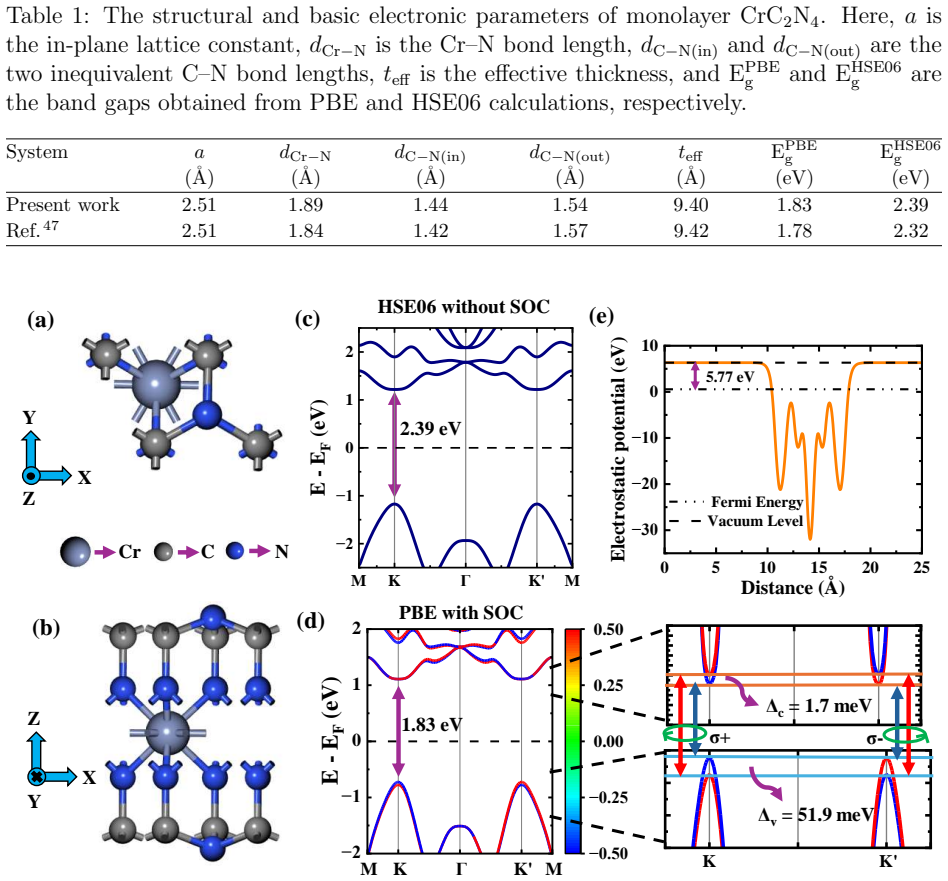
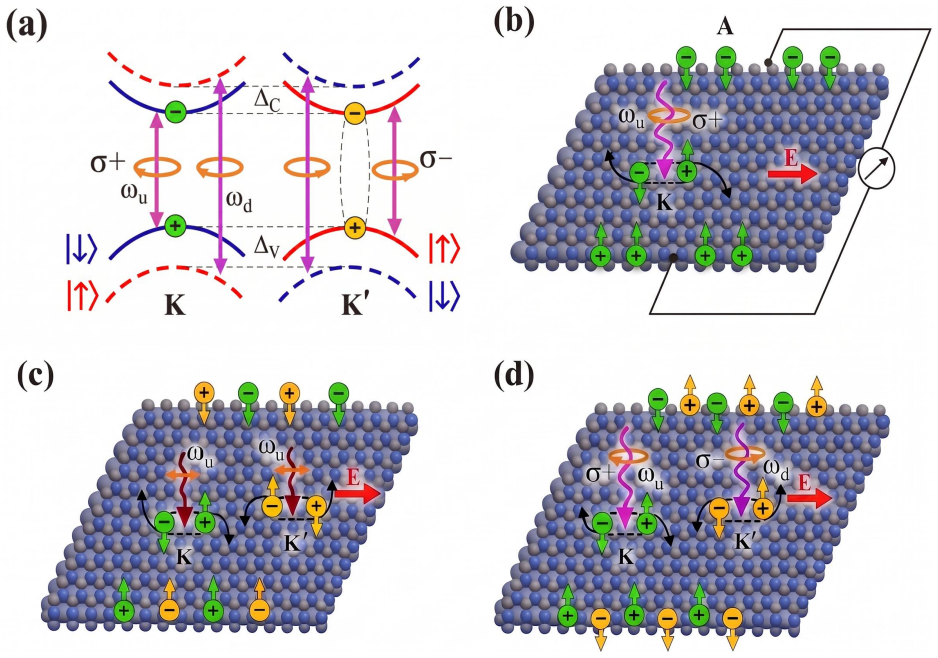
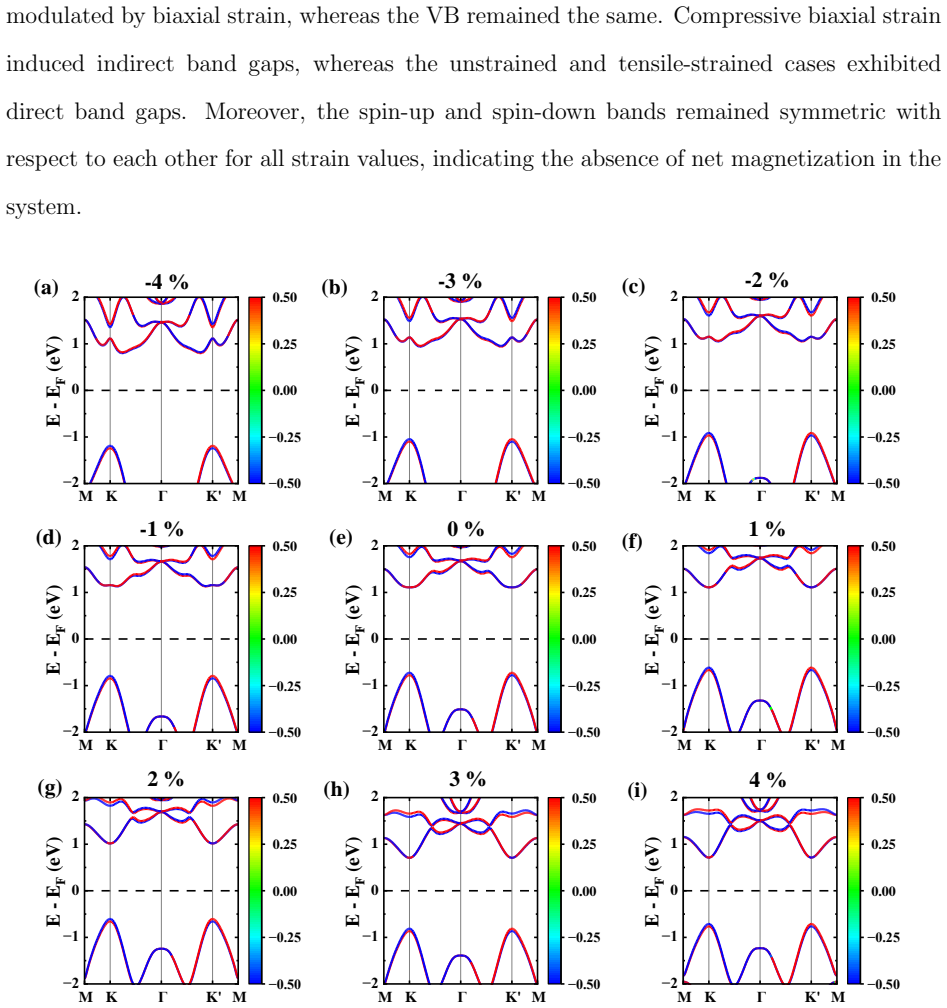
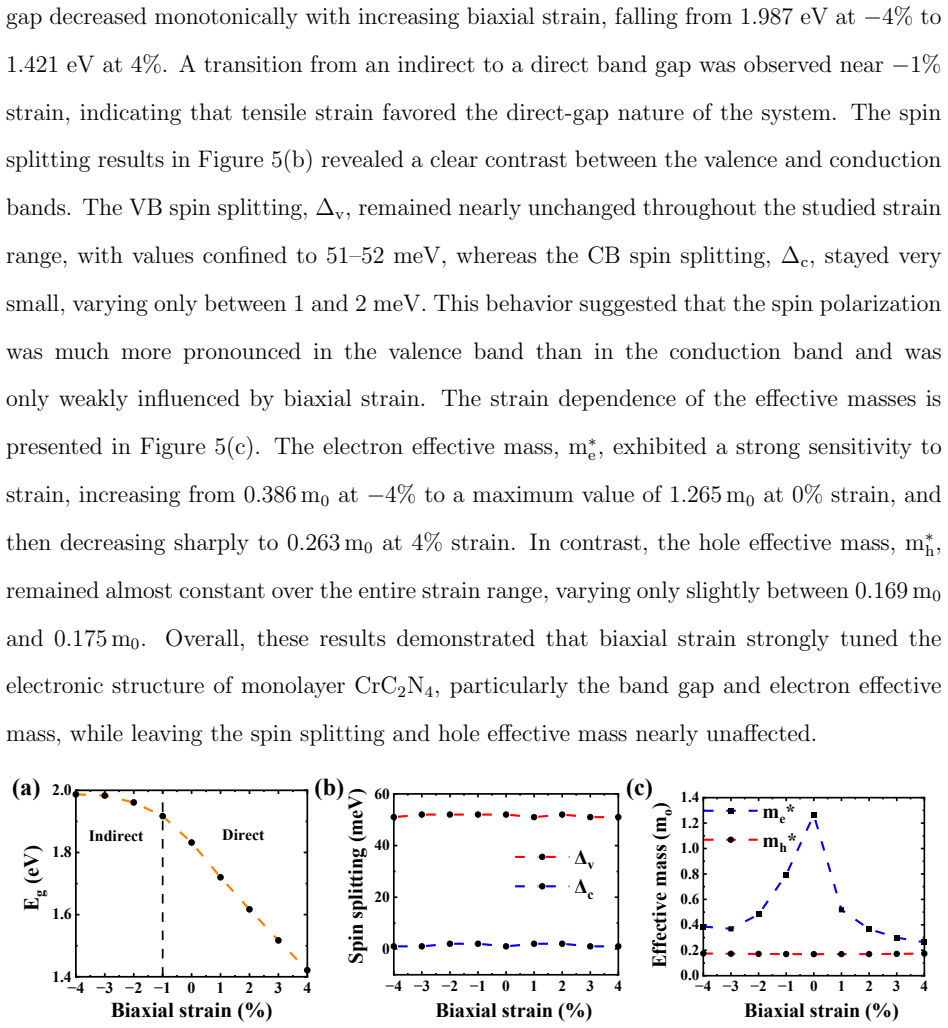
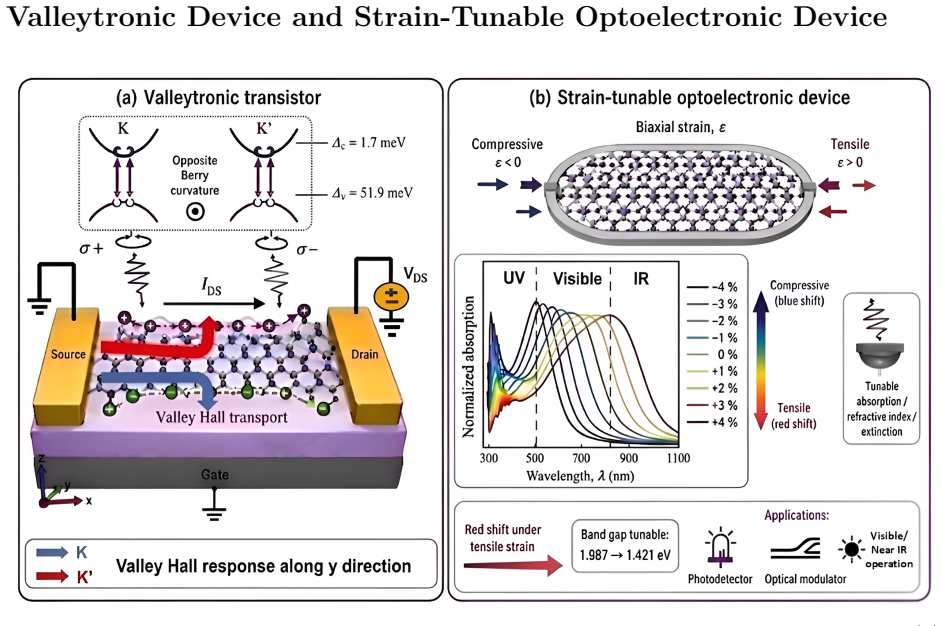
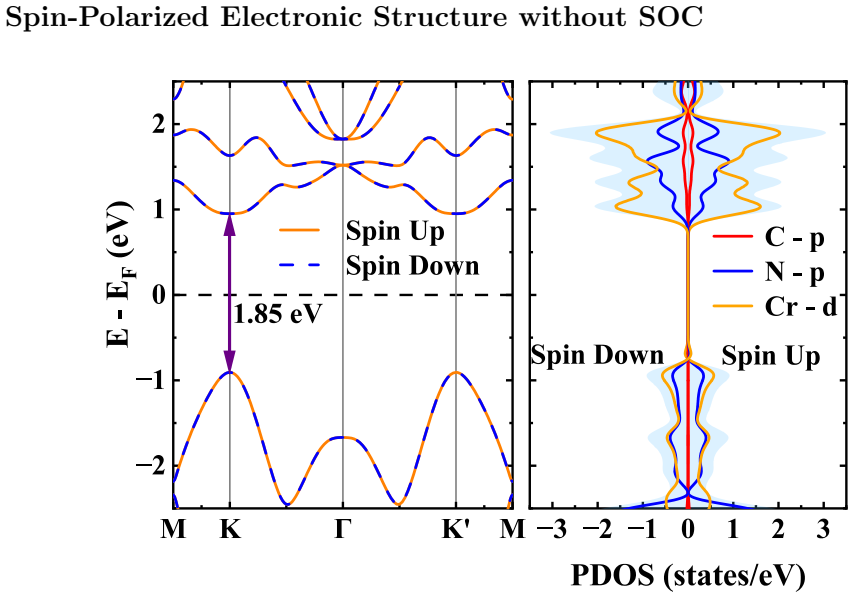
Monolayer CrC2N4 exhibits a direct band gap at the K/K' valleys; SOC produces valley-contrasting out-of-plane spin polarization with 51.9 meV valence-band and 1.7 meV conduction-band spin splitting; biaxial strain from -4% to +4% tunes the gap from 1.987 to 1.421 eV, drives an indirect-to-direct transition near -1%, enhances Berry curvature, and red-shifts the optical response.
What carries the argument
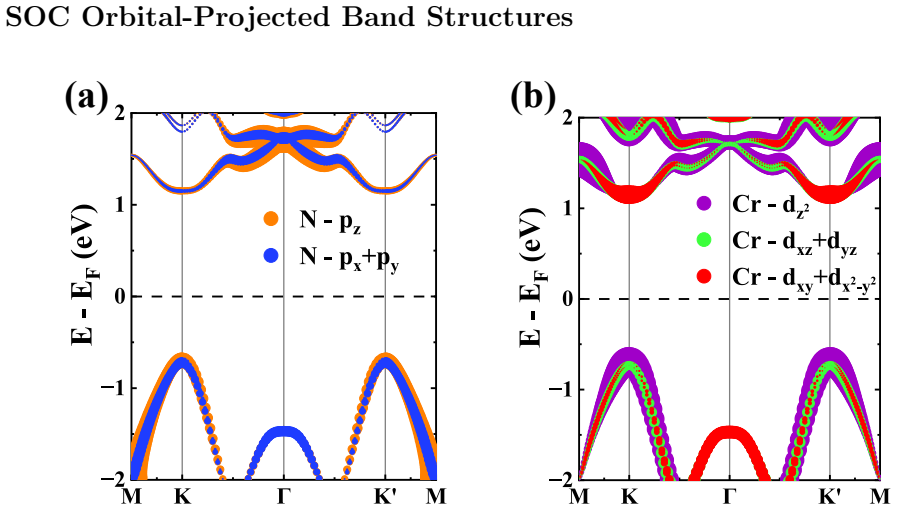
Biaxial strain applied to the CrC2N4 monolayer lattice that alters the K-valley band edges through changes in Cr-d and N-p orbital hybridization and thereby modifies the Berry curvature.
If this is right
- Biaxial strain near -1 percent switches the gap from indirect to direct.
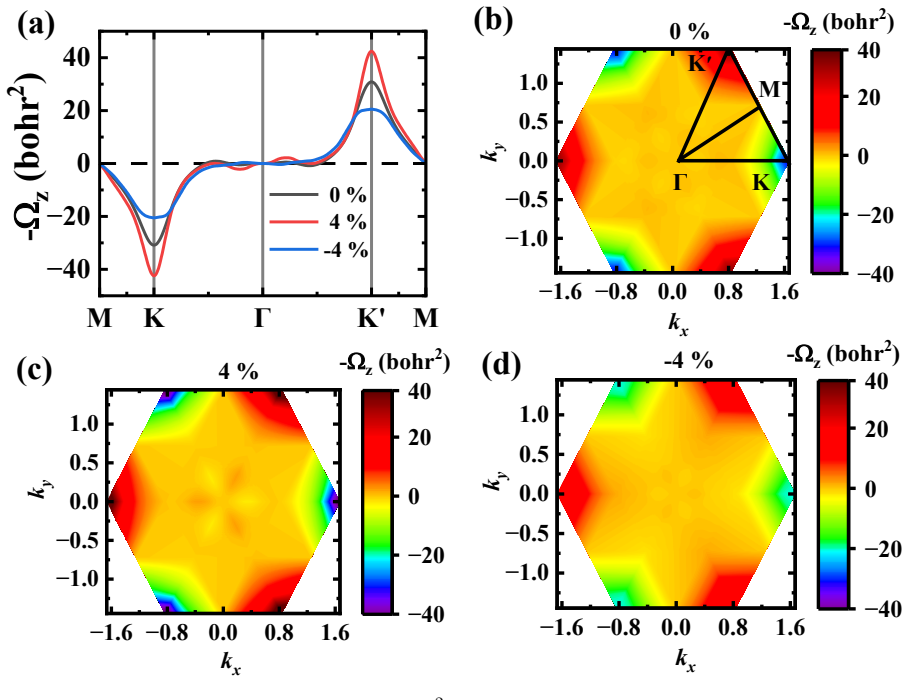
- Tensile strain increases Berry curvature at the K valleys.
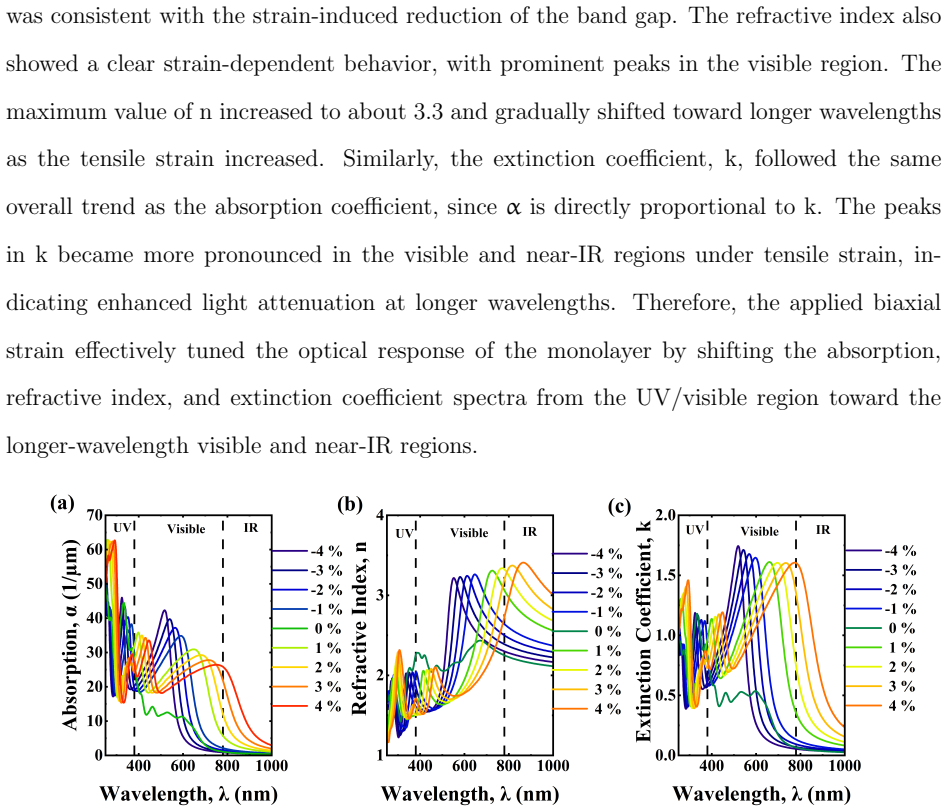
- Positive strain red-shifts the optical absorption edge into the visible-near-infrared range.
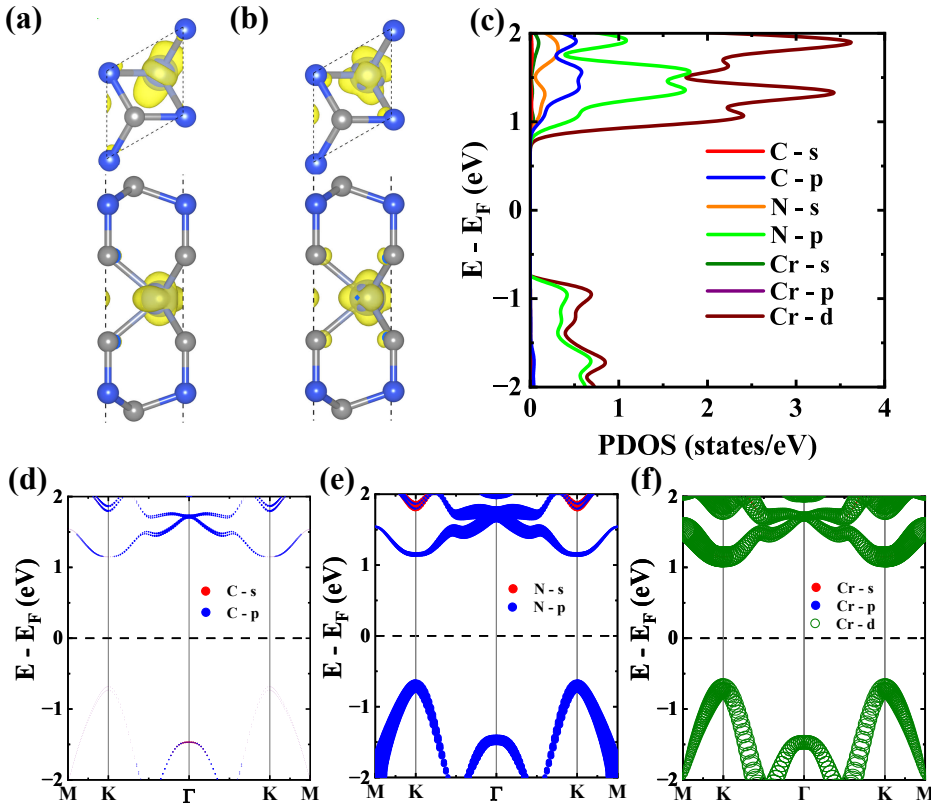
- Charge transfer toward N atoms produces polar-covalent bonding that shapes the band-edge states.
Where Pith is reading between the lines
- Local strain gradients could create adjacent regions with different optical gaps within one flake.
- The moderate spin splitting values suggest the material may support valley spin effects at accessible temperatures when combined with electric or magnetic controls.
- Nitride-based monolayers sharing similar d-p hybridization might display comparable strain-tunable valley features.
Load-bearing premise
The first-principles DFT calculations, including the treatment of spin-orbit coupling, accurately reproduce the real electronic structure, valley spin polarization, and strain response of monolayer CrC2N4 without significant errors from exchange-correlation functional choice or missing many-body effects.
What would settle it
An optical or ARPES measurement on monolayer CrC2N4 that finds the valence-band spin splitting at zero strain far from 51.9 meV or shows no indirect-to-direct gap transition under approximately 1 percent compressive biaxial strain.
Figures
read the original abstract
Monolayer CrC2N4 recently emerged as a promising two-dimensional semiconductor, yet its spin-orbit-coupled (SOC) physics and strain-tunable optical response remained largely unexplored. Here, we investigated the electronic, valley, charge-transfer, and optical properties of pristine and biaxially strained monolayer CrC2N4 using first-principles calculations. The monolayer exhibited a direct band gap at the K/K' valleys. SOC produced valley contrasting out-of-plane spin polarization, yielding a moderate valence band spin splitting of 51.9 meV and a small conduction band spin splitting of 1.7 meV. Orbital-resolved analysis showed that the edge states were mainly governed by Cr-d and N-p hybridization, while Bader analysis indicated polar-covalent bonding through charge transfer toward N atoms. Biaxial strain in the range of -4% to +4% tuned the band gap from 1.987 to 1.421 eV and drove an indirect-to-direct gap transition near -1% strain. Tensile strain enhanced the Berry curvature and red-shifted the optical response toward the visible-near-infrared region. These results suggested monolayer CrC2N4 as a promising platform for strain-engineered valleytronic and optoelectronic device applications.
Editorial analysis
A structured set of objections, weighed in public.
Referee Report
Summary. The manuscript reports first-principles DFT calculations on monolayer CrC2N4, claiming a direct band gap of 1.987 eV at the K/K' valleys, valley-contrasting out-of-plane spin polarization with SOC-induced splittings of 51.9 meV (valence band) and 1.7 meV (conduction band), Cr-d/N-p orbital character at the edges, polar-covalent bonding, biaxial strain tuning of the gap from 1.987 eV to 1.421 eV over -4% to +4% with an indirect-to-direct transition near -1% compressive strain, enhanced Berry curvature under tension, and red-shifted optical absorption, positioning the material for strain-engineered valleytronic and optoelectronic uses.
Significance. If the numerical predictions are reliable, the work adds a new 2D candidate with moderate valley spin splitting and strain-tunable gap and optics. The internal consistency of the reported trends (gap closure, transition, Berry curvature increase) is plausible within standard DFT, but the quantitative values used to support application claims rest on an unbenchmarked approximation whose error relative to experiment or higher-level theory is unknown.
major comments (2)
- [Abstract/Methods] Abstract and computational methods section: the exchange-correlation functional, k-point mesh, vacuum spacing, and SOC implementation (pseudopotential or otherwise) are not specified, preventing assessment of convergence for the central numerical results (direct gap 1.987 eV, VB splitting 51.9 meV, CB splitting 1.7 meV, and strain derivatives).
- [Results (SOC and strain)] Results on electronic structure and strain response: no hybrid-functional or GW benchmark is provided to test the semilocal DFT gap and spin-orbit splittings, even though the orbital hybridizations (Cr-d/N-p) that control the reported valley spin texture are known to be sensitive to functional choice.
minor comments (2)
- The abstract states numerical outcomes without referencing the corresponding figures or tables that display the band structures, spin textures, or absorption spectra; cross-references should be added.
- Bader charge values and orbital projections are mentioned but not tabulated; a supplementary table would improve traceability.
Simulated Author's Rebuttal
We thank the referee for the careful reading and constructive comments on our manuscript. We address the two major points below and will revise the manuscript accordingly.
read point-by-point responses
-
Referee: [Abstract/Methods] Abstract and computational methods section: the exchange-correlation functional, k-point mesh, vacuum spacing, and SOC implementation (pseudopotential or otherwise) are not specified, preventing assessment of convergence for the central numerical results (direct gap 1.987 eV, VB splitting 51.9 meV, CB splitting 1.7 meV, and strain derivatives).
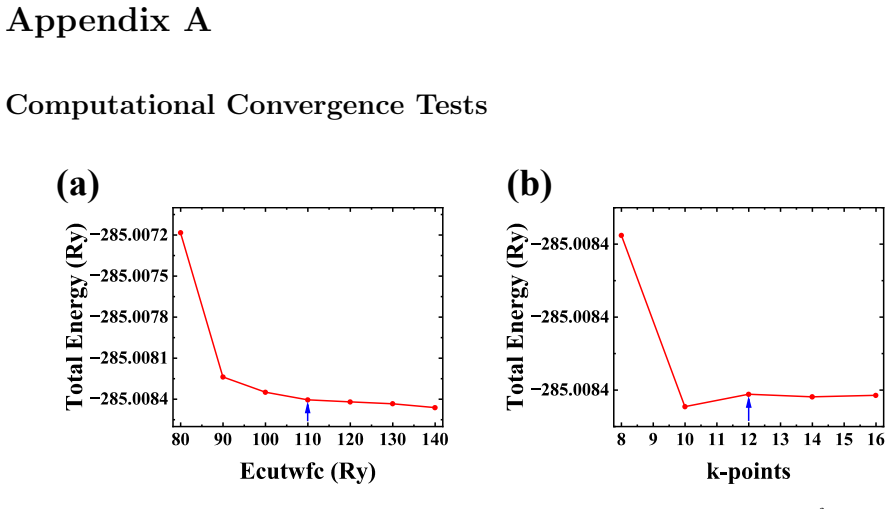
Authors: We agree that the computational details were omitted and that this prevents proper evaluation of convergence. In the revised manuscript we will add the missing information: PBE exchange-correlation functional, 12 imes12 imes1 Γ-centered k-mesh, 20 Å vacuum spacing, and SOC treated with fully relativistic pseudopotentials. These settings were confirmed to converge the reported gap and spin splittings to <0.01 eV. revision: yes
-
Referee: [Results (SOC and strain)] Results on electronic structure and strain response: no hybrid-functional or GW benchmark is provided to test the semilocal DFT gap and spin-orbit splittings, even though the orbital hybridizations (Cr-d/N-p) that control the reported valley spin texture are known to be sensitive to functional choice.
Authors: The referee correctly identifies the absence of higher-level benchmarks. While we recognize that hybrid-functional or GW calculations would give more accurate absolute gaps, the strain-induced trends, indirect-to-direct transition, and relative spin splittings are expected to be robust within semilocal DFT when the orbital character is correctly captured. In the revision we will add an explicit discussion of PBE limitations and the consistency of our results with the Cr-d/N-p hybridization analysis. Performing GW+SOC benchmarks is computationally prohibitive for the present study but will be noted as future work. revision: partial
Circularity Check
No circularity: standard DFT computations are independent of target claims
full rationale
The paper reports electronic, valley, and optical properties obtained from first-principles DFT calculations on monolayer CrC2N4, including band gaps, SOC-induced spin splittings (51.9 meV VB, 1.7 meV CB), strain dependence, Berry curvature, and optical spectra. These quantities are computed outputs, not fitted parameters or self-defined quantities. No equations reduce the reported values to the claims by construction, no self-citation chain justifies the central results, and no ansatz or uniqueness theorem is invoked from prior author work. The derivation chain consists of standard DFT steps (structure optimization, band-structure evaluation, SOC inclusion, strain application) whose validity rests on external benchmarks and convergence tests rather than internal redefinition. This is the normal non-circular case for computational materials papers.
Axiom & Free-Parameter Ledger
axioms (1)
- domain assumption Standard density functional theory (including spin-orbit coupling) accurately describes the electronic band structure and optical response of monolayer CrC2N4
Forward citations
Cited by 1 Pith paper
-
Strain- and Electric-Field-Tunable Valley Polarization in Mo0.75V0.25Te2(Mo3VTe8) for Valleytronic Application
DFT calculations on Mo0.75V0.25Te2 monolayer show spontaneous valley polarization that is enhanced by electric field (max 132.8 meV valence) and biaxial strain (max 160.8 meV valence).
Reference graph
Works this paper leans on
-
[1]
Bhimanapati, Ganesh R. and Lin, Zhong and Meunier, Vincent and Jung, Yeonwoong and Cha, Judy and Das, Saptarshi and Xiao, Di and Son, Youngwoo and Strano, Michael S. and Cooper, Valentino R. and Liang, Liangbo and Louie, Steven G. and Ringe, Emilie and Zhou, Wu and Kim, Steve S. and Naik, Rajesh R. and Sumpter, Bobby G. and Terrones, Humberto and Xia, Fen...
-
[2]
Recent Advances in Ultrathin Two-Dimensional Nanomaterials , volume =
Tan, Chaoliang and Cao, Xiehong and Wu, Xue-Jun and He, Qiyuan and Yang, Jian and Zhang, Xiao and Chen, Junze and Zhao, Wei and Han, Shikui and Nam, Gwang-Hyeon and Sindoro, Melinda and Zhang, Hua , year =. Recent Advances in Ultrathin Two-Dimensional Nanomaterials , volume =. Chemical Reviews , publisher =. doi:10.1021/acs.chemrev.6b00558 , number =
-
[3]
The chemistry of two-dimensional layered transition metal dichalcogenide nanosheets , volume =
Chhowalla, Manish and Shin, Hyeon Suk and Eda, Goki and Li, Lain-Jong and Loh, Kian Ping and Zhang, Hua , year =. The chemistry of two-dimensional layered transition metal dichalcogenide nanosheets , volume =. Nature Chemistry , publisher =. doi:10.1038/nchem.1589 , number =
-
[4]
Metal dichalcogenide nanosheets: preparation, properties and applications , volume =
Huang, Xiao and Zeng, Zhiyuan and Zhang, Hua , year =. Metal dichalcogenide nanosheets: preparation, properties and applications , volume =. Chemical Society Reviews , publisher =. doi:10.1039/c2cs35387c , number =
-
[5]
Wu, Zefei and Zhou, Benjamin T. and Cai, Xiangbin and Cheung, Patrick and Liu, Gui-Bin and Huang, Meizhen and Lin, Jiangxiazi and Han, Tianyi and An, Liheng and Wang, Yuanwei and Xu, Shuigang and Long, Gen and Cheng, Chun and Law, Kam Tuen and Zhang, Fan and Wang, Ning , year =. Intrinsic valley Hall transport in atomically thin. Nature Communications , p...
-
[6]
Discovery of 2D van der Waals layered
Novoselov, Kostya S , year =. Discovery of 2D van der Waals layered. National Science Review , publisher =. doi:10.1093/nsr/nwaa190 , number =
-
[7]
Chemical vapor deposition of layered two-dimensional
Hong, Yi-Lun and Liu, Zhibo and Wang, Lei and Zhou, Tianya and Ma, Wei and Xu, Chuan and Feng, Shun and Chen, Long and Chen, Mao-Lin and Sun, Dong-Ming and Chen, Xing-Qiu and Cheng, Hui-Ming and Ren, Wencai , year =. Chemical vapor deposition of layered two-dimensional. Science , publisher =. doi:10.1126/science.abb7023 , number =
-
[8]
Strain-induced valley polarization and quantum anomalous valley Hall effect in single septuple layer
Guo, Jiatian and Li, Mingxin and Yuan, Hongkuan and Chen, Hong , year =. Strain-induced valley polarization and quantum anomalous valley Hall effect in single septuple layer. doi:10.1016/j.mseb.2024.117193 , journal =
-
[9]
Zhao, X.W. and Li, Y. and Liang, R.D. and Hu, G.C. and Yuan, X.B. and Ren, J.F. , year =. Enhanced valley polarization at valence/conduction band in transition-metal-doped. doi:10.1016/j.apsusc.2019.144367 , journal =
-
[10]
Chen, Rui and Chen, Dazhu and Zhang, Weibin , year =. First-principles calculations to investigate stability, electronic and optical properties of fluorinated. doi:10.1016/j.rinp.2021.104864 , journal =
-
[11]
Li, Xueping and Li, Ting and Wang, Jianye and Song, Xiaohui and Xia, Congxin , year =. Adsorption behavior of Janus. doi:10.1016/j.physe.2023.115777 , journal =
-
[12]
Yadav, Asha and Kangsabanik, Jiban and Singh, Nirpendra and Alam, Aftab , year =. Novel two-dimensional. The Journal of Physical Chemistry Letters , publisher =. doi:10.1021/acs.jpclett.1c02650 , number =
-
[13]
Li, Si and Wu, Weikang and Feng, Xiaolong and Guan, Shan and Feng, Wanxiang and Yao, Yugui and Yang, Shengyuan A. , year =. Valley-dependent properties of monolayer. Physical Review B , publisher =. doi:10.1103/physrevb.102.235435 , number =
-
[14]
Accurate electronic properties and non-linear optical response of two-dimensional
Yang, Jia-Shu and Zhao, Luneng and LI, Shi-Qi and Liu, Hongsheng and Wang, Lu and Chen, Maodu and Gao, Junfeng and Zhao, Jijun , year =. Accurate electronic properties and non-linear optical response of two-dimensional. Nanoscale , publisher =. doi:10.1039/d0nr09146d , number =
-
[15]
Predicted septuple-atomic-layer Janus
Guo, San-Dong and Mu, Wen-Qi and Zhu, Yu-Tong and Han, Ru-Yue and Ren, Wen-Cai , year =. Predicted septuple-atomic-layer Janus. Journal of Materials Chemistry C , publisher =. doi:10.1039/d0tc05649a , number =
-
[16]
Structural Symmetry, Spin–Orbit Coupling, and Valley-Related Properties of Monolayer
Zhou, Wenzhe and Wu, Liang and Li, Aolin and Zhang, Bei and Ouyang, Fangping , year =. Structural Symmetry, Spin–Orbit Coupling, and Valley-Related Properties of Monolayer. The Journal of Physical Chemistry Letters , publisher =. doi:10.1021/acs.jpclett.1c03197 , number =
-
[17]
Characteristic excitonic absorption of
Liu, Hongling and Huang, Baibiao and Dai, Ying and Wei, Wei , year =. Characteristic excitonic absorption of. Journal of Physics D: Applied Physics , publisher =. doi:10.1088/1361-6463/ace11d , number =
-
[18]
Faria and Fabian, Jaroslav , year =
Zollner, Klaus and Junior, Paulo E. Faria and Fabian, Jaroslav , year =. Strain-tunable orbital, spin-orbit, and optical properties of monolayer transition-metal dichalcogenides , volume =. Physical Review B , publisher =. doi:10.1103/physrevb.100.195126 , number =
-
[19]
Mortazavi, Bohayra and Shojaei, Fazel and Javvaji, Brahmanandam and Rabczuk, Timon and Zhuang, Xiaoying , year =. Outstandingly high thermal conductivity, elastic modulus, carrier mobility and piezoelectricity in two-dimensional semiconducting. doi:10.1016/j.mtener.2021.100839 , journal =
-
[20]
Valley-Contrasting Physics in Single-Layer
Liu, Yibo and Zhang, Ting and Dou, Kaiying and Du, Wenhui and Peng, Rui and Dai, Ying and Huang, Baibiao and Ma, Yandong , year =. Valley-Contrasting Physics in Single-Layer. The Journal of Physical Chemistry Letters , publisher =. doi:10.1021/acs.jpclett.1c02069 , number =
-
[21]
Promising valleytronic materials with strong spin-valley coupling in two-dimensional
Dou, Kaiying and Ma, Yandong and Peng, Rui and Du, Wenhui and Huang, Baibiao and Dai, Ying , year =. Promising valleytronic materials with strong spin-valley coupling in two-dimensional. Applied Physics Letters , publisher =. doi:10.1063/5.0026033 , number =
-
[22]
Spin-valley coupling in a two-dimensional
Cui, Qirui and Zhu, Yingmei and Liang, Jinghua and Cui, Ping and Yang, Hongxin , year =. Spin-valley coupling in a two-dimensional. Physical Review B , publisher =. doi:10.1103/physrevb.103.085421 , number =
-
[23]
Manipulation of Valley and Spin Properties in Two-Dimensional Janus
Sheoran, Sajjan and Phutela, Ankita and Moulik, Ruman and Bhattacharya, Saswata , year =. Manipulation of Valley and Spin Properties in Two-Dimensional Janus. The Journal of Physical Chemistry C , publisher =. doi:10.1021/acs.jpcc.3c02819 , number =
-
[24]
Applied Physics Reviews , publisher =
Tho, Che Chen and Guo, San-Dong and Liang, Shi-Jun and Ong, Wee Liat and Lau, Chit Siong and Cao, Liemao and Wang, Guangzhao and Ang, Yee Sin , year =. Applied Physics Reviews , publisher =. doi:10.1063/5.0156988 , number =
-
[25]
Theoretical evidence of the spin–valley coupling and valley polarization in two-dimensional
Ai, Haoqiang and Liu, Di and Geng, Jiazhong and Wang, Shuangpeng and Lo, Kin Ho and Pan, Hui , year =. Theoretical evidence of the spin–valley coupling and valley polarization in two-dimensional. Physical Chemistry Chemical Physics , publisher =. doi:10.1039/d0cp05926a , number =
-
[26]
Yao, Hui and Zhang, Chao and Wang, Qiang and Li, Jianwei and Yu, Yunjin and Xu, Fuming and Wang, Bin and Wei, Yadong , year =. Novel Two-Dimensional Layered. Nanomaterials , publisher =. doi:10.3390/nano11030559 , number =
-
[27]
Xu, Xuhui and Yang, Lei and Gao, Quan and Jiang, Xinxin and Li, Dongmei and Cui, Bin and Liu, Desheng , year =. Type-II. The Journal of Physical Chemistry C , publisher =. doi:10.1021/acs.jpcc.3c00773 , number =
-
[28]
Wang, Lei and Shi, Yongpeng and Liu, Mingfeng and Zhang, Ao and Hong, Yi-Lun and Li, Ronghan and Gao, Qiang and Chen, Mingxing and Ren, Wencai and Cheng, Hui-Ming and Li, Yiyi and Chen, Xing-Qiu , year =. Intercalated architecture of. Nature Communications , publisher =. doi:10.1038/s41467-021-22324-8 , number =
-
[29]
Emerging Versatile Two‐Dimensional
Yin, Yan and Gong, Qihua and Yi, Min and Guo, Wanlin , year =. Emerging Versatile Two‐Dimensional. Advanced Functional Materials , publisher =. doi:10.1002/adfm.202214050 , number =
-
[30]
Jin, Wenyuan and Zuo, Jingning and Pang, Jiafei and Yang, Jinni and Yu, Xin and Zhong, Hongxia and Kuang, Xiaoyu and Lu, Cheng , year =. Two-Dimensional. The Journal of Physical Chemistry Letters , publisher =. doi:10.1021/acs.jpclett.4c02452 , number =
-
[31]
Latychevskaia, T. and Bandurin, D. A. and Novoselov, K. S. , year =. A new family of septuple-layer 2D materials of. Nature Reviews Physics , publisher =. doi:10.1038/s42254-024-00728-x , number =
-
[32]
Efficient Ohmic Contact in Monolayer
Shu, Yu and Liu, Yongqian and Cui, Zhou and Xiong, Rui and Zhang, Yinggan and Xu, Chao and Zheng, Jingying and Wen, Cuilian and Wu, Bo and Sa, Baisheng , year =. Efficient Ohmic Contact in Monolayer. Advanced Electronic Materials , publisher =. doi:10.1002/aelm.202201056 , number =
-
[33]
Giannozzi, Paolo and Baroni, Stefano and Bonini, Nicola and Calandra, Matteo and Car, Roberto and Cavazzoni, Carlo and Ceresoli, Davide and Chiarotti, Guido L and Cococcioni, Matteo and Dabo, Ismaila and Dal Corso, Andrea and de Gironcoli, Stefano and Fabris, Stefano and Fratesi, Guido and Gebauer, Ralph and Gerstmann, Uwe and Gougoussis, Christos and Kok...
-
[34]
Perdew, John P. and Burke, Kieron and Ernzerhof, Matthias , year =. Generalized Gradient Approximation Made Simple , volume =. Physical Review Letters , publisher =. doi:10.1103/physrevlett.77.3865 , number =
-
[35]
van Setten, M.J. and Giantomassi, M. and Bousquet, E. and Verstraete, M.J. and Hamann, D.R. and Gonze, X. and Rignanese, G.-M. , year =. The PseudoDojo: Training and grading a 85 element optimized norm-conserving pseudopotential table , volume =. doi:10.1016/j.cpc.2018.01.012 , journal =
-
[36]
Monkhorst, Hendrik J. and Pack, James D. , year =. Special points for Brillouin-zone integrations , volume =. Physical Review B , publisher =. doi:10.1103/physrevb.13.5188 , number =
-
[37]
Mostofi, Arash A. and Yates, Jonathan R. and Pizzi, Giovanni and Lee, Young-Su and Souza, Ivo and Vanderbilt, David and Marzari, Nicola , year =. An updated version of wannier90: A tool for obtaining maximally-localised Wannier functions , volume =. Computer Physics Communications , publisher =. doi:10.1016/j.cpc.2014.05.003 , number =
-
[38]
Tsirkin, Stepan S. , year =. High performance Wannier interpolation of Berry curvature and related quantities with WannierBerri code , volume =. npj Computational Materials , publisher =. doi:10.1038/s41524-021-00498-5 , number =
-
[39]
A fast and robust algorithm for Bader decomposition of charge density , volume =
Henkelman, Graeme and Arnaldsson, Andri and Jónsson, Hannes , year =. A fast and robust algorithm for Bader decomposition of charge density , volume =. Computational Materials Science , publisher =. doi:10.1016/j.commatsci.2005.04.010 , number =
-
[40]
Many-body perturbation theory calculations using the yambo code , volume =
Sangalli, D and Ferretti, A and Miranda, H and Attaccalite, C and Marri, I and Cannuccia, E and Melo, P and Marsili, M and Paleari, F and Marrazzo, A and Prandini, G and Bonfà, P and Atambo, M O and Affinito, F and Palummo, M and Molina-Sánchez, A and Hogan, C and Gr\". Many-body perturbation theory calculations using the yambo code , volume =. Journal of...
-
[41]
yambo: An ab initio tool for excited state calculations , volume =
Marini, Andrea and Hogan, Conor and Gr\". yambo: An ab initio tool for excited state calculations , volume =. Computer Physics Communications , publisher =. 2009 , month = Aug, pages =. doi:10.1016/j.cpc.2009.02.003 , number =
-
[42]
Wang, Sake , year =. Valley-dependent Berry phase effects and related valleytronic applications in two-dimensional materials , volume =. Modern Physics Letters B , publisher =. doi:10.1142/s0217984925300029 , number =
-
[43]
Shoufie and Saito, Riichiro , year =
Wang, Sake and Ukhtary, M. Shoufie and Saito, Riichiro , year =. Strain effect on circularly polarized electroluminescence in transition metal dichalcogenides , volume =. Physical Review Research , publisher =. doi:10.1103/physrevresearch.2.033340 , number =
-
[44]
Two-dimensional Valleytronic Materials: From principles to device applications , ISBN =
Wang, Sake and Tian, Hongyu , year =. Two-dimensional Valleytronic Materials: From principles to device applications , ISBN =. doi:10.1088/978-0-7503-5562-9 , publisher =
-
[45]
and Ernzerhof, Matthias , year =
Heyd, Jochen and Scuseria, Gustavo E. and Ernzerhof, Matthias , year =. Hybrid functionals based on a screened Coulomb potential , volume =. The Journal of Chemical Physics , publisher =. doi:10.1063/1.1564060 , number =
-
[46]
Chowdhury, Vivek and Zubair, Ahmed , year =. Strain-tunable spin filtering and valley splitting coexisting with the anomalous Hall effect in the 2D half-metallic. Journal of Materials Chemistry C , publisher =. doi:10.1039/d5tc04495b , number =
-
[47]
Tunable valley polarization and anomalous hall effect in ferrovalley
Islam, Samiul and Mominuzzaman, Sharif Mohammad and Zubair, Ahmed , year =. Tunable valley polarization and anomalous hall effect in ferrovalley. doi:10.1016/j.apsusc.2025.165094 , journal =
-
[48]
Valley-related multiple Hall effect in monolayer
Feng, Xiangyu and Xu, Xilong and He, Zhonglin and Peng, Rui and Dai, Ying and Huang, Baibiao and Ma, Yandong , year =. Valley-related multiple Hall effect in monolayer. Physical Review B , publisher =. doi:10.1103/physrevb.104.075421 , number =
-
[49]
Tunable valley splitting and an anomalous valley Hall effect in hole-doped
Zhou, Baozeng and Li, Zheng and Wang, Jiaming and Niu, Xuechen and Luan, Chongbiao , year =. Tunable valley splitting and an anomalous valley Hall effect in hole-doped. Nanoscale , publisher =. doi:10.1039/c9nr03315g , number =
-
[50]
Characterization of ferromagnetic semiconductors and valley polarization in janus
Long, Mei and Miao, Feng and Xu, Min and Feng, Shi-quan and Yang, Yang , year =. Characterization of ferromagnetic semiconductors and valley polarization in janus. Physica Scripta , publisher =. doi:10.1088/1402-4896/ad6ec1 , number =
-
[51]
and Yang, Yang and Sahay, Shubham and Das, Saptarshi , year =
Ghosh, Subir and Zheng, Yikai and Rafiq, Musaib and Ravichandran, Harikrishnan and Sun, Yongwen and Chen, Chen and Goswami, Mrinmoy and Sakib, Najam U and Sadaf, Muhtasim Ul Karim and Pannone, Andrew and Ray, Samriddha and Redwing, Joan M. and Yang, Yang and Sahay, Shubham and Das, Saptarshi , year =. A complementary two-dimensional material-based one ins...
-
[52]
Thakur, Nikhil and Kumar, Pawan and Kumar, Sanjeev and Singh, Arun Kumar and Sharma, Hitesh and Thakur, Nagesh and Dahshan, A. and Sharma, Pankaj , year =. A review of two-dimensional inorganic materials: Types, properties, and their optoelectronic applications , ISSN =. doi:10.1016/j.progsolidstchem.2024.100443 , journal =
-
[53]
Ahn, Ethan C. , year =. 2D materials for spintronic devices , volume =. npj 2D Materials and Applications , publisher =. doi:10.1038/s41699-020-0152-0 , number =
-
[54]
Peng, Zhiwei and Chen, Xiaolin and Fan, Yulong and Srolovitz, David J. and Lei, Dangyuan , year =. Strain engineering of 2D semiconductors and graphene: from strain fields to band-structure tuning and photonic applications , volume =. Light: Science & Applications , publisher =. doi:10.1038/s41377-020-00421-5 , number =
-
[55]
Strain Engineering in 2D Material‐Based Flexible Optoelectronics , volume =
Du, Junli and Yu, Huihui and Liu, Baishan and Hong, Mengyu and Liao, Qingliang and Zhang, Zheng and Zhang, Yue , year =. Strain Engineering in 2D Material‐Based Flexible Optoelectronics , volume =. Small Methods , publisher =. doi:10.1002/smtd.202000919 , number =
-
[56]
Yang, Shichao and Long, Hanyan and Chen, Wenwei and Sa, Baisheng and Guo, Zhiyong and Zheng, Jingying and Pei, Jiajie and Zhan, Hongbing and Lu, Yuerui , year =. Valleytronics Meets Straintronics: Valley Fine Structure Engineering of 2D Transition Metal Dichalcogenides , volume =. Advanced Optical Materials , publisher =. doi:10.1002/adom.202302900 , number =
-
[57]
and Yu, Hongyi and Clark, Genevieve and Rivera, Pasqual and Ross, Jason S
Schaibley, John R. and Yu, Hongyi and Clark, Genevieve and Rivera, Pasqual and Ross, Jason S. and Seyler, Kyle L. and Yao, Wang and Xu, Xiaodong , year =. Valleytronics in 2D materials , volume =. Nature Reviews Materials , publisher =. doi:10.1038/natrevmats.2016.55 , number =
-
[58]
Coupled Spin and Valley Physics in Monolayers of
Xiao, Di and Liu, Gui-Bin and Feng, Wanxiang and Xu, Xiaodong and Yao, Wang , year =. Coupled Spin and Valley Physics in Monolayers of. Physical Review Letters , publisher =. doi:10.1103/physrevlett.108.196802 , number =
-
[59]
Valley-selective circular dichroism of monolayer molybdenum disulphide , volume =
Cao, Ting and Wang, Gang and Han, Wenpeng and Ye, Huiqi and Zhu, Chuanrui and Shi, Junren and Niu, Qian and Tan, Pingheng and Wang, Enge and Liu, Baoli and Feng, Ji , year =. Valley-selective circular dichroism of monolayer molybdenum disulphide , volume =. Nature Communications , publisher =. doi:10.1038/ncomms1882 , number =
-
[60]
Mak, Kin Fai and He, Keliang and Shan, Jie and Heinz, Tony F. , year =. Control of valley polarization in monolayer. Nature Nanotechnology , publisher =. doi:10.1038/nnano.2012.96 , number =
-
[61]
Wang, Gang and Chernikov, Alexey and Glazov, Mikhail M. and Heinz, Tony F. and Marie, Xavier and Amand, Thierry and Urbaszek, Bernhard , year =. Colloquium: Excitons in atomically thin transition metal dichalcogenides , volume =. Reviews of Modern Physics , publisher =. doi:10.1103/revmodphys.90.021001 , number =
-
[62]
Luo, Yuan and Zhao, Jiaxin and Fieramosca, Antonio and Guo, Quanbing and Kang, Haifeng and Liu, Xiaoze and Liew, Timothy C. H. and Sanvitto, Daniele and An, Zhiyuan and Ghosh, Sanjib and Wang, Ziyu and Xu, Hongxing and Xiong, Qihua , year =. Strong light-matter coupling in van der Waals materials , volume =. Light: Science & Applications , publisher =. do...
-
[63]
Fujita, T. and Jalil, M. B. A. and Tan, S. G. , year =. Valley filter in strain engineered graphene , volume =. Applied Physics Letters , publisher =. doi:10.1063/1.3473725 , number =
-
[64]
Valley-polarized and enhanced transmission in graphene with a smooth strain profile , volume =
Wang, Sake and Tian, Hongyu and Sun, Minglei , year =. Valley-polarized and enhanced transmission in graphene with a smooth strain profile , volume =. Journal of Physics: Condensed Matter , publisher =. doi:10.1088/1361-648x/accbf9 , number =
discussion (0)
Sign in with ORCID, Apple, or X to comment. Anyone can read and Pith papers without signing in.