Soft-Radiation-Induced Decoherence of Heavy-Quark Spin Entanglement at the Electron-Ion Collider
Pith reviewed 2026-06-30 05:42 UTC · model grok-4.3
The pith
Unresolved soft gluons induce a dephasing channel that suppresses in-plane spin coherences of heavy quark pairs while leaving the normal-axis correlation unchanged at the EIC.
A machine-rendered reading of the paper's core claim, the machinery that carries it, and where it could break.
Core claim
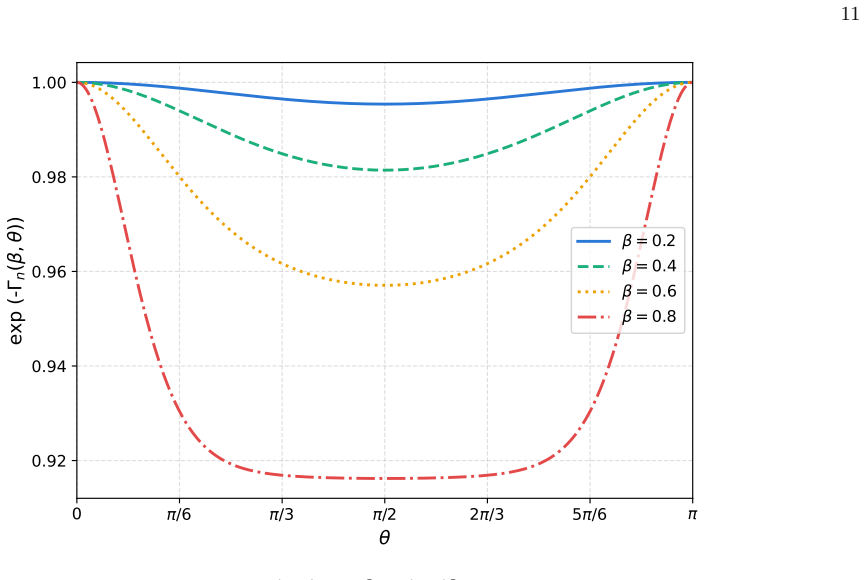
Using the soft-gluon theorem, unresolved gluon radiation induces decoherence in the spin correlations of heavy quark-antiquark pairs produced in deep-inelastic scattering. The eikonal soft contribution preserves the Born spin structure, whereas the subleading soft term generates stochastic recoil-induced rotations of the spin-correlation plane. Upon tracing over the unresolved gluon, these rotations produce an effective dephasing channel: the normal-axis correlation remains unchanged at this order, while the in-plane spin coherences are suppressed.
What carries the argument
The subleading term of the soft-gluon theorem, which alone generates stochastic recoil rotations of the spin-correlation plane when applied to heavy quark pairs.
If this is right
- The normal-axis spin correlation remains unchanged at this perturbative order.
- In-plane spin coherences experience suppression from the stochastic rotations.
- Concurrence of the quark-antiquark spin state and violation of the Bell-CHSH inequality are both reduced.
- A radiation-binned observable defined by the ratio of in-plane to normal spin correlations isolates the anisotropic suppression.
Where Pith is reading between the lines
- The proposed ratio observable could be applied to other collider processes involving heavy quarks to separate radiation-induced decoherence from production-level spin correlations.
- If the mechanism holds, binning events by soft radiation activity offers a general experimental handle for studying decoherence in entangled particle pairs.
- The anisotropic nature of the suppression suggests that full tomography of the spin state may require separate measurements along multiple axes to capture the full effect.
Load-bearing premise
The soft-gluon theorem and its subleading term can be applied directly to the spin-correlation plane of heavy-quark pairs such that the eikonal contribution preserves the Born spin structure while the subleading term alone generates the stochastic recoil rotations.
What would settle it
Measurement of the ratio of in-plane to normal spin correlations in radiation-binned events at the EIC showing no anisotropic suppression, or equal suppression in all directions despite the presence of soft radiation, would falsify the predicted dephasing channel.
Figures
read the original abstract
Using the soft-gluon theorem, we identify a soft-recoil mechanism by which unresolved gluon radiation induces decoherence in the spin correlations of heavy quark-antiquark pairs produced in deep-inelastic scattering. We show the eikonal soft contribution preserves the Born spin structure, whereas the subleading soft term generates stochastic recoil-induced rotations of the spin-correlation plane. Upon tracing over the unresolved gluon, these rotations produce an effective dephasing channel: the normal-axis correlation remains unchanged at this order, while the in-plane spin coherences are suppressed. We estimate the resulting reduction of concurrence and Bell-CHSH violation, and propose a radiation-binned EIC observable based on the ratio of in-plane to normal spin correlations. This observable isolates the characteristic anisotropic suppression predicted by the soft-recoil mechanism and provides a measurable handle on radiation-induced spin decoherence of an entangled quark-antiquark pair produced in a deep-inelastic scattering process.
Editorial analysis
A structured set of objections, weighed in public.
Referee Report
Summary. The paper claims that unresolved soft gluon radiation induces decoherence in the spin correlations of heavy quark-antiquark pairs produced in deep-inelastic scattering at the EIC. Using the soft-gluon theorem, the eikonal contribution preserves the Born spin structure while the subleading term generates stochastic recoil-induced rotations of the spin-correlation plane. Tracing over the unresolved gluon produces an effective dephasing channel in which the normal-axis correlation remains unchanged at this order but in-plane spin coherences are suppressed. The work estimates the resulting reduction in concurrence and Bell-CHSH violation and proposes a radiation-binned observable based on the ratio of in-plane to normal spin correlations to isolate the anisotropic suppression.
Significance. If the derivation holds, the result identifies a novel, radiation-induced source of anisotropic decoherence for entangled heavy-quark pairs that is testable at the EIC. The distinctive normal-versus-in-plane pattern supplies a falsifiable signature that connects soft QCD theorems with quantum-information observables, and the proposed ratio observable provides a concrete experimental handle on the effect.
major comments (2)
- [Section deriving the dephasing channel from the soft-gluon theorem] The central claim that the subleading soft term alone generates the stochastic rotations whose trace yields the anisotropic dephasing channel is load-bearing, yet the manuscript supplies no explicit operator or matrix-element calculation demonstrating how the recoil rotations act on the spin-correlation plane and why the normal axis is protected at this order. Without this derivation the soundness of the effective channel cannot be verified.
- [Section on numerical estimates and observable] The estimates of concurrence reduction and Bell-CHSH violation are presented without numerical values, kinematic cuts, or comparison to the Born-level baseline; these quantities are essential to assess whether the predicted suppression is experimentally accessible at EIC luminosities.
minor comments (2)
- [Observable proposal] Define the precise binning variable (e.g., gluon energy or transverse momentum) used for the radiation-binned observable and state how it is reconstructed from final-state hadrons.
- [Spin-correlation definitions] Clarify the frame in which the normal axis and in-plane directions are defined relative to the DIS kinematics.
Simulated Author's Rebuttal
We thank the referee for their careful reading of the manuscript and for the constructive comments. We address each major comment below and will revise the manuscript accordingly to improve clarity and completeness.
read point-by-point responses
-
Referee: [Section deriving the dephasing channel from the soft-gluon theorem] The central claim that the subleading soft term alone generates the stochastic rotations whose trace yields the anisotropic dephasing channel is load-bearing, yet the manuscript supplies no explicit operator or matrix-element calculation demonstrating how the recoil rotations act on the spin-correlation plane and why the normal axis is protected at this order. Without this derivation the soundness of the effective channel cannot be verified.
Authors: We thank the referee for identifying the need for a more explicit derivation. The application of the soft-gluon theorem is presented in Section 3, where the eikonal term is shown to factorize while preserving the Born-level spin density matrix, and the subleading term introduces a recoil operator whose action on the spin operators is derived from the next-to-eikonal current. The normal axis remains protected because the recoil momentum lies in the production plane, leaving the out-of-plane component unaffected at this order. To make the derivation fully verifiable, we will expand Section 3 with the explicit form of the recoil rotation operator acting on the spin-correlation matrix and add an appendix containing the relevant matrix elements before and after tracing over the unresolved gluon. revision: yes
-
Referee: [Section on numerical estimates and observable] The estimates of concurrence reduction and Bell-CHSH violation are presented without numerical values, kinematic cuts, or comparison to the Born-level baseline; these quantities are essential to assess whether the predicted suppression is experimentally accessible at EIC luminosities.
Authors: We agree that concrete numerical values, kinematic cuts, and Born-level comparisons are required to evaluate experimental accessibility. In the revised manuscript we will add a new subsection with explicit estimates of concurrence reduction and Bell-CHSH violation for representative EIC kinematics (Q² = 5–20 GeV², x ≈ 0.01–0.1), including cuts on soft-gluon energy and transverse momentum. Direct comparisons to the Born baseline will be provided, together with an assessment of the luminosity needed to observe the effect. The radiation-binned ratio observable will be illustrated with these numbers to demonstrate the anisotropic suppression. revision: yes
Circularity Check
No significant circularity in derivation chain
full rationale
The paper applies the standard soft-gluon theorem to heavy-quark spin correlations in DIS. The eikonal term is stated to preserve the Born spin structure by the theorem's known properties, while the subleading term supplies recoil rotations whose trace produces the anisotropic dephasing channel. No parameter fitting, self-definitional loops, or load-bearing self-citations are described. The proposed radiation-binned ratio observable follows directly as a measurable consequence of the traced channel and does not reduce to any input by construction. The chain is self-contained against the external soft-gluon theorem.
Axiom & Free-Parameter Ledger
Reference graph
Works this paper leans on
-
[1]
(74) 12 Using Eq. (72), we obtain Pexp = 1+λ 2 2 = 1+e −2Γn 2 .(75) For weak dephasing, Pexp =1−Γn+O(Γ 2 n).(76) Thus the purity decreases linearly with the dephasing exponent in the perturbative regime. B. Linear Entropy The linear entropy is defined by SL =1−Trρ2.(77) Using Eq. (75), one finds SL,exp = 1−λ2 2 = 1−e−2Γn 2 .(78) For Γn ≪1, SL,exp =Γ n+O(Γ...
-
[2]
However, the violation remains above the classical bound as long as Bmax,exp >2,(94) which is satisfied for any finite positiveλ=e −Γn. Collecting the exponentiated multiple-soft-emission estimates, we have Cexp =e −Γn ,(95) Nexp = 1 2 e−Γn ,(96) Pexp = 1+e −2Γn 2 ,(97) SL,exp = 1−e−2Γn 2 ,(98) SvN,exp =−1+e −Γn 2 ln( 1+e −Γn 2 )−1−e−Γn 2 ln( 1−e−Γn 2 ),(...
-
[3]
A. Einstein, B. Podolsky, and N. Rosen, Phys. Rev.47, 777 (1935), URLhttps://link.aps.org/doi/10.1103/PhysRev. 47.777
-
[4]
Schr¨ odinger, Mathematical Proceedings of the Cambridge Philosophical Society31, 555–563 (1935)
E. Schr¨ odinger, Mathematical Proceedings of the Cambridge Philosophical Society31, 555–563 (1935)
1935
-
[5]
Schr¨ odinger, Mathematical Proceedings of the Cambridge Philosophical Society32, 446–452 (1936)
E. Schr¨ odinger, Mathematical Proceedings of the Cambridge Philosophical Society32, 446–452 (1936)
1936
-
[6]
J. S. Bell, Physics Physique Fizika1, 195 (1964), URLhttps://link.aps.org/doi/10.1103/PhysicsPhysiqueFizika.1. 195
-
[7]
J. F. Clauser, M. A. Horne, A. Shimony, and R. A. Holt, Phys. Rev. Lett.23, 880 (1969), URLhttps://link.aps.org/ doi/10.1103/PhysRevLett.23.880
-
[8]
B. Hensen et al., Nature526, 682 (2015), 1508.05949, URLhttps://doi.org/10.1038/nature15759
work page internal anchor Pith review Pith/arXiv arXiv doi:10.1038/nature15759 2015
-
[9]
Significant-loophole-free test of Bell's theorem with entangled photons
M. Giustina et al., Phys. Rev. Lett.115, 250401 (2015), 1511.03190, URLhttps://link.aps.org/doi/10.1103/ PhysRevLett.115.250401
work page internal anchor Pith review Pith/arXiv arXiv 2015
-
[10]
M. J. Stevens et al., Phys. Rev. Lett.115, 250402 (2015), 1511.03189, URLhttps://link.aps.org/doi/10.1103/ PhysRevLett.115.250402
work page internal anchor Pith review Pith/arXiv arXiv 2015
-
[11]
D. E. Kharzeev and E. M. Levin, Phys. Rev. D95, 114008 (2017), 1702.03489, URLhttps://link.aps.org/doi/10. 1103/PhysRevD.95.114008
work page internal anchor Pith review Pith/arXiv arXiv 2017
-
[12]
G. Aad et al. (ATLAS), Nature633, 542 (2024), 2311.07288, URLhttps://doi.org/10.1038/s41586-024-07824-z
-
[13]
Y. Hatta and J. Montgomery, Phys. Rev. D111, 014024 (2025), 2410.16082, URLhttps://link.aps.org/doi/10.1103/ gbk8-z3dd
-
[14]
S. Agrawal and R. Abir, Phys. Lett. B868, 139802 (2025), 2505.21048, URLhttps://www.sciencedirect.com/science/ article/pii/S0370269325005635
-
[15]
Tolerance versus synaptic noise in dense associative memo- ries
Y. Afik and J. R. M. de Nova, Eur. Phys. J. Plus136, 907 (2021), 2003.02280, URLhttps://doi.org/10.1140/epjp/ s13360-021-01902-1
-
[16]
M. Fabbrichesi, R. Floreanini, and G. Panizzo, Phys. Rev. Lett.127, 161801 (2021), 2102.11883, URLhttps://link. aps.org/doi/10.1103/PhysRevLett.127.161801
- [17]
-
[18]
M. Fucilla and Y. Hatta, Phys. Rev. D113, L031504 (2026), 2509.05267, URLhttps://link.aps.org/doi/10.1103/ gbk8-z3dd
-
[19]
Y. Hatta and J. Schoenleber, Phys. Rev. D113, 094016 (2026), URLhttps://link.aps.org/doi/10.1103/qdb2-k2nh
-
[20]
M. Fucilla, Y. Hatta, and B.-W. Xiao (2026), 2604.11697
work page internal anchor Pith review Pith/arXiv arXiv 2026
-
[21]
Y.-X. Liu, W. Qi, L.-T. He, and B.-W. Xiao (2026), 2604.17756
work page internal anchor Pith review Pith/arXiv arXiv 2026
- [22]
-
[23]
Controlling Quantum discord and steering in Electron-Positron Annihilation Using Polarized Beams
H.-W. Zhang, X. Cao, and T.-F. Feng (2026), 2605.19642
work page internal anchor Pith review Pith/arXiv arXiv 2026
- [24]
-
[25]
Quantum entanglement between partons in a strongly coupled quantum field theory
W. Zhang, W. Qian, Y. Zhou, Y. Li, and Q. Wang (2025), 2512.21228
work page internal anchor Pith review Pith/arXiv arXiv 2025
-
[26]
C. E. P. Robin and M. J. Savage (2026), 2604.26376
work page internal anchor Pith review Pith/arXiv arXiv 2026
- [27]
discussion (0)
Sign in with ORCID, Apple, or X to comment. Anyone can read and Pith papers without signing in.