Wave Optics Effects from Gravitational Wave Propagation Through Dark Matter Halos
Pith reviewed 2026-06-30 05:11 UTC · model grok-4.3
The pith
Gravitational waves do not propagate along null geodesics through Gaussian dark matter density profiles in both weak and strong gravity regimes.
A machine-rendered reading of the paper's core claim, the machinery that carries it, and where it could break.
Core claim
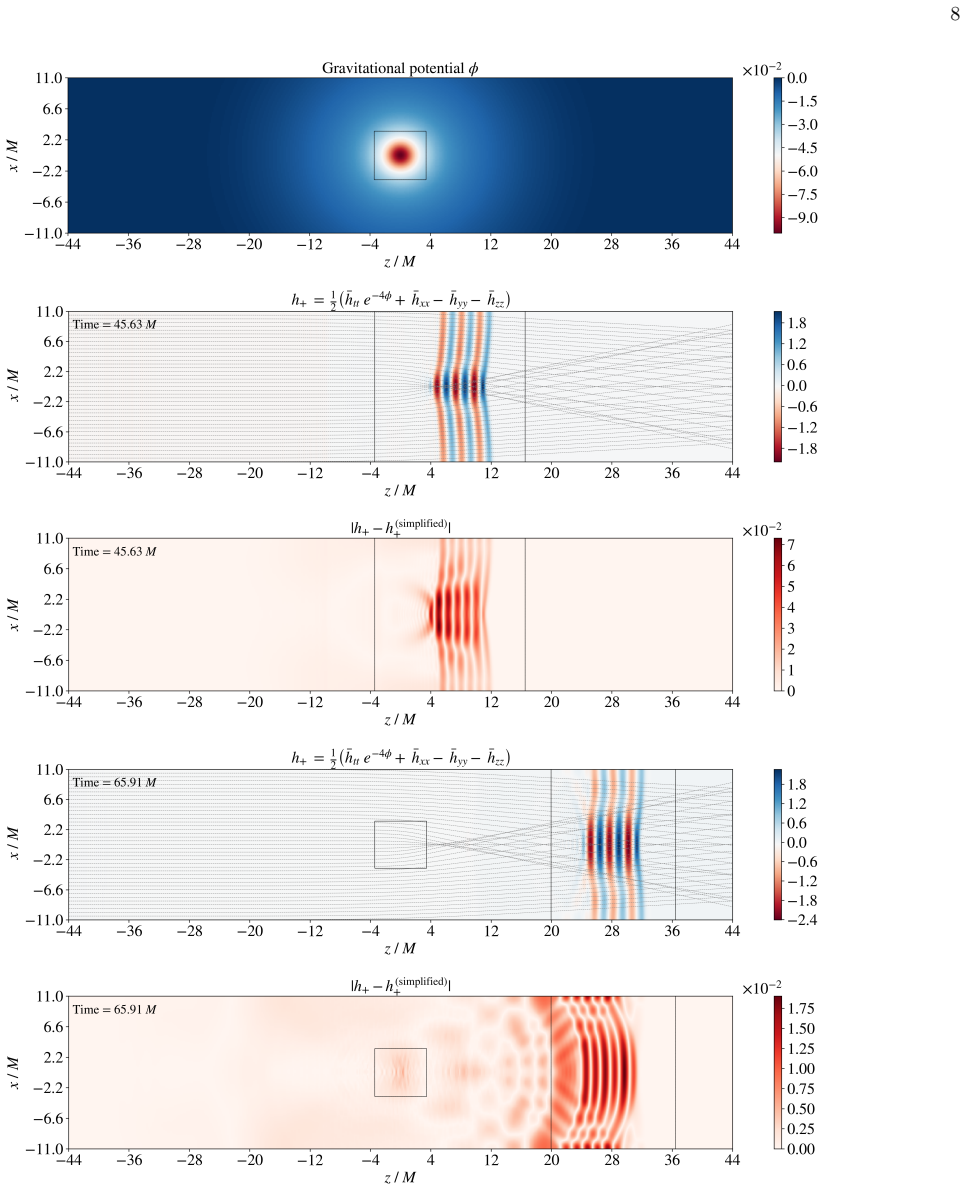
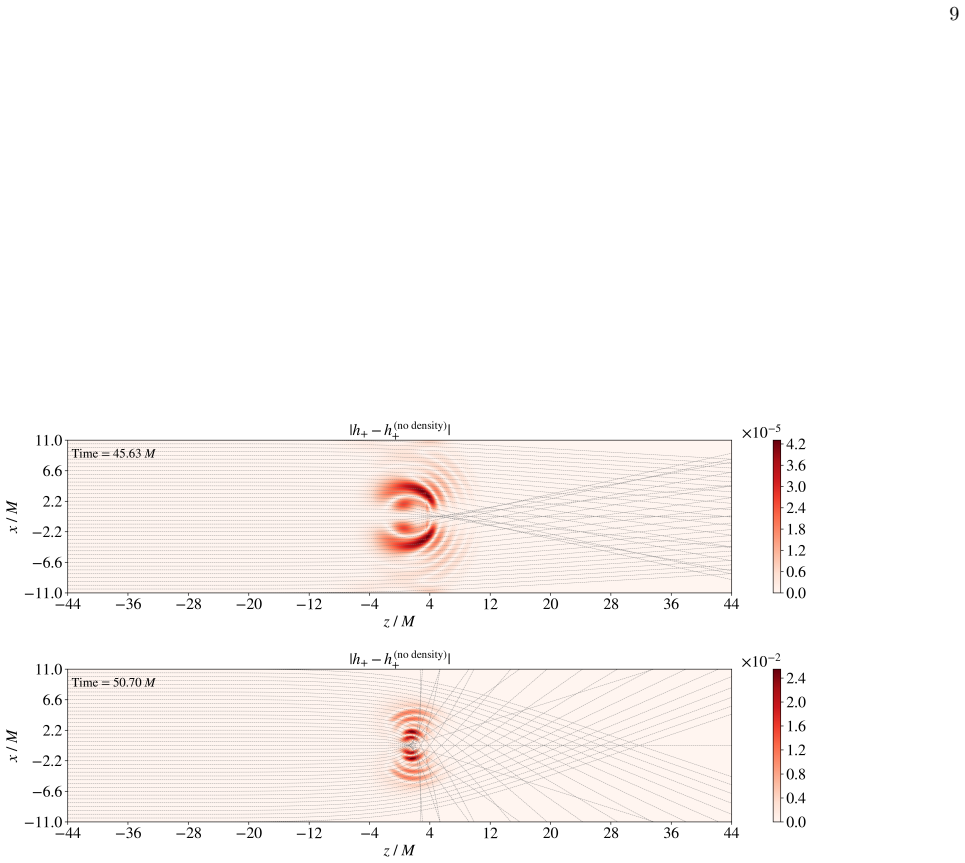
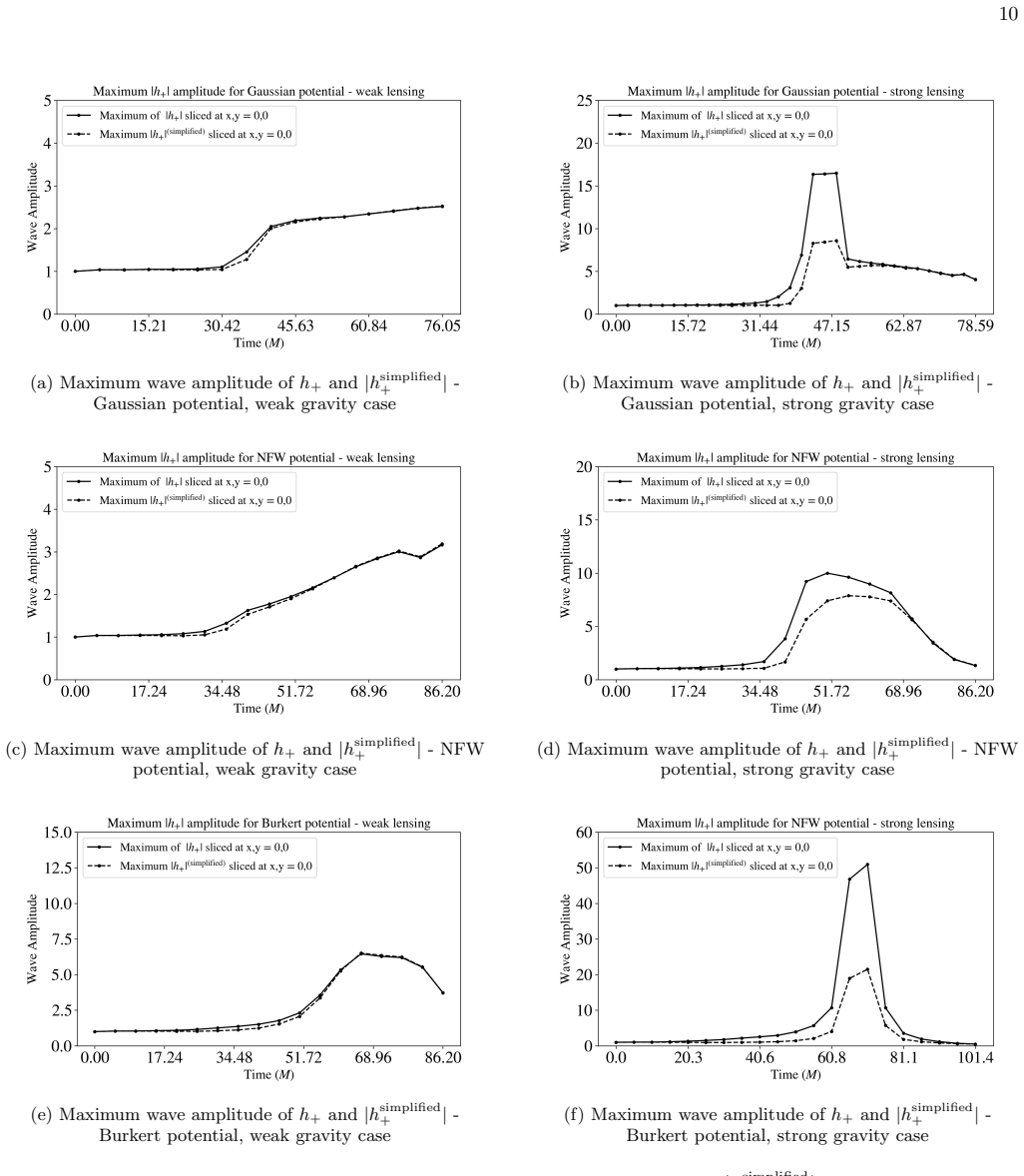
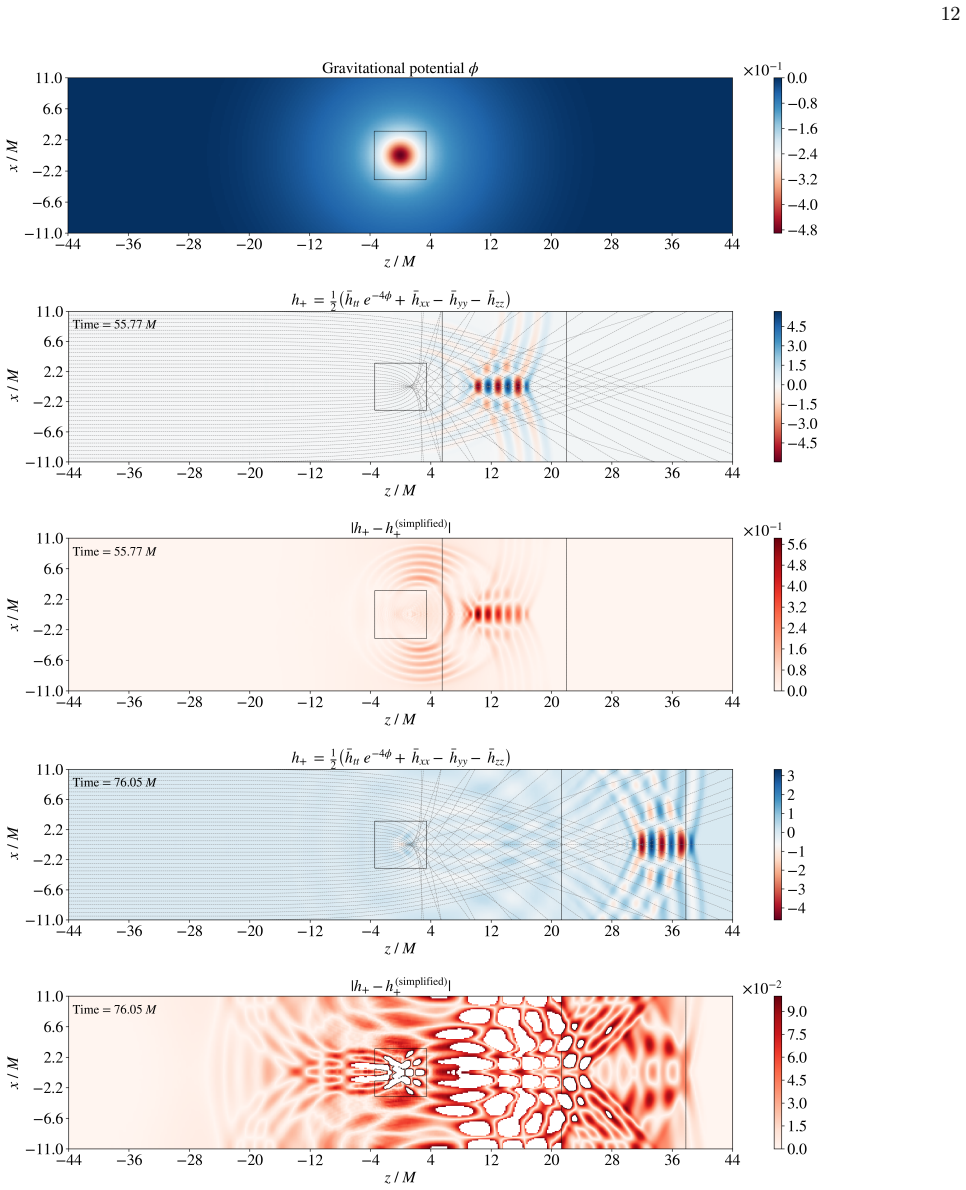
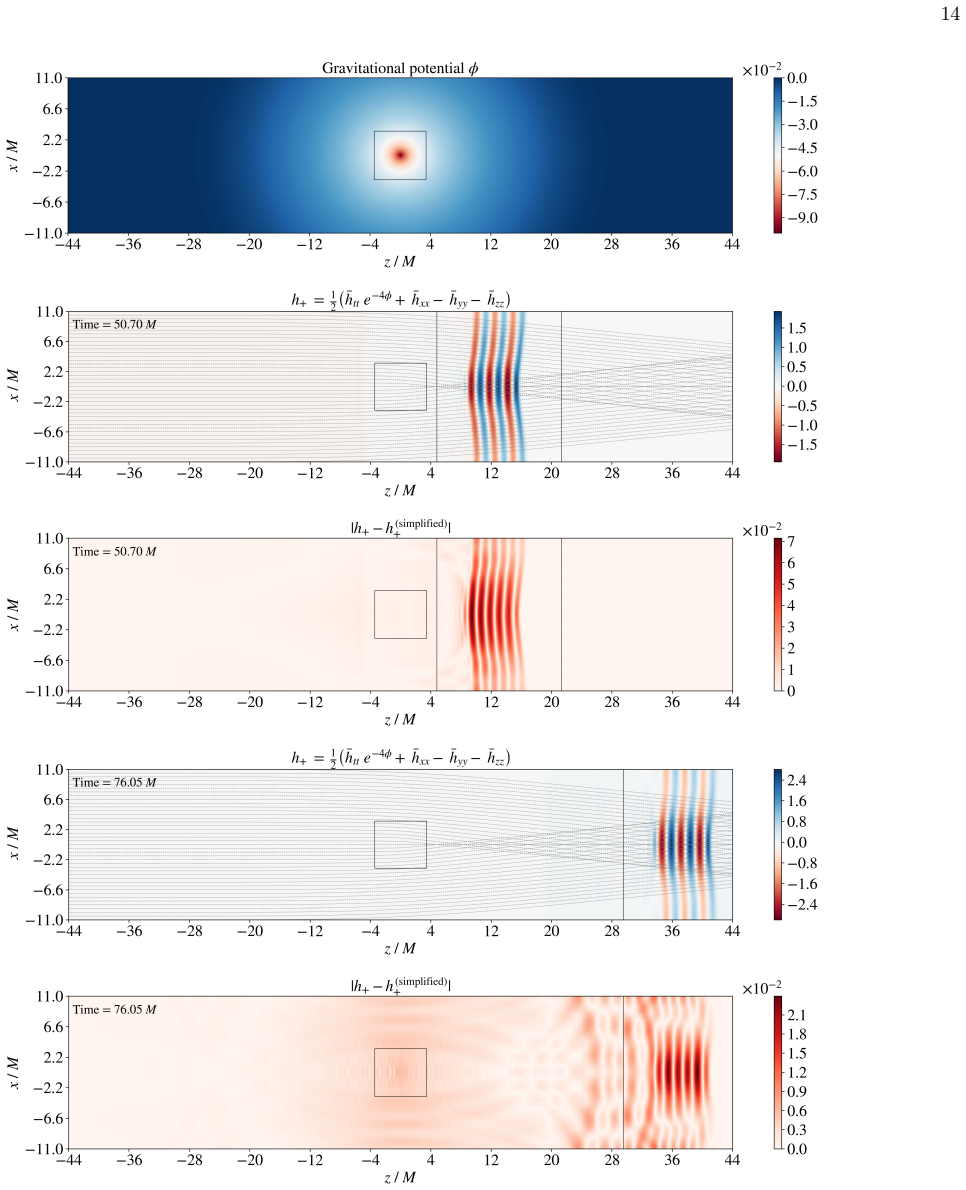
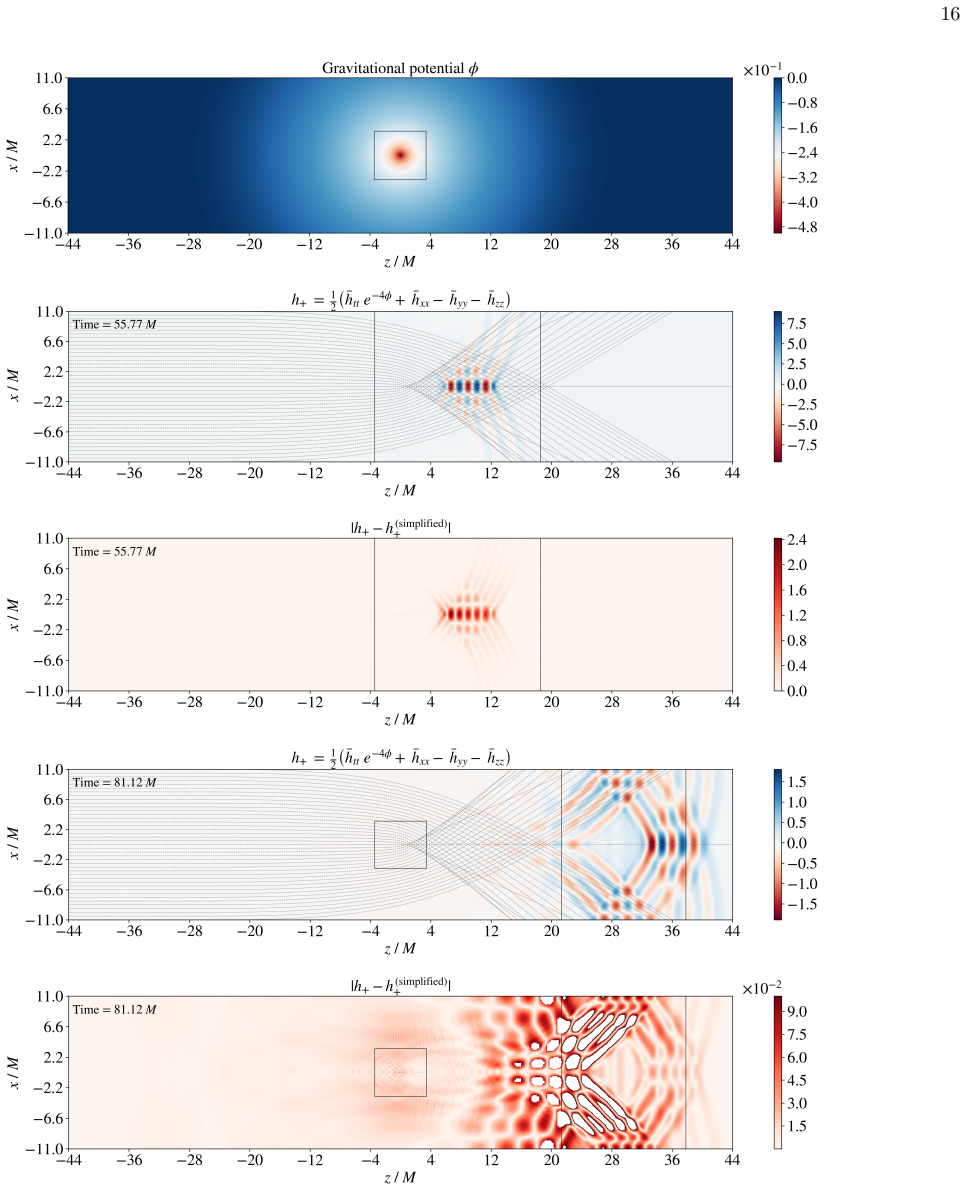
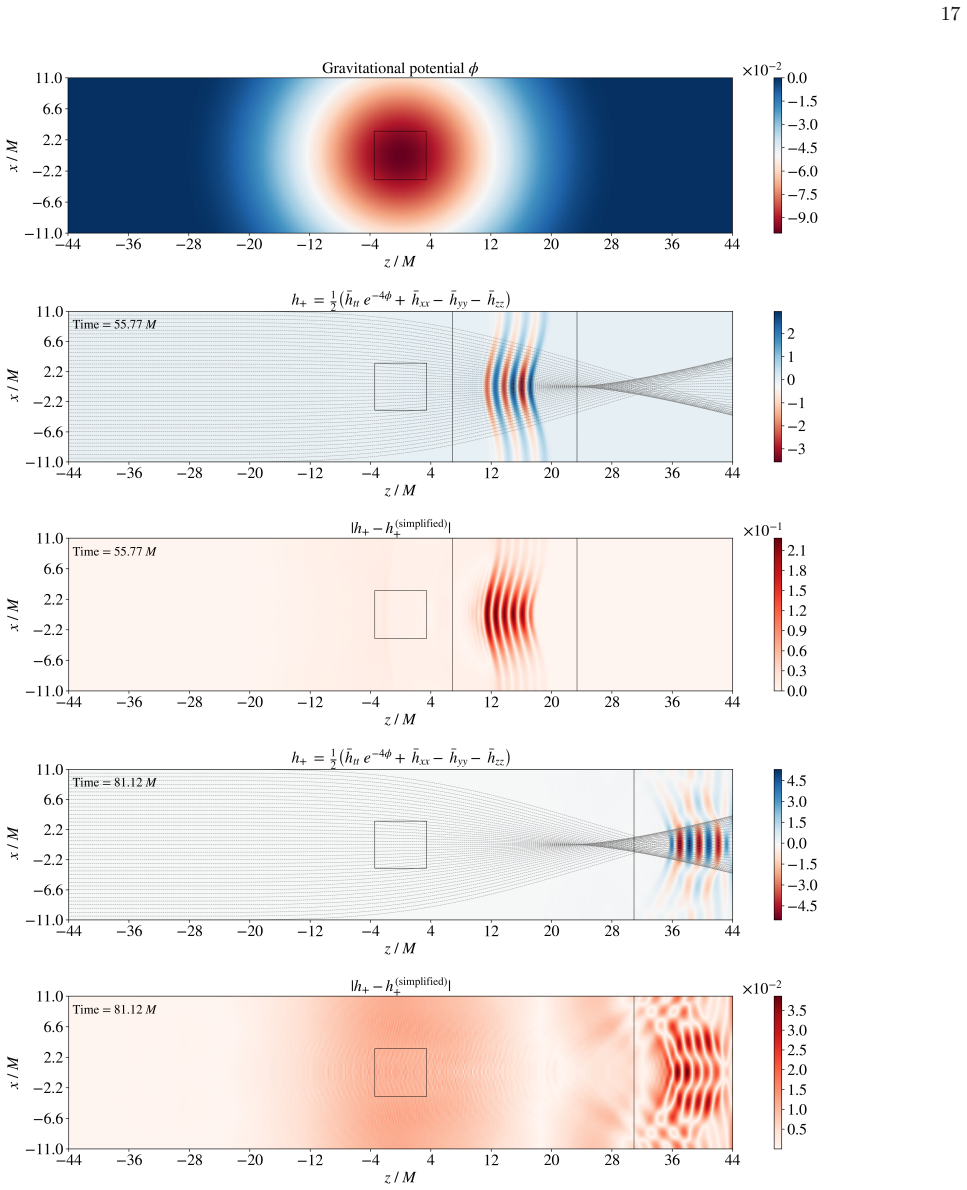
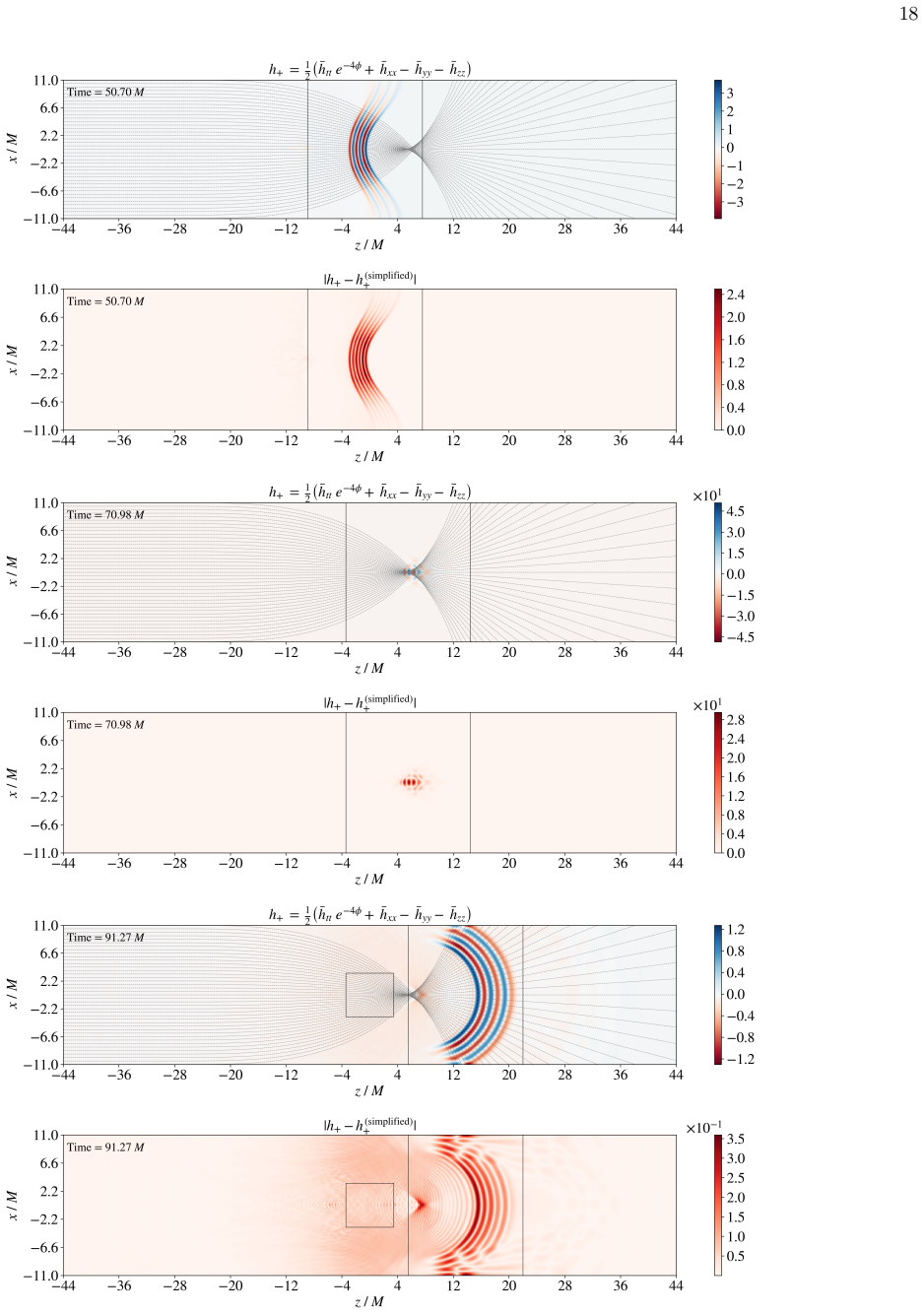
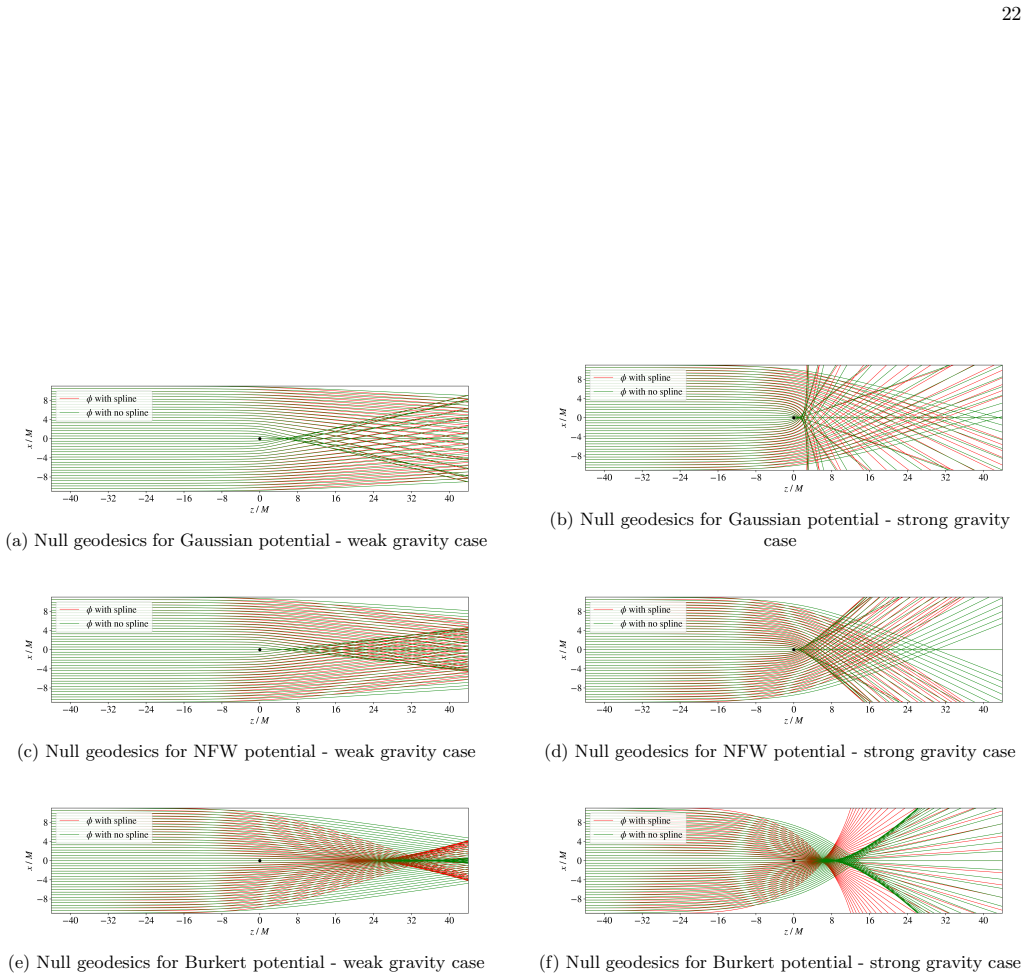
Linearized plane gravitational waves evolved through Gaussian density profiles do not propagate along null geodesics in either the weak or strong gravity regime. For the Burkert potential the convexity of the plane wave is flipped upon leaving the structure in the strong-gravity case. The scattering depends on the gravitational potential distribution of the lens as well as its mass, and the difference between exact gravitational-wave modes and linearized scalar-wave predictions is order one inside the central potential yet only a few percent after the wave has passed through.
What carries the argument
Numerical evolution of the full ten-component linearized Einstein equations for plane gravitational waves through simplified stationary spherically symmetric potentials.
If this is right
- Scattering of gravitational waves depends strongly on the detailed gravitational potential distribution of the lens, not only on its total mass.
- Differences between exact gravitational-wave modes and linearized scalar-wave predictions are of order one inside the central potential but reduce to a few percent after passage.
- Wave-optics effects appear even when the gravitational-wave wavelength is smaller than the Schwarzschild radius of the structure.
- Future gravitational-wave detectors and pulsar timing arrays could register these signals and thereby constrain the inner structure of dark-matter spikes or halos.
Where Pith is reading between the lines
- The result implies that geometric-optics lensing calculations must be supplemented by wave-optics corrections whenever source or lens structures have sizes comparable to the gravitational-wave wavelength.
- The numerical scheme could be applied to time-varying or non-spherical potentials to model more realistic dark-matter distributions and test whether the geodesic deviation persists.
- Detection of such effects would provide an independent probe of the central density slope in halos that is complementary to stellar-dynamics or strong-lensing observations.
Load-bearing premise
The astrophysical structures can be treated as stationary, spherically symmetric potentials while the incoming gravitational waves remain linearized plane waves throughout the evolution.
What would settle it
Direct comparison of observed gravitational-wave arrival times or waveforms from sources lensed by a known Gaussian-profile halo against the null-geodesic prediction; a statistically significant mismatch in phase or amplitude would confirm the deviation.
Figures
read the original abstract
Gravitational wave (GW) propagation is usually studied under the geometric optics approximation. But when GWs propagate through structures of sizes similar to their wavelength, this approximation breaks down. Going beyond the geometric optics approximation allows us to explore the wave optics effects in curved background that appear in such cases. In this work, we present a scheme for numerically evolving linearised plane GWs through stationary, spherical astrophysical structures in both weak and strong gravity regimes. Our simulations evolve the full Einstein equations (with all 10 components) for Gaussian, NFW and Burkert potentials, although in simplified form for the two latter. Our simulations show that the scattering of the GWs depends not only on the mass of the lens but also strongly on the gravitational potential distribution of the lens. We isolate the effects of diffraction by setting the wavelength of GW to be less than the Schwarzschild radius of the structure. Among our most important results, we find that the GWs do not propagate along null geodesics when propagating through the Gaussian density, neither in the strong nor weak gravity setting. We also find that for the Burkert potential, the convexity of the plane wave is flipped when leaving the structure, in the strong gravity case. We compare our results with the linearized scalar wave predictions and find that the difference between these and the exact GW modes are of order one when the wave is inside the central potential. However, the difference reduces to only a few percent when the wave has passed through the structure. Although these effects are small, future GW detectors and Pulsar Timing Arrays (PTAs) could be sensitive to these signals which could thus potentially help in constraining the structure of dark matter spikes or halos.
Editorial analysis
A structured set of objections, weighed in public.
Referee Report
Summary. The manuscript presents a numerical scheme for evolving linearized plane gravitational waves through stationary, spherically symmetric astrophysical structures modeled by Gaussian, NFW, and Burkert density profiles in both weak and strong gravity regimes. By solving the full Einstein equations, the authors report that gravitational waves do not follow null geodesics when propagating through Gaussian density profiles in either regime, and that the convexity of the plane wave is flipped upon exiting a Burkert potential in the strong gravity case. They also compare the results to linearized scalar wave predictions, finding order-one differences inside the potential that reduce to a few percent after passage.
Significance. If the numerical findings are confirmed to be free of artifacts, the work would demonstrate wave-optics corrections to geometric-optics propagation that depend on the detailed shape of the gravitational potential, with potential implications for interpreting signals from future GW detectors and PTAs in the presence of dark matter structures. The use of the full set of Einstein equations rather than a scalar approximation is a positive feature.
major comments (2)
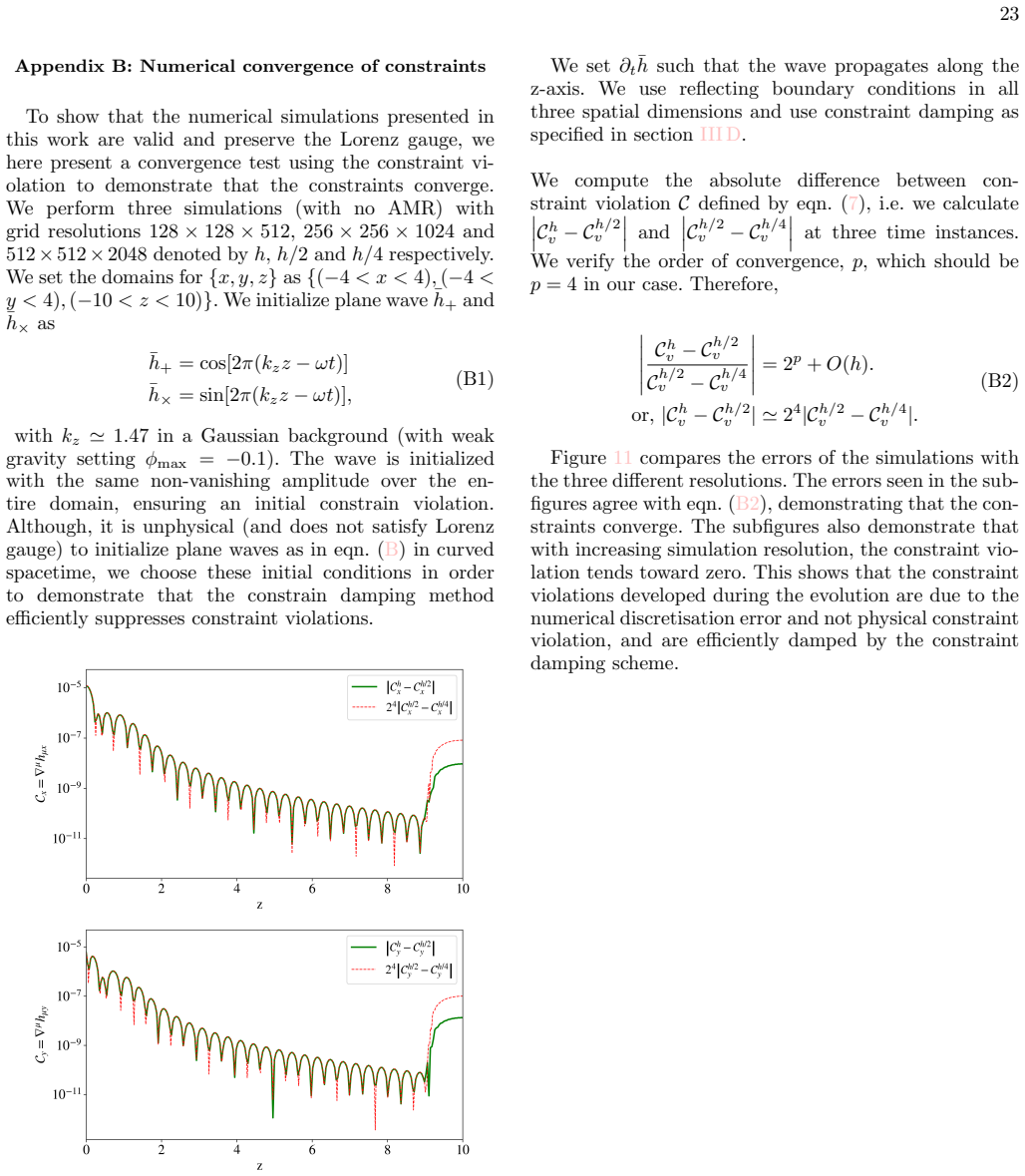
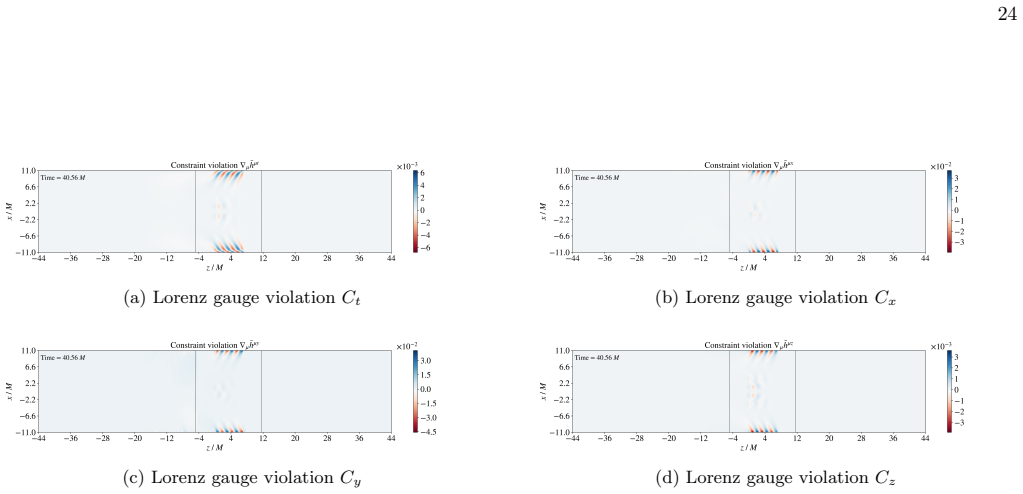
- [Numerical evolution and results sections] The central claims of non-geodesic propagation for the Gaussian profile (both regimes) and convexity flip for Burkert (strong gravity) rest entirely on the output of the numerical evolution of the full Einstein equations. No convergence tests with respect to spatial resolution or time step, no quantitative truncation-error estimates, and no comparison of the reported deviations to numerical error are provided anywhere in the manuscript. This directly undermines the ability to assess whether the O(1) interior differences and few-percent post-exit differences survive refinement.
- [Model and implementation description] The abstract states that the NFW and Burkert cases are implemented 'in simplified form,' yet the precise approximations, boundary conditions, and how the full 10-component Einstein system is reduced are not specified with sufficient detail to allow independent reproduction or error assessment. This is load-bearing because the reported profile dependence of the scattering is the main physical result.
minor comments (2)
- [Setup] The statement that 'the wavelength of GW [is set] to be less than the Schwarzschild radius' to isolate diffraction should be accompanied by an explicit statement of the chosen wavelength-to-radius ratio and its relation to the grid scale.
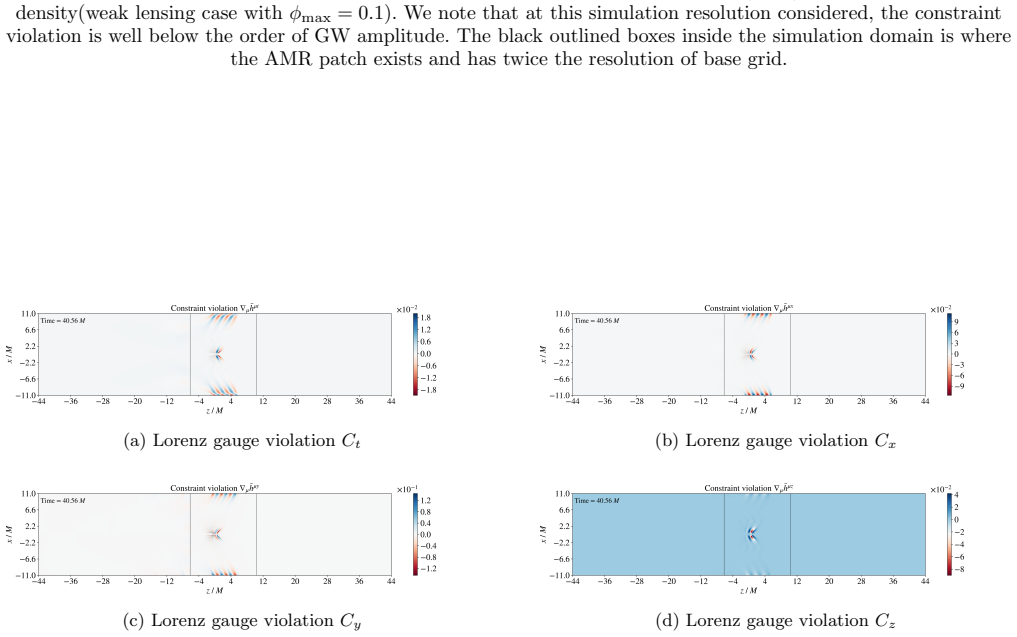
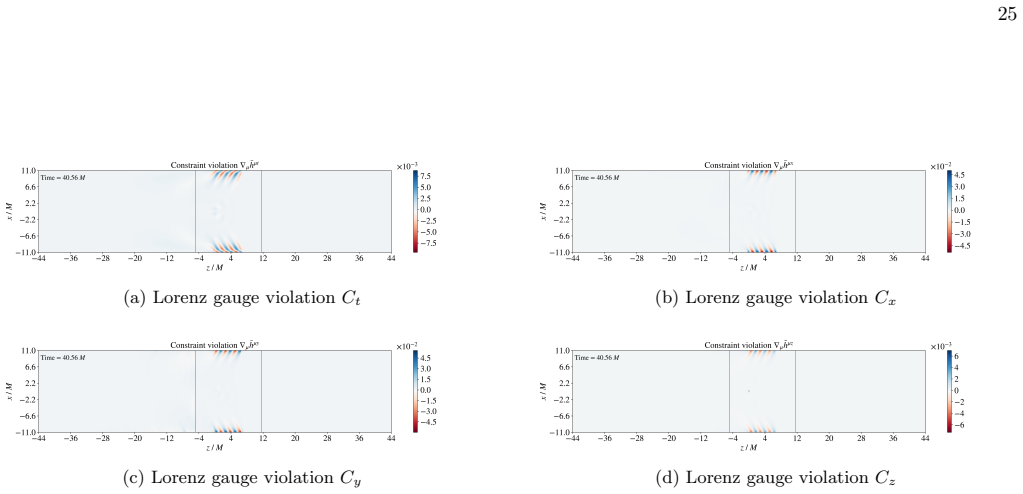
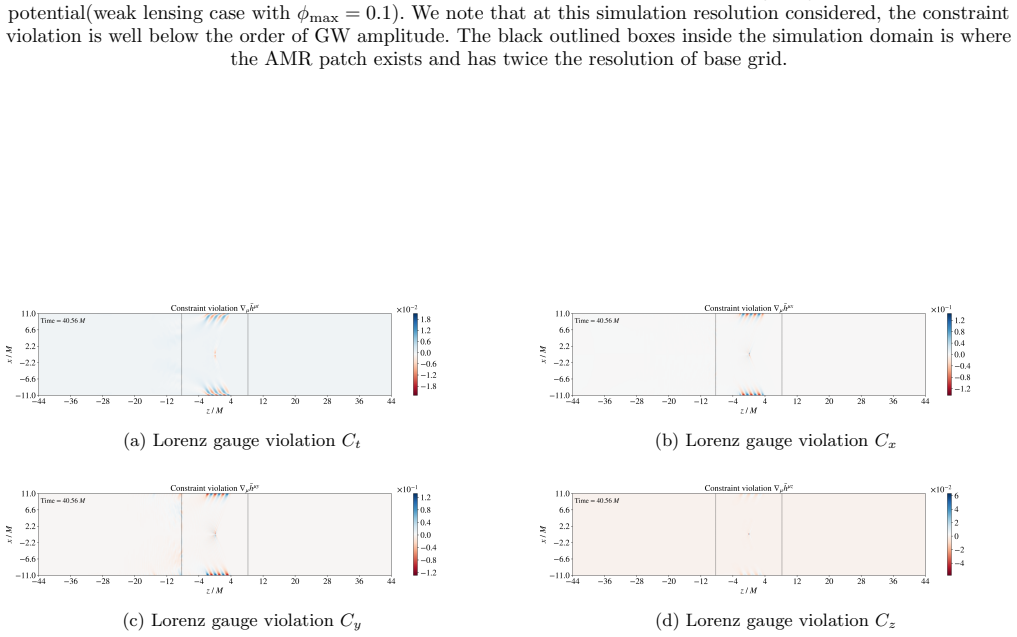
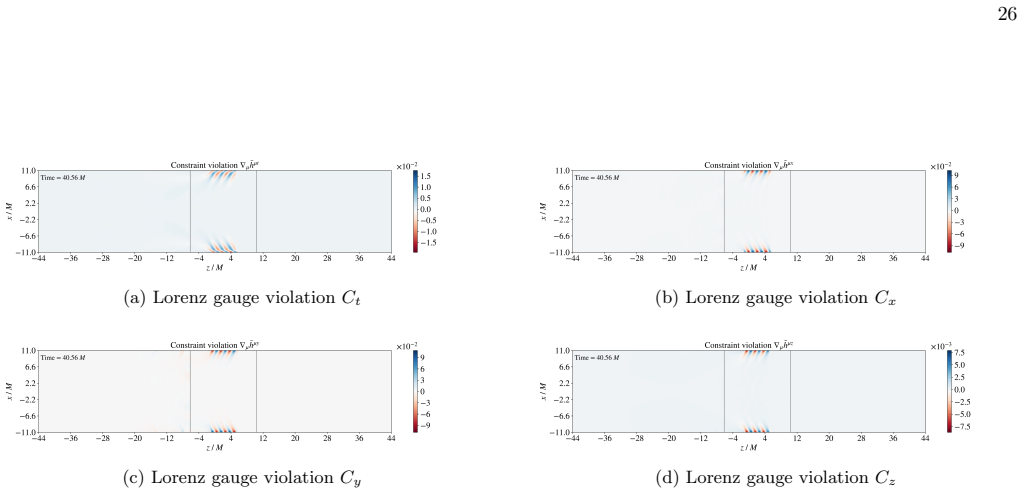
- [Figures and results] Figure captions and text should clarify whether the plotted wave profiles are extracted along a fixed radial line or represent a full 2D/3D slice, and whether any gauge choice affects the apparent convexity.
Simulated Author's Rebuttal
We thank the referee for their careful reading of the manuscript and for highlighting these important points regarding numerical validation and reproducibility. We address each major comment below.
read point-by-point responses
-
Referee: [Numerical evolution and results sections] The central claims of non-geodesic propagation for the Gaussian profile (both regimes) and convexity flip for Burkert (strong gravity) rest entirely on the output of the numerical evolution of the full Einstein equations. No convergence tests with respect to spatial resolution or time step, no quantitative truncation-error estimates, and no comparison of the reported deviations to numerical error are provided anywhere in the manuscript. This directly undermines the ability to assess whether the O(1) interior differences and few-percent post-exit differences survive refinement.
Authors: We agree that the absence of explicit convergence tests and truncation-error estimates is a significant omission that weakens the presentation of the results. In the revised manuscript we will add a dedicated subsection on numerical validation, including convergence studies under successive spatial and temporal refinements, quantitative estimates of truncation error (via Richardson extrapolation or similar), and direct comparison of the reported O(1) interior and few-percent post-exit deviations against these error measures. This will allow readers to confirm that the profile-dependent effects exceed numerical artifacts. revision: yes
-
Referee: [Model and implementation description] The abstract states that the NFW and Burkert cases are implemented 'in simplified form,' yet the precise approximations, boundary conditions, and how the full 10-component Einstein system is reduced are not specified with sufficient detail to allow independent reproduction or error assessment. This is load-bearing because the reported profile dependence of the scattering is the main physical result.
Authors: We acknowledge that the current description of the NFW and Burkert implementations is insufficient for independent reproduction. The revised manuscript will expand the model section to specify exactly which metric components are retained or set to zero, the precise form of the density profiles and their associated metric perturbations, the boundary conditions (including outgoing-wave and asymptotic flatness conditions), and any symmetry reductions applied to the ten-component Einstein system. These additions will make the profile-dependent scattering results fully reproducible and will facilitate independent error analysis. revision: yes
Circularity Check
Numerical evolution outputs independent of input fitting or self-definition
full rationale
The paper reports results from direct numerical integration of the linearized Einstein equations for plane GWs propagating through fixed spherical potentials (Gaussian, NFW, Burkert). No parameter is fitted to a subset of data and then relabeled as a prediction; no quantity is defined in terms of the target observable; no uniqueness theorem or ansatz is imported via self-citation to force the outcome. The reported deviations from null geodesics and the convexity flip are stated as simulation outputs, with comparison to scalar-wave solutions serving only as an external benchmark rather than a definitional reduction. The derivation chain therefore remains self-contained against external numerical benchmarks.
Axiom & Free-Parameter Ledger
axioms (3)
- standard math Einstein equations govern the evolution of the metric and matter
- domain assumption The lens can be modeled as a stationary, spherically symmetric potential
- domain assumption Incoming gravitational waves remain linearized plane waves
Reference graph
Works this paper leans on
-
[1]
B. P. Abbottet al.(LIGO Scientific, Virgo), Phys. Rev. X9, 031040 (2019), arXiv:1811.12907 [astro-ph.HE]
work page internal anchor Pith review Pith/arXiv arXiv 2019
-
[2]
R. Abbottet al.(LIGO Scientific, Virgo), Phys. Rev. X 11, 021053 (2021), arXiv:2010.14527 [gr-qc]
work page internal anchor Pith review Pith/arXiv arXiv 2021
-
[3]
B. P. Abbottet al.(LIGO Scientific, Virgo), Phys. Rev. Lett.116, 061102 (2016), arXiv:1602.03837 [gr-qc]
work page internal anchor Pith review Pith/arXiv arXiv 2016
-
[4]
R. Abbottet al.(KAGRA, VIRGO, LIGO Scientific), Phys. Rev. X13, 041039 (2023), arXiv:2111.03606 [gr- qc]
work page internal anchor Pith review Pith/arXiv arXiv 2023
-
[5]
L. S. Collaboration, V. Collaboration, K. collaboration, et al., Astrophysical Journal Letters1004, L22 (2026)
2026
-
[6]
B. P. Abbottet al.(LIGO Scientific, Virgo), Phys. Rev. X6, 041015 (2016), [Erratum: Phys.Rev.X 8, 039903 (2018)], arXiv:1606.04856 [gr-qc]
work page internal anchor Pith review Pith/arXiv arXiv 2016
-
[7]
B. P. Abbottet al.(LIGO Scientific, Virgo), Phys. Rev. Lett.119, 141101 (2017), arXiv:1709.09660 [gr-qc]
work page internal anchor Pith review Pith/arXiv arXiv 2017
-
[8]
B. P. Abbottet al.(LIGO Scientific, Virgo), Phys. Rev. Lett.119, 161101 (2017), arXiv:1710.05832 [gr-qc]
work page internal anchor Pith review Pith/arXiv arXiv 2017
-
[9]
Baileset al., Nature Rev
M. Baileset al., Nature Rev. Phys.3, 344 (2021)
2021
-
[10]
B. S. Sathyaprakash and B. F. Schutz, Living Rev. Rel. 12, 2 (2009), arXiv:0903.0338 [gr-qc]
work page internal anchor Pith review Pith/arXiv arXiv 2009
-
[11]
Takahashi and T
R. Takahashi and T. Nakamura, The Astrophysical Jour- nal595, 1039–1051 (2003)
2003
-
[12]
R. J. Bontz and M. P. Haugan, Astrophys. Space Sci.78, 199 (1981)
1981
-
[13]
T. T. Nakamura, Phys. Rev. Lett.80, 1138 (1998)
1998
-
[14]
T. T. Nakamura and S. Deguchi, Progress of Theoretical Physics Supplement133, 137 (1999), https://academic.oup.com/ptps/article- pdf/doi/10.1143/PTPS.133.137/5283012/133-137.pdf
-
[15]
The finite source size effect and the wave optics in gravitational lensing
N. Matsunaga and K. Yamamoto, JCAP01, 023, arXiv:astro-ph/0601701
work page internal anchor Pith review Pith/arXiv arXiv
-
[16]
T. T. Nakamura, Physical Review Letters80, 1138 (1998)
1998
-
[17]
G. Cusin and M. Lagos, Physical Review D101, 10.1103/physrevd.101.044041 (2020)
-
[18]
X. Guo and Y. Lu, Physical Review D102, 10.1103/physrevd.102.124076 (2020)
-
[19]
Amaro-Seoane, Physical Review D99, 10.1103/phys- revd.99.123025 (2019)
G. Tambalo, M. Zumalac´ arregui, L. Dai, and M. H.- Y. Cheung, Physical Review D108, 10.1103/phys- revd.108.043527 (2023)
-
[20]
H. Yarimoto and M. Oguri, Physical Review D111, 083541 (2025), arXiv:2412.07272 [astro-ph.CO]
-
[22]
P. C. Peters, Phys. Rev. D9, 2207 (1974)
1974
- [23]
- [24]
- [25]
- [26]
-
[27]
M. C ¸ alι¸ skan, L. Ji, R. Cotesta, E. Berti, M. Kamionkowski, and S. Marsat, Physical Review D107, 10.1103/physrevd.107.043029 (2023)
-
[28]
S. Jung and C. S. Shin, Physical Review Letters122, 10.1103/physrevlett.122.041103 (2019)
-
[29]
J. M. Diego, O. A. Hannuksela, P. L. Kelly, G. Pagano, T. Broadhurst, K. Kim, T. G. F. Li, and G. F. Smoot, Astronomy & Astrophysics627, A130 (2019)
2019
-
[30]
S. M. C. Yeung, M. H. Y. Cheung, E. Seo, J. A. J. Gais, O. A. Hannuksela, and T. G. F. Li, Monthly Notices of the Royal Astronomical Society526, 2230–2240 (2023)
2023
-
[31]
X. Guo and Y. Lu, Physical Review D106, 10.1103/physrevd.106.023018 (2022)
-
[32]
Fairbairn, J
M. Fairbairn, J. Urrutia, and V. Vaskonen, Journal of Cosmology and Astroparticle Physics2023(07), 007
-
[33]
S. Savastano, G. Tambalo, H. Villarrubia-Rojo, and M. Zumalac´ arregui, Physical Review D108, 10.1103/physrevd.108.103532 (2023)
-
[34]
J. Urrutia and V. Vaskonen, The dark timbre of gravita- tional waves (2025), arXiv:2402.16849 [gr-qc]
-
[35]
A. Chen and J. Zhang, arXiv preprint arXiv:2605.19476 (2026)
work page internal anchor Pith review Pith/arXiv arXiv 2026
-
[36]
Ahmed, Q
F. Ahmed, Q. Wu, S. G. Ghosh, and T. Zhu, Journal of Cosmology and Astroparticle Physics2026(02), 004
-
[37]
He, Monthly Notices of the Royal Astronomical So- ciety506, 5278–5293 (2021)
J.-h. He, Monthly Notices of the Royal Astronomical So- ciety506, 5278–5293 (2021)
2021
- [38]
-
[39]
A. K. Meena and J. S. Bagla, Monthly Notices of the Royal Astronomical Society492, 1127 (2020)
2020
-
[40]
A. R. A. C. Wierda, E. Wempe, O. A. Hannuksela, L. V. E. Koopmans, and C. Van Den Broeck, The As- trophysical Journal921, 154 (2021)
2021
-
[41]
Villarrubia-Rojo, S
H. Villarrubia-Rojo, S. Savastano, M. Zumalac´ arregui, L. Choi, S. Goyal, L. Dai, and G. Tambalo, Physical Re- view D111, 103539 (2025)
2025
-
[42]
S.-S. Li, S. Mao, Y. Zhao, and Y. Lu, Monthly Notices of the Royal Astronomical Society476, 2220–2229 (2018)
2018
-
[43]
Y. Wang, A. Stebbins, and E. L. Turner, Physical Review Letters77, 2875–2878 (1996)
1996
-
[44]
X. Ding, M. Biesiada, and Z.-H. Zhu, Journal of Cosmol- ogy and Astroparticle Physics2015(12), 006
-
[45]
O. A. Hannuksela, T. E. Collett, M. C ¸ alı¸ skan, and T. G. Li, Monthly Notices of the Royal Astronomical Society 498, 3395 (2020)
2020
-
[46]
Sereno, P
M. Sereno, P. Jetzer, A. Sesana, and M. Volonteri, Monthly Notices of the Royal Astronomical Society415, 2773 (2011)
2011
-
[47]
Tambalo, M
G. Tambalo, M. Zumalac´ arregui, L. Dai, and M. H.-Y. Cheung, Physical Review D108, 103529 (2023)
2023
-
[48]
S. Cao, J. Qi, Z. Cao, M. Biesiada, J. Li, Y. Pan, and Z.-H. Zhu, Scientific Reports9, 11608 (2019)
2019
-
[49]
F. Xu, J. M. Ezquiaga, and D. E. Holz, The Astrophysical Journal929, 9 (2022)
2022
-
[50]
M. Colpi, K. Danzmann, M. Hewitson, and et al., arXiv preprint arXiv:2402.07571 (2024), arXiv:2402.07571 28 [astro-ph.CO]
work page internal anchor Pith review Pith/arXiv arXiv 2024
-
[51]
Current status of space gravitational wave antenna DECIGO and B-DECIGO
S. Kawamura, M. Ando, N. Seto, and et al., Progress of Theoretical and Experimental Physics (2020), arXiv:2006.13545 [gr-qc]
work page internal anchor Pith review Pith/arXiv arXiv 2020
-
[52]
M. Grespan and M. Biesiada, Universe9, 10.3390/uni- verse9050200 (2023)
-
[53]
J.-h. He and Z. Wu, Physical Review D106, 10.1103/physrevd.106.124037 (2022)
-
[54]
J. F. Navarro, C. S. Frenk, and S. D. M. White, The Astrophysical Journal462, 563 (1996)
1996
-
[55]
Burkert, The Astrophysical Journal447, 10.1086/309560 (1995)
A. Burkert, The Astrophysical Journal447, 10.1086/309560 (1995)
-
[56]
Schnetter, S
E. Schnetter, S. Brandt, S. Cupp, R. Haas, P. M¨ osta, and S. Shankar, Zenodo (2010)
2010
-
[57]
L¨ offler, J
F. L¨ offler, J. Faber, E. Bentivegna, T. Bode, P. Diener, R. Haas, I. Hinder, B. C. Mundim, C. D. Ott, E. Schnet- ter, G. Allen, M. Campanelli, and P. Laguna, Classical and Quantum Gravity29, 115001 (2012)
2012
-
[58]
C. W. Misner, K. S. Thorne, and J. A. Wheeler,Gravi- tation(Macmillan, 1973)
1973
-
[59]
Adamek, J
J. Adamek, J. Brandbyge, C. Fidler, S. Hannestad, C. Rampf, and T. Tram, Monthly Notices of the Royal Astronomical Society470, 303–313 (2017)
2017
-
[60]
K. S. Thorne (1989), unpublished manuscript, Chapter 5: Propagation of Gravitational Waves
1989
-
[61]
Introducing Cadabra: A Symbolic computer algebra system for field theory problems,
K. Peeters, Introducing cadabra: a symbolic computer al- gebra system for field theory problems (2018), arXiv:hep- th/0701238 [hep-th]
-
[62]
Peeters, Journal of Open Source Software3, 1118 (2018)
K. Peeters, Journal of Open Source Software3, 1118 (2018)
2018
-
[63]
Peeters, Computer Physics Communications176, 550–558 (2007)
K. Peeters, Computer Physics Communications176, 550–558 (2007)
2007
-
[64]
Scheisser, The numerical method of lines (1991)
W. Scheisser, The numerical method of lines (1991)
1991
-
[65]
Granados, D
A. Granados, D. Torres, L. Casta˜ neda, L. Henao, and S. Vanegas, New Astronomy82, 101456 (2021)
2021
-
[66]
A. P. Shanmugaraj, E. Schnetter, and S. Koksbang, Physical Review D111, 10.1103/physrevd.111.104056 (2025)
-
[67]
Choquet-Bruhat,General Relativity and the Einstein Equations, Oxford Mathematical Monographs (Oxford University Press, Oxford, 2008)
Y. Choquet-Bruhat,General Relativity and the Einstein Equations, Oxford Mathematical Monographs (Oxford University Press, Oxford, 2008)
2008
-
[68]
Gundlach, G
C. Gundlach, G. Calabrese, I. Hinder, and J. M. Mart´ ın- Garc´ ıa, Classical and Quantum Gravity22, 3767 (2005)
2005
-
[69]
Barack and C
L. Barack and C. O. Lousto, Physical Review D—Particles, Fields, Gravitation, and Cosmology72, 104026 (2005)
2005
-
[70]
I. I. Shapiro, Physical Review Letters13, 789 (1964)
1964
- [71]
-
[72]
R. K. Sachs and A. M. Wolfe, The Astrophysical Journal 147, 73 (1967)
1967
- [73]
- [74]
discussion (0)
Sign in with ORCID, Apple, or X to comment. Anyone can read and Pith papers without signing in.