GRay: Ray Tracing 3D Gaussians Near the Speed of Splats
Pith reviewed 2026-07-01 01:13 UTC · model grok-4.3
The pith
GRay makes ray tracing of 3D Gaussians competitive with rasterization by favoring dense scenes of many small primitives.
A machine-rendered reading of the paper's core claim, the machinery that carries it, and where it could break.
Core claim
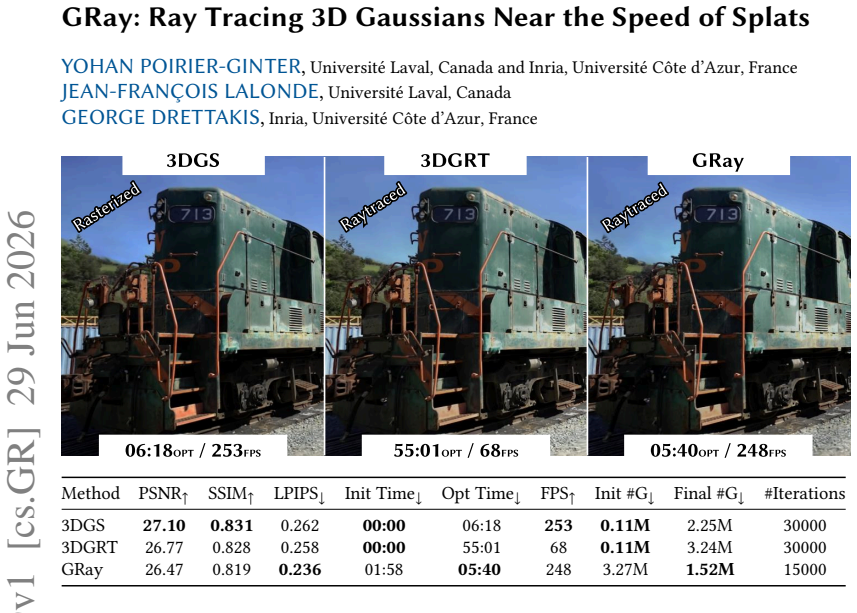
GRay is a ray tracer for 3D Gaussians that closes the performance gap with rasterization-based 3DGS by leveraging the fact that ray tracing only processes intersected Gaussians, which favors scenes with numerous small Gaussians. It renders nearly 4x faster and optimizes nearly 10x faster than 3DGRT with similar quality, and offers competitive speed to 3DGS at somewhat lower quality.
What carries the argument
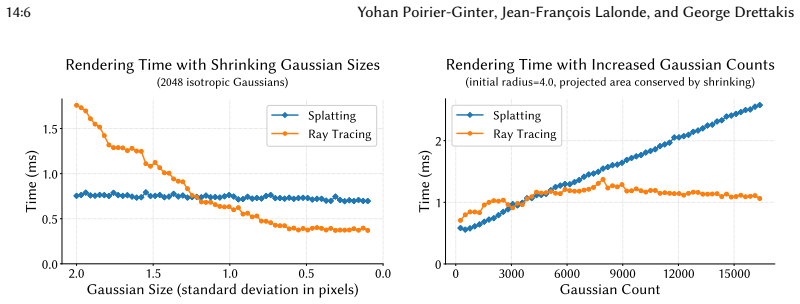
The algorithmic difference that ray tracing evaluates only intersected Gaussians (logarithmic scaling) rather than all primitives (linear scaling), allowing dense tiny-Gaussian scenes to become an advantage.
If this is right
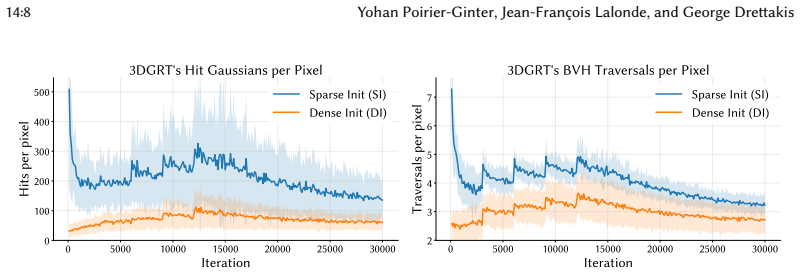
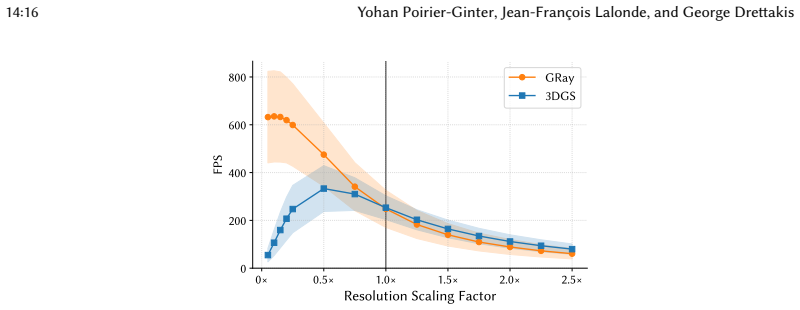
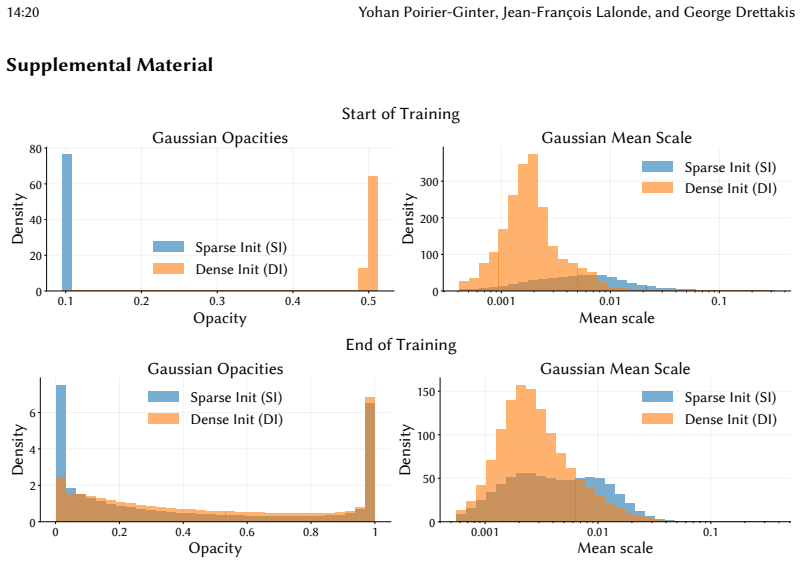
- Ray tracing benefits from dense initialization with many small Gaussians while rasterization is slowed by it.
- GRay renders nearly 4 times faster than 3DGRT at comparable quality.
- Optimization with GRay is nearly 10 times faster than with 3DGRT.
- GRay achieves rendering speeds competitive with 3DGS, though at somewhat lower quality.
Where Pith is reading between the lines
- Scene density could become a controllable parameter to switch between rasterization and ray tracing for best performance.
- Initialization routines for Gaussian radiance fields may need to be renderer-aware rather than universal.
- The logarithmic scaling property suggests ray tracing could scale to scene complexities that currently challenge rasterizers.
Load-bearing premise
Dense initialization producing many small Gaussians remains practical and does not introduce unacceptable quality loss or memory overhead.
What would settle it
A direct speed comparison of GRay versus 3DGRT on the same scenes but with standard sparse rather than dense initialization, which would eliminate the reported advantage if the scaling claim holds.
Figures
read the original abstract
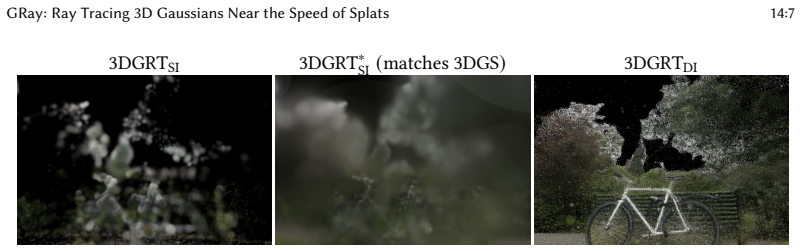
3D Gaussian Splatting (3DGS) is a popular representation for radiance field reconstruction, distinguished by the rendering speed of its rasterization-based renderer. While 3D Gaussians can also be ray traced, this approach has so far been slower, with 3D Gaussian Ray Tracing (3DGRT) taking nearly one order of magnitude longer to optimize. To address this, we present GRay, a fast ray tracer for 3D Gaussians designed to close this performance gap and match 3DGS's speed. Our method leverages the algorithmic difference between both approaches: unlike rasterization, ray tracing evaluates only Gaussians that are actually intersected by a ray, leading to potentially logarithmic--rather than linear--scaling in the number of primitives. This property allows ray tracing to better exploit dense scenes composed of numerous tiny Gaussians, a configuration which has largely been overlooked. Notably, we show that dense initialization--which creates many small Gaussians--slows down rasterization, but instead speeds up ray tracing. Designed to leverage this effect, GRay renders nearly 4x faster and optimizes nearly 10x faster than 3DGRT while maintaining similar quality, and has competitive speed with 3DGS albeit at somewhat lower quality. Code is available at https://repo-sam.inria.fr/nerphys/gray.
Editorial analysis
A structured set of objections, weighed in public.
Referee Report
Summary. The paper presents GRay, a ray tracer for 3D Gaussians that exploits the logarithmic scaling of ray-primitive intersections to benefit from dense initialization with many small Gaussians (a regime that slows rasterization). It claims GRay renders nearly 4x faster and optimizes nearly 10x faster than 3DGRT while maintaining similar quality, and offers competitive speed with 3DGS at somewhat lower quality. Code is released.
Significance. If the empirical claims hold under the dense-initialization regime, the work would narrow the long-standing performance gap between ray tracing and rasterization for 3D Gaussian representations, potentially enabling real-time global-illumination effects without sacrificing the representation's advantages. Releasing code is a clear strength for reproducibility.
major comments (2)
- [Abstract] Abstract: the central performance advantage is explicitly attributed to dense initialization of many tiny Gaussians, yet the manuscript provides no explicit quantification (e.g., memory footprint vs. Gaussian count, or PSNR sensitivity curves) of the memory overhead or quality impact of this regime in the reported experiments; without these data the claim that the net advantage over 3DGRT is preserved cannot be assessed.
- [Experimental results] Experimental results (implied by the abstract's multiplier claims): the 4x rendering and 10x optimization speedups versus 3DGRT are presented as direct measurements, but the text does not supply the precise scene statistics, hardware configuration, or per-scene primitive counts that would allow verification that the logarithmic scaling actually materializes without compensatory increases in total primitives.
minor comments (1)
- [Abstract] The abstract states that the method has 'competitive speed with 3DGS albeit at somewhat lower quality' without defining the quality metric (PSNR, SSIM, LPIPS) or the magnitude of the drop; a short table or sentence in the abstract would improve clarity.
Simulated Author's Rebuttal
We thank the referee for the constructive comments highlighting areas where additional quantification would strengthen the claims. We address each major comment below and commit to revisions that provide the requested data without altering the core contributions.
read point-by-point responses
-
Referee: [Abstract] Abstract: the central performance advantage is explicitly attributed to dense initialization of many tiny Gaussians, yet the manuscript provides no explicit quantification (e.g., memory footprint vs. Gaussian count, or PSNR sensitivity curves) of the memory overhead or quality impact of this regime in the reported experiments; without these data the claim that the net advantage over 3DGRT is preserved cannot be assessed.
Authors: We agree that explicit quantification of memory overhead and quality sensitivity to dense initialization would allow better assessment of the net advantage. In the revision we will add a dedicated analysis subsection (with accompanying table and plot) reporting Gaussian count versus memory footprint across initialization densities, plus PSNR sensitivity curves for the evaluated scenes. This directly addresses the concern while preserving the abstract's focus on the logarithmic scaling benefit. revision: yes
-
Referee: [Experimental results] Experimental results (implied by the abstract's multiplier claims): the 4x rendering and 10x optimization speedups versus 3DGRT are presented as direct measurements, but the text does not supply the precise scene statistics, hardware configuration, or per-scene primitive counts that would allow verification that the logarithmic scaling actually materializes without compensatory increases in total primitives.
Authors: The current manuscript reports aggregate timing and quality results but lacks the per-scene primitive counts and explicit hardware details needed for independent verification of the scaling claim. We will expand the experimental section with a table listing per-scene primitive counts (before/after optimization), exact hardware configuration, and a short analysis confirming that total primitive count does not increase to offset the logarithmic benefit. This will make the 4x/10x claims verifiable. revision: yes
Circularity Check
No circularity; performance claims are empirical measurements against external baselines
full rationale
The paper's central claims concern measured speedups (4x render, 10x optimize vs 3DGRT) and competitive performance with 3DGS, derived from direct experimental comparisons on standard benchmarks rather than any internal derivation, fitted parameter, or self-citation chain. The algorithmic insight about logarithmic scaling in dense Gaussian scenes is presented as a property of ray tracing versus rasterization, with no equations or uniqueness theorems reducing the result to its own inputs. No self-definitional steps, fitted-input predictions, or load-bearing self-citations appear in the provided abstract or described method; the work is self-contained as an empirical graphics systems contribution.
Axiom & Free-Parameter Ledger
axioms (1)
- domain assumption Ray-Gaussian intersection tests can be performed efficiently enough to realize logarithmic scaling in dense scenes
Reference graph
Works this paper leans on
-
[1]
Hugo Blanc, Jean-Emmanuel Deschaud, and Alexis Paljic. 2025a. Raygauss: Volumetric gaussian-based ray casting for photorealistic novel view synthesis. In2025 IEEE/CVF Winter Conference on Applications of Computer Vision (W ACV). IEEE, 1808–1817. Hugo Blanc, Jean-Emmanuel Deschaud, and Alexis Paljic. 2025b. RayGaussX: Accelerating Gaussian-Based Ray Marchi...
-
[2]
InProceedings of the IEEE conference on computer vision and pattern recognition
The perception-distortion tradeoff. InProceedings of the IEEE conference on computer vision and pattern recognition. 6228–6237. Krzysztof Byrski, Marcin Mazur, Jacek Tabor, Tadeusz Dziarmaga, Marcin Kądziołka, Dawid Baran, and Przemysław Spurek. 2025a. Raysplats: Ray tracing based gaussian splatting.arXiv preprint arXiv:2501.19196(2025). Krzysztof Byrski,...
-
[3]
A Survey on 3D Gaussian Splatting
A Survey on 3D Gaussian Splatting.ArXivabs/2401.03890 (2024). https: //api.semanticscholar.org/CorpusID:266844057 Yun Chen, Matthew Haines, Jingkang Wang, Krzysztof Baron-Lis, Sivabalan Manivasagam, Ze Yang, and Raquel Urtasun
work page internal anchor Pith review Pith/arXiv arXiv 2024
-
[4]
SaLF: Sparse Local Fields for Multi-Sensor Rendering in Real-Time
SaLF: Sparse Local Fields for Multi-Sensor Rendering in Real-Time.arXiv preprint arXiv:2507.18713(2025). Jorge Condor, Sebastien Speierer, Lukas Bode, Aljaz Bozic, Simon Green, Piotr Didyk, and Adrian Jarabo
work page internal anchor Pith review Pith/arXiv arXiv 2025
-
[5]
Keyan Ding, Kede Ma, Shiqi Wang, and Eero P Simoncelli
Don’t Splat your Gaussians: Volumetric Ray-Traced Primitives for Modeling and Rendering Scattering and Emissive Media.ACM Transactions on Graphics44, 1 (2025), 1–17. Keyan Ding, Kede Ma, Shiqi Wang, and Eero P Simoncelli
2025
-
[6]
Johan Edstedt, Qiyu Sun, Georg Bökman, Mårten Wadenbäck, and Michael Felsberg
Comparison of full-reference image quality models for optimization of image processing systems.International Journal of Computer Vision129, 4 (2021), 1258–1281. Johan Edstedt, Qiyu Sun, Georg Bökman, Mårten Wadenbäck, and Michael Felsberg
2021
-
[7]
Sharath Girish, Kamal Gupta, and Abhinav Shrivastava
Relightable 3D Gaussian: Real-time Point Cloud Relighting with BRDF Decomposition and Ray Tracing.arXiv:2311.16043(2023). Sharath Girish, Kamal Gupta, and Abhinav Shrivastava
-
[8]
Chun Gu, Xiaofei Wei, Zixuan Zeng, Yuxuan Yao, and Li Zhang
Radiant Foam: Real-Time Differentiable Ray Tracing.arXiv:2502.01157(2025). Chun Gu, Xiaofei Wei, Zixuan Zeng, Yuxuan Yao, and Li Zhang
-
[9]
Computer Graphics Forum44, 2 (2025)
Efficient Perspective-Correct 3D Gaussian Splatting Using Hybrid Transparency. Computer Graphics Forum44, 2 (2025). doi:10.1111/cgf.70014 Alex Hanson, Allen Tu, Geng Lin, Vasu Singla, Matthias Zwicker, and Tom Goldstein. 2025a. Speedy-Splat: Fast 3D Gaussian Splatting with Sparse Pixels and Sparse Primitives. InProceedings of the Computer Vision and Patte...
-
[10]
Bernhard Kerbl, Georgios Kopanas, Thomas Leimkühler, and George Drettakis
The Impact and Outlook of 3D Gaussian Splatting.arXiv preprint arXiv:2510.26694(2025). Bernhard Kerbl, Georgios Kopanas, Thomas Leimkühler, and George Drettakis
-
[11]
https://repo-sam.inria.fr/fungraph/3d- gaussian-splatting/ Dmytro Kotovenko, Olga Grebenkova, and Bjorn Ommer
3D Gaussian Splatting for Real-Time Radiance Field Rendering.ACM Transactions on Graphics42, 4 (July 2023). https://repo-sam.inria.fr/fungraph/3d- gaussian-splatting/ Dmytro Kotovenko, Olga Grebenkova, and Bjorn Ommer
2023
-
[12]
EDGS: Eliminating Densification for Efficient Convergence of 3DGS.ArXivabs/2504.13204 (2025). https://api.semanticscholar.org/CorpusID:277940156 Junseo Lee, Sangyun Jeon, Jungi Lee, Junyong Park, and Jaewoong Sim
-
[13]
GRTX: Efficient Ray Tracing for 3D Gaussian- Based Rendering.arXiv preprint arXiv:2601.20429(2026). Alexander Mai, Peter Hedman, George Kopanas, Dor Verbin, David Futschik, Qiangeng Xu, Falko Kuester, Jonathan T Barron, and Yinda Zhang
-
[14]
InSIGGRAPH Asia 2024 Conference Papers (SA ’24)
Taming 3DGS: High-Quality Radiance Fields with Limited Resources. InSIGGRAPH Asia 2024 Conference Papers (SA ’24). Association for Computing Machinery, New York, NY, USA, Article 2, 11 pages. doi:10.1145/ 3680528.3687694 Marilena Maule, João Comba, Rafael Torchelsen, and Rui Bastos
-
[15]
Hybrid transparency. InProceedings of the ACM SIGGRAPH Symposium on Interactive 3D Graphics and Games(Orlando, Florida)(I3D ’13). Association for Computing Machinery, New York, NY, USA, 103–118. doi:10.1145/2448196.2448212 Morgan McGuire and Louis Bavoil
-
[16]
http://jcgt.org/published/0002/02/09/ Houman Meshkin
Weighted Blended Order-Independent Transparency.Journal of Computer Graphics Techniques (JCGT)2, 2 (18 December 2013), 122–141. http://jcgt.org/published/0002/02/09/ Houman Meshkin
2013
-
[17]
GDC Vault — GDC 2007 Session
Sort-Independent Alpha Blending. GDC Vault — GDC 2007 Session. https://www.gdcvault.com/ play/535/Sort-Independent-Alpha Perpetual Entertainment. Ben Mildenhall, Pratul P. Srinivasan, Matthew Tancik, Jonathan T. Barron, Ravi Ramamoorthi, and Ren Ng
2007
-
[18]
Michael Niemeyer, Fabian Manhardt, Marie-Julie Rakotosaona, Michael Oechsle, Daniel Duckworth, Rama Gosula, Keisuke Tateno, John Bates, Dominik Kaeser, and Federico Tombari
3D Gaussian Ray Tracing: Fast Tracing of Particle Scenes.ACM Transactions on Graphics and SIGGRAPH Asia(2024). Michael Niemeyer, Fabian Manhardt, Marie-Julie Rakotosaona, Michael Oechsle, Daniel Duckworth, Rama Gosula, Keisuke Tateno, John Bates, Dominik Kaeser, and Federico Tombari
2024
-
[19]
Steven G
Reducing the memory footprint of 3d gaussian splatting.Proceedings of the ACM on Computer Graphics and Interactive Techniques7, 1 (2024), 1–17. Steven G. Parker, James Bigler, Andreas Dietrich, Heiko Friedrich, Jared Hoberock, David Luebke, David McAllister, Morgan McGuire, Keith Morley, Austin Robison, and Martin Stich
2024
-
[20]
Yohan Poirier-Ginter, Jeffrey Hu, Jean-François Lalonde, and George Drettakis
OptiX: A General Purpose Ray Tracing Engine.ACM Transactions on Graphics(August 2010). Yohan Poirier-Ginter, Jeffrey Hu, Jean-François Lalonde, and George Drettakis
2010
-
[21]
Editable Physically-based Reflections in Raytraced Gaussian Radiance Fields. InSIGGRAPH Asia 2025 - 18th ACM SIGGRAPH Conference and Exhibition on Computer Graphics and Interactive Techniques in Asia. Hong Kong, Hong Kong SAR China. doi:10.1145/3757377.3763971 Lukas Radl, Michael Steiner, Mathias Parger, Alexander Weinrauch, Bernhard Kerbl, and Markus Steinberger
-
[22]
Samuel Rota Bulò, Lorenzo Porzi, and Peter Kontschieder
StopThe- Pop: Sorted Gaussian Splatting for View-Consistent Real-time Rendering.ACM Transactions on Graphics4, 43, Article 64 (2024). Samuel Rota Bulò, Lorenzo Porzi, and Peter Kontschieder
2024
-
[23]
Johannes Lutz Schönberger and Jan-Michael Frahm
SpotLessSplats: Ignoring Distractors in 3D Gaussian Splatting.arXiv:2406.20055(2024). Johannes Lutz Schönberger and Jan-Michael Frahm
-
[24]
Stochastic Ray Tracing of 3D Transparent Gaussians.arXiv preprint arXiv:2504.06598(2025). Shimon Ullman
-
[25]
Series B
The interpretation of structure from motion.Proceedings of the Royal Society of London. Series B. Biological Sciences203, 1153 (1979), 405–426. Proc. ACM Comput. Graph. Interact. Tech., Vol. 9, No. 1, Article
1979
-
[26]
Using Hardware Ray Transforms to Accelerate Ray/Primitive Intersections for Long, Thin Primitive Types.Proc. ACM Comput. Graph. Interact. Tech.3, 2, Article 17 (Aug. 2020), 16 pages. doi:10.1145/3406179 Xinzhe Wang, Ran Yi, and Lizhuang Ma
-
[27]
In SIGGRAPH Asia 2024 Conference Papers
Adr-gaussian: Accelerating gaussian splatting with adaptive radius. In SIGGRAPH Asia 2024 Conference Papers. 1–10. Zhou Wang, A.C. Bovik, H.R. Sheikh, and E.P. Simoncelli
2024
-
[28]
Image quality assessment: from error visibility to structural similarity.IEEE Transactions on Image Processing13, 4 (2004), 600–612. doi:10.1109/TIP.2003.819861 Qi Wu, Janick Martinez Esturo, Ashkan Mirzaei, Nicolas Moenne-Loccoz, and Zan Gojcic
-
[29]
Tao Xie, Xi Chen, Zhen Xu, Yiman Xie, Yudong Jin, Yujun Shen, Sida Peng, Hujun Bao, and Xiaowei Zhou
3DGUT: Enabling Distorted Cameras and Secondary Rays in Gaussian Splatting.Conference on Computer Vision and Pattern Recognition (CVPR) (2025). Tao Xie, Xi Chen, Zhen Xu, Yiman Xie, Yudong Jin, Yujun Shen, Sida Peng, Hujun Bao, and Xiaowei Zhou
2025
- [30]
-
[31]
doi:10.1111/j.1467-8659.2010.01725.x Yuxuan Yao, Zixuan Zeng, Chun Gu, Xiatian Zhu, and Li Zhang
Real-Time Concurrent Linked List Construction on the GPU.Computer Graphics Forum(2010). doi:10.1111/j.1467-8659.2010.01725.x Yuxuan Yao, Zixuan Zeng, Chun Gu, Xiatian Zhu, and Li Zhang
-
[32]
Kai Zhang, Gernot Riegler, Noah Snavely, and Vladlen Koltun
Reflective gaussian splatting.arXiv preprint arXiv:2412.19282(2024). Kai Zhang, Gernot Riegler, Noah Snavely, and Vladlen Koltun
-
[33]
Richard Zhang, Phillip Isola, Alexei A Efros, Eli Shechtman, and Oliver Wang
NeRF++: Analyzing and Improving Neural Radiance Fields.arXiv:2010.07492(2020). Richard Zhang, Phillip Isola, Alexei A Efros, Eli Shechtman, and Oliver Wang
-
[34]
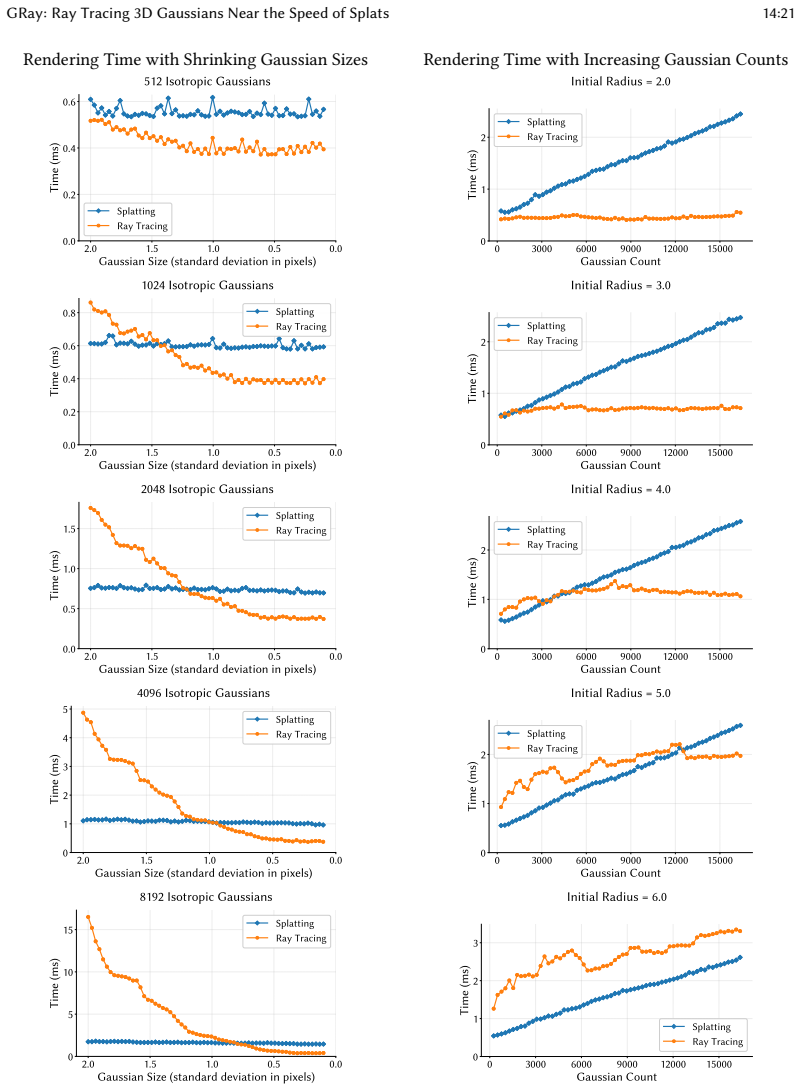
GRay: Ray Tracing 3D Gaussians Near the Speed of Splats 14:21 Rendering Time with Shrinking Gaussian Sizes 0.00.51.01.52.0 Gaussian Size (standard deviation in pixels) 0.0 0.2 0.4 0.6Time (ms) 512 Isotropic Gaussians Splatting Ray Tracing 0.00.51.01.52.0 Gaussian Size (standard deviation in pixels) 0.0 0.2 0.4 0.6 0.8Time (ms) 1024 Isotropic Gaussians Spl...
2048
-
[35]
in between
14:22 Yohan Poirier-Ginter, Jean-François Lalonde, and George Drettakis To make this experiment robust we had to control for several factors. First, early ray termina- tion can skip many Gaussians evaluations if their opacity is high enough for the ray to go over transmittance threshold. Hence we chose a very low opacity value, 0.01, to avoid this. Howeve...
2048
-
[36]
D.1 CUDA Implementation Differences As compared to EPBRR, we do not fuse the forward and backward pass to allow for the SSIM loss and easy addition of other custom losses
26.45 0.818 0.236 05:38 247 D Implementation Details This section clarifies implementation and hyperparameters. D.1 CUDA Implementation Differences As compared to EPBRR, we do not fuse the forward and backward pass to allow for the SSIM loss and easy addition of other custom losses. We also use a CUDA-side Adam optimizer that launches a separate thread fo...
2024
-
[37]
Publication date: May 2026
2026
discussion (0)
Sign in with ORCID, Apple, or X to comment. Anyone can read and Pith papers without signing in.