One-loop proton decay from Peccei-Quinn symmetry
Pith reviewed 2026-07-03 10:54 UTC · model grok-4.3
The pith
Promoting the Standard Model B+L symmetry to Peccei-Quinn symmetry with vector-like quarks induces one-loop proton decay while a residual Z2 forbids tree-level decay.
A machine-rendered reading of the paper's core claim, the machinery that carries it, and where it could break.
Core claim
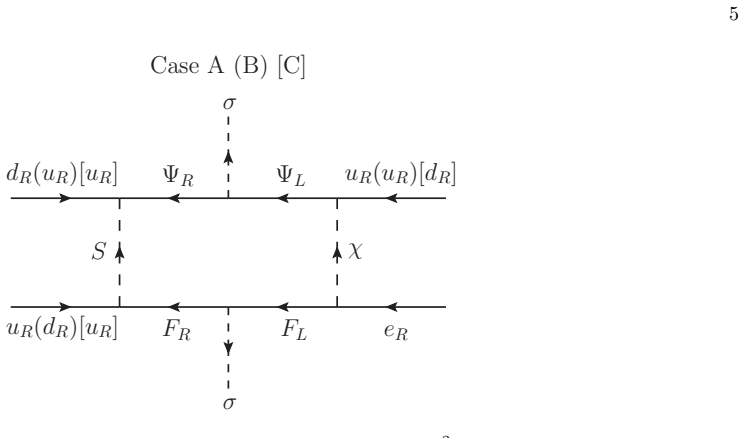
We promote the accidental B+L symmetry of the Standard Model to a Peccei-Quinn symmetry while realizing spontaneous proton decay radiatively. The PQ anomaly sector consists of vector-like quarks providing a KSVZ-type axion solution to the strong CP problem. After spontaneous PQ breaking a residual Z2 symmetry remains which forbids tree-level proton decay. The VLQs required to generate the QCD anomaly, together with scalar mediators odd under the residual Z2, induce one-loop proton decay through the effective operator u_R u_R d_R e_R. The resulting models lead to distinct predictions for the axion-to-photon coupling.
What carries the argument
The residual Z2 symmetry after PQ breaking, together with vector-like quarks and Z2-odd scalars that generate the one-loop effective operator u_R u_R d_R e_R.
If this is right
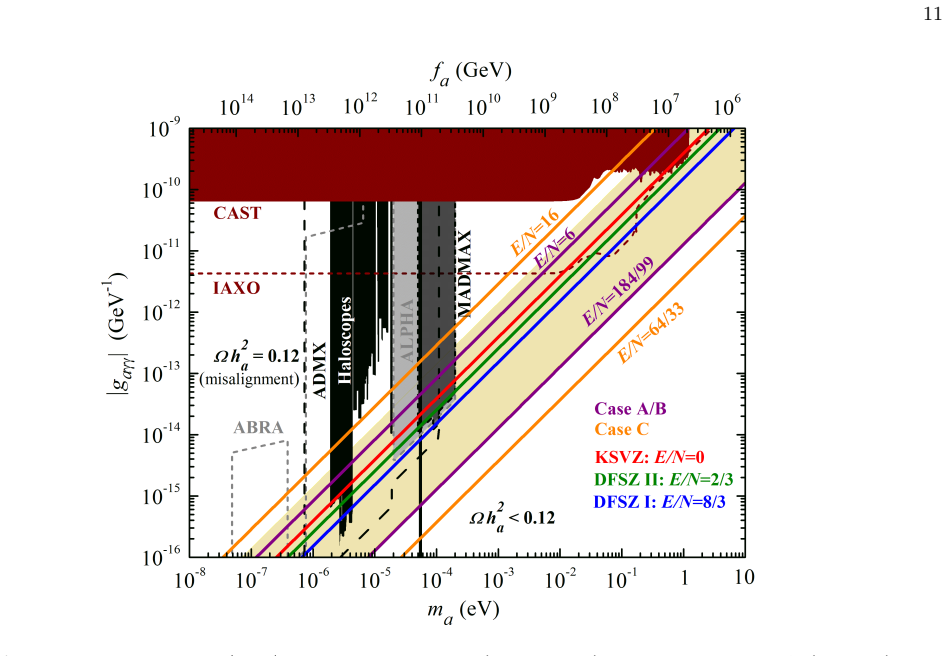
- Different ultraviolet completions with distinct vector-like fermion and scalar representations produce different values of the axion-photon coupling testable in helioscope and haloscope experiments.
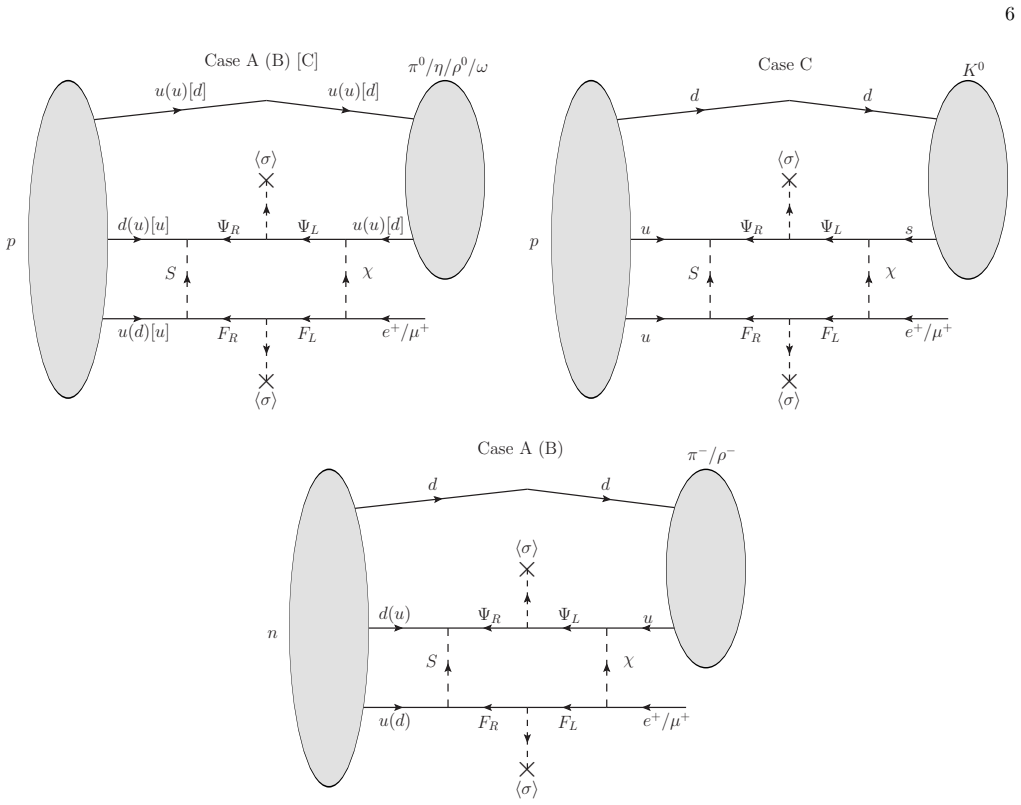
- The model predicts the additional decay channel p to e+ pi0 a, suppressed by the PQ-breaking scale.
- Axion dark matter can be realized consistently in both pre-inflationary and post-inflationary cosmological scenarios.
Where Pith is reading between the lines
- Searches for the axion-accompanied proton decay mode could serve as a distinctive signature that separates this mechanism from conventional GUT-induced decays.
- The same Z2-odd scalars that mediate the loop may open new channels for axion production in astrophysical environments.
- The construction suggests that other accidental global symmetries of the Standard Model could be promoted to Peccei-Quinn-like symmetries with similar radiative decay implications.
Load-bearing premise
Vector-like fermion and scalar representations exist that satisfy the PQ anomaly condition, carry the required Z2 charges, and generate a viable one-loop diagram for the u_R u_R d_R e_R operator without introducing other unwanted effects.
What would settle it
Observation of proton decay in the e+ pi0 channel at a rate far above the loop-suppressed expectation, or failure to find the predicted axion-photon coupling in the range fixed by the same representations, would rule out the construction.
Figures
read the original abstract
We promote the accidental $B+L$ symmetry of the Standard Model to a Peccei-Quinn (PQ) symmetry while realizing spontaneous proton decay radiatively. The PQ anomaly sector consists of vector-like quarks (VLQs), providing a Kim-Shifman-Vainshtein-Zakharov-type axion solution to the strong CP problem. After spontaneous PQ breaking, a residual $\mathcal{Z}_2$ symmetry remains, which forbids tree-level proton decay. The VLQs required to generate the QCD anomaly, together with scalar mediators, odd under the residual $\mathcal{Z}_2$, induce one-loop proton decay through the effective operator $u_R u_R d_R e_R$. We study its ultraviolet completions, featuring distinct vector-like fermion and scalar representations, and show that the resulting models lead to distinct predictions for the axion-to-photon coupling, testable in helioscope and haloscope experiments. In addition to the proton decay channel $p \rightarrow e^+ \pi^0$, this framework predicts proton decay with an axion in the final state, $p \rightarrow e^+ \pi^0 a$, suppressed by the PQ-breaking scale. We also discuss axion dark matter in pre- and post-inflationary cosmology.
Editorial analysis
A structured set of objections, weighed in public.
Referee Report
Summary. The paper promotes the SM's accidental B+L symmetry to a global PQ symmetry solved by vector-like quarks (VLQs) in a KSVZ-like setup. Spontaneous PQ breaking leaves a residual Z2 that forbids all tree-level ΔB=1 operators. The same VLQs, together with additional Z2-odd scalar mediators, generate a one-loop diagram for the effective operator u_R u_R d_R e_R, inducing proton decay. Explicit UV completions with different fermion and scalar representations are constructed; these yield distinct values of the axion-photon coupling g_aγγ and predict an additional channel p → e⁺ π⁰ a suppressed by the PQ scale. Axion dark-matter cosmology in pre- and post-inflationary scenarios is also discussed.
Significance. If the charge assignments and loop diagrams are viable, the work supplies a concrete mechanism that simultaneously addresses the strong-CP problem and renders proton decay radiative while protecting against tree-level violation. The explicit construction of multiple UV completions that produce distinguishable g_aγγ predictions (testable in helioscopes and haloscopes) and the additional axion-accompanied decay mode constitute clear strengths. The framework is falsifiable and links two otherwise separate phenomenological sectors.
major comments (1)
- [UV completions] UV-completion sections: the manuscript states that the chosen VLQ and scalar representations simultaneously satisfy the QCD anomaly condition, carry the required Z2 charges, and permit a one-loop diagram for u_R u_R d_R e_R without generating tree-level ΔB=1 operators. An explicit listing or table of all allowed operators generated by the new fields at dimension 6 and below would make this claim directly verifiable; without it the protection argument remains schematic.
minor comments (2)
- [Abstract / Introduction] The abstract and introduction refer to 'distinct predictions for the axion-to-photon coupling' but do not quote the numerical ranges or the functional dependence on the PQ scale; adding a short table or explicit expressions would improve clarity.
- [Model setup] Notation for the residual Z2 charges on the scalar mediators is introduced without a dedicated charge table; a compact table listing all new fields, their SM quantum numbers, PQ charges, and Z2 parities would aid the reader.
Simulated Author's Rebuttal
We thank the referee for the careful reading and positive assessment of our work. The single major comment is constructive and we address it directly below. We will incorporate the requested addition in the revised manuscript.
read point-by-point responses
-
Referee: [UV completions] UV-completion sections: the manuscript states that the chosen VLQ and scalar representations simultaneously satisfy the QCD anomaly condition, carry the required Z2 charges, and permit a one-loop diagram for u_R u_R d_R e_R without generating tree-level ΔB=1 operators. An explicit listing or table of all allowed operators generated by the new fields at dimension 6 and below would make this claim directly verifiable; without it the protection argument remains schematic.
Authors: We agree that an explicit operator table would make the Z2 protection argument immediately verifiable. In the revised version we will add a new table (or subsection) that enumerates all gauge- and Z2-invariant operators involving the VLQs and Z2-odd scalars up to dimension 6. The table will explicitly show (i) the absence of any tree-level ΔB=1 operators, (ii) the presence of the required one-loop diagram for u_R u_R d_R e_R, and (iii) consistency with the QCD anomaly condition. This addition will be placed in the UV-completion sections and will not alter any numerical results or conclusions. revision: yes
Circularity Check
No significant circularity identified
full rationale
The paper constructs explicit UV completions by choosing vector-like fermion and scalar representations that simultaneously satisfy the PQ anomaly condition, residual Z2 charge assignments, and permit a one-loop diagram for the u_R u_R d_R e_R operator. The resulting axion-photon coupling predictions follow directly from the anomaly coefficients of those chosen representations rather than from any fitted parameter or self-citation chain. No load-bearing step reduces by construction to an input; the central claims remain independent of the target observables once the representations are fixed.
Axiom & Free-Parameter Ledger
free parameters (1)
- PQ breaking scale
axioms (1)
- domain assumption Vector-like quarks can be chosen to generate the required QCD anomaly while preserving a residual Z2 after PQ breaking.
invented entities (1)
-
Z2-odd scalar mediators
no independent evidence
Reference graph
Works this paper leans on
-
[1]
Baryon and Lepton Nonconserving Processes,
S. Weinberg, “Baryon and Lepton Nonconserving Processes,”Phys. Rev. Lett.43(1979) 1566–1570
1979
-
[2]
Operator Analysis of Nucleon Decay,
F. Wilczek and A. Zee, “Operator Analysis of Nucleon Decay,”Phys. Rev. Lett.43(1979) 1571–1573
1979
-
[3]
The Effective Hamiltonian for Nucleon Decay,
L. F. Abbott and M. B. Wise, “The Effective Hamiltonian for Nucleon Decay,”Phys. Rev. D22(1980) 2208
1980
-
[4]
Baryon Number, Lepton Number, and Operator Dimension in the Standard Model
A. Kobach, “Baryon Number, Lepton Number, and Operator Dimension in the Standard Model,”Phys. Lett. B758(2016) 455–457,arXiv:1604.05726 [hep-ph]
work page internal anchor Pith review Pith/arXiv arXiv 2016
-
[5]
Dimension-Six Terms in the Standard Model Lagrangian
B. Grzadkowski, M. Iskrzynski, M. Misiak, and J. Rosiek, “Dimension-Six Terms in the Standard Model Lagrangian,” JHEP10(2010) 085,arXiv:1008.4884 [hep-ph]
work page internal anchor Pith review Pith/arXiv arXiv 2010
-
[6]
Unified Lepton-Hadron Symmetry and a Gauge Theory of the Basic Interactions,
J. C. Pati and A. Salam, “Unified Lepton-Hadron Symmetry and a Gauge Theory of the Basic Interactions,”Phys. Rev. D8(1973) 1240–1251
1973
-
[7]
Unity of All Elementary Particle Forces,
H. Georgi and S. L. Glashow, “Unity of All Elementary Particle Forces,”Phys. Rev. Lett.32(1974) 438–441
1974
-
[8]
Unified Interactions of Leptons and Hadrons,
H. Fritzsch and P. Minkowski, “Unified Interactions of Leptons and Hadrons,”Annals Phys.93(1975) 193–266
1975
-
[9]
Experimental Tests of Baryon and Lepton Number Conservation,
V. Takhistov, “Experimental Tests of Baryon and Lepton Number Conservation,”arXiv:2602.09097 [hep-ph]. [10]Super-KamiokandeCollaboration, A. Takenakaet al., “Search for proton decay viap→e +π0 andp→µ +π0 with an enlarged fiducial volume in Super-Kamiokande I-IV,”Phys. Rev. D102no. 11, (2020) 112011,arXiv:2010.16098 [hep-ex]. [11]Hyper-KamiokandeCollaborat...
-
[10]
J. C. Helo, M. Hirsch, and T. Ota, “Proton decay at one loop,”Phys. Rev. D99no. 9, (2019) 095021,arXiv:1904.00036 [hep-ph]
work page internal anchor Pith review Pith/arXiv arXiv 2019
-
[11]
Radiative Seesaw Mechanism at Weak Scale
Z.-j. Tao, “Radiative seesaw mechanism at weak scale,”Phys.Rev.D54(1996) 5693–5697,arXiv:hep-ph/9603309 [hep-ph]
work page internal anchor Pith review Pith/arXiv arXiv 1996
-
[12]
Verifiable Radiative Seesaw Mechanism of Neutrino Mass and Dark Matter
E. Ma, “Verifiable radiative seesaw mechanism of neutrino mass and dark matter,”Phys. Rev. D73(2006) 077301, arXiv:hep-ph/0601225
work page internal anchor Pith review Pith/arXiv arXiv 2006
-
[13]
Extended scotogenic model of neutrino mass and proton decay,
T. Nomura and O. Popov, “Extended scotogenic model of neutrino mass and proton decay,”Phys. Rev. D110no. 7, (2024) 075035,arXiv:2406.00651 [hep-ph]
-
[14]
Pathways to proton’s stability via naturally small neutrino masses,
S. K. Kang and O. Popov, “Pathways to proton’s stability via naturally small neutrino masses,”arXiv:2412.20723 [hep-ph]
-
[15]
Dark Matter Induced Proton Decays
R. Kumar and R. Srivastava, “Dark matter induced proton decays,”JHEP04(2026) 024,arXiv:2506.04370 [hep-ph]
work page internal anchor Pith review Pith/arXiv arXiv 2026
-
[16]
A Revised Experimental Upper Limit on the Electric Dipole Moment of the Neutron
J. M. Pendleburyet al., “Revised experimental upper limit on the electric dipole moment of the neutron,”Phys. Rev. D 92no. 9, (2015) 092003,arXiv:1509.04411 [hep-ex]
work page internal anchor Pith review Pith/arXiv arXiv 2015
-
[17]
An Improved Experimental Limit on the Electric Dipole Moment of the Neutron
C. A. Bakeret al., “An Improved experimental limit on the electric dipole moment of the neutron,”Phys. Rev. Lett.97 (2006) 131801,arXiv:hep-ex/0602020
work page internal anchor Pith review Pith/arXiv arXiv 2006
-
[18]
CP Conservation in the Presence of Instantons,
R. D. Peccei and H. R. Quinn, “CP Conservation in the Presence of Instantons,”Phys. Rev. Lett.38(1977) 1440–1443
1977
-
[19]
Constraints Imposed by CP Conservation in the Presence of Instantons,
R. D. Peccei and H. R. Quinn, “Constraints Imposed by CP Conservation in the Presence of Instantons,”Phys. Rev. D 16(1977) 1791–1797
1977
-
[20]
A New Light Boson?,
S. Weinberg, “A New Light Boson?,”Phys. Rev. Lett.40(1978) 223–226
1978
-
[21]
Problem of StrongPandTInvariance in the Presence of Instantons,
F. Wilczek, “Problem of StrongPandTInvariance in the Presence of Instantons,”Phys. Rev. Lett.40(1978) 279–282
1978
-
[22]
On Possible Suppression of the Axion Hadron Interactions. (In Russian),
A. R. Zhitnitsky, “On Possible Suppression of the Axion Hadron Interactions. (In Russian),”Sov. J. Nucl. Phys.31(1980) 14 260
1980
-
[23]
A Simple Solution to the Strong CP Problem with a Harmless Axion,
M. Dine, W. Fischler, and M. Srednicki, “A Simple Solution to the Strong CP Problem with a Harmless Axion,”Phys. Lett. B104(1981) 199–202
1981
-
[24]
Weak Interaction Singlet and Strong CP Invariance,
J. E. Kim, “Weak Interaction Singlet and Strong CP Invariance,”Phys. Rev. Lett.43(1979) 103
1979
-
[25]
Can Confinement Ensure Natural CP Invariance of Strong Interac- tions?,
M. A. Shifman, A. I. Vainshtein, and V. I. Zakharov, “Can Confinement Ensure Natural CP Invariance of Strong Interac- tions?,”Nucl. Phys. B166(1980) 493–506
1980
-
[26]
The landscape of QCD axion models
L. Di Luzio, M. Giannotti, E. Nardi, and L. Visinelli, “The landscape of QCD axion models,”Phys. Rept.870(2020) 1–117,arXiv:2003.01100 [hep-ph]
work page internal anchor Pith review Pith/arXiv arXiv 2020
-
[27]
Cosmology of the Invisible Axion,
J. Preskill, M. B. Wise, and F. Wilczek, “Cosmology of the Invisible Axion,”Phys. Lett. B120(1983) 127–132
1983
-
[28]
A Cosmological Bound on the Invisible Axion,
L. F. Abbott and P. Sikivie, “A Cosmological Bound on the Invisible Axion,”Phys. Lett. B120(1983) 133–136
1983
-
[29]
The Not So Harmless Axion,
M. Dine and W. Fischler, “The Not So Harmless Axion,”Phys. Lett. B120(1983) 137–141
1983
-
[30]
µ→eγat a Rate of One Out of 10 9 Muon Decays?,
P. Minkowski, “µ→eγat a Rate of One Out of 10 9 Muon Decays?,”Phys. Lett. B67(1977) 421–428
1977
-
[31]
Complex Spinors and Unified Theories
M. Gell-Mann, P. Ramond, and R. Slansky, “Complex Spinors and Unified Theories,”Conf. Proc. C790927(1979) 315–321,arXiv:1306.4669 [hep-th]
work page internal anchor Pith review Pith/arXiv arXiv 1979
-
[32]
Horizontal gauge symmetry and masses of neutrinos,
T. Yanagida, “Horizontal gauge symmetry and masses of neutrinos,”Conf. Proc. C7902131(1979) 95–99
1979
-
[33]
Neutrino Masses in SU(2) x U(1) Theories,
J. Schechter and J. W. F. Valle, “Neutrino Masses in SU(2) x U(1) Theories,”Phys. Rev. D22(1980) 2227
1980
-
[34]
The Future of Elementary Particle Physics,
S. L. Glashow, “The Future of Elementary Particle Physics,”NATO Sci. Ser. B61(1980) 687
1980
-
[35]
Neutrino Mass and Spontaneous Parity Nonconservation,
R. N. Mohapatra and G. Senjanovic, “Neutrino Mass and Spontaneous Parity Nonconservation,”Phys. Rev. Lett.44 (1980) 912
1980
-
[36]
NATURALNESS OF THE INVISIBLE AXION MODEL,
R. R. Volkas, A. J. Davies, and G. C. Joshi, “NATURALNESS OF THE INVISIBLE AXION MODEL,”Phys. Lett. B 215(1988) 133–138
1988
-
[37]
J. D. Clarke and R. R. Volkas, “Technically natural nonsupersymmetric model of neutrino masses, baryogenesis, the strong CP problem, and dark matter,”Phys. Rev. D93no. 3, (2016) 035001,arXiv:1509.07243 [hep-ph]
work page internal anchor Pith review Pith/arXiv arXiv 2016
-
[38]
VISHν: a unified solution to five SM shortcomings with a protected electroweak scale,
A. H. Sopov and R. R. Volkas, “VISHν: a unified solution to five SM shortcomings with a protected electroweak scale,” arXiv:2206.11598 [hep-ph]
-
[39]
VISHν: Flavour-Variant DFSZ Axion Model for Inflation, Neutrino Masses, Dark Matter, and Baryogene- sis,
R. R. Volkas, “VISHν: Flavour-Variant DFSZ Axion Model for Inflation, Neutrino Masses, Dark Matter, and Baryogene- sis,”LHEP2023(2023) 358
2023
-
[40]
Inflation and Higgs phenomenology in a model unifying the DFSZ axion with the majoron,
M. Matlis, J. Dutta, G. Moortgat-Pick, and A. Ringwald, “Inflation and Higgs phenomenology in a model unifying the DFSZ axion with the majoron,”JCAP07(2024) 007,arXiv:2309.10857 [hep-ph]
-
[41]
A. Salvio, “A Simple Motivated Completion of the Standard Model below the Planck Scale: Axions and Right-Handed Neutrinos,”Phys. Lett. B743(2015) 428–434,arXiv:1501.03781 [hep-ph]
work page internal anchor Pith review Pith/arXiv arXiv 2015
-
[42]
Unifying inflation with the axion, dark matter, baryogenesis and the seesaw mechanism
G. Ballesteros, J. Redondo, A. Ringwald, and C. Tamarit, “Unifying inflation with the axion, dark matter, baryogenesis and the seesaw mechanism,”Phys. Rev. Lett.118no. 7, (2017) 071802,arXiv:1608.05414 [hep-ph]
work page internal anchor Pith review Pith/arXiv arXiv 2017
-
[43]
G. Ballesteros, J. Redondo, A. Ringwald, and C. Tamarit, “Standard Model—axion—seesaw—Higgs portal inflation. Five problems of particle physics and cosmology solved in one stroke,”JCAP08(2017) 001,arXiv:1610.01639 [hep-ph]
work page internal anchor Pith review Pith/arXiv arXiv 2017
-
[44]
Flavored Peccei-Quinn symmetries in the minimalνDFSZ model,
J. R. Rocha, H. B. Cˆ amara, and F. R. Joaquim, “Flavored Peccei-Quinn symmetries in the minimalνDFSZ model,”Phys. Rev. D112no. 7, (2025) 075053,arXiv:2504.00088 [hep-ph]
-
[45]
Axion Paradigm with Color-Mediated Neutrino Masses,
A. Batra, H. B. Cˆ amara, F. R. Joaquim, R. Srivastava, and J. W. F. Valle, “Axion Paradigm with Color-Mediated Neutrino Masses,”Phys. Rev. Lett.132no. 5, (2024) 051801,arXiv:2309.06473 [hep-ph]
-
[46]
Axion framework with color-mediated Dirac neutrino masses,
A. Batra, H. B. Cˆ amara, F. R. Joaquim, N. Nath, R. Srivastava, and J. W. F. Valle, “Axion framework with color-mediated Dirac neutrino masses,”Phys. Lett. B868(2025) 139629,arXiv:2501.13156 [hep-ph]
-
[47]
Spontaneous proton decay and the origin of Peccei-Quinn symmetry
M. Reig and R. Srivastava, “Spontaneous proton decay and the origin of Peccei–Quinn symmetry,”Phys. Lett. B790 (2019) 134–139,arXiv:1809.02093 [hep-ph]
work page internal anchor Pith review Pith/arXiv arXiv 2019
-
[48]
$\Delta L = 3$ processes: Proton decay and LHC
R. M. Fonseca, M. Hirsch, and R. Srivastava, “∆L= 3 processes: Proton decay and the LHC,”Phys. Rev. D97no. 7, (2018) 075026,arXiv:1802.04814 [hep-ph]
work page internal anchor Pith review Pith/arXiv arXiv 2018
-
[49]
G. Grilli di Cortona, E. Hardy, J. Pardo Vega, and G. Villadoro, “The QCD axion, precisely,”JHEP01(2016) 034, arXiv:1511.02867 [hep-ph]. [54]Super-KamiokandeCollaboration, N. Taniuchiet al., “Search for proton decay via p→e+ηand p→µ+ηwith a 0.37 Mton- year exposure of Super-Kamiokande,”Phys. Rev. D110no. 11, (2024) 112011,arXiv:2409.19633 [hep-ex]. [55]Su...
work page internal anchor Pith review Pith/arXiv arXiv 2016
-
[50]
Improved lattice computation of proton decay matrix elements
Y. Aoki, T. Izubuchi, E. Shintani, and A. Soni, “Improved lattice computation of proton decay matrix elements,”Phys. Rev. D96no. 1, (2017) 014506,arXiv:1705.01338 [hep-lat]
work page internal anchor Pith review Pith/arXiv arXiv 2017
-
[51]
Baryon-number-violating nucleon decays in ALP effective field theories,
T. Li, M. A. Schmidt, and C.-Y. Yao, “Baryon-number-violating nucleon decays in ALP effective field theories,”JHEP08 (2024) 221,arXiv:2406.11382 [hep-ph]
-
[52]
W.-Q. Fan, Y. Liao, X.-D. Ma, and H.-L. Wang, “Comprehensive investigation on baryon number violating nucleon decays involving an axion-like particle*,”Chin. Phys. C50no. 3, (2026) 033103,arXiv:2507.11844 [hep-ph]. [61]PlanckCollaboration, N. Aghanimet al., “Planck 2018 results. VI. Cosmological parameters,”Astron. Astrophys.641 (2020) A6,arXiv:1807.06209...
-
[53]
Isocurvature bounds on axions revisited
M. Beltran, J. Garcia-Bellido, and J. Lesgourgues, “Isocurvature bounds on axions revisited,”Phys. Rev. D75(2007) 103507,arXiv:hep-ph/0606107
work page internal anchor Pith review Pith/arXiv arXiv 2007
-
[54]
L. Di Luzio, F. Mescia, and E. Nardi, “Redefining the Axion Window,”Phys. Rev. Lett.118no. 3, (2017) 031801, arXiv:1610.07593 [hep-ph]
work page internal anchor Pith review Pith/arXiv arXiv 2017
-
[55]
Revisiting isocurvature bounds on the minimal QCD axion,
P. W. Graham and D. Racco, “Revisiting isocurvature bounds on the minimal QCD axion,”JHEP12(2025) 028, arXiv:2506.03348 [hep-ph]
-
[56]
Evidence for a Scaling Solution in Cosmic String Evolution,
D. P. Bennett and F. R. Bouchet, “Evidence for a Scaling Solution in Cosmic String Evolution,”Phys. Rev. Lett.60(1988) 257
1988
-
[57]
Gravitational Bose-Einstein condensation in the kinetic regime
D. G. Levkov, A. G. Panin, and I. I. Tkachev, “Gravitational Bose-Einstein condensation in the kinetic regime,”Phys. Rev. Lett.121no. 15, (2018) 151301,arXiv:1804.05857 [astro-ph.CO]
work page internal anchor Pith review Pith/arXiv arXiv 2018
-
[58]
Axions from Strings: the Attractive Solution
M. Gorghetto, E. Hardy, and G. Villadoro, “Axions from Strings: the Attractive Solution,”JHEP07(2018) 151, arXiv:1806.04677 [hep-ph]
work page internal anchor Pith review Pith/arXiv arXiv 2018
-
[59]
Early-Universe Simulations of the Cosmological Axion,
M. Buschmann, J. W. Foster, and B. R. Safdi, “Early-Universe Simulations of the Cosmological Axion,”Phys. Rev. Lett. 124no. 16, (2020) 161103,arXiv:1906.00967 [astro-ph.CO]
-
[60]
Spontaneous Breaking of Lepton Number and Cosmological Domain Wall Problem
G. Lazarides, M. Reig, Q. Shafi, R. Srivastava, and J. W. F. Valle, “Spontaneous Breaking of Lepton Number and the Cosmological Domain Wall Problem,”Phys. Rev. Lett.122no. 15, (2019) 151301,arXiv:1806.11198 [hep-ph]
work page internal anchor Pith review Pith/arXiv arXiv 2019
-
[61]
Axion dark matter from topological defects
M. Kawasaki, K. Saikawa, and T. Sekiguchi, “Axion dark matter from topological defects,”Phys. Rev. D91no. 6, (2015) 065014,arXiv:1412.0789 [hep-ph]
work page internal anchor Pith review Pith/arXiv arXiv 2015
-
[62]
V. B. . Klaer and G. D. Moore, “The dark-matter axion mass,”JCAP11(2017) 049,arXiv:1708.07521 [hep-ph]
work page internal anchor Pith review Pith/arXiv arXiv 2017
-
[63]
M. Gorghetto, E. Hardy, and G. Villadoro, “More axions from strings,”SciPost Phys.10no. 2, (2021) 050, arXiv:2007.04990 [hep-ph]
-
[64]
M. Buschmann, J. W. Foster, A. Hook, A. Peterson, D. E. Willcox, W. Zhang, and B. R. Safdi, “Dark matter from axion strings with adaptive mesh refinement,”Nature Commun.13no. 1, (2022) 1049,arXiv:2108.05368 [hep-ph]
-
[65]
Axion Mass Prediction from Adaptive Mesh Refinement Cosmological Lattice Simulations,
J. N. Benabou, M. Buschmann, J. W. Foster, and B. R. Safdi, “Axion Mass Prediction from Adaptive Mesh Refinement Cosmological Lattice Simulations,”Phys. Rev. Lett.134no. 24, (2025) 241003,arXiv:2412.08699 [hep-ph]
-
[66]
Of Axions, Domain Walls and the Early Universe,
P. Sikivie, “Of Axions, Domain Walls and the Early Universe,”Phys. Rev. Lett.48(1982) 1156–1159
1982
-
[67]
Using gravitational waves to see the first second of the Universe,
R. Roshan and G. White, “Using gravitational waves to see the first second of the Universe,”Rev. Mod. Phys.97no. 1, (2025) 015001,arXiv:2401.04388 [hep-ph]
-
[68]
Constraining postinflationary axions with pulsar timing arrays,
G. Servant and P. Simakachorn, “Constraining postinflationary axions with pulsar timing arrays,”Phys. Rev. D108no. 12, (2023) 123516,arXiv:2307.03121 [hep-ph]
-
[69]
A. P. Morais, V. Oliveira, A. Onofre, R. Pasechnik, and R. Santos, “Exploring the viability of a pseudo-Nambu-Goldstone boson as ultralight dark matter in a mass range relevant for strong gravity applications,”Phys. Rev. D110no. 3, (2024) 035008,arXiv:2305.03776 [hep-ph]
-
[70]
Are exotic stable quarks cosmologically allowed?,
E. Nardi and E. Roulet, “Are exotic stable quarks cosmologically allowed?,”Phys. Lett. B245(1990) 105–110
1990
-
[71]
The Search for Stable, Massive, Elementary Particles
M. L. Perl, P. C. Kim, V. Halyo, E. R. Lee, I. T. Lee, D. Loomba, and K. S. Lackner, “The Search for stable, massive, elementary particles,”Int. J. Mod. Phys. A16(2001) 2137–2164,arXiv:hep-ex/0102033
work page internal anchor Pith review Pith/arXiv arXiv 2001
-
[72]
Searches for fractionally charged particles,
M. L. Perl, E. R. Lee, and D. Loomba, “Searches for fractionally charged particles,”Ann. Rev. Nucl. Part. Sci.59(2009) 47–65
2009
-
[73]
Non-collider searches for stable massive particles
S. Burdin, M. Fairbairn, P. Mermod, D. Milstead, J. Pinfold, T. Sloan, and W. Taylor, “Non-collider searches for stable 16 massive particles,”Phys. Rept.582(2015) 1–52,arXiv:1410.1374 [hep-ph]
work page internal anchor Pith review Pith/arXiv arXiv 2015
-
[74]
Astrophysical Constraints on Singlet Scalars at LHC
M. P. Hertzberg and A. Masoumi, “Astrophysical Constraints on Singlet Scalars at LHC,”JCAP04(2017) 028, arXiv:1607.06445 [hep-ph]
work page internal anchor Pith review Pith/arXiv arXiv 2017
-
[75]
G. D. Mack, J. F. Beacom, and G. Bertone, “Towards Closing the Window on Strongly Interacting Dark Matter: Far- Reaching Constraints from Earth’s Heat Flow,”Phys. Rev. D76(2007) 043523,arXiv:0705.4298 [astro-ph]
work page internal anchor Pith review Pith/arXiv arXiv 2007
-
[76]
Window for preferred axion models
L. Di Luzio, F. Mescia, and E. Nardi, “Window for preferred axion models,”Phys. Rev. D96no. 7, (2017) 075003, arXiv:1705.05370 [hep-ph]. [86]CASTCollaboration, V. Anastassopouloset al., “New CAST Limit on the Axion-Photon Interaction,”Nature Phys.13 (2017) 584–590,arXiv:1705.02290 [hep-ex]. [87]ADMXCollaboration, N. Duet al., “A Search for Invisible Axion...
work page internal anchor Pith review Pith/arXiv arXiv 2017
-
[77]
Limits on the Abundance and Coupling of Cosmic Axions at 4.5-Microev< m(a)<5.0-Microev,
S. De Panfilis, A. C. Melissinos, B. E. Moskowitz, J. T. Rogers, Y. K. Semertzidis, W. Wuensch, H. J. Halama, A. G. Prodell, W. B. Fowler, and F. A. Nezrick, “Limits on the Abundance and Coupling of Cosmic Axions at 4.5-Microev< m(a)<5.0-Microev,”Phys. Rev. Lett.59(1987) 839. [91]CAPPCollaboration, O. Kwonet al., “First Results from an Axion Haloscope at ...
-
[78]
I. Shilon, A. Dudarev, H. Silva, and H. H. J. ten Kate, “Conceptual design of a new large superconducting toroid for IAXO, the new international AXion observatory,”IEEE Transactions on Applied Superconductivity23no. 3, (2013) 4500604– 4500604.https://doi.org/10.1109%2Ftasc.2013.2251052
-
[79]
I. Stern, “ADMX Status,”PoSICHEP2016(2016) 198,arXiv:1612.08296 [physics.ins-det]
work page internal anchor Pith review Pith/arXiv arXiv 2016
-
[80]
S. Beurtheyet al., “MADMAX Status Report,”arXiv:2003.10894 [physics.ins-det]. [96]ALPHACollaboration, A. J. Millaret al., “Searching for dark matter with plasma haloscopes,”Phys. Rev. D107no. 5, (2023) 055013,arXiv:2210.00017 [hep-ph]
discussion (0)
Sign in with ORCID, Apple, or X to comment. Anyone can read and Pith papers without signing in.