Dark Matter Induced Proton Decays
Pith reviewed 2026-05-19 10:36 UTC · model grok-4.3
The pith
Proton decay occurs at one loop mediated by dark matter particles through a residual Z4 symmetry
A machine-rendered reading of the paper's core claim, the machinery that carries it, and where it could break.
Core claim
Spontaneous breaking of the global U(1)B+L symmetry yields a residual Z4 symmetry. This Z4 symmetry guarantees dark matter stability and forbids proton decay at tree level, so decay occurs only at one loop through dark-sector particles. The proton lifetime is thereby linked to the dark matter mass, with larger dark matter masses corresponding to longer proton lifetimes. Mediator masses of order TeV remain consistent with current experimental bounds on proton decay.
What carries the argument
Residual Z4 symmetry produced by spontaneous breaking of global U(1)B+L, which stabilizes dark matter while restricting proton decay to one-loop mediation by dark sector particles
Load-bearing premise
The spontaneous breaking of the global U(1)B+L symmetry produces a residual Z4 symmetry that simultaneously ensures dark matter stability and forbids proton decay at tree level.
What would settle it
A measured proton lifetime that fails to increase with increasing dark matter mass, or the absence of the predicted exotic-B+L leptoquark signals at TeV energies in collider data
Figures




read the original abstract
We propose a novel theoretical framework in which proton decay is induced by the dark matter. While proton decay requires violation of the $B+L$ symmetry, dark matter stability often relies on the presence of an unbroken symmetry. These seemingly distinct phenomena are unified through the global $U(1)_{B+L}$ symmetry inherent in the Standard Model. Its spontaneous breaking leads to a residual $Z_4$ symmetry, which ensures dark matter stability and forbids proton decay at tree level. Consequently, proton decay occurs at the one-loop level, mediated by dark sector particles. The proton lifetime is linked with the dark matter, the heavier dark matter mass enhancing proton stability, and vice versa. The $\mathcal{O}$(TeV) masses of the mediators remain consistent with current proton lifetime limits, making them accessible to experimental searches. In particular, the leptoquark mediating proton decay, carrying exotic $B+L$ charges, leads to a distinctive signature in collider searches. By intertwining proton decay, dark matter stability, and collider phenomenology, this framework offers distinctive signatures that can be probed in current and future experiments.
Editorial analysis
A structured set of objections, weighed in public.
Referee Report
Summary. The manuscript proposes a novel theoretical framework in which proton decay is induced by dark matter. Spontaneous breaking of the global U(1)_{B+L} symmetry leaves a residual Z_4 symmetry that stabilizes the dark matter candidate while forbidding proton decay at tree level, allowing it only at one-loop level mediated by dark-sector particles. The proton lifetime is linked to the dark matter mass such that heavier dark matter enhances stability, with O(TeV) mediator masses remaining consistent with current limits; the exotic-B+L leptoquark yields distinctive collider signatures.
Significance. If the symmetry mechanism and loop-level suppression hold, the work provides a concrete link between dark matter stability and baryon-number violation, yielding falsifiable predictions that tie the proton lifetime directly to the dark matter mass and point to TeV-scale mediators accessible at current colliders. This unified approach offers new search strategies and could guide model building in beyond-Standard-Model physics.
major comments (2)
- [§3] §3 (Symmetry Breaking and Residual Z_4): The central claim that the unbroken Z_4 forbids all tree-level B+L-violating operators (e.g., dimension-6 four-fermion terms) while permitting the claimed one-loop diagrams requires explicit verification. The manuscript must list the Z_4 charges of the dark-sector mediators, the exotic-B+L leptoquark, and the DM candidate, then enumerate all relevant operators to confirm none are Z_4-neutral at tree level. Without this, the prohibition of tree-level decay and the resulting lifetime-DM-mass correlation remain unestablished.
- [§4] §4 (One-Loop Proton Decay): The statement that the proton lifetime is linked to the dark matter mass, with heavier DM enhancing stability, is presented qualitatively. No explicit one-loop diagrams, Feynman rules, or decay-width formula (e.g., relating Γ_p to mediator masses and DM mass) are shown, nor are numerical lifetime predictions provided to demonstrate consistency with current bounds for O(TeV) mediators. This quantitative link is load-bearing for the main phenomenological claim.
minor comments (1)
- [Abstract] The abstract states 'the heavier dark matter mass enhancing proton stability, and vice versa' without specifying the functional dependence; a brief qualifier on the scaling would improve clarity.
Simulated Author's Rebuttal
We thank the referee for the thorough review and valuable comments on our manuscript. The suggestions help to clarify the key aspects of our proposed framework. We address each major comment below and have made revisions to the manuscript to incorporate the requested details.
read point-by-point responses
-
Referee: [§3] §3 (Symmetry Breaking and Residual Z_4): The central claim that the unbroken Z_4 forbids all tree-level B+L-violating operators (e.g., dimension-6 four-fermion terms) while permitting the claimed one-loop diagrams requires explicit verification. The manuscript must list the Z_4 charges of the dark-sector mediators, the exotic-B+L leptoquark, and the DM candidate, then enumerate all relevant operators to confirm none are Z_4-neutral at tree level. Without this, the prohibition of tree-level decay and the resulting lifetime-DM-mass correlation remain unestablished.
Authors: We agree with the referee that an explicit listing of the Z_4 charges and enumeration of operators is necessary to substantiate the claims. In the revised version, we have expanded §3 to include a dedicated table presenting the Z_4 charges assigned to the dark matter candidate, the dark-sector mediators, and the exotic-B+L leptoquark. Following this, we enumerate all dimension-6 B+L violating four-fermion operators and show that none are neutral under the residual Z_4 symmetry, thereby forbidding tree-level proton decay. The one-loop diagrams are permitted because they involve fields whose charge combinations allow effective Z_4 invariance after integrating out the mediators. This addition establishes the symmetry protection rigorously and reinforces the link between the proton lifetime and the dark matter mass. revision: yes
-
Referee: [§4] §4 (One-Loop Proton Decay): The statement that the proton lifetime is linked to the dark matter mass, with heavier DM enhancing stability, is presented qualitatively. No explicit one-loop diagrams, Feynman rules, or decay-width formula (e.g., relating Γ_p to mediator masses and DM mass) are shown, nor are numerical lifetime predictions provided to demonstrate consistency with current bounds for O(TeV) mediators. This quantitative link is load-bearing for the main phenomenological claim.
Authors: We recognize that the original manuscript presented the connection between proton lifetime and dark matter mass in a primarily qualitative manner. To provide the necessary quantitative support, the revised manuscript now includes the explicit one-loop Feynman diagrams in §4, along with the derivation of the effective Feynman rules from the model Lagrangian. We derive and present the decay width formula Γ_p, which depends on the masses of the mediators and the dark matter particle through the loop suppression factors. Numerical evaluations are added, demonstrating that for mediator masses around 1-2 TeV, the predicted proton lifetime exceeds the current experimental lower bounds (e.g., >10^34 years) and increases with larger dark matter masses due to the kinematic and coupling structure. These results are summarized in a new figure and table, confirming consistency with observations while highlighting the model's testability. revision: yes
Circularity Check
No significant circularity; model construction is self-contained
full rationale
The paper proposes a new particle content and symmetry-breaking pattern (global U(1)_{B+L} broken to residual Z_4) chosen so that DM is stable while proton decay is forbidden at tree level but allowed at one loop. This is a standard model-building construction whose central claims follow directly from the assigned charges and the resulting operator selection rules. No parameter is fitted to data and then relabeled as a prediction, no load-bearing result reduces to a self-citation, and the lifetime–DM-mass relation is an output of the loop calculation rather than an input by definition. The framework is therefore self-contained against external benchmarks.
Axiom & Free-Parameter Ledger
free parameters (1)
- mediator masses
axioms (1)
- domain assumption Global U(1)B+L symmetry exists in the Standard Model and breaks spontaneously to a residual Z4.
invented entities (1)
-
dark sector mediators with exotic B+L charges
no independent evidence
Lean theorems connected to this paper
-
IndisputableMonolith/Foundation/AlexanderDuality.leanalexander_duality_circle_linking unclear?
unclearRelation between the paper passage and the cited Recognition theorem.
Its spontaneous breaking leads to a residual Z4 symmetry, which ensures dark matter stability and forbids proton decay at tree level. Consequently, proton decay occurs at the one-loop level, mediated by dark sector particles.
-
IndisputableMonolith/Cost/FunctionalEquation.leanwashburn_uniqueness_aczel unclear?
unclearRelation between the paper passage and the cited Recognition theorem.
The proton lifetime is linked with the dark matter, the heavier dark matter mass enhancing proton stability
What do these tags mean?
- matches
- The paper's claim is directly supported by a theorem in the formal canon.
- supports
- The theorem supports part of the paper's argument, but the paper may add assumptions or extra steps.
- extends
- The paper goes beyond the formal theorem; the theorem is a base layer rather than the whole result.
- uses
- The paper appears to rely on the theorem as machinery.
- contradicts
- The paper's claim conflicts with a theorem or certificate in the canon.
- unclear
- Pith found a possible connection, but the passage is too broad, indirect, or ambiguous to say the theorem truly supports the claim.
Reference graph
Works this paper leans on
-
[1]
Dark Matter Induced Proton Decays
INTRODUCTION Within the Standard Model (SM), baryon number (B) and lepton number (L) are pertur- batively conserved accidental global symmetries, which prevent processes like proton decay. However, this need not be true for higher dimensional operators. Indeed, the well-known dim-5 Weinberg operator [1] violates lepton number by two units and generates th...
work page internal anchor Pith review Pith/arXiv arXiv 2025
-
[2]
The stability of the DM candidate is ensured by the residual Z4 arising from U(1)B+L symmetry
MODEL FRAMEWORK We present a loop-induced proton decay framework in a scotogenic-like setup [23], where the dark sector particles run in the loop and mediate proton decay. The stability of the DM candidate is ensured by the residual Z4 arising from U(1)B+L symmetry. We address proton decay in our model via the dim-6 effective operator [ du][ue]. To realiz...
-
[5]
0 → 1 BSM (EL, ER) (1, 1, −1) ( 5 6 , − 1
-
[6]
→ (ω, ω3) (UL, UR) (3, 1, 2
-
[7]
→ (ω3, ω) ˜S1 (¯3, 1, 4
-
[8]
An alternative UV-completion, featuring a fermionic DM candidate, is discussed in App
1 6 → ω σ (1, 1, 0) 4 3 → 1 χ (1, 1, 0) 2 3 → 1 ζ (1, 1, 0) 1 6 → ω TABLE I: The particle content and their transformations under various symmetries are presented for the case where the DM candidate is a scalar. An alternative UV-completion, featuring a fermionic DM candidate, is discussed in App. A. Notably, the scalar ζ is both color and electromagnetic...
-
[9]
The UV-complete Feynman diagram corresponding to this process is shown in Fig
PROTON DECA Y We now discuss the phenomenology of proton decay, which occurs at the one-loop level through the two-body process p → e+π0. The UV-complete Feynman diagram corresponding to this process is shown in Fig. 2. Due to the specific charge assignments of both SM and p e+ π0 u u d ELER u uUR UL ˜S1 ζ σ χ FIG. 2: Proton decay at one-loop level mediat...
-
[10]
DARK MA TTER In the dark sector, we have two color neutral particles, scalar ζ and fermion E. In the present scenario, scalar ζ is also electromagnetically neutral, making it a viable DM candi- date. However, it is possible to construct a scenario where the DM candidate is a fermion, as we discuss in App A. We now present the numerical results for DM phen...
work page 2022
-
[11]
The searches for these particles are ongoing in the collider experiments
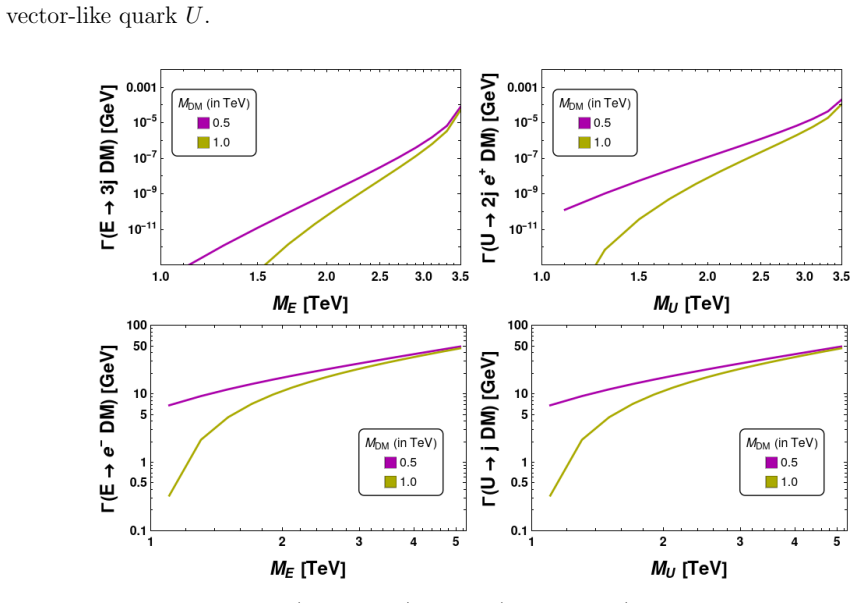
COLLIDER SIGNA TURE Apart from the DM candidate ζ, our model features a rich BSM sector that includes the leptoquark ˜S1, a heavy charged lepton E, and a vector-like quark U. The searches for these particles are ongoing in the collider experiments. The conventional collider searches for these BSM particles do not directly apply to our model, as they carry...
-
[12]
This scenario arose naturally from the U(1)B+L symmetry, which is already present in the SM
CONCLUSIONS In this work, we presented a theoretical framework for DM induced proton decay. This scenario arose naturally from the U(1)B+L symmetry, which is already present in the SM. Its spontaneous breaking through the vev of the scalar fields χ and σ results in a residual Z4 symmetry. This residual symmetry serves a dual purpose: it ensures the stabil...
-
[13]
ACKNOWLEDGMENTS We would like to thank Martin Hirsch, Oleg Popov, and Duttatreya Malayaja for useful discussions. Also, we acknowledge Salvador Centelles Chuli´ a for his contributions during the preliminary stage of this work. Authors would like to acknowledge the SARAH [53], SPheno [54], micrOMEGAs [55], and MadGraph5 [56] packages, which have been used...
-
[14]
1 3 → ω2 Li (1, 2, − 1
-
[15]
1 3 → ω2 ei (1, 1, −1) 1 → ω2 di (3, 1, − 1
-
[16]
0 → 1 BSM (N1, N2) (1, 1, 0) (− 1 2 , 5
-
[17]
→ (ω3, ω) (D1, D2) (3, 1, − 1
-
[18]
→ (ω, ω3) S1 (¯3, 1, 1
-
[19]
However, the DM and collider phenomenology exhibit significant differences
1 6 → ω σ (1, 1, 0) 4 3 → 1 χ (1, 1, 0) 2 3 → 1 ϕ− (1, 1, −1) 1 6 → ω TABLE II: Particle content and their transformation under different symmetries in the case of fermionic DM. However, the DM and collider phenomenology exhibit significant differences. Unlike scalar DM, fermionic DM has distinct relic density production channels and DD prospects, leading...
-
[20]
Baryon and Lepton Nonconserving Processes,
S. Weinberg, “Baryon and Lepton Nonconserving Processes,” Phys. Rev. Lett. 43 (1979) 1566–1570
work page 1979
-
[21]
Operator Analysis of Nucleon Decay,
F. Wilczek and A. Zee, “Operator Analysis of Nucleon Decay,” Phys. Rev. Lett. 43 (1979) 1571–1573
work page 1979
-
[22]
The Effective Hamiltonian for Nucleon Decay,
L. F. Abbott and M. B. Wise, “The Effective Hamiltonian for Nucleon Decay,” Phys. Rev. D 22 (1980) 2208
work page 1980
-
[23]
Unified Lepton-Hadron Symmetry and a Gauge Theory of the Basic Interactions,
J. C. Pati and A. Salam, “Unified Lepton-Hadron Symmetry and a Gauge Theory of the Basic Interactions,” Phys. Rev. D 8 (1973) 1240–1251
work page 1973
-
[24]
Unity of All Elementary Particle Forces,
H. Georgi and S. L. Glashow, “Unity of All Elementary Particle Forces,” Phys. Rev. Lett. 32 (1974) 438–441
work page 1974
-
[25]
Unified Interactions of Leptons and Hadrons,
H. Fritzsch and P. Minkowski, “Unified Interactions of Leptons and Hadrons,” Annals Phys. 93 (1975) 193–266
work page 1975
-
[26]
Super-Kamiokande Collaboration, A. Takenaka et al. , “Search for proton decay via p → e+π0 and p → µ+π0 with an enlarged fiducial volume in Super-Kamiokande I-IV,” Phys. Rev. D 102 no. 11, (2020) 112011, arXiv:2010.16098 [hep-ex]
-
[27]
Search for proton decay via p → µ+K0 in 0.37 megaton-years exposure of Super-Kamiokande,
Super-Kamiokande Collaboration, R. Matsumoto et al. , “Search for proton decay via p → µ+K0 in 0.37 megaton-years exposure of Super-Kamiokande,” Phys. Rev. D 106 no. 7, (2022) 072003, arXiv:2208.13188 [hep-ex]
-
[28]
DUNE Collaboration, B. Abi et al. , “Deep Underground Neutrino Experiment (DUNE), Far Detector Technical Design Report, Volume II: DUNE Physics,” arXiv:2002.03005 [hep-ex]
-
[29]
Hyper-Kamiokande Design Report
Hyper-Kamiokande Collaboration, K. Abe et al. , “Hyper-Kamiokande Design Report,” arXiv:1805.04163 [physics.ins-det]
work page internal anchor Pith review Pith/arXiv arXiv
-
[30]
JUNO Collaboration, A. Abusleme et al. , “JUNO physics and detector,” Prog. Part. Nucl. Phys. 123 (2022) 103927, arXiv:2104.02565 [hep-ex]
-
[31]
J. C. Helo, M. Hirsch, and T. Ota, “Proton decay at one loop,” Phys. Rev. D 99 no. 9, (2019) 095021, arXiv:1904.00036 [hep-ph]
work page internal anchor Pith review Pith/arXiv arXiv 2019
-
[32]
Triple-leptoquark interactions for tree- and loop-level proton decays,
I. Dorˇ sner, S. Fajfer, and O. Sumensari, “Triple-leptoquark interactions for tree- and loop-level proton decays,” JHEP 05 (2022) 183, arXiv:2202.08287 [hep-ph]
-
[33]
Extended scotogenic model of neutrino mass and proton decay,
T. Nomura and O. Popov, “Extended scotogenic model of neutrino mass and proton decay,” Phys. Rev. D 110 no. 7, (2024) 075035, arXiv:2406.00651 [hep-ph]
-
[34]
Pathways to proton’s stability via naturally small neutrino masses,
S. K. Kang and O. Popov, “Pathways to proton’s stability via naturally small neutrino masses,” arXiv:2412.20723 [hep-ph]
-
[35]
Three lepton decay modes of the proton
P. J. O’Donnell and U. Sarkar, “Three lepton decay mode of the proton,” Phys. Lett. B 316 (1993) 121–126, arXiv:hep-ph/9307254. 22
work page internal anchor Pith review Pith/arXiv arXiv 1993
-
[36]
B-L Violating Proton Decay Modes and New Baryogenesis Scenario in SO(10)
K. S. Babu and R. N. Mohapatra, “B-L Violating Proton Decay Modes and New Baryogenesis Scenario in SO(10),” Phys. Rev. Lett. 109 (2012) 091803, arXiv:1207.5771 [hep-ph]
work page internal anchor Pith review Pith/arXiv arXiv 2012
-
[37]
Extending the Standard Model Effective Field Theory with the Complete Set of Dimension-7 Operators
L. Lehman, “Extending the Standard Model Effective Field Theory with the Complete Set of Dimension-7 Operators,” Phys. Rev. D 90 no. 12, (2014) 125023, arXiv:1410.4193 [hep-ph]
work page internal anchor Pith review Pith/arXiv arXiv 2014
-
[38]
Dimension Seven Operators in Standard Model with Right handed Neutrinos
S. Bhattacharya and J. Wudka, “Dimension-seven operators in the standard model with right handed neutrinos,” Phys. Rev. D 94 no. 5, (2016) 055022, arXiv:1505.05264 [hep-ph]. [Erratum: Phys.Rev.D 95, 039904 (2017)]
work page internal anchor Pith review Pith/arXiv arXiv 2016
-
[39]
Proton decay into charged leptons
T. Hambye and J. Heeck, “Proton decay into charged leptons,” Phys. Rev. Lett. 120 no. 17, (2018) 171801, arXiv:1712.04871 [hep-ph]
work page internal anchor Pith review Pith/arXiv arXiv 2018
-
[40]
$\Delta L = 3$ processes: Proton decay and LHC
R. M. Fonseca, M. Hirsch, and R. Srivastava, “∆ L = 3 processes: Proton decay and the LHC,” Phys. Rev. D 97 no. 7, (2018) 075026, arXiv:1802.04814 [hep-ph]
work page internal anchor Pith review Pith/arXiv arXiv 2018
-
[41]
Planck 2018 results. VI. Cosmological parameters
Planck Collaboration, N. Aghanim et al. , “Planck 2018 results. VI. Cosmological parameters,” Astron. Astrophys. 641 (2020) A6, arXiv:1807.06209 [astro-ph.CO] . [Erratum: Astron.Astrophys. 652, C4 (2021)]
work page internal anchor Pith review Pith/arXiv arXiv 2018
-
[42]
Verifiable Radiative Seesaw Mechanism of Neutrino Mass and Dark Matter
E. Ma, “Verifiable radiative seesaw mechanism of neutrino mass and dark matter,” Phys. Rev. D 73 (2006) 077301, arXiv:hep-ph/0601225
work page internal anchor Pith review Pith/arXiv arXiv 2006
-
[43]
Scotogenic dark matter stability from gauged matter parity,
S. K. Kang, O. Popov, R. Srivastava, J. W. F. Valle, and C. A. Vaquera-Araujo, “Scotogenic dark matter stability from gauged matter parity,” Phys. Lett. B 798 (2019) 135013, arXiv:1902.05966 [hep-ph]
-
[44]
Scotogenic dark matter and Dirac neutrinos from unbroken gauged B-L symmetry,
J. Leite, A. Morales, J. W. F. Valle, and C. A. Vaquera-Araujo, “Scotogenic dark matter and Dirac neutrinos from unbroken gauged B-L symmetry,” Phys. Lett. B 807 (2020) 135537, arXiv:2003.02950 [hep-ph]
-
[45]
CDF-II W boson mass in the Dirac Scotogenic model,
S. Centelles Chuli´ a, R. Srivastava, and S. Yadav, “CDF-II W boson mass in the Dirac Scotogenic model,” Mod. Phys. Lett. A 38 no. 7, (2023) , arXiv:2206.11903 [hep-ph]
-
[46]
CDF-II W-boson mass anomaly in the canonical Scotogenic neutrino–dark matter model,
A. Batra, S. K. A, S. Mandal, H. Prajapati, and R. Srivastava, “CDF-II W-boson mass anomaly in the canonical Scotogenic neutrino–dark matter model,” Mod. Phys. Lett. A 38 no. 18n19, (2023) 2350090, arXiv:2204.11945 [hep-ph]
-
[47]
Predictions from scoto-seesaw with A4 modular symmetry,
R. Kumar, P. Mishra, M. K. Behera, R. Mohanta, and R. Srivastava, “Predictions from scoto-seesaw with A4 modular symmetry,” Phys. Lett. B 853 (2024) 138635, arXiv:2310.02363 [hep-ph]
-
[48]
Cutting the Scotogenic Loop: A4 Flavor Symmetry to Z2 Dark Symmetry,
R. Kumar, N. Nath, and R. Srivastava, “Cutting the Scotogenic Loop: A4 Flavor Symmetry to Z2 Dark Symmetry,” Springer Proc. Phys. 304 (2024) 1183–1185
work page 2024
-
[49]
Cutting the scotogenic loop: adding flavor to dark matter,
R. Kumar, N. Nath, and R. Srivastava, “Cutting the scotogenic loop: adding flavor to dark matter,” JHEP 12 (2024) 036, arXiv:2406.00188 [hep-ph]
-
[50]
Comprehensive Phenomenology of the Dirac Scotogenic Model: Novel Low Mass Dark Matter,
S. Centelles Chuli´ a, R. Srivastava, and S. Yadav, “Comprehensive Phenomenology of the Dirac Scotogenic Model: Novel Low Mass Dark Matter,” arXiv:2409.18513 [hep-ph] . 23
-
[51]
Scotogenic dark matter from gauged B − L,
Y. Garnica, A. Morales, and C. A. Vaquera-Araujo, “Scotogenic dark matter from gauged B − L,” arXiv:2411.13756 [hep-ph]
-
[52]
Type-III Scotogenic Model: Inflation, Dark Matter and Collider Phenomenology,
L. Singh, R. Srivastava, S. Verma, and S. Yadav, “Type-III Scotogenic Model: Inflation, Dark Matter and Collider Phenomenology,” arXiv:2501.13171 [hep-ph]
-
[53]
Collider signatures of fermionic scotogenic dark matter,
V. M. Lozano, G. Sanchez Garcia, and J. W. F. Valle, “Collider signatures of fermionic scotogenic dark matter,” arXiv:2502.05270 [hep-ph]
-
[54]
Dirac Scoto Inverse-Seesaw from A4 Flavor Symmetry,
R. Kumar, N. Nath, R. Srivastava, and S. Yadav, “Dirac Scoto Inverse-Seesaw from A4 Flavor Symmetry,” arXiv:2505.01407 [hep-ph]
-
[55]
Spontaneous proton decay and the origin of Peccei-Quinn symmetry
M. Reig and R. Srivastava, “Spontaneous proton decay and the origin of Peccei–Quinn symmetry,” Phys. Lett. B 790 (2019) 134–139, arXiv:1809.02093 [hep-ph]
work page internal anchor Pith review Pith/arXiv arXiv 2019
-
[56]
Observation of a new boson at a mass of 125 GeV with the CMS experiment at the LHC
CMS Collaboration, S. Chatrchyan et al. , “Observation of a New Boson at a Mass of 125 GeV with the CMS Experiment at the LHC,” Phys. Lett. B 716 (2012) 30–61, arXiv:1207.7235 [hep-ex]
work page internal anchor Pith review Pith/arXiv arXiv 2012
-
[57]
A TLASCollaboration, G. Aad et al. , “Observation of a new particle in the search for the Standard Model Higgs boson with the ATLAS detector at the LHC,” Phys. Lett. B 716 (2012) 1–29, arXiv:1207.7214 [hep-ex]
work page internal anchor Pith review Pith/arXiv arXiv 2012
-
[58]
Particle Data Group Collaboration, S. Navas et al. , “Review of particle physics,” Phys. Rev. D 110 no. 3, (2024) 030001
work page 2024
-
[59]
Update on scalar singlet dark matter
J. M. Cline, K. Kainulainen, P. Scott, and C. Weniger, “Update on scalar singlet dark matter,” Phys. Rev. D 88 (2013) 055025, arXiv:1306.4710 [hep-ph] . [Erratum: Phys.Rev.D 92, 039906 (2015)]
work page internal anchor Pith review Pith/arXiv arXiv 2013
-
[60]
Improved lattice computation of proton decay matrix elements
Y. Aoki, T. Izubuchi, E. Shintani, and A. Soni, “Improved lattice computation of proton decay matrix elements,” Phys. Rev. D 96 no. 1, (2017) 014506, arXiv:1705.01338 [hep-lat]
work page internal anchor Pith review Pith/arXiv arXiv 2017
-
[61]
Dark Matter Escaping Direct Detection Runs into Higgs Mass Hierarchy Problem,
P. Bharadwaj, R. Kumar, H. K. Prajapati, R. Srivastava, and S. Yadav, “Dark Matter Escaping Direct Detection Runs into Higgs Mass Hierarchy Problem,” arXiv:2412.13301 [hep-ph]
-
[62]
First Dark Matter Search Results from the LUX-ZEPLIN (LZ) Experiment
LZ Collaboration, J. Aalbers et al. , “First Dark Matter Search Results from the LUX-ZEPLIN (LZ) Experiment,” Phys. Rev. Lett. 131 no. 4, (2023) 041002, arXiv:2207.03764 [hep-ex]
work page internal anchor Pith review arXiv 2023
-
[63]
Dark Matter Search Results from 4.2 Tonne-Years of Exposure of the LUX-ZEPLIN (LZ) Experiment
LZ Collaboration Collaboration, J. Aalbers et al. , “Dark Matter Search Results from 4.2 Tonne-Years of Exposure of the LUX-ZEPLIN (LZ) Experiment,” arXiv:2410.17036 [hep-ex]
work page internal anchor Pith review Pith/arXiv arXiv
-
[64]
First Dark Matter Search with Nuclear Recoils from the XENONnT Experiment,
XENON Collaboration, E. Aprile et al. , “First Dark Matter Search with Nuclear Recoils from the XENONnT Experiment,” Phys. Rev. Lett. 131 no. 4, (2023) 041003, arXiv:2303.14729 [hep-ex]
-
[65]
Dark Matter Search Results from 1.54 Tonne ·Year Exposure of PandaX-4T,
PandaX Collaboration, Z. Bo et al. , “Dark Matter Search Results from 1.54 Tonne ·Year Exposure of PandaX-4T,” arXiv:2408.00664 [hep-ex] . 24
-
[66]
Search for scalar leptoquarks in $pp$ collisions at $\sqrt{s} = 13$ TeV with the ATLAS experiment
A TLASCollaboration, M. Aaboud et al. , “Search for scalar leptoquarks in pp collisions at √s = 13 TeV with the ATLAS experiment,” New J. Phys. 18 no. 9, (2016) 093016, arXiv:1605.06035 [hep-ex]
work page internal anchor Pith review Pith/arXiv arXiv 2016
-
[67]
CMS Collaboration, A. M. Sirunyan et al. , “Search for supersymmetry in multijet events with missing transverse momentum in proton-proton collisions at 13 TeV,” Phys. Rev. D 96 no. 3, (2017) 032003, arXiv:1704.07781 [hep-ex]
work page internal anchor Pith review Pith/arXiv arXiv 2017
-
[68]
A TLASCollaboration, M. Aaboud et al. , “Search for squarks and gluinos in final states with jets and missing transverse momentum using 36 fb −1 of √s = 13 TeV pp collision data with the ATLAS detector,” Phys. Rev. D 97 no. 11, (2018) 112001, arXiv:1712.02332 [hep-ex]
work page internal anchor Pith review Pith/arXiv arXiv 2018
-
[69]
CMS Collaboration, T. C. Collaboration et al. , “Search for supersymmetry in proton-proton collisions at 13 TeV in final states with jets and missing transverse momentum,” JHEP 10 (2019) 244, arXiv:1908.04722 [hep-ex]
-
[70]
Physics of leptoquarks in precision experiments and at particle colliders
I. Dorˇ sner, S. Fajfer, A. Greljo, J. F. Kamenik, and N. Koˇ snik, “Physics of leptoquarks in precision experiments and at particle colliders,” Phys. Rept. 641 (2016) 1–68, arXiv:1603.04993 [hep-ph]
work page internal anchor Pith review Pith/arXiv arXiv 2016
-
[71]
FCC-hh: The Hadron Collider: Future Circular Collider Conceptual Design Report Volume 3,
FCC Collaboration, A. Abada et al. , “FCC-hh: The Hadron Collider: Future Circular Collider Conceptual Design Report Volume 3,” Eur. Phys. J. ST 228 no. 4, (2019) 755–1107
work page 2019
-
[72]
Exploring new models in all detail with SARAH
F. Staub, “Exploring new models in all detail with SARAH,” Adv. High Energy Phys. 2015 (2015) 840780, arXiv:1503.04200 [hep-ph]
work page internal anchor Pith review Pith/arXiv arXiv 2015
-
[73]
SPheno 3.1: extensions including flavour, CP-phases and models beyond the MSSM
W. Porod and F. Staub, “SPheno 3.1: Extensions including flavour, CP-phases and models beyond the MSSM,” Comput. Phys. Commun. 183 (2012) 2458–2469, arXiv:1104.1573 [hep-ph]
work page internal anchor Pith review Pith/arXiv arXiv 2012
-
[74]
micrOMEGAs4.1: two dark matter candidates
G. B´ elanger, F. Boudjema, A. Pukhov, and A. Semenov, “micrOMEGAs4.1: two dark matter candidates,” Comput. Phys. Commun. 192 (2015) 322–329, arXiv:1407.6129 [hep-ph]
work page internal anchor Pith review Pith/arXiv arXiv 2015
-
[75]
J. Alwall, R. Frederix, S. Frixione, V. Hirschi, F. Maltoni, O. Mattelaer, H. S. Shao, T. Stelzer, P. Torrielli, and M. Zaro, “The automated computation of tree-level and next-to-leading order differential cross sections, and their matching to parton shower simulations,” JHEP 07 (2014) 079, arXiv:1405.0301 [hep-ph]
work page internal anchor Pith review Pith/arXiv arXiv 2014
discussion (0)
Sign in with ORCID, Apple, or X to comment. Anyone can read and Pith papers without signing in.